
How private firms now run public exams | Mumbai News
How private firms now run public exams
India’s vast examination system relies on many private contractors for its operations.

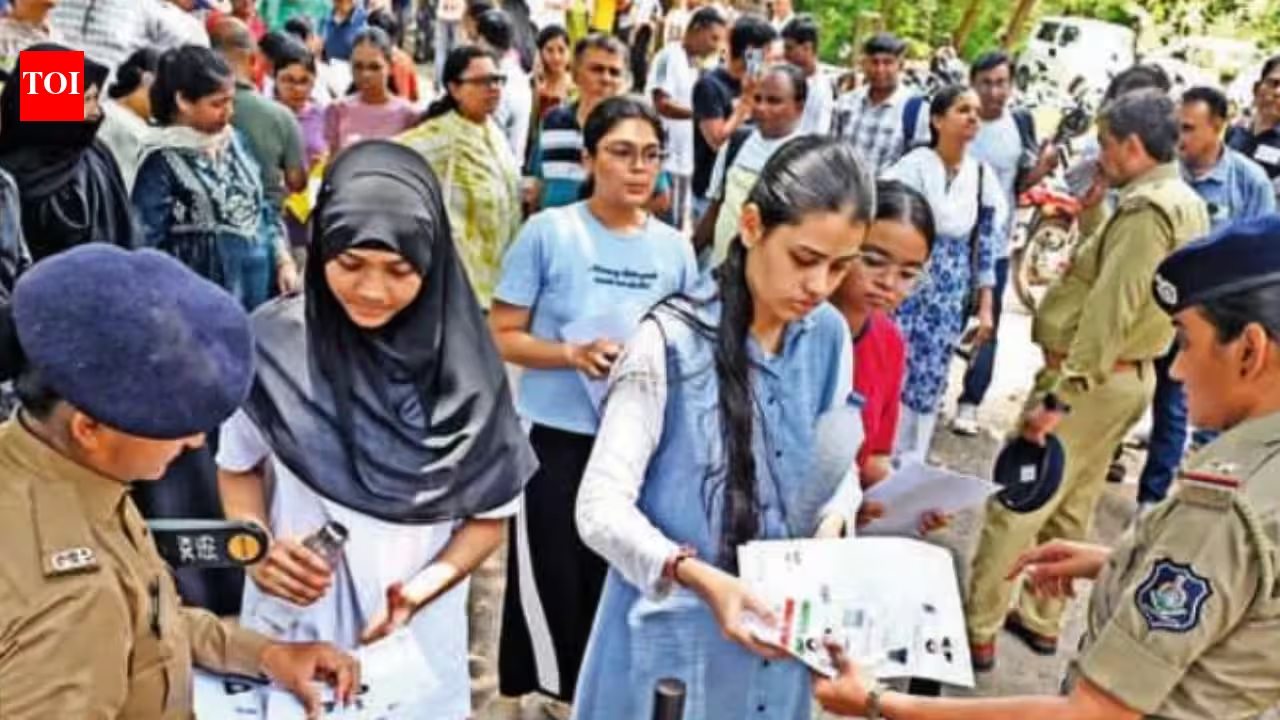
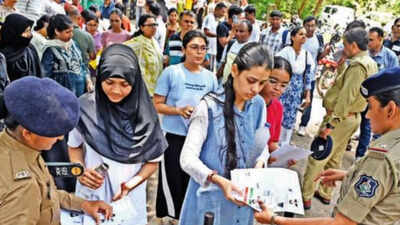
MUMBAI: A security guard stands at the gate of an exam centre in Mumbai. Inside, women staff frisk female candidates before letting them in.A doorframe metal detector marks the entrance. Computer terminals wait in disciplined rows. Invigilators watch for the smallest suspicious movement, as CCTV cameras record every second of the examination.Somewhere behind this elaborate machinery sits the question paper, delivered by a logistics firm.To a student entering the centre, it may appear to be a single examination. In reality, almost every part of it has been assembled by a different agency.India’s calendar is marked not only by seasons and festivals, but by examinations. On nearly every day of the year, except national holidays, somewhere in the country, a student or job applicant is being tested, and a future being decided.The scale is difficult to comprehend.An estimated 31.4 crore candidates registered for various govt recruitment exams in 2025, according to consulting firm Frost & Sullivan, and 38.3 crore registered for academic exams.

Pieces Of A Puzzle

India’s examination system is a vast, fragmented enterprise that increasingly resembles a jigsaw puzzle assembled in the dark. And the final picture of how an exam is pieced together is rarely visible to students, parents and educators.In India, unlike China, what appears to be a public examination is often delivered through a long chain of private contractors.One company may operate the exam centres. A second may provide the computers, servers and testing software.Manpower aggregators may recruit smaller agencies to supply invigilators, security personnel, frisking staff and technicians. Each contractor performs one part of the examination.Yet, no single participant may fully control the whole.Until recently, India had no clearly articulated national norms governing which service provider could undertake which part of the process.That began to change in April, when a handbook of standards was released.The handbook recommends that exam-conducting agencies, exam security providers and content providers operate independently of one another.Facility management, however, may either be handled by a separate service provider or combined with the responsibilities of the exam-conducting or security agency, depending on operational requirements.

Decentralising Power

Separating the creation of the question paper, the administration of the examination and the security of the centre can prevent too much power from being concentrated in one place.Each layer can watch the others. Conversely, each layer can also create greater distance between authority and responsibility.The agency that hires the guards may not operate the computers.The company managing the centre may not control the exam software. The institution conducting the test may not directly supervise the people interacting with candidates.This fragmentation matters most when something goes wrong: a computer crash, a malfunctioning server, mistreatment of candidates during frisking, and the like. Whom does one hold responsible?In each case, accountability may travel from one contractor to another, through agreements, subcontracting arrangements and service-level clauses.“With so much sub-contracting, no one gets to know if a firm defaulted in a previous exam,” a source says.

Checks And Balances

Yet, the same fragmentation can also produce checks and balances, argues Ashish Mittal, founder and director of Innovatiview, which supplies examination security equipment.In 2024, Innovatiview secured 735 examinations across India, monitored 44,045 venues and covered examinations involving 3.5 crore candidates, Mittal said. Its systems also processed more than 4.4 crore biometric scans.Those numbers reveal not only the scale of the examination economy, but also the infrastructure required to sustain it.Innovatiview is now constructing examination centres in several states after concluding that India does not have enough dedicated seats to conduct large computer-based exams.The largest provider of computer-based testing venues is currently TCS, which uses a combination of its own TCS iON facilities and other smaller centres operating from multipurpose buildings.The shortage of reliable exam infrastructure creates another vulnerability. A testing venue may appear to be a secure, technologically controlled environment, but it still depends on people hired locally: centre managers, guards, invigilators, technicians and temporary staff.And people are the most difficult part of the system to standardise.“The manpower agencies are the biggest loopholes,” said the vice-chancellor of a group of universities that conducts a computer-based entrance exam.“We have seen paan sellers and thela waalas being supervisory roles for high-stakes exams,” said Abhay Jere, former vice-chairman of the All India Council for Technical Education and CEO of Dexit Global, a digital exam agency.The re-NEET 2026 was compromised at a centre in Lakhisari, Bihar, where apart from dummy candidates, biometric staff members, supervisors and other operators were arrested.“Undertrained, unsupervised invigilators are India’s most consistent point of failure,” said Jere. Rajat Moona, the director of IIT Gandhinagar , said exams used to be run out of schools, and teachers took up supervision and the role of invigilators.“Today’s exam supervisors are 23-25-year-olds who are employees of companies that run the exam venue. They don’t come with the maturity of teachers,” he said.

New Problems, New Solutions

Threats are no longer limited to candidates carrying handwritten notes into the examination hall.“They have cameras in spectacles, in their pens. The idea is to stop communication and so, year, for JEE (Advanced), we scanned students for electronic devices, machines that can tell if there are any wi-fi or Bluetooth waves,” Moona explained.Unfortunately, ‘large gangs’ now study the examination system with the same attention that authorities devote to protecting it.The vice-chancellor described one such operation uncovered through conversations with first-year students. Gangs, he said, work to compromise exam centres from within.“They may bribe a centre in-charge, a faculty member or a security employee to smuggle a mobile phone into the premises. Candidates then enter wearing Bluetooth devices so small that they need to be injected into the ear, and ordinary frisking cannot detect them.”Once the candidate gains access to the concealed phone, the integrity of the entire examination can collapse.The case came to light not because the security system detected the breach, but because the financial arrangement behind it failed. The candidate qualified and then allegedly refused to make the promised payment.Exam-conducting authorities operate independently, and there is no shared infrastructure, no common benchmark, and institutional memory. Vendors migrate across agencies without accountability.And that is the central paradox of an outsourced exam. The process may be monitored extensively, yet accountability can remain invisible. Every candidate is watched, every movement recorded, every entry point guarded.But when the system itself fails, identifying who was responsible may prove difficult, said an IIT director who said they are against outsourcing exams to private agencies.

‘An Outsourcing Of Trust’

Questions, however, remain. Can a system claim integrity merely because it has cameras, computers and metal detectors? Must it also not possess a clear chain of command, enforceable standards and an accessible mechanism through which candidates can seek redress?“We have to alter the way we conduct exams,” said Moona. “No single private enterprise can have the infrastructure or manpower to conduct exams at the scale we have in India. So, either we go back to schools or start bucketing the exams in a way that an exam can be taken any time of year.”The danger is compounded when companies found unfit in one jurisdiction continue to get work elsewhere.A parliamentary committee reported in 2025 that some firms involved in setting question papers, administering exams and evaluating responses had been blacklisted by one organisation or state govt, only for them to secure contracts from another.One exam contractor, Confisec Pvt Ltd, resurfaced as Edutest Solutions Pvt Ltd after an earlier paper-leak controversy and continued securing govt examination contracts.Rajasthan investigators identified another firm that allegedly rebranded itself as Rabhav Ltd after being barred in UP. Despite getting blacklisted, companies like Eduquity, Satvat Infosol, Aptech kept bagging contracts to conduct exams.The committee said such companies should not be engaged by the National Testing Agency or state govts. It recommended the creation of a nationwide register of blacklisted firms, along with details of the people and entities associated with them, so that disqualified operators could not simply return under another name.“Such a register would be an elementary safeguard,” Jere said.But it would also acknowledge a larger truth: the exam system cannot depend on each institution discovering the same unreliable contractor separately, after the damage has already been done.Ultimately, an exam is an act of public trust, which may determine admission to a university, a profession, a govt job, a future. But the State, in outsourcing buildings, computers, surveillance equipment and manpower, “is outsourcing its obligation to ensure fairness to India’s youth,” said the IIT director.
Police launch inquiry into drunk driving FIR against Mumbai’s stroke victim | Mumbai News

Police launch inquiry into drunk driving FIR against Mumbai's stroke victim
A 73-year-old man who suffered a stroke while driving his car was kept at Versova police station for allegedly five hours.

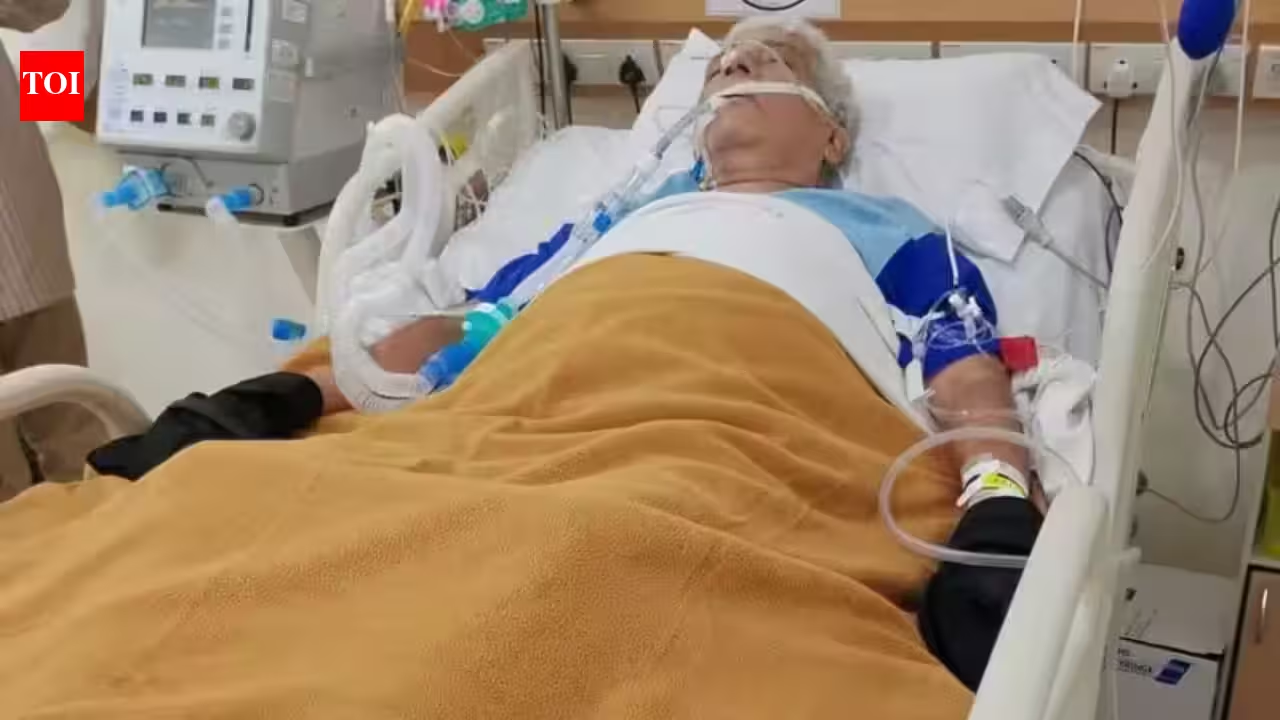
MUMBAI: A departmental inquiry has been initiated into a drunk driving FIR registered by the Versova police against 73-year-old Versova-resident Sharad Kadam, who dashed his car into another on July 25, said police.The inquiry was initiated by zonal DCP Purushottam Karad after TOI published the article “Man suffers stroke, gets held up for drunk driving, lands in ICU” on Thursday.The inquiry was conducted by an assistant commissioner of police (ACP), who gathered details of the case from officers or cops who had registered the FIR. The Versova police waited for the blood test report to know the alcohol content in his blood.DCP Karad did not respond to TOI’s message on Thursday regarding the inquiry assigned to an ACP-rank officer.“Details will be gathered from hospitals at Cooper and at Nanavati to know the current medical condition of Kadam. Probe will also be done to know if Kadam had actually suffered a stroke and there was medical negligence on behalf of the cops. The ACP is also waiting for the blood report to find out whether Kadam drove his car under the influence of alcohol. His family members maintain he suffered a stroke,” said a police source from the Versova police station.MLA Ameet Satam said he received acknowledgement from the DCP that an inquiry was initiated and a senior officer was asked to submit the report at the earliest.“A Nanavati Hospital medical report, issued on July 26, confirmed that he tested negative for alcohol. So it is a clear case of negligence by cops and wrong FIR filed,” said Satam.Agreeing with Satam, Kadam’s nephew Rohan Rathod told TOI: “When a lawyer relative reached the police after learning about the incident, she noticed my uncle was unable to talk or stand with slurry speech. How are the cops claiming that he was drunk.”

Canteen at Bombay high court shuts before FDA visit, gets stop biz order | Mumbai News

Canteen at Bombay high court shuts before FDA visit, gets stop biz order
An FDA team inspected Bombay High Court canteens following a court query.

MUMBAI: A day after Bomb­ay HC orally asked FDA if it was inspecting govt canteens like the ones at Mantralaya and HC, besides private establishments, an FDA team visited three canteens on the HC premises Thursday.However, it found one of them, the Bombay Bar Association canteen, had voluntarily closed in the morning.The FDA team discovered it was being run without an FSSAI licence and later issued a “stop business” order till it shows compliance. Govt sources said the other two were issued improvement notices.

FDA ripple effect

FDA ripple effect

Bar assn says canteen got licence during day, would restart op soon

In its stop business order to the BBA canteen, FDA said non compliance of its order attracts a penalty of up to 2 lakh and continuation without valid licence can attract a prosecution under the Food Safety and Standards Act.The FDA notice to the BBA canteen, run by a contractor, said the “food business was allegedly operating without mandatory FSSAI license”.The canteen on the third floor of the HC only serves snacks to the original side members.BBA issued a notice to its members saying the canteen services “are temporarily discontinued until further intimation. This is a step initiated by the association. No adverse communication or order or notice has been received by the association from the FDA.’’

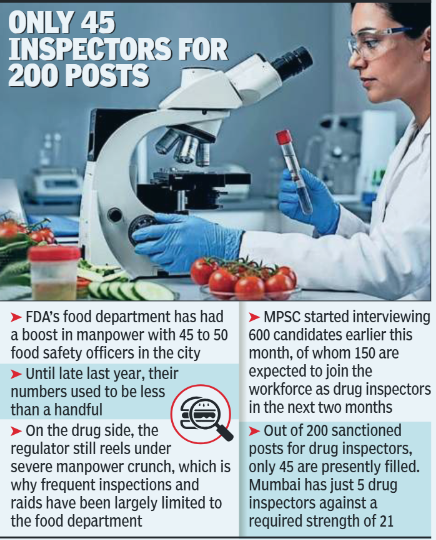
Only 45 inspectors for 200 posts (AI-generated image)

Only 45 inspectors for 200 posts (AI-generated image)

BBA president Nitin Thakker said the FDA order came after it had already voluntarily closed the canteen and informed its members about it. He added that the contractor, in the course of the day, received a licence and would resume operation soon.FDA officials said the inspections of canteens on the HC premises continued till evening, and the paperwork was ongoing after that.A small canteen only for tea next to room 36 where the appellate side bar members sit, was also shut on Thursday. Advocate Suresh Sabrad, secretary of Advocates Association of Western India (AAWI) said the canteen was shut voluntarily and that no FDA inspector showed up.The larger staff canteen on the ground floor was visited for an FDA inspection, and samples were taken, but it continued to remain operational through the day.

BMC’s plan to buy SUVs for Rs 1.5 crore sparks debate over spending | Mumbai News

BMC’s plan to buy SUVs for Rs 1.5 crore sparks debate over spending
Standing Committee chairperson Prabhakar Shinde also defended the proposal

Mumbai: BMC’s proposal to replace Mahindra Scorpio-N SUVs with six new Toyota Innova Crysta vehicles for key political office-bearers led to a heated political slugfest at Thursday’s standing committee meeting, with the opposition questioning the expenditure and the ruling BJP accusing it of backtracking on a decision taken unanimously by all political parties.Congress corporator and also the party leader in BMC, Ashraf Azmi, objected to the proposed purchase, saying the civic body should avoid spending on expensive vehicles at a time when it is facing financial constraints. He argued that the BMC should exercise fiscal prudence instead of upgrading official cars.The BJP hit back immediately, claiming that the decision to replace the vehicles had been taken unanimously at a meeting of leaders of all political parties.BJP group leader Ganesh Khankar said the controversy was unnecessary as there had been consensus across party lines. “The next time such a decision is taken, I will ensure it is signed by all present and in agreement of such decisions before it is approved, so that such controversies do not arise,” he remarked.Standing Committee chairperson Prabhakar Shinde also defended the proposal, saying opposition members were fully aware of and had agreed to the decision earlier. “It is incorrect to now create an issue over something that was discussed and accepted by all political parties,” he said.The discussion soon descended into a noisy exchange, with ruling party members objecting to Azmi raising the issue since the proposal was not listed on the day’s agenda. They demanded that the chairperson confine the discussion to listed business. Azmi, however, maintained that he was speaking about the need for financial discipline in the BMC which was the need of the current time.The controversy comes a day after the BMC administration proposed spending around Rs 1.5 crore to procure six Toyota Innova Crysta vehicles for the deputy mayor, leader of the House, leader of the opposition, and chairpersons of the standing, improvements and education committees.The civic administration has cited demands from political office-bearers for more comfortable vehicles for long commutes across the city and official site inspections. The proposal follows the allotment of Toyota Innova Hycross Hybrid vehicles to mayor Ritu Tawde and additional municipal commissioners.A BMC official said the vehicle replacement system is followed to ensure that once a car completes a prescribed age, it is phased out and replaced with a new one.However, BJP leader Ganesh Khankar demanded that the BMC scrap the practice of allotting different categories of cars to political leaders and administrative officers. “The same type of vehicle should be provided to everyone, whether elected representatives or civic officials,” he said.Khankar added that the category of car made no difference to him as he regularly travels by train. “I have never demanded a particular kind of car,” he said.He also pointed out that the vehicles are hired on contract and the BMC pays a monthly rental to the companies providing them. “Therefore, there is no question of the civic body making a permanent capital expenditure on these vehicles,” he said.Meanwhile, Shiv Sena (UBT) MLA Aaditya Thackeray on Thursday criticised the BMC’s proposal to induct a new fleet of official vehicles for top political functionaries, accusing the ruling BJP-Shiv Sena civic body of promoting VIP culture while ignoring the city’s public transport and infrastructure issues.Thackeray said the ruling alliance had already “emptied the BMC’s coffers” over the past four years and was now seeking new cars and official bungalows barely six months after assuming office. Deputy Mayor Sanjay Ghadi a corporator of Shiv Sena had made a demand for an official bungalow last month.“VIP culture is one thing, but look at the excuses being offered — long commutes, potholes and traffic. Lakhs of Mumbaikars travel by local trains every day, yet the BJP has failed to improve the suburban railway system despite being in power for 12 years,” Thackeray said in a post on social media X.He also questioned why elected representatives could not use public transport, asking why they did not travel by BEST buses or the Metro. Alleging that the government was weakening BEST in favour of private contractors, he said the leaders should experience the city’s public transport just as ordinary citizens do.Referring to reports that the Deputy Mayor had sought an official bungalow in south Mumbai, Thackeray said the demand reflected misplaced priorities. He also reminded the ruling alliance of its earlier promise to make Mumbai’s roads pothole-free within two years.He added that if public representatives travelled by BEST buses, they would understand the value of an affordable public transport system. Thackeray claimed that during the previous Shiv Sena-led administration, efforts were underway to expand the BEST fleet to 10,000 buses.

Rs 2.2k cr for Manori desal water tunnel cleared amid fears | Mumbai News

Rs 2.2k cr for Manori desal water tunnel cleared amid fears
BMC officials said two tunnel boring machines (TBMs) will be deployed simultaneously to expedite construction

Mumbai: BMC’s ambitious plan to connect Mumbai’s first seawater desalination plant at Manori with the city’s water distribution network through a 7.2-km underground tunnel came under scrutiny in the civic standing committee on Thursday, with corporators raising concerns over water quality, the tendering process and technical aspects of the project. The project proposal, however, was passed eventually.The civic administration had sought approval to award the Rs 2,241.3-crore contract to Afcons Infrastructure Ltd for the design, construction, operation and maintenance of the tunnel and associated infrastructure. The work is expected to begin next month and be completed in 45 months, with the project targeted for commissioning by December 2029.The tunnel will form a crucial link between the upcoming desalination plant at Manori and Mumbai’s existing water supply network. It will run from Manori to Charkop and further to the existing shaft at Mahavir Nagar in Kandivli, largely beneath the Gorai creek. The 3.2-metre finished-diameter tunnel will initially carry 200 MLD of desalinated water but has been designed to accommodate a future capacity of 400 MLD.BMC officials said two tunnel boring machines (TBMs) will be deployed simultaneously to expedite construction. The project includes a shaft at Manori, where water from the desalination plant will enter the tunnel, a new shaft at Charkop, and integration with the existing Mahavir Nagar shaft. Officials clarified that no water will be drawn out at Charkop, with the tunnel serving only as a transmission link.During the discussion, Yashodhar Phanse, Shiv Sena (UBT) corporator, questioned whether the quality of desalinated water would match that of water supplied from the Bhandup water treatment complex. “We are in favour of the project, but our staff should also be trained to execute such specialised works,” he said.Congress corporator Ashraf Azmi said the desalination plant and the tunnel should have been tendered together to avoid delays. “Also why did the BMC keep 16% as contingency fund for the project?,” said Azmi.BJP corporator Prakash Darekar said Mumbai’s water shortage needed a permanent solution and supported the project.Congress corporator Tulip Miranda expressed concerns over blending desalinated water with treated lake water coming from the Bhandup water treatment plant. “People have raised concerns about hair dryness and breakage because of minerals and chlorine in desalinated water. What steps will the BMC take to ensure there is no impact on citizens to whom this water is supplied?” she asked.Replying to the queries, additional municipal commissioner Abhijit Bangar said the quality of desalinated water would be matched with that of water supplied from the existing Bhandup water treatment complex before it enters the city’s distribution system.“The tunnel is technically complex. Of the 7.2 km length, about 5.1 km will have RCC lining while the remaining stretch will have mild steel lining with M30 grade concrete protection. Strict penalties have been built into the contract for any leakage,” Bangar said.He said the tunnel alignment and desalination project had been planned together during the detailed design stage. The desalination project was floated as a global tender because of its specialised nature, while the tunnel work was tendered separately.Bangar also defended the 16% contingency provision in the project cost, saying it accounted for annual price escalation of 4% over the construction period and was in line with industry norms.He added that while the desalination plant’s first phase would produce 200 MLD, the transmission infrastructure had been designed for an ultimate capacity of 400 MLD to meet Mumbai’s future water demand.

Blindfolds on, stress off: Mumbaikars experience unique art and sound healing | Mumbai News

Blindfolds on, stress off: Mumbaikars experience unique art and sound healing
Mumbaikars experienced a unique creative session combining blindfold painting and sound healing. Participants found the workshop offered a relaxing pause from daily stimuli and pressure. Art facilitator Lavanya Rastogi and sound healer Shikha Jhunjhunwala led the therapeutic event. Attendees expressed liberation and a new way of experiencing artistic creation. The event encouraged letting go of perfection and trusting the creative process.

For a few hours on Sunday afternoon, a group of Mumbaikars, stepped away from the noise of everyday life and immersed themselves in an unusual creative experience. The Bombay Times Life Styled Club hosted the Feel and Paint Workshop, that combined blindfold painting with sound healing, encouraging participants to let go of perfection, quiet their minds and express themselves freely.The session was conducted by art facilitator Lavanya Rastogi, founder of an art-and-therapy platform, along with yoga therapist and sound healer Shikha Jhunjhunwala.A PAUSE FROM EVERYDAYExplaining the idea behind the workshop, Lavanya said, “This workshop is about a nervous system reset. When you are constantly seeing and hearing multiple stimuli, your mind becomes cluttered. This workshop gives you a small, relaxing pause where you create something beautiful to take home. When you aren’t seeing, you stop looking for perfection. Blindfold painting removes the pressure to perform perfectly and helps you let go. It allows you to process your emotions without feeling overwhelmed.”PAINTING TO HEALING FREQUENCIESThe workshop began with Shikha guiding participants through three breathing techniques to help them settle into the moment. Once blindfolded, they painted freely while she played singing bowls and other sound-healing instruments, filling the room with calming frequencies that complemented the creative process. For many, the experience was both therapeutic and liberating. Investment advisor Leena Pathare from Vile Parle, who had never painted before, said, “This was wonderful. I wanted to try something different from my daily routine. I’ve never painted before, and today I absolutely loved creating this.”Former banker-turned-entrepreneur Bhumika Jain from Santa Cruz, who painted bright flowers and shrubs, found the combination deeply immersive. “I love painting and have attended sound healing sessions before, but this was the perfect blend of both. Once I was blindfolded, I experienced painting in a completely different way- I just let everything be, without trying to control it,” she said. Recalling what she visualised during the session, Bhumika added, “It felt as though I was running through meadows filled with flowers, with birds chirping all around me.CREATING WITHOUT JUDGEMENTReal estate developer Raunak Mehta from Juhu attended the workshop with his wife, Avani Saghvi Mehta. “My wife brought me here, and this is the first time we’ve done something like this together. I used to paint many years ago, so revisiting it in this way was a completely new experience,” he said. Avani added, “I loved the sounds. They were incredibly refreshing. I had attended a sound healing workshop before, but combining it with painting made this experience even more special.Advocate Sweta Doshi from Vile Parle appreciated the freedom that came with painting without expectations. “Blindfold painting means you don’t know what’s emerging on the canvas, and later you shape it into something you want. It was wonderful to sit with myself, paint to these calming sounds and leave all my worries at home,” she said.Another participant, Geeta Bhatia, admitted meditation had never appealed to her. “I’m usually restless and have a wandering mind, but I absolutely loved today’s one-of-a-kind workshop,” she said.As participants finally removed their blindfolds to discover vibrant, instinctive artworks on their canvases, they left with more than colourful paintings. They carried home a reminder that slowing down, trusting the process and letting go of perfection can sometimes be the most creative act of all. Event Partner:Happy HikkupsVenue Partner: Redbox Cafe, Juhu

Unions upset as govt announces sudden end of deep-sea fishing ban | Mumbai News

Unions upset as govt announces sudden end of deep-sea  fishing ban
The fishermen’s unions met state fisheries minister Nitesh Rane over the issue on Thursday evening

Mumbai: Maharashtra’s fishermen unions expressed anger over the state govt’s announcement that the monsoon ban on deep-sea fishing will end on Aug 1, not Aug 15 as stipulated earlier. Koli fishers say this sudden reversal will mainly benefit commercial operators whose large trawlers are better equipped to venture out quickly, unlike local boatmen.“Traditional fishermen are not prepared to resume fishing yet, whereas wealthy boat owners, who are equipped and ready, will gain an unfair 15-day advantage,” said Devendra Tandel, president of the Akhil Maharashtra Machhimar Kruti Samiti.In May-June, the Kolis were happy after the Maharashtra govt extended the monsoon ban till Aug 15 to preserve marine life and allow fish to breed. However the Central govt had already devised a separate Exclusive Economic Zone (EEZ) policy for fishing beyond 12 nautical miles, wherein the ban ends July 31. The state govt did not communicate this contradiction to local fishermen.Irate unions met state fisheries minister Nitesh Rane over the issue Thursday evening.Tandel said, “The state govt itself announced a ban until Aug 15. Trusting this decision, thousands of fishermen planned maintenance of their boats, engines, fishing nets and the engagement of crew members. However, at the last moment, the govt has now announced that fishing beyond 12 nautical miles (24 km) will be permitted from Aug 1. If the govt was aware since March that the Centre’s EEZ fishing ban would end on July 31, why weren’t we informed? Moreover, fisheries laws are enacted not for fishermen but for the fish which need to be conserved and protected. Fish do not know the 12 nautical mile concept. They are migratory in nature.”Versova Koli leader Pradeep Tapke said local boats are idling because the owners have been planning to repair and paint them by Aug 15. “We cannot suddenly rise and head out to sea Aug 1. Riding a boat is not like driving a car where you just fill petrol and start the engine. Each trip calls for planned investment, diesel stocks, labourers, food and equipment. The authorities should plan better.”Kalina Koli leader Nayana Patil asked if the govt would compensate fishers who court danger by venturing out to sea amid stormy weather before Aug 15.The minister told TOI that the ban till Aug 15 remains in force within 12 nautical miles (state boundary).Fishermen point out that they are protesting against the Centre’s simultaneous decision to permit deep-sea fishing beyond that limit. That will indeed resume on Aug 1.

Eknath Shinde, Uddhav Thackeray to record statements via videoconferencing in 17-year-old defamation complaint filed by late NCP leader Davkhare | Mumbai News

Eknath Shinde, Uddhav Thackeray to record statements via videoconferencing in 17-year-old defamation complaint filed by late NCP leader Davkhare

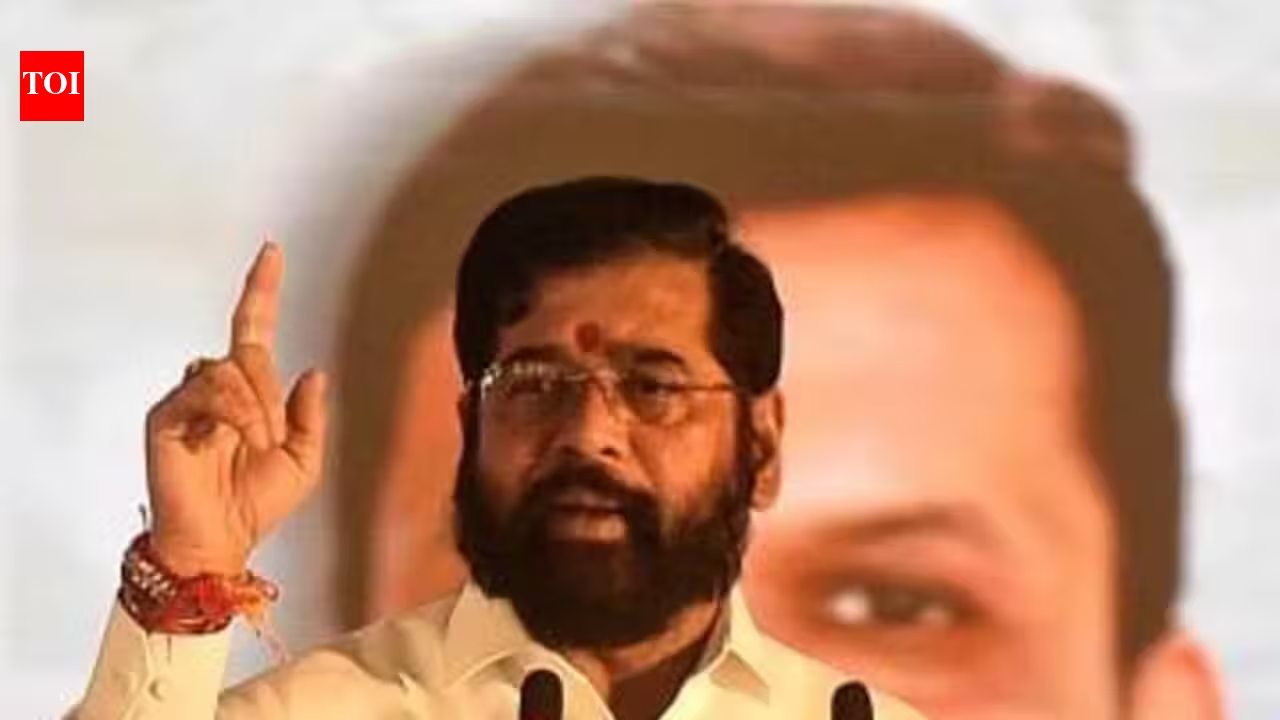
Kalyan: Maharashtra deputy chief minister Eknath Shinde and Shiv Sena (UBT) chief Uddhav Thackeray are scheduled to record their statements via videoconferencing before a Kalyan court in a 17-year-old defamation complaint filed by late NCP leader Vasant Davkhare.Thackeray’s statement will be recorded on August 5, and Shinde’s on August 6 under Section 313 of the Code of Criminal Procedure (CrPC), a routine stage of a criminal trial in which the accused are given an opportunity to explain the evidence brought against them. With this process nearing completion, the long-pending trial is expected to move closer to its conclusion.The case dates back to the 2009 Lok Sabha elections, which saw a fierce contest in the Kalyan constituency between the undivided NCP candidate Davkhare and the undivided Shiv Sena’s Anand Paranjpe.According to the prosecution, during an election campaign meeting at Pote Maidan in Kolsewadi, Shiv Sena leaders allegedly screened a video of Davkhare at a meeting at Ulhasnagar politician Pappu Kalani’s residence purportedly making controversial remarks. Davkhare claimed that the video was doctored with the deliberate intent to malign his public image and defame him ahead of the polls. Sena denied the claim. Later, Paranjpe won the election.Following a complaint by Davkhare, Kolsewadi police registered a case of defamation. A criminal case was subsequently filed before the Kalyan court against Thackeray, Shinde, Paranjpe and the event organiser, Ramakant Deolekar.Davkhare passed away in 2018, but the trial continued. The recording of statements of Thackeray and Shinde is expected to mark a significant stage in the proceedings before the court delivers its judgment.

Central Railway Seals Thane Station Stall Over Hygiene Violations | Mumbai News

Central Railway Seals Thane Station Stall Over Hygiene Violations
Complaint Over Expired Beverage Triggers Action Against Thane Railway Stall

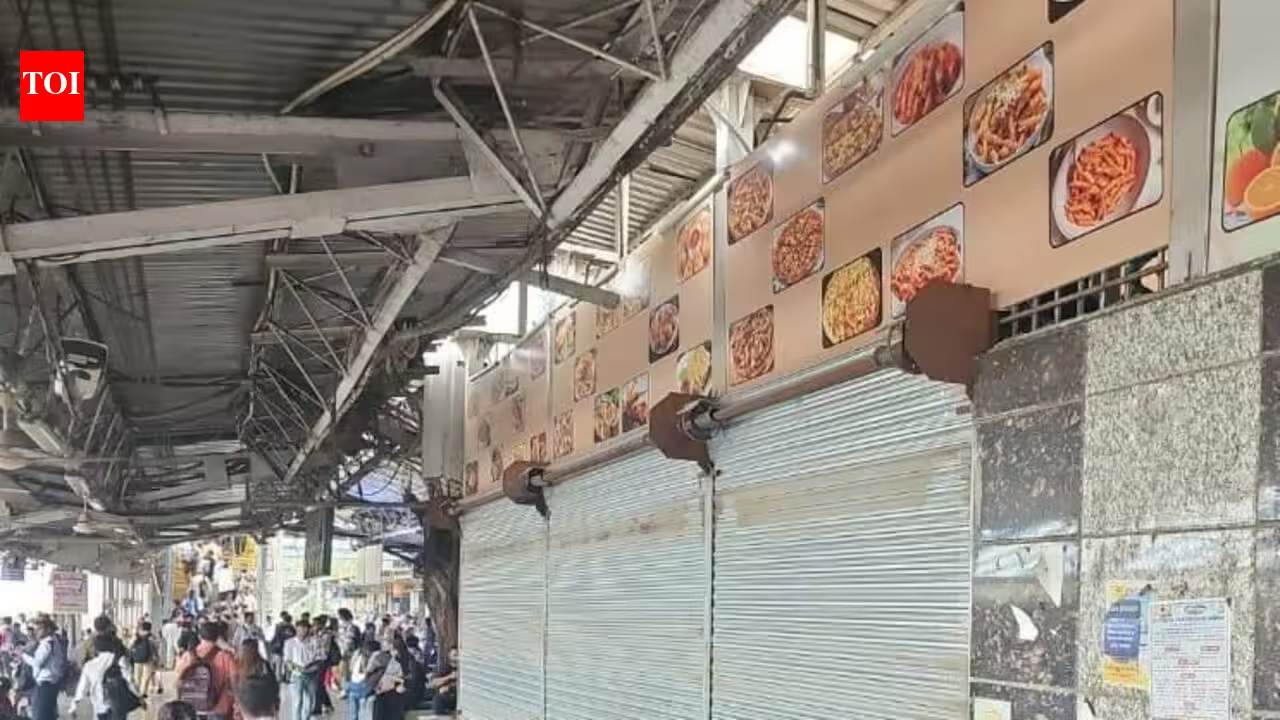
Thane: The Central Railway has temporarily sealed a multi-purpose stall in the waiting room area at Thane railway station and imposed penalty on its contractor after complaints of unhygienic conditions, officials said on Thursday.The action follows repeated complaints from commuters about poor hygiene at the stall near Platform 2. A recent inspection by members of the Divisional Railway Users’ Consultative Committee (DRUCC) found the complaints to be valid and recommended action against the operator.“We received complaints, conducted an inspection and, after verifying the allegations, sealed the stall and penalised the contractor,” a railway official said. “The outlet has been shut for seven days, and a penalty of ₹15,000 has been imposed for violating hygiene and cleanliness norms.”In a statement, the Central Railway reiterated its zero-tolerance policy towards unhygienic conditions at catering and commercial establishments operating on railway premises.“Regular inspections are being carried out across stations to ensure strict compliance with food safety and cleanliness standards,” an official said, urging passengers to report issues related to cleanliness, catering services or passenger amenities through the RailMadad portal.The action comes days after Thane MP Naresh Mhaske took up the issue following a complaint from a woman passenger who alleged that she had been sold a soft drink well past its printed expiry date at the same stall.Acting on the complaint, DRUCC member Sanjeev Kulkarni and Shiv Sena functionary Prakash Payre inspected the outlet and confirmed the alleged violations. Based on their findings, Mhaske wrote to the Divisional Railway Manager seeking stringent action against the canteen operator.

Eight of family injured after Tempo Traveller rams into parked truck on Mumbai-Nashik Highway in Bhiwandi | Mumbai News

Eight of family injured after Tempo Traveller rams into  parked truck on Mumbai-Nashik Highway in Bhiwandi
Four passengers who sustained minor injuries were treated and discharged, while the four seriously injured were given primary treatment before being taken by their relatives to Jalgaon for further medical care

Bhiwandi: Eight members of a family from Chalisgaon in Jalgaon district were injured, four of them seriously, after the Tempo Traveller they were travelling in rammed into a parked truck on Mumbai-Nashik Highway near Sonale village in Bhiwandi taluka on Thursday early morning.According to Bhiwandi Taluka police, the Sheikh family had travelled to Mumbai airport to drop two relatives, who were leaving for Umrah pilgrimage. The accident occurred while they were returning to Chalisgaon.Tausif, the driver of the Tempo Traveller, told TOI that heavy rainfall had drastically reduced visibility on the highway. He said two vehicles were moving ahead of him, and while attempting to overtake them from the left, he mistook a truck parked on the roadside for a moving vehicle. Before he could react, the Tempo Traveller crashed into the rear of the truck.Following the accident, local residents rushed to the spot and shifted all the injured to Indira Gandhi Memorial Hospital in Bhiwandi. Four passengers who sustained minor injuries were treated and discharged, while the four seriously injured were given primary treatment before being taken by their relatives to Jalgaon for further medical care.The injured alleged that the truck driver had parked the vehicle on the roadside without switching on the hazard indicators, and claimed that the absence of warning lights, coupled with poor visibility due to heavy rain, led to the accident.Senior police inspector Harshvardhan Barve of Bhiwandi Taluka police station said the injured had left for their native place with relatives before their statements could be recorded. “An FIR will be registered after recording the statements of the injured, and appropriate action will be taken against the person found responsible,” he said.