

Bandra’s gaothans are open for business — but at what cost to the community? | Mumbai News
Bandra’s gaothans are open for business — but at what cost to the community?
Residents, architects, and urban planners have long demanded special development control regulations and a policy for gaothans

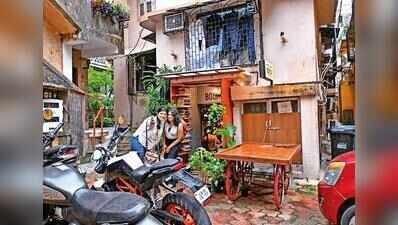
Mumbai: Charles Correa once said, “People don’t come to cities for housing, they come for jobs.” People come to Bandra’s gaothans to escape the city — and for its houses. Here, they make themselves at home in postcard cottages, settling on century-old verandahs to watch village life unspool. It’s a life few can own, but many can briefly have for the price of a coffee and a complimentary madeleine.That’s what the cafes, bookshops, B&Bs and concept stores in Bandra’s gaothans are serving up. In a city caught in the chokehold of concrete, the rustic charm of a rosewood cottage down a flagstone alley flanked by hibiscus in full bloom is a breath of fresh air.Book Bar, far from the madding crowds, has started drawing a crowd of its own. Housed in a low-rise building in the heart of Pali Village, this semi-basement cafe is plastered in paperbacks. “We looked across Bandra, Khar, Versova — until we chanced on this,” says co-founder Avneesh Gadgil. One of four Book Bar cafes — the others are in Pune — it opened in May, removed from the chaos of Ambedkar Road and 16th Road on either side. Gadgil likens the contrast to a cassette: “Everyone experiences Side A of the city, the noise and mayhem; but Bombay also has a Side B — places for pause.”On the adjacent street, Neil Pereira is less charmed. “Pali Village is categorised as a residential zone. How can commercial establishments be allowed here?” demands the longtime resident — though Book Bar, it should be noted, stepped into a former AC repair shop and simply inherited its commercial licence. The concern runs deeper than zoning. “There’s a risk of fire from circuit overload, owing to the high demand for electricity for lighting, cooking and cooling,” says Pereira, founder of the Pali Gaothan East Indian Association. Fire safety norms for commercial establishments in gaothans already forbid flame-cooking, but the risk of electrical overload in these densely wired old buildings is real.Fire is only one worry. S Gonsalves, another Pali Village resident, flags water. “The increased demand from restaurants, offices and studios has affected domestic supply. Their illegal high-horsepower pumps draw water before our tanks can fill up.” Sewage is another pressure point: “The gaothan’s drains were not built for the extra footfall,” says Pereira. “Sewage lines have overflowed in some places.” Heat envelopes from multiple AC units, strangers in the lanes for selfies, security concerns — the list is long.Shormishtha Mukherjee, author of Pudding: The Memory Keepers of Bandra, recalls residents telling her they’ve taken to closing their doors and windows, when once these were gateways to niceties and news. “The changing character of the gaothans has intensified in the last 3-4 years, and it’s visible on its walls. Chapel Road, which once had graffiti, now has ad graffiti.”The question, she asks, is — what are commercial spaces doing for the community? Do they become part of it? Do they ask their customers to be mindful of the neighbourhood?Some do. Chuim 66, a micro-restaurant dishing out pot pies and craft coffee, has signage reminding customers they’re in a residential neighbourhood. “We refitted our chimney when a neighbour complained of the exhaust,” says co-founder Vidit Aren. “We ran the ducting through the centre of the building instead of the exterior to reduce noise. We hope to be here for years and want to coexist with the community.” Book Bar halted interior work for an hour each afternoon to accommodate a neighbour’s nap. “We request customers not to smoke outside and keep the music low,” says Gadgil. “We even hosted an inauguration party for the villagers.”Commerce and community can be combative bedfellows initially, but they can learn to make peace. The sooner the better, because incoming traffic in the gaothans is only going to intensify, warns Shaan Shaikh, a real estate broker. “Enquiries for gaothans have multiplied in the last 3-4 years. I currently have 10 clients looking for cafe space, mostly in Chapel Road and Pali Village. A 250 sq ft cafe rental can cost Rs 1.5-2 lakh at either place,” Shaikh says. “The asking price for a 2,460 sqft, ground+2 bungalow off Carter Road is Rs 5 lakh.” But even at those rates, gaothan cafes are paying nearly 30% less than high-street rents. For homeowners — particularly elderly couples with limited income — the offers are a windfall and a saving grace.Gaothans receive no renovation or maintenance funds from govt. “I spend Rs 3-4 lakh on maintenance every couple of years,” says Clarence Gomes, 75, founder-editor of Bandra Times. “Our 150-year-old house on Bazar Road needs a new balcony, but we’ve been quoted Rs 5-6 lakh just to replace the Burma teak one.”“The question is how to negotiate change while preserving the integrity of the gaothan,” says conservation architect David Cardoz. “Anything that keeps the place going at the same scale without gutting it is fine — unlike redevelopment, which does exactly that.”Residents, architects, and urban planners have long demanded special development control regulations and a policy for gaothans. “In their absence, it’s the community that has conserved them,” says Pankaj Joshi, principal director, Urban Centre Mumbai. He believes communities should link arms with their new commercial neighbours and with civic officials to resolve tensions — and points to European cities developing soft bylaws for residential heritage precincts: noise restrictions at certain hours, rules on lighting and congregation. Mumbai has no such framework yet.“We wanted to establish a low-key neighbourhood space that was accessible,” says Aren, “and the gaothans were the only area that made financial sense. Anywhere else in Bandra and it would have been a heavier ship to run.”


23-year-old man found dead with bullet injury at Badlapur farmhouse | Mumbai News

23-year-old man found dead with bullet injury at Badlapur farmhouse

Badlapur: A 23-year-old man was found dead with a bullet injury to his chest at a cricket turf inside a farmhouse in Badlapur on Saturday late evening, with police investigating whether the death was a case of murder or suicide.The deceased, identified as Bhuvan Krishna Patil, operated the cricket turf business at the farmhouse in Sagaon village. His body was found on the premises, prompting an investigation by the Kulgaon police.After being alerted, officers from Kulgaon police station, along with a forensic team, rushed to the spot and collected evidence. During the preliminary investigation, police found that Patil sustained a single gunshot wound to his chest. A revolver was recovered from near the body.An assistant police inspector, Shivaji Dhavale, from Kulgaon police station said CCTV footage from the farmhouse showed Patil was alone at the cricket turf when the incident occurred. “The footage indicates it could be a case of suicide. However, we are also investigating the possibility of murder. The exact cause of death will be established only after the post-mortem report, forensic analysis and completion of the investigation,” the officer said.

SIR toh mera chakraaye, say many Mumbaikars citing confusion over documents | Mumbai News

SIR toh mera chakraaye, say many Mumbaikars citing confusion over documents
Mumbaikars cite confusion over documents

Mumbai: Mumbai’s special intensive revision (SIR) 2026 voter verification drive is producing sharply different experiences across the city as the submission deadline nears, with residents, political representatives and booth-level officers (BLOs) describing an uneven rollout that ranges from smooth doorstep verification to confusion, anxiety and repeated follow-ups.Across several neighbourhoods, residents reported that the process depends heavily on local execution. Some areas saw quick, orderly visits by officials and clear communication, while others described unclear instructions, uncertainty over acceptable documents and difficulty in contacting BLOs. Many citizens said comparatively better-off localities appeared to face fewer disruptions, while dense neighbourhoods with frequent residential movement reported heightened stress and what locals termed a growing “fear psychosis” around possible deletion from the electoral rolls due to paperwork gaps, spelling mismatches or address changes.Political representatives echoed the concern that shifting interpretations of documentation rules are adding to public anxiety. Nadeem Nusrath, vice-president of Mumbai Congress, pointed to confusion around the status of documents, saying a recent controversy over a passport not being treated as proof of citizenship has intensified fear, confusion and stress across class lines.Residents also alleged gaps in geographic coverage. In Bandra West, some said SIR verification was not being conducted at certain Slum Rehabilitation Authority project sites to which beneficiaries have been shifted, including Lalmatti, Shastri Nagar, Maharashtra Nagar and Slaughter House Compound. According to residents, BLOs cited instructions not to conduct verification at these sites for now. For families who have moved into these locations, the reported pause has created uncertainty about where verification will occur and how their records will be updated to reflect their current addresses.In the Kurla assembly constituency, residents described particular difficulties for voters whose names remain linked to older addresses after relocation. Some complained that BLOs were not answering calls or returning them even after callback requests were logged through the EC app. One voter questioned why contact numbers are shared if they remain unreachable, adding that even after visiting the election office, the guidance received was simply to keep trying because the BLO does not answer. The voter said their name was already in the electoral form (EF), yet completing the formalities still required repeated effort, calling it unnecessary inconvenience for genuine voters.Other localities reported technical and procedural hurdles in linking current electoral entries to older rolls, especially where residents have moved across wards, cities or states. At Dheeraj Upvan Society in Borivli East, a large residential complex built around 2000 with many migrants from other parts of Mumbai and outside Maharashtra, residents said the most difficult step was matching current details with the 2002 list through the app. Even so, some residents described strong participation and a willingness to comply despite the paperwork burden. One resident said the effort was creating chaos around arranging documents but argued it would improve security and help eliminate bogus voters.In Kanjurmarg, resident Tasneem B described a prolonged and shifting verification process that left her uncertain about her status. She said she was initially visited during pre-SIR mapping. When officials could not locate her parents—based in Nagpur—on the 2002 list, she downloaded the ward list and searched manually. She said her father’s name contained multiple errors, making it hard to trace, a problem she said is common on voter lists. Although she was initially told mapping was successful, she later received a message from the BLO that she had been flagged as an anomaly due to a “different parent” and was advised to present her father’s documents and her passport to resolve it. After she complied, she said the BLO again informed her that even with documentary proof, BLOs lack the authority to complete verification in such cases and that she would likely need to attend an SIR hearing after receiving a notice. She criticised the dependence on an AI-driven system that can flag anomalies without an easy correction path and said the experience felt especially harsh for voters acting in good faith. She added that the episode revived fears, based on past experiences elsewhere, that minorities may face stricter scrutiny and higher compliance burdens.BLOs, for their part, are described as being under visible pressure as volume increases. At a housing society in Mira Road, residents gathered around a BLO as people sought help identifying their booths and submitting forms. Residents recounted that the BLO appeared overworked and responded sharply to repeated questions, underscoring how crowding and last-minute demands are testing capacity on the ground.In Mira Road and other areas with sizable Muslim populations, residents and local representatives said misinformation, difficulty locating names on older SIR lists, and spelling discrepancies between documents and earlier records are complicating compliance. A long-time voter, Sani Aslam, said he had tried calling for days without response and later realised he had contacted the wrong BLO, illustrating how confusion over BLO jurisdiction can add to delays.Samajwadi Party MLA Rais Shaikh said volunteers were being deployed in Madanpura, Govandi and Bhiwandi to help residents fill forms and locate BLO information. He said many fear that spelling mismatches could lead to deletions from draft lists. Govandi resident advocate Faiyyaz Alam Shaikh described the situation in Mankhurd Shivaji Nagar assembly constituency as “alarming”, citing density, socio-economic vulnerability and many voters being given the “anomaly” status. He called office-based verification impractical and inaccessible for many genuine electors.Some residents reported smooth experiences. In Vashi’s Sector 9A, Kedarnath Rao Ghorpade said four officers from Navi Mumbai Municipal Corporation arrived prepared, conducted verification transparently and followed a structured process, although he noted that documentation was a challenge for some. In Nana Chowk, Chandana Shetye described a positive interaction, saying the BLO waited for her to return from work and accepted alternative details when she opted not to provide her Aadhaar number.

Mumbai Police probing ‘love jihad’ threat to Aamir Khan: Minister | Mumbai News

Mumbai Police probing ‘love jihad’ threat to Aamir Khan: Minister
Aamir Khan was allegedly issued a threat by jailed gangster Lawrence Bishnoi’s brother Aarzoo Bishnoi and gang member Tyson Bishnoi on Facebook for promoting ‘love jihad’

Navi Mumbai: Minister of state for home (urban) Yogesh Ramdas Kadam said Mumbai Police have initiated a suo motu inquiry into the threat issued to actor Aamir Khan in the name of the Lawrence Bishnoi gang accusing him of promoting ‘love jihad’.Kadam said they will contact the Khan, who recently married Gauri Spratt, after he returns to India. The actor is currently abroad.The social media post, purportedly by gangsters Tyson Bishnoi and Aarzoo Bishnoi on Facebook, alleged Khan and others were promoting ‘love jihad’, which they said was against their culture.“We received information about the threat to Khan by Bishnoi gang members on social media. We have not yet received any complaint from Khan, but Mumbai police are taking suo motu action. The matter is being investigated,” said Kadam, adding that the actor already has security cover, which will be reviewed and enhanced if required even as police vigilance around his residence has been increased.Kadam also said the Bishnoi gang typically issues threats to extort money, especially from Bollywood celebrities, and that Mumbai Police have acted in such cases in the past.

Scammers Steal Rs 78 Lakh via Gold Loan Firm Software Hack in Mumbai | Mumbai News

Scammers Steal Rs 78 Lakh via Gold Loan Firm Software Hack in Mumbai
The case was registered at the Central Cyber police station on July 17 after police learnt that fraudsters gained unauthorised access to the firm’s authorised Omnifin (Loan Management System – LMS) software and third-party API system, and that fraudulent transactions were auto-generated without any company approval or one time password (OTP) and transferred to various unknown bank accounts.

Mumbai: Scammers gained illegal access to the software of a Parel-based gold loan firm and, through the app, instructed a private bank to clear 18 suspicious and unauthorised transactions totalling Rs 78.1 lakh from the company’s current account within an hour on July 13, police said.The case was registered at the Central Cyber police station on July 17 after police learnt that fraudsters gained unauthorised access to the firm’s authorised Omnifin (Loan Management System – LMS) software and third-party API system, and that fraudulent transactions were auto-generated without any company approval or one-time password (OTP) and transferred to various unknown bank accounts.While tracking the money trail, cyber police found that scammers transferred the funds to a finance company and to nationalised and private banks in Jammu & Kashmir, Kerala, Maharashtra and other states between 10.49 am and 12.18 am on July 13. “The team has sought details from the banks about the account holder to which the money has been credited. Meanwhile, the nodal officers of these banks have instructed to freeze the account. The team is gathering details as the 18 transactions was done in the range between Rs2 lakhs and Rs7 lakhs each. Probe is on to find out any internal bank or company’s staffs involvement in the fraud,” said a police officer of the Central cyber police station.During the probe, it was observed that an unknown accused tampered with the original bank details and system of the gold loan company and gained unauthorised access to its authorised Omnifin (Loan Management System – LMS) software and third-party API system.In the complaint, the company’s director GM Amit said: “Our company’s current account is our corporate account, and all financial transactions of the company are conducted through this account. As per our business process, after receiving the necessary documents and application form from the borrower, the relevant loan amount is disbursed to the borrower’s account after verification as per company rules. To streamline the loan disbursement process, our company uses a ‘Loan Management System’ (LMS) software named ‘Omnifin’. This is our internal software, and it contains complete information about all transactions, vendors, and third parties.”Police said the software was integrated with the private bank’s system through an authorised third-party API service provider, Paysprint Private Limited Company. “Due to this secure API integration, payment instructions are directly transferred to the bank. According to this system, when a request for loan disbursement comes from a borrower or a third party, the loan process is completed by the software. After the process is complete, an automatic notification is sent to the Bank via the authorized API to transfer the amount. Since this entire system is completely API-based, no manual OTP or separate approval is required. Information about money being debited from the account is automatically generated once the transaction is complete,” said the cyber police.The firm noticed discrepancies in its bank account on July 14 and found unauthorised transactions. “The transactions were not related to any approved loan account or valid as per our company’s daily routine, all transactions from the previous day are reconciled on the next day. Accordingly, on July 14, when we were verifying and reconciling the transactions, we noticed that the above entries did not match. Upon thorough investigation, it became clear that all these transactions were not related to any approved loan cases or customer requests, but were completely unauthorized and illegal,” the firm’s director said in the FIR.The company then filed a complaint on the 1930 Cyber Helpline on July 16 and lodged the FIR with the Central Cyber police against unknown cyber criminals for gaining unauthorised access to the company’s accounts by tampering with the system. The complaint was filed against the unknown cyber criminals, bank account holders and their accomplices.

Speeding Porsche hits divider, car on Coastal Road, girl injured | Mumbai News

Speeding Porsche hits divider, car on Coastal Road, girl injured
The Porsche driver and the girl’s parents were unhurt

Mumbai: Days after a car caught fire in a tunnel of Coastal Road, a speeding Porsche rammed into a divider on the road and hit another car on Sunday morning. While the Porsche’s driver escaped unhurt because its airbags deployed, a minor girl in the other car sustained minor injuries.An officer from Gamdevi police station said the incident took place behind Breach Candy Hospital around 8.30am, when the Porsche driver, Vijay Pandey, who was speeding, lost control of the vehicle and hit the divider. The Porsche then hit an Ertiga that was behind it. The officer said the girl’s father, a Colaba-based doctor, was driving the Ertiga and her mother were also in the car. The girl was taken to a hospital, where she received treatment and was discharged.Police were waiting for the Porsche driver’s blood sample reports to ascertain whether he was driving under the influence of alcohol.The officer said police sent the driver to the hospital for blood tests. “An FIR is being registered against the Porsche driver under various sections of rash driving and negligence. We are awaiting the blood test report to confirm if he was under some influence when the incident took place,” the officer added. There was some traffic congestion after the accident as the lane was blocked for some time, police said.Last Wednesday, a fire in a moving car at the Marine Drive end of the Coastal Road tunnel caused panic, leading to massive traffic snarls. No one was injured and the road was reopened after the vehicle was removed.

School bus operators oppose seat belt, panic button mandate in Maharashtra’s newly notified policy; parents raise concern on 20-year bus life extension | Mumbai News

School bus operators oppose seat belt, panic button mandate in Maharashtra’s newly notified policy; parents raise concern on 20-year bus life extension
Another key point in the policy was Regional Transport Authority (RTA) fixing a base fare per km per student. The fees decided by school bus operators cannot exceed or fall below the RTA fare by more than 10% and this will keep in check any arbitrary fare hikes

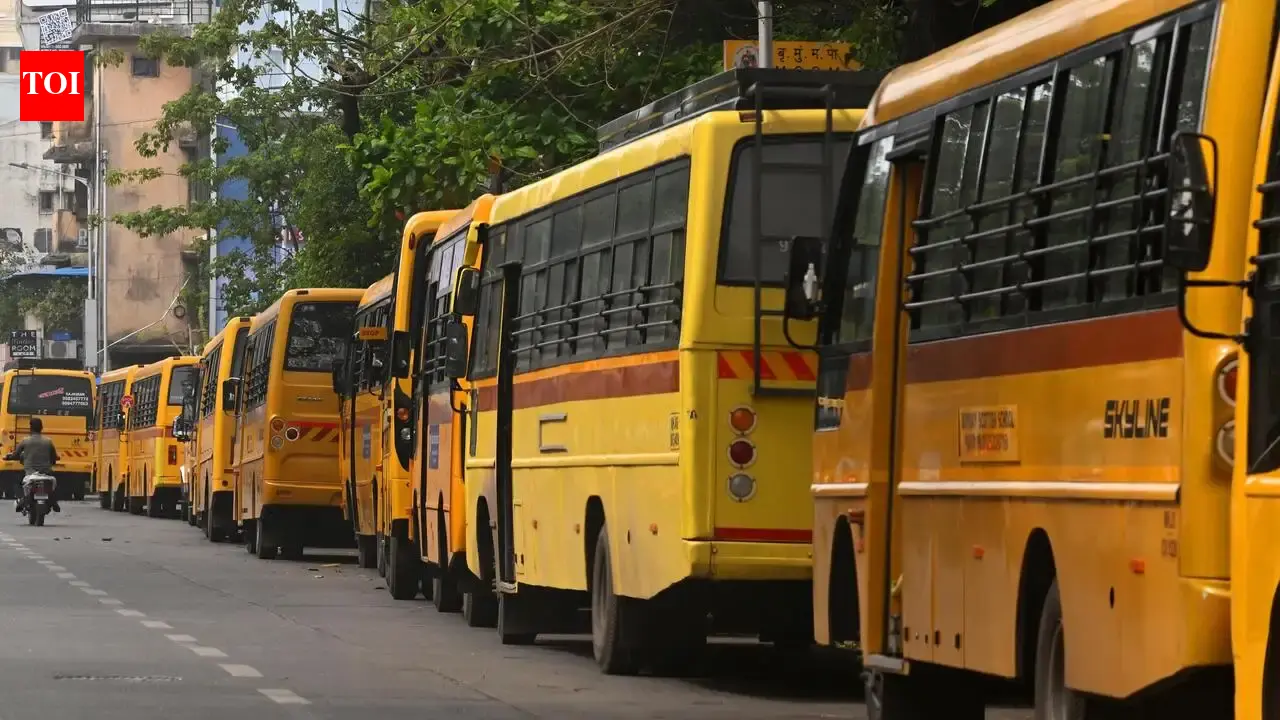
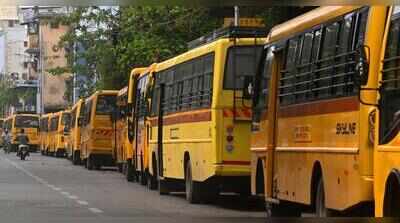
Mumbai: School bus operators on Sunday opposed the mandatory seat belts and panic buttons under Maharashtra’s newly notified School Bus Policy, citing practical challenges in implementation.At the same time, parents have voiced concerns about older buses remaining on the roads, with the new rule extending the permissible lifespan of school buses from 15 to 20 years, saying this could compromise bus and student safety. Mumbai, which is in BMC limits, however, has a rule of strictly phasing out school buses after eight years as per court orders. The 20-year rule applies to districts such as Thane and Navi Mumbai.Another key point in the policy was the Regional Transport Authority (RTA) fixing a base fare per km per student. The fees decided by bus operators cannot exceed or fall below the RTA fare by more than 10% and this will keep in check any arbitrary fare hikes.On mandatory seat belts, the School Bus Owners Association (SBOA) said it is difficult to design seat belt systems suitable for all age groups. Ramesh Manian of SBOA pointed out that existing regulations permit four children below the age of 12 to occupy seats designed for three adults and three children on seats meant for two adults. “Seat belts designed for adults cannot practically accommodate children ranging from pre-primary to Class X. A belt suitable for a class V student may not be safe for a preschool child or comfortable for an older student,” he said.SBOA president Anil Garg echoed the concerns, saying school buses carry students of widely varying ages and sizes. “Besides, students may misuse seat belts, play with them or get into fights using the belts, which could cause injuries.”Operators have also expressed reservations about the mandatory installation of panic buttons. Manian said authorities should first ensure adequate infrastructure, monitoring systems and response mechanisms (from police) for a panic switch before enforcing the provision. He noted that most school buses already have GPS tracking systems costing between Rs 3,000 and Rs 5,000, allowing parents to track vehicles in real-time.School bus operator Radhakrishnan Nair warned that panic buttons could trigger frequent false alarms if accidentally pressed by children. “Before introducing new rules, authorities should address blatant violations already visible on the roads, including overcrowded vans carrying as many as 18 children,” he said.On the bus lifespan being extended from 15 to 20 years outside Mumbai, Pratima Dey, a parent from Thane, said that older buses could be in bad condition and unsafe for students. “Who will guarantee that the buses are properly maintained after 15 years,” she asked.Bus operators, however, backed the government decision. Garg said school buses undergo rigorous fitness checks. “Most buses cover only around 3.5 lakh kilometres in 15 years against an engine life of nearly five lakh kilometres. Annual fitness tests are mandatory and even minor defects are not overlooked by RTO authorities,” he added.Maharashtra’s School Bus Policy# Fare Regulation: Regional Transport Authority will fix a base fare per km per student# Digital Safety Monitoring System: GPS tracking, CCTV cameras, integration with the state’s monitoring platform, parents to receive live bus location and CCTV access through certified apps# 30-Day CCTV Footage Storage: Schools must preserve CCTV recordings for at least 30 days; footage to be provided to transport, education, or police authorities when required# Seat Belts & Panic Buttons: Seat belts for all seats, vehicle location tracking device, panic button, fire detection and alarm system or approved fire-safety equipment# Digital Attendance System: Daily digital records of every student’s boarding time and de-boarding time# Additional Safety: Lady attendant or a designated staff member on board# Children With Disabilities: Mandatory accessibility features, trained attendants for children with special needs# School Transport Committees Get More Powers: Verify whether operators charge RTA-approved fares; address complaints regarding safety, fares and service quality; submit quarterly compliance reports to District School Bus Safety Committees# Mandatory Staff Verification: Drivers, attendants and transport staff can be appointed only after background verification and medical fitness certification; records must be maintained and made available for inspection by transport authorities and police# School Bus Lifespan Extended: Maximum permissible age of buses increased from 15 to 20 years

Midnight Goal: Eateries, hotels in Mumbai open till 4 am for FIFA World Cup final clash between Spain and Argentina | Mumbai News

Midnight Goal: Eateries, hotels in Mumbai open till 4 am for FIFA World Cup final clash between Spain and Argentina

Mumbai: In a massive shot in the arm for soccer aficionados and the nightlife industry across Maharashtra, the state govt on Sunday cleared a special extension allowing hotels, restaurants and eateries to remain open until 4 AM on Monday. The late-night relaxation was specifically aimed at facilitating public screenings of the high-octane FIFA World Cup 2026 final showdown between European champions Spain and defending global champions Argentina.The notification, issued on July 19 by the State Home Department under Section 33 of the Maharashtra Police Act, 1951, came in response to an urgent appeal made by the National Restaurant Association of India (NRAI), Mumbai. With the final kicking off late in the night according to Indian Standard Time (IST), the directive ensures Mumbaikars can experience the global football spectacle on the big screen without the dampener of early closing hours. HRAWI, a body representing premium restaurants, bars and hotels, too, made the demand.However, the late-night permission came anchored with stringent legal and security guardrails. Joint Secretary (Home) Mugdha N. Dhuri clarified in the official order that the extension applies strictly to indoor establishments operating within closed structures or buildings. Open-air rooftops, lawns and outdoor dining decks will not be permitted to stream or operate beyond standard deadlines, the home dept circular stated.To prevent any post-match rowdyism or security lapses, the home department has put the onus completely on the hospitality sector. “Establishment owners must deploy a substantial number of private security guards both inside and outside the venue premises,” the order stated, warning that licensees will face direct prosecution and strict legal liability if any untoward incident or crime triggers a law-and-order situation.Crucially for residential neighbourhoods, the state refused to relax noise pollution norms. Eateries using heavy sound systems or loudspeakers must operate strictly within the permissible decibel limits regulated by the Supreme Court and High Court guidelines, the circular stated.Furthermore, the govt gave absolute veto power to local law enforcement. Local police commissioners and district administrations retained the statutory right to deny or immediately revoke this timing relaxation to any specific establishment if they sense a threat to public peace. Top sources confirmed that the Director General of Police (DGP) already ordered “extremely tight security deployments” across key entertainment hubs in Mumbai, Thane and Pune to ensure the night passes smoothly.Local football fan clubs and restaurant operators welcomed the move with open arms. “The World Cup final happens once in four years, and this time it’s the ultimate dream match. Getting to watch it legally with fellow fans until 4 AM with food and beverages available is the best news we could have hoped for,” said a representative of a prominent Mumbai-based fan club.

Attack on doctors: After Bombay HC stays bail, Sena corporator surrenders; patient’s mom held | Mumbai News

Attack on doctors: After Bombay HC stays bail, Sena corporator surrenders; patient’s mom held
Shiv Sena corporator Ramesh Mhatre being produced in court after his surrender

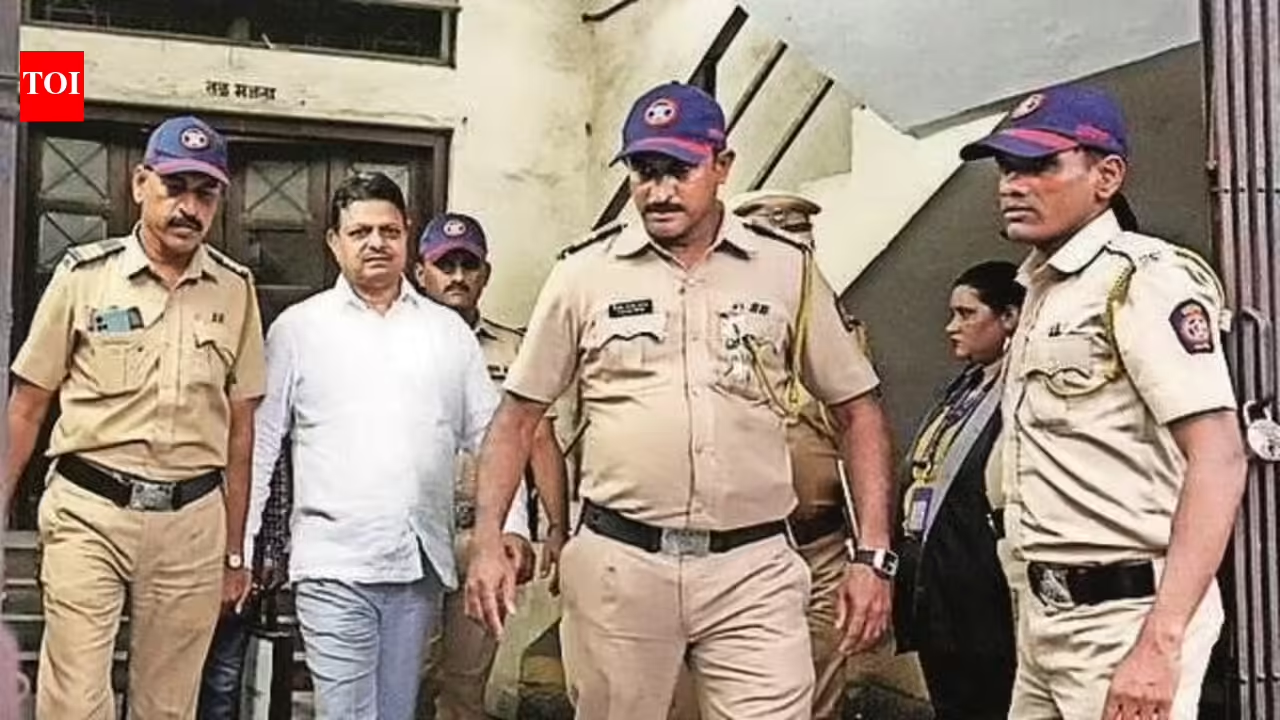
Kalyan: A day after Bombay HC suo motu stayed the bail granted to him by a local court over the recent attack on doctors and nurses of a Dombivli civic hospital, Shiv Sena corporator Ramesh Mhatre surrendered before police on Sunday. A Kalyan court remanded him in judicial custody till Aug 3.Meanwhile, police arrested Sadhana Karande, one of the alleged attackers and mother of the pregnant woman whose purported delayed treatment had triggered the violence. She was sent to police custody for a day.After the court proceedings, Mhatre’s advocate Ganesh Patil told reporters, “Bombay HC has only stayed the bail granted to my client. The matter is scheduled for further hearing on July 22, when we will place our arguments before HC.”While staying the bail given by the Kalyan judicial magistrate first class court and directing Mhatre to surrender before police by 5pm on Sunday, HC had said on Saturday that it was “disturbed” on reading the news about the alleged assault. It had said the magistrate “did not even notice” that Mhatre had not been interrogated after his first statement was recorded. “Even though he (Mhatre) was acquitted in 17 cases, the court ought to have considered the fact that he was named in 18 cases, some of which were of very serious and heinous nature,” the bench led by acting Chief Justice Ravindra Ghuge and Justice Gautam Ankhad had said. HC had warned of coercive action, including attachment of his properties, if he failed to surrender.After being remanded into judicial custody, Mhatre was sent to Adharwadi jail in Kalyan.Meanwhile, deputy CM Eknath Shinde said in Pandharpur that neither he nor his party would ever condone any attack on the medical fraternity.Mahendra Baviskar, father of Dr Shrushti Baviskar who was among those assaulted at Dombivli’s Shastri Nagar Hospital, welcomed HC’s intervention. “The order has reaffirmed that the rule of law prevails in the country. After the accused was granted bail, there was widespread disappointment among doctors. Healthcare professionals should be able to work in an environment free of fear and that has always been our stand,” he said.On July 6, Priyanka Ugmale (33) was admitted to the hospital in an advanced stage of pregnancy. Doctors found that the umbilical cord had looped itself twice around the foetus and decided to perform a C-section. But since the hospital’s neonatal intensive care unit (NICU) was full, the medical team began contacting other hospitals to secure a NICU bed before proceeding with the surgery. The family called Mhatre and his supporters, alleging undue delay in treatment, following which the staffers were attacked. The assault had triggered statewide protests by the medical fraternity, with doctors in Kalyan-Dombivli suspending non-emergency services for two days. The strike was called off only after Mhatre’s arrest and civic chief Abhinav Goel’s assurances of enhanced security.

Citizens’ Campaign Raises Awareness on Smart Meters, Collects Consumer Complaints | Mumbai News

Citizens’ Campaign Raises Awareness on Smart Meters, Collects Consumer Complaints

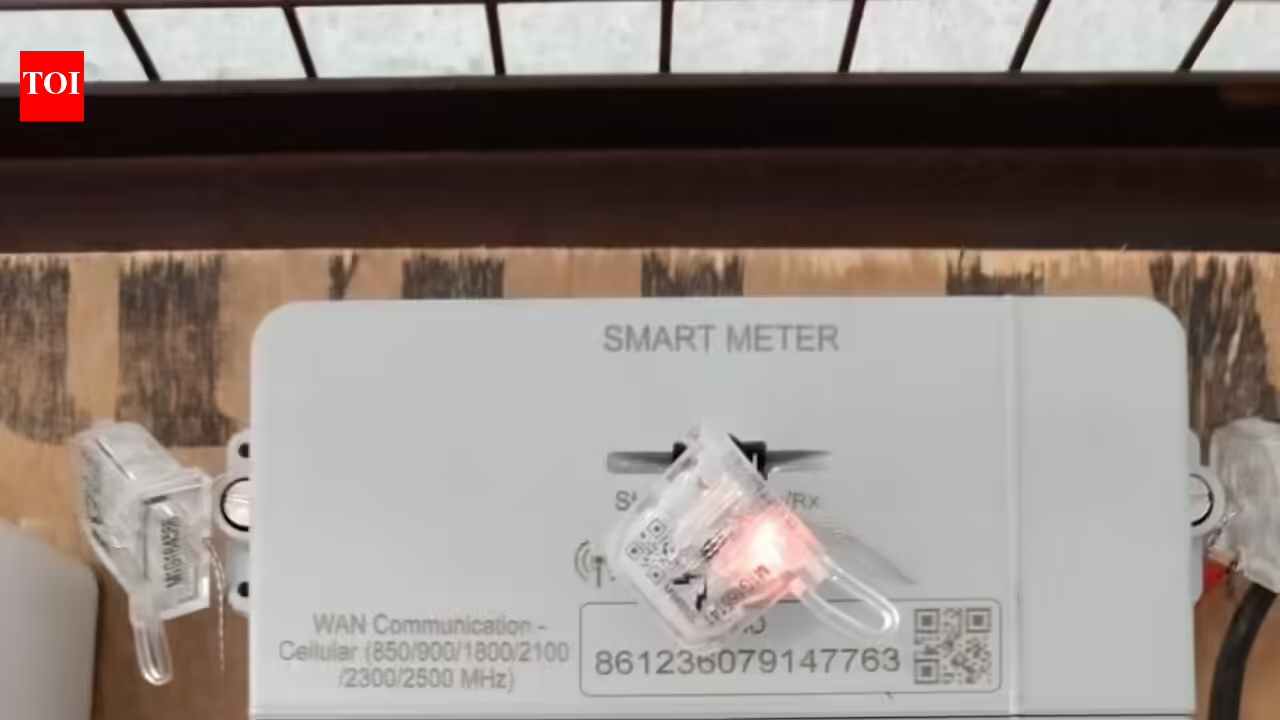
Mumbai: A citizen-led awareness campaign on smart electricity meters was conducted recently across several locations in Mumbai, said civic activist G R Vora on Sunday. The initiative was spearheaded by social activist Kamlakar Shenoy and supported by concerned citizens seeking to address growing consumer grievances related to the installation of smart meters.The campaign was held at Matunga East, Byculla, Parel Village, Vile Parle, Santacruz East, Vashi, Dharavi, Thane, and Virar West. Besides educating residents about smart meters and their implications, the drive also invited written complaints from consumers who had either received notices from electricity providers or had their conventional meters replaced with smart meters without their consent.Organisers reported receiving around 100 written complaints from affected consumers. They stated that these representations would be submitted to the relevant authorities, including power distribution agencies, police authorities, and, if necessary, pursued through legal proceedings.“We are committed to protect consumer rights and ensure that public concerns are adequately addressed,” added Vora.