PM Modi mourns loss of lives in Bhiwandi building collapse, announces ex gratia relief | Mumbai News

PM Modi mourns loss of lives in Bhiwandi building collapse, announces ex gratia relief
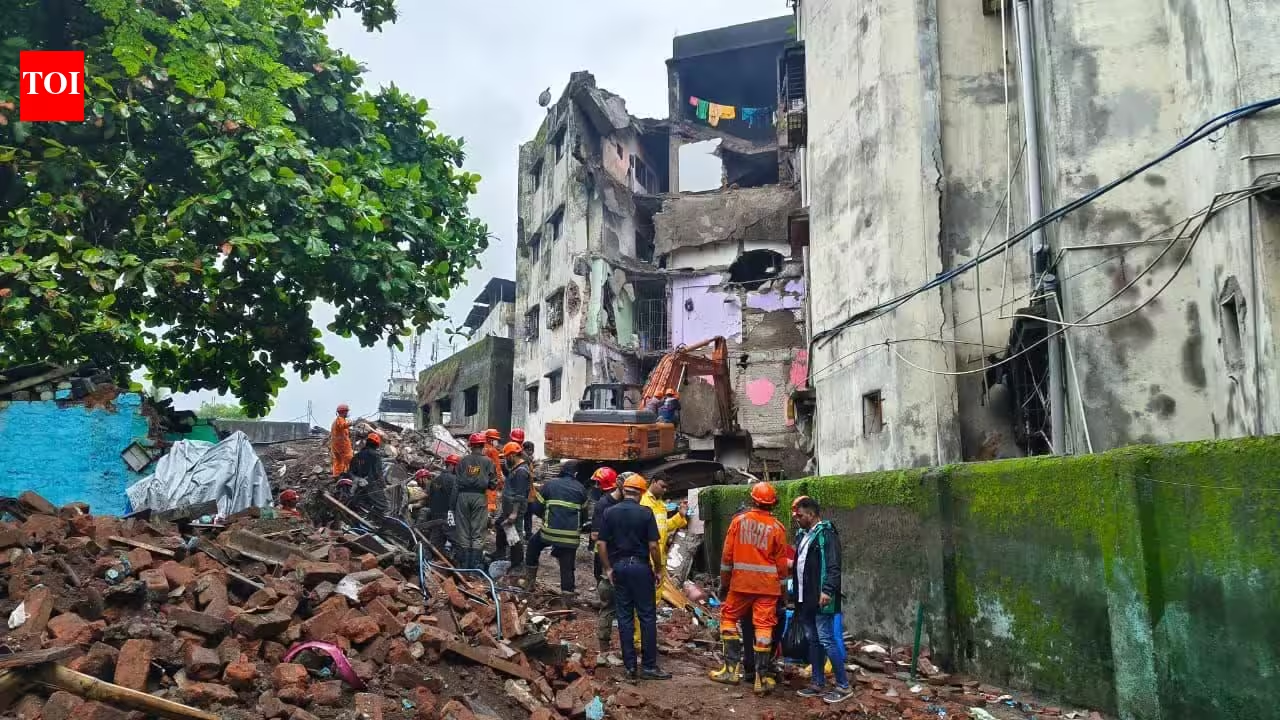
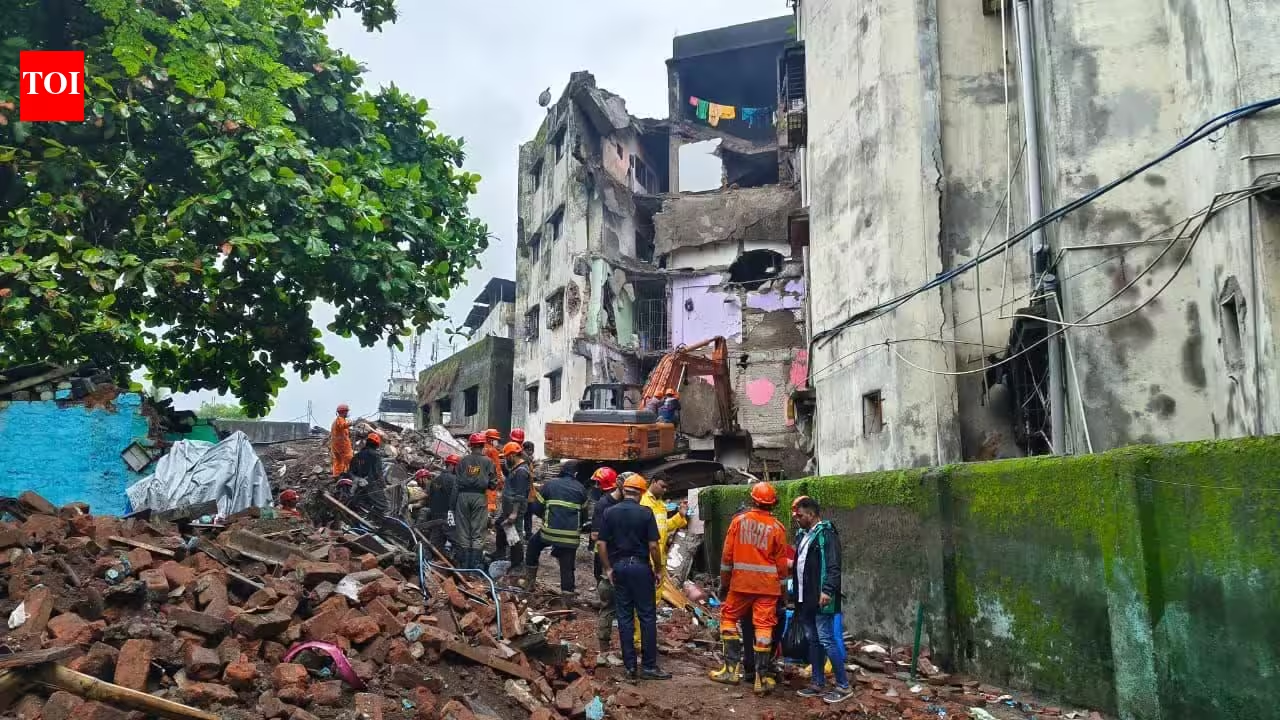
At least 10 people were killed after a four-storey building collapsed in Bhiwandi on Thursday night

New Delhi: Prime Minister Narendra Modi on Friday expressed grief over the loss of lives due to the collapse of a building at Bhiwandi in Maharashtra’s Thane district, and announced an ex gratia relief of Rs 2 lakh to the next of kin of those who died and Rs 50,000 to the injured.At least 10 people were killed after the four-storey building collapsed in Bhiwandi on Thursday night.“Pained to hear about the loss of lives due to the collapse of a building in Thane, Maharashtra. My thoughts are with the bereaved families in this hour of grief. May the injured recover at the earliest,” Modi said in a post on X.The Prime Minister also announced that an ex-gratia relief of Rs 2 lakh from the PM National Relief Fund would be given to the next of kin of each deceased, while Rs 50,000 would be given to each injured.The building had been declared “dangerous” by the civic authorities, and repair work was underway on the premises.

President Murmu expresses grief over loss of lives in Bhiwandi building collapse | Mumbai News

President Murmu expresses grief over loss of lives in Bhiwandi building collapse
At least 10 persons were killed after a ground-plus-four-storey building collapsed in Bhiwandi

New Delhi: President Droupadi Murmu on Friday expressed grief over the loss of lives in the building collapse in Maharashtra’s Thane district, and prayed for swift recovery of those injured.At least 10 persons were killed after a ground-plus-four-storey building, which had been tagged as ‘dangerous’ by the local civic body, collapsed in Bhiwandi.“The news of the deaths of people in a building collapse accident in Bhiwandi, Maharashtra, is extremely sad. I express my condolences to the grieving families. I pray for the swift recovery of those injured in this accident,” Murmu said in a post on X in Hindi.

‘Fingerprints on stones will be linked to Aadhaar’: BJP minister on CJP protest probe | Mumbai News

'Fingerprints on stones will be linked to Aadhaar': BJP minister on CJP protest probe
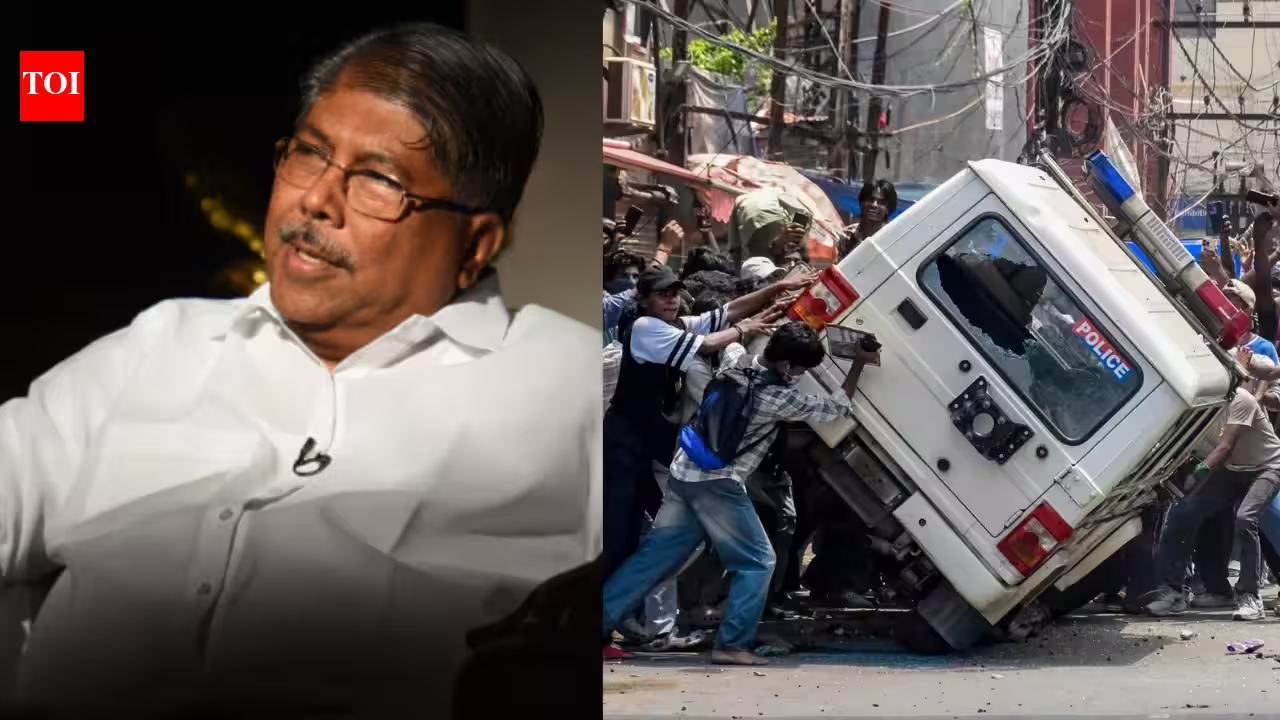
Maharashtra minister Chandrakant Patil stated Delhi Police collected protesters’ fingerprints from stones

MUMBAI: Maharashtra minister Chandrakant Patil on Thursday claimed that the Delhi Police had collected fingerprints from even the smallest stones allegedly used during the Cockroach Janta Party (CJP) protest in the national capital and would link them with Aadhaar records to identify those involved.Addressing reporters in Kolhapur, the Higher and Technical Education Minister claimed the Delhi Police had prepared a detailed report using advanced technology to identify protesters with criminal antecedents and alleged foreign links.“The Delhi Police have prepared a detailed report that will stun everyone. It contains an analysis based on advanced technology showing how people facing criminal charges and foreign elements were involved in the protest. They have collected even the smallest stones used during the protest.”“The fingerprints found on them will be linked with the Aadhaar number for their identification and to check their past records. The police will substantiate their claims based on the report,” he said.Patil further claimed that the police had analysed the criminal backgrounds of those detained, categorised protesters with criminal cases according to the nature of the offences, and were preparing a separate database of such individuals.He also indicated that action would be taken against anti-social elements and those with criminal records who participated in the protest.Reacting to Patil’s remarks, Shiv Sena (UBT) MP Sanjay Raut mocked the minister and said chief minister Devendra Fadnavis should recommend his name to the Nobel Prize Committee “for such an extraordinary scientific innovation”.“Patil holds the Higher and Technical Education portfolio, which certainly includes science. Such innovation deserves a Nobel Prize recommendation,” Raut told reporters.The remark made by the Higher and Technical Education Minister on Thursday at a press conference in western Maharashtra’s Kolhapur, drew mocking comments from Shiv Sena (UBT) leader Sanjay Raut, who said he would suggest Chief Minister Devendra Fadnavis to recommend Patil’s name for the Nobel Prize in the field of scientific research.The Cockroach Janta Party (CJP) led a month-long protest at Jantar Mantar in Delhi over examination paper leaks.The demonstration escalated into clashes, barricade breaches, and stone-pelting. The most intense violence broke out on July 20, when thousands of protesters attempted a ‘Sansad Chalo’ march to Parliament, leading to clashes in which demonstrators as well as security personnel were injured.He claimed that the police had analysed the criminal backgrounds of those detained, categorised protesters with criminal cases according to the nature of offences, and were creating a separate database of such individuals.The minister also indicated that action would be taken against anti-social elements and those with criminal records who participated in the protest.Reacting to the remarks, Sena (UBT) MP Raut mocked the minister and said Fadnavis should recommend Patil’s name to the Nobel Prize Committee “for such an extraordinary scientific innovation”.(With PTI inputs)

Chembur tree mishap: Ex-Mumbai University vice-chancellor to head panel for fresh probe | Mumbai News

Chembur tree mishap: Ex-Mumbai University vice-chancellor to head panel for fresh probe
The BMC has appointed an independent committee to re-examine the Chembur tree crash incident

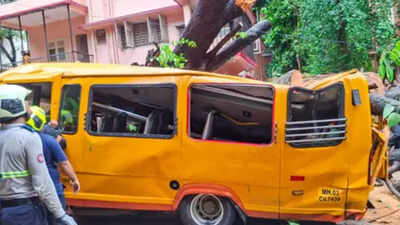
MUMBAI: Almost a fortnight after the BMC’s internal inquiry into the Chembur tree crash came under criticism, the civic body on Thursday appointed former Mumbai University vice-chancellor and botanist Prof Sanjay V Deshmukh to head an independent single-member committee to reprobe the incident that claimed the life of an 11-year-old schoolboy Vihaan Srivastava.The committee has been asked to submit its report in a month.The move follows the rejection of the preliminary inquiry conducted by two of BMC’s own officials.Mayor Ritu Tawde and the BMC general body had found the report inadequate.Vihaan’s family said an independent panel doesn’t mean having only one member on it.“We welcome the appointment of an expert, but we remain cautious until accountability is fixed. Our concern is not Dr. Deshm­u­kh’s ability, it is whether this inquiry is even meant to hold the responsible BMC officials accountable. We ask that full record be placed before him and that he be empowered to name those who ignor­ed them,” said Gaurav Sriv­a­s­t­av, Vihaan’s father.

AI-powered factories gather pace as manufacturers race to build ‘factory of future’ | Mumbai News

AI-powered factories gather pace as manufacturers race to build ‘factory of future’
Industry shifts from automation to intelligent production systems, promising higher productivity and export competitiveness (Representative image generated using AI)

MUMBAI: Artificial intelligence is rapidly transforming India’s factory floors, with manufacturers moving beyond conventional automation to build intelligent production systems that can predict machine failures, detect product defects, optimise energy consumption and even make real-time operational decisions with minimal human intervention.The shift, industry leaders say, marks the beginning of a new phase in Indian manufacturing—one where intelligence, rather than automation alone, will determine competitiveness in global markets.From automotive and engineering to electronics and industrial machinery, companies are increasingly investing in AI-powered predictive maintenance, machine vision-based quality inspection, digital twins and production planning tools as they seek to improve productivity, reduce downtime and build resilient supply chains.A practical example of this transformation can be seen in India’s automotive component sector.Several Tier-1 suppliers have integrated AI-powered machine vision systems, predictive maintenance platforms and digital production dashboards across their manufacturing lines.One leading auto component manufacturer in Tamil Nadu, for instance, deployed AI-based visual inspection to detect microscopic defects in precision-machined parts while using predictive analytics to monitor the health of critical CNC machines.Within a year, the company reported a significant reduction in quality rejections, lower unplanned machine downtime and improved overall equipment effectiveness (OEE), enabling faster deliveries to global OEM customers.The initiative also reduced maintenance costs by shifting from reactive repairs to condition-based maintenance, demonstrating how AI investments are delivering measurable returns rather than remaining experimental projects.Bosch Limited has integrated AI-powered machine vision systems for automated quality inspection and predictive maintenance across its manufacturing operations.By analysing real-time data from production equipment, the company can identify potential machine failures before they occur and detect product defects with greater accuracy than manual inspection.This has helped improve production quality, reduce unplanned downtime, lower maintenance costs and enhance overall operational efficiency.The transition comes at a crucial time for Indian industry.As global manufacturers diversify supply chains under the “China+1” strategy and India pushes to establish itself as a global manufacturing hub through the Make in India initiative, companies face mounting pressure to deliver world-class quality, shorter production cycles and greater operational efficiency.Unlike traditional automated factories that rely on fixed programming, AI-enabled manufacturing systems continuously analyse data generated by sensors, connected machines and production lines, allowing factories to learn, adapt and optimise operations in real time.For manufacturers, the benefits extend beyond faster production.Predictive maintenance helps prevent costly equipment failures before they occur, AI-powered vision systems detect defects that may escape manual inspection, while digital twins—virtual replicas of manufacturing systems—allow engineers to simulate production changes before implementing them, reducing operational risks and improving decision-making.Industry experts say these technologies are becoming increasingly important as manufacturers contend with rising labour costs, supply-chain disruptions, growing customer expectations and stricter sustainability goals.Adithya Jayakar, Deputy Managing Director of UCAL Ltd, said digital transformation has evolved from being merely a technology initiative to becoming a strategic business necessity.“The future factory will not be defined merely by automation, but by intelligence. AI enables manufacturers to make faster, more accurate decisions by converting vast amounts of production data into actionable insights. That is where the real competitive advantage lies,” Jayakar said.According to a senior manufacturing industry expert, who requested anonymity, AI adoption has already moved beyond pilot projects in many Indian factories.“The conversation today is no longer about whether companies should invest in AI, but how quickly they can scale it across their operations. Manufacturers that fail to embrace intelligent production risk losing competitiveness in global supply chains,” the expert said.Industry observers believe India enjoys a distinct advantage because many manufacturers can modernise existing factories by integrating AI into current production systems instead of building entirely new facilities.This allows companies to improve productivity while keeping capital expenditure under control.Jayakar said Indian manufacturers have consistently demonstrated their ability to embrace emerging technologies.“Indian manufacturers have demonstrated remarkable agility in adopting new technologies. By combining AI, connected machines and skilled human talent, we can build factories that are not only more productive but also more flexible and resilient,” he said.Experts expect the next wave of industrial transformation to see wider adoption of collaborative robots (cobots), autonomous production cells, automated material handling systems and AI-assisted quality inspection, particularly in automotive component manufacturing, where precision, traceability and consistency are critical for meeting global customer requirements.For consumers, the shift could eventually translate into products with fewer defects, improved quality and more reliable delivery schedules.Manufacturers also expect lower wastage, reduced energy consumption and better utilisation of machinery, helping improve profitability while supporting sustainability goals.However, industry leaders caution that the race towards autonomous manufacturing is not without challenges.While the technology is becoming increasingly accessible, successful implementation depends on high-quality production data, robust cybersecurity, reliable industrial connectivity and a workforce equipped to work alongside AI-enabled systems.“Many companies have digitised parts of their operations, but building a truly autonomous factory requires clean data, robust cybersecurity and a workforce capable of working with AI-enabled systems. Technology is available; the real challenge is change management,” another senior industry expert said, requesting anonymity.The rapid deployment of AI has also sparked concerns over its impact on employment.Industry leaders, however, argue that intelligent factories are more likely to redefine jobs than eliminate them, with routine manual activities increasingly giving way to higher-value roles involving data analysis, machine supervision, maintenance and digital operations.Jayakar echoed that view.“Autonomous factories are not about eliminating human involvement. They are about empowering people with better tools, better information and better decision-making capabilities. The companies that invest equally in technology and talent will define the next era of manufacturing,” he said.Industry experts believe the coming decade will determine whether India can leverage AI to emerge as a preferred global manufacturing destination.While automation laid the foundation for modern factories, they say the next competitive advantage will belong to companies capable of combining intelligent technologies with skilled human talent, secure digital infrastructure and continuous innovation.For India’s manufacturers, the journey towards autonomous factories has already begun.The challenge now is not whether AI will reshape industrial production, but how quickly companies can adapt to a future where data-driven intelligence becomes as important as machines on the shop floor.


‘Some restaurants you shut, others you give improvement notice’: FDA action must be fair to all, says Bombay HC | Mumbai News

'Some restaurants you shut, others you give improvement notice': FDA action must be fair to all, says Bombay HC

MUMBAI: The Bombay high court on Friday grilled the government and its Food and Drugs Administration (FDA) on what parameters it relied on when shutting down certain eating houses while giving first an improvement notice to others. The FDA had given an improvement notice to Mantralaya canteen, while Poornima a popular 60-year-old udipi restaurant in Fort, flocked by office goers got an immediate shuttering last week, the HC was informed.“Show us the photographs and footages of Mantralaya canteen inspection,’’ Acting Chief Justice RV Ghuge and Justice Gautam Ankhad immediately said to the government pleader.“Under what circumstances are you giving improvement and suspension notices? Do you have parameters? In some cases you are giving improvement notice and some case, suspension,’’ Justice Ankhad remarked orally while hearing a petition filed by Poornima’s owner to challenge the legality of a July 23 suspension order from FDA.“Also ask your officer why on the same day when inspection is done suspension notice is given why is no improvement notice given,’’ the HC asked the State.The government lawyer said Mantralaya showed high compliance. The bench let it rip. “So you thought you can get away by showing us a report. you never thought that lawyers will agree to to Mantralaya to see (There was a discussion in court to let lawyers visit). You show us the Mantralaya footage and photos,’’ said the ACJ orally.The ACJ went on, “ This is what we said in our earlier order: Be uniform. Be fair to all. You (FDA) can’t target only private premises… and certain govt premises you are saying shows 98 percent compliance. Show us the photos of 98 percent compliance.’’Senior counsel Venkatesh Dhond with Mayur Khandeparkar and Sameer Pandit representing Poornima said “no samples were taken during the inspection, so how can they decide if food was unsafe.”Dhond submitted, “Just because you (FDA) has the power to suspend doesn’t mean have to use it immediately.’’ The bench said, “we must appreciate that the FDA is taking action,’’ but added, “it must be equal to all, not lopsided.’’Dhond said, the FDA inspection report said it found ‘black marks’ on bananas and “fungus’’ on some drumsticks. “At my house, you can find bananas turning black when uneaten,’’ said Dhond. “Even at mine,’’ the ACJ quipped.The government lawyer said, “we have videography of the inspection of the drainage condition…allow us to show the videography.” The bench immediately accepted. “Show us the videography right now. Ask for it,’’ the ACJ said adding, “show us the footage from Mantralaya too.’’The Govt lawyer sought time till 3 pm to take instructions, “Give some time to see what was done at Mantralaya and to produce the photo.”

Jail training programmes for undertrials face uphill battle | Mumbai News

Jail training programmes for undertrials face uphill battle
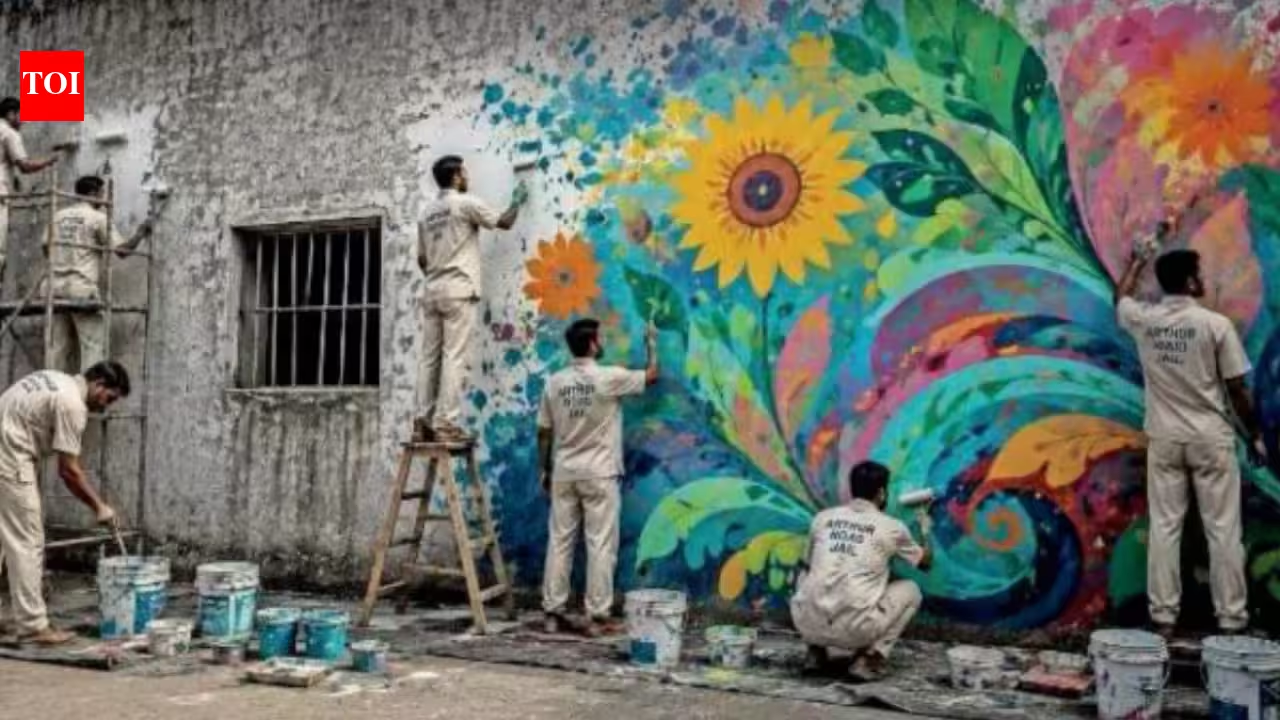
Incarcerated individuals gain valuable practical skills through vocational courses, setting the stage for future job prospects (AI-generated image)

MUMBAI: Bacchu Khan (name changed), a former Arthur Road jail inmate who dreams of a Dubai job after undergoing a wall-painting course during his time in prison, said he took up the course as “it seemed something quite interesting and I thought I could take up commissions and contracts and make a living”.The course teaches inmates practical painting skills ranging from applying putty and preparing walls to advanced finishes, textures and decorative designs.“Now my mother is happy and doesn’t worry about me anymore,” he said. “She is happy with the life I have made for myself,” Khan said.The importance of such programmes extends beyond skill development. Nearly three-fourths of India’s prison population comprises undertrials, people who have been accused but not convicted of crimes.Many spend years awaiting the outcome of their cases, only to be acquitted or handed sentences equivalent to the time they have already spent in jail.For them, courses such as wall painting, lift repair and English speaking offer not just a distraction from prison life but a chance to rebuild careers and livelihoods after years lost to the judicial process.

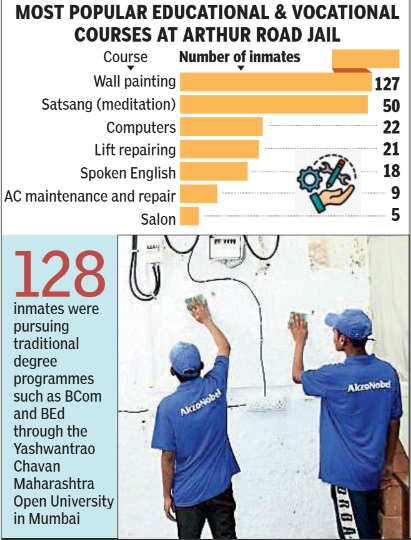
Most popular educational and vocational courses at Arthpur Road jail

Most popular educational and vocational courses at Arthpur Road jail

Arthur Road jail superintendent Harshad Ahirrao said convincing undertrials to join educational or vocational programmes remains a challenge.“The prison houses only undertrials who think they will be out in no time,” Ahirrao said. “Inevitably many end up spending three to four years at least here, but initially they are not concerned about learning something new. Convicted prisoners, on the other hand, know that they have to spend a long time behind prison walls and are more willing to sign up.”Ahirrao said the biggest impediment to scaling up educational and vocational initiatives inside the prison is the lack of space.“To conduct these classes you need a large hall or dedicated space, which is really hard to come by in a prison that is already heavily overcrowded,” he said.Mahipal Singh (name changed; 40) spent nearly two decades working as a spot boy on film sets in Mumbai before he too was arrested in a phone theft case.Inside prison, thoughts of his 12-year-old son, who had no one to care for him, tormented him day and night. To distract himself during the long lonely hours of prison, Singh too joined the wall-painting course.

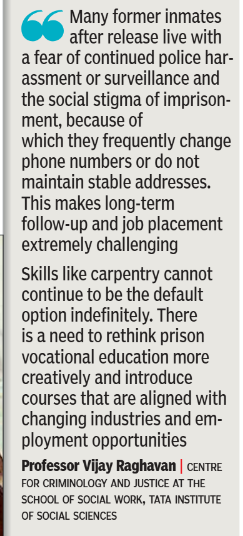
Prof Vijay Raghavan

Prof Vijay Raghavan

After his release, he found work at construction sites, and eventually secured regular employment in the sector.His son, now 17, has just finished his junior college and is fascinated by the stock market and plans to pursue a course in it.“Many don’t have anybody to guide them or speak for them, so they don’t know the correct path to take,” Singh said. “There should be more opportunities like these.”Sachin Bhinge, the course trainer and coordinator, said more than 650 inmates have been trained through the programme over the past five years.“We have been able to place around 50 inmates in jobs after release, while many others found work on their own,” Bhinge said.When asked about how contractors and companies react to and treat former prisoners working with them, he said, “To be honest, many times we don’t tell employers about their past. There are only two or three contractors we work with regularly.”According to Bhinge, one of the biggest challenges after inmates are released is simply staying in touch with them.“Most don’t have a stable address or even a phone number, so tracking them and following up becomes difficult,” he said.The wall-painting course is part of a broader shift in education and vocational training at Arthur Road jail. Alongside painting, lift-repair training has emerged as one of the most sought-after programmes among inmates.Avinash Gavit, senior jailer and in charge of education at Arthur Road, said inmates prefer courses that directly improve employment prospects after release.“These two courses are the most popular because inmates are able to find work in these sectors after leaving prison,” Gavit said. “Courses like welding, electronics and computers were very popular once and don’t attract much attention anymore. English-speaking classes on the other hand, however, have remained evergreen.”Ahirrao said English-speaking courses often give inmates hope that they may someday join respectable society.Gavit narrates an interesting event about a former inmate who became a stylist to the stars.“Many years ago a young boy from UP wound up in jail here, he took up our salon classes and after a few years here when he went free he joined the film industry, and now after many years he has become a hair stylist for some of the biggest stars in the industry, and they are none the wiser where he learnt these skills.”

Generation Gutter vs. Civic Dissent: Gen Z Fumes Over Kangana Ranaut’s Scathing Attack on Mumbai Protesters | Mumbai News

Generation Gutter vs. Civic Dissent: Gen Z Fumes Over Kangana Ranaut’s Scathing Attack on Mumbai Protesters
Actor Kangana Ranaut faces strong criticism from young people for her social media comments.

MUMBAI : Actor and Member of Parliament Kangana Ranaut has drawn fierce backlash from the younger demographic following a series of inflammatory Instagram stories targeting student-led protests across Mumbai and other cities.In her widely circulated posts, Ranaut slammed the students protestors organized under the banner of the ‘Cockroach Janta Party’, describing the content put out on social media about the protest as “puke-inducing” and “crass.”Singling out young women, she branded them “Generation Gutter” and accused them of displaying “filth, garbage, and ugliness” without accountability.The remarks have triggered widespread outrage among Gen Z, who argue that the actor-politician is generalizing a diverse movement and dismissing legitimate democratic expression.Weighing in on Ranaut’s harsh characterization, 25-year-old content marketing professional Pooja Mahabadi expressed deep dismay over the rhetoric used by a prominent public figure.“I am truly hurt by the words a public figure like her has used. Someone like her shouldn’t talk like this,” Mahabadi said.Condemning the terminology directed at women exercising their right to dissent, she added, “To use such words for women just because she has decided to exercise her democratic rights I am disgusted by these filthy words which she used.”While acknowledging that some elements of language in public demonstrations took a turn for the ugly, young participants emphasize that sweeping generalizations ignore the peaceful and creative core of the movement.Alakshendra Suryavansi, a 24-year-old working in corporate communications, noted that while language in parts of the protest was “crass,” the overarching environment was defined by artistic and civic engagement.“There were many students over there singing the national anthem and nursery rhymes like Nanna Munna Rahi,” Suryavansi noted, pointing out how protesters refashioned popular tracks like Jeene Mera Dil Luteya and songs from Chak De! India, to voice their message”.Speaking about songs which became a staple across different protest sites like Azaadi from the movie Gully Boy and Khalbali from the movie Rang De Basanti, he said ” these songs were made and used to express dissent and asked questions of the powers that be.He adds “If we can’t sing and we can’t ask accountability from the government, then what is the point of democracy and rights?”Echoing these sentiments, 24-year-old Mumbai-based producer Divyanshu Anand criticized Ranaut for adopting a posture of moral superiority. “She is not some perfect person who has the right to pass judgment. A small section of the content that she has seen does not define the nature of the protest itself.”Adding to the pushback, Yash Tiwary, 24, who works as a creative producer for a digital content company, pointed the lens right back at the older generation.Addressing Ranaut’s critique regarding how youth are raised, Tiwary noted, “If you are talking about who raised this generation, it is your generation who has raised us. And by the state of the politics of the country, we can see who is educated and who values education and studies well.”Tiwary added, “No matter what we say she is completely prejudiced against us. And 10 more statements like this from her are bound to come in”.

Maharashtra CM Devendra Fadnavis to launch financial security initiative for 1,000 Girls in Mumbai | Mumbai News

Maharashtra CM Devendra Fadnavis to launch financial security initiative for 1,000 Girls in Mumbai
Maharashtra chief minister Devendra Fadnavis will inaugurate accounts for one thousand girls.

MUMBAI : In a significant step towards strengthening financial inclusion and long-term security for young girls, Maharashtra chief minister Devendra Fadnavis will inaugurate the opening of Sukanya Samriddhi Yojana and NPS Vatsalya Scheme accounts for 1,000 girls under the special initiative, “Empowering Her Future: 1000 Betiyaan, 1000 Sapne, Ek Vishwas,” at Ghatkopar on Friday.The programme will be held at 12.30pm at the Auditorium, SPRJ Kanyashala Trust School, Kamalane, Ghatkopar (West), Mumbai.The initiative aims to promote financial literacy, encourage long-term savings, and build a secure future for girl children through two key government-backed schemes focused on wealth creation and pension security.Fadnavis will attend the event as the chief guest, while BJP MLA Prasad Lad will also be present on the occasion.The programme is being organised under the leadership of Gaurav Bhandari.

Sessions Court Rejects Anticipatory Bail for Juhu Teen in Prabhadevi Assault Case | Mumbai News

Sessions Court Rejects Anticipatory Bail for Juhu Teen in Prabhadevi Assault Case
The court refused to extend the benefit of probation

Mumbai: A sessions court on Thursday observed that the charges invoked against a 19-year-old Juhu resident, including criminal intimidation, are classified as bailable under the new criminal laws, but refused anticipatory bail after noting the seriousness of the assault allegations and the alleged pressure on the complainant’s family. The court rejected the plea submitted by Arjun Khanna, who is accused of orchestrating a violent assault on two brothers and their security staff during a late-night party in Prabhadevi. The plea was opposed by Kaykasshan Patel, former actor and mother of the victims Arhan Patel, aged 19, and Numaire Patel, aged 15, through her lawyer Satish Maneshinde. “…victim is 19 years old and 15 years old, having no father. The applicant (Khanna) allegedly assaulted fist blows on the face of 15 years old boy which is serious in nature. As per the allegation, the fist blow was given by the friend of the applicant on the nose of the informant and caused him nose bleeding injury and also pulled his hand forcefully, that he suffered shoulder dislocation injury. Not only this, the applicant and his friends threatened to kill the informant while pressing his neck,” judge Judge SB DigeThe father of the victims, businessman Areef Patel, died in 2019.The prosecution case was that on July 18, during a late-night party in the parking area of Chaitanya Tower at Prabhadevi, the brothers were leaving with bodyguards when an altercation allegedly began after Arhan Patel gestured goodbye to Aditya Agarwal. According to the FIR, Khanna questioned Agarwal if Arhan was his friend, pushed Arhan, and thereafter an unidentified person punched him on the nose, causing bleeding, and pulled his hand, allegedly causing a shoulder injury.The FIR further alleged that another person issued a threat to kill and that Khanna and two others assaulted bodyguard Mohsin. When Numaire stepped out of the car and questioned the assault, Khanna allegedly caught hold of Numaire’s hair, punched Numaire on the face, abused and threatened Numaire. The FIR also stated that when friend Shene Iglesias tried to intervene, Khanna allegedly assaulted Iglesias, causing a bleeding injury.Khanna’s defence argued that the case was falsely exaggerated from a non-cognisable dispute into a grievous hurt case, and that there was no medical material showing a nose fracture or shoulder dislocation. The defence also argued that Arhan was allegedly intoxicated, that the building had CCTV cameras and watchmen but no supporting material had emerged, and that nothing was required to be recovered from Khanna.Maneshinde argued that Khanna had allegedly assaulted the complainant, minor brother, bodyguard and friend without reason, and that more serious offences were made out than those mentioned in the FIR. The intervenor also alleged that Khanna’s family was influential and that the police were not investigating properly, leading the complainant to approach the Bombay High Court for transfer of investigation to the State CID or another independent agency.The court also took note of a written complaint filed by the complainant’s mother alleging pressure on the family.