Customs foil bid to export drugs, 2 held in Mumbai | Mumbai News

Customs foil bid to export drugs, 2 held in Mumbai
Mumbai customs officials arrested Sreekant Sreedhan, a marketing manager, and a customs broker.

MUMBAI: The customs department arrested Sreekant Sreedhan, marketing manager of Supriya Lifescience ltd, and a customs broker for allegedly attempting to export 200 kg of Ketamine Hydrochloride, a psychotropic substance illegally to South Korea.Export of the substance requires a prior No Objection Certificate (NOC) from the Narcotics Commissioner under the NDPS Act, 1985.Ketamine hydrochloride is a controlled “psychotropic substance” under NDPS Act.Reacting to the situation, Supriya Lifescience issued an official statement stating that the company has manufactured and exported this regulated pharmaceutical ingredient for legitimate medical use for over three decades under a strict statutory framework.“The Company is extending its full cooperation to the investigating agencies, has initiated an internal review, and remains committed to complying with all applicable regulatory requirements. As the matter is under investigation, it would not be appropriate to comment further at this stage,” the statement read.

RTI activist Jeetendra Ghadge questions Maharashtra SIC order denying access to corruption sanction data | Mumbai News

RTI activist Jeetendra Ghadge questions Maharashtra SIC order denying access to corruption sanction data
RTI activist Jeetendra Ghadge criticized the decision, alleging it shields information on prosecution approvals (Photo credit: X)

MUMBAI: A recent order of the Maharashtra State Information Commission (SIC) upholding the Anti-Corruption Bureau’s (ACB) response to an RTI application seeking details of prosecution sanctions in corruption cases has triggered fresh debate over transparency in anti-corruption investigations.Mumbai-based RTI activist Jeetendra Ghadge, founder of The Young Whistleblowers Foundation, has criticised the order, alleging it effectively shields information on prosecution sanctions sought, granted, refused or pending under Section 17A of the Prevention of Corruption Act.The RTI application had sought statewide data from January 2020 on sanction proposals, decisions on those proposals, copies of sanction or rejection orders, and details of cases allegedly delayed for want of government approval.After hearing the matter, the SIC dismissed Ghadge’s appeal, accepting the ACB’s contention that the information sought was not maintained in the compiled format requested and that the information available with the public authority had already been provided.Ghadge has argued that the Commission should have examined whether the Public Information Officer was required under Sections 5(4) and 6(3) of the RTI Act to obtain records from other authorities or transfer the application to departments holding the information.He also contended that while compiled statistics may not exist, individual records such as sanction proposals, pending files and sanction or rejection orders could still be disclosed under the RTI Act.Section 17A of the Prevention of Corruption Act requires prior government approval before investigation against a public servant in specified circumstances, making the sanction process a key stage in corruption cases.“This was never about statistics alone. It was about finding out whether corruption complaints are being buried because prosecution sanctions are refused or indefinitely delayed. When the transparency watchdog refuses to enforce the RTI Act in such a matter, the public loses its only independent window into how anti-corruption laws are functioning,” Ghadge said.He further alleged that permitting public authorities to deny information on the ground that it is “not compiled” could weaken transparency and accountability under the RTI Act.The order was passed by State Information Commissioner Dr. Pradeep Vyas. Ghadge has also raised concerns over Vyas hearing the matter, noting that Vyas’s name had figured in the investigation into the Adarsh Housing Society scam. Public records show Vyas was arrested during the probe and later granted bail. The case remains pending before the courts, and there has been no final finding of guilt against him.Ghadge has appealed for wider public attention to the issue, saying access to information on prosecution sanctions is essential to independently assess whether corruption investigations are progressing or being delayed.The ACB’s position, as recorded by the Commission, is that the information sought is not maintained in the form requested and that all available information had already been furnished. Meanwhile, SIC Mumbai Dr Pradeep Vyas did not respond to the message regarding the same order when contacted.

IMA warns of private doctors’ shutdown over assault on Kalyan-Dombivli municipal corporation hospital staff | Mumbai News

IMA warns of private doctors' shutdown over assault on Kalyan-Dombivli municipal corporation hospital staff
An IMA delegation met the KDMC Commissioner demanding immediate action against attackers.

KALYAN: The Kalyan-Dombivli branches of the Indian Medical Association (IMA) on Tuesday warned that private doctors across the twin city would suspend medical services if strict legal action is not taken against those accused of assaulting doctors and nurses at the KDMC-run Shastrinagar Hospital in Dombivli.An IMA delegation met KDMC Commissioner Abhinav Goel on Tuesday and demanded immediate action against the accused. The delegation expressed full support for the ongoing protest by doctors and medical staff at Shastrinagar and Rukminibai hospitals.The protest follows Monday night’s alleged assault on doctors and nurses by Shiv Sena corporator Ramesh Mhatre and his supporters after a dispute over the treatment of a pregnant woman at Shastrinagar Hospital.Following the incident, doctors and hospital staff at Shastrinagar and Rukminibai hospitals launched an indefinite boycott of routine services, stating that the agitation would continue until action is taken against those responsible.IMA office-bearers said attacks on healthcare professionals cannot be tolerated and urged the civic administration to ensure prompt legal action. They warned that if no action is initiated by Wednesday, all private doctors affiliated with the IMA in Kalyan and Dombivli would also suspend their medical services in solidarity with the protesting government hospital staff.Speaking after the meeting with the civic commissioner, IMA Kalyan president Dr. Rajesh Raghav Raju said the association stands firmly with the assaulted doctors and nurses and expects the administration to act without delay.The IMA delegation included Kalyan president Dr. Rajesh Raghav Raju, Dombivli president Dr Kamat, Kalyan secretary Dr Himanshu Thakkar, treasurer Dr Swati Shelar, former president Dr. Prashant Patil, and office-bearers Dr Rahul Tiwari, Dr Amit Dharmadhikari and Dr Manoj Patil.

High tide + torrential downpour trap: The perfect formula for a Mumbai shutdown | Mumbai News

High tide + torrential downpour trap: The perfect formula for a Mumbai shutdown

Every monsoon, Mumbai residents hear the same warning from the India Meteorological Department (IMD) and the Brihanmumbai Municipal Corporation (BMC): High tide expected. Heavy rain possible. When the two forecasts coincide, officials gear up for flooding, gridlock, and disruption to suburban train services.But what makes this particular combination so troublesome?The answer is a simple but powerful scientific principle: rainwater can only escape the city if the sea lets it go. At high tide, the Arabian Sea effectively closes the city’s drainage outlet when huge volumes of rainwater attempt to escape.Here’s how the lethal overlap operates.Mumbai is basically a giant bowl that drains into the sea. Mumbai is a narrow coastal city built on reclaimed islands, unlike inland cities. Much of the city’s rain water is drained away through hundreds of storm water drains, nullahs and rivers, before eventually reaching the Arabian Sea.Under normal conditions, gravity does the work. Water naturally flows downhill to the sea. But this system depends on one condition – the sea level outside must be lower than the water in the drains. When that condition is removed, so is the city’s natural drainage.

Mumbai rain

Step 1: The drains fill with heavy rainDuring the southwest monsoon, intense convective clouds have the potential to dump extraordinary amounts of rain over Mumbai in a very short span of time.These storms are usually not like steady, gentle rain:50-80 mm per hour 100-150 mm within 3 hoursMajor events with over 200 mm in a single dayEvery litre of this water ends up straight onto roads, into gutters and down stormwater drains. The water in these drains usually ends up in rivers and creeks and finally in the sea.Step 2: High tide blocks exits.Mumbai’s geography is its biggest weakness, and this is where it comes into play. Most stormwater drains empty directly into the Arabian Sea at outfall points.At high tide, especially above about 4.5 metres depending on the location, the water level outside these outfalls rises dramatically. If the sea level is higher than the level of the water in the drain, gravity can no longer push the stormwater out. In effect, the sea becomes a wall. The drains are still full of rainwater, but now they have no way of discharging it.Step 3: The water starts to back upAs soon as the drainage network is without an outlet, the whole system starts to fill up like a blocked sink.It happens fast:Roads drain and collect runoff.Stormwater drains clog up.Nallahs sluggish.Rivers swell.Water backs into streets.First, low-lying neighborhoods flood.The flooding could last even after the rain stops until the tide goes down and the drainage starts again.

Rain alert in Mumbai

Why pumping stations are not the solutionMumbai built a number of major pumping stations in sensitive areas, after the deadly floods on 26 July 2005. These pumps move water at high tide by mechanically pushing it out to sea. But pumps can only do so much.Each pumping station can only pump a limited amount of water per second. During cloudburst-like rainfall, water often enters the drainage network faster than it can be pumped out of it. If the rainfall intensity is more than the pumping capacity, flooding is unavoidable.The cloudburst factor Not every rainstorm causes the shutdown. Sudden convective cloudbursts are the most dangerous phenomena. These are formed when warm, moist air rises rapidly. This creates huge thunderclouds that pour huge amounts of rain onto a very small area.Within minutes, there is a huge rush of water into the drainage network. Drains may receive the same amount of rainfall in one or two hours as would be received over a period of six hours.The perfect stormThings come together a few times in Mumbai and it shuts down. Picture it as a four-part formula:Heavy rain + high tide + blocked or overloaded drains + Low-lying neighbourhoods = Significant urban flooding.Take away one factor, and the effect is often far less serious.Here is an example:Low tide, heavy rain, and it usually drains away much quicker.Widespread flooding at high tide rarely requires heavy rain.Heavy rain is less disruptive if drainage is clean and efficient.Flood-resilient neighborhoods stay safer, even during heavy rain.

Mumbai rain

Why are some days of the month riskierAuthorities pay close attention to tide charts for a reason. High tides can be predicted. The Moon’s gravity causes ocean tides.Every new moon and full moon, the Moon and Sun line up in their gravitational pull and create spring tides. These are the highest tides of the month. The name, of course, does not refer to spring, but to the tide “springing forth.” These times often lead to tides exceeding 4.5 metres along the Mumbai coast.Disaster managers know that the risk of flooding rises sharply when very heavy monsoon rainfall is predicted at the same time. This is why IMD forecasts are routinely verified against tide tables before issuing public advisories.The odds are increasing due to climate changeScientists say the combination of heavy rain and high tides could get more destructive in the future. Warmer oceans put more moisture into the atmosphere, raising the odds of short-duration, high-intensity rainfall.But higher sea levels also mean that future high tides will begin from a higher baseline. This leaves less space for rainwater to drain naturally. The combo can worsen flooding in vulnerable coastal neighbourhoods even without record-breaking rainfall.

Mumbai shutdown

Is Mumbai immune to these shutdowns?There is no way to reduce all flood risk in a low-lying coastal megacity. But the flooding can be made less severe.Experts recommend: Expansion of high-capacity pumping stationsUpgrade the storm water drainage system.Clearing drains, nullahs and rivers of silt and waste before monsoon.Preserving mangroves and wetlands that temporarily hold surplus water.Real-time rainfall radar, tide monitoring and flood modelling to predict which neighbourhoods will be flooded hours in advance.The problem is the city gets hit by a heavy rain at high tide and the drainage “exit” is blocked at the same time as huge amounts of water are trying to get out. Add ageing infrastructure, clogged drains, low-lying terrain and dense urban development, and you have the familiar monsoon shutdown.So, Mumbai’s flood alerts are never just based on rain forecasts. It is not just the most important question each monsoon is, ‘How much rain will fall?’ but ‘When it does, what will the tide be?’


Explained: The 12 reasons why Mumbai floods year after year | Mumbai News

Explained: The 12 reasons why Mumbai floods year after year

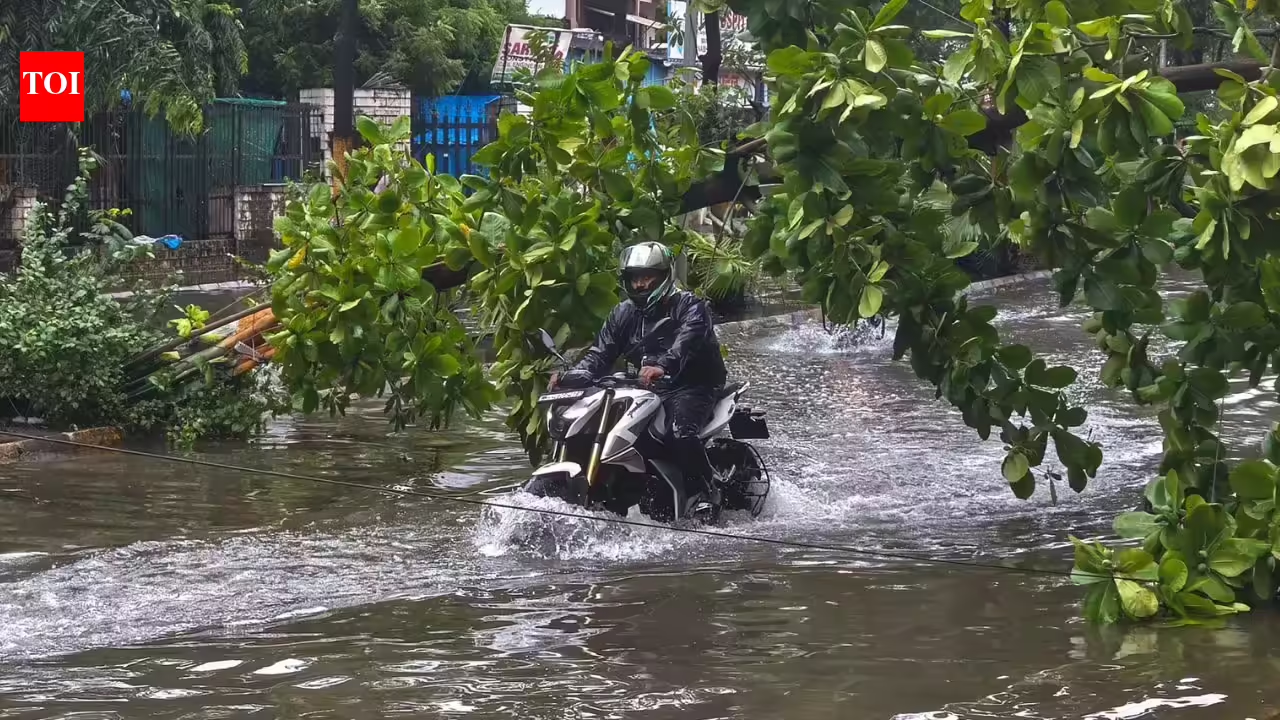
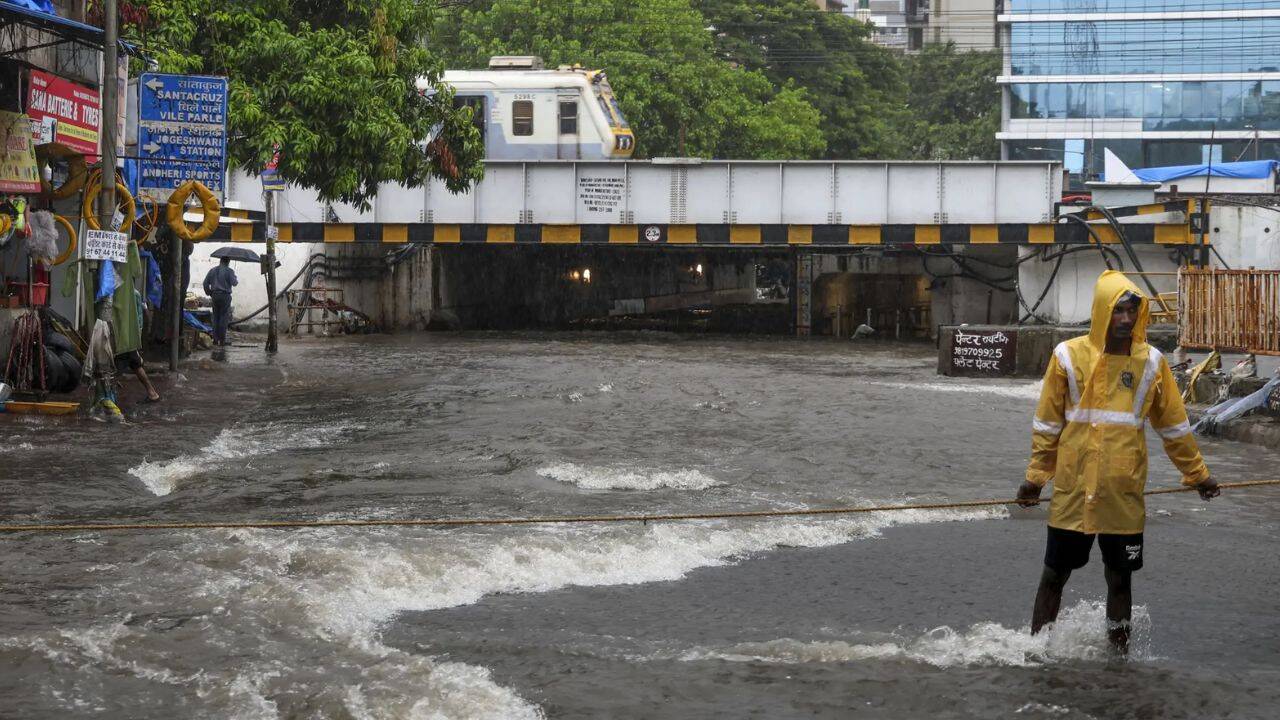
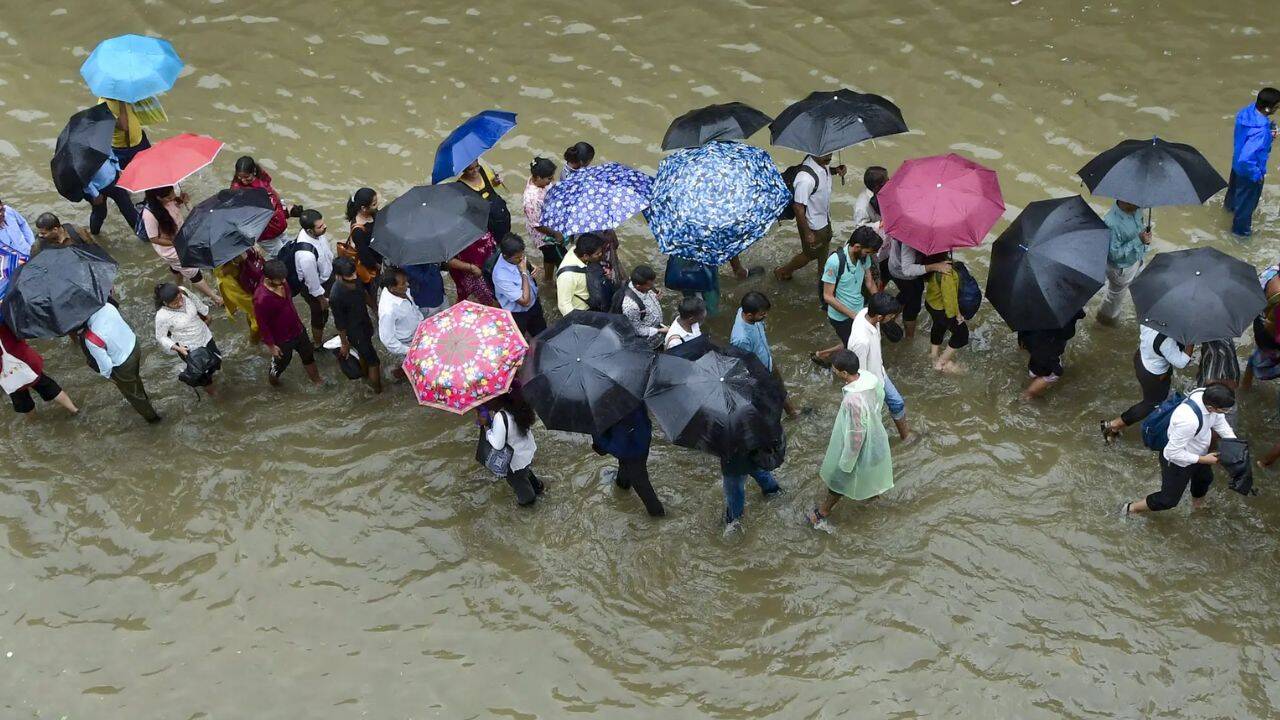
MUMBAI: Mumbai’s roads get flooded, train services get disrupted, traffic snarls and daily life come to a standstill every monsoon season. Heavy rain is the immediate trigger, but experts say it’s a combination of natural and man-made causes behind the city’s annual flooding.Because of the increased frequency of extreme rainfall events, which often take place at the same time as high tides, stormwater is less able to get out to sea. The city’s vulnerability is compounded by its low-lying geography, ageing drainage network, stressed rivers and nullahs, shrinking wetlands and mangroves and rapid urbanisation. Blocked drains, ongoing infrastructure projects and long periods of rain with strong winds are also causing widespread disruption.

Mumbai rains

Localized flooding alone can cripple Mumbai’s transport network and affect millions of commuters. This is made more difficult by the expected rise in the number of heavy rainfall events due to climate change. Here we examine 12 reasons why Mumbai continues to flood in the monsoon season and why creating a more flood-resilient city will take long-term planning, stronger infrastructure and better environmental management.1. Greater incidence of extreme rainfallMumbai has always experienced heavy monsoon rains but the intensity of rainfall is increasing over shorter durations, experts say. Even well-functioning infrastructure is hard pressed to cope when 150–300 mm falls within a few hours.2. Mumbai is a coastal city and is low-lying.Much of Mumbai is only a few meters above sea level. These low-lying areas are vulnerable to water flow and localities such as Hindmata, Sion, Kurla and Milan Subway are particularly vulnerable.3. High tides stop rainwater from draining into the seaThe storm water drains of Mumbai finally discharge into the Arabian Sea. During high tide this seawater slows or stops the outflow. When it rains hard at high tide that water stays in the city for hours.

Mumbai rain

4. Stormwater drains have a limited capacity to carryAlthough the drainage network has been upgraded over the years, many areas of the city still receive rainfall that exceeds the rate at which the system can evacuate. When the drains are full, water begins to collect on the roads.5. Rivers and natural channels under pressureImportant flood channels are Mithi River, Dahisar River, Poisar River, Oshiwara River and many nullahs. Siltation, encroachments and waste reduce their capacity to carry huge volumes of rainwater during peak monsoon.6. Wetlands and mangrove lossMangroves and wetlands once absorbed excess water and slowed runoff, acting as natural flood buffers. As urbanisation has increased, many of these natural protections have been reduced or fragmented, increasing flood risk.7. The fast growth of cities has put more pressureMumbai today has many more people, vehicles and buildings than it did a few decades ago. Infrastructure upgrades often have not kept pace with this growth, leaving many systems working under constant pressure during heavy rains.

826 trees fell in just 14 days in Mumbai

8. Blocked drains – a constant headacheStormwater drains are often clogged with plastic waste, construction debris, silt and household garbage. A modern drainage system will be useless if water can not get into it or flow through it.9. Major infrastructure projects lead to short-term headachesMetro construction, bridge works, road widening, redevelopment and utility projects are common for excavation and traffic diversions. Poor temporary water management practices during construction can change local drainage patterns.10. Trees can fall victim to high winds, and prolonged rainContinuous days of rain soften the soil, which decreases root stability. High winds could bring down trees, blocking roads, damaging vehicles and cutting power supplies.

Train services disrupted

11. Mumbai’s transport system cannot afford to be disruptedThe city is largely dependent on suburban railways and a few major arterial roads. Flooding at just a few critical spots can quickly affect trains, buses, taxis and private cars, creating cascading delays across the metropolitan region.12. Climate change increases uncertaintyMore and more scientists are linking global warming to the increasing frequency of extreme rainfall events along India’s west coast. Mumbai’s flood management may become more difficult in the coming decades with rising sea levels and changing weather patterns.

Just 6 days into July, Mumbai has already got 60% of average rainfall for entire season | Mumbai News

Just 6 days into July, Mumbai has already got 60% of average rainfall for entire season
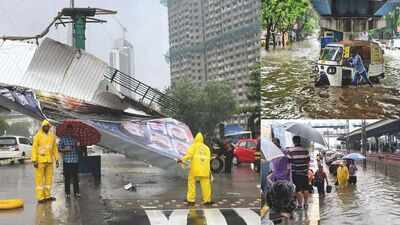
From 7-8am, high wind speeds were recorded across Mumbai areas, including 66kmph in Malabar Hill; hoarding collapses were also reported.

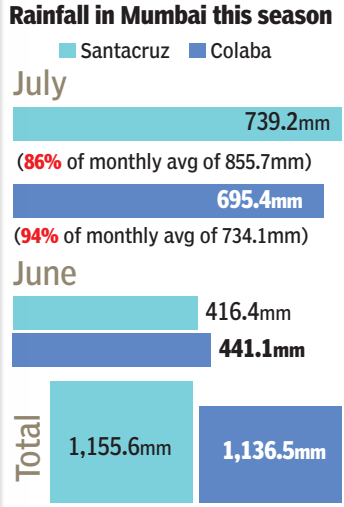
MUMBAI: In just the first six days of July, Mumbai has received more than its average rainfall for the month, with the IMD’s Colaba and Santacruz observatories recording 823.4 mm and 898.4 mm respectively. The average July rain for the two observatories is 734.1 mm and 855.7 mm.July is usually the wettest month in the year recording the highest rain, and on July 26, 2005, Mumbai’s Santacruz observatory had seen an unprecedented 944 mm of rain in a 24-hour period, which has never been met. However, the Colaba observatory logged its wettest July day in five decades between July 4-5 this year as 265. 6mm of rainfall was recorded in the area in the 24 hours ending 8.30 am Sunday.Since the onset of the monsoon, cumulative rainfall has reached 1,264.5 mm at Colaba and 1,314.8 mm at Santacruz. This means that within just the first fortnight of the season, Colaba has received nearly 60% of its average seasonal rainfall, while Santacruz has received around 57%.For Tuesday, an orange alert has been issued for Mumbai and Thane, warning of heavy to very heavy rain with strong winds. For Raigad and Palghar, a red alert stays, indicating heavy to very heavy rainfall with extremely heavy rainfall at isolated places.“Widespread rainfall activity with heavy to very heavy rainfall over a few places and extremely heavy rainfall at isolated places with strong winds reaching 70-80 kmph is very likely over Konkan and adjoining ghat areas of Madhya Maharashtra on July 6-7, with gradual reduction thereafter,” said IMD. Mumbai also recorded its sixth consecutive day of triple-digit rainfall in 24 hours ending Monday morning.The Colaba observatory logged 128 mm, while Santacruz recorded 159 mm. Rainfall from 8. 30am to 8.30 pm on Monday was 46.8 mm in Colaba and 83 mm in Santacruz. Rainfall data for the 24 hours ending July 6 also showed that areas surrounding Mumbai-including Thane, Navi Mumbai, Vasai and Palghar-got heavier rainfall than the city during the period.On Monday morning a red alert for Mumbai, Thane, Raigad and Palghar was issued by IMD for the day, stating that it was being done considering the impact of the winds. During early morning hours on Monday, between 7am and 8 am, the wind speed in Malabar Hill was 66kmph, in Reay Road 53 it was kmph, in Santacruz 49 kmph, Ghatkopar 42 kmph and Malad 47 kmph.“The active monsoon conditions over Mumbai are driven by a combination of favourable weather systems, including a persistent offshore trough from south Gujarat to the north Kerala coast, a shear zone over central India, and a depression over south Jharkhand and adjoining north interior Odisha. These systems are enhancing moisture inflow and strengthening monsoon activity along the west coast. The depression is expected to move northwestwards over next 24 hours, and its influence, coupled with the offshore trough, is likely to keep rainfall activity over Konkan coast, including Mumbai, active,” said IMD.

Mumbai monsoon mayhem: 2 trees fell every hour on average in just 14 days | Mumbai News

Mumbai monsoon mayhem: 2 trees fell every hour on average in just 14 days

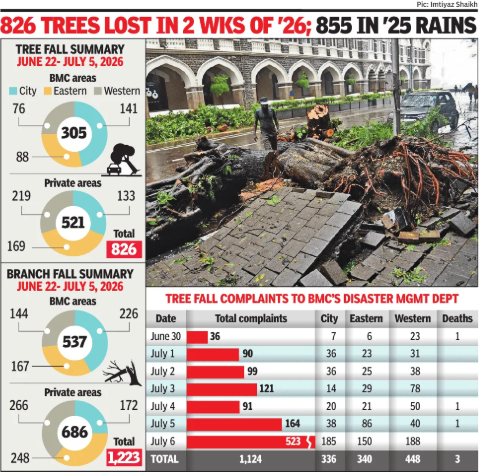
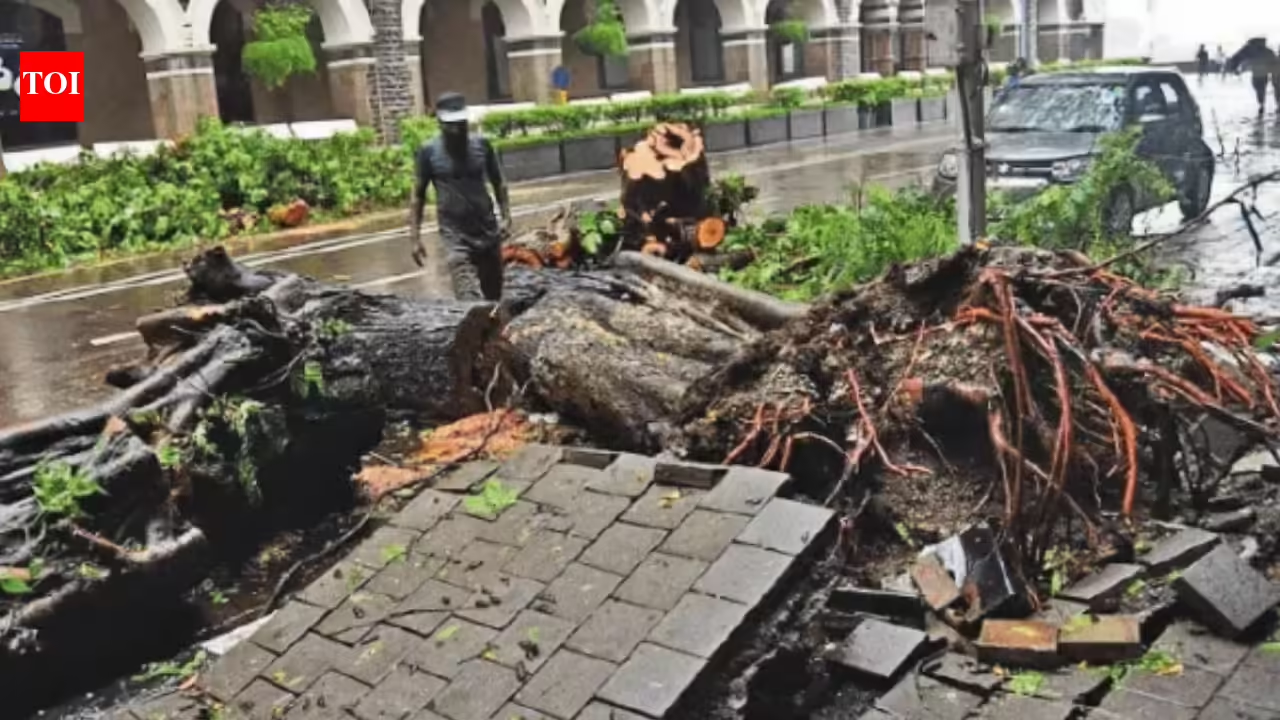
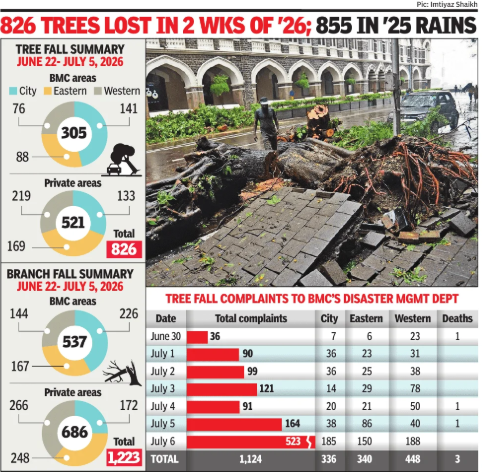
MUMBAI: Barely a fortnight into the monsoon, Mumbai has lost 826 trees—59 every day, or more than two every hour—highlighting the growing danger posed by ageing trees, infrastructure works and unusually strong monsoon winds.Even before monsoon diseases peak, Mumbai is grappling with another public safety crisis: falling trees. The problem seems acute this year compared to 2025, when 855 tree falls were recorded throughout the monsoon. In 2023 and 2024, BMC recorded 687 and 653 tree falls, respectively.In the first fortnight of rains (June 22-July 5), 305 trees on civic land and 521 on private properties fell or were uprooted. In the same period, another 1,223 tree branches crashed across the city.

Mumbai Rain

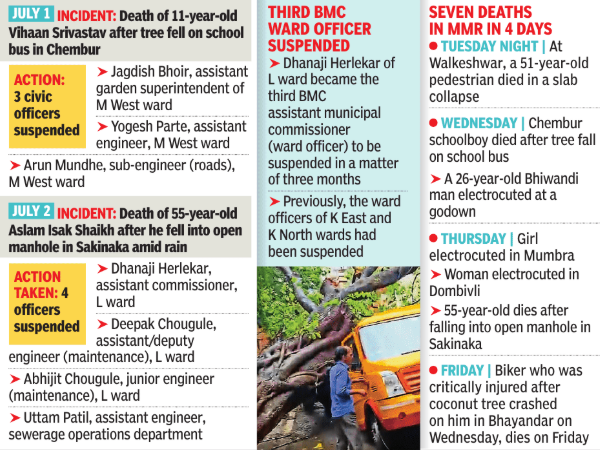
The crashes have already claimed three lives, including 11-year-old Vihaan Srivastava, who passed away on June 30 when a tree crashed onto his school van in Chembur. Two deaths were reported in the July 4-5 period.A BMC official said the preliminary inquiry into the fatal Chembur tree collapse suggested that excavation during road works may have damaged structural roots on one side of the tree. “This may have triggered internal decay that could not have been detected during routine visual inspections,” he said. With the tree dependent on roots on the opposite side for support, heavy rains and strong winds could have led to its collapse, he added.The BMC’s disaster management cell received 1,124 complaints of fallen trees and branches between June 30 and July 6. This includes 336 complaints from the island city, 340 from the eastern suburbs and 448 from the western suburbs. The numbers climbed steadily through the week before spiking to 523 complaints on July 6 alone—more than three times the previous day’s tally —as wind gusts reached 77 kmph, among the strongest recorded this monsoon.Botanist Suchandra Dutta, professor at R D National College in Bandra and founding director of Green Neev Foundation, said the increase in tree falls cannot be blamed on the monsoon alone.“Pre-monsoon tree pruning is carried out every year, but it’s often not done scientifically. At the same time, road concretisation and repeated excavation around trees weaken their root systems,” he said. Trees need adequate open soil for their roots to grow, but in many places the area around the trunk is completely concretised. “During infrastructure work, roots are often exposed and left unprotected, making trees highly vulnerable to collapse,” said Dutta.Improper pruning also creates an imbalance, with trees becoming top-heavy or lopsided. “If urban planning genuinely factored in environmental concerns, protecting existing trees would be a priority. Infrastructure work should be carried out in consultation with experts so that root systems are not damaged and unnecessary digging around trees is avoided,” Dutta added.Two decades ago, Singapore reported over 3,000 tree and branch failures a year, some of them fatal. Today, following scientific pruning, risk assessment and continuous monitoring, the annual number has fallen to around 300. In parts of Australia, tree failures leading to falling branches are recognised as a major problem, though “loss of human lives is low”.(Inputs by Malathy Iyer)

Seepage in Coastal Road tunnel; not uncommon: Officials | Mumbai News

Seepage in Coastal Road tunnel; not uncommon: Officials

Mumbai: Water leakage was detected in Coastal Road’s northbound tunnel on Sunday morning amid heavy rain. Civic authorities undertook immediate repair work. Officials said the leakage was plugged and the tunnel was safe for traffic.They said only one leakage point was identified at the interface section between the cut-and-cover portion and the tunnel on the Priyadarshini Park side. To arrest the seepage, engineers carried out pressure injection grouting using hydro-active polyurethane injection, a commonly used waterproofing technique for underground structures. The chemical reacts with water to form expanding foam, sealing the joints and preventing further ingress of water into the tunnel.Leader of opposition Kishori Pednekar visited the spot and raised concerns.Breach Candy resident Nigum Lakhani said, “On Sunday night, when I was returning from Marine Drive through the Coastal Road tunnel, I saw that water was leaking from the left side wall and a team was trying to work on it.”An official said tunnels built adjacent to water bodies cannot be made completely watertight, especially during periods of intense rainfall when hydrostatic pressure increases significantly. They said international engineering standards permit a limited amount of seepage, and isolated leakages through construction or expansion joints are not uncommon. Such seepage is continuously monitored and addressed whenever detected, they said.This was not the first instance of seepage in Coastal Road’s tunnel. In May 2024, shortly after the southbound tunnel was opened to traffic, water seepage was observed through two expansion joints. —Richa Pinto

Delivery boy killed in road crash in Mumbai after being hit by tanker | Mumbai News

Delivery boy killed in road crash in Mumbai after being hit by tanker

Mumbai: An 18-year-old delivery boy was killed after a water tanker struck him while he was making a late-night delivery in Jogeshwari (W) early Saturday.The deceased, Harsh Barnwal, was a native of Jharkhand and lived with his elder brother at Virar. Barnwal’s father had passed away, and he is survived by his mother.The fatal crash took place around 1.15 am on July 4 near Ajit Glass in Jogeshwari (W). Barnwal had reached the location on his scooter to deliver an order. Preliminary investigation revealed that he was standing at the corner of a lane and checking his mobile phone to locate the delivery address.At the same time, a water tanker steered by Ranjit Yada, entered the lane and veered towards the corner, colliding with Barnwal’s scooter. The impact caused the teenager to fall to the ground and suffer a severe head injury.Local residents and passers-by immediately rushed him to the Trauma Care Hospital, Jogeshwari (E). He was pronounced dead on admission.Following a complaint made by Barnwal’s brother, Oshiwara Police registered an FIR against the tanker driver under section 106 (causing death by negligence) and section 281 (rash or negligent driving on a public way) of the BNS.Yadav was arrested and later released on bail.

Four TET paper leak accused sent to judicial custody | Mumbai News

Four TET paper leak accused sent to judicial custody

Bhiwandi: A Bhiwandi court on Monday remanded four accused in the TET paper leak case to judicial custody after the expiry of their police remand, as the Special Investigation Team (SIT) of the Thane police continues to probe the interstate examination racket.The four accused include Suman Gupta, wife of the alleged mastermind Bijendra Gupta, who remains absconding, along with three other accused – Rajiv Shah, Akash Singh and Dhiraj Singh, arrested for the first time in the case.Suman Gupta was arrested by the SIT from her residence in Samastipur, Bihar, and brought to Bhiwandi on transit remand. Investigators suspect that she played a role in assisting her husband, who is believed to have orchestrated the paper leak network.The case came to light after Thane police arrested three accused first, Rajiv Shah, Akash Singh and Dhiraj Singh, from Bhiwandi just a day before the TET examination while trying to find customers to buy leaked papers they were carrying. During questioning, the accused allegedly revealed the name of Bijendra Gupta, mastermind of the case, from whom they got leaked papers. The disclosures led investigators to a wider interstate racket involving four states and, so far, a total of 10 accused were arrested and the remaining six accused are still under police custody.Officials said the probe is currently focused on tracing absconding mastermind Bijendra Gupta and identifying others who may have been part of the organised network responsible for leaking the Teachers Eligibility Test (TET) paper.