Koli cooking scales with cloud kitchens and big-ticket catering | Mumbai News

Koli cooking scales with cloud kitchens and big-ticket catering
Both independent chefs and collectives are driving the Koli culinary market, largely through referrals and WhatsApp marketing.

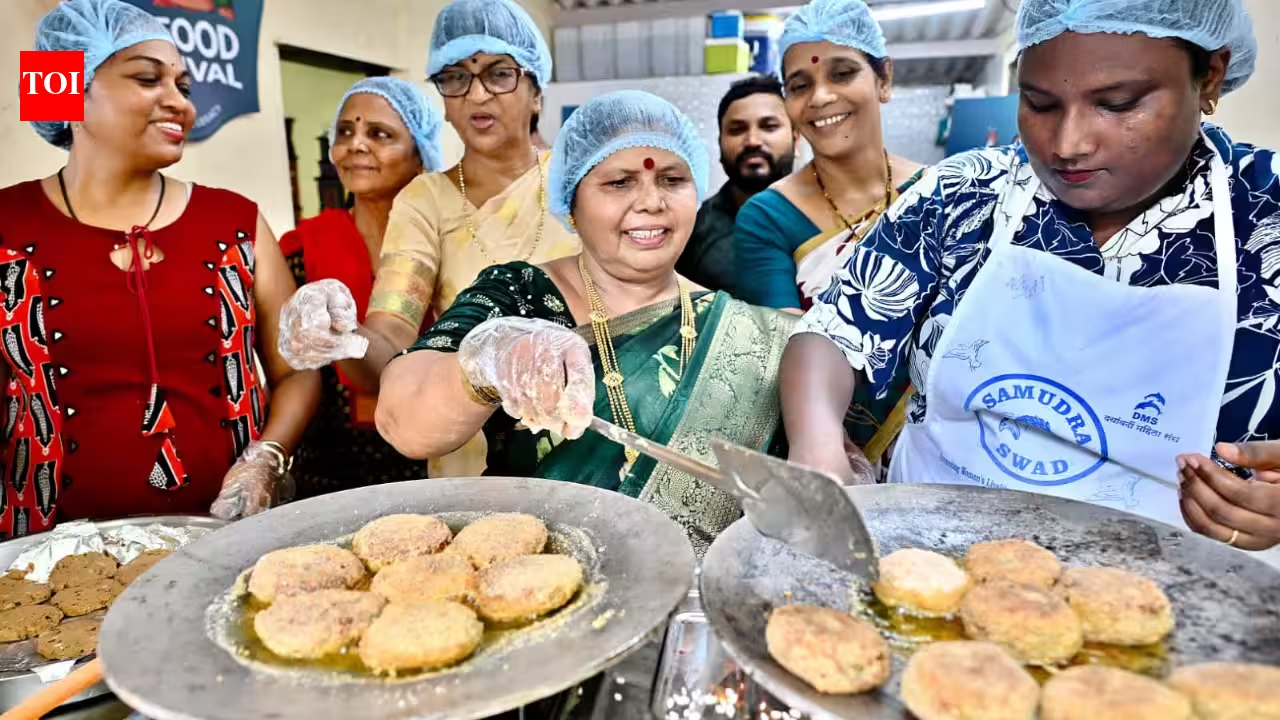
The tilapia, a freshwater fish, is far from home in a Koli kitchen. Yet on Friday, a batch of shapely tilapia patties made their way down the final stages of an assembly line — water, semolina, hot oil on the griddle — passing through Koli hands more accustomed to bangda and surmai. But customers wanted tilapia, and so tilapia it was.Metres away, the city goes about its business, oblivious to what’s cooking in Mahim Koliwada — its first cloud kitchen. It’s the newest venture from the hamlet’s home chefs, and the first permanent alternative to the neighbourhood’s seasonal seafood plaza, which runs only six to eight months a year.Set up last week by the Daryavardi Producer Company Limited (DPCL), the city’s largest women-led fish farmer producer organisation, the kitchen marks a milestone in the women’s entrepreneurial journey — from home kitchens to seafood festivals and seasonal plazas, and now full-fledged catering and delivery.In June, 12 Koli home chefs took a bus to Pune, carrying 40 kg of pomfret, surmai and prawns, commissioned to cater a 78th birthday party at Alkashray, a senior citizens’ resort in Wai, Satara. “It was my first ‘work trip’ outside Mumbai — a great experience,” says Pramila Peter of Dharavi Koliwada, who manages DPCL’s existing cloud kitchen there.The women arrived a day early, setting up base in the resort’s kitchen and live cooking stations on the grounds once celebrations began. “The theme was ‘Mee Marathi’, which made Koli cuisine an obvious choice, because we ourselves are from the Konkan,” says Mridula Musale, of the family that owns the resort. The theme ran through the clothes, games, décor, music — and the food.The menu ran the length of a shoreline: surmai fry, pomfret fry, prawn pakodas, fugias (“we hadn’t had these before,” Musale says), kelyache shikran (a banana-based dessert), modak, jawala chatpata, prawn biryani, bhakris, chapatis, veg pakodas, and chawli-vanga-batata bhaji.The home chefs cooked for 150 people. But they didn’t just cook — the Musales invited them to sell their masalas and pickles, and even join the celebrations, with the women teaching guests some of their signature dance moves. A cake was arranged for Geeta Gawde, one of DPCL’s directors, who was also celebrating her birthday that day.“The whole affair was beautiful; it felt more personal than professional,” says Musale. “The women have a big heart. It was like talking to your aunts.”For the chefs, the experience was heartwarming, but instructive too. Two tastings before the party taught them about customisation and client expectations — fish slices no thicker than a standard cell phone, for instance — and an important lesson in prep: prepare the sol kadhi closer to service.“Every large-scale event teaches us how to improve,” says Gawde, recalling losses from an earlier Pune college festival, where high-quality fish and prawns were sold in thalis priced at just Rs 150. “We took that lesson to Wai, where we first calculated the cost of ingredients, transport and labour, and only then set our price.”They’re also wising up to shifting market preferences. Bombay duck does well in Mumbai but not in Pune, where they have a growing customer base. “While our USP is authentic Koli cuisine, we go with popular dishes rather than lesser-known specialties like moongacha goda (a dessert made with whole moong) or moongri (made with rice flour, coconut water and jaggery),” Gawde says.That instinct for reading a market has been sharpened through formal training too. At the Central Institute of Fisheries Education, the women are learning product development, food safety and hygiene. Separately, last month, 30 Koli women completed a two-day crash course in project and event management at Google’s BKC office, part of its volunteer programme, with lessons in budgeting, pitching and expense tracking.Peter, who attended the Google workshop, put the lessons to work at the Dharavi kitchen. “DPCL paid the women Rs 100 an hour for chapatis, but output varied — some made them faster but earned the same. We then decided to pay a fixed wage per batch of 50, which improved output and performance,” she says.Unlike the newly launched Mahim kitchen, which will serve lunch and dinner meals of gravies, bhakri, rice and fried fish, the Dharavi centre focuses on lighter fare — poha, upma, puri bhaji, bhakris and rotis. The rotis and bhakris are sold to restaurants, while the meals go to the Maithili Samajik Trust, an NGO that feeds families of patients at Sion and Tata Memorial hospitals.DPCL’s collectives aren’t the only ones cashing in on the demand for Koli food. Independent home chefs are building parallel businesses too. “Entrepreneurship is in our blood,” says Vaishali Gajanand Balasathi, a Koli fisher from Khar Danda, who cooks to order for customers who want their catch done the Koli way, or don’t know how to cook it themselves — squid or crab, for instance. Orders she can’t manage go to her sister-in-law Akshata Chimbaikar, whose stuffed crab, lobster and coconut-stuffed prawns have drawn a loyal clientele for parties and weekend meals.Both independent chefs and collectives are driving the Koli culinary market, largely through referrals and WhatsApp marketing. Next month, DPCL customers will also be able to order meals through its app, Samudra Swad.“The women are ready to take on large orders; they’re just seeking better market integration,” says Amrita Sharma, a market consultant working with DPCL to study the business models of successful Mumbai home chefs outside the Koli community, so those lessons can be passed on to the Kolis. “One takeaway was that social media platforms like Instagram should be leveraged, rather than food delivery apps like Swiggy and Zomato, to build loyalty.”Building loyalty with customers shouldn’t be hard for the community. The Mahim cloud kitchen has already secured an order for 800 fish cutlets — even before their burners were rigged up and the fish netted.


Security guard found dead at under-construction project site in Maharashtra | Mumbai News

Security guard found dead at under-construction project site in Maharashtra

Thane: A 60-year-old security guard was found dead on Sunday in the open basement area of an under-construction project in Thane, police said.The deceased has been identified as Ashok Salunkhe who was working as a contract security guard at SATIS-2 project site.Station Area Traffic Improvement Scheme (SATIS-2) project in Thane (East) is a multimodal transit initiative by the municipal corporation designed to declog station-area traffic, separate pedestrian and vehicular movement, and build a massive multi-tier public transport deck.Salunkhe had completed his usual shift from 8 am to 8 pm on Saturday but failed to return home in Kopri. Following an overnight search, his family members located his body on Sunday morning in the project’s basement area and immediately informed the Kopri Police.A preliminary investigation and eyewitnesses’ accounts indicate visible signs of severe physical assault on the body, along with a severed finger, a police officer said, adding that the exact cause of death will be confirmed once the autopsy report is received.He said police are examining whether Salunkhe was attacked during an altercation with trespassers or intoxicated individuals and scanning CCTV camera footage.

Panvel-Karjat corridor nears completion, MRVC accelerates Mumbai rail upgrades | Mumbai News

Panvel-Karjat corridor nears completion, MRVC accelerates Mumbai rail upgrades
Significant progress was also recorded under the Virar–Dahanu Road Quadrupling Project, said an MRVC official

Mumbai: The Mumbai Railway Vikas Corporation (MRVC) has achieved a series of significant infrastructure milestones across key suburban rail projects in the past one month, reinforcing momentum on capacity enhancement and passenger-focused improvements across the Mumbai Metropolitan Region, a senior official said on Sunday. A standout achievement was the rapid progress on the Panvel–Karjat New Suburban Corridor, which is now nearing completion.Commenting on the corridor, the official said: “During July, subways at Chikhale and Mohape were completed, while road over-bridges (ROBs) were opened for local residents. Cabling works in Tunnel-1 and Tunnel-3 were also completed. Electrification activities gathered pace, with 4km each of OHE catenary and contact wire laying and 32 km of dropping wire installation completed.”The corridor is expected to be ready for inspection by the Commissioner of Railway Safety (CRS) by the end of 2026.An official said that significant progress was also recorded under the Virar–Dahanu Road Quadrupling Project. An ROB in the Vangaon–Dahanu section and a minor bridge were completed. At Kelve Road station, Phase-I signalling and telecommunication works, automatic signalling between Saphale and Kelve Road, and new electronic interlocking systems were successfully commissioned, enhancing safety and operational reliability.“Under the Borivli–Virar 5th and 6th Lines Project, MRVC secured possession of 1.81 hectares of land at Bhayandar and completed staff quarters at Vasai Road and Bhayander. Passenger convenience received a major boost through station improvement projects,” said a senior spokesperson.Elevated decks at Kandivli and Mira Road have been handed over to Western Railway, while new facilities have been commissioned at Mankhurd and Ghatkopar, strengthening passenger circulation and Metro connectivity.MRVC also carried out extensive girder-launching operations at Dombivli, Dahisar, Virar, Bhayandar and Nallasopara, advancing critical skywalk, foot overbridge and elevated deck projects.The Maharashtra cabinet had recently approved a substantial strengthening of MRVC’s financial base by increasing its authorised share capital from Rs 25 crore to Rs 500 crore and paid-up capital from Rs 25 crore to Rs 225 crore. The move is expected to bolster the corporation’s ability to execute large-scale suburban railway infrastructure projects under the Mumbai Urban Transport Project (MUTP).The corporation was additionally honoured with the “Utkrisht Nishpadan Puraskar” by NARAKAS Mumbai for excellence in implementing the Official Language Policy.The achievements underscore MRVC’s sustained push towards expanding suburban rail capacity, improving commuter amenities and delivering transformative transport infrastructure for Mumbai.

Save Neville D’Souza ground, urges Mumbai’s football fraternity; Bombay high court may hear writ plea today | Mumbai News

Save Neville D’Souza ground, urges Mumbai’s football fraternity; Bombay high court may hear writ plea today
The Mumbai Football Association held a peaceful protest at Neville D’Souza Football Ground on Sunday evening

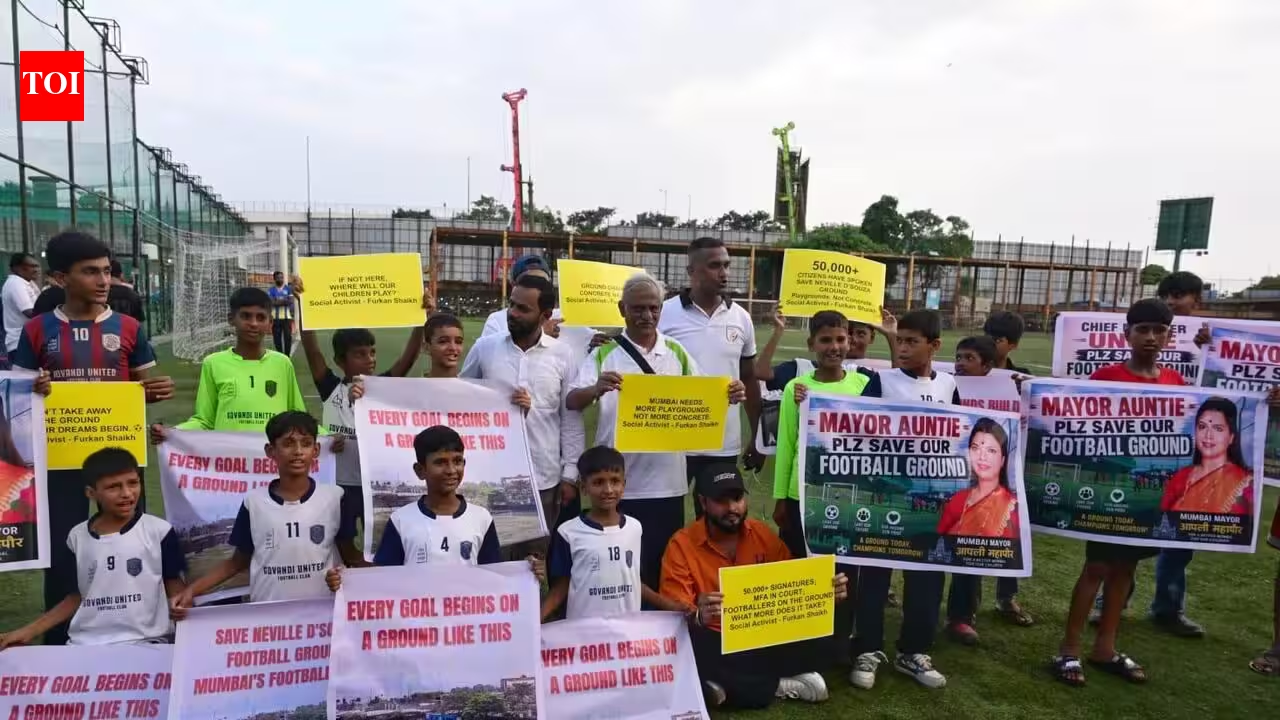
Mumbai: On Sunday evening, the city’s football fraternity gathered for a peaceful protest at Neville D’Souza Football Ground at Bandra Reclamation to oppose the proposed change in the plot’s reservation from a playground to an exhibition-and-convention centre.The Mumbai Football Association’s (MFA) writ petition before the Chief Justice’s bench of the Bombay high court challenging the proposed change in reservation is likely to come up for a hearing on Monday, even as the controversial proposal — already cleared by BMC’s improvements committee in June — is scheduled to be placed before the civic house of corporators for a sanction this week.The MFA has maintained and used the ground for organised football for more than 15 years under periodically renewed permissions from Mhada. Its application, dated July 31, 2025, seeking continuation of the permission, is still pending, the writ petition stated.“We are doing everything we can to stop this change in reservation,” said Ryan Menezes, vice president of MFA which organised the peaceful protest. “Sunday evening was an attempt to gather different stakeholders like our club members, team owners, former players, and coaches and create awareness on what is likely to happen if this reservation changes. We will fight till the last moment for this ground that means so much to everyone in the football community. We can’t allow the reservation to be changed just like that.”The controversy centres around the Mhada-owned plot, which is currently reserved as a playground/sports ground under the Development Plan (DP) 2034. Mhada has sought restoration of the site’s earlier reservation as a convention complex, prompting the BMC to initiate the process for modifying the existing reservation.Named after Neville D’Souza, the first Indian footballer to score a hat-trick at the Olympic Games, the ground has long been a hub for grassroots coaching, school tournaments, local leagues and competitive football.

Gas cylinder-laden truck hits bike in Nalasopara, rider killed, another injured | Mumbai News

Gas cylinder-laden truck hits bike in Nalasopara, rider killed, another injured

Vasai: A motorcycle rider was killed and another person injured after their bike was hit by a truck carrying LPG cylinders near Martin Complex in the Achole police station area on Sunday afternoon.The accident took place around 1 pm when the motorcycle, ridden by Krishna Vishwakarma, was travelling towards Vasai Link Road. As the bike reached near Martin Complex, a Bharat Gas cylinder-laden truck allegedly rammed into it.The impact caused the motorcycle to come under the truck, resulting in Vishwakarma’s death. Another person travelling on the bike sustained injuries and was rushed for medical treatment.Police, with the help of local residents, detained the truck driver and subsequently arrested him. The Achole police are investigating the incident.

Rain to continue across Mumbai Metropolitan Region this week | Mumbai News

Rain to continue across Mumbai Metropolitan Region this week
For Mumbai, the IMD has forecast moderate rain on Monday, followed by light rain on Tuesday, Wednesday and Thursday

Mumbai: Rainfall is likely to continue across the Mumbai Metropolitan Region through this week, with the city expected to see moderate rain on Monday before the intensity eases to light showers from Tuesday, according to the India Meteorological Department’s (IMD) latest five-day forecast. The probability of rain has been classified as “very likely” across the region throughout the forecast period.For Mumbai, the IMD has forecast moderate rain on Monday, followed by light rain on Tuesday, Wednesday and Thursday. The forecast does not indicate any heavy rainfall for the city during the period.Thane is expected to receive moderate rain on Monday, followed by light to moderate rainfall from Tuesday through Thursday. Palghar is likely to see light to moderate rain and thundershowers on Monday and Tuesday, followed by light to moderate rain on Wednesday and light rain on Thursday.Raigad district, including Navi Mumbai, is likely to remain wetter, with moderate rain forecast on Monday, Tuesday and Wednesday before easing to light to moderate rain on Thursday. The probability of rainfall remains “very likely” throughout the five-day forecast for the district.The forecast comes as parts of the wider Konkan region remain under a more active monsoon spell. The IMD has warned that heavy rainfall, when it occurs, can cause localised flooding in low-lying and urban areas, disruption to transport and rough sea conditions along the Konkan coast.

Filmmaker Shakeel Noorani held for rape, blackmail of aspiring actress | Mumbai News

Filmmaker Shakeel Noorani held for rape, blackmail of aspiring actress
Shakeel Noorani is in police custody till Aug 12

Mumbai: Producer-director Shakeel Noorani (73) was arrested on Saturday from a Mahabaleshwar farmhouse after being on the run for 40 days for allegedly raping an aspiring actress repeatedly over the last four years, threatening to release videos of the assault and inducing a miscarriage.Malwani police produced him before a court, which remanded in police custody till Aug 12.Sections 64(2)(M) (rape), 123 (causing hurt by means of poison), 351(2) (criminal intimidation) and 88 (causing miscarriage) of BNS have been invoked against him.In her complaint, the woman said, Noorani, who is also a scriptwriter, called her to his Malwani residence four years ago under the pretext of discussing a film script, spiked her drink and raped her. She said she lost consciousness and when she came to, he allegedly showed her a video on his phone of the sexual assault and allegedly threatened to circulate it if she approached police or confided in her family. She alleged Noorani subsequently used the video to threaten her and rape her on multiple occasions. She also alleged that he repeatedly gave her contraceptive pills following the alleged sexual assaults.“He went into hiding after the FIR was filed 40 days ago. A police team even searched his son’s house in Lokhandwala, Andheri, but there was no trace of him. Using technical assistance, we traced him to a farmhouse in Medha, Satara district. Our counterparts from Medha police station detained him. Our team then took his custody,” said a Malwani police officer.DCP (zone 2) Sandip Ghuge said the police team had been gathering details since the complaint was filed.Noorani’s lawyer, Vikas Singh Goar, told TOI that he was falsely implicated and refused to offer more comments as the matter is in court.Noorani’s films include ‘Vishnu Devaa’ (1991), ‘Shreeman Aashique‘ (1993), ‘Bade Dilwala‘ (1999), and ‘Joru Ka Ghulam’ (2000).

Central Railway Achieves Record ₹202 Crore Scrap Sale Revenue | Mumbai News

Central Railway Achieves Record ₹202 Crore Scrap Sale Revenue

Mumbai: Central Railway (CR) on Sunday announced that it has achieved a major milestone in resource management and revenue generation, recording its highest-ever scrap sale revenue of Rs 202 crore up to August 5, 2026, marking a sharp 76.94 % increase over the corresponding period of the previous financial year.The achievement is particularly significant as it represents the fastest-ever crossing of the Rs 200 crore mark in scrap sales in Central Railway’s history, underscoring the organisation’s sustained efforts towards efficient asset management, financial prudence and operational excellence.According to railway officials, the record revenue was generated through the systematic identification, segregation and disposal of obsolete materials and unserviceable assets across various divisions and depots. The disposed items included substantial quantities of railway infrastructure and rolling stock scrap, helping convert idle inventory into valuable financial resources.Among the major commodities sold were 17,755 metric tonnes of rail permanent-way scrap, 1,21,381 sleepers, 11,658 metric tonnes of ferrous scrap, and 1,370 metric tonnes of non-ferrous scrap. Central Railway also disposed of 11 locomotives, 33 coaches and 33 wagons, contributing significantly to the record-breaking revenue figures.All divisions and production units played a crucial role in achieving the milestone. The Mumbai Division emerged as the highest contributor among operational divisions with scrap sales worth Rs 36.78 crore, followed by Bhusaval Division at Rs 33.19 crore, Pune Division at Rs 27.22 crore, Nagpur Division at Rs 26.12 crore, and Solapur Division at Rs 10.85 crore. Production units and workshops together generated Rs 68.39 crore, taking the total revenue to Rs 202.55 crore.Railway officials attributed the success to the ongoing “Zero Scrap Status” initiative, under which intensive drives are being conducted to clear accumulated scrap and optimise inventory management across the network. The programme aims to eliminate redundant material, free up valuable space and ensure timely disposal of outdated assets through transparent and scientific processes.Beyond the financial gains, the initiative is expected to deliver environmental benefits by promoting recycling and responsible waste management practices. Central Railway said the achievement reflects its continued commitment to the Zero Scrap Mission, while strengthening operational efficiency, sustainability and effective utilisation of public resources.The record performance sets a new benchmark for the zone and highlights its focus on transforming unused assets into productive revenue streams while supporting modernisation efforts across the railway network.

Footpaths barricaded and turned into private properties, complain residents of Powai in Mumbai | Mumbai News

Footpaths barricaded and turned into private properties, complain residents of Powai in Mumbai
At the centre of a controversy is Citipark on the main Central Avenue where residents said that the new project has taken over the broad pavements adjoining its property and has now barricaded a long stretch

Mumbai: Residents of Powai’s Hiranandani Gardens have complained that public footpaths, which have existed since the township was built, have been barricaded by new redevelopment building projects and turned into private properties.At the centre of a controversy is Citipark on the main Central Avenue where citizens said that the new project has taken over the broad pavements adjoining its property and has now barricaded a long stretch. The new property is being redeveloped by Brookfield.Brookfield, now BGRE, however, maintains that the pavement in question forms part of its property. “All works are being undertaken in accordance with the requisite statutory approvals,” said a spokesperson of BGRE.But residents contend that if the land on which people have walked for decades is indeed privately owned, how was Central Avenue, one of Powai’s busiest commercial streets, approved without provision of public footpaths?In an email sent to municipal authorities on August 7, Powai Action Forum member Ratan Sharda said residents had been told that municipal records showed the pavement outside Citipark is a part of Brookfield’s property. Additionally, he alleged that flowerpots had also been placed on the pavement on the opposite side of the road and that residents were informed that walkway too belonged to Brookfield.“Does it mean that the BMC passed this crucial commercial street without any footpaths on either side?” Sharda asked in the letter. He pointed out that residents had been using the pavements for at least 25 years and questioned whether the BMC could have sanctioned the layout of the township’s commercial street without providing pedestrian space.Debi Goenka, an environmentalist, demanded that whilst as per Supreme Court’s order, the BMC needs to construct pavements on both sides of every road for pedestrians, this was a situation where existing pavements were being taken away and pedestrians forced to walk on the road.In a separate representation addressed to municipal commissioner Ashwini Bhide, members of the Powai Advanced Locality Management (ALM) Pamela Cheema cited that the pavement outside Citipark had been barricaded, leaving no space for pedestrians; that the footpath outside Ambrosia was completely obstructed; and that the pavement adjoining the Lakepoint project had also been barricaded too. They have asked the civic body to restore these stretches for pedestrian use.“We also need the BMC and the MMRDA to have a public meeting with the residents and clarify the details of the plans approved by them,” added Goenka. “In the interim, in conformity with the orders of the Supreme Court regarding road safety, the BMC must direct the builders to immediately restore the pavements to the public.”

BMC plans to give 13-inch tablets to all 237 corporators in Mumbai to access agendas and documents; opposition criticises move | Mumbai News

BMC plans to give 13-inch tablets to all 237 corporators in Mumbai to access agendas and documents; opposition criticises move
Physical copies of BMC meeting agendas and proposals will, however, continue to be circulated during the transition towards a paperless system, BJP group leader in the BMC Ganesh Khankar said

Mumbai: The BMC has proposed to provide 13-inch tablets to all 237 corporators, including the 10 nominated members, as part of its initiative to digitise the functioning of the civic House and its statutory committees. Physical copies of meeting agendas and proposals will, however, continue to be circulated during the transition, with the civic administration not planning to discontinue them immediately.The proposal, mooted by the ruling BJP in the BMC, has drawn criticism from the opposition. Shiv Sena (UBT) leader and former Mumbai mayor Kishori Pednekar questioned the need to purchase separate devices when most corporators already have smartphones. “Almost every corporator today has a smartphone. The municipal agenda can very easily be accessed on their phones. There is no need to spend taxpayers’ money on purchasing separate tablets,” she pointed out.BJP group leader in the BMC Ganesh Khankar said the initiative was aimed at gradually moving municipal proceedings towards a paperless system. The tablets will allow corporators to access agendas, proposals and related documents for the civic House and various committee meetings digitally.“At present, many corporators are digitally savvy and would prefer receiving the agenda online rather than physical copies being delivered to their homes. But this does not mean that physical copies will be discontinued immediately. There may still be corporators who are not comfortable with digital platforms and may need physical copies,” he said.The BMC is also exploring the use of technology during civic House proceedings. Khankar said efforts were being made to introduce a voice-to-text system in the civic House so that speeches made by corporators during proceedings could simultaneously be converted into text. “If a corporator speaks during a House meeting, a text version of the speech should also be generated. Work is being done to explore such a proposal,” he said.BMC currently prints and distributes voluminous documents for the monthly civic House meetings as well as meetings of various statutory and special committees. These include standing committee, education committee, improvements committee, ward committees, works committee (City), works committee (Suburbs), women and child welfare committee, law and revenue committee, and health committee, among others.Several proposals run into hundreds of pages, resulting in substantial expenditure on paper, printing, transportation and distribution.A dedicated application is proposed for the tablets, through which corporators will be able to access agendas and supporting documents. Each proposal will be accessible using a designated code number.Khankar said the shift to a completely digital system would have to be gradual. “The Shiv Sena (UBT), when in power in BMC, had given laptops to all corporators, so why is it criticising our move now?” He said providing tablets to corporators is an important step towards familiarising the elected wing with digital tools and eventually enabling paperless functioning.In her party’s defence, Pednekar said the situation was different when Sena (UBT) was in power in the BMC. “At that time, smartphones were not as common as they are today. Therefore, laptops were provided. But now almost everyone has a smartphone, and the municipal agenda can be accessed easily on it,” she said. Pednekar questioned whether spending public money on another electronic device was justified when the stated objective was simply to make civic documents available digitally.