

Bar Council of India directive: Maharashtra orders inspection of law colleges in 6 weeks | Mumbai News

Bar Council of India directive: Maharashtra orders inspection of law colleges in 6 weeks

Mumbai: State govt has directed all public universities to carry out an immediate and in-depth physical inspection of every law college affiliated to them and submit a detailed report to Bar Council of India (BCI) within six weeks. The state’s directive follows BCI’s order which took serious cognisance of Supreme Court’s oral observations while hearing a petition regarding the deteriorating quality of legal education in the country. The apex court observed that the legal education centres were operating with inadequate facilities and without meeting the prescribed standards.In a letter to the universities, BCI mentioned that the SC observations “underscore the immediate need for every authority in the statutory and academic chain to discharge its own continuing responsibility with complete seriousness”. Mentioning that the universities’ responsibilities do not end with the initial grant of affiliation and that they should ensure that colleges do not merely run on the strength of paper compliance, it has sought a report on every affiliated college within six weeks.Universities have been directed to constitute one or more competent inspection teams to carry out immediate physical inspection of law colleges. The teams have been tasked with verifying the availability of faculty members, adequate classrooms, libraries, reading rooms, journals, law reports, electronic databases, land and building infrastructure, fire and safety compliance, sanitation facilities, legal aid clinics, and other essential requirements. They have also been instructed to notify BCI of any colleges found to have made false declarations, fabricated faculty records, submitted misleading photographs, shifted their premises without approval, or admitted students in excess of the permitted intake.BCI has directed the universities to submit a consolidated report by classifying institutions as fully compliant, deficient but capable of immediate correction without affecting academic standards and seriously deficient requiring suspension, non-renewal or withdrawal of affiliation.Prior to this, state govt and Mumbai University had initiated separate action against colleges that failed to comply with the prescribed norms. While the state took action against 103 colleges that did not have BCI recognition, the university reduced the intake capacity of 50 colleges by up to 50% and imposed fines of up to Rs 10 lakh for failing to appoint approved teachers.
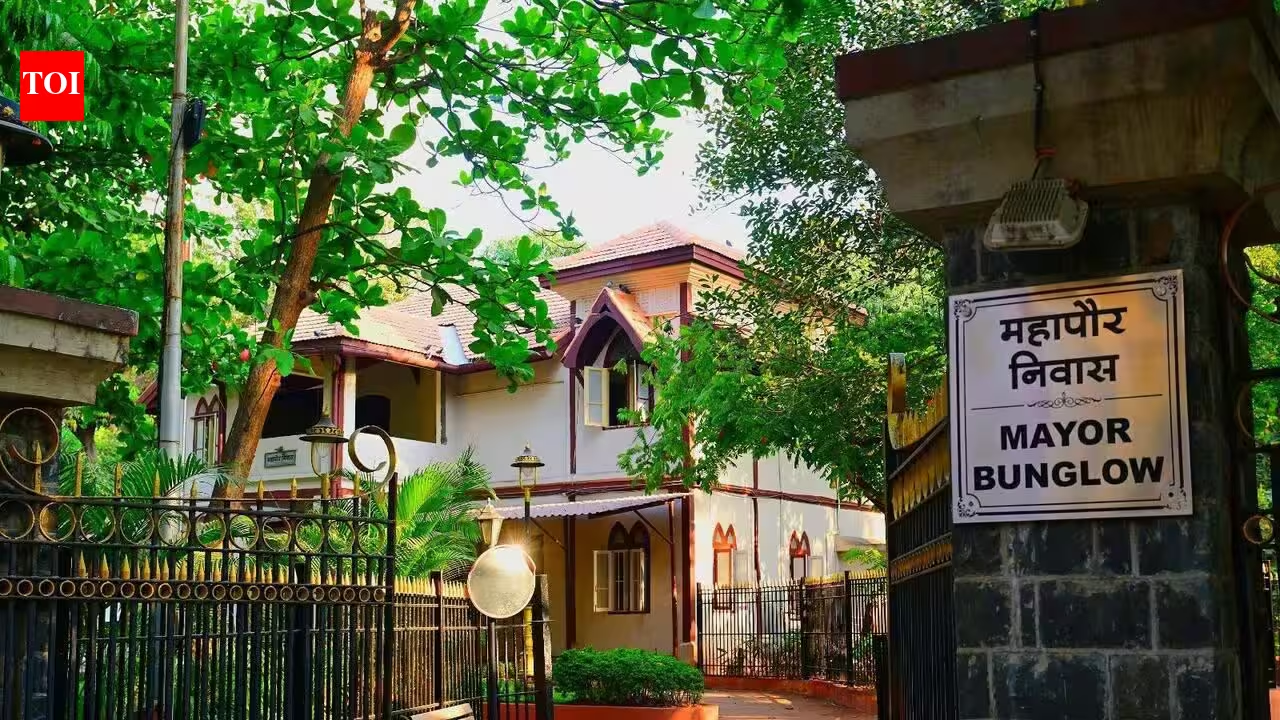
Didn’t ask for Rs 2.9cr bungalow revamp: Mumbai mayor amid uproar; tender cancelled | Mumbai News

Didn’t ask for Rs 2.9cr bungalow revamp: Mumbai mayor amid uproar; tender cancelled
The plan to install bio-absorbent sound barriers along the road bordering the bungalow premises was particularly panned

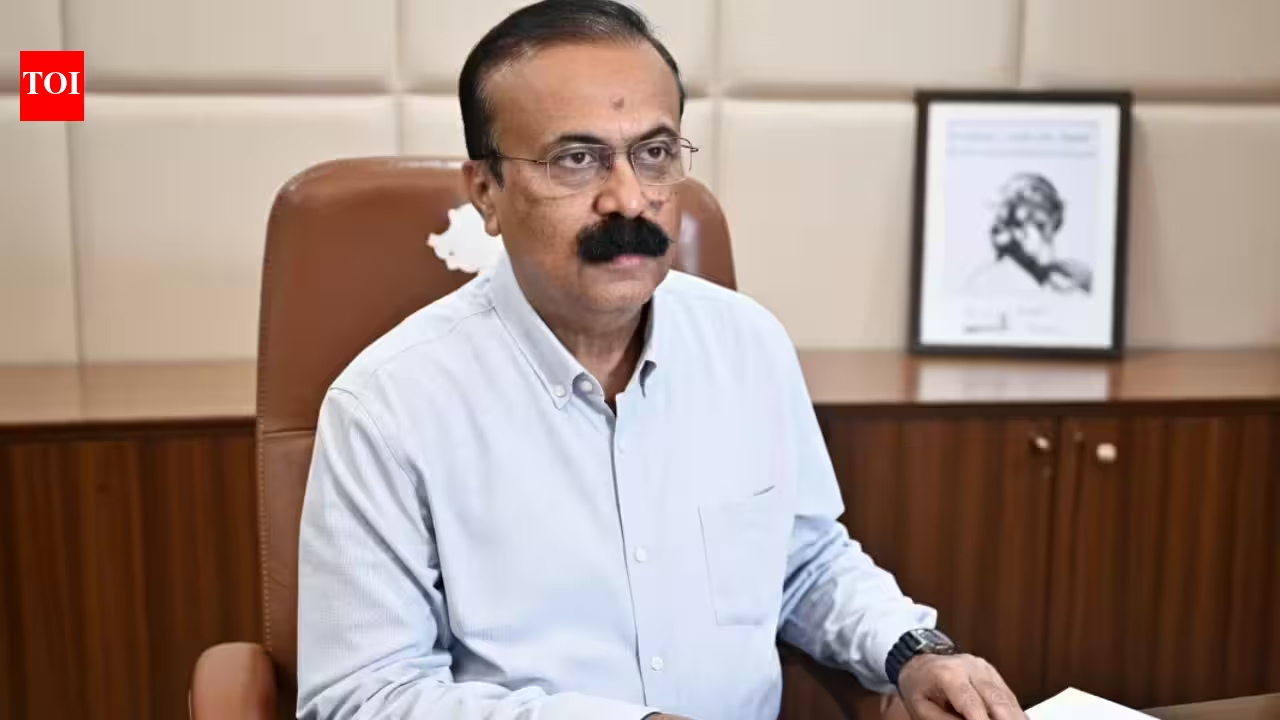
Mumbai: Hours after TOI’s report on Wednesday that the premises housing her official residence—a heritage bungalow in Byculla zoo—was set to undergo a revamp at Rs 2.9 crore within four months of a Rs 2.4-crore facelift, the BMC administration cancelled the tender and mayor Ritu Tawde distanced herself from it.The move came on the heels of massive public and political outrage, particularly over the plan to install bio-absorbent sound barriers along E S Patanwala Road bordering the premises.Earlier in the day, Tawde sought that the work be stayed. By evening, the zoo director’s department, which had floated the tender, proposed its cancellation and the civic administration accepted it.Tawde, who is also a BJP corporator, asserted that she had no connection with the tender and accused Shiv Sena (UBT) of spinning a “fake narrative”. “I have been staying at the mayor’s bungalow only for one-and-a-half months. I never asked for any upgrade. Mumbaikars are intelligent and will not believe such lies,” she said.Sources said city BJP chief Ameet Satam took cognisance of the matter, which led to Tawde seeking the tender’s cancellation and her office issuing a statement on the controversy. “The works mentioned in the tender are not for the mayor’s residence but for the surrounding areas and the zoo premises as a whole. The mayor has no knowledge of the tender, nor was there any reason for the mayor to be aware of it. The mayor has also not requested any of the proposed works,” said the statement.Opposition parties, however, weren’t convinced. Former mayor Kishori Pednekar from Shiv Sena (UBT) questioned how any work at the mayor’s official residence could have been proposed without her knowledge or consent. “It is impossible for such an upgrade to be undertaken without the mayor being aware of it,” she said.Targeting BJP, Shiv Sena (UBT) MLA Aaditya Thackeray alleged that public money was being spent on the mayor’s “whims”. In a post on X, he criticised the proposed facelift, questioned the need for sound barriers in an otherwise quiet locality and alleged that BMC was prioritising such expenditure while “handing over Mumbai’s open spaces to private hands”.Congress’s leader in BMC Ashraf Azmi called the planned renovation a waste of taxpayers’ money.Criticism also came from Shiv Sena, BJP’s ally in BMC. Amey Ghole, Shiv Sena’s group leader in the civic House, sought action against the zoo department for proposing the work without the mayor’s consent.Besides the sound barriers, the renovation involved relaying interlocking concrete pavers after laying sewer, stormwater drainage and utility lines, construction of underground and overhead water tanks, renovation of rooms for domestic and security staffers, and fabrication and installation of container-based structures to house a conference hall, according to the tender, which was floated on July 31.

Central Railway ticket collector carries injured passenger to safety at Mumbai’s Dombivli station | Mumbai News

Central Railway ticket collector carries injured passenger to safety at Mumbai's Dombivli station
A Central Railway ticket collector assisted an injured passenger at Dombivli station

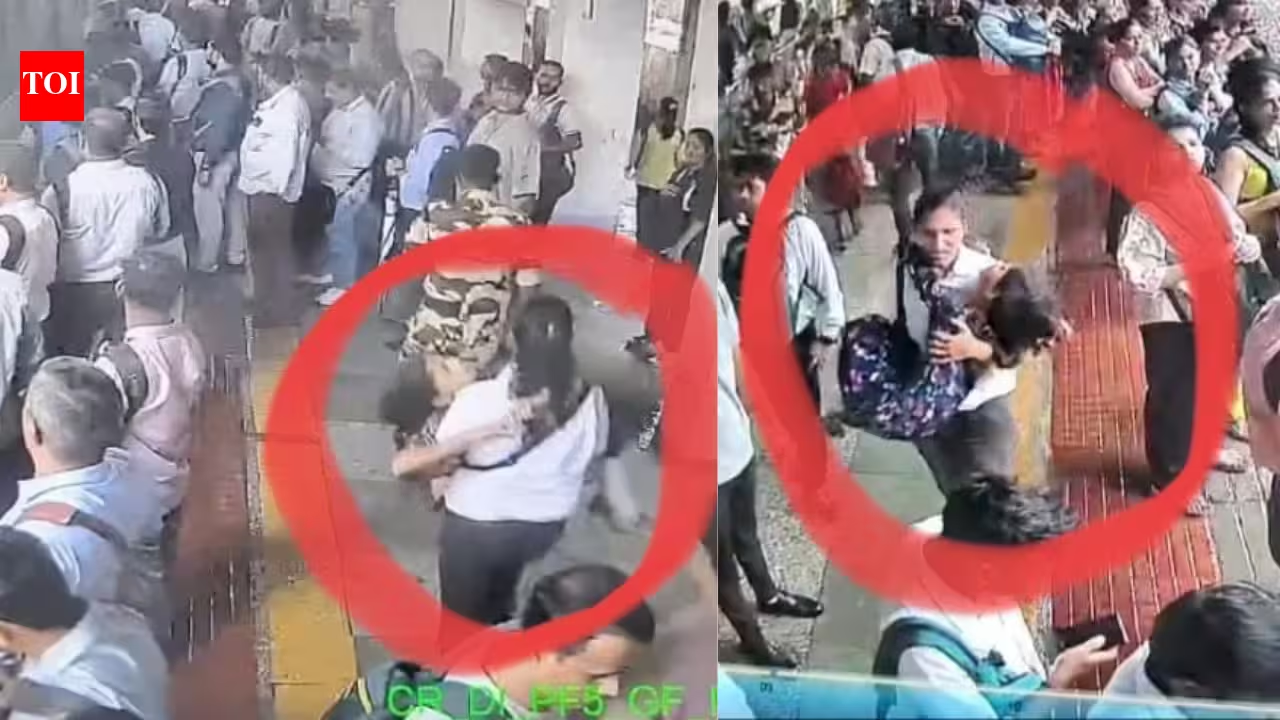
MUMBAI: A Central Railway ticket collector carried an injured passenger to safety after she fell while alighting from a train at Dombivli station on Wednesday, ensuring she received immediate medical attention.The incident occurred on Platform No. 5 when 23-year-old Pooja lost her balance after getting off a train. In the rush of commuters, several passengers inadvertently stumbled over her, leaving her injured and unable to get back on her feet.Vrushali Sawant Jadhav, Head Ticket Collector at Dombivli, who was on duty at the time, rushed to assist the woman.She alerted the station announcer to arrange for a licensed porter but, realising that the passenger required urgent medical attention, decided not to wait.Jadhav lifted the injured passenger in her arms and carried her to the Station Manager’s office, from where she was taken to a nearby hospital for treatment.Central Railway said Jadhav’s prompt response ensured that the passenger received timely medical care and appreciated her presence of mind and commitment to passenger safety.The railway administration appealed to commuters to exercise caution while boarding and alighting from trains and urged them to allow passengers to get off before attempting to board.It also reiterated its commitment to passenger safety and acknowledged the efforts of frontline staff who assist passengers during emergencies.

Kalwa Youth Fined for Performing Dangerous Train Stunt for Social Media Reel | Mumbai News

Kalwa Youth Fined for Performing Dangerous Train Stunt for Social Media Reel

Thane: A 22-year-old youth from Kalwa was fined by the Railway Court in Kalyan on Wednesday after he was caught performing dangerous stunts aboard a moving suburban train and uploading the video on social media.The accused, identified as Mohammad Khurshid, was seen performing the stunt on a moving suburban train at Platform No. 1 of Kalwa railway station on August 2. The video later went viral on social media, prompting the Railway Protection Force (RPF) to launch a search operation in the Kalwa-Mumbra area.The RPF tracked Khurshid to his residence in Kalwa East on Tuesday and registered a case against him at the RPF Post, Mumbra, under Sections 145, 154 and 156 of the Railways Act. He appeared before the Railway Court in Kalyan on Wednesday, which imposed a fine and released him with a warning.Central Railway said performing stunts on moving trains, footboards or rooftops can lead to fatal accidents, including electrocution, falls and collisions and appealed commuters to avoid such acts. It warned that such acts are punishable under the Railways Act and that videos posted online often encourage others to imitate the dangerous behaviour.Passengers have been urged to report such incidents by calling Railway Helpline 139 or informing the nearest Railway Protection Force (RPF) or Government Railway Police (GRP) personnel. Central Railway said it is conducting regular enforcement drives and monitoring social media to identify and take action against offenders.

NRI home selloff may widen choices for buyers, not weaken realty market: Report | Mumbai News

NRI home selloff may widen choices for buyers, not weaken realty market: Report
Many non-resident Indians plan to sell Indian properties soon (Representative image)

MUMBAI: A growing wave of non-resident Indians (NRIs) looking to sell residential properties in India is unlikely to dent the country’s housing market.Instead, it could improve choices for homebuyers by increasing the supply of ready-to-move-in homes while reflecting a broader shift in how globally settled Indians manage their wealth, according to a new report and an urban planning expert.The Remittor Annual NRI Wealth Report 2026 found that 46.4% of surveyed NRI property owners want to sell immediately, while another 26.2% plan to exit within six months, signalling a preference for liquidity and portfolio rebalancing rather than distress selling.However, the report says its findings are based on proprietary data from around 150 NRI clients and should be viewed as indicative of behavioural trends rather than representative of the overall Indian property market.The report attributes the trend to a structural shift among overseas Indians who migrated during the past two decades, particularly those who have now settled permanently in countries such as Canada, the US, the UK and Australia.Having established careers, homes and financial commitments abroad, many are reassessing Indian property as a financial asset rather than a legacy holding.Overseas mortgages, currency movements, tax compliance requirements and the desire to diversify investments are increasingly driving decisions to monetise real estate.Urban planner Dikshu C. Kukreja, Managing Principal of CP Kukreja Architects, said the trend should not be misconstrued as a sign of weakening confidence in India.“If a large proportion of NRIs choose to monetise their residential assets over the coming months, it should not necessarily be viewed as a sign of weakening confidence in India’s real estate market,” Kukreja said.“It reflects the natural evolution of a globally mobile investor who is rebalancing assets across geographies as financial priorities change.”For homebuyers, particularly in Mumbai and other major metros, the development could bring a wider selection of resale properties to the market.According to the report, well-located homes in Mumbai, Delhi-NCR, Bengaluru and Hyderabad continue to benefit from robust end-user demand, improving infrastructure and better urban connectivity.Additional resale inventory could enhance market liquidity, provide more ready-to-move-in options and promote more realistic price discovery without necessarily triggering a fall in property prices.Quality housing in established micro-markets is expected to remain resilient.The report identifies Maharashtra as the largest contributor to NRI resale listings, with most properties located in Mumbai, Thane and Pune.While Mumbai’s residential market has seen slower sales and a moderation in launches, it remains among India’s most liquid housing markets.Demand has increasingly shifted towards suburban locations such as Thane, Navi Mumbai and the western suburbs, supported by Metro expansion, the Coastal Road and the upcoming Navi Mumbai International Airport.Residential properties account for 88.8% of NRI assets being sold, with apartments making up nearly two-thirds of listings.The report says apartments are easier to transact because they typically have clearer titles, standardised documentation, structured housing society governance and lower management requirements for overseas owners.The study also highlights the growing complexity of owning property across borders.More than half of respondents reported difficulties accessing Indian tax portals, while many face compliance requirements related to tax deduction at source (TDS), FEMA regulations and overseas tax disclosures, factors that increasingly influence decisions to exit Indian real estate.Kukreja said the trend underscores the importance of continued investment in Indian cities rather than signalling a market slowdown.“The stronger our urban ecosystems become, the more Indian real estate will continue to attract both domestic and global capital, regardless of whether investors are buying, holding or monetising their assets,” he said.For developers and investors, the report concludes, the emerging trend is less about capital leaving India and more about the evolution of NRI wealth management, where property is increasingly treated as one component of a globally diversified investment portfolio rather than an asset to be held indefinitely.

Maharashtra bans manufacture, sale of artificial cheese; strict action for passing it off as dairy paneer | Mumbai News

Maharashtra bans manufacture, sale of artificial cheese; strict action for passing it off as dairy paneer
Maharashtra has banned all analog cheese manufacturing and sales statewide (File photo enhanced with AI)

MUMBAI: The Maharashtra government has completely banned the manufacture, sale, storage, transportation and distribution of analog or artificial cheese across the state, according to an order issued by food safety commissioner Tukaram Mundhe on July 30.The order covers non-dairy or artificial cheese products and comes with strict provisions against establishments selling such products as genuine dairy paneer, news agency ANI reported.Passing off analog paneer as dairy paneer to invite actionThe Food and Drug Administration (FDA) has clarified that selling analog paneer while representing it as genuine dairy paneer would amount to misleading consumers and constitute an unfair trade practice under the Food Safety and Standards Act, 2006.Authorities have warned that strict legal action will be taken against individuals and establishments found violating the provisions.Penalties include jail, fineDepending on the severity of the offence, violations can attract imprisonment of up to six months and a fine of up to Rs 1 lakh under the food safety law.The penalties become significantly more stringent if consumption of unsafe food results in a person’s death.In such cases, the law provides for life imprisonment and a minimum fine of Rs 10 lakh.(With agency inputs)

Timely intervention by Maharashtra transport commissioner restores pending RTO services | Mumbai News

Timely intervention by Maharashtra transport commissioner restores pending RTO services
Transport commissioner Rajesh Narwekar directed manual processing of affected applications (File photo enhanced with AI)

MUMBAI : Thousands of vehicle owners and transport operators across Maharashtra have received much-needed relief after the Maharashtra transport department stepped in to address a technical issue that had stalled several key Regional Transport Office (RTO) services.The intervention by transport commissioner Shri Rajesh Narwekar, IAS, has ensured the continuation of essential services while efforts are underway to resolve the underlying system-related problem.Over the past several days, transactions relating to Transfer of Ownership, Hire Purchase Agreement (HPA), HP Termination and No Objection Certificate (NOC) had been severely affected due to a technical mismatch between vehicle owners’ names recorded in the Registration Certificate (RC) and those linked with their Aadhaar details.As a result, the online system automatically rejected applications, causing significant inconvenience to vehicle owners, transport operators and members of the public dependent on timely processing of these services.The matter was brought to the attention of the transport commissioner by Shri Bal Malkit Singh, advisor and former president of the All India Motor Transport Congress (AIMTC), following numerous complaints and representations received from transporters and affected vehicle owners from various parts of the state.Responding swiftly, Shri Rajesh Narwekar directed RTO authorities to process such affected applications manually until the technical issue is fully resolved.The decision has enabled pending cases to move forward and has prevented disruptions that could have adversely impacted vehicle transactions and transport operations.Welcoming the move, Shri Bal Malkit Singh said, “The prompt intervention of the Hon’ble Transport Commissioner has provided immediate relief to thousands of vehicle owners and members of the transport fraternity. We sincerely appreciate the proactive approach of the Maharashtra Transport Department in addressing public grievances and ensuring that essential RTO services continue uninterrupted.”He also urged the authorities to expedite a permanent technical solution so that seamless online processing can resume across Maharashtra at the earliest.Shri Singh further expressed gratitude to the officers and staff of the Maharashtra Transport Department for their cooperation, responsiveness and commitment to public service.

Maharashtra FDA bans analogue paneer with fine and jail for violations | Mumbai News

Maharashtra FDA bans analogue paneer with fine and jail for violations

Mumbai: The FDA has issued an immediate, one-year state-wide ban on the manufacture, distribution and sale of all unstandardised analogue and non-dairy paneer, citing severe public health risks and widespread consumer deception.​The punishment for violations ranges from fines and imprisonment up to six months, and extending to life imprisonment in severe cases.The order also extends to the hotel and catering industries, as well as any other eateries. While earlier the FDA had asked restaurants to declare analogue paneer, now there is a complete ban.Under the Food Safety and Standards (Food Products Standards and Food Additives) Regulations, 2011, paneer is strictly defined as a standardised dairy product derived exclusively from milk using permitted coagulants, with milk fat serving as an essential, non-substitutable component.​The rules split paneer into different categories based on fat content. Standard general paneer can be sold either loose or packaged, and medium-fat or low-fat paneer must be sold exclusively in sealed packaging.Any food item that breaks these rules or swaps out natural milk fat for cheap vegetable oil violates the law and cannot legally be called, sold, or served as “paneer”. FDA commissioner Tukaram Mundhe said FDA tested 308 samples of paneer, and 79 samples were found substandard and 30 unsafe.

Remove ‘vile, defamatory’ posts against Gadkari over E20 ethanol row: Bombay high court to social media platforms | Mumbai News

Remove ‘vile, defamatory’ posts against Gadkari over E20 ethanol row: Bombay high court to social media platforms
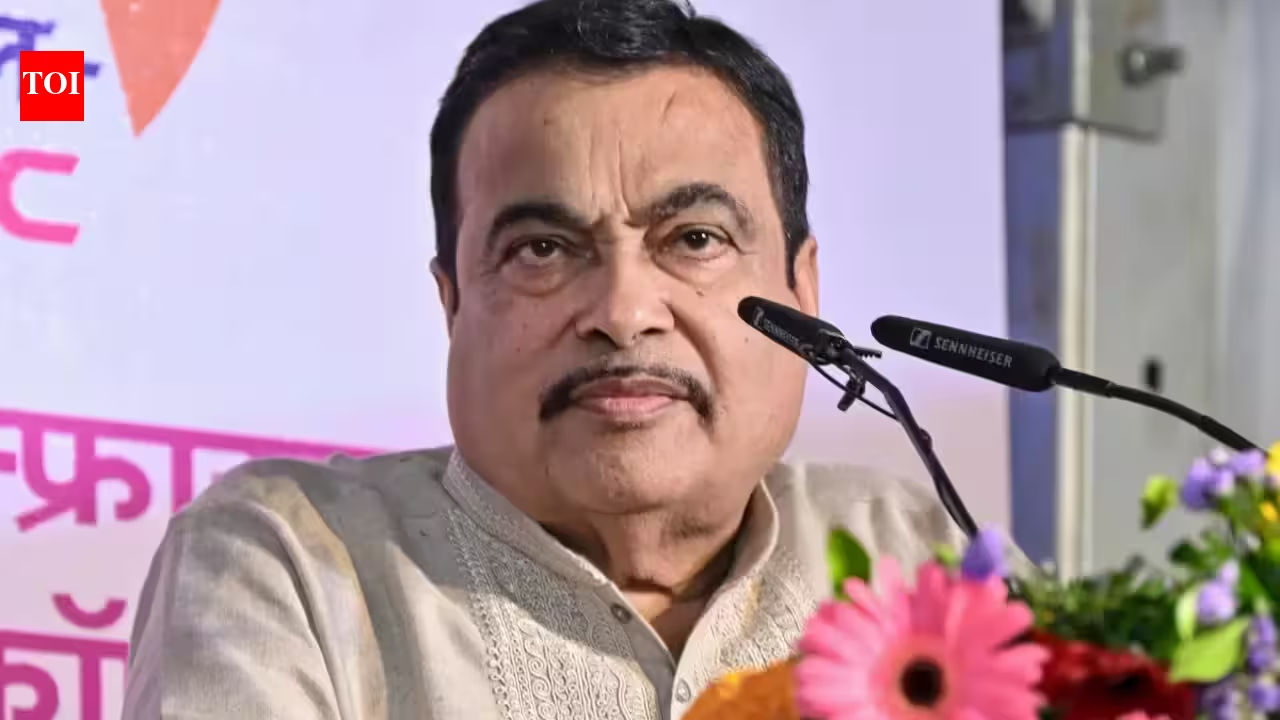
Bombay high court on Wednesday granted urgent interim relief to Union Transport Minister Nitin Gadkari

MUMBAI: Observing that some of the content was “vile’’ “abusive’’ and “certainly defamatory’’, Bombay high court on Wednesday granted urgent interim relief to Union Transport Minister Nitin Gadkari and directed Social Media intermediaries to remove posts including videos that linked him to the ethanol-blended fuel (EBP) controversy.Gadkari had sought judicial intervention against Meta Platforms, X Corp, Google LLC, and others to delete online content he alleged was “false, fabricated, and defamatory”, AI-generated deepfake videos and other manipulated digital content linking him incorrectly to EBP programme.Justice Arif Doctor sitting singly who heard the matter and passed the order, said the online platforms ought to have or prepare a framework to take down such content without necessitating a court intervention each time.The posts went beyond acceptable political criticism or satire, said his suit and transgressed on his personal rights, his public persona, his personality rights with “profane and abusive’’ content, Gadkari’s suit contended.He sought ₹11 crore in damages from John Doe (the unnamed and unidentified persons or entities) that posted content he submitted was “malicious, false…’’Gadkari’s counsel Sandeep Ladda submitted that the ‘defamatory and deepfake contents’ ought to be taken down, as they were harming the Minister’s reputation and goodwill, as well his personality rights and public standing.“I can only say that the same is absolutely vile and abusive,’’ Justice Doctor said on seeing the content Ladda cited. The HC Judge added, “Such material should have no place on a public platform, which is accessible to everyone, including young.’’The HC asked the counsel for Meta and others, if the intermediaries had any measures in place for taking down defamatory content.Justice Doctor directed the platforms to give the “basic customer information’’ of content creators and granted liberty to Gadkari to add them as parties to the suit.There is a rising pushback against the blended fuel programme introduced to curb crude oil imports. Motorists and critics said it corrodes fuel tanks in older or non-compliant cars.Gadkari’s suit said the Centre had way back in 2003 introduced Ethanol Blending Programme (EBP) as a national policy initiative to blend ethanol with petrol in a phased manner. Gadkari has been serving as the Minister of Road Transport since 2014.The implementation and progress details of EBP policy are handled by the Ministry of Petroleum and Natural Gas, his suit added.In 2025-26 the Centre achieved 20%blending of ethanol with petrol or E20 as it is called. His suit claims though he has no role in the programme, some content circulated online in July falsely associates him with the EBP and E20 initiative.His suit stressed that he has “no role or nexus whatsoever with EBP or the E20 initiative which is administered exclusively by the Ministry of Petroleum and Natural Gas’’ and the content online “falls out of the ambit of legitimate political criticism or satire.”Gadkari’s suit says it is not intended to prevent public discussion or criticism of his public duty actions or government policies.It said he “does not seek to stifle or restrain fair criticism, dissent, debate or bona fide expression of opinion concerning his public life, governmental policies or official functions.”The HC granted Gadkari the liberty to convey to the online platforms any future abusive content and to approach the court in case of any “grey area’’.The HC will hear the matter next after 4 weeks.

Mumbai Firm Loses ₹1.98 Crore as Cyber Fraudster Impersonates Director | Mumbai News

Mumbai Firm Loses ₹1.98 Crore as Cyber Fraudster Impersonates Director

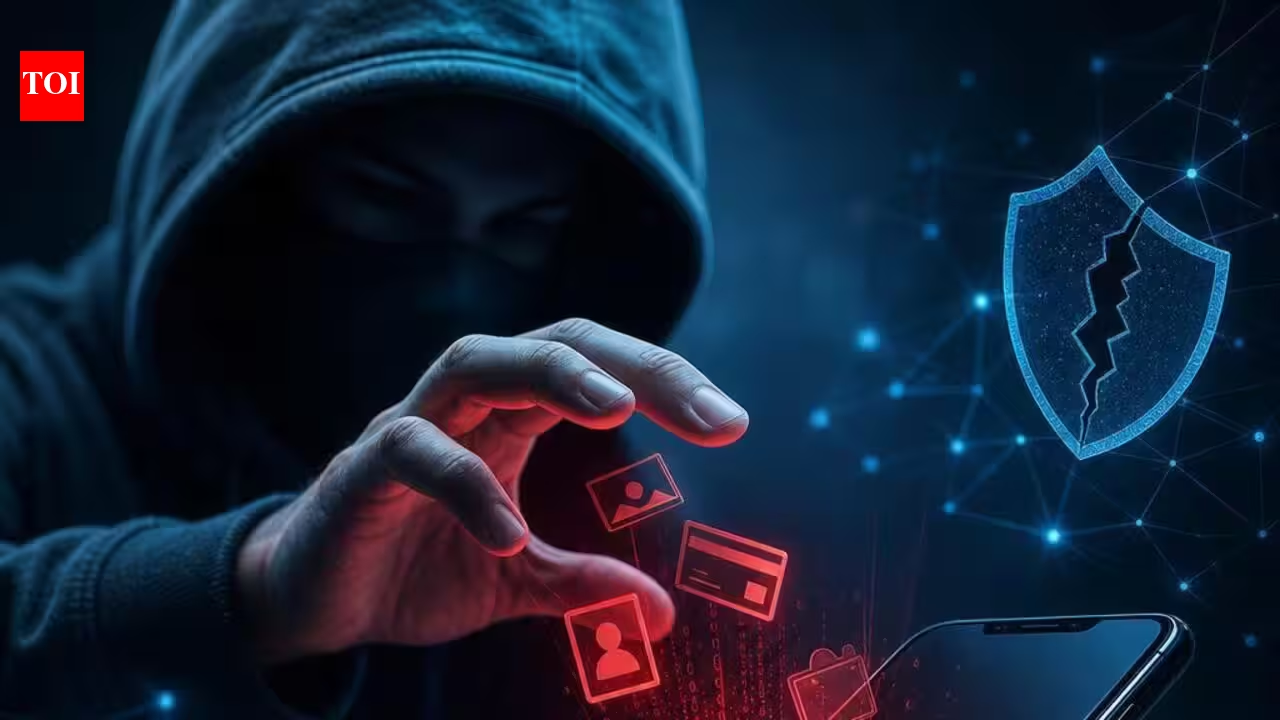
Mumbai: A Mumbai-based company allegedly lost Rs 1.98 crore after a cyber fraudster impersonated its director on WhatsApp and convinced an accounts executive to transfer the money to a beneficiary account.According to the complaint filed by the General Manager-Accounts and Banking Administrator at Oriental Foundry Pvt Ltd, he received a WhatsApp message on Tuesday from an unknown number. The sender used the name and photograph of the director and claimed that it was his new contact number.The following day, the impersonator allegedly told the complainant that an urgent payment of ₹1.98 crore had to be made to a client and shared the bank details of an account in the name of Rajput Enterprises Multipal. Believing the instructions had come from his employer, he transferred ₹1.98 crore from the company’s bank current account.The fraud came to light after the complainant informed the director about the transaction and learnt that he had not issued any such instructions. The company then realised that an unidentified person had impersonated the director using his name and photograph. The GM subsequently approached the cybercrime helpline 1930 and lodged a complaint with the South Cyber Cell. Police are investigating the mobile number used by the impersonator and the beneficiary account into which the funds were transferred.