

Study reveals hidden pollution from diesel generators may be posing bigger health risk than thought | Mumbai News
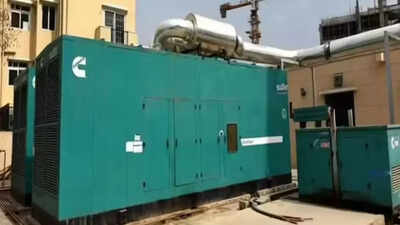
Study reveals hidden pollution from diesel generators may be posing bigger health risk than thought
Diesel generators pose greater air pollution risks than previously understood (Representative image)

MUMBAI: Diesel generator (DG) sets, relied upon by millions of homes, housing societies, hospitals, offices, industries and construction sites during power outages, could be contributing far more to urban air pollution and public health risks than previously recognised, according to a new study by researchers from Shiv Nadar University.The study, published in the peer-reviewed journal Emission Control Science and Technology, found that stationary diesel generators emit large quantities of ultrafine and submicron particles laden with toxic carbon compounds that can penetrate deep into the lungs, potentially increasing the risk of respiratory illnesses, cardiovascular diseases and even cancer.The findings assume significance for cities such as Mumbai, where diesel generators are widely used in high-rise residential complexes, commercial buildings, hospitals, malls, hotels and infrastructure projects as backup power sources.Led by Prof Sailesh Narayan Behera of the School of Engineering, Shiv Nadar University, the researchers said stationary diesel generators have remained a “hidden” source of pollution despite extensive attention on vehicle emissions, industries and construction dust.“While diesel generators help bridge gaps in electricity supply, their hidden health costs cannot be ignored. Understanding and addressing these emissions is essential if India is to balance energy reliability with public health and environmental sustainability,” Behera said.The research analysed emissions from a stationary diesel engine under six operating loads and characterised 24 trace elements and eight carbon fractions across 10 particle sizes ranging from 56 nanometres to 18 micrometres.It also assessed how these particles deposit within different regions of the human respiratory system using internationally accepted lung deposition models.One of the key findings was that emissions increased sharply as engine load rose.While organic carbon dominated at lower loads, elemental carbon, commonly known as soot or black carbon—became the dominant pollutant when generators operated under heavier demand.Most emissions were concentrated in the submicron size range, making them particularly hazardous because such particles can bypass the body’s natural defence mechanisms.The study found ultrafine particles were capable of reaching the deepest parts of the lungs, while increased engine loads significantly raised the respiratory deposition of particulate matter.Researchers warned that prolonged exposure could trigger pulmonary inflammation, reduce lung function and contribute to chronic respiratory and cardiovascular diseases.The particles may also enter the bloodstream and affect other organs, including the cardiovascular and nervous systems.According to the researchers, the groups most vulnerable to exposure include children, senior citizens, asthma and heart patients, generator operators, maintenance workers, construction labourers and residents living close to generator installations.The paper also points out that previous source apportionment studies by the Central Pollution Control Board had identified diesel power generators as a significant contributor to particulate pollution in major Indian cities, including Mumbai, Delhi, Chennai, Bengaluru, Pune and Kanpur.The researchers have urged policymakers to bring stationary diesel generators more firmly within air quality management frameworks by strengthening emission monitoring, tightening regulatory oversight and encouraging cleaner backup power technologies such as battery energy storage, gas-based systems and renewable-powered alternatives.For urban residents, the study suggests that while backup generators ensure uninterrupted electricity during outages, they may also expose nearby populations to invisible air pollutants with long-term health consequences.It recommends minimising unnecessary generator use, ensuring proper maintenance and locating DG sets away from occupied spaces wherever possible, while accelerating the transition to cleaner backup power systems.

Seven-year-old brutally assaulted by mother’s live-in partner dies in Mumbai | Mumbai News

Seven-year-old brutally assaulted by mother’s live-in partner dies in Mumbai

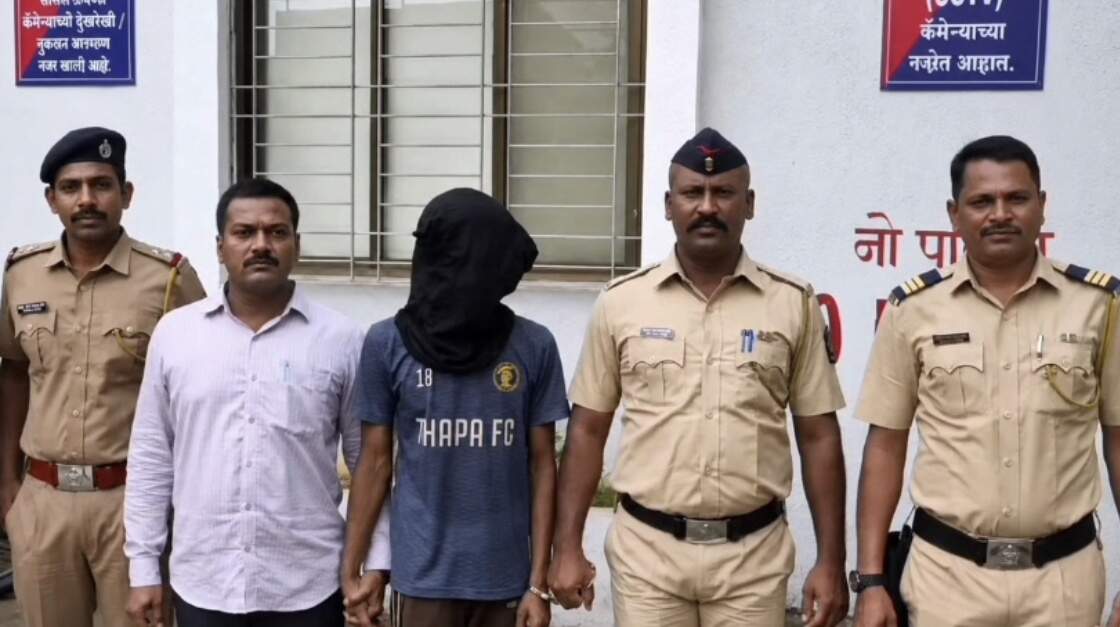
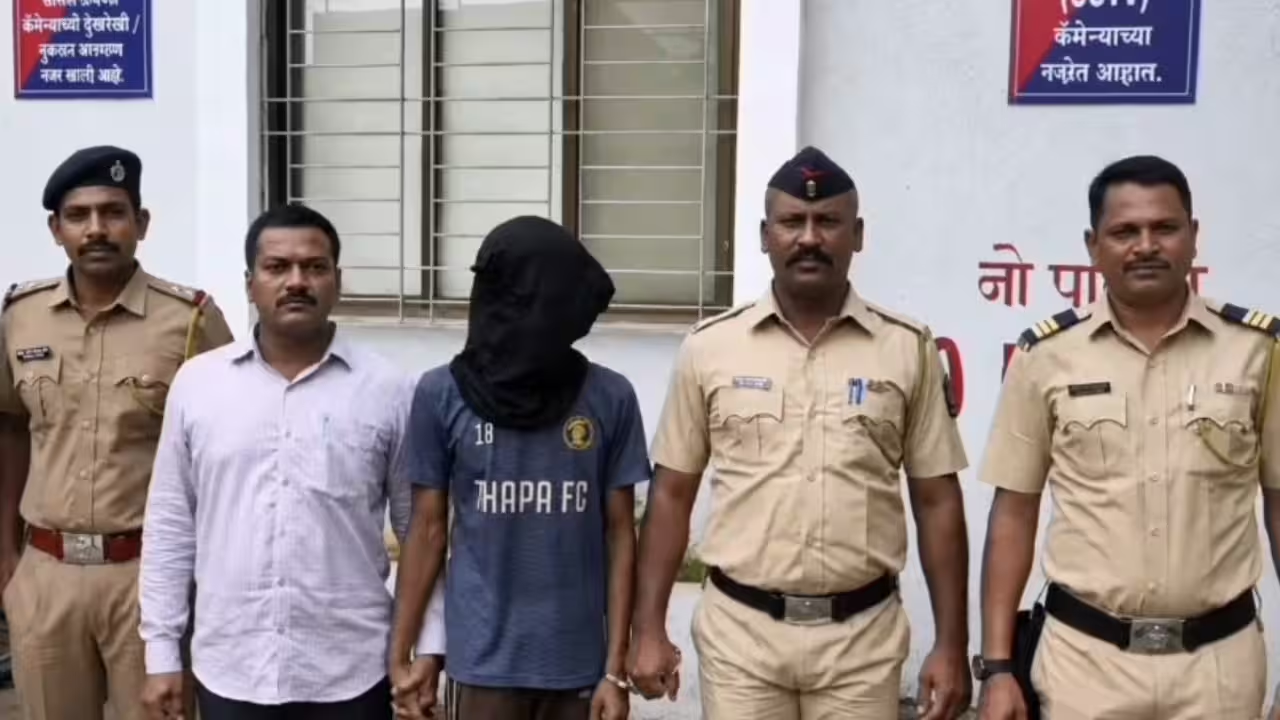
Ambernath: A seven-year-old boy, who was battling for life after allegedly being brutally assaulted by his mother’s live-in partner in Ambernath, died during treatment at Mumbai’s KEM Hospital, prompting police to register a murder case against the accused.The accused, Vikas Singh (25), has now been booked under charges of murder and taken into custody after the child’s death on Tuesday night.According to the FIR lodged by the victim’s 38-year-old mother Salma (name changed), she came in contact of Singh through one of her relatives and they both fell in love. Last month, on June 26, she separated from her husband and was living with Singh in Kalyan at his house in Ambernath along with her youngest son (7). Her two elder children stayed with their father. She worked at a private company in Ambernath, while the child remained at home during the day with Singh, who does odd jobs for a living.Investigators said Singh allegedly harboured resentment towards the boy because he slept beside his mother at night. The FIR states that the child had repeatedly complained that Singh beat him whenever his mother was away at work. The woman also alleged Singh would force the boy to sleep separately and had earlier threatened to kill him if he continued to come between them.According to the complaint, on July 17, the woman left for work around 9am after seeing her son asleep. Around 11.45am, Singh arrived at her workplace with the child and allegedly told her that he had beaten him. She noticed injury marks on the boy’s face and body, but Singh allegedly dismissed them as minor.Later that afternoon, the child’s condition deteriorated. He complained of severe pain in his stomach and private parts, and repeatedly told his mother that Singh had kicked him there. On examining him, she noticed swelling and immediately rushed him to Central Hospital in Ulhasnagar. As his condition worsened, he was shifted to Sion Hospital, and later referred to Mumbai’s KEM Hospital, where doctors admitted him to the Intensive Care Unit.Despite intensive medical treatment, the seven-year-old succumbed to his injuries.Senior police inspector Shabbir Sayyed of Ambernath Police station said that following the child’s death, they have added section of a murder in the case against Singh, who is already in police custody after victim’s mother lodge complaint with police.Police are awaiting the final post-mortem report and are continuing their investigation into the case. — Pradeep Gupta

6536e77c-005a-469f-b4d0-e7dd147d11f4_1000755973.jpg
Constructions for bullet train project blocking natural drainage channels, worsening flooding: Sena’s Thane corporators | Mumbai News

Constructions for bullet train project blocking natural drainage channels, worsening flooding: Sena’s Thane corporators
TMC officials and local representatives inspect the Mumbai-Ahmedabad High Speed Rail Project stretch between Mhatardi and Betawade on Wednesday after corporators raised concerns over waterlogging and the impact of construction on natural drainage.

iThane: The Mumbai-Ahmedabad High Speed Rail Project (MAHSRP) has come under fire from Shiv Sena corporators in Thane, who have alleged that constructions at a few spots between Mhatardi and Betawade villages have obstructed natural drainage channels, worsening flooding in the flood-prone belt and affecting farmers’ livelihoods.The issue was raised during the Thane municipal corporation’s general body meeting, where Sena corporator and former deputy mayor Ramakant Madhvi claimed embankments and related infrastructure for the bullet train corridor had blocked natural stormwater routes, leading to unusually widespread waterlogging this year.“Earlier, rainwater drained naturally into the adjoining creek through existing natural channels. This year, several fields and nearby areas remained waterlogged, causing losses to farmers. In residential pockets too, land-filling for the project is higher than in the surrounding settlements, making them vulnerable to flooding during heavy rain,” Madhvi alleged.He was supported by other Sena corporators, who urged the civic administration to coordinate with the National High Speed Rail Corporation Ltd (NHSRCL), which is executing the project, to protect natural waterways, culverts and drainage channels. Sena corporator Adesh Bhagat demanded technical assessment of the project’s impact on the city’s drainage network and mitigation measures “before a disaster occurs.The general body accordingly passed a resolution seeking intervention, following which TMC officials and local representatives conducted a site inspection on Wednesday.The NHSRCL said a joint inspection with TMC was carried out before the rains and corrective measures had already been implemented. “Temporary waterlogging occurs during heavy rainfall. Once the rain subsides, accumulated water is designed to drain through a network of pipes and culverts at various locations in the region,” a spokesperson said.The TMC said it has undertaken a fresh survey to verify existence of natural drains in the stretch. “If required, corrective measures will be recommended. Though it is a Central govt project, we will ensure residents do not suffer and steps are taken to minimise flooding risk,” a civic official said.

Mumbai Cement Mixer Truck Hits Delivery Boy, Driver Flees After Fatal Crash | Mumbai News

Mumbai Cement Mixer Truck Hits Delivery Boy, Driver Flees After Fatal Crash
The incident occurred at 5.15 pm on Andheri Kurla Road when Zulfukar was riding his electric bike and was heading to deliver a parcel when the speeding mixer truck hit him, causing serious head injuries.

Mumbai: A delivery boy was killed after a cement mixer truck hit his bike on Andheri Kurla Road on July 19, Sakinaka police said.The deceased was Mohammad Azim Zulfukar (21), who was heading to deliver a parcel when the incident occurred. Police said the accused cement mixer truck driver abandoned the vehicle and fled from the spot to avoid being thrashed by a mob, and a search was on to trace him.The incident occurred at 5.15 pm on Andheri Kurla Road when Zulfukar was riding his electric bike and was heading to deliver a parcel when the speeding mixer truck hit him, causing serious head injuries.“The driver escaped from the spot. The injured was brought to Rajawadi Hospital where the doctors on duty declared him dead at 6.22 pm,” said the Sakinaka police.In the complaint, the deceased’s cousin Mohammad Kasim (34) said: “I was at my workplace in Goregaon when I received the information about my cousin’s accident who work as a delivery boy with an Indian quick commerce company. The driver of the mixer truck drove his vehicle negligently and at high speed, hitting him, causing serious head injuries and leading to my cousin’s death.”

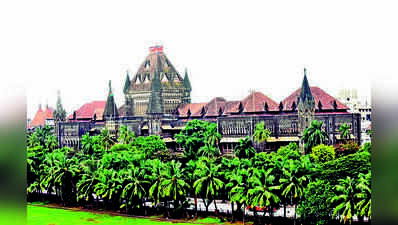
Police must protect law-abiding citizens, not accused: Bombay high court | Mumbai News

Police must protect law-abiding citizens, not accused: Bombay high court
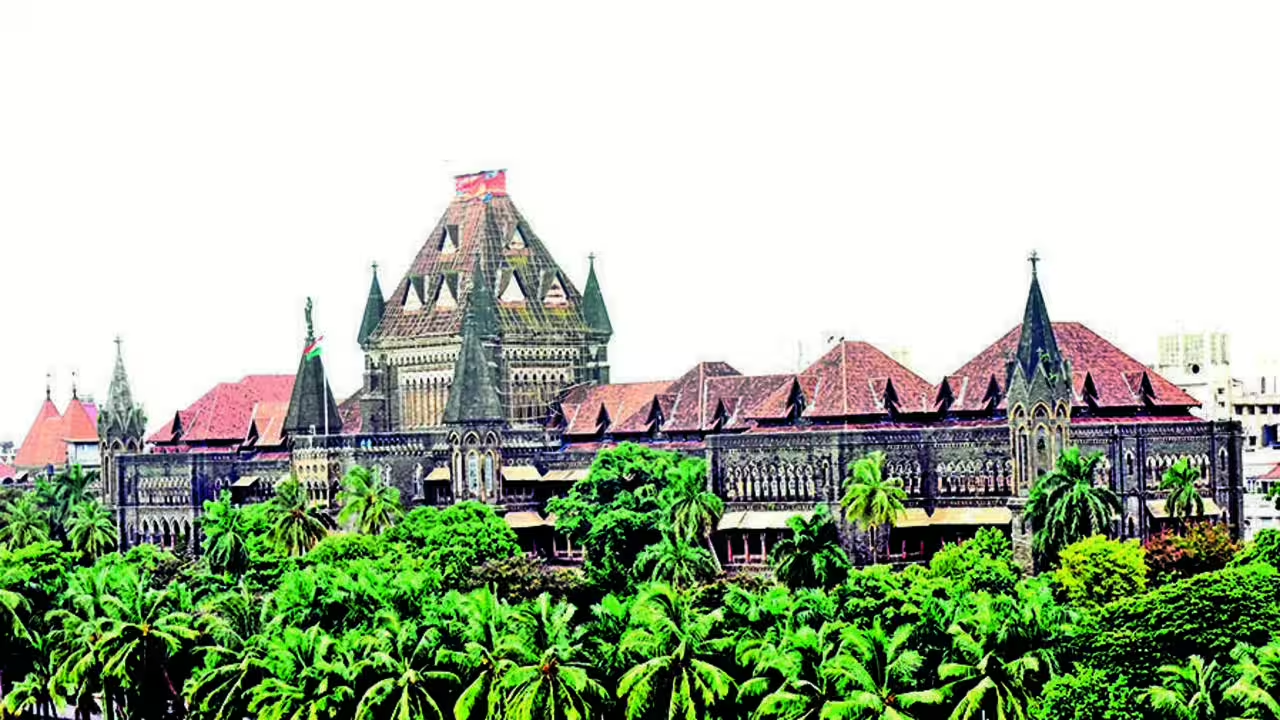
The Bombay high court bench asked why had police offered to produce Mhatre via videoconferencing for his first remand following his July 8 arrest

Mumbai: Police must be there to protect law-abiding citizens and not accused, said Bombay high court on Wednesday, questioning the ‘VIP treatment’ extended to Shiv Sena corporator Ramesh Mhatre, who was arrested for allegedly assaulting three doctors, including a woman, at the civic-run Shastri Nagar Hospital in Dombivli on July 6. The HC bench, headed by Acting Chief Justice Ravindra Ghuge, asked why had police offered to produce Mhatre via videoconferencing for his first remand following his July 8 arrest.The state public prosecutor Shishir Hiray explained that on his arrest, Mhatre’s blood pressure was 160 and hence, after the hospital visit and the paucity of time as the 24-hour deadline to produce an arrested accused before the magistrate was approaching, the police requested the local court if he could be produced via videoconferencing. The magistrate denied the request and sought his physical presence, after which Mhatre was initially remanded to police custody and then to judicial custody, before being granted bail.The HC directed the CCTV footage of the alleged assault and of Mhatre’s hospitalisation be downloaded and preserved in case it wants to view the footage on Monday, when it will hear the matter next. The HC instructed that the CCTV footage of the civic hospital, where Mhatre was admitted on July 8 till he was produced on July 10 and then again his hospitalisation on July 14-15 till he was released, be downloaded.On July 18, the HC had suo motu at a special hearing taken up the matter of three civic doctors being assaulted in the Dombivli hospital and stayed the bail granted by a magistrate to Mhatre and co-accused — Ramesh Pawar, Pramod alias Prakash Nikam and Akshay Karande. While the three co-accused were yet to be released, Mhatre was directed to surrender to the police by July 19, 5pm, which on Wednesday, his counsel Sanaa Raees Khan said he had.Pointing out that Mhatre is a “73-year-old with multiple ailments and only one functional kidney,’’ Khan said his custody is not essential as police have already seized the CCTV footage and its authenticity can be assessed during trial. To a query from the court, she said Mhatre “is a social worker’’, adding that the “backdrop of the case was it was an emotionally charged medical emergency… a female patient could have died’’. Khan further said that while on bail, Mhatre has flouted no conditions imposed on him.Mhatre is in judicial custody till Aug 3.The HC permitted an intervention application of the Indian Medical Association, Maharashtra, after its senior counsel S U Kamdar said it “stands by the three doctors who were brutally assaulted by the four accused”. Kamdar also strenuously submitted that the Kalyan-Dombivli Municipal Corporation (KDMC), whose employees — doctors — were assaulted, flouted the legal mandate to lodge an FIR within six hours of the incident.Advocate general Milind Sathe and Hiray said once an FIR was lodged, a second one for the same incident could not, in law, have been filed and statements would be recorded. Kamdar argued that the FIR was lodged only the next day and said KDMC ought to be made to answer whether political influence played any role.The state filed an interim application in the matter on Wednesday and the HC appointed senior counsel Ashok Mundargi as an amicus curiae (friend of court ) to assist it in the matter and asked him to file a fresh memo of the petition for the state by Monday.

3 years on, MIDC police reunite missing boy with family in Mumbai | Mumbai News

3 years on, MIDC police reunite missing boy with family in Mumbai

Mumbai: MIDC police team traced and reunited an 11-year-old boy, Anis Khan, with his parents in Malvani on Wednesday — three years after he allegedly fled from his home after being scolded for not studying. Police said the boy had been staying at a Matunga child welfare institution for the past three years under a different name, Aman Sheikh.The breakthrough came after the team travelled across seven states and examined missing child record cases, and filtered at least 50 photographs of missing children from the CCTNS (Crime and Criminal Tracking Network and Systems) site that resembled the boy. Police located him at a child welfare centre and reunited him with his family after his parents identified him.“His parents, who are daily wage earners, were very happy on learning about their child. The minor was initially found by Juhu police sub-inspector Wagh wandering at Juhu Chowpatty in 2023. After he failed to locate the boy’s whereabouts, he got him admitted to Sneha Sadan children’s orphanage in Andheri East then. However, the boy ran away from the orphanage and a kidnap case was registered. After tracing the boy, we learnt from him that he went to Uttar Pradesh from where he returned to Mumbai. While wandering in the city someone got him admitted into the Matunga children welfare centre,” said DCP Datta Nalawade.Nalawade said they received orders from the Mumbai commissionerate to track missing persons and child cases. He supervised three teams comprising ACP Yogesh Shirke, senior police inspector Ghanshyam Nair, police inspector (crime) Sunil Karande, police sub-inspector Sagar Hujare, Kiran Parbat and staff, and collected details of abducted children aged 5 to 15 years whose cases were registered in Maharashtra and other states, including Bihar, Delhi, Gujarat, Karnataka and UP, and railway police stations in 2023.“Information about missing and found children in India was also obtained through the CCTNS, ICGS portal, by contacting the Maharashtra Missing Persons Search Centre and Child Helpline No 1098. Finally, the team zeroed in on 50 missing children details that were filtered from CCTNS since 2023 and tracked the minor,” he said.The kidnap case was registered with the MIDC police on Oct 22, 2023, based on a complaint by Chanchal Prasad Nair, an employee of Sneha Sadan Children’s Orphanage, residing at Sneha Sadan Vinayalaya Campus in Andheri East. In the complaint, Nair said: “The minor boy, Anis Khan, was found wandering unattended at Juhu Chowpatty within the jurisdiction of Juhu police station. Police sub-inspector Wagh of Juhu police station, after an extensive search for the boy’s parents, and failing to find them, admitted him to Sneha Sadan Orphanage. The minor boy who was admitted to Sneha Sadan had left Sneha Sadan without informing anyone.”Upon receiving the complaint, police registered a case. “In connection with the said crime, there was no information available about the missing boy’s parents or his residence, which created obstacles in tracing the boy for the past three years. To search for the boy involved in the said crime, a special team comprising police sub-inspector Sagar Hujare and his squad was appointed as per the orders of the senior cops. The said team visited all children’s orphanages in Mumbai city and suburban areas and obtained photos and information of children aged 8 to 13 years who were admitted from 2023 to date. Accordingly, a matching photo of a minor boy admitted to the children’s reformatory in Matunga was obtained. Upon visiting the said location and inquiring about the photo, preliminary information was received that the boy in the Matunga institution was named Aman Sheikh,” said DCP Nalawade.The DCP said police also received information that the boy’s parents resided in Malvani. He said that when the minor boy’s photo was shown to his parents and aunt within the jurisdiction of Malvani police station, they identified him, confirmed he was their nephew, and said he had been missing since 2023.Police said the MIDC police station surveillance team traced the boy, who was registered under two different names for the past three years, using the obtained photograph, and handed him over to his parents.

Protests rock Mumbai over NEET paper leak; Congress leaders detained, protesters dragged into police vans | Mumbai News

Protests rock Mumbai over NEET paper leak; Congress leaders detained, protesters dragged into police vans
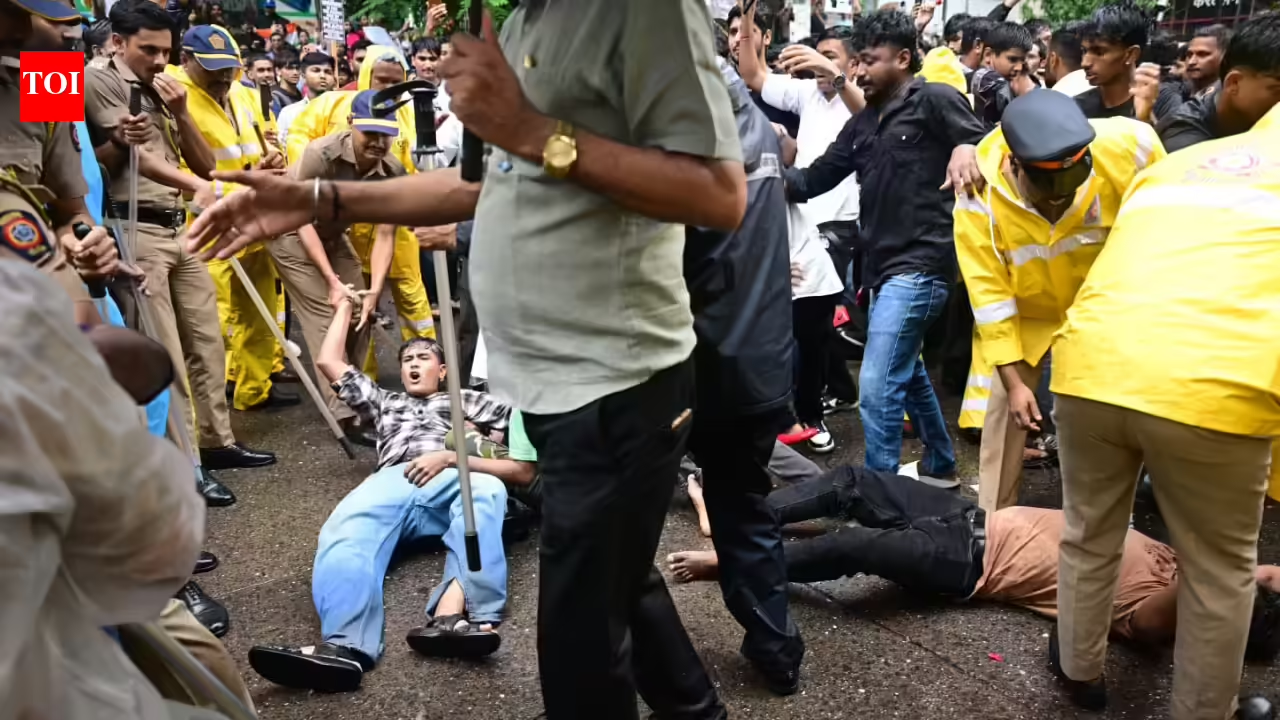
Mumbai became a hub of activism on Wednesday, as protests unfolded over allegations of exam irregularities

MUMBAI: Mumbai witnessed protests at several locations on Wednesday in support of the Cockroach Janta Party’s (CJP) agitation over alleged irregularities in competitive examinations, with police detaining several demonstrators and forcibly evicting senior Congress leaders from a key intersection in south Mumbai.Police stopped Maharashtra Congress president Harshvardhan Sapkal, Congress Legislature Party leader Vijay Wadettiwar and former minister Naseem Khan at Regal Cinema Chowk as they headed towards the Maharashtra BJP office in south Mumbai.The leaders were taken away in police vans and shifted to Colaba police station.The Congress leaders had planned to present copies of the Constitution to BJP leaders.Protesters raised slogans such as “Modi Hato, Desh Bachao” during the demonstration.Across the city, hundreds gathered at multiple locations to protest against the alleged NEET paper leak despite prohibitory orders being in force.According to officials, a large number of protesters assembled at Dr Babasaheb Ambedkar Garden in Chembur amid heavy police deployment.Several protesters were detained, with eyewitnesses alleging that some were dragged into police vehicles before being taken to the local police station.The protesters in Chembur carried placards demanding reforms in the education system and action over the alleged examination irregularities.After detaining several people, police dispersed the remaining crowd.Some protesters alleged that they had been stopped by police while travelling to the protest site.Shiv Sena (UBT) MLA Aaditya Thackeray and Maharashtra Navnirman Sena (MNS) leader Amit Thackeray later reached the protest venue and visited the police station.Sources said the detained protesters were released following their intervention.At Shivaji Park in Dadar, police personnel stopped a woman wearing a burqa while she was protesting.MNS chief Raj Thackeray’s wife, Sharmila Thackeray, came to her support and sat beside her during the demonstration.A large crowd also gathered outside Shiv Sena Bhavan in Dadar and raised slogans against Union education minister Dharmendra Pradhan and Prime Minister Narendra Modi.Police maintained a heavy presence at all protest sites to prevent any untoward incident.(With PTI inputs)

Orange alert stays for Mumbai as Tansa overflows, lake stocks rise to 62% | Mumbai News

Orange alert stays for Mumbai as Tansa overflows, lake stocks rise to 62%
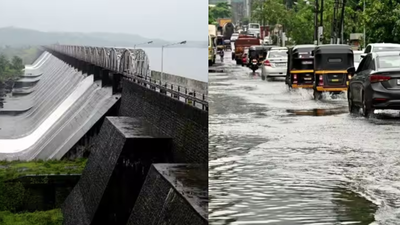
As heavy downpours continue, Mumbai is on high alert with the IMD raising an orange signal

MUMBAI: India Meteorological Department (IMD) on Wednesday retained the orange alert for Mumbai and the Mumbai Metropolitan Region (MMR), forecasting heavy to very heavy rainfall accompanied by gusty winds through the day, even as the sustained monsoon showers pushed Tansa, one of the city’s seven drinking water reservoirs, to overflow.With Tansa joining Vihar and Tulsi, three of Mumbai’s seven lakes are now overflowing, while the combined water stock across all reservoirs has touched 62% of total capacity, providing a boost to the city’s water reserves.The IMD issued an orange alert for Mumbai, Thane and Raigad for Wednesday, warning of heavy to very heavy rainfall at a few places, with strong winds of 50-60 kmph gusting up to 70 kmph.Palghar remains under a red alert, with extremely heavy rainfall likely at isolated places along with similar wind speeds.For Thursday, Mumbai and Thane have been downgraded to a yellow alert, indicating heavy rainfall at isolated places.The weather department has forecast that rainfall activity is likely to ease from Friday, with light to moderate rain expected across the region.In the 24 hours ending 8.30 am on Wednesday, the IMD’s Colaba observatory recorded 35.6 mm of rainfall, while Santacruz logged 48.4 mm.Thane recorded 88.63 mm, while Navi Mumbai received an average of 61.17 mm.The continuous rainfall over the catchment areas has led to a rapid rise in reservoir levels too.While Tansa Lake began overflowing at 8.51 am on Wednesday, it became the third reservoir to spill this monsoon after Vihar, which overflowed at 9 pm on July 7, and Tulsi, which followed at 11.43 pm the same night.According to the BMC’s Hydraulic Engineer’s Department, the combined water stock in Mumbai’s seven lakes stood at 61.90% of total storage capacity as of 6 am on Wednesday.Located in Shahapur taluka of Thane district, Tansa is one of the few masonry dams in the country.It has a maximum storage capacity of 145.08 billion litres (145,080 million litres) and contributes about 455 million litres per day (MLD), or 11%, of Mumbai’s daily water supply.Commissioned in 1892, the dam is 2,743.2 metres long, making it one of the world’s longest masonry dams.Tansa had overflowed on July 23 last year, on July 24 in 2024, July 26 in 2023, July 14 in 2022, July 22 in 2021, and August 20 in 2020, indicating that this year’s overflow is broadly in line with recent monsoon patterns.

BEST bus mounts divider while avoiding biker in Borivli, no injuries reported | Mumbai News

BEST bus mounts divider while avoiding biker in Borivli, no injuries reported

Mumbai: A BEST bus got stuck on a road divider after its driver allegedly swerved to avoid a motorcyclist in Borivli East late on Monday. The incident occurred at around 11.20 pm near Daulat Nagar bus stop and did not result in any injuries.According to a report from the Magathane depot, the bus on Route A-462 was travelling from Vaishali Nagar towards Borivli East when an unidentified motorcyclist suddenly cut across from the left lane. In an attempt to prevent a collision, the driver steered the bus sharply to the right, causing it to mount and get lodged on the road divider.A towing vehicle was later deployed to remove the stranded bus and bring it back to the Magathane depot. BEST officials said neither passengers nor bus staff were injured in the incident.

Hormone injections used to boost milk yield seized from Ulhasnagar dairy | Mumbai News

Hormone injections used to boost milk yield seized from Ulhasnagar dairy
The action is part of the Maharashtra FDA’s intensified statewide drive against food adulteration and milk-related offences

Ulhasnagar: In a major crackdown on the illegal sale and use of oxytocin injections in dairy animals, a joint team of the Central police station and the Maharashtra Food and Drug Administration (FDA) seized 612 bottles of suspected oxytocin injections from a dairy in Ulhasnagar, reports Pradeep GuptaInvestigators suspect the banned drug was being used to increase buffalo milk production.The action is part of the Maharashtra FDA’s intensified statewide drive against food adulteration and milk-related offences under FDA commissioner Tukaram Mundhe, who has launched an aggressive campaign against adulterated food, synthetic milk and illegal practices in the dairy sector across the state.The raid was conducted on July 16 at Prakash Tabela near Jaslok School in Bhaji Market, Ulhasnagar-3, following a specific tip-off received by the FDA. Deputy commissioner of police (Zone IV) Sachin Gore said the police had received credible information that buffaloes at the dairy were allegedly being administered oxytocin injections to extract higher quantities of milk.“We are investigating since when the dairy operator had been using the injections and from where the banned drug was being procured. We are also probing whether an interstate supply network is involved,” Gore said.During the raid, drug inspector M V Gotmare and his team found 60 buffaloes, 15 cows and six calves at the dairy. They seized six boxes containing 600 unlabelled 100-ml plastic bottles, 12 loose-filled bottles, two empty bottles, and used syringes. Officials also found that the premises did not possess a valid licence to store or deal in such drugs.The dairy owner, Prakash Wadhwani (64), allegedly failed to produce buy invoices or disclose the source of procurement of the injections. FDA officials collected statutory samples for laboratory analysis and seized the remaining stock under the provisions of the Drugs and Cosmetics Act.Police have registered an FIR under relevant provisions of the Drugs and Cosmetics Act, Section 223(a) of the Bharatiya Nyaya Sanhita (BNS) and the Prevention of Cruelty to Animals Act. Officials said oxytocin is a prescription hormone and its routine use in animals is prohibited. Its indiscriminate use not only affects animal health but may also pose risks to consumers through contaminated milk. The FDA has appealed to citizens to report the illegal sale, storage or use of oxytocin and other banned drugs, reiterating that strict action will be taken against violators as part of its ongoing statewide enforcement drive.