

Navi Mumbai man arrested for killing mother over marital dispute

Navi Mumbai man arrested for killing mother over marital dispute

Navi Mumbai: A 42-year-old man killed his 65-year-old widowed mother residing in Vashi by strangling and banging her head on the floor on Sunday. The man allegedly murdered her as she was preventing him from staying with his estranged wife, who had seperated from him due to frequent quarrels with his mother.Shashikant Chandekar, senior inspector of Vashi, said, “The accused identified as Mahesh Ratnakar Kadam was arrested on Monday early morning from his third-floor apartment in Ashtavinayak society, Sector 11 in Juhugaon, Vashi. The murder victim was identified as Nanda Ratnakar Kadam, residing with her accused son, who works as housekeeping staff at Mindspace IT Park in Juinagar. The incident occurred after 6 pm and came to light around 9.10 pm, when a building resident alerted the Vashi police and two beat marshal constables reached the building and detained Kadam. The accused’s brother-in-law, Mangesh Kashiram Devlekar (49), a resident of Mankhurd has been made a complainant, who had reached the building after being informed by the neighbours.”SPI Chandekar further informed that the victim was rushed to NMMC Hospital, Vashi, where the doctors declared her brought dead on arrival. Police arrested Mahesh on Monday after registering a case against him under BNS section 103(1).Mahesh alleged that his mother was responsible for his wife separating from him due to frequent quarrels. This led his wife to leave him and move away with their two minor daughters. As his mother was reluctant to resolve the dispute with his wife, a verbal argument with his mother escalated. In a fit of rage, he allegedly strangled her with a cloth and banged her head on the floor that proved fatal. Mahesh was produced before the Belapur JMFC court that remanded him to police custody, police said.
BJP plan to provide tabs to 227 corporators hits procurement hurdle

Mumbai: BJP plan to provide tabs to 227 corporators hits procurement hurdle

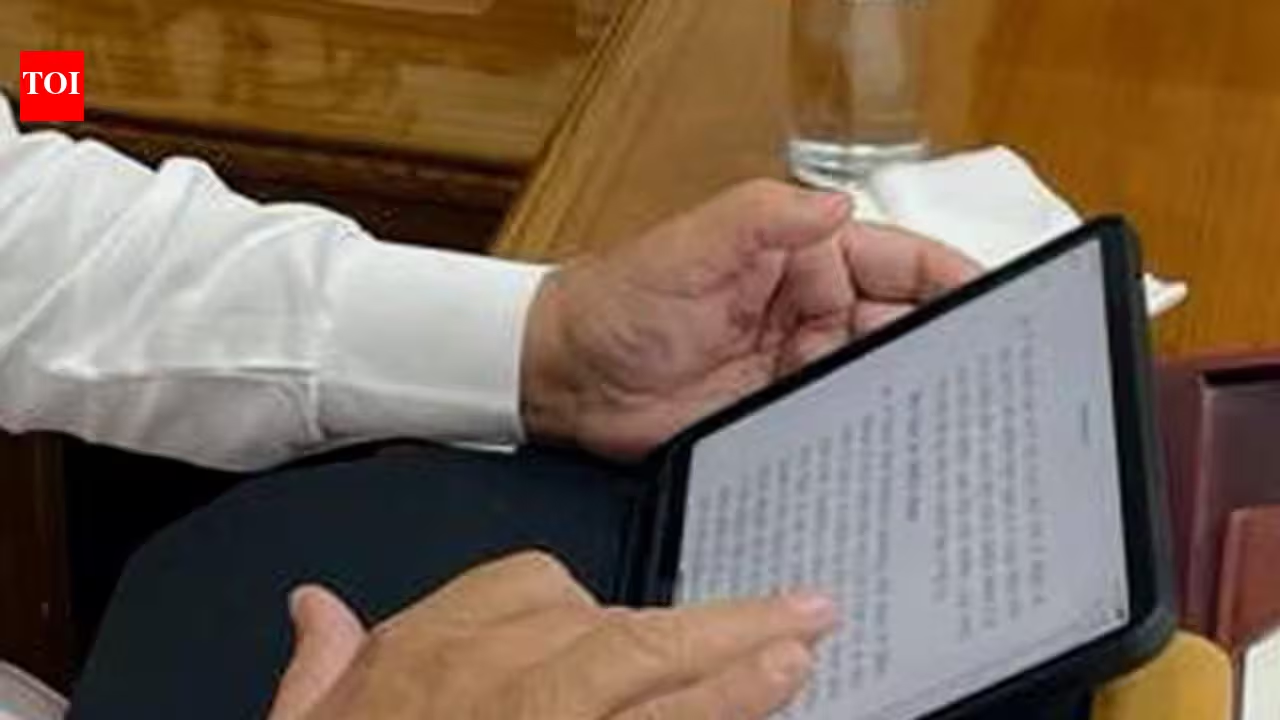
Mumbai: BJP’s plan to provide tablet devices to all 237 corporators appears to have hit a procurement hurdle, with the civic administration finding it difficult to buy the devices through Government e-Marketplace (GeM) portal.According to a BJP functionary, the tablets proposed to be purchased are of Chinese make. Since the particular Chinese-made tablets are reportedly not available for procurement through GeM, BMC may find it difficult to go ahead with the buy through the govt portal.BMC had in recent months decided to procure all of the civic body’s requirements through GeM, govt’s centralised public procurement platform. The portal is used by govt departments and public bodies to buy goods and services through an online system. The proposal to provide tablets to all 227 elected corporators plus 10 nominated corporators had drawn opposition from Shiv Sena (UBT), which had questioned the need for the civic body to incur expenditure on devices for elected representatives.BMC currently prints and distributes voluminous documents for the monthly civic House meetings as well as meetings of various statutory and special committees. These include standing committee, education committee, improvements committee, ward committees, works committee (city), works committee (suburbs), women and child welfare committee, law and revenue committee and health committee, among others.BMC official and BJP functionary Ganesh Khankar said, “Our aim to give tablets to all corporators was only to encourage paperless works. Our intent was good and it would have helped in ensuring that there’s no unnecessary wastage of paper. However, I have been informed that the administration may not be able to procure the devices via the GeM portal, in which case we will not be in favour of it as it was our govt that insisted on the use of the portal.” A dedicated application was proposed for the tablets, through which corporators would have been able to access the agenda and supporting documents.UBT leader and former mayor Kishori Pednekar said that she was opposed to the move since the beginning. “What is the point of providing tablets to all corporators when everyone today has a smart phone? Apart from it, we still prefer civic meeting agendas on paper so that later on it doesn’t give any scope to make any changes once the same is circulated,” she said.

Juvenile lover detained for abetting 24-year-old woman’s suicide

Juvenile lover detained for abetting 24-year-old woman's suicide

Navi Mumbai: After a 24-year-old woman died by suicide after jumping from a moving local train between Vashi and Mankhurd near Vashi creek railway bridge on Aug 1, Vashi GRP has registered a suicide abetment case against a 17-year-old teenage boy hailing from Bihar.The deceased was identified as Priyanka Mithu Ram, who worked as a sales girl at an agritech platform store in Ghansoli and resided in Ghansoli with her widowed mother, elder brother, his wife and two children.Kiran Undre, senior inspector of Vashi GRP, said, The complainant, the deceased woman’s brother, Mahadev Ram Mithu (26), alleged that his sister killed herself due to mental stress. The accused juvenile, with whom she was in a love relationship, had allegedly refused to marry her and threatened her by sending her semi-nude video screenshots, for persuading him to marry her. The IT Act has been invoked since it includes the offence that punishes the violation of personal privacy.Inspector Undre added, “The accused who has been working in Kalyan for past two months was detained and not arrested as he is a juvenile. Hence, he was produced before the Juvenile Justice Board at Bhiwandi that has sent him to juvenile shelter home. However, when the accused’s mobile was seized and checked, it was found that he had deleted the victim’s obscene images, which will be retrieved sending his mobile to the forensic lab.”As per the FIR, Priyanka and her accused lover were in a long-distance love relationship since April 27. They met when she and her mother had gone to their native place in Bihar for her cousin’s wedding.As her mother and brother agreed to their marriage and contacted the accused over mobile, he claimed that he is willing to get married only after one year as he wants to buy a house first; before that, he can marry Priyanka in a temple. Thereafter, Priyanka and her lover continued talking over mobile, but she started suffering from mental health issues as he had allegedly refused to marry her. On Aug 1, around 7:45 pm, while returning home from her workplace, Priyanka sent a voice recording message to her mother saying that she doesn’t want to live as she cannot survive without him and she is ending her life.Around 8:45 pm, Mankhurd GRP informed her brother Mahadev about Priyanka’s fall from a train and directed him to Vashi GRP, which in turn took him to NMMC hospital, Vashi, where Priyanka was already declared brought dead due to grievous head injuries after jumping off the moving train.On Aug 5, when Mahadev checked the Whatsapp of Priyanka and their mother, he found Priyanka’s obscene images sent from the accused’s mobile number. Acting on Mahadev’s complaint, Vashi GRP seized the mobiles of Priyanka and their mother as technical evidence against the accused and registered an FIR on Aug 7.

Konkani musician Henry D’Souza passes away on Aug 14, 2026 at 83

Konkani musician Henry D’Souza passes away on Aug 14, 2026 at 83

Mumbai: Veteran Konkani musician, composer and singer Henry D’Souza, renowned for iconic songs like ‘Ye Ye Katrina’ and ‘Ami Dogi Sezara’, died at his Mumbai residence on August 14, aged 83.Born in 1943 in Basrikatte, Chikkamagaluru, D’Souza later settled in Mumbai, where he studied law, dabbled in journalism, and eventually carved a career in Konkani music. His most celebrated song, ‘Ye Ye Katrina’ — recorded with Helen D’Cruz, released on HMV in 1971, and touring Byculla, Mahim and Bandra in its lyrics — spawned versions in Hindi and Sinhalese and remains a staple at Goan weddings to this day.With over 700 songs recorded for All India Radio and broadcasts across Sri Lanka, Bahrain and Kuwait, and concerts in India and abroad, D’Souza took Konkani music to the world.

Women Graduates Union turns 111

Leaning in for more than a century: Women Graduates Union turns 111
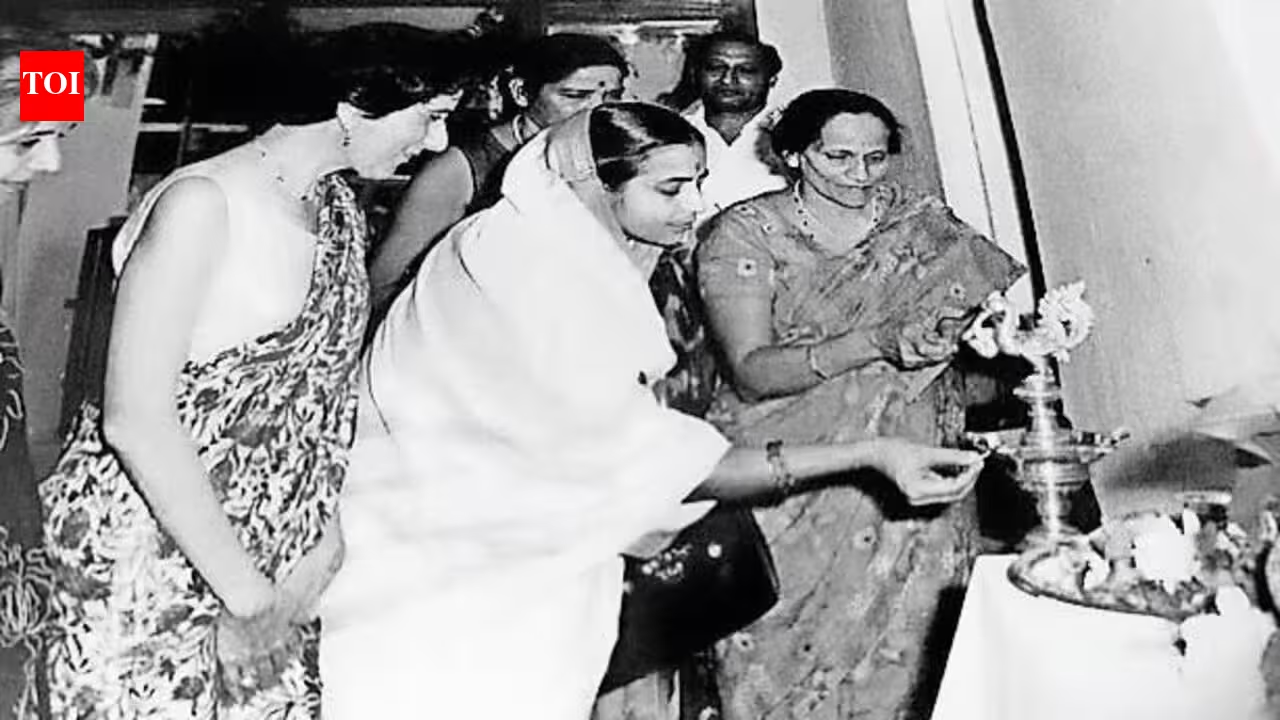
Pratibha Patil inaugurated the Women Graduates Union hostel in 1974

Not far from the bustling fish market in Sassoon Dock sits the Women Graduates Union building in Colaba, with its offices and working women’s hostel tucked into a leafy lane. The organisation, established in 1915, turns 111 this year.It plans to celebrate with a host of cultural events this month (and later in the year) and launch its annual scholarship scheme on Aug 18“We’ve been distributing scholarships since 1957. This year, Rs 25 lakh will be awarded to more than 100 students,” says Gauri Chhabria, the Union’s former president and Scholarship Committee chairperson.Among the thousands who received scholarships from the Union include deputy municipal commissioner, BMC, Chanda Jadhav, “We awarded her a scholarship when she was young and she went on to donate Rs 1 lakh to our scholarship fund later on,” says Chhabria.An initiative of the Association of British University Women in India, the Women Graduates Union is committed to women’s empowerment through education, skill-building and counselling.The Bombay Presidency Women Graduates Union —founded by Dr Annette Benson, a medical officer at Cama Hospital—was the precursor of the Women Graduates Union.Significantly, the first woman Bachelor of Arts graduate from Bombay Province was Cornelia Sorabji, who secured her degree in 1888. (Bombay University opened all its degree courses to women in 1883.)In 1921, Sorabji became the first secretary of the Federation of University Women in India, an institution which was renamed Indian Federation of University Women’s Association (IFUWA). The Women Graduates Union is affiliated with this body and with Graduate Women International.Since its inception, Women Graduates Union has consistently advocated for women’s rights: it secured seats for them in several male-dominated power centres, including the Bombay University senate and Bombay Municipal Corporation.It also secured women bed and board with a hostel, inaugurated by Pratibha Patil, minister for social welfare and cultural affairs at the time—and later President of India—on October 27, 1974.Today, the hostel accomodates more than 100 working women in 80 rooms. “They have to be working women with a monthly salary between Rs 15,0000 and Rs 50,000. Our hostelites include PhD scholars too. Admission is granted after an interview and verification of their jobs, salary and identification of local guardians,” explains chairperson of the hostel committee, Kanta Tripathi.Anushka (second name withheld on request), a scientist at Tata Institute of Fundamental Research, says the hostel is an ideal place for working women. “It is a home away from home, safe and secure.”Besides the hostel which allows women to pursue careers and aspirations with confidence, Women Graduates Union also runs a counselling and guidance centre, a study centre for children from municipal schools and a balwadi for toddlers. “The aim is to provide a strong foundation in education to children in their formative years,” says honourary secretary Raka Ghosh.The organisation’s counselling centre, on the other hand, aims to build a strong emotional bedrock. “Our sessions on mental health teach our members breathing methods, relaxation and mindfulness techniques, how to manage stress and anxiety and cognitive exercises for the brain,” says counsellor and psychologist Rielle Martin.Women Graduates Union also hosts conferences and is invited by other women’s organisations to discuss critical issues of women’s welfare and empowerment, says former president Sabita Chuganee.Their 111-year journey has indeed been eventful.

‘Sebi must act on ex-Axis AMC chief dealer case:’ Bombay High Court junks FIR

‘Sebi must act on ex-Axis AMC chief dealer case:’ Bombay High Court junks FIR

Mumbai: Observing that proceedings for an offence under Securities and Exchange Board of India Act can be initiated only on a complaint by Sebi, Bombay High Court has quashed an FIR against former Axis Asset Management Company Ltd chief dealer Viresh Joshi in an alleged front-running case.Justice Ranjitsinha Bhosale on Aug 13 said, “It is the Sebi who has to take steps to initiate the proceedings.” Sebi is entrusted with the responsibility of regulating the market and safeguarding the investors and the securities market and “would have the expertise to analyse the allegations for offences under the Sebi Act.”The Dec 23, 2024, FIR was registered at Sion police station, and later transferred to Economic Offences Wing, under IPC, including criminal breach of trust, cheating and forgery.Complainant Soni Parmar alleged that Joshi shared in advance non-public information about substantial trades/large orders with co-accused and others. After the trades/orders were placed in the market, Joshi and his co-accused would then sell the shares they had bought. The information was shared through mobile numbers and WhatsApp calls. By this modus operandi—which comprised co-accused Sumit Desai, Pranav Vora, Vaibhav Pandya and Marfatia group—a huge profit was made, causing loss to Parmar and other investors. Parmar alleged Joshi cheated 66 lakh investors and caused a loss of over Rs 2.52 lakh crore. Enforcement Directorate’s advocate said the total fraud is Rs 93 crore, of which Rs 29 crore only has been secured.Senior advocate S Nagmuthu, for Joshi, argued that the offence of front running or passing of non-public information was an offence only under Sebi Act and not under IPC/BNS. Further, offences in the FIR are also not made out. Nagmuthu said Soni on Oct 3, 2025, consented to quashing the FIR on the ground that it was filed on some misunderstanding.Justice Bhosale agreed with Nagmuthu that Section 26 bars courts from taking cognisance of offences punishable under Sebi Act except on Sebi’s complaint. “The Sebi Act is a special Act… the same would prevail over general law,” he added. He said, considering the seriousness of the allegations, the gravity of the offence, if a prima facie offence is made out, and the adverse financial impact not only on the securities market but on the entire financial system, “this court trusts that the SEBI will take prompt, swift and effective steps and action” to protect the interest of the investors and integrity of the securities market.Quashing the FIR, Justice Bhosale said it will be open to Sebi to independently consider whether the allegations against Joshi make out a criminal offence under Sebi Act. He directed it to take necessary steps within 12 weeks.

Foreign law degree can’t be treated as ‘first degree’ for 3-year LLB, says Bombay high court

Foreign law degree can’t be treated as ‘first degree’ for 3-year LLB, says Bombay high court

Mumbai: Bombay high court has dismissed a student’s petition challenging cancellation of his provisional admission to the three-year LLB course. It held that his three-year undergraduate law degree from a foreign university cannot be treated as a qualifying ‘first degree’ for admission in India.Justices Riyaz Chagla and Farhan Dubash on Friday said the three-year LLB course in India is a second-stage degree to be pursued after graduation in any discipline. “We have independently examined the statutory framework and have concluded that the petitioner’s foreign undergraduate law degree does not constitute the antecedent ‘first degree’ required for admission to the three-year LLB course,” they added.Yohaan Abraham (25) completed class XII from a Chembur school before pursuing the undergraduate degree from Queen Mary University of London. After his provisional admission to Panvel’s Chhatrapati Shivaji Maharaj University, he was told it is subject to clarification from the Bar Council of India or the State Bar Council whether a foreign undergraduate law degree would entitle him to pursue an LLB degree here. On Jan 6, Abraham’s admission was cancelled. His advocate Aneesa Cheema said after accepting his documents and fees, the admission was abruptly cancelled without reasons or a hearing.The judges agreed with BCI’s advocate Yogesh Naidu that the three-year LLB in India is a second-stage degree after graduation. They also agreed that Abraham did not possess a separate ‘first degree’ in any discipline before undertaking the degree from Queen Mary. “His three-year law degree commenced immediately after completion of class XII and constituted his first undergraduate qualification,” they noted.They referred to the Rules of Legal Education, 2008 which “consistently contemplate a sequence — an applicant must first possess a qualifying graduation-level qualification and thereafter pursue the three-year degree course in law.” It reflects the “very structure” of the LLB course as a second-stage professional law degree. “… the route available to a student proceeding directly after class XII is the integrated five-year law course,” the judges added.They disagreed with Cheema that Abraham’s foreign law degree was recognised by a BCI notification and, therefore, qualified as a ‘first degree’. They said BCI’s notification does not override eligibility rules for admission. While noting there “was substance” in Abraham’s grievance that the Jan 6 communication gave no reasons for cancellation, the record showed the issue was known to him. “The petitioner has failed to establish that he possessed the requisite qualification for admission to the three-year LLB course,” they concluded.