
Tender dispute triggers knife attack outside BMC office in Mumbai | Mumbai News
Tender dispute triggers knife attack outside BMC office in Mumbai
A civil contractor and a vegetable vendor were injured in knife attacks near the BMC F-North Ward office.

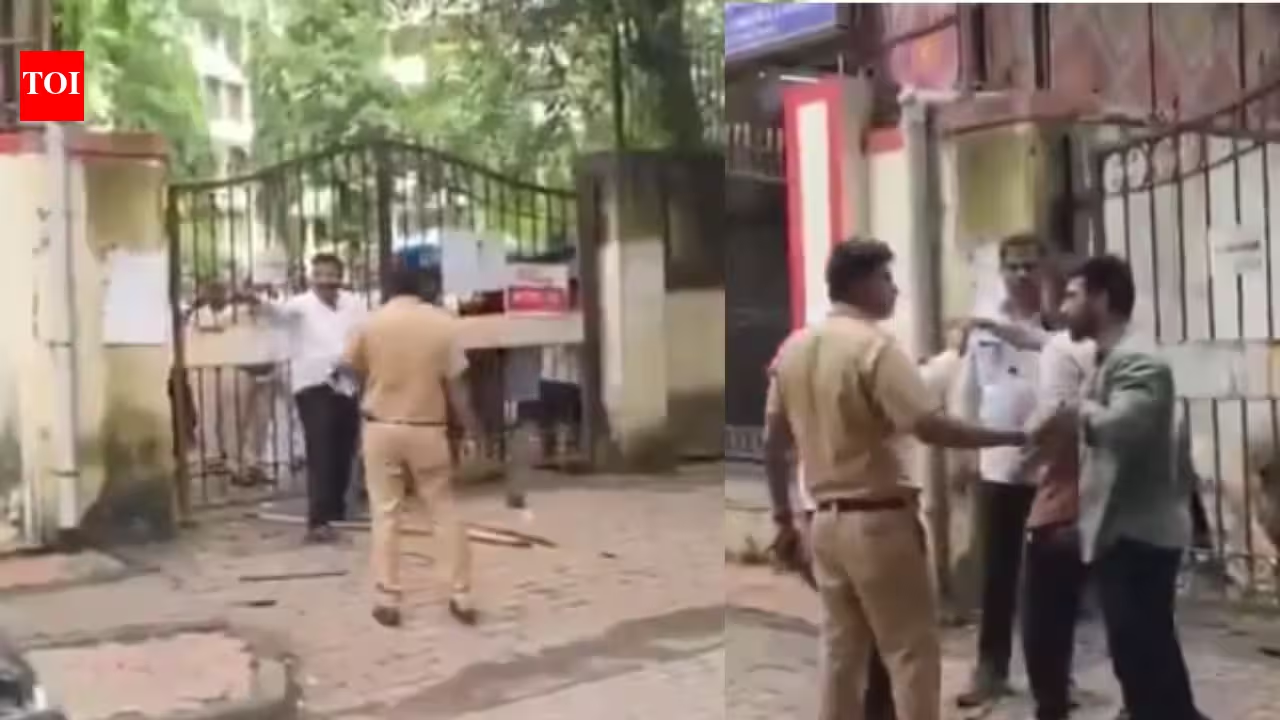
MUMBAI: A dispute allegedly linked to a BMC contract tender turned violent in Matunga on Monday, with two separate complaints registered after a civil contractor and a vegetable vendor were injured in knife attacks near the rear gate of the BMC F-North Ward office.According to the complaints, the incident occurred near Pioneer Hall on Telang Road, Matunga East outside BMC office shortly after civil contractor Bhairu Singh, 43, visited the BMC office to enquire about a tender for construction of ladi and koba works in slum areas under the F-North Ward.Singh told police that he had submitted an online tender for the work about a week earlier. A day before the incident, he allegedly received a threatening call from an unidentified person questioning him about why he had taken the Matunga BMC contract.On Monday, after making enquiries with officials at the ward office, Singh said that he coming out when he was approached by four unidentified men near the rear gate. After confirming his identity, two of them allegedly assaulted him. Singh alleged that one man wearing a red T-shirt stabbed him on the right side of his abdomen with a knife, while another allegedly struck his left hand with a beer bottle, causing injuries to his fingers.Singh further told police that he had carried a knife for self-protection after receiving the previous day’s threat. When the assailants allegedly attacked him, he took out the knife, following which some of them fled.Singh allegedly chased him and, after the man slipped and fell, stabbed him in the left leg. Police reached the spot and seized the knives involved in the incident. Singh was subsequently taken to Sion Hospital for treatment.In a separate Fir was registered following the same incident, 30-year-old Ashish Yadav, a vegetable vendor from Vikhroli East, alleged that he was injured while attempting to intervene in the altercation.Yadav alleged that one of the men, wearing a white shirt, suddenly pulled out a knife from behind his trousers and raised it towards the persons involved in the fight. When Yadav tried to run away, the man allegedly chased him with the knife. Yadav slipped and fell, and the knife blow allegedly struck his left leg, causing a serious injury.Yadav was subsequently taken to Sion Hospital by an acquaintance on a motorcycle.Police have registered two separate cases based on the complaints and are investigating the circumstances leading to the confrontation. Investigators are also attempting to identify the unidentified persons through witness accounts and other available evidence.The complaints indicate that the two injured persons have given different descriptions of the alleged attackers and have told police that they would be able to identify them if they encountered them again.The police are also probing Singh’s allegation that the assault was connected to the BMC tender and the threatening phone call he allegedly received a day before the incident
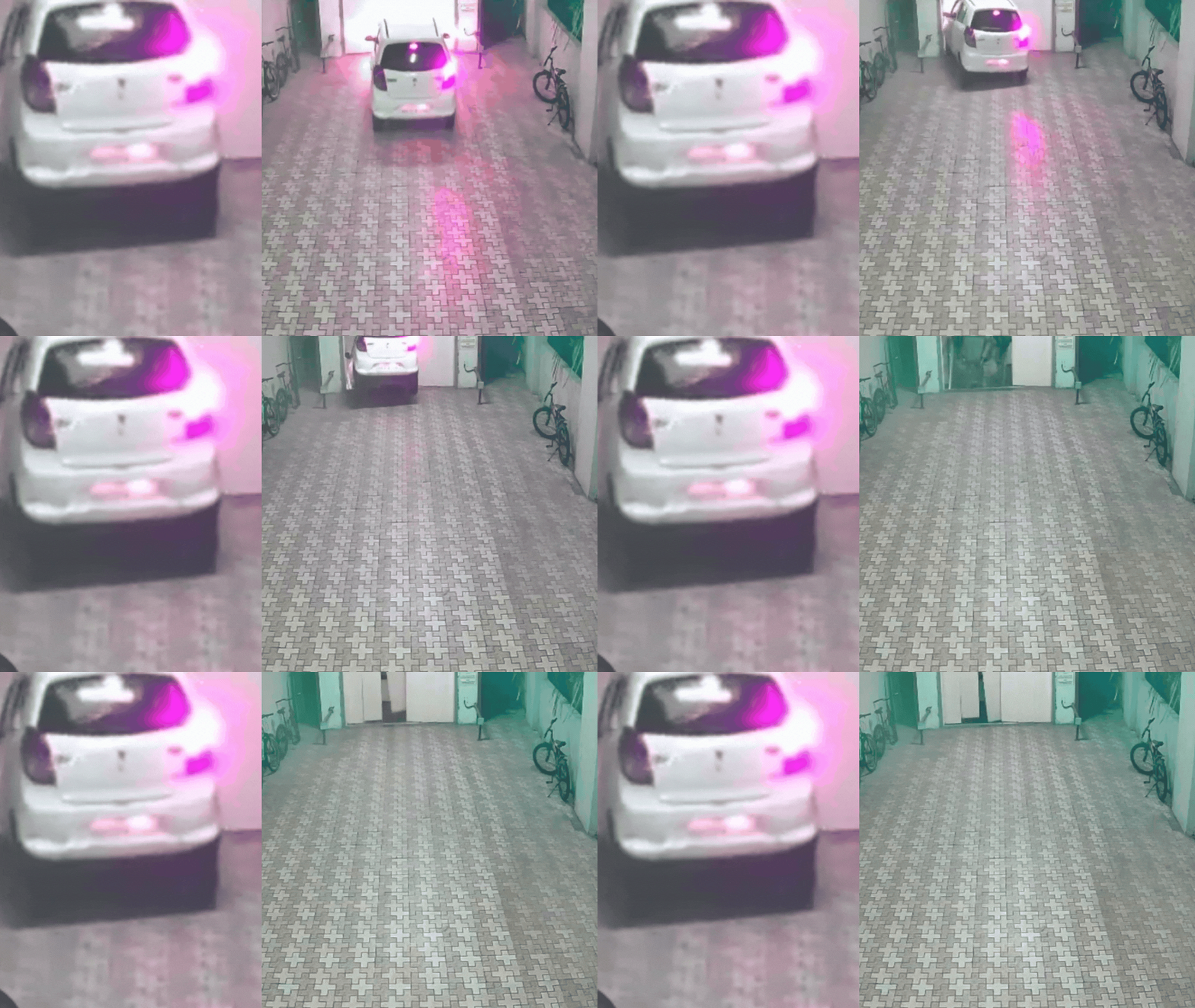

Watch: Valet drives car into parking lift shaft, plunges 2 floors | Mumbai News

Watch: Valet drives car into parking lift shaft, plunges 2 floors
A car fell about twenty-five feet down a parking lift shaft.

MUMBAI: A car, with the valet attendant seated inside, tum-bled about 25 feet down a parking lift shaft at a housing society in Charkop Sector 3, Kandivli West, around 9.30 pm on Monday. The incident occurred at the ground-plus-21-storey Horizon Gold building near Ganesh Chowk. According to information provided by the police, the fire brigade and the owner of the car, Subhash Kumar Yadav, the valet attendant was steering the car parked on the second-floor podium out of the building at the owner’s request. Yadav seemed to be unaware that the parking platform was not aligned with the lift and drove into the shaft instead. The Alto car, with Yadav seated inside, fell about 25 feet. People pre sent in the building managed to extricate Yadav and took him to the Aastha Hospital in Kandivli. “It is an unfortunate incident. The valet parking attendant claims to have lost control of the car. I had asked for the car to be brought out of the parking area as I was stepping out of the building. The attendant was bringing the vehicle out when the incident took place. It is not clear whether he applied the brakes or whether he couldn’t control the car de spite applying them and rammed through the metal sheets covering the entrance. In any case, it is human error, and it was not a deliberate act on the part of the attendant. Fortunately, the attendant escaped wit-hout serious injuries despite the car tumbling down,” said Vipul Doshi, the owner of the car and husband of BMC Improvements Committee Chair person Sandhya Doshi. Yadav (30), who suffered leg injuries, was treated at the hospital and discharged. Fire brigade officials said Horizon Gold is a residential building with a ground floor, four podium levels, and residential flo-ors from the fifth to the 21st floor. Following the incident, a crane was requisitioned, and a private Hydra crane was deployed to remove the damaged car from the parking lift pit. “It is for the police to investigate who is at fault in the incident,” said a fire brigade official. The Charkop police were summo-ned to the spot. Police said the car was completely mangled. However, they added that no complaint had been received.

Sharad Pawar: Sharad Pawar’s NCP removes all spokespersons but two — here’s who’s left | Mumbai News

Sharad Pawar's NCP removes all spokespersons but two — here's who's left
The Nationalist Congress Party (SP) dissolved all spokesperson appointments immediately.

MUMBAI: The Sharad Pawar-led Nationalist Congress Party on Tuesday dissolved all existing appointments to the post of party spokesperson with immediate effect and designated former MLA Vidya Chavan and Mahesh Tapase as the only authorised spokespersons until further orders.In a statement posted on X, the party said the decision had been approved by Maharashtra unit president and former minister Shashikant Shinde.“With the approval of the party’s Provincial President and former Minister Shri Shashikant Shinde, effective immediately from today, August 4, 2026, all previous appointments to the position of party spokesperson are hereby cancelled until further orders,” the statement said.It added that during this period, “former MLA Vidya Chavan and Shri Mahesh Tapase will represent the party’s official stand before the media as the party’s authorised spokespersons.”The reshuffle comes amid heightened political activity within the party, with speculation over its future strategy and internal differences on key political issues.Former party spokesperson Vikas Lawande accepted the decision, saying he remained committed to the party and its ideology.“All spokesperson positions have been cancelled. Accordingly, I am no longer in the party’s spokesperson position from today. The party’s decision is like an order for the workers. I accept it,” Lawande said in a post on X.Thanking the leadership for the opportunity to serve as spokesperson since 2015, he said he would continue to work to strengthen the organisation and uphold its “democratic, progressive and secular ideals.”National spokesperson Anish Gawande also posted a message reflecting on his two-year tenure, expressing gratitude to Sharad Pawar and MP Supriya Sule for entrusting him with the role.The development came on a day when the Congress and the Sunetra Pawar-led NCP traded barbs over the latter’s description of Maharashtra deputy chief minister Sunetra Pawar as “Gungi Gudiya” (silent doll).

Bombay HC grants bail to cocaine accused, flags gross procedure lapse | Mumbai News

Bombay HC grants bail to cocaine accused, flags gross procedure lapse
The Bombay High Court granted bail to a man accused of carrying cocaine.

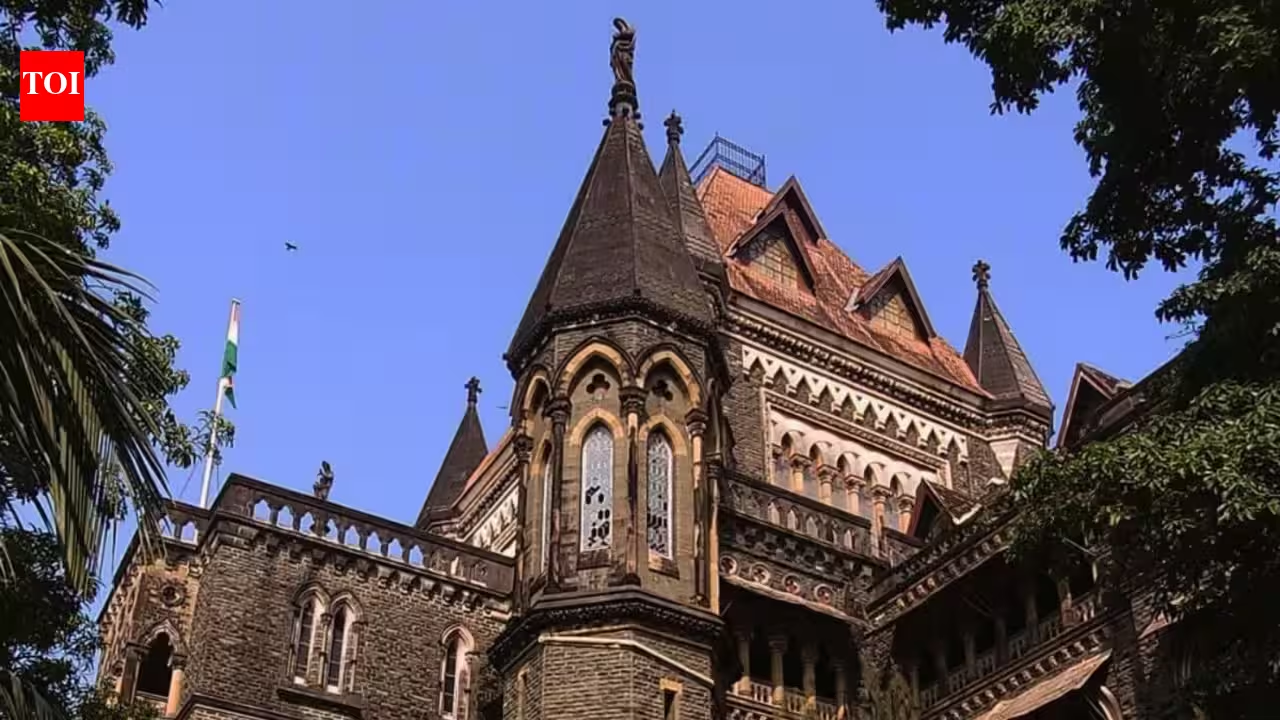
MUMBAI: The Bombay High Court has granted bail to a man accused of carrying nearly 1.5 kg of cocaine, observing that authorities had committed a “gross violation” of procedure by failing to produce him before the trial court on most dates for more than two years.A division bench of Justices Sarang V. Kotwal and Ashish S. Chavan passed the order on July 29 while hearing a habeas corpus petition filed by Satly Thomas, who is facing trial in an NDPS case arising from an investigation by the Directorate of Revenue Intelligence (DRI).According to the prosecution, DRI officials intercepted Thomas at CSMI Airport, , early on August 18, 2023, after receiving information that he was carrying narcotics concealed in his luggage. A search allegedly led to the recovery of three packets containing 666 grams, 629 grams and 467 grams of cocaine. The total net weight was 1,496 grams, substantially above the 100-gram commercial quantity prescribed under the NDPS Act.Thomas challenged his continued detention, alleging that although he was arrested around 2.30 am on August 18, 2023, he was shown as arrested only at 10.30 am the following day and produced before a magistrate at 4.20 pm on August 19.The High Court, however, focused on a more serious issue concerning his production before the court during custody. The court noted that between August 2023 and December 2025, Thomas was physically produced before the court on only five occasions out of 70 dates. Apart from these occasions, he was not produced either physically or through video conferencing, barring four attempts at connecting through video conferencing.The court also noted that after the Special Court took cognizance of the case on February 9, 2024, there was no communication between the trial court and the jail authorities regarding extension of his remand until April 2025.“This, in our opinion, is gross violation of the procedure,” the bench observed, holding that there was no authority for the Superintendent of Taloja Central Prison to keep Thomas incarcerated during that period of more than one year.Referring to a Supreme Court ruling which stressed that production of an accused before court is a fundamental safeguard against abuse and enables a prisoner to raise grievances directly before the court, the bench held that Thomas’s non-production amounted to a violation of his fundamental right to a fair trial under Article 21 of the Constitution.“The court said the seriousness of the alleged offence could not justify ignoring mandatory procedural safeguards. It consequently ordered Thomas’s release on bail on furnishing a personal bond of Rs 50,000 with one or two sureties of the same amount.” said advocate Prasanna Namboodiri.The court imposed stringent conditions, including mandatory attendance on every trial date, weekly attendance at the DRI office on Mondays between 4 pm and 5 pm, surrender of his passport, and a restriction on leaving the trial court’s jurisdiction without permission.

Bombay high court accepts CID closure report in 2007 builder murder plot case | Mumbai News

Bombay high court accepts CID closure report in 2007 builder murder plot case
The Bombay high court accepted a closure report in a builder conspiracy case (File Photo).

MUMBAI: Nearly 20 years after a criminal case was filed alleging a conspiracy to kill a builder in a redevelopment dispute, the Bombay high court has accepted the State CID’s ‘B-Summary’ closure report in the matter involving Shreepati builder managing director Rajendra Chaturvedi.It said that investigators found no material against the accused and that a Magistrate’s earlier refusal to accept the closure report went against the evidence gathered during the probe.A division bench of Justices A.S. Gadkari and Kamal Khata, in an order dated July 27, allowed a writ petition filed by Chaturvedi and a criminal revision application filed by the State CID. The court quashed and set aside the January 30, 2013 order of the Metropolitan Magistrate, 10th Court, Andheri, and accepted the B-Summary report submitted by the State CID, Konkan Bhavan, Navi Mumbai.The case originated in 2007 amid a dispute linked to a redevelopment project at Kalachowky, said to be worth around Rs 500 crore. Chaturvedi had contended that he was falsely implicated in a case alleging a plot to eliminate rival builder Rashmikant Shah.As per the allegations in the initial case, Juhu police in February 2007 intercepted four men near the Holiday Inn hotel in Juhu and claimed they had been hired to kill Shah. The police had alleged that Chaturvedi paid Rs 50 lakh for the alleged contract killing. The case had also, at one stage, seen consideration of invoking provisions of the Maharashtra Control of Organised Crime Act (MCOCA).Chaturvedi denied the allegations and maintained that the case was driven by business rivalry and efforts to frame him. The matter was later transferred for investigation to the State CID.During the CID probe, the agency raised questions about the prosecution narrative and indicated an alleged nexus involving the rival builder and certain police officers, suggesting Chaturvedi may have been framed. The investigation led to action against police personnel, with seven policemen suspended in connection with the matter, including then Additional Commissioner of Police Bipin Bihari, who has since retired.The CID also re-examined witness claims about the purported Juhu incident. According to findings placed before the Andheri court, witnesses who had earlier asserted they were present when Shah was allegedly fired at later denied that any such incident occurred.On the basis of its investigation, the State CID concluded there was no material to proceed against the accused and filed a B-Summary report seeking closure on February 13, 2008. The agency also submitted a report under Section 169 of the Criminal Procedure Code, 1973, seeking discharge of some accused due to insufficient evidence.However, the Metropolitan Magistrate, 10th Court, Andheri, rejected the B-Summary report and declined the Section 169 request in an order dated January 30, 2013.Chaturvedi then approached the High Court challenging the Magistrate’s decision and seeking acceptance of the closure report. The State CID filed a separate revision application seeking similar relief, with connected intervention applications also filed by another accused.In its decision, the High Court reviewed the investigation record and the material compiled by the CID, observing that the investigation led to the conclusion that the informant had lodged a false case.

Maharashtra imposes 1-year ban on analogue, non-dairy paneer | Mumbai News

Maharashtra imposes 1-year ban on analogue, non-dairy paneer
Maharashtra has banned unstandardised paneer statewide for one year.

MUMBAI: Maharashtra has imposed an immediate one-year statewide ban on the manufacture, distribution and sale of all unstandardised analogue and non-dairy paneer, citing serious public health concerns and widespread consumer deception.The ban also applies to hotels, caterers, restaurants and other eateries, making it illegal to manufacture, store, sell or serve such products across the state.Under the Food Safety and Standards (Food Products Standards and Food Additives) Regulations, 2011, paneer is defined as a standardised dairy product made exclusively from milk using permitted coagulants, with milk fat as an essential and non-substitutable ingredient.

CG imposes 1-yr ban on non-standard dairy analog paneer, cream and butter products

The regulations classify paneer into three categories based on fat content: standard paneer, which may be sold loose or packaged, and medium-fat and low-fat paneer, which can be sold only in sealed packages.Any product that substitutes natural milk fat with vegetable oils or other non-dairy ingredients violates the prescribed standards and cannot legally be labelled, sold or served as “paneer”, the order said.Authorities warned that violations could attract penalties ranging from monetary fines and imprisonment of up to six months to life imprisonment in cases involving serious health consequences.

British have returned. This time, through school gates | Mumbai News

British have returned. This time, through school gates
A number of heritage schools have set up base in India. But the central question is rarely asked: How much of the British school will actually travel? The Indian branch may carry the same name but without reproducing the same institution

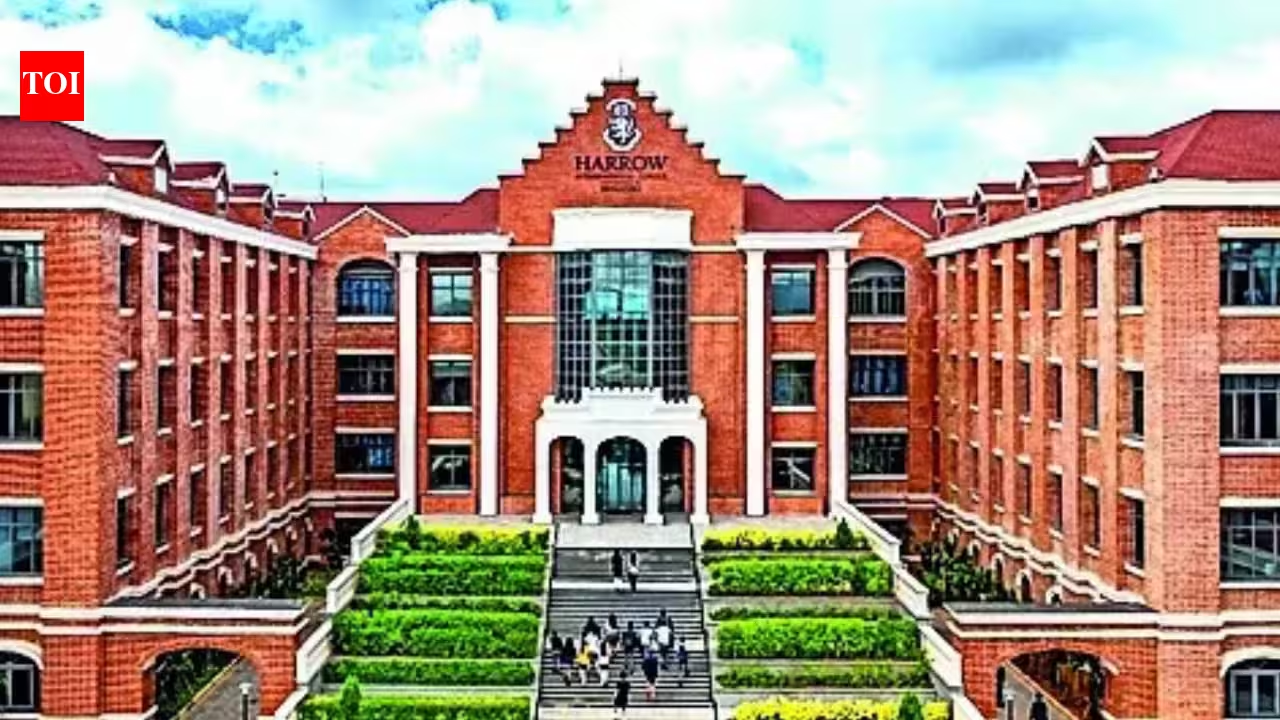
MUMBAI: In Gurgaon, a school carrying the name of Queen Elizabeth is preparing to open its gates. In Bengaluru, pupils already walk beneath the banner of Harrow. Pune has Wellington; Bhopal, Shrewsbury. In Hyderabad, Sagebrook, in partnership with Whitgift, has completed its first round of admissions. Another British grammar school, founded nearly five centuries ago, is now drawing up plans for Bengaluru. And Highgrove Education is going to Uttar Pradesh.The British have returned to India. This time, through school gates.There is no colonial officer at the blackboard. The new intermediaries are Indian education companies, real-estate developers and investment groups partnering with some of Britain’s oldest schools.“The transaction is wrapped in the language of global learning, leadership, heritage and international exposure,” said an expert watching the sector. But what is being imported is not merely a curriculum. It is a name and the history, prestige and the social aspiration that come with it.Queen Elizabeth’s School, established in Barnet in 1573, is scheduled to open its Gurgaon campus this month. The original institution is especially notable because it is a state-funded grammar school in England. But a school supported by public money at home will, in effect, lend its centuries-old heritage to a premium institution overseas.It is a curious reversal of history.Francis Joseph, India CEO of Dubai-based GEMS Education which operates schools in 10+ countries, calls arrival of British school franchises interesting, but says it carries an obligation. “Every global education brand entering India must remember one fundamental truth: schools are local learning communities, deeply rooted in culture, traditions, local languages and aspirations of the communities they serve,” he said.Swati Popat Vats, director of Inspirenext Learning Foundation, points to colonial education’s long shadow. One of colonialism’s most enduring legacies, she said, was the belief that imported knowledge was inherently superior to indigenous capability.Independent India has spent decades building confidence in its own education. “It would be unfortunate if education once again created a hierarchy in which foreign is assumed to mean better and Indian is viewed as needing validation from elsewhere,” she said.In Bengaluru, Harrow International School has placed one of British education’s most recognisable names on Indian soil. Even the uniform carries the weight of tradition: it includes a hat.Harrow’s appeal lies partly in its 450-year history. Founded under a royal charter during Elizabeth I’s reign, it counts statesmen and writers among its alumni. For Indian families, one name has particular resonance: Jawaharlal Nehru. That history is not decorative. It is central to the proposition. It’s the principal item being sold.“For Harrow School, however, this was never simply about establishing more schools. It was about extending the reach of a distinctive educational philosophy and finding communities that value an education which prepares young people not only for university, but for life,” said Caroline Pascoe, head of the institution in Bengaluru.In Pune, Wellington College International operates with the identity of Wellington College in England. In Bhopal, Shrewsbury International School India has introduced a British boarding-school model. The symbolism is almost too neat: a tradition once designed to educate an empire’s governing class is now being adapted for the children of India’s corporate elite.Royal Grammar School Guildford has partnered with the Ryan Group to establish four schools in India. The first, RGS Guildford Bengaluru, is expected to open in 2028.Hyderabad’s Sagebrook International offers another variation. It is not a transplanted British school, but advertises a partnership with Whitgift School, founded in 1596. “Ours is a collective model, not a prescriptive one. We feel there is a market for quality education with so many GCCs being set up and Indians from around the world returning home,” said Sagebrook founder Praveen Raju.But the central question is rarely asked: how much of the British school will actually travel? A crest can cross continents instantly. A curriculum can be licensed. Teachers can be trained, inspected and reviewed.Yet the Indian branch may carry the same name without reproducing the same institution. There is also a question of access. In Britain, Queen Elizabeth’s School is a selective state school. In Gurgaon, its international branch belongs to the premium private-school market. The name travels easily across borders; the social model does not.Joseph said schools must remain custodians of India’s heritage, values and aspirations. The future, he argued, belongs not to schools that are merely international, but to those combining global excellence with local relevance.These arrivals are not a residue of British rule. They represent commercial revival of British prestige. The old empire governed India. The new one invoices Indian parents.

12,000 doctors to boycott OPD from today, emergency services from tomorrow in Maharashtra | Mumbai News

12,000 doctors to boycott OPD from today, emergency services from tomorrow in Maharashtra
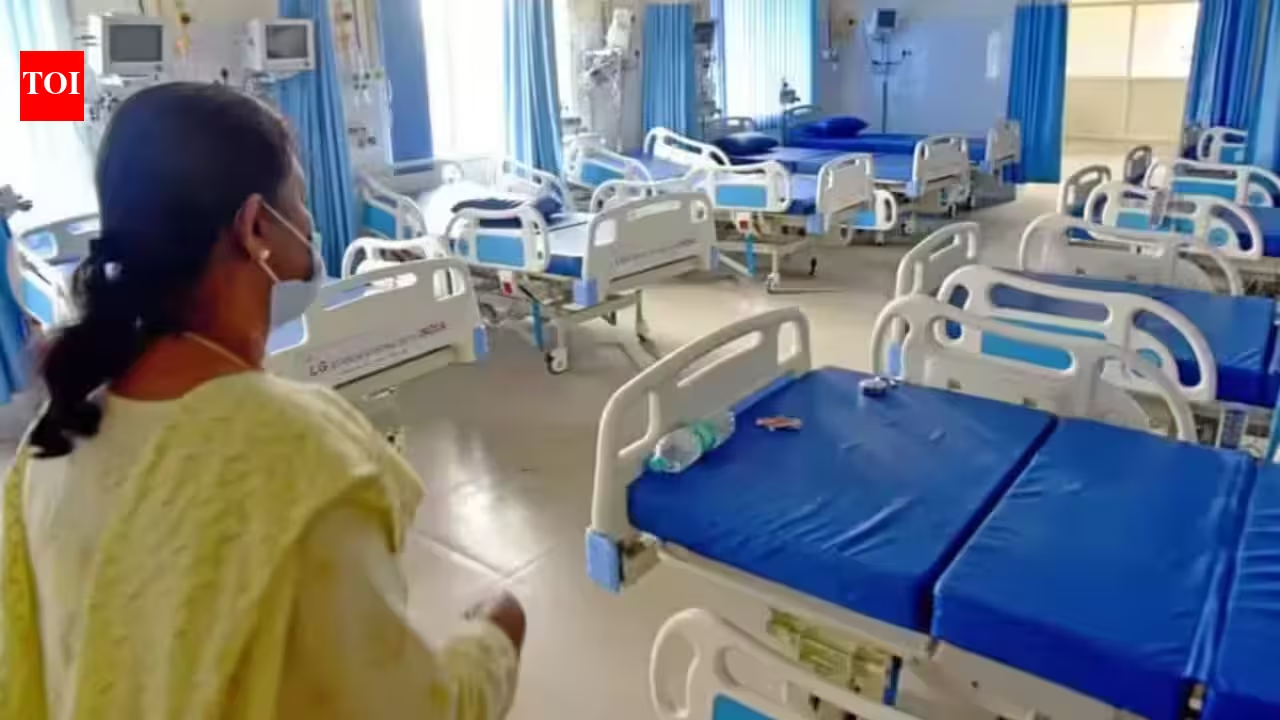
The Maharashtra Association of Resident Doctors (MARD) has also given a call for a strike, with 12,000 doctors set to boycott emergency services starting Thursday and OPD services from Wednesday. (Representational image)

MUMBAI: A government resolution (GR) on Monday paved the way for homeopaths to be registered, enabling them to prescribe modern medicines. The GR had directed MMC to begin registering homeopaths who had completed a one-year certificate course.However, not a single registration had been approved through the day and the first registration was done by 8.30pm. Soon after the GR, IMA’s call for a strike on Tuesday had received a lukewarm response throughout the city, with most clinics and OPD services functioning as usual.The GR has formed a committee to set-up a grievance me­chanism in case of negligence by homeopath, but until then, there is no framework to deal with such cases.Dr Shivkumar Utture, an IMA member and past MMC president, said that the move will have life-threatening consequences for the common people. The call for a first strike was issued late Monday, but many doctors were unaware of it.On Tuesday afternoon, Dheeraj Kumar, secretary of medical education, invited the IMA for further discussions.Dr Utture said the association was asked to keep emergency services functioning.“We were clear that this is our last option, to be used only if the MMC proceeds with registrations,” he said. The strike would also be extended to the Association of Medical Consultants (AMC), which includes specialty doctors.The Maharashtra Association of Resident Doctors (MARD) has also given a call for a strike, with 12,000 doctors set to boycott emergency services starting Thursday and OPD services from Wednesday.The move would impact government hospitals across the state. Moreover, over 2,000 resident doctors from four BMC-run medical colleges have also announced a strike on OPD services for Wednesday, and a further course of action will be decided based on developments of the day.Currently, 2,500 applications from homeopaths have been pending since last year. About 10,000 more have completed the one-year certificate course in pharmacology, which serves as the basis for granting these registrations.Speaking to the press as part of a debate at the Mumbai Press Club, Bahubali Shah, administrator of the homeopathic council, said there is no telling if the final order would be passed, as the case has been ongoing for the last 12 years.On the other hand, Dr Jayesh Lele, who was representing the IMA, said the rush to allow registrations before the final order is to fill up seats in private homeopathic colleges, many of which have political links.

BEST Launches Special Safety Training Drive for Wet Lease Bus Drivers | Mumbai News

BEST Launches Special Safety Training Drive for Wet Lease Bus Drivers
The proposal was cleared by the BEST committee on Tuesday

Mumbai : In a significant step towards strengthening passenger and road safety, the Brihanmumbai Electric Supply and Transport (BEST) Undertaking has launched a special safety sensitisation and training drive for approximately 5,200 Wet Lease bus drivers across Mumbai.The initiative follows a special meeting convened with all Wet Lease Operators on 24 July 2026 in the wake of the recent accident at Mankhurd. During the meeting, BEST management emphasized the need for enhanced safety measures and the importance of strict adherence to safe driving practices by all drivers operating buses under the Wet Lease model.The comprehensive training programme has been designed to reinforce defensive driving techniques and promote greater awareness of road safety standards. Key areas of focus include maintaining lane discipline, avoiding lane cutting, adherence to prescribed speed limits, keeping safe distances from other vehicles, and ensuring the complete prohibition of mobile phone use while driving. Drivers will also be sensitised to the importance of alertness, responsible behaviour on the road, and compliance with traffic regulations.The campaign will be conducted in coordination with Wet Lease operators across all BEST depots as well as at the Dindoshi Training Centre. The programme will include counselling sessions, safety briefings, interactive discussions, and practical training modules aimed at improving driving skills and decision-making under various traffic conditions.BEST management has reiterated that passenger safety remains its top priority and has directed all Wet Lease operators to ensure active participation of their drivers in the training programme. The Undertaking believes that continuous training, regular counselling, and sustained sensitisation efforts are essential to fostering a strong safety culture among drivers.Through this special drive, BEST aims to further strengthen operational safety standards, reduce the likelihood of accidents, and enhance the overall reliability and safety of Mumbai’s public transport system, ensuring a safer commuting experience for millions of daily passengers.Ends

BEST eyes higher FSI for transit-oriented development to fund BEST revival | Mumbai News

BEST eyes higher FSI for transit-oriented development to fund BEST revival
The proposal was cleared by the BEST committee on Tuesday

Mumbai: BEST general manager Sonia Sethi on Tuesday announced a massive Rs 28,000 crore BEST Kayapalat (transformation) project aimed at restoring the utility’s financial health and making it self-reliant. One of the key points in the plan is increasing FSI of BEST depot land from 1.3 to 7, thereby ensuring more revenue through premium FSI.The proposal was cleared by the BEST committee on Tuesday. The proposal will now be sent to the BMC, which will forward it to the Urban Development Department before placing it before the state cabinet for final approval.Another key point in the transformation plan includes the development of public parking facilities,creating 36,000 car parking spaces for Mumbai at the depots, and social infrastructure including schools, hospitals, art museums,theatres, sports centres and cultural centres and not just malls and commercial offices coming up at BEST properties across the city, she said.According to Sethi, the BEST has proposed Transit oriented development (Tod) at all bus depots across city so that they get more FSI — from 1.3 to 7. As per TOD, developers can leverage an increased FSI up to 7 within a 500-meter radius as has been done in the Metro-3 underground project. The premium FSI charges will be handed over to BEST — ensuring that it earns a huge revenue from the Transformation Project.“The upfront premium generated through the project will be used to clear liabilities, pay pending dues of retired and serving employees, and support the purchase and operation of BEST-owned buses. We plan to purchase 5,000 buses and recruit more drivers and conductors,” she mentioned at the panel meeting.The proposal envisages the creation of dedicated corpus and recurring funds to meet future financial commitments while reducing dependence on external financial assistance, said Sethi. “BEST is burdened with an accumulated deficit of over Rs 7,300 crore and liabilities exceeding Rs 14,300 crore. The administration has also estimated that procuring and operating 5,000 self-owned buses and meeting employee-related commitments would require an additional Rs 13,500 crore. Together, the undertaking would need nearly Rs 28,000 crore to achieve long-term financial stability,” she said.To address this challenge, BEST has proposed implementing the project through a Public-Private Partnership (PPP) model on a Design, Build, Finance, Operate and Transfer (DBFOT) basis. A key feature of the proposal is that ownership of all BEST land parcels will remain entirely with the undertaking, while private participation will be used to generate funds and modernise infrastructure.The BEST will secure permissions for mixed land use from the UD department while also looking at a lease of 49+49 years as has been done by the transport department for MSRTC land parcels across the state.BEST officials said the transformation project could help secure the undertaking’s future while enabling it to deliver modern, efficient and sustainable services to Mumbai’s commuters.The transformation plan has been prepared in line with directions from the chief minister and deputy chief minister, who also heads the Urban Development department. Sethi said the undertaking’s financial position has become increasingly unsustainable, making structural reforms unavoidable.