Maharashtra Plans Land Titling Law, Property Cards for All Owners | Mumbai News

Maharashtra Plans Land Titling Law, Property Cards for All Owners

Thane: Maharashtra is set to introduce a Land Titling Act that will replace the existing ownership record system with government-backed digital property titles, Revenue Minister Chandrashekhar Bawankule announced on Thursday.The proposed law, modelled on land title systems followed in Dubai and Singapore, is expected to be placed before the state legislature during the winter session. If passed, Maharashtra will become the first state in the country to implement such a framework.“Under the proposed system, property ownership will be established through a digital title record carrying details of the current owner, legal heirs, land records and complete property information, replacing the need to trace the entire chain of previous ownership. The government-issued property card will serve as an authenticated ownership document,” Bawankule said while addressing the ‘Society Manch’ programme organised by MLA Sanjay Kelkar and the Thane District Housing Federation.The minister also announced a “measurement first, registration later” policy, under which land measurement will become mandatory before any property transaction is registered. In addition, every flat owner in urban cooperative housing societies will be issued an individual vertical property card, a move aimed at streamlining ownership records and reducing disputes.

Bhiwandi building collapse that killed 10: Builder abroad, contractor may have died in crash, say cops | Mumbai News

Bhiwandi building collapse that killed 10: Builder abroad, contractor may have died in crash, say cops
The building came down sometime between 11.20pm on July 30 and 5pm on July 31, trapping several residents under the debris as they slept

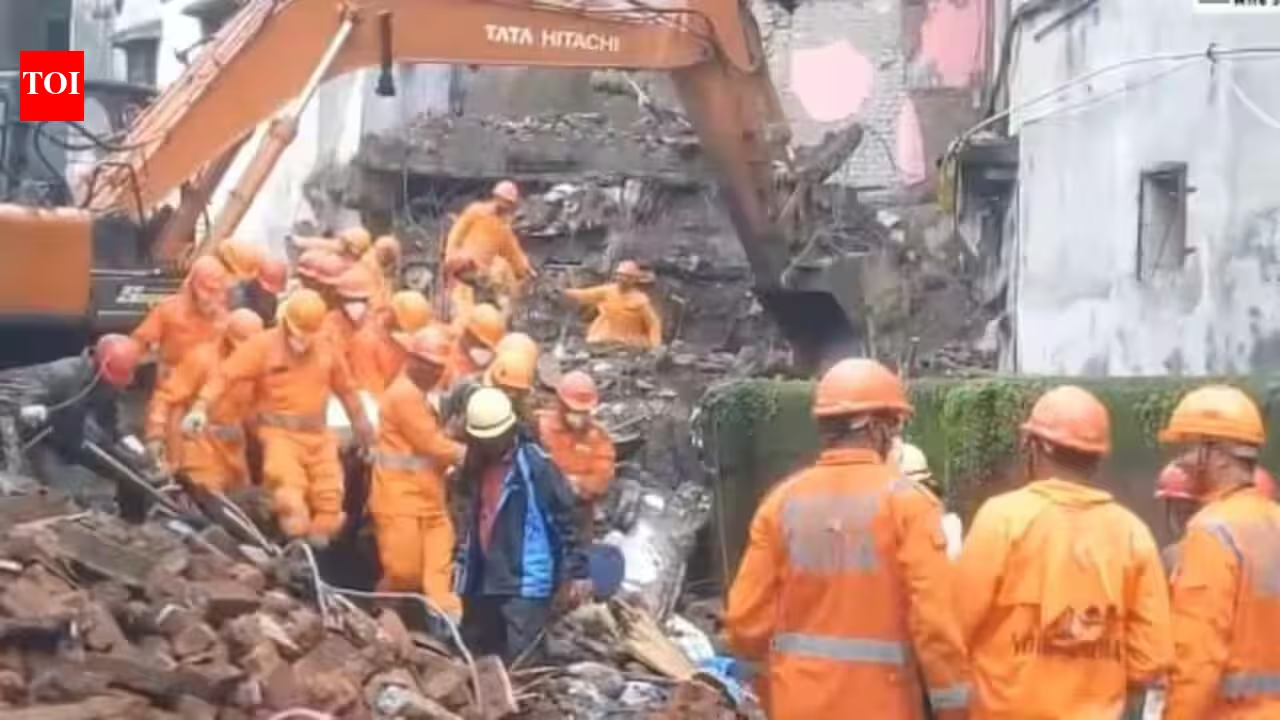
Thane: Poor quality construction spanning 13 years and unauthorised repair work that damaged the building’s structural pillars led to the collapse of a wing at Kohinoor Apartment in Gangaramwadi, New Tavare Compound, Bhiwandi, killing 10 people and injuring three others, following which police booked the building owner and the repair contractor for negligence. The building came down sometime between 11.20pm on July 30 and 5pm on July 31, trapping several residents under the debris as they slept.Police said the B Wing of the building had deteriorated rapidly despite being barely 13 years old, owing to extremely poor construction quality. The structure had been built without any sanctioned plans or approvals from the Bhiwandi Nizampur City Municipal Corporation, and had reportedly been flagged as structurally unsound by civic authorities on more than one occasion. The owner, identified as Bilal Ahmed Abubakar Khan, a Mumbai resident, allegedly ignored repeated notices warning that the building was unsafe for habitation, and made no effort to evacuate tenants despite being fully aware of the risk to their lives.Investigators said the immediate trigger for the collapse was unauthorised repair work carried out without civic permission in the days leading up to the incident. A contractor identified only as Ashok allegedly undertook structural repairs with gross negligence, compromising and damaging load-bearing pillars on the lower floors, which directly caused the structure to give way and cave in on itself.Among the deceased were residents aged between 30 and 48 years, most of them daily-wage workers and their family members who lived on rent in the building. Three others, aged between 24 and 36 years, were pulled out with injuries and are undergoing treatment. Rescue teams, aided by disaster response units, worked through the night clearing debris in search of survivors before the operation was formally called off.An FIR was registered at Bhoiwada police station following a complaint by an assistant commissioner overseeing unauthorised construction at the municipal corporation. Cases have been filed against the building owner and the contractor under the relevant sections.The FIR was registered on the complaint of an assistant commissioner from the municipal corporation’s unauthorised constructions department. Police invoked Section 105 (culpable homicide not amounting to murder), Sections 125(a) and 125(b) (acts endangering life and causing hurt), and Section 3(5) (common intention) of the Bharatiya Nyaya Sanhita, along with Sections 52 and 53 of the Maharashtra Regional and Town Planning Act relating to unauthorised construction.Bhiwandi police have launched a manhunt to trace Bilal Ahmed Abubakar Khan. A police team was sent to his Mumbai residence to apprehend him, but he is believed to be abroad. Investigators are now gathering details of his travel and are exploring legal options to secure his return. The contractor, Ashok, who has also been booked in the case, is suspected to have died, though police officials said they are yet to officially verify and confirm reports of his death.Police said further investigation is underway to establish the full extent of negligence by both the owner and the contractor, and to examine whether municipal officials failed to act on earlier complaints about the building’s dangerous condition. “We have sought the documents of the building and its land from the concerned authorities,” said Vikram Mohite, senior inspector of Bhoiwada police station.Originally from Madhubani district of Bihar, Ram Vilas Ram, a survivor of the Bhiwandi building collapse, recalled that he noticed a crack in the building around 8.30 pm, after which someone placed a temporary support under a pillar. Around 11.20 pm, just as he was about to sit down for dinner at his rented apartment on fourth floor, with his wife and two children, the building suddenly collapsed. Fearing for their lives, he wrapped his family in a thick blanket as a section of the structure came crashing down in front of them, leaving them stranded and unable to move.In a desperate attempt to attract attention, Ram switched on the torch of his mobile phone, which was spotted by rescue personnel, leading to the family’s safe evacuation. ,Ram said he has been working in Bhiwandi’s powerloom sector since 1994. Following the collapse, he and his family are staying at a nearby temple, where locals are providing them with food and other basic necessities.

Thane Municipal Chief Submits Balkum Data Centre Report to State | Mumbai News

Thane Municipal Chief Submits Balkum Data Centre Report to State

Thane: Thane Municipal Commissioner Saurabh Rao has submitted a detailed report on the Balkum Data Centre to the Principal Secretary, Industries after a detailed meeting with representatives of Amazon Data Services India and citizen group We are Thanekar.“The report records concerns raised by us and affected residents regarding the proposed Data Centre relating to land use, public health, environmental impact, safety issues due to fuel storage, impact on traffic, and the need for wider public consultation. We have been informed that the matter has now been escalated to the state government for further consideration,” said activist Dayanand Nene.The team said they are now waiting to present their stand before the state authorities.

Versova set to be new Bandra as builders line seafront with 35-floor luxury redevelopment towers | Mumbai News

Versova set to be new Bandra as builders line seafront with 35-floor luxury redevelopment towers
According to data collated from local sources in Versova, sea-facing societies/plots are expected to add about 10 lakh sq ft of RERA carpet area for sale

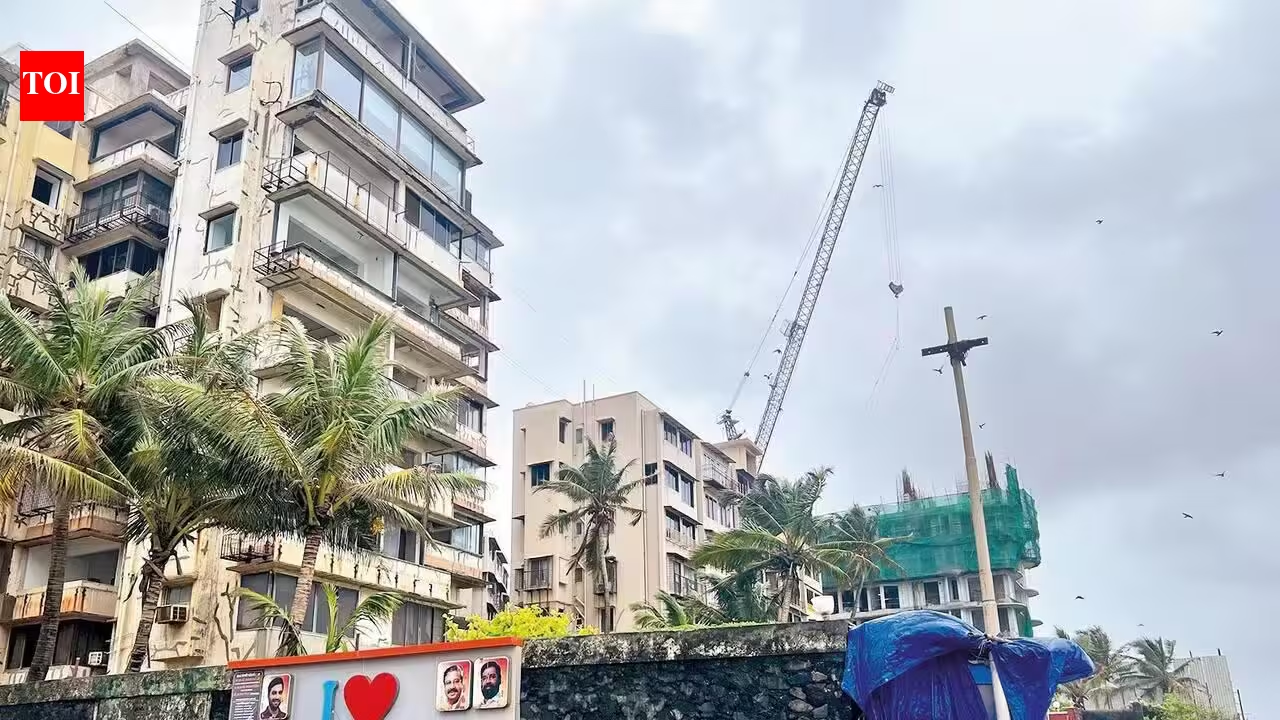
Mumbai: Once a quiet fishing village of shorefront bungalows, Versova, with its low-rise, middle-class housing societies that rose in the 1980s and 1990s, is now becoming a skyscraper enclave for the ultra-rich.Along a 2km stretch from J P Road — running from Seven Bungalows bus depot to Yari Road bus depot— as many as 26 housing societies have signed redevelopment deals with some of Mumbai’s biggest builders.Many of these plots are close to the beach, and some directly touch the sea. Where four- to-seven storey buildings once defined the horizon, 25- to 35-storey luxury towers are planned. Local property dealers say they expect over 3,600 new apartments in the free sale component to flood the market in the next five years in this locality. “This translates to a huge inventory build-up of at least 120 months,’’ one of them said.The numbers reveal the scale. According to data collated from local sources, sea-facing societies/plots are expected to add about 10 lakh sq ft of RERA carpet area for sale. Existing members in these sea-touching societies are being offered extra area in the range of 50% to 70% — a 700 sq ft home can become 1,110 to 1,200 sq ft — along with corpus payments ranging from Rs 2,500 to Rs 6,000 per sq ft.In the non-sea-facing category, around 3,000 flats are in the pipeline, with about 45 lakh sq ft of RERA carpet area for sale. Here, extra area offers range from 33% to 53%, and corpus typically falls between Rs 2,500 and Rs 4,000 per sq ft.This is only the first wave. At least another 25 societies — comprising around 30 to 35 buildings — are up for redevelopment and are currently in tendering.For existing residents, the redevelopment pitch arrives wrapped in aspiration: larger homes, new amenities, modern lobbies, mechanised parking, branded finishes. But beneath the shine is a fear that Versova is building towers without building the infrastructure to support them.Architect and Versova resident Sanjeev Punjabi, argues that the area’s biggest threat is not merely vertical growth, but the sudden surge of vehicles and services it will trigger.With new links planned to improve connectivity — projects like the Coastal Road extension towards Lokhandwala Complex and further to Malad North, and the Bandra-Versova Sea Link — Punjabi warns that better access could become an “undoing” if Versova’s internal roads and junctions remain unchanged. “Thousands of cars will ply,” he cautions, shifting congestion to choke points like the Versova junction. The glamour of “Italian marble in the lobby”, he says, distracts from fundamental questions: sanitation capacity, water supply, parking spill over, and what happens once you enter Versova’s narrow street grid.Dhaval Shah of the Lokhandwala Oshiwara Citizens Association traces the construction boom to the last three years and predicts a branding shift: “Versova will be the new Bandra.” His warning is not about status but preparedness. Luxury sea-facing apartments in the new towers are commanding around Rs 1 lakh per sq ft, yet the neighbourhood, he argues, is not being upgraded in proportion to the price tags. The fear is that a premium skyline will sit on top of overstretched civic systems.Punjabi warns about towers rising above the tree canopy, leaving fewer setbacks and less open breathing space. More podiums and basements are being planned, and mechanised parking systems are becoming standard — solutions on paper that can create new choke points at entry ramps, and new maintenance headaches once societies take over.Developer Vishal Ratanghayra of Platinum Corp, who is redeveloping a Versova society, said authorities will be required to gear up the social infrastructure and civic infrastructure like healthcare, sewerage, drainage, and utilities. “Not achieving this and coupled with rapid redevelopment will lead to traffic jams, water shortages and overwhelmed sanitation systems in Versova and in surrounding areas,’’ he said.Versova’s transformation also carries a quieter loss: the thinning of memory. The area’s identity is still tied, in popular language, to Seven Bungalows — yet none of the original seven bungalows remain. They were built after the plague hit the city in 1896, when wealthy families sought a calmer edge outside the dense core. An INTACH report records their names — Talati Bungalow, Kaikei Villa, Rus Cottage, Jasbir Villa, Gulistaan, Vijay Bhawan and Shanti Niwas — and the constellation of owners that included the Maharaja of Gwalior, the Maharaja of Kutch, Dadabhai Naoroji, scholar Rustom Masani, Sorabji Talati, and families such as the Chinais and Khambattas. Coconut palms, sea and sand framed those homes. Today, the names survive largely as a label on bus depots and real estate listings.


Birth certificate bottlenecks leave weddings, visas in limbo; BMC seeks 7 more registrars | Mumbai News

Birth certificate bottlenecks leave weddings, visas in limbo; BMC seeks 7 more registrars

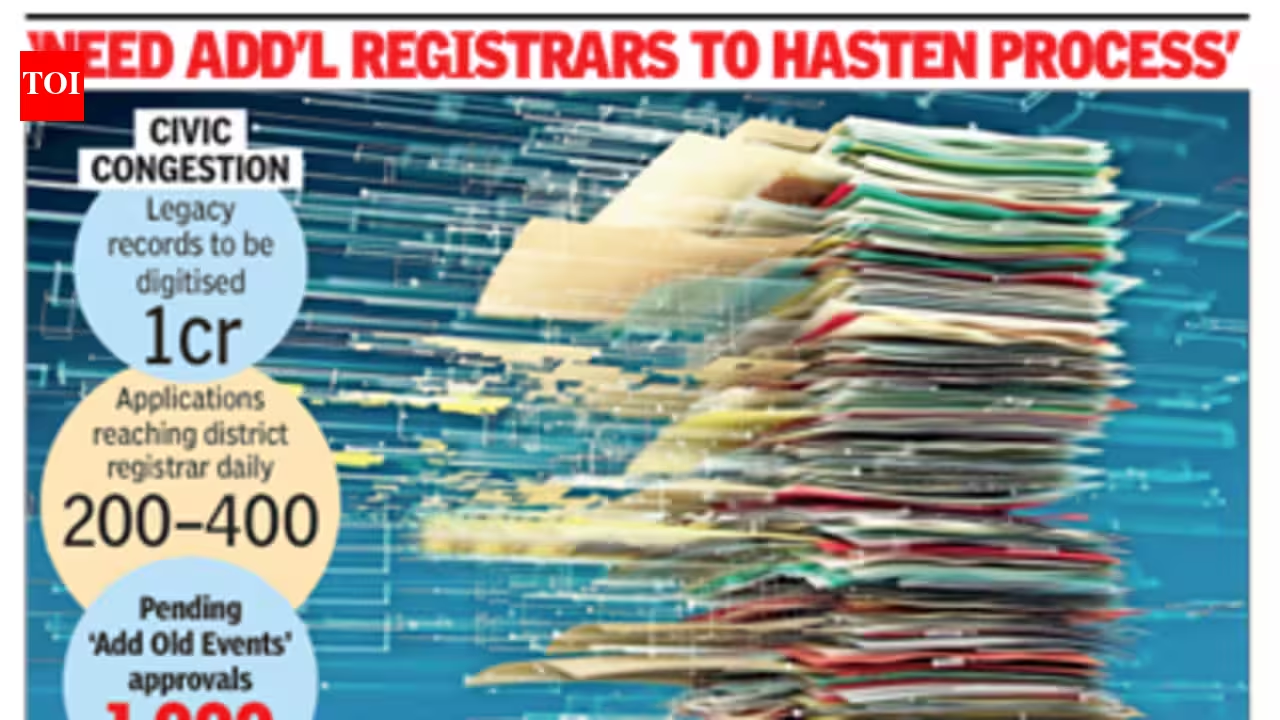
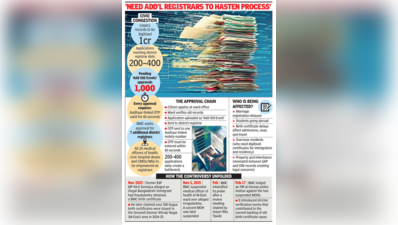
Mumbai: A Goa woman has postponed her wedding registration after waiting months for a correction to her Mumbai birth certificate. A Bandra family fears a nephew’s Dutch residency application could be jeopardised because they have been told a digitally printed birth certificate may take up to eight months. Students headed overseas are struggling to meet admission and visa deadlines.BMC has now formally admitted it’s facing a severe bottleneck in processing old birth and death records. In a July 22 letter to the Registrar General and Census Commissioner of India, municipal commissioner Ashwini Bhide sought approval to appoint seven additional district registrars to speed up approvals of nearly “one crore legacy records”. The existing system is overwhelmed, says her letter.The letter, accessed by TOI, says 200–400 “Add Old Events” applications reach the district registrar every day, while nearly 1,000 applications are pending approval. Under the new Civil Registration System (CRS), every approval requires an Aadhaar-linked one time password (OTP) sent only to the district registrar and valid for 60 seconds.“It is physically not possible for the district registrar to provide this number of OTPs within 60 seconds,” the letter states.Mumbai has nearly one crore legacy birth and death records in manual and electronic formats that must be digitised under Registrar General’s new guidelines. Demand has surged as citizens require birth certificates for passports, marriages, admissions, visas, inheritance claims and other legal purposes.To ease the bottleneck, BMC has requested Centre to designate seven deputy executive health officers as additional district registrars with separate logins to process approvals. It has also sought permission from Maharashtra govt to empower all 26 medical officers of health, along with deans and chief medical officers of civic hospitals, to function as registrars.For applicants, the delays have become deeply personal.A 27-year-old woman now living in Goa said she applied in March to correct her full name on her birth certificate after being told the process would take 10 days. “My fiancé came from abroad in June, but we couldn’t register our marriage. We’ve postponed it to September and still don’t know when the correction will happen,” she said.An Andheri resident alleged that corrections made by BMC in its SAP system in 2019 are still not reflected in the new CRS portal. “BMC is not willing to honour certificates issued by itself and isn’t giving any clarity. I’ve been following up since May,” the resident said, adding that the discrepancy could create complications in inheritance matters.In another case, a Bandra West resident said his nephew in the Netherlands urgently needs a digitally printed birth certificate for permanent residency but has been asked to wait six to eight months despite seeking no corrections.Former BJP MP Kirit Somaiya, who had earlier exposed alleged irregularities in birth registrations, said the issue does not affect new registrations.“There is no problem in obtaining birth certificates for newborns within 21 days. Corrections are also possible if adequate documentary proof is submitted. The issue arises mainly with decades-old handwritten records, which need to be digitised before corrections are made,” he said.He said the digitisation process was made mandatory after the birth certificate scam he exposed in which 86,000 fraudulent certificates were reportedly issued under the guise of corrections.A BMC health department official said, “We are afraid. Our colleagues have been suspended; FIRs are being filed. Why are we being targeted?”Congress MLA Amin Patel said genuine applicants are paying the price. “Students admitted to universities abroad are the worst affected. Delays are disrupting visa processing and travel plans,” he said.Former Congress corporator Asif Zakaria alleged the process has become excessively centralised. “Earlier, certificates issued after 2002 were available from citizen facilitation centres across Mumbai,” he said. Now, applications are routed through ward offices before being sent to Central Record Centre in Parel for verification, creating delays even for records that are already digitally available.The crisis comes amid an ongoing investigation into irregularities in birth registrations. A Mumbai Police SIT is probing suspected unauthorised changes to birth records after BMC found discrepancies between corrections made in its in-house SAP system and those recorded on the official CRS portal. It suspended two medical officers and lodged an FIR alleging irregularities in birth registrations.BMC is also developing software for birth certificate applications and correction requests that will allow uploads and provide a dashboard to track applications.

CBI admits Sheena Bora murder case documents untraceable, Mumbai court orders affidavit | Mumbai News

CBI admits Sheena Bora murder case documents untraceable, Mumbai court orders affidavit

Mumbai: In the 2015 Sheena Bora murder trial, the CBI admitted before a special court on Saturday that initial communication documents sent by the investigating officer to various authorities are currently “untraceable”. Taking note of the missing documents, Special Judge J P Darekar directed the CBI’s chief investigating officer to file a formal affidavit on the issue by August 5.The revelation came during the Supreme Court-expedited trial proceedings. The special public prosecutor informed the court that these initial communications were neither included in the list of relied-upon documents nor the un-relied documents, and cannot be located.Defence advocates strongly objected, accusing the CBI of suppressing foundational documents from both the defense and the court. They argued that the absence of these initial communications severely hampers the accused’s ability to mount a proper defense and jeopardises the fairness of the trial. The defence further argued that without the originating correspondence, any replies received by the investigating officer (IO) during the probe would lose their evidentiary value.Observing the necessity of ensuring a fair trial, the judge noted that the prosecution’s admission was only made orally. The court directed the CBI to formally put their submission on record.Meanwhile, the recording of evidence continued with the 149th prosecution witness, Kaushal Kishore Singh, the investigating officer. The matter will continue on Monday.The CBI’s case is that Indrani Mukerjea, along with her former husbands Sanjeev Khanna and Peter Mukerjea— who in 2015 was still married to her — and their driver Shyamvar Rai hatched a plan to abduct and murder her daughter Sheena and attempt to murder her son Mekhail. The CBI claimed that on April 24, 2012, Indrani, Khanna, and Rai abducted Sheena in a car, administered sedatives, strangled her, and disposed of her body in a forest in Pen in Raigad district. The alleged crime came to light in August 2015. Rai turned approver and deposed as a prosecution witness.

Alert policewoman prevents suicide bid at Dadar station. | Mumbai News

Alert policewoman prevents suicide bid at Dadar station.

Mumbai: An alert policewoman averted a suicide attempt by a passenger at Dadar railway station on the Western line recently. CCTVs captured the incident.On July 30, female police constable AA Narvade was patrolling on platform no. 1. Around 10.52 pm, a Borivali-bound slow local started to move from Dadar station. A passenger suddenly lied down on the platform and slid his neck into the gap between the rake and the platform. He was trying to end his life when Narvade caught him by his legs and pulled him away from the gap. She later inquired about his name and address, but he refused to answer any questions.