
‘Academics, art can coexist’: Mumbai girl hits back at BJP ‘Gen Z’ post, claims scored 93% in Class 10 and 12 | Mumbai News

'Academics, art can coexist': Mumbai girl hits back at BJP 'Gen Z' post, claims scored 93% in Class 10 and 12
A BJP Chhattisgarh social media post contrasted two Gen Z mindsets using a dancer’s video. Urwashi Palandurkar accused the party of using her footage without permission.

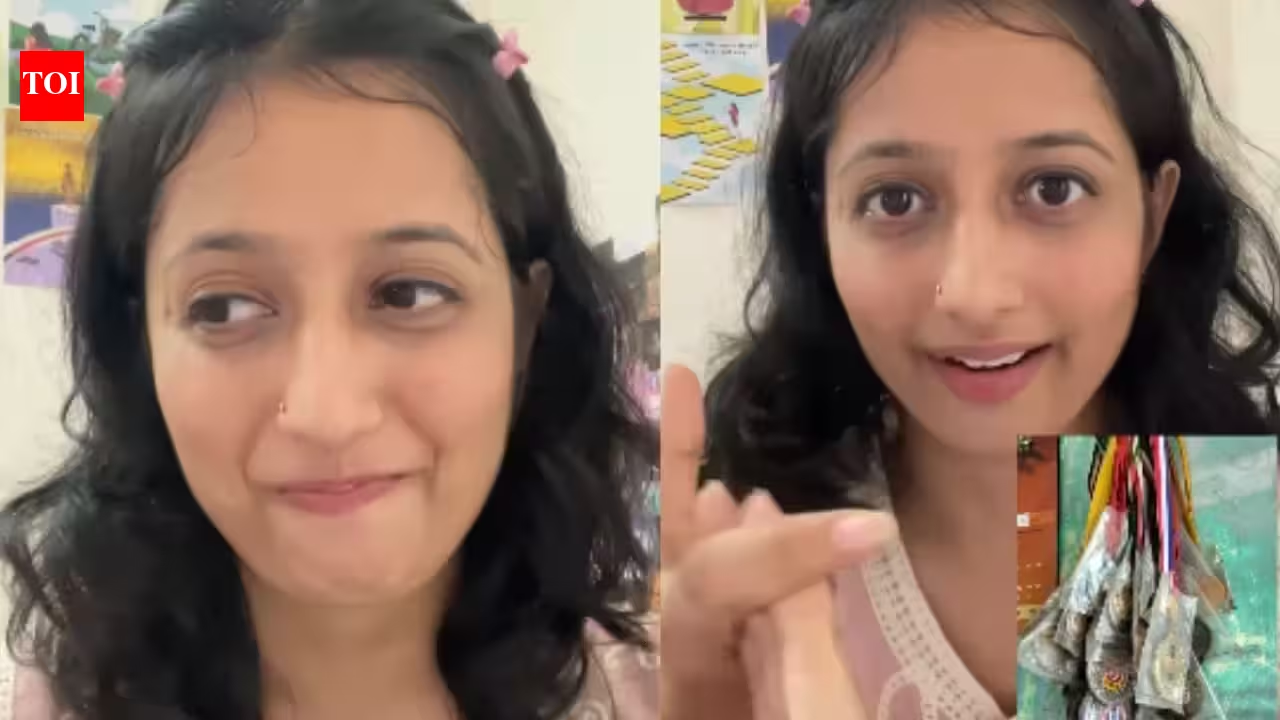
MUMBAI: A social media post by the BJP’s Chhattisgarh unit contrasting two “Gen Z mindsets” has sparked a political row after Mumbai-based professional dancer and content creator Urwashi Palandurkar, whose protest video was used in the post, accused the party of using her footage without permission and responded with a sarcastic rebuttal that has since gone viral.The BJP Chhattisgarh post asked, “Which mindset Gen Z will you choose?” On one side, it featured a video of Palandurkar with the caption, “Babar ki virasat par thumke lagane wali Gen Z.” On the other, it highlighted 14-year-old national judoka Yogita Mandavi, who was recently conferred the Pradhan Mantri Rashtriya Bal Puraskar by President Droupadi MurmuPalandurkar, who has over 3,00,000 followers on Instagram, first posted the protest dance video during the NEET protest, where it went viral and has since garnered more than 24 million views. Reacting after the BJP post on Instagram, she alleged that her video had been used without her permission. She said the post had led to her direct messages being flooded with people asking if she was okay. Her reaction reel carried the caption: “Please watch till end🙏 I AM NOT OKAY!!!! Not okay with reaching and being followed by the wrong audience 💀 The right ones please engage and help me get my cult balance back🥹🎀.” Beginning the video with a serious expression before bursting into laughter, she said, “No, I am not okay. I am that Gen Z student who is facing all this.”Calling it her “reaction video”, Palandurkar responded point by point to the BJP’s post.Mocking the caption, she said, “Your caption game is very weak. Your ChatGPT is not giving you good responses. What is ‘Babar ki virasat’? We can’t relate with it. Make it more relatable.”She also accused the party of trying to divide young people. “Divide and rule in 2026? You’re trying to divide the same Gen Z whose unity taught Parliament the term ‘Gen Z’. Logic is not logicing,” she said.Responding to the comparison between academic excellence and extracurricular activities, Palandurkar said both could coexist. “I got 93% in Class 10 and 93% in Class 12. I danced and created content throughout,” she said, showing photographs of medals and certificates displayed at her home. She added that the awards reflected achievements in academics as well as yoga, karate and other activities.“Extra-curriculars and academics can coexist, and I am living proof of it,” she said.Defending street performances during protests, she added that dancing in public had long been associated with celebration. “I’ve always seen people dancing on the streets after victories. I don’t know why it is not clocking.”She also joked about what she called the “brown girl trauma”, saying, “Being a brown girl, our parents have already taught us how to deal with trauma. You guys are not able to give trauma. Try harder.”Ending the video, Palandurkar acknowledged that she had approached the issue humorously despite its seriousness before signing off with a sarcastic remark, “Vastaguna huiya.”

Rahul Gandhi story snip

The reel has gained traction online and entered the political discourse. Congress leader Rahul Gandhi shared it on his Instagram Story, while Samajwadi Party chief Akhilesh Yadav posted on X: “Those who are companions on the new path, don’t think that they are misguided.”The BJP Chhattisgarh unit has not publicly responded to Palandurkar’s allegations that her video was used without permission.
Treat South Bombay eatery’s suspension as improvement notice, HC tells FDA | Mumbai News

Treat South Bombay eatery's suspension as improvement notice, HC tells FDA

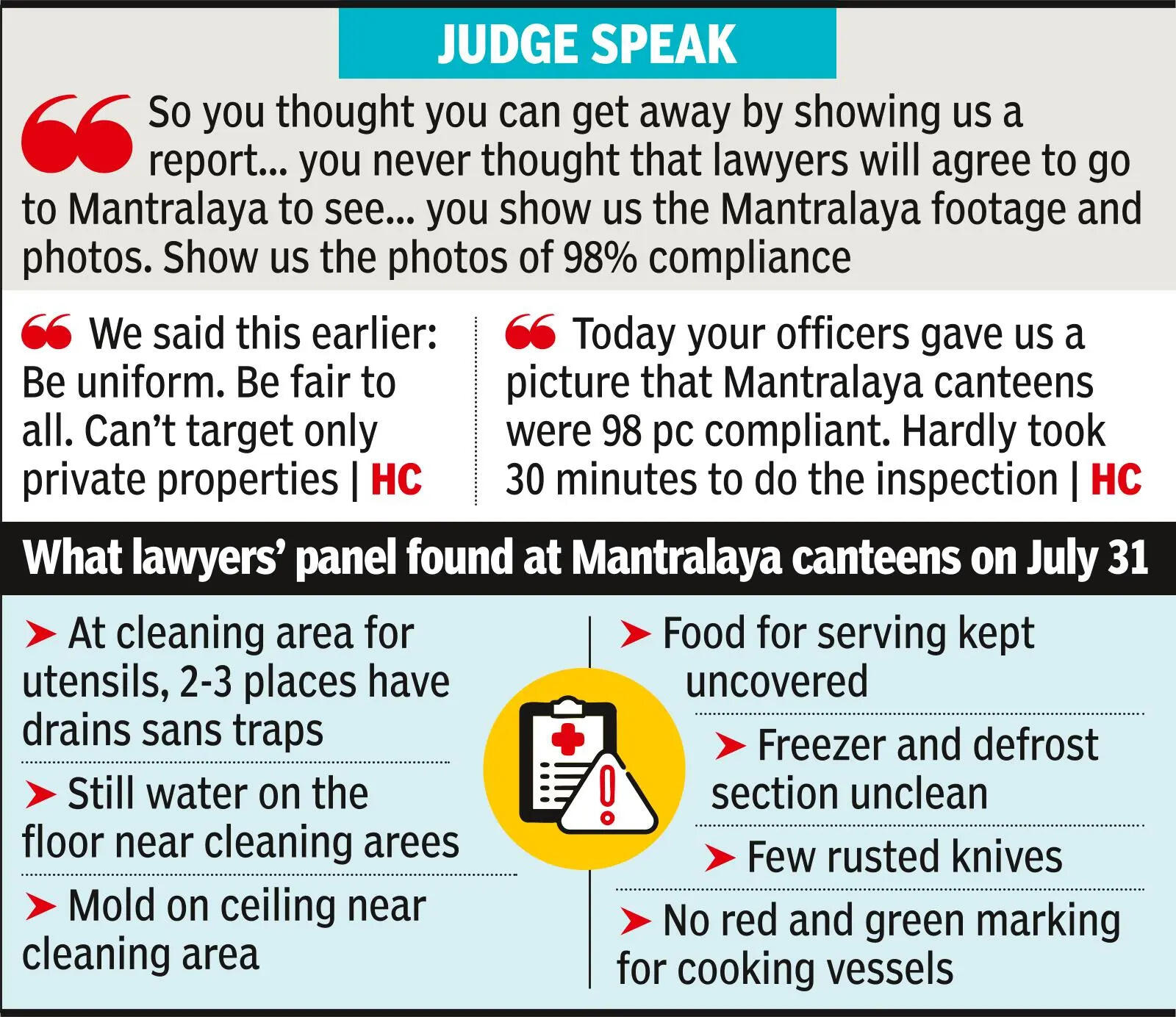
MUMBAI: A High Court bench of acting CJ Ravindra Ghuge and Justice Gautam Ankhad directed that suspension of Poornima restaurant be treated as an “improvement notice” till next Tuesday, with fresh inspection on Wednesday. “All litigants should be treated equally before the law. No special treatment to any, and FDA inspections cannot be lopsided,” the court said.The Udupi restaurant’s owner Pramod Nayak had challenged the July 23 suspension of its Food Safety and Standards Authority of India (FSSAI) licence. The state lawyer said Mantralaya’s canteens had received a 98% compliance report from the FDA team. The HC sought action by FDA against officials who completed the inspection at Mantralaya in 30 minutes and gave the high compliance report. Poornima said the inspection at its 600sqft area went on for five hours. HC pointed out that in the case of Park Inn by Radisson, the inspection went on for 8-10 hours.

Treat SoBo eatery’s suspension as improvement notice, HC tells FDA

Remarking that FDA officers have taken a “chance” with the court, the bench said they (FDA) did not expect that lawyers would be ready to visit the Mantralaya canteens.Representing Poornima, senior counsel Venkatesh Dhond, with Mayur Khandeparkar and Sameer Pandit, had questioned the variance at play. Dhond said “no food samples were taken during the inspection at Poornima, so how can they decide if food was unsafe”; FDA had cited hygiene issues and “fungal” growth on raw food like drumsticks and black spots on bananas. Dhond said uneaten bananas at his home turn black. Acting CJ Ghuge added, “Even at my home.The bench said, “We must appreciate that FDA is taking action,” but added, “It must be equal to all.” State lawyer Pooja Patil said there was videography of the inspection…of the drainage condition. Justice Ghuge responded, “Show us the videography right now. Also show us the footage from Mantralaya.” Grilling the state and FDA lawyer, the judges said, “Under what circumstances are you giving improvement and suspension notices? Do you have parameters? Ask your officer why on the same day when inspection is done is a suspension notice given? Why is no improvement notice given first?”Patil then sought time and the matter was kept back for hearing post lunch when the advocates’ panel comprising Suresh Sabrad, Feroze Bharucha, Kainaz Irani and Swanand Ganoo submitted its report and photographs of the Mantralaya canteens. Holding up photos from Mantralaya and Poornima, HC said, “Tell us why suspension for some? If one is bad, so is the other.” The HC read the advocates’ report of 3 canteens (2 at Mantralaya, 1 at Vidhan Bhavan) and said 2-3 cockroaches were spotted on the wall. The state lawyer said the FDA was agreeable to an “improvement notice” to Poornima and the matter could be heard next week. The hearing is now on Aug 6. Meanwhile, three hospitality industry bodies-HRAWI, NRAI and AHAR-have petitioned the PM, state CM and FSSAI, seeking mandatory improvement notices, a review of the June 23 compliance order and restraint in premature public disclosure.

HC trashes BMC’s waste management near Mumbai heritage sites | Mumbai News

HC trashes BMC’s waste management near Mumbai heritage sites
The HC sought ward-wise action to ensure strict and constant vigilance against garbage dumping

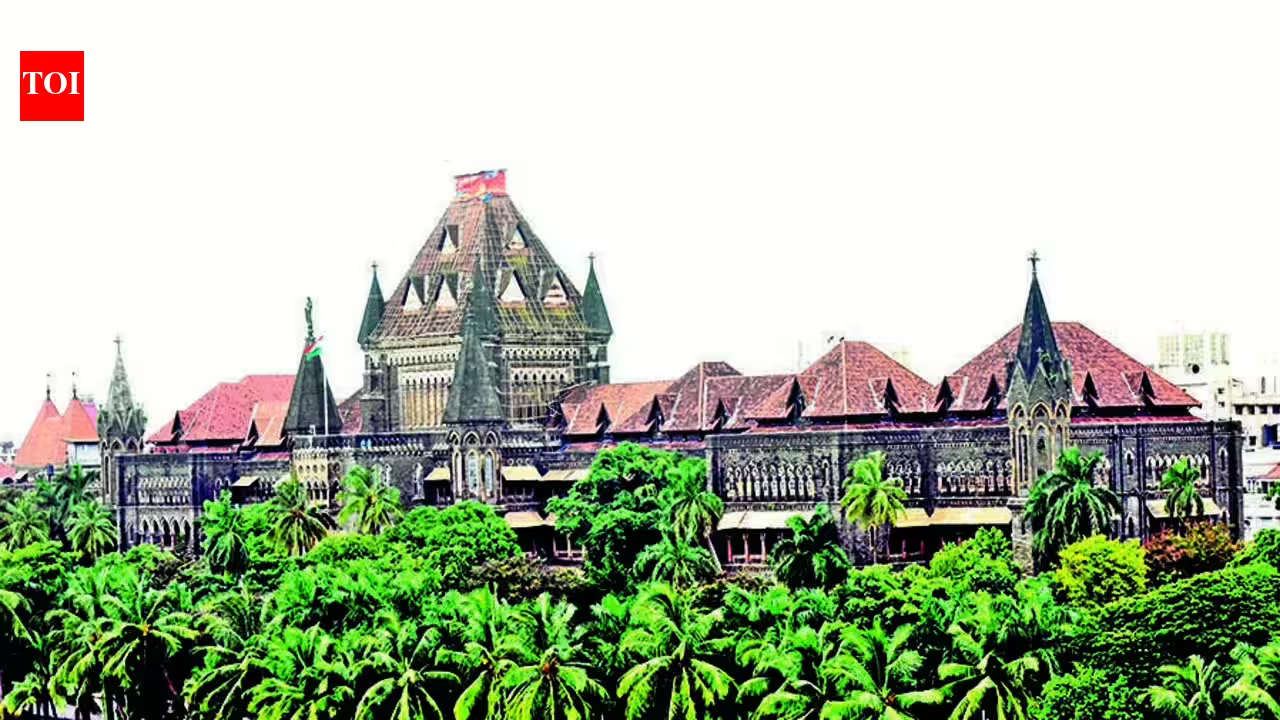
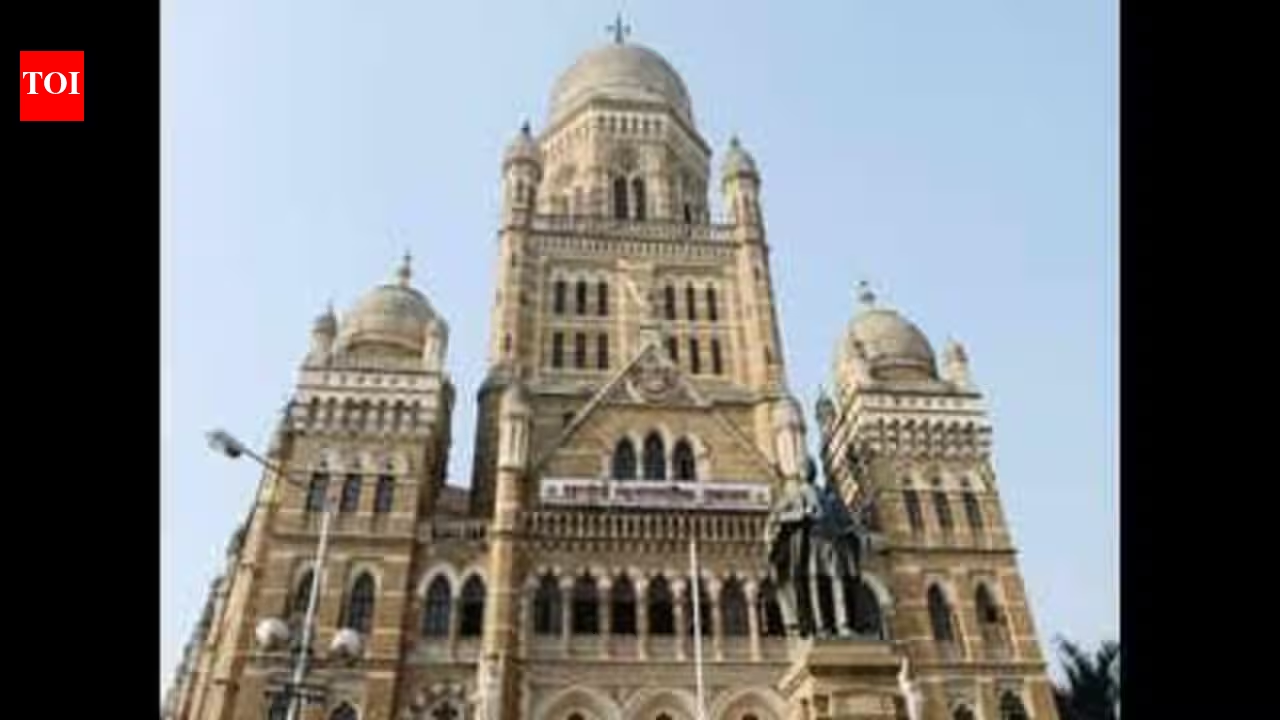
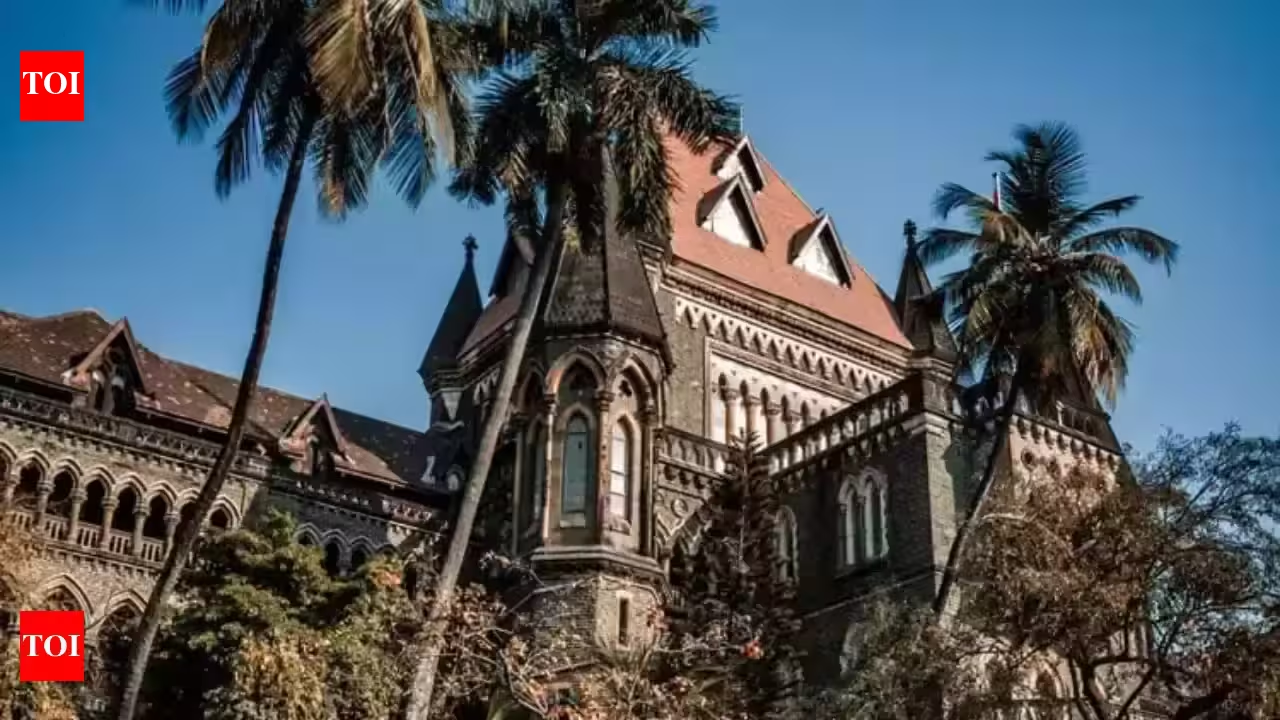
Mumbai: Bombay high court on Friday cited photos of uncleared garbage on roads and pavements, including in the Fort area in south Mumbai. Expressing distress at the lack of proper implementation by BMC of its own Clean Mumbai campaign, it sought ward-wise action to ensure strict and constant vigilance against garbage dumping not only on roads but in nullahs, lakes and the sea.Justices Girish Kulkarni and Aarti Sathe asked the BMC to take police help, too, “to deal with any resistance and/or to discipline unruly citizens.’’ HC cited instances at Horniman Circle in south Mumbai where a huge garbage collection chowki is installed and said the heritage site was “full of trash and odour’’. It commented on “total mismanagement” of waste collection with a chowki for garbage trucks set up close to heritage sites including the Bombay HC, Institute of Science and City Civil Court where foreign tourists flock”, adding that the vehicles cause “nuisance and odour.’’HC said it had listed a petition filed by Kannamwar Nagar residents regarding the Kanjumarg dumping ground’s waste management on Friday to bring to BMC’s notice the “tons of garbage on a day-to-day basis being dumped on the main roads…including plastic bags and bottles… and the serious health issues’’ arising from it. The HC said the judges travel into suburban areas and also till Uttan (where the judicial academy is located) and said the situation of garbage piled by the roads was the same.The HC order said, “It will also be open to the ward officer to take civil or criminal action against those who, with impunity, are violating the provisions of law in destroying/damaging public streets by dumping waste, creating health and hygiene issues detrimental to the larger interest of the society.’

CM Devendra Fadnavis holds stakeholder meeting in Mumbai on PM Modi’s call for clay Ganesh idols | Mumbai News

CM Devendra Fadnavis holds stakeholder meeting in Mumbai on PM Modi’s call for clay Ganesh idols
The Akhil Sarvajanik Utsav Samiti has urged the government not to ban plaster of Paris idols outright, rather to insist on the use of eco-friendly paints for the idols

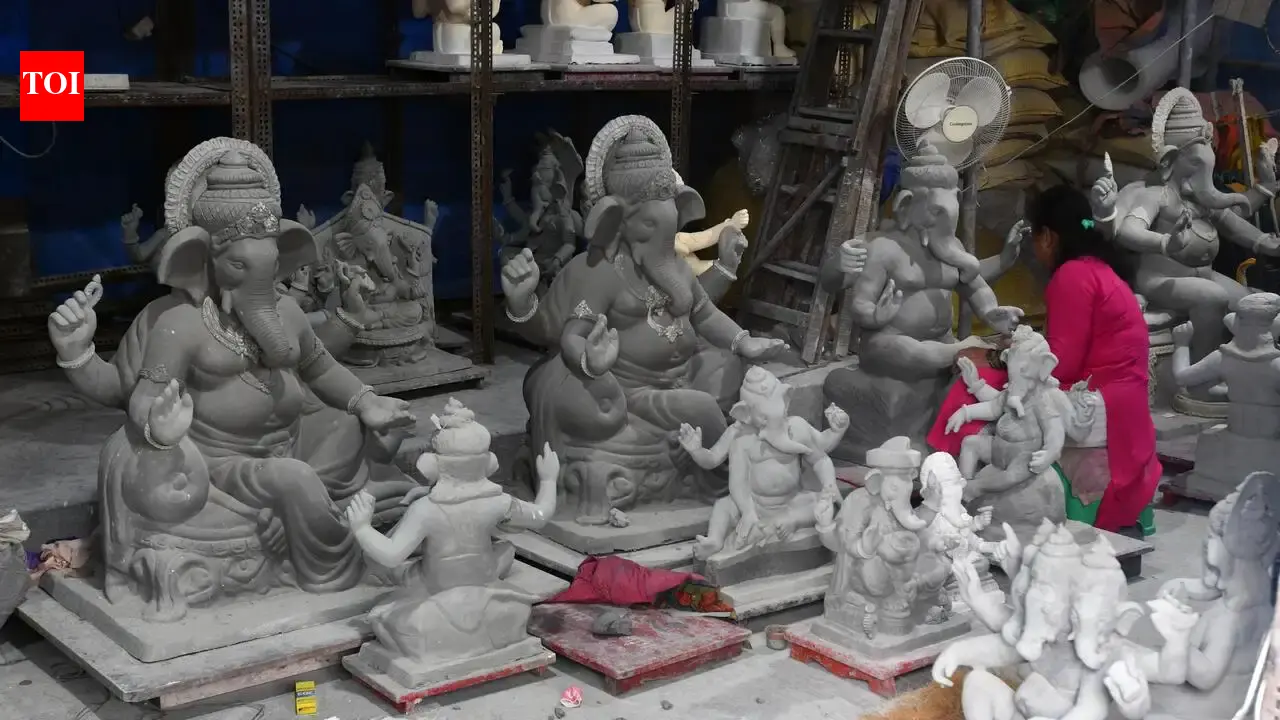
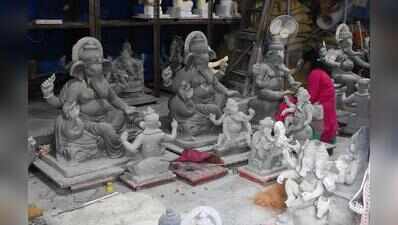
Mumbai: Chief minister Devendra Fadnavis on Friday held a stakeholders’ meeting to consider PM Narendra Modi’s appeal to use clay idols during the Ganesh festival.Hitesh Jadhav, president of Akhil Sarvajanik Utsav Samiti, Maharashtra, said they have submitted a list of suggestions to the government. He said the Samiti has urged the government not to ban plaster of Paris (PoP) idols outright, rather to insist on the use of eco-friendly paints for the idols. They have also asked the government to make the restriction on height of the Sarvajanik Ganesh idol voluntary.Jadhav said the maximum height of a Ganesh idol in Maharashtra is around 30 feet. “There is not enough clay to cater to the demand across the state. Further, the use of artificial immersion ponds ensure that the PoP idols are not immersed in the sea,” he said. “In Navi Mumbai the recycled PoP was used to make study desks and this was distributed to students two months ago by deputy chief minister Eknath Shinde.”The meeting was held at the chief minister’s residence and was attended by state cultural affairs minister Ashish Shelar, deputy chairperson of the legislative council Sachin Ahir and senior officials.Sources said a core committee of the government will now meet in a couple of days and a report will be submitted to the Bombay High Court on Tuesday.A division bench of Justices AS Gadkari and Kamal Khata is hearing a PIL filed by Thane resident and activist Rohit Joshi, seeking implementation of the Central Pollution Control Board (CPCB) guidelines prohibiting the manufacture and immersion of PoP Ganesha idols. The petition highlights the pollution caused to rivers, lakes and other natural water bodies because of the immersion of PoP idols.

Make Mumbai manhole death inquiry report public: Congress | Mumbai News

Make Mumbai manhole death inquiry report public: Congress
The BMC had maintained that safety nets had been installed on the majority of the city’s manholes

Mumbai: Nearly a month after a 60-year-old man died after falling into an uncovered storm-water drain manhole in Sakinaka during heavy rain, Congress group leader in the BMC Ashraf Azmi on Friday demanded that the civic administration immediately make public the inquiry report into the incident and fix accountability.Aslam Isak Shaikh died on July 2 after falling into an open manhole on Khairani Road in Sakinaka amid heavy rainfall. The incident had triggered outrage, following which the BMC suspended four officials concerned, blacklisted the contractor and ordered an inquiry.Azmi alleged that despite these announcements, the inquiry report had not been made public even after nearly a month.“This was not a natural calamity but a preventable tragedy caused by administrative negligence. Mumbaikars have a right to know who has been held accountable and what action has been taken,” Azmi said.He questioned whether criminal proceedings had been initiated against those responsible and whether Shaikh’s family had received adequate compensation.The Congress corporator demanded that the inquiry report be released without delay, strict action be taken against all officials and contractors found responsible, and concrete measures be implemented to prevent similar incidents during the monsoon.The July 2 incident had renewed concerns over the safety of stormwater drain infrastructure during heavy rain. At the time, the BMC had maintained that safety nets had been installed on the majority of the city’s manholes but ordered a departmental inquiry into the Sakinaka incident after preliminary findings pointed to lapses.

Non-profit organisation launches toolkit for community climate action plan in Mumbai | Mumbai News

Non-profit organisation launches toolkit for community climate action plan in Mumbai

Mumbai: Even as the Navi Mumbai Municipal Corporation announced plans this week to develop its own Climate Change Action Plan (CCAP) for the city, a toolkit for a different kind of CCAP was launched in Mumbai on Thursday.The Community Climate Action Plan, developed by the non-profit YUVA, is not a one-size-fits-all formula but an adaptable framework that identifies local climate vulnerabilities and builds tailored adaptation and coping measures around them.Roshni Nuggehalli, executive director of YUVA, stressed that climate action planning must be anchored in the realities of the communities most exposed to climate vulnerabilities — without that grounding, she cautioned, broad-based CAPs risk being ineffective.Having piloted the framework successfully in 2022 in Ambojwadi — an informal settlement of roughly 53,000 people in Malvani, Malad West — and later implemented it in three other informal settlements, the organisation has now launched it for public use.Unlike top-down city, state, and national climate plans, this ground-up model is led by local people’s collectives who engage local govt directly for targeted interventions.“Around 42% of Mumbai’s population of 11.8 million live in bastis, yet climate action often bypasses this large group,” said Dulari Parmar, project lead for climate justice at YUVA. “CCAPs connect neighborhood priorities with city CAPs and can complement them.” Informal settlements commonly bear the brunt of heat, flooding, rising AQI, landslides, and sea-level rise.The CCAP follows a four-step framework: climate hazard mapping, rapid assessment, community-based vulnerability assessment, and the CCAP itself, with staggered adaptation and coping measures planned across immediate, short-term, and long-term horizons. For water and heat stress in an informal settlement, an immediate measure might be cool roofs paired with strengthened water-rights advocacy, while a long-term goal could be permanent municipal water connections.The CCAP isn’t meant only for informal settlements, said Nuggehalli, but for any community looking to be proactive on climate planning.In Ambojwadi, community consultations identified flood- and sewage-prone areas caused by the absence of sewage lines and successfully advocated with BMC for drains. “We didn’t just go to the ward office with a problem — we brought solutions devised by the community itself,” Parmar says, noting that the settlement’s lack of land tenure rights often blocks access to basic civic services, even as govt has grown more receptive to climate framing.Kiran Dighavkar, associate municipal commissioner for solid waste management at BMC, acknowledged the need to integrate informal settlements more meaningfully into climate planning — but argued that community stewardship, especially around waste management, must go hand in hand with govt action. “Get people to demand segregation and processing centres in their bastis,” he said. “This too is climate action.

SUV row: BJP neta in BMC demands uniformity in car allocation | Mumbai News

SUV row: BJP neta in BMC demands uniformity in car allocation
BJP neta Ganesh Khankar’s statement comes days after the BMC floated a proposal to induct new Toyota Innova Crysta SUVs for the Leader of the House, Leader of the Opposition and chairpersons of statutory committees

Mumbai: Amid the controversy over the BMC administration’s proposal to lease new Toyota Innova Crysta SUVs for top political functionaries, Leader of the House and BJP’s Ganesh Khankar on Friday distanced himself from the move, stating that he had never sought new vehicles and had no intention of doing so.In a letter to municipal commissioner Ashwini Bhide, Khankar said reports suggesting that the civic body was splurging public money on new vehicles had created a wrong impression among Mumbaikars. He said the opposition was deliberately misrepresenting the proposal without taking into account that the vehicles were to be procured on lease under the existing policy.“We have never demanded that new vehicles be taken on lease, nor have I submitted any such request earlier,” Khankar said in the letter.Instead, Khankar urged the civic administration to continue with the existing Mahindra Scorpio SUVs and ensure uniformity in vehicle allocation. He requested that all senior civic officers and chairpersons of statutory committees, barring the municipal commissioner and the mayor, be provided Scorpio vehicles of the same category so that there was parity among all functionaries.“I request you to issue the necessary orders so that equality is maintained and no special vehicle facilities are extended beyond the existing Scorpio fleet,” he said.The clarification comes days after the BMC floated a proposal to induct new Toyota Innova Crysta SUVs for the Leader of the House, Leader of the Opposition and chairpersons of statutory committees, replacing the existing Scorpio-N vehicles. The move had drawn criticism from opposition parties, including Worli MLA Aaditya Thackeray, which questioned the timing of the proposed fleet upgrade and the expenditure involved.

Bhiwandi building crash: Man offering shelter, 3 from 1 family hired for repairs among victims | Mumbai News

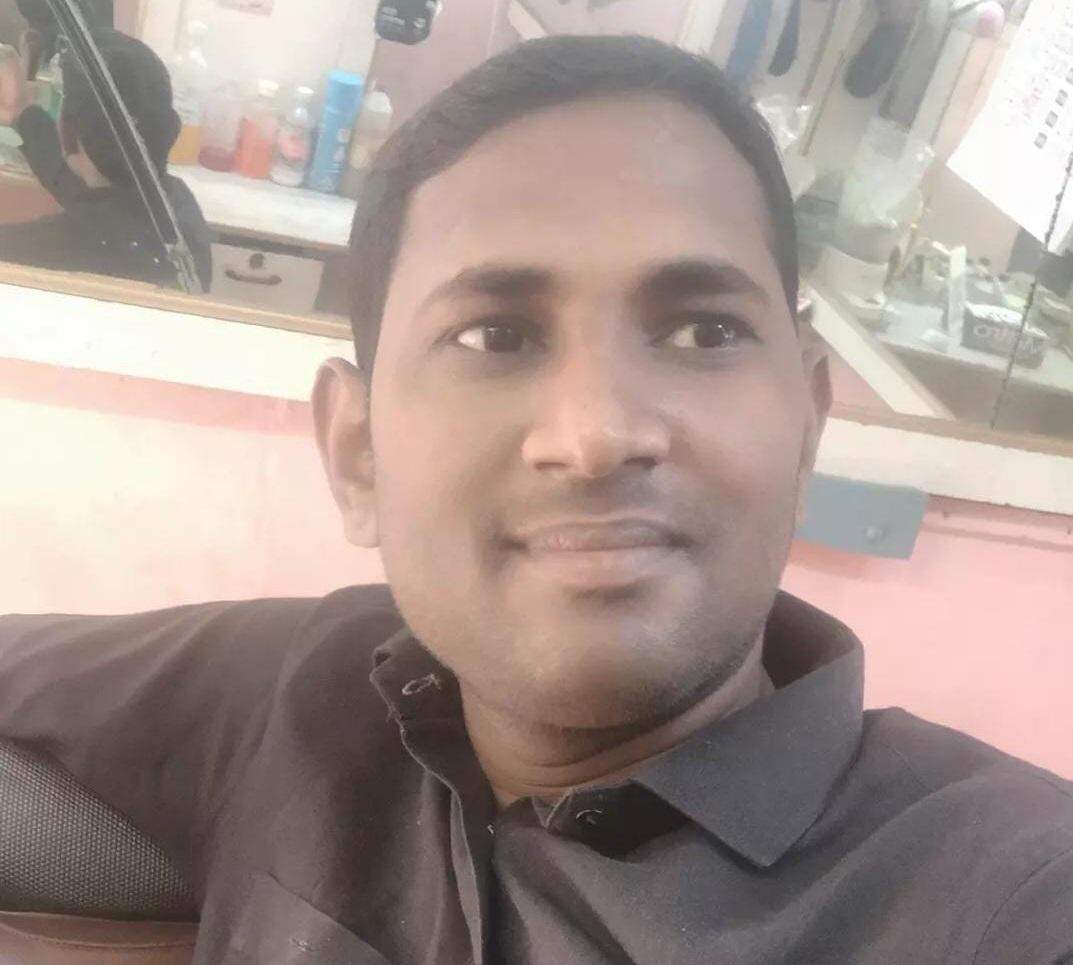
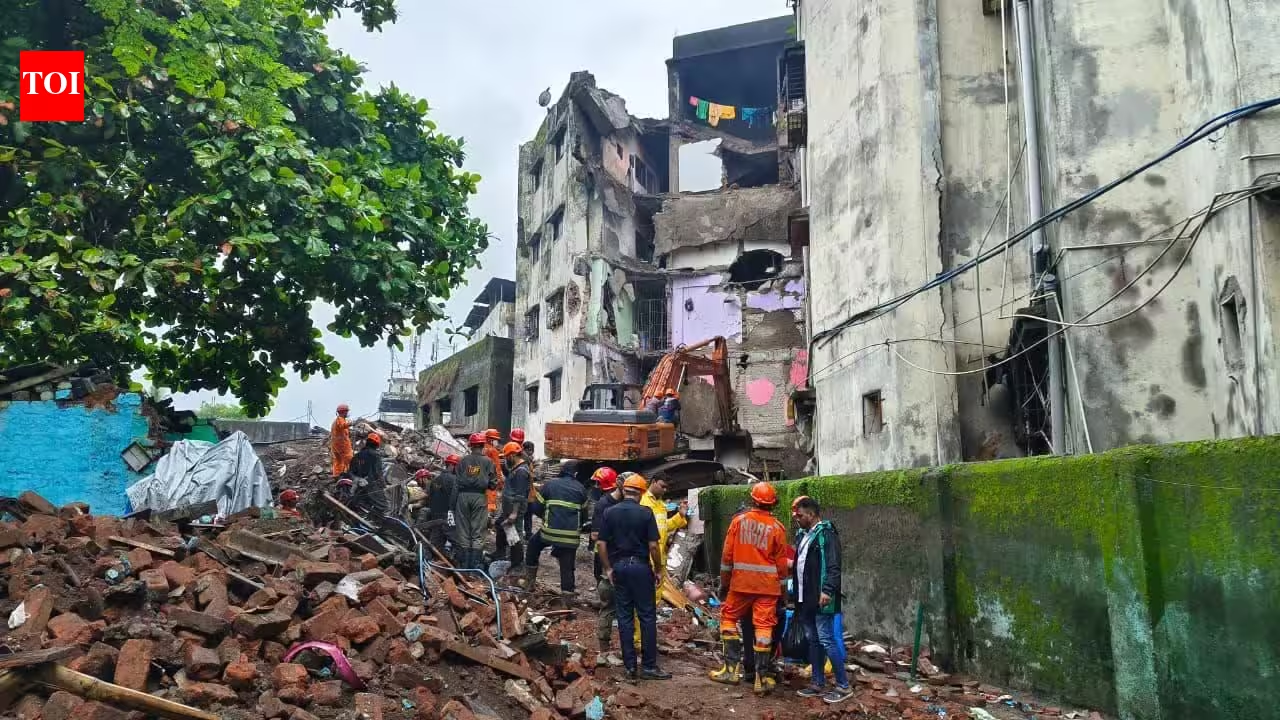
Bhiwandi: A Good Samaritan who offered shelter to relatives, three daily-wagers from one family counting down the minutes to the end of the day’s work, and a wife struggling with survivor’s guilt. The building crash plunged many families into insurmountable grief.Shamim Ansari (32) did not even live in the building and had rushed to offer help to a relative, Mehtab Ansari (32), after learning that a pillar in the building was tilting and occupants were shifting out. He offered Mehtab and his wife a vacant house he owned until things settled. “He insisted that we leave immediately,” Mehtab told TOI.Shamim convinced the two to leave with him. After they gathered a few essentials and walked out, Shamim stayed back to speak to some labourers repairing the pillar. “Within moments, the building collapsed. We survived because of him, but he got trapped under the debris,” Mehtab said. Shamim leaves behind his wife and three children.Siblings Ashok Paswan (40) and Rakesh Paswan (25) and their cousin, Mukesh Paswan (30), who were hired for repairs undertaken over four days, were also buried under the rubble. Ashok’s wife and their three young children are staring at an uncertain future since he was the sole breadwinner. “The three left for work together like every other day. We never imagined they would all die in the same accident,” a relative said.Ranjit Singh (45) failed to make it out of the building in time, while his wife escaped just moments prior. “Why couldn’t it have been me instead?” the wife cried at the hospital repeatedly.Three others escaped in the nick of time. Brothers Abhay Yadav (26) and Deepak Yadav (25), who lived on rent, said they decided to vacate the house after the pillar tilted and as they were stepping out, the building collapsed. “I managed to run to safety, but suffered injuries to my leg,” said Abhay. Deepak said he was on the first floor when he found that the staircase had given way. “I had no option but to jump. I fractured my leg. There was complete chaos. The entire area was engulfed in dust within seconds.Another survivor, Sangita Prajapati, said she lost consciousness while running towards the exit and the rescue team found her.
70 Years Ago, Apsara Powered India Into The Atomic Age | Mumbai News

70 Years Ago, Apsara Powered India Into The Atomic Age
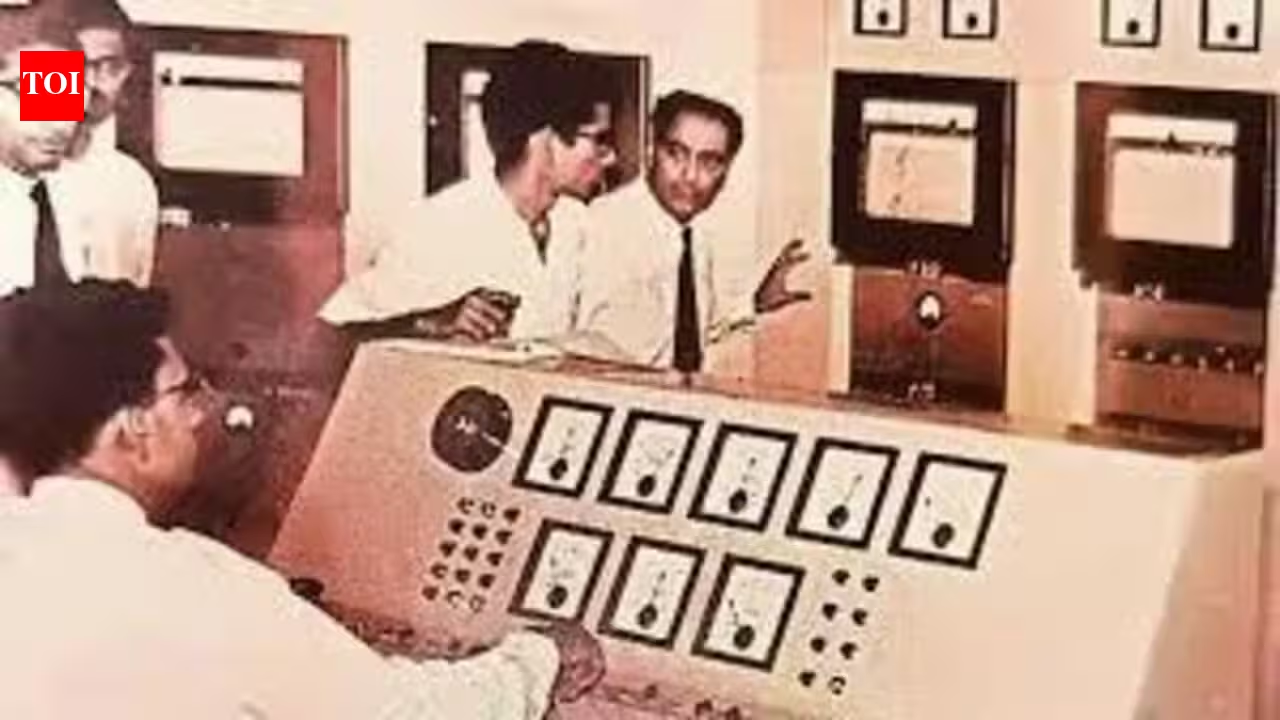
The role of the reactor was multipurpose—training scientists, doing experiments in what is known as neutron physics, the production of radioisotopes and studies in shielding of nuclear radiation

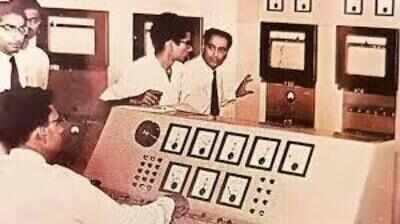
Mumbai: Saturday. Aug 4 1956. 3.45 p.m.Seventy years ago on this very day, as the monsoon was unleashing its full fury, India was rocketing into a new scientific era.It was India’s first nuclear reactor, Apsara —a pet project of Homi Bhabha—which attained criticality on that day at 3.45 p.m.In layman’s parlance, it means that this one mw reactor, which ushered in the atomic era not only in India, but also in Asia, had become operational. It was then formally inaugurated by Jawaharlal Nehru on January 20, 1957.Criticality in a nuclear reactor is attained when a self-sustaining fission chain reaction is achieved.The process begins when the reactor operators insert control rods. Then, at a certain point, these rods are withdrawn to initiate the process of starting the reactor.Former Indian nuke chief, R Chidambaram, recalled Nehru drawing a comparison between Elephanta Caves and Apsara. He remembered Nehru saying: “Both have their place and any person who ignores either of them misses an important element of life.’’The first attempt to make Apsara operational on July 31, 1956, failed due to technical reasons.In the second attempt on Aug 4, 1956, as the historic moment was nearing Raja Ramanna, the father of India’s nuclear weapon programme, who played a key role in the development of Apsara recalled in his autobiography, Years of Pilgrimage: “The event coincided with the heaviest monsoon in Mumbai. The roof was leaking, but so were the walls of the reactor hall.’’It was called a swimming pool reactor because, according to M R Srinivasan, former Indian nuclear chief, the core where the uranium chain reaction takes place is suspended in a pool of water.Six kg of enriched uranium fuel rods were imported from the UK.Bulk of the equipment, he said in his memoir, “From Fission To Fusion,’’ was obtained locally, with the New Standard Engineering Company at Chinchpokli, Mazagon Dock and TIFR playing a major part.Important visitors to Mumbai made it a point to visit Apsara, which included Chinese premier Chou-a-lai, Emperor Haile Selassie of Ethiopia and the Dalai Lama and Panchen Lama.The role of the reactor was multipurpose—training scientists, doing experiments in what is known as neutron physics, the production of radioisotopes and studies in shielding of nuclear radiation.TOI spoke to two officials who worked in Apsara.Anil Anand, former director of BARC’s reactor projects group, recalled it was a rewarding experience doing experiments at Apsara as it helped in developing future projects.Mohan Phadnis, scientific officer, explained the significance of Apsara, saying that it marked the first step in India’s journey into the nuclear domain.A.C. Tikku, former director of the reactor group when Apsara was taking shape, has been quoted as saying that the commissioning of Apsara laid the necessary infrastructure for nuclear research in basic and applied sciences and isotope production.’’It was decommissioned in 2009, but almost a decade later upgraded and recommissioned in Sept 10, 2018.

Maharashtra chief minister Devendra Fadnavis orders forced evacuation from ‘dangerous’ buildings after Bhiwandi crash | Mumbai News

Maharashtra chief minister Devendra Fadnavis orders forced evacuation from ‘dangerous’ buildings after Bhiwandi crash
An old and dilapidated building in Bhiwandi crashed, claiming 10 lives

Mumbai: Following the collapse of an old and dilapidated building in Bhiwandi claiming 10 lives and injuring several others, chief minister Devendra Fadnavis said the municipal commissioner had been issued orders to use force to get people to vacate such buildings. He also directed the municipal commissioner to take legal action against the contractor.Speaking to the media in Mumbai, Fadnavis said even the Mankhurd building, that had collapsed on July 5, had been vacated and the structure it fell on had also been vacated, except for a few who had not moved out.“Once a building is declared C-1 (dangerous), we get people out, but some refuse to vacate. Life is important and since it is necessary to save lives, force will be used to get people out. In all C-1 buildings, directions have been issued to use force to get people out of the building. There are court orders that do not allow the use of force beyond a certain level, but even then we shall try to use force and get people out,” the CM said.Fadnavis added that the Bhiwandi building was in the C-1 category and orders had been issued to vacate it. “The municipal commissioner informed us that nearly 25 families had vacated the building. However, the contractor continued the repair works and thereafter the incident took place. The municipal commissioner has been directed to lodge a cognisable offence against the contractor and take strict action,” he added.Fadnavis expressed condolences to the families of those who lost their lives and said the state government would provide financial assistance to the next of kin of the deceased.