Flamingos bid adieu to Mumbai Metropolitan Region, leave wetland warning behind | Mumbai News

Flamingos bid adieu to Mumbai Metropolitan Region, leave wetland warning behind

Navi Mumbai: Flamingos have begun their annual departure from the Mumbai Metropolitan Region (MMR) with the arrival of the monsoon, ending a migration season marked by delayed arrivals and sharply lower numbers, conservationists said.Birdwatchers reported that flamingos have disappeared from NRI wetland in Navi Mumbai, while their numbers at Thane Creek Flamingo Sanctuary (TCFS), a Ramsar site of global importance, have also dwindled. “These are clear indications that the flamingo season has ended for now,” said environmentalist B N Kumar.Greens said every winter, thousands of flamingos arrive at TCFS before spreading to satellite wetlands such as the NRI wetland, DPS Flamingo Lake, T S Chanakya wetland, and the Bhandup pumping station in search of food.Bird lovers said that this season, however, stood out for the wrong reasons. The migratory birds arrived much later than usual, and their numbers were significantly lower than in previous years. “The delayed arrival and reduced population are warning signals. They reflect the combined impact of climate change and the deteriorating condition of our wetlands,” said a wildlife photographer.Environmentalists pointed to the worsening quality of creek water feeding the wetlands. Untreated sewage, pollution, siltation and impaired tidal flow degraded the mudflats where flamingos fed on algae, plankton and small aquatic organisms.The ecological condition of DPS Flamingo Lake, which is part of the NRI wetland complex, has steadily worsened, while the adjoining TS Chanakya wetland has also suffered degradation due to neglect and developmental pressures, said Kumar, who spearheaded the campaign that won Navi Mumbai recognition as ‘Flamingo City’.Conservationists cautioned that unless these fragile ecosystems were restored and protected, MMR could see not only shorter flamingo seasons, but also a continuing decline in the number of these winter visitors.

Man captured on camera threatening co-passenger inside Mumbai local | Mumbai News

Man captured on camera threatening co-passenger inside Mumbai local
Lokmanya Tilak Terminus GRP have started a manhunt for the man

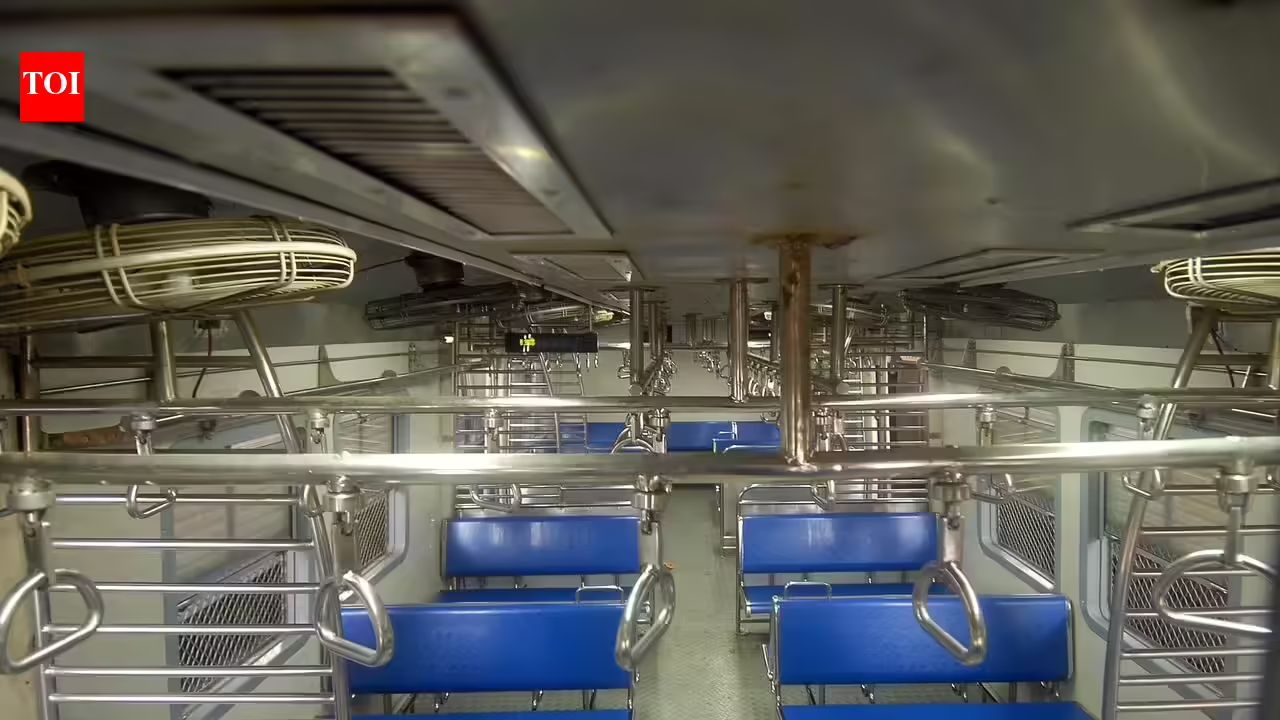
Mumbai: A week after the horrific murder of a passenger in a local train between Goregaon and Malad stations, a viral video on a Central Railway (CR) local has captured a shabbily dressed man threatening a co-passenger following an altercation in a local train at Govandi.Lokmanya Tilak Terminus (LTT) GRP have started a manhunt for the man. They are yet to lodge an FIR as the complainant hasn’t come forward.Police said they are also probing if the accused was inebriated. “Cameras on CR have not been fitted with Facial Recognition System unlike Western Railway stations so we have to manually track down the individual. A search is on,” said a senior official.

Save Bandra football ground, Mumbai legislator urges state government in legislative council | Mumbai News

Save Bandra football ground, Mumbai legislator urges state government in legislative council
BMC’s proposal to convert nearly 8,450 sq m of the Neville D’Souza Football Ground into a convention centre has triggered protests from footballers, coaches, local residents, sports associations and even politicians

Mumbai: Concern over the future of Neville D’Souza Football Ground in Bandra West echoed in the Maharashtra Legislative Council, with NCP MLC Zeeshan Siddique urging the state government to protect one of Mumbai’s most important football venues from redevelopment.Siddique on Wednesday said the ground serves thousands of footballers and has played a key role in nurturing sporting talent in the city. He warned that the steady loss of playgrounds and open spaces was harming the development of football and other sports in Mumbai.“We often ask why India does not qualify for the FIFA World Cup or why Indian footballers do not feature regularly in top international clubs. How will our players reach that level if we continue taking away their grounds?” Siddique asked, calling for immediate intervention by the state government.The issue has gained prominence amid opposition to BMC’s proposal to convert nearly 8,450 sq m of the Neville D’Souza Football Ground into a convention centre. The proposal has triggered protests from footballers, coaches, local residents and sports associations, who argue that the city cannot afford to lose one of its few dedicated football facilities.Named after Neville D’Souza, the first Indian footballer to score a hat-trick at the Olympic Games, the ground has long been a hub for grassroots coaching, school tournaments, local leagues and competitive football.The Mumbai Football Association, along with several clubs and football academies, has also voiced concern over the proposed change in land use. Supporters of the ground argue that Mumbai is already facing an acute shortage of playgrounds and sports infrastructure, making preservation of existing facilities critical.The issue has also acquired political significance, with leaders across party lines expressing concern that replacing sports grounds with built infrastructure would undermine efforts to promote sporting culture among youngsters.Siddique urged the government to safeguard the ground for future generations, saying that preserving sports infrastructure is essential if Mumbai and the country hope to produce world-class football talent and encourage greater participation in the sport.Key demands by footballers and citizens include:* Withdrawal of the proposal to convert the football ground into a convention centre* Retention of the entire land exclusively for sports and recreation* Long-term protection of the ground through a permanent playground reservation* Consultation with football associations, residents and sports bodies before any change in land use* A broader policy to safeguard Mumbai’s playgrounds from commercial or non-sporting development

Hike in bronze price stalls Ambedkar statue work at Indu Mill in Mumbai | Mumbai News

Hike in bronze price stalls Ambedkar statue work at Indu Mill in Mumbai

Mumbai: Social justice minister Sanjay Shirsat on Thursday told the Legislative Assembly that work on the statue to be erected at Dr Babasaheb Ambedkar at Indu Mills was stuck due to the increased rate of bronze.Shirsat admitted when work on the statue was commissioned in 2018, the price of bronze was Rs 8 per inch, but now the price has reached Rs 17 per inch, or from Rs 850 per kg to around Rs 1,700 per kg. The cost of the statue has increased significantly, and there are difficulties in providing funds. Shirsat said this increase is not in accordance with the regular price adjustment (price escalation) provisions of the original contract, so once a report is received from MMRDA, the state govt will take a decision. Shirsat was replying to questions raised by MLAs Ashok Mane and Santosh Danve.“Shapoorji Pallonji appointed renowned sculptor Ram Sutar Fine Arts as a subcontractor for the statue. The work of the statue is of a very special technical nature. The contractor and subcontractor pointed out in April 2026 that the cost of bronze metal and its processing had increased significantly due to unexpected conditions in the international market.“In 2018, the original contract included the height of the statue of 350 feet (250 feet statue and 100 feet pedestal). Later, the height of the statue was increased to make the pedestal 100 feet high and the statue 350 feet high, making a total height of 450 feet … According to the agreement between the company and sculptor, the price of bronze metal was Rs 850 per kg, but at present the price of bronze metal is around Rs 1,500 to Rs 1,700 per kg,” Shirsat said in his written reply.“The contractor and subcontractor have demanded an increase in price for both bronze metal and its processing. However, a detailed proposal has not been given by the contractor yet. After receiving the proposal, the project consultant and MMRDA will scrutinise it. As per the revised concept, the cost of the project has been approved at Rs 1,089.95 crore; so far, Rs 748 crore is given to MMRDA,” Shirsat said.“After receiving a detailed proposal from the contractor regarding the abnormal increase in bronze ore and processing cost, it will be scrutinised by MMRDA. This increase is not in accordance with the regular price adjustment (price escalation) provisions of the original contract. So once a report is received from MMRDA, the state govt will take a decision,” Shirsat said in his reply.

1,28,290 pending land survey cases in Maharashtra | Mumbai News

1,28,290 pending land survey cases in Maharashtra

Mumbai: Revenue minister Chandrashekhar Bawankule on Thursday told the Legislative Assembly that there are 1,28,290 pending land survey cases in the state, and the average time taken to resolve land survey applications is 121 days. Bawankule was replying to questions raised by MLA Bhimrao Tapkir.“In pursuance of the appointment of licensed surveyors for survey work, Maharashtra Land Revenue (Boundaries and Boundary Marks) Rules, 1969, Rule 13 of 1989 was amended. Approval has been given to determine the criteria for technical qualification, experience and age limit, honorarium, training and licensing, administrative control, and measurement matters for conducting the tender process at the district level for the appointment of licensed surveyors in March 2026,” Bawankule said in his written reply.“Studies are underway to implement a procedure such as officially measuring the relevant property before registering the land buy deed and determining its exact area, length-width, boundary, geographical location (coordinates), registering the buy deed only after that, and updating the title record by approving the change entry after registration, on the lines of the practice being implemented in other states,” Bawankule said.“To effectively implement this process in the state, necessary amendments and corrections are being examined in the relevant laws, rules, procedures and processes related to the Revenue, Registration and Stamps, and Land Records Departments,” Bawankule said.

Bombay high court dismisses challenge to 2 GRs by housing societies, paves way for redevelopment of prime Mhada layouts in Bandra and Worli | Mumbai News

Bombay high court dismisses challenge to 2 GRs by housing societies, paves way for redevelopment of prime Mhada layouts in Bandra and Worli

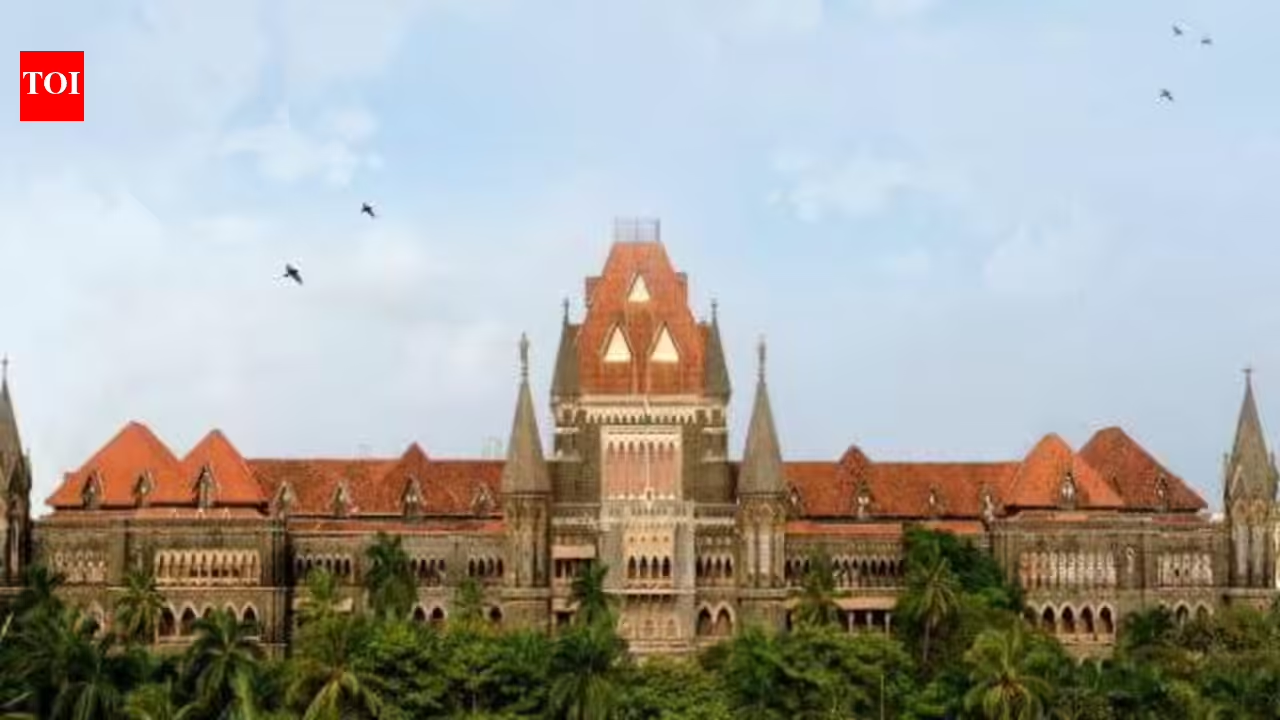
Mumbai: Holding that larger public interest is demonstrated in the state’s decision, the Bombay High Court on Thursday paved the way for a cluster redevelopment of massive 34 acres in Worli and 98 acres in Bandra Reclamation area under the state’s move to appoint a developer for Mhada’s layouts.The HC bench of Justices M S Karnik and S M Modak dismissed as meritless a challenge raised by a group of cooperative housing societies to two govt resolutions (GRs) that provided for a bidding process and the redevelopment of the two prime layouts of Maharashtra Housing and Area Development Authority (Mhada) layouts in Bandra Reclamation and Adarsh Nagar in Worli.Adani Properties emerged winner in the bidding process for the appointment of a construction and development agency for both the plots. Mhada is to receive Rs 3,900 crore as premium for the Bandra plot and Rs 1,922 crore for the Adarsh Nagar plot, the HC noted.The justices agreed with the state advocate general to hold that Mhada, as the owner, had preferential rights to initiate redevelopment of its land under Regulation 33 (5) of Development Control (and Promotion) Regulation 2034.Adarsh Nagar and Bandra Reclamation layouts comprise several old buildings developed decades ago.The HC held that the state’s “policy decision demonstrates that redevelopment of Mhada layouts is not merely a private redevelopment exercise between a society and a developer, but is intrinsically linked with larger housing policy objectives of the state and Mhada concerning planned housing distribution, urban infrastructure, housing affordability and balanced development of public housing stock.” The state estimates that over 3,000 housing units would be generated under the scheme for yawning gap in public housing availability.The HC “is expected to act with a great caution while it interferes with the priorities fixed by the govt, unless it is established that the decision taken by it is patently arbitrary or not in larger public interest,” the judgement running into 247 pages said.“The govt should be free to take policy decisions or to decide priorities and it is better left to the wisdom of the state, which is well advised by the bureaucrats, and its other officers, who possess an expertise in taking policy decisions, which may involve various factors like the availability of fund, the requirement of the state to focus upon a particular sector in precedence over the other etc,” it reasoned.Ten petitions by B-Adarsh Nagar CHS, Kamalpushpa, Parijat, Bandra HIG Agasti and other societies approached HC this year and assailed two GRs of April and Dec 2025 specifically for redevelopment of Bandra Reclamation and Worli plots through a bidding process to be initiated by Mhada as the landowner. Earlier, the state issued a GR for redevelopment of 56 Mhada layouts in the state.The challenge by the societies was that they were owners of the plots and the GR as well as bidding process flouted their constitutional rights under Article 300A. The GR was invalid as it did away with mandatory consent of societies under Regulation 33(5) and also included in its fold high income group (HIG) societies. Article 300A protects citizens against arbitrary deprivation of their property by the state.Advocate General Milind Sathe argued that the GR was valid and the process too, saying Article 300A was a flawed argument of the petitioners as the societies are still “occupiers ” not owners, claiming rights under a sub-lease. Two former state advocate generals, Ravi Kadam and Darius Khambata, with advocate P G Lad for Mhada, said it was Mhada land and hence under rules governing development, as the owner, it was empowered to redevelop by appointing a developer. They too argued that since the societies were not owners, but lessees, the redevelopment rights vest with Mhada as owner while flat owners’ rights are being protected for permanent rehabilitation.Through a bevy of senior counsel, including Y S Jahagirdar, Girish Godbole, Zal Andhyarujina, Vishwajeet Sawant, Surel Shah and other counsel, including Anshuman Jagtap, Karl Tamboly, Mayur Khandeparkar and Huzefa Nasikwala, however, argued that the lands were conveyed to them and were being taken away sans any proper procedure of law.The HC found force in submissions made by Sathe, Kadam and Khambata that “Mhada continues to have overarching authority to develop Mhada schemes, colonies, layouts or … any ‘authority premises.’”Allottees or lessees have limited rights, which is subject to Mhada’s right to redevelop the lands, the HC held.Mhada said permitting individual societies in layouts such as Adarsh Nagar and Bandra Reclamation to independently redevelop isolated buildings through private developers would completely defeat the larger policy framework underlying the aforesaid GR and Regulation 33(5). The HC agreed.The HC said it found no substance in the housing societies’ contention that they have an unfettered right to development of the plots under the terms of the sub-lease deeds and sale agreements.


Hike in bronze price stalls Ambedkar statue work at Indu Mill in Mumbai | Mumbai News

Hike in bronze price stalls Ambedkar statue work at Indu Mill in Mumbai

Mumbai: Social justice minister Sanjay Shirsat on Thursday told the Legislative Assembly that work on the statue to be erected at Dr Babasaheb Ambedkar at Indu Mills was stuck due to the increased rate of bronze.Shirsat admitted when work on the statue was commissioned in 2018, the price of bronze was Rs 8 per inch, but now the price has reached Rs 17 per inch, or from Rs 850 per kg to around Rs 1,700 per kg. The cost of the statue has increased significantly, and there are difficulties in providing funds. Shirsat said this increase is not in accordance with the regular price adjustment (price escalation) provisions of the original contract, so once a report is received from MMRDA, the state govt will take a decision. Shirsat was replying to questions raised by MLAs Ashok Mane and Santosh Danve.“Shapoorji Pallonji appointed renowned sculptor Ram Sutar Fine Arts as a subcontractor for the statue. The work of the statue is of a very special technical nature. The contractor and subcontractor pointed out in April 2026 that the cost of bronze metal and its processing had increased significantly due to unexpected conditions in the international market.“In 2018, the original contract included the height of the statue of 350 feet (250 feet statue and 100 feet pedestal). Later, the height of the statue was increased to make the pedestal 100 feet high and the statue 350 feet high, making a total height of 450 feet … According to the agreement between the company and sculptor, the price of bronze metal was Rs 850 per kg, but at present the price of bronze metal is around Rs 1,500 to Rs 1,700 per kg,” Shirsat said in his written reply.“The contractor and subcontractor have demanded an increase in price for both bronze metal and its processing. However, a detailed proposal has not been given by the contractor yet. After receiving the proposal, the project consultant and MMRDA will scrutinise it. As per the revised concept, the cost of the project has been approved at Rs 1,089.95 crore; so far, Rs 748 crore is given to MMRDA,” Shirsat said.“After receiving a detailed proposal from the contractor regarding the abnormal increase in bronze ore and processing cost, it will be scrutinised by MMRDA. This increase is not in accordance with the regular price adjustment (price escalation) provisions of the original contract. So once a report is received from MMRDA, the state govt will take a decision,” Shirsat said in his reply.

Mumbai’s deputy mayor calls for municipal commissioner’s resignation; safety measures questioned after man dies in manhole | Mumbai News

Mumbai's deputy mayor calls for municipal commissioner's resignation; safety measures questioned after man dies in manhole
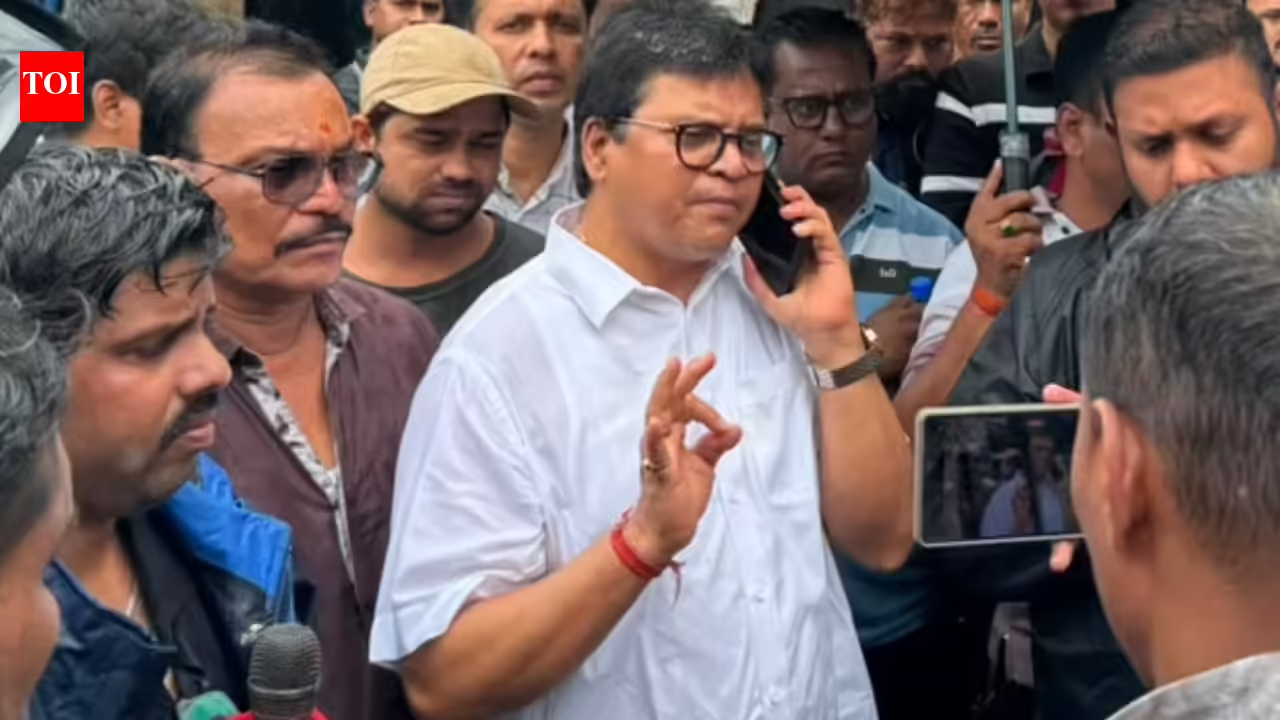
Deputy mayor Sanjay Ghadi arrives at the scene of the accident where a man died after falling into a manhole (Photo credit: X/@Sanjay Ghadi)

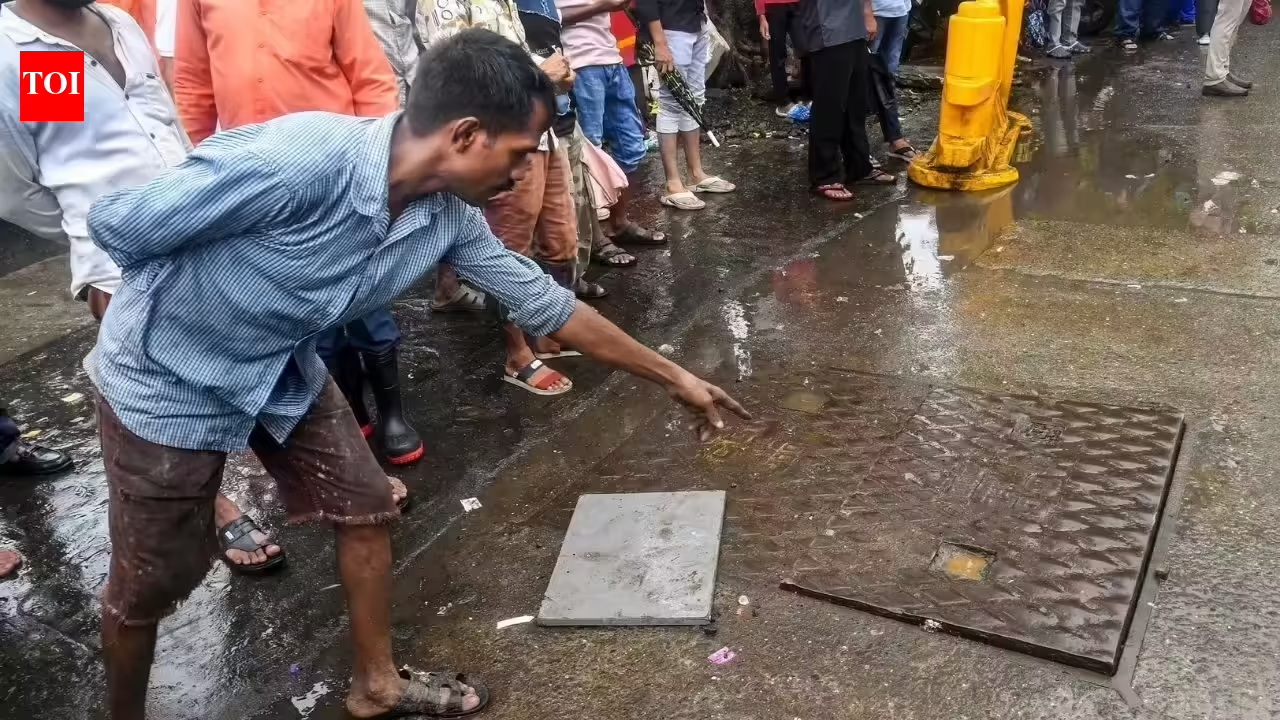
MUMBAI: Deputy mayor Sanjay Ghadi of the Eknath Shinde-led Shiv Sena on Thursday demanded the resignation of municipal commissioner Ashwini Bhide, holding the civic administration accountable for the death of a 55-year-old man who fell into an open manhole during civic works at Khairani Road in Saki Naka.Ghadi visited the accident site hours after the incident and alleged that the tragedy was the result of administrative negligence and the BMC’s failure to implement basic safety measures. His demand came even as the BMC suspended four officials, including the L ward assistant commissioner, pending an inquiry, and ordered the blacklisting of the contractor for alleged safety lapses.“There should have been a comprehensive inspection to ensure that all manholes were fitted with adequate protective grills before the monsoon. If necessary, the BMC should have floated a dedicated tender for the work. In fact, if public safety demanded it, such an important exercise should have been undertaken even without waiting for the tendering process,” Ghadi said.Referring to the death of actor Deepak Amrapurkar, who died after falling into an uncovered manhole during heavy rain in 2017, Ghadi said the civic administration had failed to learn from past tragedies.“Despite the painful memory of Dr Deepak Amrapurkar’s death, the municipal administration has not taken sufficient preventive measures. This incident reflects a serious lapse in planning and execution. Municipal Commissioner Ashwini Bhide must take responsibility for what has happened,” he said.The victim, Aslam Isak Shaikh (55), died after falling into an open manhole while BMC workers were installing a protective grill over it.According to the civic body, workers attempted to warn Shaikh as he approached the site, but he reportedly lost his balance and fell into the manhole. The BMC has constituted a high-level inquiry committee, suspended four officials pending investigation, ordered the contractor to be blacklisted, and announced an ex gratia compensation of Rs 10 lakh for the deceased’s family.

Mumbai manhole tragedy: 4 BMC officials suspended after 60-year-old dies in storm drain | Mumbai News

Mumbai manhole tragedy: 4 BMC officials suspended after 60-year-old dies in storm drain
A 60-year-old man tragically lost his life after falling into an open manhole during drain maintenance in Sakinaka.

MUMBAI: BMC on Thursday suspended four officials pending an inquiry after a 60-year-old man was swept to his death after falling into an open manhole during drain maintenance work in Sakinaka, an incident that triggered widespread outrage and renewed questions over safety measures at civic work sites.Municipal commissioner Ashwini Bhide ordered the suspension of Dhanaji Herlekar, assistant commissioner of L Ward; Deepak Chougule, assistant/deputy engineer (maintenance), L Ward; Abhijit Chougule, junior engineer (maintenance), L Ward; and Uttam Patil, assistant engineer in the Sewerage Operations Department.As an immediate preventive measure, the BMC has once again instructed all departments that barricades must be erected on all four sides of every manhole work site during maintenance or installation work.The commissioner has also directed all additional municipal commissioners, the deputy commissioners of all seven zones, and the assistant commissioners of all 26 administrative wards to ensure 100% inspection of all manholes across Mumbai within the next eight days, verify their safety, and submit a compliance report.Aslam Sheikh, 60, died after allegedly stepping into an uncovered manhole on Khairani Road while civic workers were carrying out desilting and drain maintenance work on Thursday afternoon. According to eyewitnesses, three contractual workers had removed the manhole cover to clean the drain when Sheikh, who was speaking on his mobile phone, failed to notice the opening and fell into the stormwater drain.The workers immediately lowered a ladder in an attempt to rescue him, but only his umbrella and slippers were recovered. With rainwater flowing rapidly through the drain, rescue teams were initially unable to determine where he had been swept. After an extensive search operation, the Mumbai Fire Brigade traced his body downstream and recovered it.Police have registered the incident and are investigating the circumstances leading to the fatal accident, while the BMC has initiated a departmental inquiry into possible negligence.The tragedy sparked sharp political reactions, with Shiv Sena (UBT) leader and Leader of Opposition in the BMC Kishori Pednekar visiting the site and questioning how an open manhole could be left unprotected on a busy arterial road during civic works. Mumbai Deputy Mayor Sanjay Ghadi and Shiv Sena leader Amey Ghole also visited the spot. Ghole termed the incident “heartbreaking” and demanded strict legal action against the L Ward Assistant Commissioner, the contractor executing the work and all officials responsible for the lapse.Mumbai Mayor Ritu Tawde announced an ex gratia compensation of Rs 10 lakh for Sheikh’s family on behalf of the BMC.Congress MP and Mumbai Congress president Varsha Gaikwad demanded that police register a murder FIR against the Mumbai Mayor and the BMC Commissioner, alleging that the deaths caused by the open manhole and a separate tree-fall incident were the result of gross administrative negligence and systemic failure.

CM Devendra Fadnavis halts Maharashtra’s controversial RTI rule changes after Anna Hazare’s protest warning | Mumbai News

CM Devendra Fadnavis halts Maharashtra's controversial RTI rule changes after Anna Hazare's protest warning
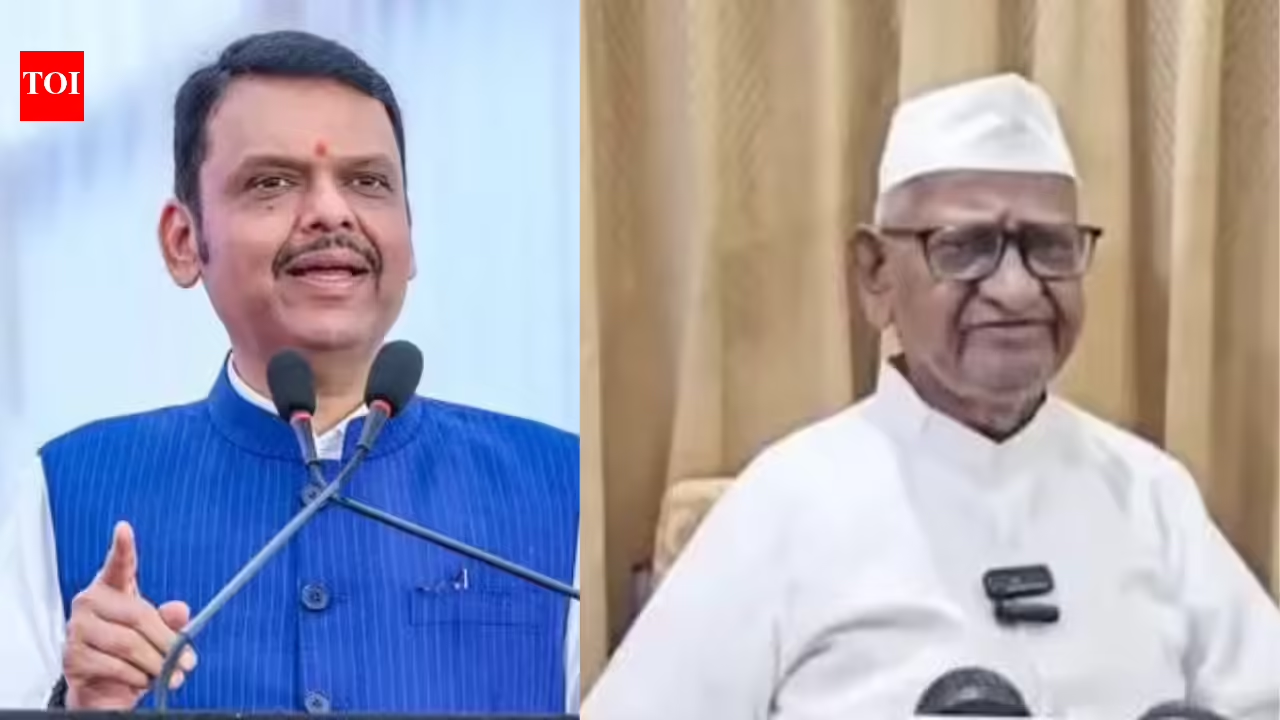
Maharashtra’s controversial RTI rule changes have been completely halted following chief minister Devendra Fadnavis’s (L) directive for consultations with Anna Hazare (R).

MUMBAI: The Maharashtra government on Wednesday put a complete hold on the controversial changes to the state’s Right to Information (RTI) Rules, with the state chief information commissioner suspending all the amended provisions after chief minister Devendra Fadnavis urged that no changes be implemented until detailed consultations are held with veteran social activist Anna Hazare.The move marks a complete rollback of the revised rules notified on June 12, weeks after the government had first issued the amendments and, following widespread criticism, had partially withdrawn some provisions within days. The latest decision suspends the entire set of amended rules until further discussions are held.In a letter to the state information commission, Fadnavis said any decision on changes to the RTI framework would not be appropriate without detailed discussions with Hazare.Acting on the chief minister’s communication, the chief information commissioner stayed all amendments published through the June 12 gazette notification.“Today we met Respected Anna Hazare and held extensive Discussion on effective implementation of RTI in State. The focus of our discussion was on making RTI regime more people-friendly with more vigorous steps on maximum suo-motu voluntary disclosure under section 4(1) of the RTI Act. My senior colleagues and SIC Pune bench Makrand Ranade and SIC Nashik Bench Prakash Indalkar also participated in the discussion and informed him about disposal and filing statistics. The recently notified RTI rules were also discussed and Respected Anna underlined importance of suo-motu disclosure and demanded to put on hold implementation of RTI rules. We are satisfied with our discussions With Anna,” said a statement issued by Rahul Pande, state CIC over the development.The decision comes after Hazare threatened an indefinite hunger strike, alleging that the revised rules would dilute citizens’ right to seek information and make the RTI process more expensive and restrictive. RTI activists and civil society organisations had also opposed the amendments, arguing that they would discourage ordinary citizens from using the transparency law.The June 12 notification had introduced 12 major changes to the Maharashtra RTI Rules. Among the most significant were tripling the RTI application fee from Rs 10 to Rs 30, increasing photocopy charges from Rs 2 to Rs 5 per page, imposing a Rs 50 fee for first appeals and Rs 100 for second appeals, restricting applications to a single subject and 150 words, and making photo identity proof mandatory.Other provisions allowed authorities to direct applicants to information already available on government websites, reject repetitive RTI applications, require applicants seeking personal information to establish larger public interest, recognise online and UPI payments, and permit dismissal of appeals if applicants repeatedly remained absent during hearings.Hazare had maintained that while misuse of the RTI Act by a few individuals could justify reasonable safeguards, the law was enacted to empower citizens and not to create financial or procedural hurdles. He had demanded restoration of the earlier rules, warning of an agitation if the amendments were not withdrawn.The latest stay means the pre-existing RTI Rules will continue to operate until the government takes a fresh decision after consultations. It may be recalled that a group of RTI activists led by former central information commissioner Shailesh Gandhi, along with journalist Vijay Kumbhar, senior journalist Vinita Deshmukh, Sajag Nagrik Manch members Vivek Velankar and Jugal Rathi, transparency campaigner Mohammed Afzal and others, had served a legal notice on the Maharashtra government seeking withdrawal of the Maharashtra RTI Rules, 2026.The notice had warned that if the rules are not rolled back within 15 days, the activists will challenge them before the Bombay high court.The activists had objected to several provisions they say dilute citizens’ statutory right to information, including mandatory submission of photo identity proof with RTI applications, the one-subject and 150-word limit on applications, higher application and appeal fees, charges for digital copies, curbs on fee exemptions for below-poverty-line applicants, shifting the burden of proving larger public interest onto applicants, and procedural rules allowing appeals to be dismissed for non-prosecution or to lapse on the appellant’s death.They contend these restrictions exceed the state’s rule-making powers under the RTI Act, 2005 and make access to information more difficult and expensive.