BJP ex-MP elected Mumbai’s Asiatic Society president, his panel sweeps polls | Mumbai News

BJP ex-MP elected Mumbai’s Asiatic Society president, his panel sweeps polls

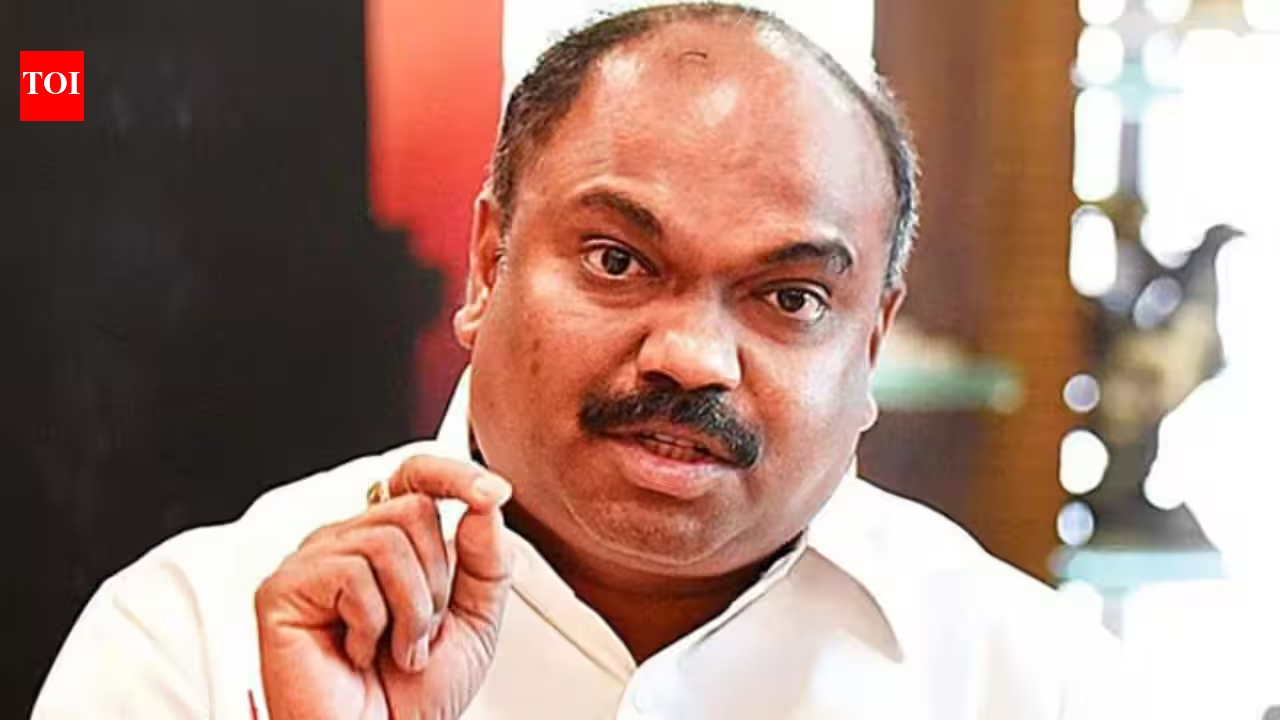
Mumbai: The delayed, fiercely-debated and much-litigated elections to the Asiatic Society of Mumbai, one of the city’s premier institutions of research and scholarship, finally took place on Saturday with former BJP Rajya Sabha member Vinay Sahasrabuddhe of the ‘Asiatic Tomorrow’ panel voted in as president and his group sweeping all the other 18 posts. The ‘Save Asiatic’ panel led by former Congress Rajya Sabha member Kumar Ketkar ended as runners-up.The poll had become a high-stakes one with the group led by Ketkar alleging a “BJP-RSS and right-wing bid” to take over the 222-year-old institution with “an openly political campaign”, while the Sahasrabuddhe group had countered the attack by claiming decades of “gatekeeping” and “exclusionary strategies aimed at throttling intellectual openness” at the institution. The Sahasrabuddhe panel had said that for years anyone who did not subscribe to the left worldview had been kept out.For the president’s post, Sahasrabuddhe secured 349 votes while Ketkar did not cross 150 as the elections, which are usually noted for their poor polling percentage, saw more than 500 members out of a total of 2,500-plus turn out at the famous Durbar Hall to cast their ballot on a day of non-stop rain.Originally scheduled to be held in Nov 2025, the elections were delayed owing to three rounds of litigation and allegations of a deliberate influx of party-affiliated members by both the major groups, with one group saying even membership fees were being allegedly paid from the NCP (SP) accounts. Two petitions, filed by Ketkar and Deepak Pawar, against the charity commissioner’s March 13 order to stay the elections were dismissed by the Bombay high court in April.The stay had come after complaints of irregularities related to addition of over 1,460 names to the list of members. Apart from deferring elections, the charity commissioner had also ordered preparation of a fresh list of eligible voters and the holding of polls to the posts of president (one member), vice-presidents (4), managing committee (6), scrutinising committee (7) and honorary secretary (1), that is, 19 posts in all.The charity commissioner had appointed K D Talokar as election officer to oversee the poll process. Just two days before the election, the high court dismissed a third petition filed by eight society members led by Vivek Monteiro challenging the decision to exclude them from the voters’ list.After the results, Sahasrabuddhe posted on X, “Deeply grateful to all voters who have given a resounding mandate to our Asiatic Tomorrow panel… Personal thanks for electing me as President of the 222-yr-old knowledge-institute of great repute. We are committed to ensure that Asiatic Society of Mumbai regains the glory and evolves while building bridges with the NextGen and extends its activities beyond South Mumbai with an all-inclusive, non-partisan approach! Thanks to CM Devendra Fadnavis for his promise of all support!”

Simply moving around Mumbai is now being seen as risky | Mumbai News

Simply moving around Mumbai is now being seen as risky

Mumbai: The daily commute is tiring for most Mumbaikars as they negotiate crowds, delays and traffic snarls. But incidents over the last fortnight — an open manhole claiming a life, a schoolboy killed by a falling tree, a commuter stabbed on local trains, passengers electrocuted in waterlogged streets and fatal road accidents — have added new facets such as “uncertainty” and “lack of safety” to this already stressful commute.Fearful FortnightOn July 2, 55-year-old labourer Aslam Shaikh died after falling into a manhole at Sakinaka, Andheri. His brother Akbar said, “It was a regular day and he was on his regular path. It’s a busy road, so to think that a manhole was left open on such a stretch is very distressing.”The day before, two college girls from Nerul, Ujwala Wagh (18) and Shubhangi Balkhande (16), suffered electric shock while walking home, unaware of electricity flowing through the floodwater near the Nerul flyover. Luckily, they survived. Shubhangi’s father Subhash Balkhande is worried such incidents can recur. “She returns from college by share auto and walks some distance after alighting. Now every day till she reaches home, we will be in constant fear.Vihaan Shrivastav, 11, the only son of his parents, was killed on June 30 when a tree fell upon his school bus in Chembur. BJP leader in BMC Ganesh Khankar said the death of another child in a tree-fall incident, after a similar tragedy killed a girl in Khar, could not be dismissed as an isolated accident.In a case that shook the city’s conscience, on June 23, train commuter Mayank Lohar, 21, was stabbed to death by co-traveller Roshan Suvarna as they argued over shutting the compartment door during a downpour. In Jan, college professor Alok Kumar Singh was similarly murdered in a local train. Lohar’s father Ramesh said the murder has sparked fear in the minds of train commuters.On June 25, office peon Navin Prasanna was stabbed multiple times outside Mahim station, only because he collided with a man who dropped his phone. On June 8, a BEST bus driver lost control in Dadar and rammed his vehicle into five vehicles, killing one person and injuring three.Depression AngleGlobally, urban commuting is being recognised as a public health issue, with a growing body of research linking long and stressful daily travel to poorer mental wellbeing. Mumbai is no different. A 20-year-old Pali Hill resident, who used to travel daily to her South Mumbai college until her graduation three months ago, refused to travel by train last week, saying it was a “scary proposition.” Two days after Lohar was stabbed, a psychologist waiting at Andheri station noticed that five youngsters were apprehensive about boarding crowded trains.A 2025 systematic review published in the ‘Journal of Transport & Health’ found prolonged and congested commutes not only increase stress and fatigue but spill over into family life, reducing leisure time. Other studies have shown commutes lasting over an hour are associated with higher levels of stress, anxiety and depression.Psychiatrist Dr Harish Shetty believes repeated exposure to uncertainty is beginning to affect the city’s psychological wellbeing.“People are constantly anticipating something going wrong — whether it is flooding, overcrowding or violence. Living with that uncertainty every day creates chronic stress,” he said. For a section of commuters, such stress-laden commute could lead to a post-traumatic stress disorder (PTSD)-like situation, he added.Train TravailsFor railway activist Subhash Gupta, commuter tragedies are symptoms of a transport system operating under relentless pressure. “Every commute has become a gamble,” he said, considering suburban trains routinely carry four times their capacity. He also cited the June 9, 2025 tragedy in which five commuters fell to their deaths from overcrowded trains between Mumbra and Diva, and the Nov 6, 2025 incident in which two stranded passengers were run over near Sandhurst Road after a railway union protest disrupted services.“Accountability after such tragedies rarely lasts long enough to deter future negligence,” Gupta said.The risks are not confined to rail travel.Although over 80% of Mumbai’s 2,000-plus roads have been concretised, pedestrians continue to negotiate broken pavements, encroachments and unsafe walking conditions. Shiv Sena MLC Manisha Kayande said the city is yet to achieve true “ease of walking.” She added, “Elderly residents are unable to walk comfortably on city roads.”AGNI trustee Zahida Banatwalla blamed haphazard road concretisation that has narrowed footpaths, poor pavement quality, encroachments, inadequate lighting, hawkers, open-flame cooking, parked two-wheelers and the added danger posed by weakened trees.Powai dabbawala Arun Shinde recalled what he described as a “close brush with death.” He said, “I had finished delivering tiffins and was walking back towards Sakinaka circle when a huge tree came crashing down behind me. A car got crushed and two women were injured. I had a close brush with death.” Mumbai is no longer a city for pedestrians, he added.BEST panel member Ajay Singh said he recently travelled in a bus where rainwater leaked through the roof, forcing passengers to open umbrellas inside. He also raised concerns over brake-related issues, maintenance of wet-lease buses and training of drivers.Walkability activist Rishi Aggarwal believes the city’s commuters endure “silent suffering” every day, much of which rarely becomes news. “Extreme incidents like Lohar come to notice. But the silent suffering rarely does,” he said. Referring to a viral video of commuters struggling to board an AC local because the doors would not close, he said, “These are horrible lived experiences of people every day.”(Inputs by Bella Jaisinghani, Malathy Iyer, Richa Pinto, Nitasha Natu, Somit Sen, Manthan Mehta, Hemali Chhapia and George Mendonca)

Breaking through the fifth wall: How immersive art draws viewers in | Mumbai News

Breaking through the fifth wall: How immersive art draws viewers in
Visitors tread through light at an immersive installation in Second Nature

Outside, Mumbai’s monsoon is doing what it does best… turning the city into an immersive installation of its own. Inside somewhere, visitors wander through forests of digital flowers, chase bubbles that pop into light, and find their own shadows swallowed and multiplied by the walls around them.That’s the world of Second Nature, an immersive showcase making its India debut across all four floors of NMACC’s Art House. Created by Superblue — the Miami-based enterprise behind some of the world’s best-known experiential art projects — the six-month exhibition belongs to a growing genre of art you can walk into, rather than admire it from behind a rope.For Mollie Dent-Brocklehurst, co-founder of Superblue, that switch from spectator to participant is what matters. Long before immersive art became one of the biggest draws for museums around the world, the British curator had already spotted its potential after having spent decades moving through the upper echelons of the art world.She helped establish Gagosian’s first London gallery, brought international contemporary art to Moscow through Garage, curated sculpture exhibitions in the grounds of her family’s Sudeley Castle, and later built a partnership between the urban design firm Futurecity and Pace Gallery to commission site-specific work beyond gallery walls.At every stage of her career, Dent-Brocklehurst questioned where art should live, and along the way kept running into the same problem. “Some of the most ambitious contemporary artists didn’t fit that well into the gallery system… paintings and sculptures or into this kind of rather pervasive art fair world,” she says. Museums, meanwhile, typically rotated exhibitions every few months, while large-scale installations took weeks to build and far longer runs to justify the cost.So when she co-founded Superblue in 2019, she built a new model that commissions large-scale experiential works, pays artists upfront, and shares ticket revenue with them, instead of relying on collectors or institutions to buy objects. She compares it to another creative industry that stopped depending on wealthy patrons. “A bit like the moment where music changed from being something that was commissioned to being bought by the public.Artists can now create works that were previously commercially unsustainable. It’s also prodded traditional institutions towards embracing artists whose work struggled to fit in. “I’ve been working in the art world all my life, and there were some artists and voices who were saying such extraordinary things but not enough people were hearing it.”Then came a bigger test. Superblue launched on the eve of the pandemic, when gathering strangers in a shared space suddenly seemed unimaginable. Yet, the wager was that people would emerge from lockdown craving shared physical experiences more, not less.That instinct appears to have paid off. Today, experience-led exhibitions have become one of the fastest-growing strands of popular culture, with museums worldwide commissioning walk-through installations that blur the boundaries between art, architecture, theatre, music, digital tech, and who gets to call themselves an artist.The artists behind Second Nature are as likely to work alongside engineers, programmers, architects and musicians as fellow painters. “In my earlier days in the gallery world, there was a sort of cut-off between art and design… fine art and craft,” says Dent-Brocklehurst. “Those definitions have been relaxed. To create these extraordinary experiences, you need multidimensional thinking.”Of course, as the format proliferates, so does criticism. Detractors dismiss it as little more than elaborate selfie backdrops. Margot Mottaz, Superblue’s senior director of exhibitions, doesn’t buy that. “It’s important to create work that people can connect with emotionally the moment they walk in, yet the longer they stay, the more layers they uncover. When immersive art is done well, and you work with great artists, it’s great art. Playfulness and immersion can coexist with meaning,” she says, adding that audiences, too, are becoming more discerning and just slick production is no longer enough.At its heart, it’s about making contemporary art feel less intimidating. “If someone who never visits museums walks into Second Nature and later decides contemporary art is for them, then we’ve done our job,” says Mottaz.

Navi Mumbai police foil dacoity attempt and arrest two, 3 others escape | Mumbai News

Navi Mumbai police foil dacoity attempt and arrest two, 3 others escape

Navi Mumbai: The patrolling team of APMC police station foiled a dacoity attempt by a five-member gang that was spotted suspiciously roaming on two bikes on the Turbhe village service road parallel to the Sion-Panvel Highway earlier this week.While three men on one bike escaped when the police team intercepted their way, police succeeded in apprehending two men on another bike by chasing them in the bylanes of Turbhe village. The arrested duo are Mayur Ananda Kale (30), and Vikas Mahadev Patil (29), both from Sangli district. Kale works as a security guard and resides at a rental house in Chembur. His aide Patil, is a farmer in Sangli, and came to stay with Kale. Both were booked under BNS section for the offence of preparation to commit dacoity. They were produced before Belapur JMFC court, which had remanded them to police custody till Saturday.Abasaheb Patil, senior inspector, said, “Around 12.45 pm, our police patrolling team spotted five men on two bikes repeatedly riding to and fro along the service road. As they had covered their faces with masks, the police team intercepted them near the entrance of Turbhe village. The police team chased the duo on bike for about 1 km in the bylanes and succeeded in apprehending them as they got stuck at a dead-end road in Turbhe village. When frisked, both were found in possession of pepper spray, and a sharp cutter blade. Even their bike had a fake number plate.”Police said they confessed they were conducting a recce to commit dacoity since there are several fuel stations, hotels and commercial offices along the service lane.

Ex-Reliance Capital CFO remanded to CBI custody in Rs 9.2k crore bank fraud case | Mumbai News

Ex-Reliance Capital CFO remanded to CBI custody in Rs 9.2k crore bank fraud case
According to the prosecution, the case originated from a complaint lodged by the Bank of Maharashtra

Mumbai: A special court on Saturday remanded Amit Bapna, the former chief financial officer of Reliance Capital Ltd, to Central Bureau of Investigation (CBI) custody until July 7 in connection with an alleged bank fraud involving Rs 9,280 crore. Special Judge Nitin V Jiwane granted the custody after Bapna was produced before the court on a production warrant from Tihar Jail in Delhi and formally arrested. He was in custody there in a case investigated by the Enforcement Directorate.Seeking Bapna’s custody, the CBI submitted that Bapna, who served as the chief financial officer from Aug 2014 to Dec 2019, colluded with other accused, including former group chief executive officer Amitabh Jhunjhunwala, to siphon off public funds. “He allegedly facilitated and approved loans to intermediary and conduit companies despite being aware that such lending was contrary to RBI guidelines and the sanction conditions governing borrowings from public-sector banks. Investigation further revealed that funds borrowed by Reliance Commercial Finance Ltd (RCFL) were diverted through such intermediary entities to various Reliance ADA Group companies, including Reliance Capital Ltd, Reliance Infrastructure Ltd and Reliance Power Ltd, thereby causing wrongful loss to the lending banks and corresponding wrongful gain to the accused persons and related entities,” the CBI submitted.According to the prosecution, the case originated from a complaint lodged by the Bank of Maharashtra, which was subsequently joined by 31 consortium banks and financial institutions after a forensic audit exposed the multi-crore fraud. The CBI argued that the borrowed funds were intentionally diverted to various shell companies instead of being utilised for their sanctioned purposes, necessitating custodial interrogation to uncover the deep-rooted conspiracy and trace the involvement of public servants.Bapna’s defence lawyer strongly opposed the CBI custody.Granting custody, the court observed that Bapna held a critical financial position during the period when the alleged offences took place and noted that the co-accused had already been arrested.

Raj Thackeray demands action against Mumbai BJP chief Ameet Satam for “laughing” at rain-related deaths | Mumbai News

Raj Thackeray demands action against Mumbai BJP chief Ameet Satam for “laughing” at rain-related deaths
Satam claimed the viral video was taken out of context

Mumbai: Maharashtra Navnirman Sena (MNS) chief Raj Thackeray demanded action from Chief Minister Devendra Fadnavis against Mumbai BJP Ameet Satam after a video of him went viral in which he is seen laughing allegedly at Mumbai’s rain-related deaths. SS UBT leader Sanjay Raut also posted a grab of Satam laughing on X in which he said, “Merchants of Death. The cruel face of Mumbai BJP.” Satam has defended himself, saying the video has been taken out of context.On Saturday, Thackeray posted an open letter to Fadnavis on X, stating, “One of your MLAs and office-bearers laughs gleefully over people’s deaths and not a single step is taken against him. There’s that famous line you may have heard too: Power tends to corrupt and absolute power corrupts absolutely.” He did not name Satam.“Devendra Fadnavis was seen as a cultured and sensitive Chief Minister. But when things like this happen and you express no regrets whatsoever, it forces one to question your very sensitivity, “ he stated. “Your ministers make utterly absurd statements every day and you say nothing about it. Your other leaders openly flaunt their insensitivity and you say nothing to them.” He ended by saying, “You should be demanding resignations from those behaving so shamelessly.”Shiv Sena (UBT) functionary and former minister Aaditya Thackeray posted, “He was laughing about Mumbaikars discussing the death of a child in a tree fall incident, followed by the manhole death. Any responsible party would immediately sack such a shameless man who can make such cruel jokes on his own party’s failure to run the city well.”Satam claimed the viral video was taken out of context. “There was a different context to what was said, which is being misconstrued. Some people sit at home and make statements. In the last 25 years, has anyone seen Uddhav Thackeray, Aaditya Thackeray and Raj Thackeray on Mumbai’s roads during the rains?” he asked. “There is only one reason they are targeting me. We have permanently shut down the 25-year-old understanding (corruption) in the Standing Committee of the BMC and the associated scams,” he stated.State revenue minister Chandrashekhar Bawankule from the BJP defended Satam and said, “Satam is a sensitive leader. The misunderstanding needs to be cleared. Sometimes in a conversation, several things are said and one is reacting to something else.”

Report contaminated water supply, says Panvel mayor after two GBS cases | Mumbai News

Report contaminated water supply, says Panvel mayor after two GBS cases

Navi Mumbai: Panvel City Municipal Corporation (PCMC) mayor, Nitin Patil, has appealed to the people to report contaminated water supply. His appeal came after two confirmed cases of the rare and serious autoimmune disorder (Guillain-Barre Syndrome-GBS) were reported in Panvel in the past month.The PCMC has launched an awareness drive across suspected places and started collecting water samples. The two cases were reported at the Aadhar Multispecialty Hospital, Panvel. A 40-year-old male patient, complaining of weakness, was admitted to the hospital on June 6 and after treatment, was released on June 15. Another 71-year-old female patient from Konkan arrived at Takka on June 12 after a Chardham journey. She had symptoms of fever and weakness from June 16. She suffered with numbness in her hands and legs on June 24.The disease is triggered by a preceding viral or bacterial infection arising out of consuming contaminated water, eating outside food, among others. This affects the brains besides other symptoms, as is observed among the infected persons. Patil stressed upon checking the potable water quality before consumption. He further said that in the advent of monsoon season, infectious diseases spread fast and hence people should remain cautious.

TET paper leak: Thane SIT arrests three Agra printing firm employees | Mumbai News

TET paper leak: Thane SIT arrests three Agra printing firm employees
The total number of arrests in the TEST paper leak has risen to 10

Thane: The Special Investigation Team (SIT) of Thane City Police, which is probing the Teacher Eligibility Test (TET) paper leak, has arrested three employees of an Agra-based private printing company who had direct access to question papers during the printing and packing process.The arrested accused Nareshkumar Puranchand Mahore alias Nikki, Sanjaykumar Sureshchandra Sharma, and Babulal Narayansinh Kushwahay are suspected of exploiting that access to smuggle the papers out of the secure facility before the examination. They are all associated with Mahim Patran Pvt Ltd, Agra. During a body search, three live 7.65 mm calibre cartridges were recovered from Sanjaykumar’s possession, prompting a separate probe into how he obtained live ammunition, police said.With these three, the number of arrested accused has risen to 10.According to police, Babulal allegedly handed over question paper sets to Nareshkumar, who hid and smuggled them out of the press. Sanjaykumar and his accomplice Sonukumar Kishanlal allegedly facilitated the removal. Though Sanjaykumar was removed from his post as packing head two years ago, he had previously headed the department and worked closely with Sonukumar for three years, establishing a long-standing connection that investigators believe was central to the conspiracy, said Panjabrao Ugale, joint commissioner (crime), Thane Police.In what investigators are calling the most glaring lapse in the entire episode, no govt agency had deployed any vigilance personnel at the private printing company’s premises at any point during the printing and packing of the question papers.The SIT is tracking financial transactions and digital trails linking the arrested individuals to suspected kingpins Bijendra Kumar Gupta and Sonukumar Kishanlal, both of whom remain at large. Police are also investigating whether the network was involved in leaking papers for other public examinations in the past.

Landlord and three tenants booked for Rs 1.6 lakh power theft in Vashi, Navi Mumbai | Mumbai News

Landlord and three tenants booked for Rs 1.6 lakh power theft in Vashi, Navi Mumbai

Navi Mumbai: Three separate FIRs of power theft were registered at APMC police station earlier this week against a landlord who has rented his three houses in a building in Kopri village in Sector 26A, Vashi, and his three tenants.The FIRs were lodged by MSEDCL’s assistant engineer (recovery squad), Jayesh Gaikar (25), on behalf of MSEDCL. The accused landlord was identified as Shankar Sitaram Pawar and the three tenants as Anand Padaichi, Renu Parveen Shaikh and Rihana Khan. While two houses were on the first floor, the third house was on the second floor.Gaikar, said, “Pawar did not install an electricity meter and indulged in power theft from July 2023 till June 2025 by tampering with electrical junction (busbar) by looping electricity meter cabin to draw direct power supply. Upon inspection of the building by MSEDCL team in June last year, the power theft came to light. Hence, the landlord was served with a notice for payment of cumulative penalty with a 24-month billing estimate of collectively around Rs 1.6 lakh. Since Padaichi, Shaikh and Khan consumed the power too, the three FIRs were registered after one year for causing financial loss to MSEDCL since the accused were not paying the billing amount despite a recovery notice.”

This Thane pet crematorium has witnessed hundreds of goodbyes | Mumbai News

This Thane pet crematorium has witnessed hundreds of goodbyes
Turtles, rabbits and even a deer have passed through this crematorium

Thane is about to get its second pet crematorium. The Kalwa facility, free like its predecessor, opens on August 15, with two more planned along Ghodbunder Road and in Kopri. Until then, the Thane Municipal Corporation’s pet crematorium in Majiwada remains the district’s only such facility. TOI meets one of its two operatorsThe faux diamond stud in his right ear catches the 6 pm light. Bluetooth earphones hang around his neck as Rahul Suradkar watches a woman walk silently down a corridor painted with paw prints and a playful pup.“I am here for the ashes… of the rabbit,” she says.“Have you brought…?”“The white dabba right there,” she replies before he can finish.That’s his cue.Suradkar opens the plastic box, disappears inside, and returns with a metal wok holding the rabbit’s cooled remains. He gently scoops the ashes into the container, snaps the lid shut and hands it back.Neither says another word.As he watches her leave, weighed down by grief, Suradkar recalls other owners who have broken down before him — some weeping uncontrollably, others calling priests to perform the last rites. “For some, they’re family,” says the khaki-clad operator.Opened in Majiwada last November by transport minister Pratap Sarnaik — whose own family had to travel to Mumbai to cremate their dog, Moti, because no such facility existed in Thane — the crematorium has already handled nearly 1,500 cremations.Families travel from as far as Ambernath and Kharegaon, says Suradkar, one of the two operators who run the gas-fired incinerator and return the ashes to owners.At 35, this animal-loving father of two, has cremated dogs, cats, rabbits, turtles and, once, a deer brought in by the forest department with all the necessary paperwork.His Rs 19,000-a-month job is not for the faint-hearted. Every day, wearing gloves, a mask and goggles, he lifts the bodies of animals into the furnace before later collecting their ashes for grieving families. Oddly, he says, the work is easier than his previous postings at four human crematoriums.“The process is the same. The machines there are just bigger.”His induction here lasted barely a day. “Once the other operator showed me how to operate the furnace, I knew the rest.”On the wall opposite his workstation is a quote from Sarnaik: “This is not just about infrastructure—it is about honouring the bond we share with our pets.”Suradkar’s shift runs from 3 pm to 11 pm, but grief doesn’t keep office hours. He once received a call at 2 am after someone close to a political heavyweight lost a pet. “My wife is used to it now,” he says.His caregiving doesn’t end when he leaves work. “My father is paralysed and bedridden. Between changing his diapers and my baby’s, this is my duty to the divine.”His cat, Chikoo, prowls the crematorium compound. He won’t take her home, fearing she could carry infections. Instead, his nine-year-old son visits the crematorium virtually through his dad’s video calls to see Chikoo. “He is proud of what I do,” says Suradkar. “I have told him I send dead animals to a better place for a living.”The service is free, though families often leave Rs 50 or Rs 100 as tips. Some return later with boxes of laddus. A civic official says the only recurring complaint has been Sunday timings. Earlier, the crematorium shut at 6 pm; it now responds to emergencies around the clock.Online, information about the facility remains sparse. A website still lists incorrect timings and omits an important requirement: owners must bring a photocopy of their Aadhaar card along with the pet’s licence. “Families who arrive without the documents have had to return to fetch them. I feel for them,” says Suradkar.NGO workers often thank Suradkar for doing what they call dangerous work. He smiles politely. What he hopes for instead is a raise “on par with permanent workers.” “They get Rs 50,000,” he says.Before another family arrives carrying a pet, Suradkar heads back to the furnace. Meanwhile, behind the human crematorium next door, Chikoo slips quietly into the shadows.