
Bling it on Mumbai: This new craft obsession is all about the sparkle | Mumbai News

Bling it on Mumbai: This new craft obsession is all about the sparkle
Mumbai residents are embracing bedazzling workshops as a popular weekend activity. These sessions allow people to transform ordinary items into sparkling works of art. Social media has significantly fueled this growing trend across the city. Participants find the craft to be a relaxing and creative stress-relief method. The workshops offer an affordable way for self-expression and artistic creation.

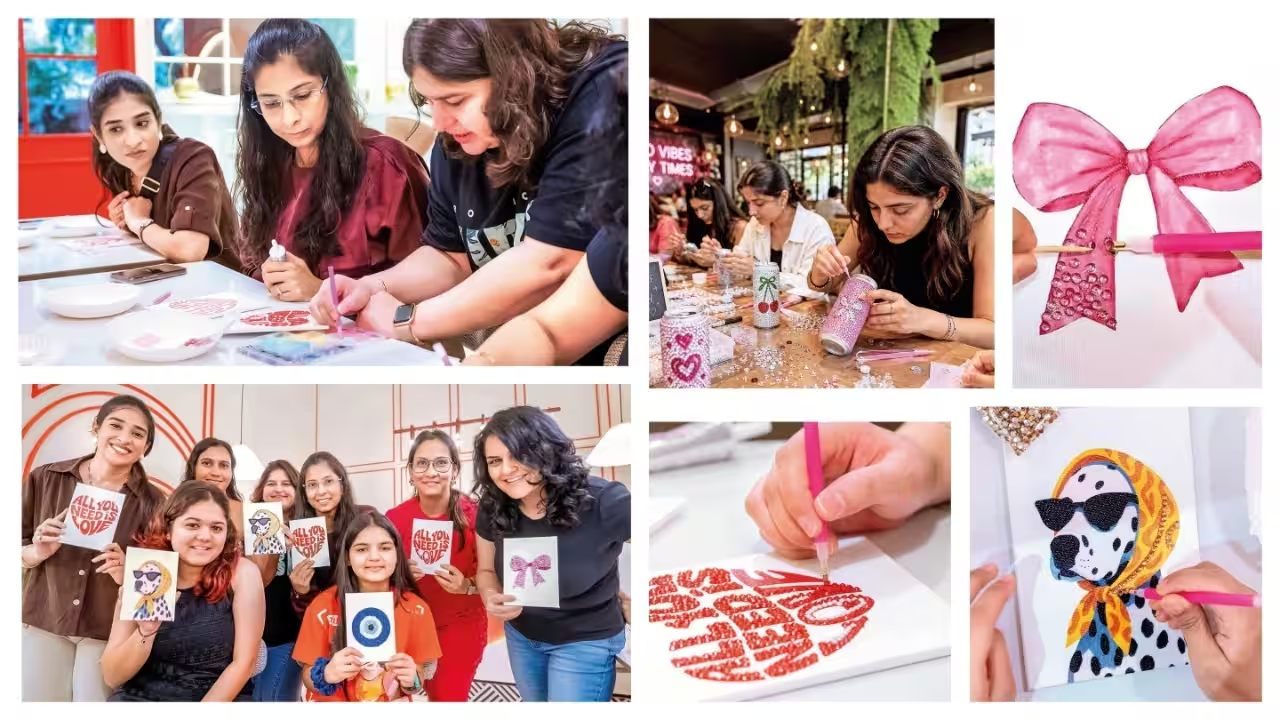
From art studios in Bandra and Kandivli to cafés in Ghatkopar and Kanjur, Mumbai’s latest weekend obsession is bedazzling. Armed with rhinestones and crystals, people are turning everything into glittering works of art.SOCIAL MEDIA’S SPARKLY OBSESSION“The moment I post a bedazzling workshop, the slots are gone. It is, without doubt, the fastest-growing category of late,” says Priyam Katakia Gandhi of Art Nook, who has seen demand soar over the past few months. She credits social media for fuelling the trend. “Every second reel is someone customising something with crystals. People don’t just want to watch it, they want to make it themselves and post their own version.” Her participants range from college students to working professionals in their thirties and forties, looking for a stress-buster. “Bedazzling doesn’t discriminate by age,” she adds.MORE THAN JUST A CRAFTFor many, the appeal goes beyond creating something sparkly. “These days people are so stressed out, so a workshop like this is perfect for them to unwind. It’s part craft, part therapy, part Instagram moment,” says Bushra Khan of The Artistic Escape. “Placing tiny rhinestones one by one requires focus. Your phone is away, mind quietens down, and before you know it, you’ve created something beautiful.”NO ARTISTIC EXPERIENCE NEEDEDThe ease of the craft is another reason behind its popularity. Rohanshi Manek of Gossip Glue, who recently conducted a workshop in Kandivli, says participants simply walk in with a plain canvas and leave with a dazzling piece of art. “You don’t need any prior art background and yet you can create something beautiful. Even a first-timer leaves with something they can proudly display.”A HOBBY FOR EVERY GENERATIONThe workshops are also attracting a surprisingly diverse audience. “It’s not just Gen Z, millennials and even boomers are signing up,” say Khushi Shah of Kya Scene Bedazzle Workshop. “Participants are first taught how to use the wax pad and applicator to place rhinestones neatly to creat their art, which they take home in a display frame,” she says. Instructor Vidhi Karatra adds, “It’s a low-pressure activity that almost everyone is able to complete,” they say.CREATIVITY WITHOUT THE LUXURY PRICE TAGFor participants, the appeal lies in both self-expression and affordability. “A crystal-studded sneaker or a bedazzled phone case says something about you that a store-bought item never can,” says Karan Mehta, who recently attended a customisation workshop. “Compared to buying a designer embellished piece, doing it yourself costs a fraction of the price, and you get bragging rights because you made it.” With workshops now popping up across the city, from Paintology in Dadar and Beautiful Hues in Khar to independent creators hosting pop-ups in cafés, Mumbai’s love affair with a little extra sparkle shows no signs of fading.BEDAZZLE THESE

  • Phone cases
  • Tumblers
  • Tote bags
  • Sneakers
  • Denim jackets
  • Caps
  • Photo frames
  • Trinket boxes
  • Coasters
  • Canvas wall hangings
CR seat fight: Woman unleashes pepper spray | Mumbai News

CR seat fight: Woman unleashes pepper spray
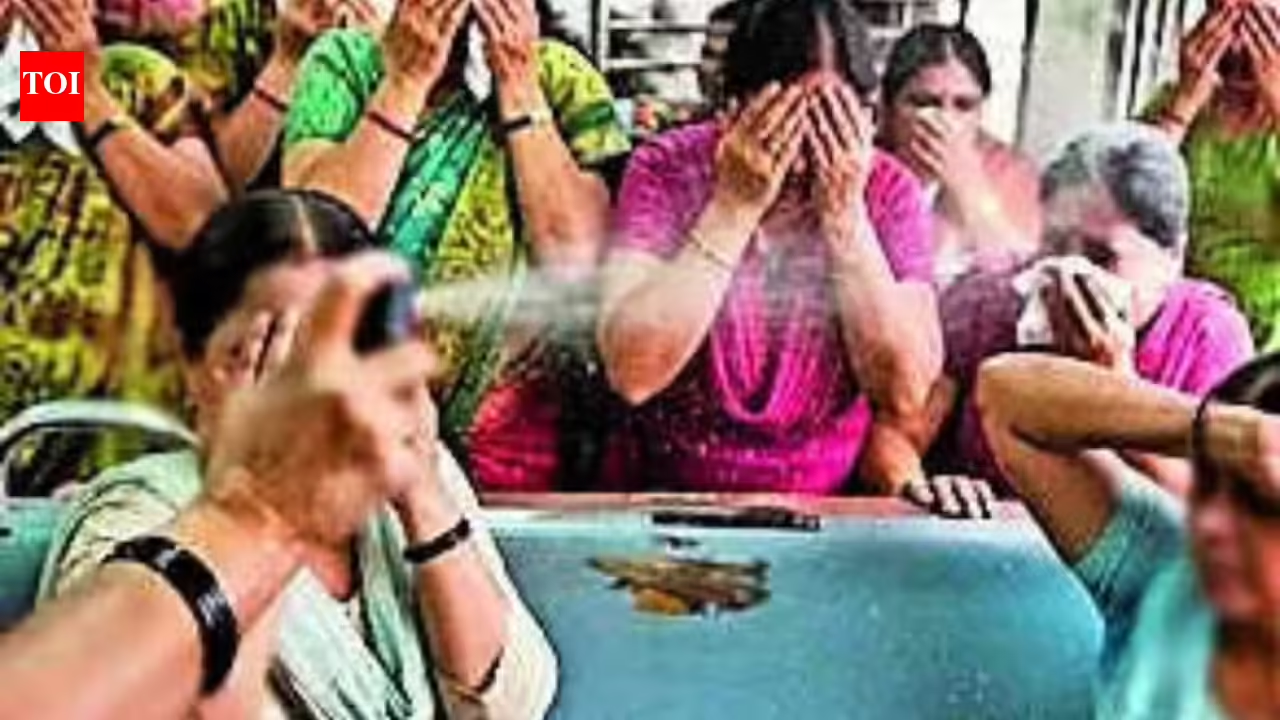
The incident occurred on the 8.33 am 15-coach Central Railway fast local from Kalyan to Chhatrapati Shivaji Maharaj Terminus (CSMT). (AI Images)

MUMBAI: A dispute over seats in the first-class ladies’ coach of a Kalyan-CSMT fast local train escalated into a scuffle after a woman allegedly used pepper spray on fellow passengers during the morning rush hour on Thursday, triggering panic inside the compartment.The incident occurred on the 8.33 am 15-coach Central Railway fast local from Kalyan to Chhatrapati Shivaji Maharaj Terminus (CSMT). According to railway officials, four women passengers boarded the first-class ladies’ coach at Dombivli before the train reached Kalyan and occupied seats.When the train arrived at Kalyan, women commuters waiting in queues on the platform boarded the coach expecting to find seats on the train originating from the station. Finding the seats already occupied led to an argument between the Kalyan and Dombivli groups of passengers.The verbal exchange soon escalated into a physical altercation. During the scuffle, one of the women from the Dombivli group allegedly took out a pepper spray canister from her handbag and sprayed it towards the women who boarded at Kalyan. The spray caused panic among passengers in the coach, although no serious injuries were reported.Despite the commotion, the train continued its journey towards CSMT. Passengers contacted the railway security helpline 1512 to report the incident. Railway police personnel reached the platform after receiving the alert, but the train had already departed from Kalyan.After the train reached CSMT, teams from the Railway Protection Force (RPF) and the Govt Railway Police (GRP) attended to the coach and detained members of both groups for inquiry. Both sides initially lodged complaints against each other, alleging assault during the dispute.However, after discussions at the police station, the women agreed to resolve the matter amicably and withdrew their complaints. The incident has been recorded at the CSMT GRP station. Since both parties chose not to pursue legal action, no case has been registered.Lata Argade of Upnagariya Pravasi Maha Sangh said pepper spray should only be used in genuine emergencies, making its use in this dispute unjustified. While passengers with valid tickets cannot be forced to vacate seats, those travelling end-to-end could show consideration and give tired commuters a seat.

Minority trust takeover will not change school’s status, Maharashtra govt clarifies | Mumbai News

Minority trust takeover will not change school’s status, Maharashtra govt clarifies
The government has now drawn a clear distinction between the identity of the managing trust and that of the school

Mumbai: The Maharashtra government has clarified that a non-minority school will not acquire minority status merely because its management is transferred to a minority educational institution.In a government resolution issued on Thursday, the school education department said the institution’s original character would remain unchanged even after the transfer, and it would not become eligible for protections available to minority institutions.The order seeks to settle what the government describes as confusion at the field level. A 2012 policy permits the management of schools to be transferred, by mutual consent, between minority and non-minority educational bodies. This had raised questions among officials and institutions over whether a school could inherit the minority status of the trust taking it over.The government has now drawn a clear distinction between the identity of the managing trust and that of the school. It said, “minority status requires an institution to have been both established and administered by a religious or linguistic minority. A trust that later assumes management may satisfy the administration test, but cannot retrospectively claim to have established the school.”The clarification comes months after Maharashtra witnessed a controversy over the grant of minority status to 75 educational institutions in a short span between Jan 28 and Feb 2. Chief minister Devendra Fadnavis subsequently stayed the certificates and ordered an inquiry.The episode triggered wider scrutiny of how minority status was being granted and used. School education minister of state Pankaj Bhoyar announced a probe into allegations that some institutions had sought the tag mainly to secure exemptions from the Right to Education Act’s requirement of reserving 25% entry-level seats for children from disadvantaged groups.

NCP (SP) flags voter roll discrepancies in Maharashtra, seeks SIR Extension and greater transparency | Mumbai News

NCP (SP) flags voter roll discrepancies in Maharashtra, seeks SIR Extension and greater transparency
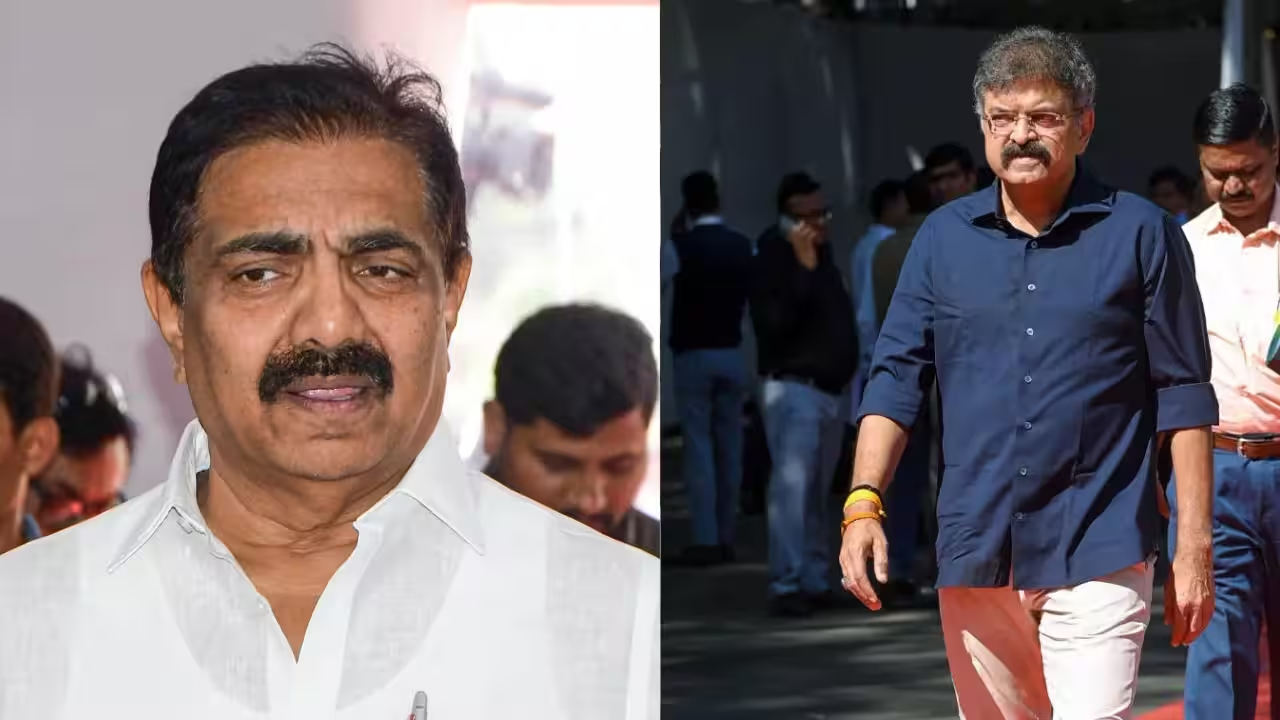
Senior leaders Jayant Patil (left), MLA Jitendra Awhad and Priya Patil met Maharashtra chief election officer on Thursday.

MUMBAI: Senior leaders of the Nationalist Congress Party (Sharadchandra Pawar), led by Jayant Patil, on Wednesday met Maharashtra chief electoral officer S. Chockalingam to raise concerns over difficulties being faced by voters during the ongoing Special Intensive Revision (SIR) of electoral rolls, and sought corrective measures to make the process more transparent and accessible.The delegation comprised senior leader Jayant Patil, MLA Jitendra Awhad and Priya Patil, head of the party’s LGBTQ cell.Addressing the media after the meeting, Jayant Patil alleged that while the SIR exercise is under way, the voter list available on the app contains several discrepancies and inconsistencies. He also claimed that many Booth Level Officers (BLOs) appeared to be facing confusion over the process and, in several places, had not been able to reach voters.Patil said the delegation urged the Election Commission authorities to rectify errors in the electoral rolls at the earliest, simplify the process for voters and make it more transparent. The party also requested an extension of the ongoing revision exercise to ensure that eligible voters are not left out because of procedural difficulties.Despite raising concerns over the process, Patil appealed to citizens to complete their voter registration and verification formalities within the stipulated period.The delegation also highlighted issues faced by members of the LGBTQ community during the electoral roll revision process. Patil said Chockalingam assured them that no injustice would be caused to any section of voters and that the concerns raised by the delegation would be looked into.The meeting comes amid political scrutiny of the ongoing SIR exercise, with opposition parties in several states raising concerns over implementation, while election authorities have maintained that the revision is aimed at ensuring accurate and updated electoral rolls.

Maharashtra Teacher Eligibility Test paper leak ‘mastermind’ promised plots to 2 printing press staffers, gave them Rs 8,000 each for ‘liquor party’: Police | Mumbai News

Maharashtra Teacher Eligibility Test paper leak ‘mastermind’ promised plots to 2 printing press staffers, gave them Rs 8,000 each for ‘liquor party’: Police
Police have intensified the hunt for the alleged main accused, Bijendra Gupta

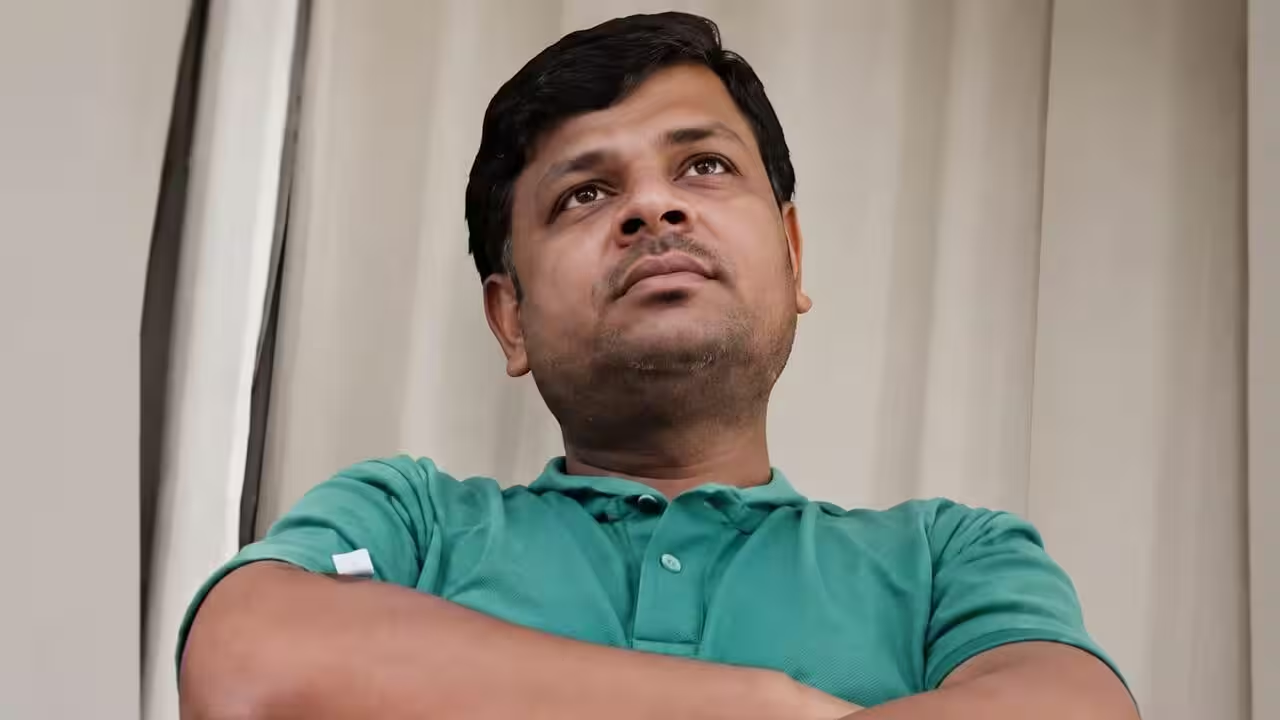
Bhiwandi: The Special Investigation Team (SIT), probing the Maharashtra Teacher Eligibility Test (TET) 2026 paper leak, has claimed that the alleged mastermind, Bijendra Gupta, had lured two employees of an Agra-based printing press that printed the question papers by promising them a plot of land each.According to investigators, Gupta also allegedly gave Babulal Kushwaha and Naresh Kumar, the two arrested printing press staffers, Rs 8,000 each for a ‘liquor party’.Police claimed that Kushwaha and Kumar exploited loopholes in the security system at the printing press to smuggle out copies of all four sets of the TET question papers before they were dispatched to Maharashtra and sent them to Gupta via his network.The investigation has further revealed that Gupta had finalised a deal to sell the leaked papers through arrested accused Kapil Dahiya to a Pune resident, who is still at large. Police claimed that the Pune man was in contact with nearly 50 teacher aspirants who were willing to buy the leaked question papers before the June 28 examination.The paper leak was foiled after Bhiwandi zone deputy commissioner of police Pawan Bansod received a tip-off a day before the examination. Posing as prospective buyers, police laid a trap in Kongaon and arrested three persons who were allegedly attempting to sell the TET question papers. State education department officials later confirmed that the seized papers were genuine, leading to the registration of the case and formation of an SIT.Till date, the SIT has arrested 12 accused, including Dahiya, Kushwaha, Kumar, and Gupta’s wife Suman from Bihar. Investigators have also seized hard disks, mobile phones, forged identity documents, and other digital evidence while probing the money trail and the interstate network behind the racket.Police have intensified the manhunt for Gupta. Bansod, who is leading the investigation, said, “Police teams are conducting searches at multiple locations across Bihar based on technical surveillance and human intelligence to trace Gupta. His arrest is crucial to identifying the full extent of the syndicate and tracing the financial transactions.”

Anti-Narcotics Cell of Navi Mumbai crime branch busts international drugs cartel, arrests six | Mumbai News

Anti-Narcotics Cell of Navi Mumbai crime branch busts international drugs cartel, arrests six

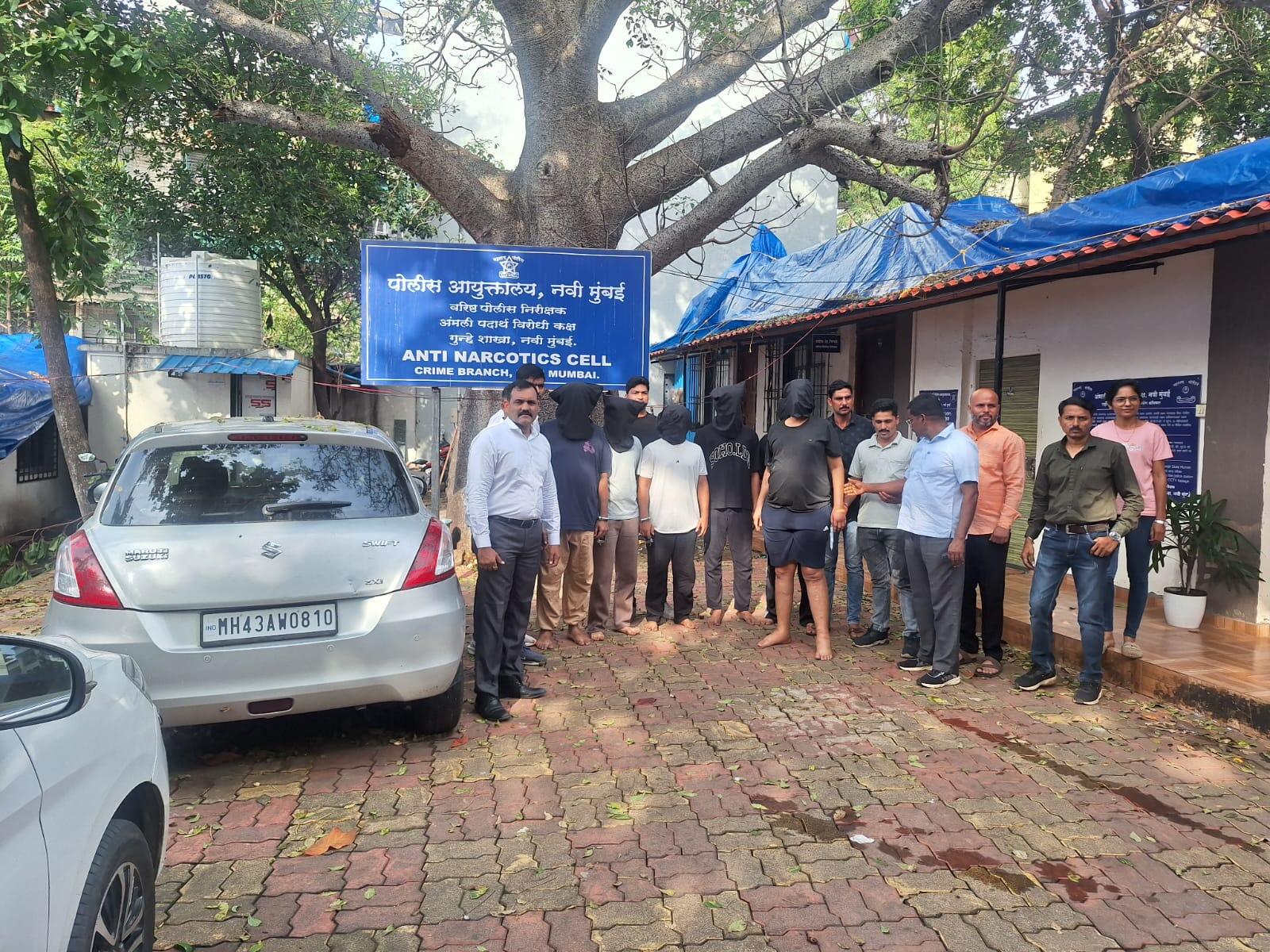
Navi Mumbai: The Anti-Narcotics Cell (ANC) of Navi Mumbai crime branch busted an international drugs cartel and arrested six people from different parts of the state. Around 1,307 gm of hydro ganja and 5 gm of cocaine collectively worth Rs 1.4 crore were seized. Two accused are wanted by the police, including a drugs supplier based in Thailand, from where he supplies hydro ganja to India.Sandeep Nigade, senior inspector of ANC, said, “The key wanted accused is Vrushang Bhanushali, a resident of Ghatkopar, who is currently residing in Thailand and supplies hydro ganja from Thailand to India, the probe has revealed. Another wanted accused is a drug peddler identified as Vinit Chandra alias Vintya, a resident of Nerul. DCP (Zone 1) Vijay Kharat has issued a Look Out Circular (LOC) against Bhanushali, for enabling to arrest him when he enters India.The arrested accused have been identified as Abdul Rauf Zareen Khan (27), a resident of Taloja, Mithun Arun Mankure (30), a resident of Vash, Gaurav Vishwajit Chindarkar (29), a resident of Chembur, Ayan Afzal Rajkotwala (25), a resident of Mira Road, Suresh Virji Bhanushali alias Surya (45), a resident of Dombivli, and Neeraj Navinbhai Shah (28), a resident of Ghatkopar. The six arrested accused are in police custody remand till July 17.Nigade said, “Under the ‘Drug-Free India 2028’ campaign to curb the menace of drugs cartel operating in Navi Mumbai, on July 10, acting on a tip-off, a raid was conducted at Hotel Monday in Turbhe and the accused Abdul Rauf Zareen Khan and his friend Mithun Arun Mankure were arrested. Subsequently, an NDPS case was registered at Turbhe police station. During interrogation in their police custody remand, they revealed the name of their accomplice Ayan Rajkotwala, who was arrested from Mira Road.Nigade further stated, “The three arrested accused revealed that they had procured the hydro ganja from Gaurav Vishwajit Chindarkar, who was then arrested from Chembur. Chindarkar revealed that he ordered hydro ganja from his friend Bhanushali, who resides in Thailand. Thereafter, Bhanushali sends hydro ganja to his partners Neeraj Shah in Ghatkopar and Suresh Bhanushali in Dombivli. Accordingly, Suresh Bhanushali was arrested from the Meet Point guest house in Dombivli. Neeraj Shah was arrested from Ghatkopar.

979c7480-daae-4cdb-9eb3-9cfb1f61c08b_IMG-20260715-WA0032.jpg

Attachment

India’s clean mobility shift won’t be EV-only; hybrids, CNG, hydrogen and biofuels to share the road | Mumbai News

India's clean mobility shift won't be EV-only; hybrids, CNG, hydrogen and biofuels to share the road
The IEA Global EV Outlook 2026 is broadly in line with NITI Aayog’s advocacy of a technology-neutral strategy for decarbonising transport. (AI-generated image)

MUMBAI: India’s transition to cleaner mobility is expected to follow a technology-agnostic path rather than an exclusively electric vehicle (EV)-led route, with industry experts and policy think tanks indicating that EVs, hybrids, compressed natural gas (CNG), biofuels, hydrogen and cleaner internal combustion engine (ICE) technologies will coexist over the coming decade.The evolving approach is also expected to reshape India’s automotive component industry, creating opportunities for manufacturers to diversify product portfolios while strengthening the country’s position as a global automotive manufacturing hub.According to the International Energy Agency’s (IEA) Global EV Outlook 2026, India continues to be among the world’s fastest-growing EV markets, driven largely by electric two- and three-wheelers. Annual EV sales have crossed 2.4 million units. However, EVs still account for only a small share of the country’s overall vehicle fleet, highlighting the continued role of conventional and alternative powertrains during the transition.The outlook is broadly in line with NITI Aayog’s advocacy of a technology-neutral strategy for decarbonising transport. The policy think tank has argued that India’s diverse geography, varying income levels, different vehicle usage patterns and uneven charging infrastructure require multiple clean mobility solutions rather than reliance on a single technology.For consumers, the multi-technology approach could translate into a wider choice of cleaner vehicles suited to different needs, while allowing the supporting infrastructure—including charging stations, CNG networks and alternative fuel ecosystems—to expand in phases.The transition is also opening new avenues for India’s automotive component industry. According to the Automotive Component Manufacturers Association of India (ACMA), the sector has grown into a USD 75-billion industry, contributing nearly 2.3% to the country’s GDP. Component exports have also risen steadily as global automakers diversify sourcing under the China-plus-one strategy, positioning India as an increasingly important manufacturing base.Industry experts said the next phase of growth will depend not merely on higher production volumes but on technological capabilities. Manufacturers are expected to develop components simultaneously for advanced ICE engines, hybrid vehicles and electric drivetrains while investing in electronics, embedded software, sensors, lightweight materials and precision engineering.They added that research and development, artificial intelligence, automation and digital manufacturing will increasingly determine competitiveness as the industry moves from conventional mechanical engineering towards software-enabled mobility solutions.“India’s automotive industry is undergoing its biggest transformation in decades. While electrification has become the defining global narrative, India’s transition to cleaner mobility will be far more nuanced than simply replacing internal combustion engine vehicles with electric vehicles,” said Adithya Jayakar, deputy managing director of UCAL Ltd.Industry observers also pointed to supply-chain resilience as a strategic priority after the Covid-19 pandemic and geopolitical disruptions exposed India’s dependence on imported electronics, semiconductors and specialised materials. While the Centre’s Production Linked Incentive (PLI) Scheme has accelerated investments in domestic manufacturing, they said deeper localisation of high-value components would be crucial for improving export competitiveness and reducing import dependence.Sustainability is also emerging as a key business imperative beyond regulatory compliance. Renewable energy use, circular manufacturing, responsible sourcing and carbon disclosure are increasingly influencing procurement decisions by global original equipment manufacturers (OEMs), prompting Indian suppliers to align with international sustainability benchmarks.Jayakar said policy support should encourage innovation across the mobility ecosystem rather than favour any single propulsion technology.“India’s competitive advantage lies in its ability to innovate across technologies, not in choosing one over another. As the country aspires to become a global automotive manufacturing hub, success will depend on building capabilities across the entire mobility spectrum,” he said.

BMC asks Taj Mahal Palace to pay ₹27 crore for road, footpath occupation around hotel | Mumbai News

BMC asks Taj Mahal Palace to pay ₹27 crore for road, footpath occupation around hotel
According to the notice issued by the assistant commissioner of A ward, the civic body has directed the hotel to pay ₹4.97 crore towards road occupancy charges and ₹22.15 crore towards footpath occupancy charges, taking the total demand to ₹27.12 crore. The amount includes interest and charges up to March 2026.

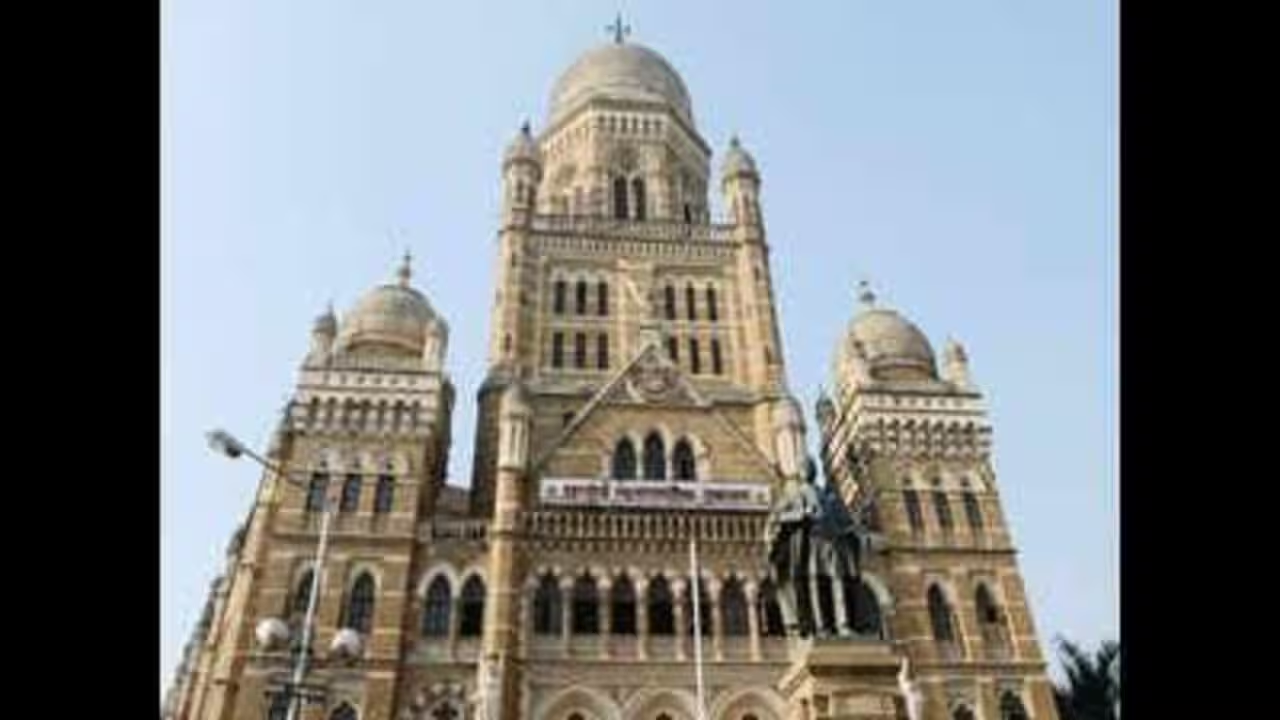
Mumbai: BMC has issued a demand notice to the Taj Mahal Palace Hotel, asking it to pay nearly ₹27 crore towards road and footpath occupation charges for security planters, barricades and parking spaces around the iconic Colaba property, after withdrawing concessions that had earlier been granted.According to the notice issued by the assistant commissioner of A ward, the civic body has directed the hotel to pay ₹4.97 crore towards road occupancy charges and ₹22.15 crore towards footpath occupancy charges, taking the total demand to ₹27.12 crore. The amount includes interest and charges up to March 2026.The dispute pertains to the occupation of 869.59 sq m of road space and 1,136.3 sq m of footpath around the hotel for security installations and parking, put in place after the 26/11 terror attacks.Initially, the Taj had sought a 50% concession on road occupancy charges and a complete waiver of footpath occupancy charges, arguing that the occupied footpath was not being used for commercial purposes. The then BMC Standing Committee approved the proposal in January 2021, but the matter remained pending before the general body.However, after the civic body recovered pending dues from the Bombay Stock Exchange (BSE), the A ward office suo motu reviewed the concessions extended to similar establishments.On February 21, 2025, the municipal commissioner approved the cancellation of the earlier concessions granted to the Taj, following which revised demand notices were issued to the Taj and the Trident Hotel.The BMC said the Trident Hotel paid all pending dues and removed security planters occupying the footpath, while the Bombay Stock Exchange (BSE) agreed to clear pending road occupancy charges amounting to ₹3.25 crore for the period between April 2012 and December 2024. However, officials said the Taj has not yet paid the revised charges despite repeated reminders.The latest reminder states that the hotel had earlier been asked to pay ₹4.03 crore towards road occupancy and ₹18.27 crore towards footpath occupancy up to July 2025. Since the dues remained unpaid, the BMC levied interest, increasing the liability to ₹4.73 crore for road occupation and ₹21.32 crore for footpath occupation up to September 2025. It has also sought an additional ₹1.08 crore for occupation charges from October 2025 to March 2026.A senior civic official said the BMC decided to adopt a uniform policy for commercial establishments occupying public roads and footpaths for security purposes.“BSE agreed to pay the prescribed charges and the Trident also complied, there was no justification for continuing the concession granted to the Taj. The civic body has therefore sought recovery of the revised dues,” the official said.When contacted Taj Mahal Palace did not comment on the issue.

Bombay high court seeks DGP’s report on CCTVs in all police stations, period of footage saved | Mumbai News

Bombay high court seeks DGP’s report on CCTVs in all police stations, period of footage saved

Mumbai: Bombay High Court has directed the state director general of police to conduct a fact-finding exercise across all police stations in Maharashtra and submit a report on the functioning of CCTV cameras and the period of preservation of their footage.Acting Chief Justice Ravindra Ghuge and Justice Gautam Ankhad on Wednesday were hearing a petition by Ghatkopar resident Prashant Kokane, 35, seeking preservation of CCTV footage of the office of DCP (Zone 7) and Ghatkopar police station between March 17 and 20, 2025.On March 17, 2025, he submitted a complaint to the ration office regarding a bogus ration card. On March 20, 2025, chapter proceedings — preventive measures to maintain public order — were initiated by the DCP, who is also special executive magistrate. Kokane said this was done by the opposite party in collusion with police to pressure him to withdraw the complaint. In April 2025, the HC disposed of Kokane’s petition after the state said chapter proceedings would be withdrawn and his allegations against police officers would be brought to the notice of senior authorities to take appropriate action.On March 5, 2026, Kokane filed another petition for preserving the CCTV footage as the inquiry was on.Additional public prosecutor Mankunwar Deshmukh, citing a July 2025 written communication of the senior inspector that CCTV footage is preserved for six months, said it is not available considering the incident is of March 2025.Kokane referred to HC’s March 2022 order in which the state had undertaken to upgrade CCTV systems in police stations and that necessary steps would be taken to ensure recording/data backup is kept for 18 months and not just 12 months. He also submitted his April 15, 2025, application to the senior inspector to preserve the CCTV footage “which was within a month” of the alleged incident. “In view of the above,” the judges directed the DGP to “take an overall view of all police stations” and submit a report on Aug 20. The report should also indicate what steps were taken after the March 2022 order and “why has the Ghatkopar police station reported to us that the CCTV footage cannot be preserved after 6 months and is not available.”

Poll demand leads to uproar in BMC House, opposition walks out | Mumbai News

Poll demand leads to uproar in BMC House, opposition walks out

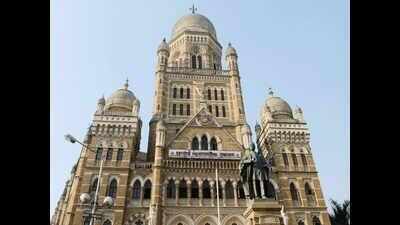
Mumbai: High drama was witnessed in the BMC general body on Thursday after the BJP-led house sought to accord urgent status to a proposal to widen a road in Ghatkopar (West), triggering a confrontation over voting procedure that ended with the opposition staging a walkout.The urgent proposal pertained to revising the regular road line of Khot Lane in Ghatkopar (West) from 6 metres to 9 metres under the Mumbai Municipal Corporation Act, 1888, and the Development Control and Promotion Regulations, 2034. The proposal covers multiple land parcels in Ghatkopar-Kirol village.Before the proposal could be taken up, however, opposition members demanded a division of votes, arguing that under the rules, an urgent business proposal requires approval by a two-thirds majority before it can be discussed.The opposition claimed the BJP-led Mahayuti did not have the required numbers, leading to a prolonged standoff. After consultations with civic officials and ruling alliance leaders, Mayor Ritu Tawde announced that the proposal would instead be placed before a special meeting on a later date and proceeded to the next agenda item — a discussion on the inquiry report into the fatal Chembur tree-fall incident.The move lead to protests from corporators of Shiv Sena (UBT), Congress, Samajwadi Party, AIMIM and MNS, who accused the Mayor of sidestepping a vote. Leader of Opposition Kishori Pednekar, Congress leader Ashraf Azmi, MNS leader Yashwant Killedar and other opposition members repeatedly demanded that a poll be conducted before the House moved on.As opposition members raised slogans of “Take the poll, take the poll,” BJP corporators countered with chants of “Ganpati Bappa Morya,” reducing the House to chaos. During the impasse, the Mayor, officials from the Municipal Secretary’s Department, Leader of the House Ganesh Khankar and Standing Committee chairman Prabhakar Shinde held discussions on the way forward.Refusing to conduct a division of votes, the Mayor reiterated that the proposal would be brought before a special meeting. The announcement prompted the opposition to walk out of the House. The protesting corporators later demonstrated outside the BMC headquarters, raising slogans against the Mayor and the BJP-Shiv Sena (Shinde) ruling alliance.The opposition said it had demanded that the inquiry report into the incident be taken up at the start of the meeting. They alleged that the inquiry committee had effectively given a clean chit to the contractor, the Gardens Department, engineers and consultants, while recommending only a Rs 7 lakh penalty on the contractor and consultant. The opposition accused the ruling alliance of prioritising administrative and financial proposals over a discussion on the fatal incident.