Jio, Airtel top Mumbai TRAI drive test on speed, voice quality; MTNL lags on coverage | Mumbai News

Jio, Airtel top Mumbai TRAI drive test on speed, voice quality; MTNL lags on coverage
Reliance Jio achieved the fastest mobile data speeds in Mumbai’s recent TRAI drive test. Airtel, too, delivered a solid overall network performance during the independent assessment.

MUMBAI: Reliance Jio topped the Telecom Regulatory Authority of India’s (TRAI) latest independent drive test in Mumbai, recording the fastest mobile data speeds and zero dropped calls on the surveyed routes, while Vodafone Idea (Vi) posted the fewest coverage gaps.Airtel also delivered a strong overall performance, whereas MTNL lagged on coverage and call quality.The findings, released on Monday, are based on drive tests conducted by TRAI between June 10 and 12 across 204.3 km of Mumbai roads and seven high-footfall locations, including CSMT, Churchgate, Dadar and Byculla railway stations, Gateway of India, Marine Drive and Parel station.The assessment evaluated 2G, 3G, 4G and 5G network performance under real-world conditions.In mobile data performance, Jio recorded the highest average download speed at 237.81 Mbps, more than twice Airtel’s 93.76 Mbps and well ahead of Vi’s 70.69 Mbps.Jio also led in upload speeds with 40.92 Mbps, compared with 25.92 Mbps for Airtel and 25.57 Mbps for Vi. MTNL’s mobile data throughput was not available in the assessment.Jio also emerged as the best performer in voice services, recording zero dropped calls out of 489 successfully established calls during the test. Airtel and Vi reported one dropped call each, while MTNL recorded 28 dropped calls out of 203 established calls.In terms of coverage, Vi performed the best, registering only five poor-signal samples out of 54,511 observations. Airtel recorded 102 poor-signal samples, while Jio logged 144. MTNL fared the worst, with poor signal strength in 17,877 of 23,461 samples and no coverage in another 7,325 samples.For the call silence parameter, where users experience silence for more than three seconds despite an active call, Jio and Vi recorded one instance each, while Airtel reported 23 instances across 14 calls. MTNL was not assessed for this parameter.The drive test covered major routes, including the Bandra-Worli Sea Link, Mahim, Dadar, Sion, Antop Hill, Worli, Parel, Sewri, Haji Ali, Mumbai Central, Byculla, Malabar Hill, Girgaon, Mazgaon and Churchgate.TRAI said the findings reflect network performance only on the routes, locations and time during which the tests were conducted. The results have been shared with telecom operators for corrective action where required, and the detailed reports have been uploaded to the regulator’s website.

Maharashtra floats EOI for state’s first floating solar-plus-storage plant at Veer dam | Mumbai News

Maharashtra floats EOI for state's first floating solar-plus-storage plant at Veer dam
Unlike conventional solar parks, the project will use the surface of the Veer reservoir, reducing the need for land acquisition while also helping minimise water evaporation.

MUMBAI: Maharashtra has initiated the process to develop its first floating solar power project with battery storage by inviting expressions of interest (EOIs) for an integrated 11-MW Floating Solar Photovoltaic (FSPV) project and a 5.5-MW Battery Energy Storage System (BESS) at the Veer reservoir in Satara district.The Maharashtra Krishna Valley Development Corporation (MKVDC) has proposed the project under a public-private partnership (PPP) model.Scheduled for commissioning in FY 2028-29, it is expected to be the state’s first reservoir-based solar plant integrated with battery storage, enabling solar energy generated during the day to be stored and supplied during peak demand hours.Unlike conventional solar parks, the project will use the surface of the Veer reservoir, reducing the need for land acquisition while also helping minimise water evaporation. The reservoir will continue to be used for irrigation alongside renewable energy generation.The project will include a 5.5-MW/11-MWh battery energy storage system, in line with the Maharashtra Renewable Energy and Energy Storage Policy, which requires storage capacity equivalent to at least 50% of renewable energy capacity for projects commissioned in FY 2028-29.The storage system is expected to improve grid stability and enhance renewable energy utilisation.The selected private developer will finance, design, construct, operate and maintain the project under a 25-year Lease-Develop-Operate-Transfer (LDOT) concession, after which the assets will be transferred back to MKVDC.Power generated will be evacuated through MSETCL/MSEDCL substations at Lonand and Shirwal.The EOI also outlines safeguards to ensure the project does not affect dam operations, irrigation releases or the reservoir’s ecology.Developers will be required to maintain exclusion zones around critical dam infrastructure, prepare environmental management plans and coordinate with fisheries stakeholders.To qualify, bidders must have experience in developing at least a 5-MW floating solar project and a 2-MW battery energy storage system, or equivalent energy-sector PPP projects, besides operating a renewable energy project of at least 5 MW for two years.They must also meet specified financial eligibility criteria.MKVDC said the EOI is only a market-sounding and shortlisting exercise and does not constitute a commitment to issue a request for proposal or award the project.

‘People are Vishnu’s avatar’: Uddhav Thackeray praises CJP protesters, slams Centre over youth discontent | Mumbai News

'People are Vishnu's avatar': Uddhav Thackeray praises CJP protesters, slams Centre over youth discontent

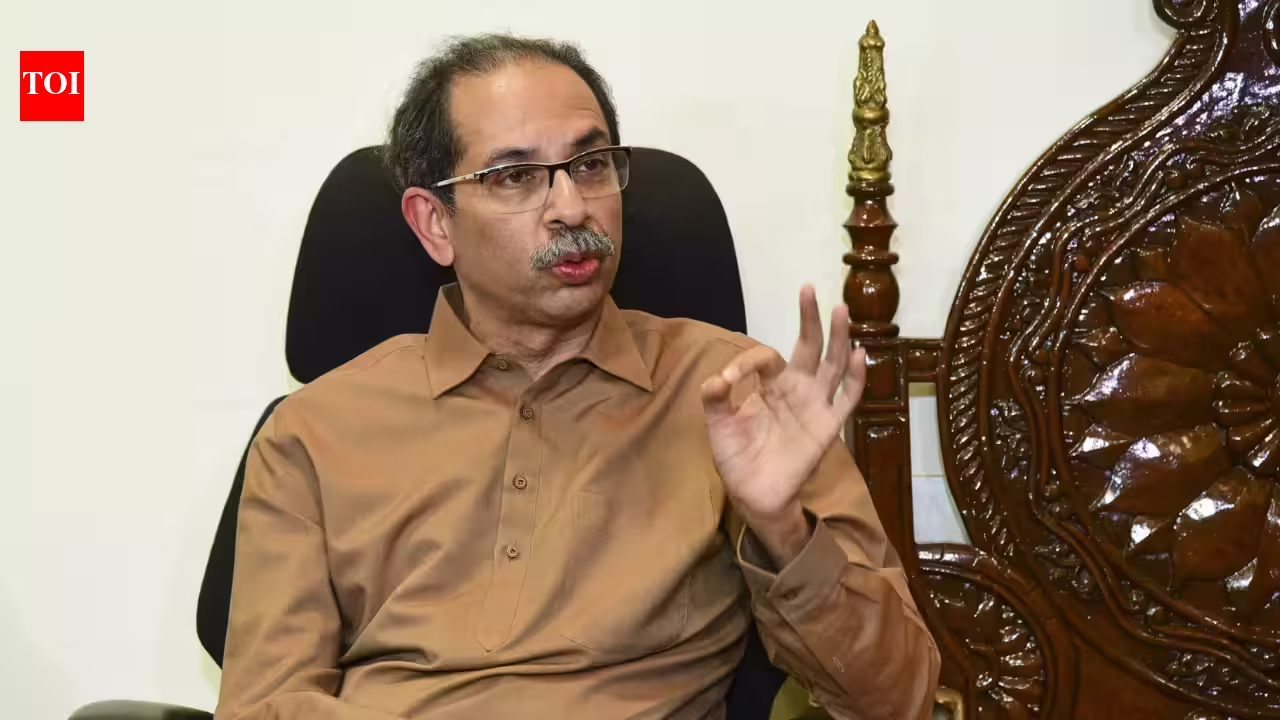
MUMBAI: Shiv Sena (UBT) chief Uddhav Thackeray on Sunday likened people participating in the CJP protests to an “avatar of Lord Vishnu”, saying citizens from Mumbai to Delhi had overcome fear and taken to the streets to save the country and democracy.In an interview with Sena (UBT) MP Sanjay Raut in the party mouthpiece Saamna, Uddhav said the government had long ruled through fear, but people were now defying it.“Vishnu has taken the form of the people. I saw it at Jantar Mantar. This is Vishnu, to save the country and religion. Religion is not just Hindu or Muslim. The religion of humanity is being protected by the youth who have come out on the streets. Their parents and grandparents are with them. This is the incarnation of Vishnu born to save the country,” he said.Warning the Centre against ignoring the protests, Uddhav cited student-led movements in neighbouring countries. “Ask Sheikh Hasina, whom you have given shelter to, why she could not crush the students’ movement. Ask Nepal’s Prime Minister why the Gen Z movement could not be suppressed. A country is its people, and they know how to express their opinion in a democracy,” he said.He said public anger could escalate into a larger movement if left unaddressed. “A spark can turn into a revolution. If corrective steps are not taken in time, a grave situation could arise. Once these young people take to the streets, they will not stop until they achieve their goal,” Uddhav said.Targeting the BJP-led Centre, he alleged that people had lost faith in politicians because parties were being split for political gain. He blamed Union education minister Dharmendra Pradhan over the alleged paper leaks and also criticised Union home minister Amit Shah.“The people elected you to govern. Do your job. Why wasn’t the machinery used to prevent paper leaks before they happened?” he asked.Uddhav also claimed that people who backed the BJP since 2014 now felt betrayed. Citing unemployment, inflation, fuel prices, pothole-ridden roads, bridge collapses and alleged irregularities in the Ram temple donation collection, he said the government had failed to deliver.“People feel those they supported have stabbed them in the back. Jobs have not come, inflation has not fallen, petrol and gas prices remain high, roads are full of potholes, bridges are collapsing and nothing of value has been delivered,” he said.

Mumbai Police stop issuing notices to CJP protest case accused, say all notices predate July 26 | Mumbai News

Mumbai Police stop issuing notices to CJP protest case accused, say all notices predate July 26
Mumbai Police clarified notices to CJP protesters stopped after July 26

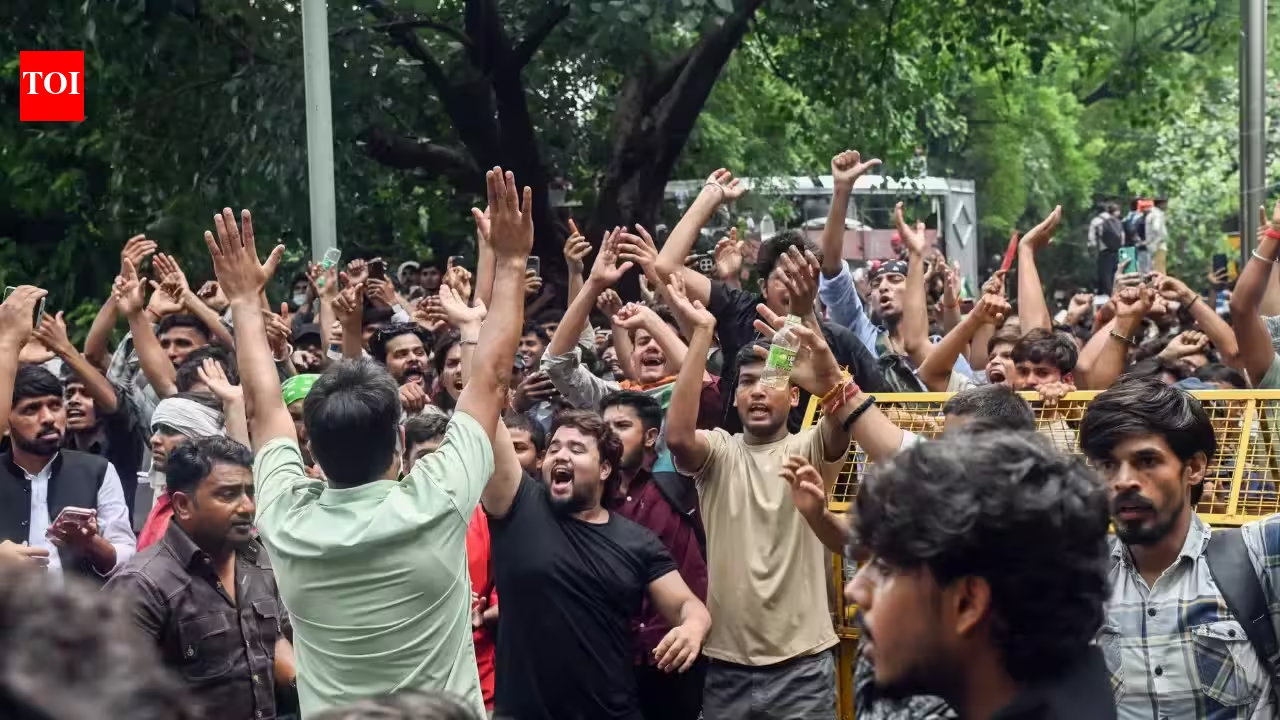
MUMBAI: Mumbai Police on Monday clarified that they have stopped issuing notices to protesters named in FIRs related to last week’s demonstrations by the Cockroach Janta Party (CJP) from July 26 onwards, and that all notices served were issued before that date.The clarification came after lawyers representing several students and protesters claimed that police were continuing the investigation by issuing notices and recording statements despite the Maharashtra government’s assurance that cases against peaceful protesters would be withdrawn.Advocate Vikrant Khare, representing several students and protesters along with a group of Bombay High Court lawyers, said police were proceeding with the investigation as no formal directions had been issued to halt the process.He urged senior police officials and the state government to issue interim instructions to suspend further proceedings until a formal order withdrawing the cases is passed.Police, however, maintained that no fresh notices have been issued since July 26 and that any notices served were issued before that date.

Acb: Two private individuals held in ACB trap for allegedly demanding bribe to release towed car | Mumbai News

Two private individuals held in ACB trap for allegedly demanding bribe to release towed car

MUMBAI: The Anti-Corruption Bureau (ACB), Worli unit, has registered a case against two private individuals for allegedly demanding and accepting a bribe to facilitate the release of a car towed by the Brihanmumbai Municipal Corporation (BMC).The accused have been identified as Santosh Sonu Patade (51) and Devendra Chandrakant Bandwadkar (52). A case has been registered against them under Sections 7 and 12 of the Prevention of Corruption Act, 1988.According to the ACB, the complainant’s Maruti Suzuki WagonR was towed by the BMC on July 14. Patade allegedly demanded ₹10,700 for releasing the vehicle. Unwilling to pay the bribe, the complainant approached the ACB’s Worli unit on July 23 and lodged a complaint.During the verification process conducted the same day, Bandwadkar allegedly stated that payment had to be made for the vehicle’s release and, after negotiations, agreed to accept ₹6,000. Acting on the complaint, the ACB laid a trap on July 27 and allegedly caught Patade red-handed while accepting ₹6,000 on behalf of Bandwadkar without issuing any official government receipt. @Prachi Kumawat dump

Maharashtra targets Rs 1 lakh crore tourism investment, 18 lakh jobs by 2034; bets on Kumbh, coast and heritage | Mumbai News

Maharashtra targets Rs 1 lakh crore tourism investment, 18 lakh jobs by 2034; bets on Kumbh, coast and heritage

MUMBAI: Maharashtra has unveiled an ambitious roadmap to transform itself into a global tourism destination, targeting ₹1 lakh crore in private investment and creation of 18 lakh jobs by 2034, while shifting the focus beyond Mumbai, Pune and the Ajanta-Ellora circuit to promote year-round travel across the state.The tourism department plans to develop integrated circuits covering heritage forts linked to Chhatrapati Shivaji Maharaj, Buddhist and spiritual destinations, wildlife parks, Konkan’s coastline, wine tourism in Nashik and rural tourism. The strategy aligns with the state’s Vikasit Maharashtra vision and aims to significantly increase domestic and international tourist arrivals.Additional Chief Secretary for Tourism Sanjay Khandare said major flagship projects include India’s first underwater naval museum and artificial reef using the decommissioned INS Guldar off Sindhudurg, expansion of scuba diving facilities at Tarkarli, development of cruise and yacht tourism along Maharashtra’s 878-km coastline, immersive AR/VR experiences at heritage sites, and a dedicated MICE (Meetings, Incentives, Conferences and Exhibitions) Convention Bureau to attract business tourism.With the 2027 Nashik Kumbh Mela expected to draw millions of pilgrims, the government is accelerating investments in roads, riverfronts, accommodation, sanitation, signage and digital crowd management systems. Khandare said the infrastructure created for the Kumbh will be retained to position Nashik and Trimbakeshwar as year-round destinations combining pilgrimage, wine tourism and heritage.To attract longer visitor stays, Maharashtra will intensify digital campaigns, destination branding and story-driven marketing highlighting forts, festivals, cuisine, local traditions and coastal experiences, he added. It has also planned investment promotion offices in Mumbai, Dubai and Singapore while encouraging public-private partnerships in hotels, eco-tourism, ropeways, adventure tourism and convention infrastructure.The state is also preparing standard operating procedures and safety audits for adventure tourism, promoting homestays and women-led tourism enterprises, and introducing the Mahatithi digital platform to integrate tourism stakeholders and generate real-time visitor analytics for policy planning, he added.Officials said the long-term objective is to position Maharashtra as a premium, experience-driven destination by combining world-class heritage, spirituality, wildlife, beaches, urban culture and business tourism with improved infrastructure and higher-quality visitor experiences.

Housing societies get sweeping governance reforms; nominees gain voting rights, approved bylaws become binding | Mumbai News

Housing societies get sweeping governance reforms; nominees gain voting rights, approved bylaws become binding

MUMBAI: Maharashtra has rolled out one of the most comprehensive overhauls of cooperative housing society governance in recent years, with amendments to the Maharashtra Co-operative Societies Rules, 1961 introducing a host of member-centric reforms that are set to affect lakhs of apartment owners across Mumbai, the MMR and the state. While the changes relating to self-redevelopment and lower penal interest on maintenance dues have received attention, several equally significant governance reforms have largely gone unnoticed.The amended Rules, which came into force on June 18, reduce the minimum number of members required to form a cooperative housing society from 10 to five, introduce a formal name reservation process for proposed societies, prescribe a procedure for admitting specified relatives as associate members on the recommendation of the original member, and make government-approved model bylaws automatically binding on all cooperative housing societies across Maharashtra, irrespective of whether an individual society formally adopts them.The amendments also grant voting rights to nominees admitted as provisional members after the death of an original member, make it mandatory for societies to issue public notices in two newspapers inviting claims from legal heirs where no nomination exists, prohibit societies from collecting charges not authorised under the Rules, empower the general body to decide parking allotments, and permit annual as well as special general body meetings, including those for redevelopment, to be conducted through video conferencing.Housing experts said the reforms are expected to reduce litigation, bring greater uniformity in society administration and improve transparency in areas that frequently trigger disputes, including succession, maintenance charges, parking and redevelopment.One of the most significant changes concerns succession. Under the amended Rules, the nominee of a deceased member can be admitted as a provisional member with voting rights until regular membership is granted. Earlier, nominees often remained without voting rights for prolonged periods because of delays in completing membership formalities, leading to uncertainty in society administration.Where a deceased member has not made a nomination, the Rules now prescribe a uniform procedure requiring societies to publish notices in two newspapers inviting claims from legal heirs before transferring membership. Housing experts said the provision is expected to reduce disputes and ensure greater legal transparency in inheritance-related matters.“The biggest challenge before cooperative housing societies has been ensuring a steady flow of maintenance funds amid frequent disputes over service charges. By incorporating well-settled legal principles into the Maharashtra Co-operative Societies Rules, the government has given statutory backing to a uniform maintenance structure,” said Ramesh Prabhu, chairman, MahaSEWA.“The amendments are based on the state’s 2000 order and the Bombay High Court’s Venus Cooperative Housing Society judgment. While building-related expenses may continue to be recovered on an area basis, common service charges must be levied equally on all members. This will reduce disputes, curb arbitrary billing and bring greater legal certainty to society administration,” he said.In another significant reform, societies have been expressly prohibited from collecting any charges other than those specifically permitted under the Maharashtra Co-operative Societies Rules, addressing a long-standing grievance of flat owners over miscellaneous levies imposed without statutory backing.Parking disputes—among the most common flashpoints in residential societies—have also been addressed. The amended Rules provide that parking allotments will be decided by the general body, reinforcing collective decision-making instead of leaving the issue solely to the managing committee.Recognising the practical difficulties faced by members residing outside their societies, the government has also allowed annual general body meetings and special general body meetings, including those convened for redevelopment proposals, to be held through video conferencing, enabling wider participation while retaining statutory compliance.The financial provisions of the amendments affect every flat owner. Service charges must now be recovered uniformly from all members irrespective of flat size, while water charges will be levied based on the number of taps in each flat. Non-occupancy charges have been capped at 10% of service charges, replacing varying practices followed by different societies, while the maximum penal interest on delayed maintenance payments has been reduced from 21% to 12% per annum.To strengthen long-term financial discipline, societies must maintain a Sinking Fund of at least 0.25% and a Repair and Maintenance Fund of at least 0.75% of the construction cost certified by an architect at the time of construction. The Rules also prescribe ceilings on annual maintenance expenditure, including audit fees, based on the size of the society.The amendments further give a major boost to member-driven redevelopment by permitting societies undertaking self-development or self-redevelopment to borrow from banks and financial institutions up to 10 times the government-approved value of the land, significantly improving access to project finance.The notification also extends key housing society provisions to societies having commercial premises and housing associations while revising registration fees payable to the Cooperation Department according to the size of the society.Housing law experts said that taken together, the amendments seek to bring greater transparency, accountability, financial discipline and uniformity in the functioning of cooperative housing societies. Beyond redevelopment, they are expected to substantially reshape the governance of thousands of housing societies across Maharashtra by simplifying society formation, strengthening members’ rights, standardising administration and reducing avoidable disputes.


‘No role in E20 fuel’: What Nitin Gadkari claimed in suit against X, Meta before Bombay high court | Delhi News

'No role in E20 fuel': What Nitin Gadkari claimed in suit against X, Meta before Bombay high court
Union minister Nitin Gadkari filed a civil suit seeking removal of deepfakes.

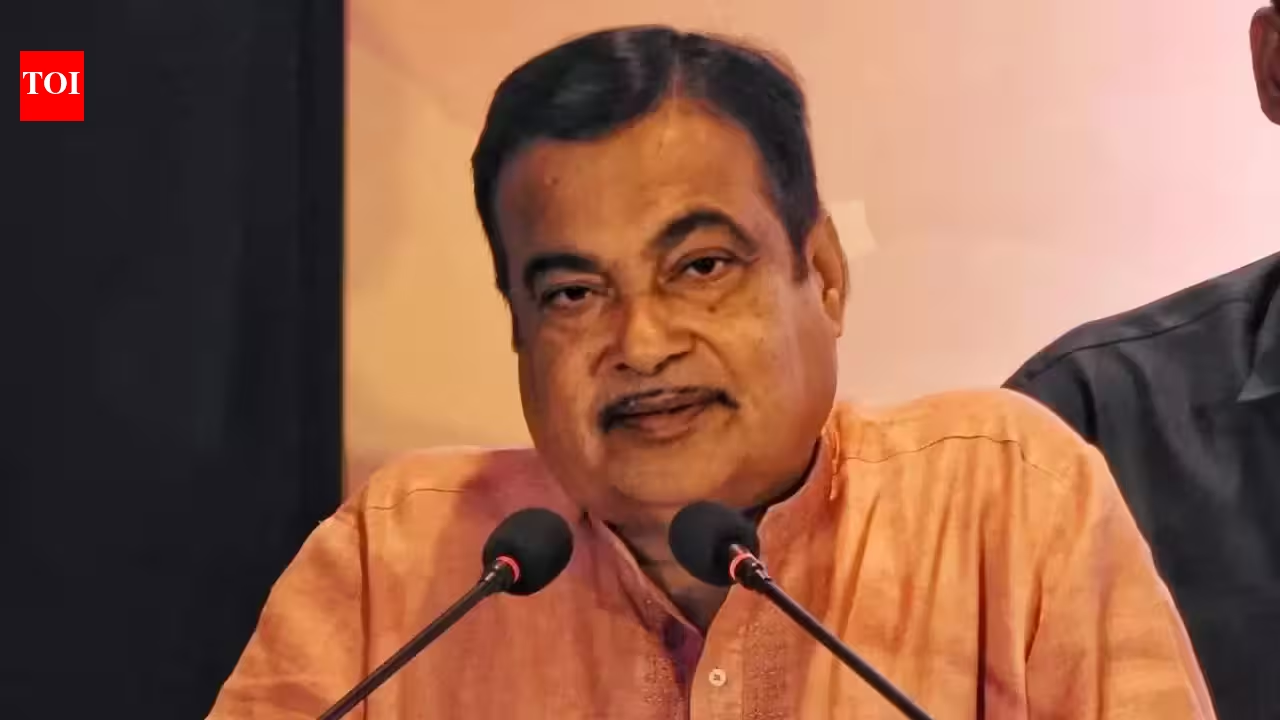
MUMBAI: Union road transport and highways minister Nitin Gadkari has claimed in a proposed civil suit before the Bombay high court that he had no role in the Ethanol Blended Petrol (EBP) programme or the E20 initiative, alleging that AI-generated deepfakes and manipulated online content falsely linked him and his family to financial gains from the policy.The Bombay high court on Monday granted Gadkari permission to file the suit against Meta Platforms, Google LLC, X Corp and others, seeking removal of allegedly “false, fabricated and defamatory” AI-generated videos and digital content.According to the proposed suit, the online posts and deepfakes wrongly portray Gadkari as the driving force behind the ethanol-blending programme and allege that he and his family benefited financially from it.However, the suit asserts that the EBP programme and the E20 initiative fall exclusively under the jurisdiction of the Union ministry of petroleum and natural gas, and not the ministry of road transport and highways headed by Gadkari.Officials from Gadkari’s Nagpur office also told TOI that the decision to implement ethanol blending was taken by the Union Cabinet, not by Gadkari’s ministry.The suit further states that its objective is not to curb public debate or criticism.“The purpose and object of filing the suit is not to curtail or prevent the public at large from engaging in discussion, debate, analysis or fair, just and bona fide criticism of any decision taken by the plaintiff himself or by his office,” the suit says.Instead, Gadkari argues that the disputed content consists of “false, fabricated, malicious, abusive and grossly defamatory” material that amounts to unauthorised use of his personality and publicity rights.His counsel, Sandeep Ladda, submitted before the high court that the allegedly defamatory content was accessible in Mumbai and elsewhere, warranting the court’s permission to institute the suit. Justice Abhay Ahuja granted leave to file the civil proceedings.Gadkari is seeking permanent injunctions directing social media platforms and other defendants to remove, disable and stop the circulation of the allegedly defamatory AI-generated content. The suit is expected to come up for hearing on interim relief on Tuesday.

BMC to re-float town hall tender with 350-seat corporation hall plan | Mumbai News

BMC to re-float town hall tender with 350-seat corporation hall plan
The demand for accommodating 350 corporators has been made after factoring in the likely increase in the number of elected corporators

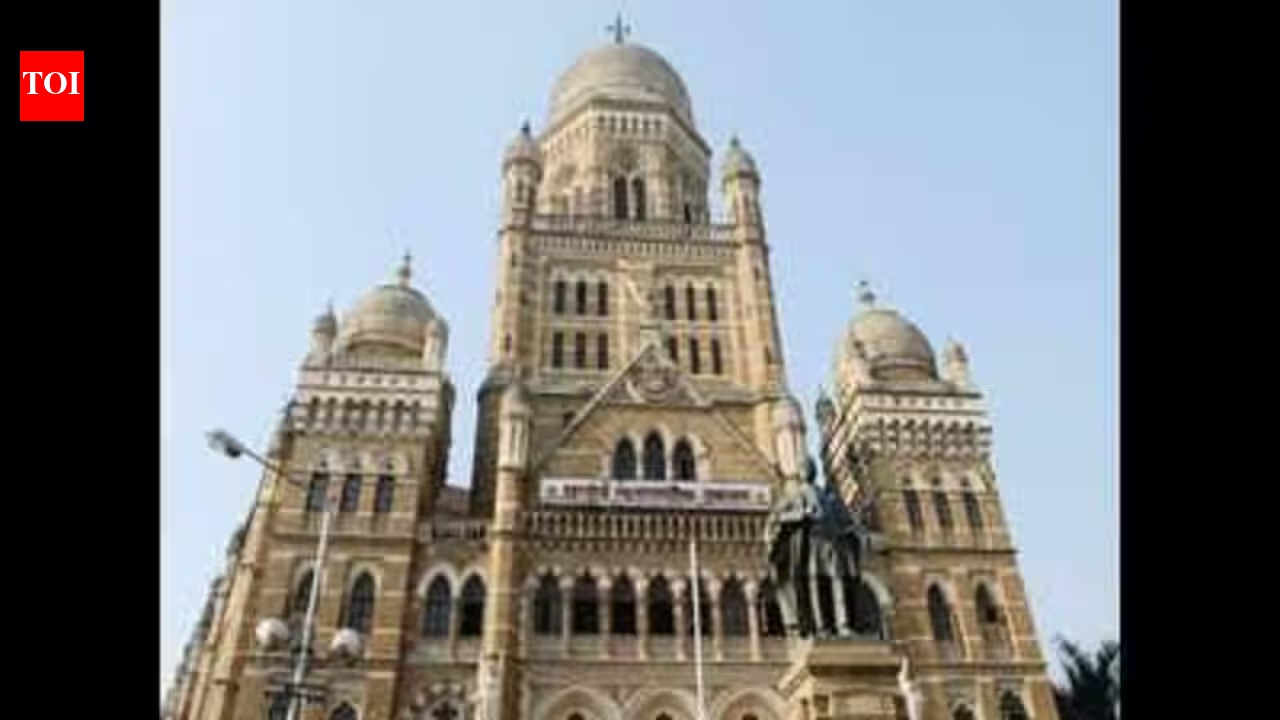
Mumbai: The BMC will soon re-float the tender for the town hall and gymkhana with a fresh proposal that will encompass a revised plan for a corporation hall intended to accommodate about 350 corporators in a tiered seating arrangement similar to that in Parliament. While the earlier proposal was to redevelop the gymkhana building opposite the BMC headquarters, corporators had sought to include a corporation hall. The tender floated earlier for the town hall is being cancelled, and a fresh tender will be issued for constructing a town hall. The shops and food stalls in the front portion of the gymkhana building will be accommodated in the new town hall structure.“We would not have been able to construct a corporation hall that could accommodate 350 corporators, as demanded by the public representatives, under the earlier tender. In the fresh plan, we intend to construct a ground-plus-five structure with a built-up area of about 38,000 square feet. The structure will have a corporation hall with tiered seating or an amphitheatre-like design and is likely to have a height of about 30 feet, which will enable us to create seating space for all the corporators. The structure will also have parking space for 70 to 80 vehicles. There will not be much open space around the structure, but it will be built by incorporating the architectural aesthetics of the heritage BMC headquarters,” said a civic official.The civic body also intends to appoint a project management consultant for the project. Corporators had earlier stalled the civic administration’s proposal to build a town hall opposite the civic body headquarters and sought the incorporation of a corporation hall (House) in the structure in view of the space constraints in accommodating the 237 corporators in the existing corporation hall.The demand for accommodating 350 corporators has been made after factoring in the likely increase in the number of elected corporators.BJP Leader of the House Ganesh Khankar has envisaged a structure that will have separate entry and exit points for the mayor, a cabin for the mayor, and space for the deputy mayor, additional municipal commissioners, group leaders, and the leader of the opposition, among others. Khankar has also sought a gallery for the press and visitors in the corporation hall, along with facilities such as a cafeteria, apart from a gymkhana and a bridge connecting the main BMC headquarters building with the town hall.

Bombay HC seeks govt response to PM’s call for clay Ganpati idols | Mumbai News

Bombay HC seeks govt response to PM’s call for clay Ganpati idols

Mumbai: The Bombay High Court on Monday asked the state government for its response on PM Narendra Modi’s appeal during Sunday’s Mann Ki Baat radio programme to use only eco-friendly clay idols during the ensuing Ganesh festival.“What is the state’s response?’’ asked Justices Gadkari and Kamal Khata during the final hearing on a PIL seeking implementation of Central Pollution Control Board’s 2020 revised guidelines that ban the use of Plaster of Paris (PoP) to make religious idols.The judges referred to a Marathi newspaper report and even showed the copy to the advocate general Milind Sathe, who sought time to respond. Last year, after CPCB clarified its guidelines were advisory in nature, HC had allowed above 6 ft idols to be immersed in natural water bodies as per state’s Aug 1, 2025 immersion policy.CPCB’s advocate Abhinandan Vagyani said the guidelines were upheld by HC and National Green Tribunal but also said they are advisory. The judges pointed out that HC and NGT proceeded with matters on the basis that the guidelines are mandatory. “How do you now say they are advisory, not mandatory?” asked Justice Gadkari.The judges questioned why CPCB shifted its stand in 2025 and “why not before 2025.” To this, Vagyani replied saying it was following the state govt’s request and committee’s recommendation. “Because the state govt told you, you changed (your stand)?’’ asked Justice Khata. The hearing will continue on Wednesday.