
40 minutes, 1 van, a city watching: Mumbai woman’s photo captures resolve behind CJP protests | Mumbai News
40 minutes, 1 van, a city watching: Mumbai woman's photo captures resolve behind CJP protests
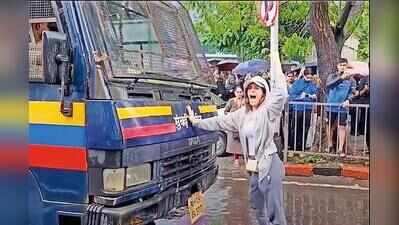
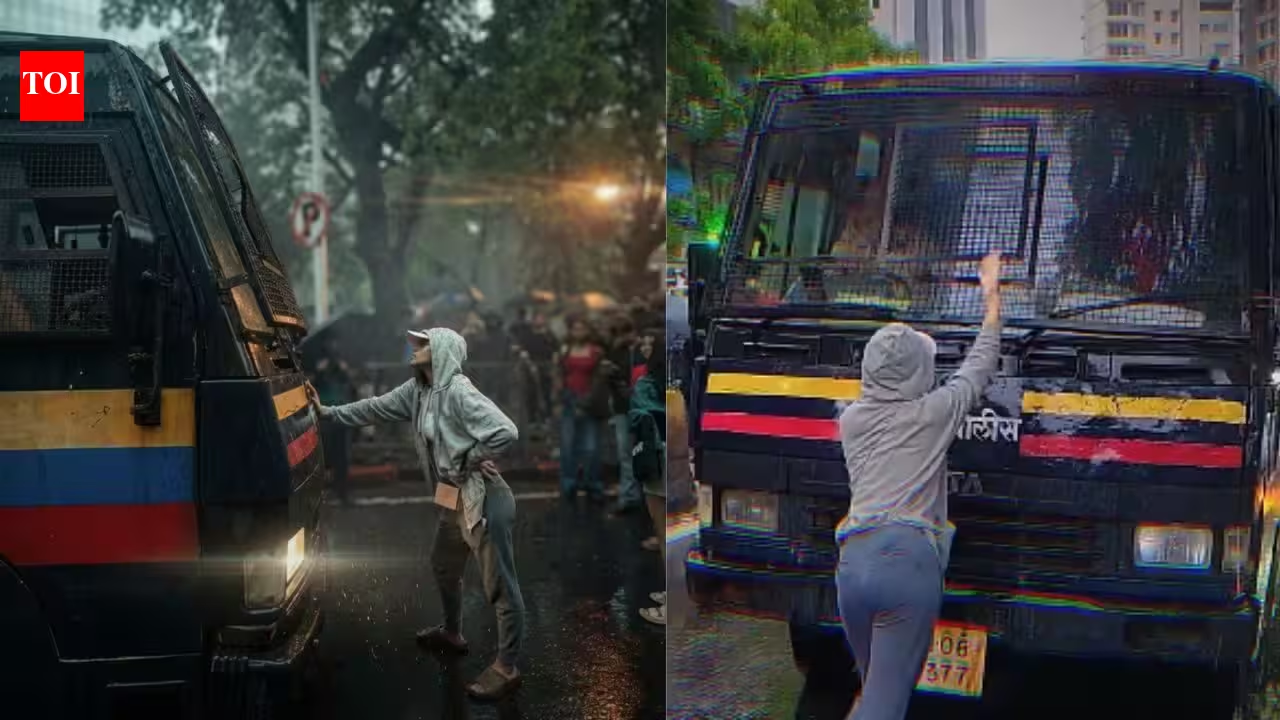
The woman, identified as Rhiya Ahir, remained in front of the van for around 40 minutes. (Image Credit: X, widely circulated by multiple users)

MUMBAI: A young woman in a rain-soaked grey hoodie stood with her arms outstretched in front of a police van, refusing to let it move.Inside the vehicle were protesters detained during demonstrations in Mumbai on Wednesday, held in solidarity with the Cockroach Janta Party’s (CJP) agitation over alleged examination irregularities and the police crackdown on protesters in Delhi.The woman, identified as Rhiya Ahir, remained in front of the van for around 40 minutes.Ahir said she had been waiting for friends before joining the protest when she noticed the police vehicle carrying detained protesters. She asked officers whether they had the required paperwork to detain those inside.Unsatisfied with the response, she first walked alongside the moving van. When she could no longer keep pace, she stepped directly into its path.“The driver revved the engine,” Ahir recalled, saying the possibility of being detained or injured crossed her mind. But she refused to move until the protesters were released.“I knew one thing,” she said. “If I had started this, I had to end it.”‘They tried to accelerate and scare me’Speaking after the incident, the 27-year-old said she could not accept seeing people being treated like criminals for protesting.“They tried to accelerate and scare me, but I did not back down,” Ahir said. “If I don’t do this, I will feel guilty for doing nothing.”She also questioned the authorities’ handling of the protests in Delhi.“While the police are doing their job, they are not doing it responsibly. If no one is taking responsibility, we will take responsibility for our citizens.”“I am not a student, my father is not a farmer, nor am I. I am not a Dalit or belong to the OBC community, but what they did to the students (in Delhi) is wrong. They have to own up to their actions.”Questioning the government’s response, she asked why, if protesters were not allowed to march to Parliament, Union Education Minister Dharmendra Pradhan had not met them at the protest site.‘The system has failed us’Ahir said her decision to intervene went beyond the issue of examination irregularities, describing it as a response to wider social concerns.“The system has failed us in so many ways—from senior citizens to animals,” she said. “This is about all the marginalised, right down to the Dalit sanitation workers who clean the city’s filth for a pittance.”She also said younger generations were no longer willing to remain silent.“We are not scared to raise our voice,” Ahir said. “We have to start a wave that they cannot ignore.”‘I wanted to know if there is victory beyond fear’Ahir said her decision to stand in front of the police van was also a personal test of courage.“I wanted to find out for myself because I feel that everyone carries some kind of fear within them. I wanted to know whether the saying ‘there is victory beyond fear’ is really true.”She said she had not anticipated the events that followed but believed the experience had answered that question.“I definitely didn’t expect everything that happened, but I can now say that there is indeed victory beyond fear.”Recalling the moments before the protest, Ahir said she had arrived intending to participate but was waiting for friends who never made it in time.“I had come specifically to be a part of this protest. I was waiting for my friends, but they got delayed and couldn’t make it. As I listened to the slogans, I thought to myself, ‘Why am I wasting my time? I should be there.'”She added that Mumbai’s traffic and parking challenges often make it difficult for people to reach demonstrations on time.“In Mumbai, traffic is a major issue, and finding parking is difficult. Because of that, you end up missing half the protest anyway…”‘My family told me: We’ll get through it’Ahir said she knew there was a possibility she could also be detained by the police.“I thought they might drag me away too, but then I looked around and realized there wasn’t even any space left, so where would they have kept me?”She admitted the experience left her shaken after returning home.“I won’t deny that I was scared last night. I didn’t fall asleep until 5.30 am. I was definitely worried about my family.”However, she said her family’s response strengthened her resolve.“But when I told them that the police might come, they simply said, ‘So what? We’ll handle it. We’ll get through it.'”“When you have such a courageous and supportive family—one that stands up for what is right and speaks against what is wrong—it gives you immense strength. That kind of support gives you the confidence to face any situation.”The video that went viralVideos of the confrontation spread widely on social media, with many showing Ahir standing in front of the police van as fellow demonstrators raised slogans in the rain, bringing traffic to a standstill.Another widely shared clip showed protesters chasing a police van and opening its rear door from the outside, allowing detained demonstrators to climb out while the vehicle was moving.Other videos from the protests captured residents cheering demonstrators from balconies despite the heavy rain, while another clip from Dadar showed protesters making way for children to reach a school bus.Who is Rhiya Ahir?According to her Instagram profile, Rhiya Ahir is an actor, model and entrepreneur with around one lakh followers on the platform.She has appeared in music videos, including Dilbara.Mumbai protests and police actionPolitical parties, activists and students staged protests across Mumbai for a third consecutive day on Wednesday over alleged examination irregularities and the police action against protesters in Delhi.According to Mumbai Police, 13 FIRs have been registered since July 18, with over 400 people booked on charges including unlawful assembly and violation of prohibitory orders.Police said demonstrations were held at several locations, including Shivaji Park, Chaityabhoomi, Chembur and Shiv Sena Bhavan, without permission.Meanwhile, prohibitory orders banning the assembly of five or more people in public places remain in force across Mumbai from July 23 to August 6, with police citing concerns over a possible breach of peace and public tranquillity.(With inputs from agencies)
Valuables worth Rs 2.7 crore stolen over five years from Sachin Ahir’s home in Mumbai | Mumbai News

Valuables worth Rs 2.7 crore stolen over five years from Sachin Ahir's home in Mumbai
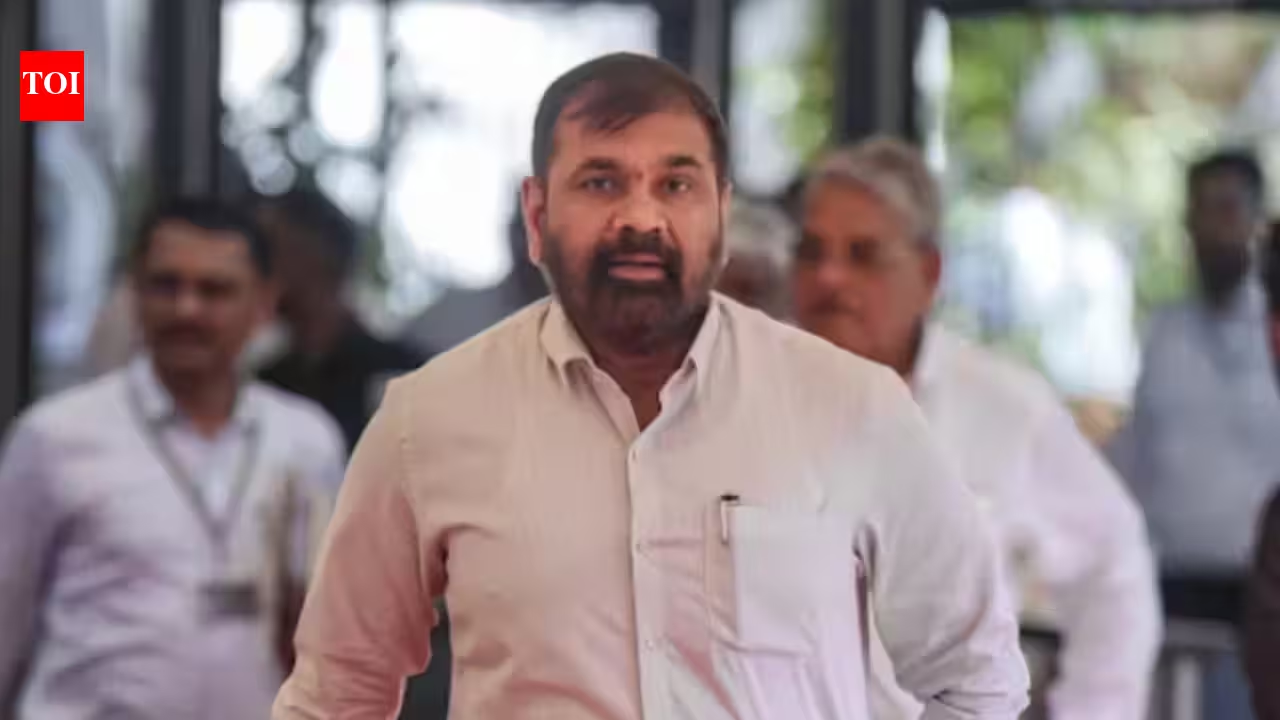
Valuables worth Rs 2.65 crore were stolen from Sachin Ahir’s Worli residence over five years (File Photo).

MUMBAI: Valuables worth Rs 2.65 crore have been stolen from the Worli residence of legislative council deputy speaker Sachin Ahir of the Shiv Sena over the past five years, his son Krishna has said in a complaint to the police.The stolen items include a 100-gram gold biscuit, diamond-studded gold bangles, a diamond-studded gold band, five diamond necklaces, diamond rings, silver glasses, silver utensils, including jugs, plates and lotas, along with an unspecified amount of cash.Krishna claimed that after a fire caused by an alleged short circuit damaged the residence on October 13, 2025, the family initially believed that cash withdrawn for household expenses had been destroyed in the blaze. Later, reviewing the CCTV footage, they discovered that portions of the recordings were missing, raising suspicion.Krishna said his four domestic help systematically stole cash, gold jewellery and other valuables worth around Rs 2.65 crore in the past five years. The city crime branch has taken over the probe.Krishna said that though he has been residing at a flat in Khar for the past two years due to work commitments in the film industry, he frequently visited the family’s residence at Gulrukh Building, Worli seaface, where his parents and sister continue to live.

Police tried to scare me, says Mumbai woman who blocked police van carrying protesters | Mumbai News

Police tried to scare me, says Mumbai woman who blocked police van carrying protesters
Riya is an actor, model, and entrepreneur, as per her Instagram bio

Mumbai: A tense standoff unfolded at Shivaji Park during students’ protest on Wednesday as a police van loaded with detained students attempted to pull away—only for 27-year-old Rhiya Ahir to step directly into its trajectory, forcing the vehicle to a complete halt. “They tried to accelerate and scare me, but I did not back down,” Ahir said. “If I don’t do this, I will feel guilty for doing nothing.”Ahir stressed her intervention was a direct response to deepening socio-economic disparity and widespread institutional failure. “I am not a student, my father is not a farmer, nor am I. I am not a Dalit nor do I belong to the OBC community, but what they did to the students (in Delhi) is wrong. They have to own up to their actions,” she said. “The system has failed us in so many ways—from senior citizens to animals,” she said. “This is about all the marginalised, right down to the Dalit sanitation workers who clean the city’s filth for a pittance.” She said that generations of public compliance have come to an end, demanding immediate accountability and open dialogue over top-down governance. Refusing to be intimidated by law enforcement tactics, Ahir stated that the growing youth movement has no intention of quietly backing away. “We are not scared to raise our voice,” Ahir said. “We have to start a wave which they cannot ignore.”Riya is an actor, model, and entrepreneur, as per her Instagram bio. She has around a lakh followers on Instagram and has been seen in music videos. (with agency inputs)

Flyer among five held for Rs 5.6cr gold smuggling at Mumbai airport | Mumbai News

Flyer among five held for Rs 5.6cr gold smuggling at Mumbai airport
The DRI told the court that investigations are continuing to identify other members of the syndicate, trace the source of the gold

Mumbai: The Directorate of Revenue Intelligence (DRI), Mumbai Zonal Unit, has arrested five persons, including a Dubai-bound passenger and two airport cleaning staff, after busting an alleged gold smuggling syndicate at Mumbai’s Chhatrapati Shivaji Maharaj International Airport and seizing 3.866 kg of smuggled gold dust in wax form valued at ₹5.63 crore.According to the DRI’s remand application filed before a Mumbai court, the operation was launched after officers received specific intelligence that passenger Mohamed Urwa, arriving from Dubai on Emirates flight EK504 on July 22, would conceal smuggled gold inside the aircraft, which would later be retrieved by airport housekeeping staff.DRI officers intercepted Urwa after he disembarked around 12.30 pm and kept surveillance on the aircraft. As the cleaning crew entered the aircraft, officers observed two AGH Port Aviation Services employees, Rajesh Manjrekar and Zaheer Qureshi, leaving the aircraft after about 15-20 minutes. They were intercepted and taken to the Customs camp office for examination.During the personal search of Qureshi, officers allegedly recovered two unusually heavy black pouches from his trouser pockets. After removing black adhesive tape, the pouches were found to contain gold dust in wax form. A government-approved valuer certified the recovered material as 24-carat gold, weighing 3,866 grams gross (3,760 grams net) and valued at ₹5,63,62,400.During interrogation, Qureshi allegedly told investigators that he had retrieved the pouches from a concealed location inside the aircraft lavatory on the instructions of supervisor Rajesh Manjrekar. Manjrekar allegedly admitted that he was working for a handler identified as Mohammed Ajhar Kazi alias Aamir, who had instructed him to supervise the recovery of smuggled gold from aircraft toilets in return for money.Following a controlled operation, DRI officers intercepted Ajhar outside the airport. He allegedly disclosed that he was working under the instructions of Mohammed Ahmed alias Mustaf, who was also apprehended the same day.The agency stated that statements of all five accused were recorded under Section 108 of the Customs Act, in which they allegedly admitted their respective roles in handling smuggled foreign-origin gold.According to DRI, had the gold been imported legally through the baggage route, customs duty of approximately ₹2.48 crore would have been payable. The agency alleged that the smuggling attempt resulted in duty evasion well above the statutory threshold prescribed under the Customs Act.The DRI told the court that investigations are continuing to identify other members of the syndicate, trace the source of the gold, examine alleged hawala transactions, identify the ultimate beneficiaries, and uncover the complete international smuggling network. It argued that the accused could influence witnesses, tamper with evidence, or coordinate with absconding conspirators if released.All five accused have been arrested under Sections 104 and 135 of the Customs Act, 1962. Their lawyer Ravi Hirani said that his clients were unaware the gold was smuggled one. The DRI has sought 14 days’ judicial custody, stating that the case involves an organised international gold smuggling syndicate and requires further investigation.

Mumbai University rolls back admission ban on 68 law, BEd colleges | Mumbai News

Mumbai University rolls back admission ban on 68 law, BEd colleges
Mumbai University had taken action against several such colleges last year as well

Mumbai: The University of Mumbai has withdrawn its decision to bar admissions at 68 law and BEd colleges that failed to appoint university-approved principals and teachers.The colleges will now be allowed to admit students to 50% of their sanctioned intake during the current academic year, subject to a penalty of Rs 10 lakh each.The university had earlier decided not to grant affiliation to 39 law colleges and 29 BEd colleges, effectively keeping them out of the state CET Cell’s centralised admission process. The institutions subsequently sought a review of the decision.Under the revised action, 11 law colleges and 23 BEd colleges where fewer than half the teachers have university approval will face a Rs 5 lakh penalty. Their intake will be reduced by 25%.Colleges where more than 50% of the faculty have been approved will be fined Rs 2 lakh each, but will face no restriction on admissions.The action follows repeated concerns over the absence of approved teachers, principals, adequate infrastructure and academic standards at several law and teacher-training colleges.The number of law colleges in the state has grown rapidly following increased demand for legal education. A similar expansion took place in the B.Ed sector when teacher-training courses attracted large numbers of students. However, faculty recruitment and infrastructure have not kept pace with the rise in institutions.Mumbai University had taken action against several such colleges last year as well. At the time, the state govt asked the university to give the institutions six months to address the deficiencies and permit them to participate in admissions. The university later granted affiliation after imposing a penalty of Rs 1 lakh.As the colleges failed to comply with the requirements even this year, the university initially ordered a complete admission ban. The decision was, however, reversed within days.A senior MU official said that the decision to relax colleges without approved principals and teachers would be permitted to fill only half their seats and would have to comply with all prescribed norms within four months

Central Railway plans 26-km emergency road in Karjat–Lonavala ghat to aid stranded passengers | Mumbai News

Central Railway plans 26-km emergency road in Karjat–Lonavala ghat to aid stranded passengers
The proposal comes after train services on the busy Mumbai-Pune corridor were disrupted for nearly a week earlier this month when heavy rain triggered multiple landslides in the ghat section

MUMBAI: Central Railway is planning to construct a 26-km emergency road along the Karjat-Lonavala ghat section to evacuate passengers stranded in trains during disruptions caused by landslides, rockfalls or other emergencies.The proposal comes after train services on the busy Mumbai-Pune corridor were disrupted for nearly a week earlier this month when heavy rain triggered multiple landslides in the ghat section, highlighting the lack of road access to stranded trains in remote areas.The proposed road, running alongside the railway tracks between Karjat and Lonavala, will enable buses and emergency vehicles to reach stranded trains and evacuate passengers to the nearest accessible locations.It will also facilitate the supply of drinking water, food, medicines and other relief material, while allowing ambulances and medical teams to reach passengers requiring urgent care.The July 6 landslides affected all three railway lines in the ghat section, bringing services to a halt. Central Railway restored the first line within 48 hours, allowing limited train operations under speed restrictions. The second line reopened on July 15, while restoration of the third line is still underway.According to Central Railway, restoration work is progressing rapidly. Around 50 to 60 dumpers carrying granular material are reaching the damaged slope on the UP line after repairs to a temporary forest access road.Long-arm excavators are being used to reinforce the slope, with nearly half of it restored from the bottom up.Railways are also using special material trains to transport granular material to the top of the slope, where it is being rolled down to stabilise the embankment. Officials said restoration work is continuing round the clock to reopen the remaining line while ensuring safety.

Urban job participation rises, but women’s employment remains a weak link as India’s unemployment stays at 5.5% | Mumbai News

Urban job participation rises, but women's employment remains a weak link as India's unemployment stays at 5.5%
AI-generated image used for representational purpose.

MUMBAI: India’s unemployment rate remained unchanged at 5.5% in June for the third consecutive month, even as urban labour force participation improved, according to the latest Periodic Labour Force Survey (PLFS) released by the National Statistics Office (NSO).The survey points to a resilient labour market supported by infrastructure, construction and services, but highlights a persistent challenge—women, particularly in urban areas, continue to have low workforce participation.The Labour Force Participation Rate (LFPR), which measures the proportion of people working or seeking work, stood at 54.4% in June, unchanged from May and marginally higher than 54.2% a year ago. Urban LFPR rose to 50.1% from 49.8% in May, while rural participation remained steady at 56.6%.The Worker Population Ratio (WPR), which measures the proportion of people employed, remained stable at 51.4%, up 0.2 percentage points from a year earlier. Male WPR increased marginally to 72.9% from 72.5% in May.The unemployment rate held steady at 5.5%, indicating that the rise in urban labour force participation was largely matched by job creation. Rural male unemployment also eased in June after rising in previous months.However, female labour force participation remained largely stagnant at 32.7%, compared with 32.8% in May. Urban women’s participation remained low at 24.8%, underscoring a persistent structural gap despite modest improvement from a year earlier.The survey suggests that while the economy is generating enough jobs to keep unemployment stable, women continue to be underrepresented in the workforce. Analysts have said higher female labour force participation could significantly boost economic growth and household incomes.The NSO noted that southern and western states, including Maharashtra, Karnataka, Tamil Nadu, Telangana and Gujarat, continue to lead employment generation, driven by manufacturing and services.Major urban centres such as Mumbai, Bengaluru, Hyderabad, Pune, Chennai and Delhi-NCR remain key employment hubs.The monthly PLFS, introduced in January 2025, provides more timely labour market data, enabling policymakers and businesses to monitor employment trends more closely.The June survey indicates that while India’s labour market remains resilient amid global economic uncertainty, increasing urban job creation and women’s workforce participation remain key policy priorities.

CBI arrests IRCTC officer from Mumbai office and Tejas caterer in bribery case | Mumbai News

CBI arrests IRCTC officer from Mumbai office and Tejas caterer in bribery case
The CBI alleged that Amar Thakkar of Araha Hospitality, which provides catering services on Tejas trains, had bribed IRCTC senior executive Tridib Banerjee through a middleman, Deepak Parmar, for clearing his bills

Mumbai: The Central Bureau of Investigation (CBI) has arrested a senior executive of IRCTC, Tridib Banerjee, from his office in Mumbai, and Amar Thakkar of Araha Hospitality, who was allegedly found with Rs 4.6 lakh cash on him, in a bribery case. Araha Hospitality provides catering services on Tejas trains, and the CBI alleged that Thakkar had bribed Banerjee through a middleman, Deepak Parmar, for clearing his bills.The CBI produced the duo before the court on Thursday, where Banerjee argued that the money he received in his bank account from Parmar was a personal loan and not a bribe. But the court didn’t accept his explanation and remanded the two accused into CBI custody till July 27. The CBI also booked Parmar in the case.The catering service provider was awarded a tender to provide on-board catering and allied services in Ahmedabad-Mumbai and Lucknow-New Delhi Tejas trains by IRCTC. In Tejas trains, meal costs are included in the ticket fare, which is later claimed by the catering contractor from IRCTC by raising bills periodically. Banerjee allegedly accepted bribes from Thakkar for clearing his pending bills at Mumbai West Zone office.During the accused remand hearing, special public prosecutor Sandeep Singh, representing the CBI, informed the court that at the time of arrest in Banerjee’s office, Thakkar was found in possession of Rs 4.6 lakh cash, for which no plausible explanation was given by him.The CBI alleged that in April, Thakkar asked Parmar to give Rs 2 lakh to Banerjee. Parmar deposited the money into Banerjee’s bank account via four ATM transactions. In June, Thakkar visited Banerjee and requested him to clear more bills; again, on instruction of Thakkar, Parmar deposited Rs 2 lakh into Banerjee’s account.The CBI informed the court that after receipt of source information, necessary inquiry was done, during which the investigating officer came across the transcript of the call record between Banerjee, Thakkar and Parmar. All those transcripts, as per prosecution, indicate demand and acceptance of bribe, and Banerjee’s bank account details indicated cash credit from the month of January till June.

Maharashtra scraps mandatory one-year service bond for MBBS graduates | Mumbai News

Maharashtra scraps mandatory one-year service bond for MBBS graduates
A Government Resolution issued on Thursday acknowledged that the rapid expansion of medical education had not been accompanied by a corresponding increase in public-sector postings. Eligible candidates were therefore left waiting for allotments, sometimes unable to fulfil the bond despite being willing to serve

Mumbai: Maharashtra has become the first state to abolish the mandatory one-year ‘social responsibility’ service required of MBBS graduates from government, municipal, aided, and private unaided medical colleges. It has, however, not been cancelled for postgraduate and superspeciality levels.Known simply as bond service, the policy was founded on a bargain: the state financed a medical education, and the young doctor repaid part of that public investment through a year of service in a government institution, local body or the armed forces. But the state now feels this policy designed to place doctors in underserved institutions has become a waiting room for doctors whose careers could not move forward.Thousands of graduates find themselves caught between an obligation they are required to fulfil and postings the govt cannot not provide. Some were reluctant to serve; others were ready, but had nowhere to go. For both, the consequences were the same: plans for postgraduate education were delayed by a requirement whose completion depended on the availability of govt jobs.A Government Resolution (GR) issued on Thursday acknowledged that the rapid expansion of medical education had not been accompanied by a corresponding increase in public-sector postings. Eligible candidates were therefore left waiting for allotments, sometimes unable to fulfil the bond despite being willing to serve. Because completion of the service was tied to eligibility for postgraduate medical education, an administrative bottleneck became an academic one as well.The govt also pointed to another contradiction. Many newly qualified doctors joined bond postings because the service was a gate they had to pass through before pursuing postgraduate studies. According to the GR, such candidates did not always contribute to their full capacity at their assigned institutions. As recent graduates, they were also not necessarily prepared to “manage emergency medical services” independently.The policy was reviewed at a meeting chaired by the chief minister on July 4, 2025. The Public Health Department subsequently proposed that the Medical Education Department reconsider and ultimately discontinue the one-year service requirement.Under the new decision, candidates who are eligible for bond service but have not received postings will no longer be required to complete it. Those who began their service but were unable to finish will not have to serve the remaining period.Doctors who have already joined their allotted institutions must, however, complete the prescribed tenure. Those who received allotment orders but have not yet joined will be exempted. Candidates currently serving may continue until their tenure ends.No fresh bond postings will be made from the date of the resolution. The online allotment portal operated by the Directorate of Medical Education and Research will be closed immediately. Candidates who previously paid the prescribed penalty to secure exemption from bond service will not receive refunds, the state said.Parent representative Sudha Shenoy said, “This decision comes with mixed feeling. While this is a big relief for students whose journey as a medical student is a long one. I wonder if this will lead to shortage of doctors in govt hospitals and whether this is an attempt towards promoting privatisation of health services.”The 2006 bond policy* “The objective of the 2006 bond policy for the graduates from Maharashtra’s government colleges was to make doctors available in the rural areas. However, the number of MBBS seats has tripled (4,555 in 2006 to 11,795 in 2025) in the interim period. Besides, the government’s policy to have one medical college in each district has resulted in sufficient doctors. Hence, the vacancies for medical officers have reduced,” read the minutes of the meeting held on July 4, 2025.* Interestingly, the introduction of rural bond was seeded in the tough times faced during the India-Pakistan war. When soldiers were dying on the border, there weren’t as many doctors to handle the patient inflow.* As former head of the Directorate of Medical Education and Research Dr Pravin Shingare recalled, Pune’s AFMC (Armed Forces Medical College) had turned to Maharashtra for doctors. “Not many stepped up then to serve in the border. So, the rural service was a national call and was introduced in the aftermath of the war. Maharashtra was the first state to implement it,” said Dr Shingare.* Like then, this time, the Covid pandemic saw the state grappling for doctors in rural pockets. “What will happen if such a situation arises again?” asked a DMER official.

Mumbai man sentenced to 10 years for attempted murder in 2015 stabbing case | Mumbai News

Mumbai man sentenced to 10 years for attempted murder in 2015 stabbing case

Mumbai: Eleven years after a 35-year-old Mankhurd resident repeatedly stabbed the fiance of the woman for whom he had one sided feelings, a sessions court on Wednesday convicted and sentenced him to 10 years’ rigorous imprisonment for attempt to murder. The accused, Vijay Shegokar, was also fined Rs 15,000.The defence sought leniency, saying he had no criminal antecedents and had to maintain a wife, child and parents. The prosecution opposed leniency.Principal judge S S Adkar rejected the plea, saying, “The offence committed by the accused is of serious nature. The reasons given for leniency in punishment are of general nature. The accused should have thought about the consequences of his acts before doing the same.” Shegokar, who was on bail, was directed to be taken into custody.On whether the offence amounted to attempted murder, the court said the injuries were not grievous, but the circumstances showed intention. “But it cannot be forgotten that when the accused assaulted…Prashant Waghmode was inside his car and he had no escape route. He could save himself only because after the first attack, he caught hold of the knife.”The court concluded, “Therefore, considering the circumstances in which Prashant was assaulted and considering the weapon which was used by the accused for committing the offence, it is evident that the accused intended to cause his death.”The prosecution submitted that the incident took place on January 27, 2015, around 7.15 pm, when Prashant Waghmode had left home for jogging and was sitting in a car parked near Nadkarni Park, Wadala. According to the prosecution, Shegokar approached the car, knocked on the window, and told Waghmode that something was on the bonnet. When Waghmode rolled down the window, Shegokar attacked him on the neck with a knife.The victim, his fiancée, and an eyewitness deposed during the trial.The court accepted the evidence of Waghmode and eyewitness Vinod Sonawane. “The statements of…Prashant (Wahhmode) were not shattered during his cross-examination. He remained firm on material points.”The court further noted, “Admittedly, he was not knowing the accused prior to the incident. Therefore, he had no reason to depose falsely against the accused.”The court also relied on Sonawane’s testimony, recording that he had seen the assault from a distance of 25-30 feet. “Thus, he was in a position to clearly see what was happening. He was also not knowing the accused prior to the incident. Therefore, he had no reason to depose falsely against the accused.”The prosecution alleged that the motive for the attack was linked to Waghmode’s proposed marriage with the woman. The woman told the court that Shegokar had one-sided love for her and that she was not interested in him. The court accepted this evidence and observed, “Thus, the accused had a motive to commit the offence in question.”Medical evidence showed that Waghmode had suffered incised wounds on the neck and injuries on the left hand. The medical officer told the court that one neck wound required suturing.The defence argued that Shegokar had been falsely implicated because of caste differences and disapproval of an alleged relationship with the woman. The defence also raised an alibi, claiming Shegokar was in Alibaug at the time. The court rejected both arguments. On the alibi claim, the judge said that it was nothing but an afterthought.