Power outage hits over 4.6 lakh consumers in Kalyan region after 220 kV Padgha-PAL line trips | Mumbai News

Power outage hits over 4.6 lakh consumers in Kalyan region after 220 kV Padgha-PAL line trips

Kalyan: More than 4.6 lakh electricity consumers in Kalyan, Dombivli, Ulhasnagar and Badlapur were left without power on Friday evening after the 220 kV Padgha-PAL transmission line tripped around 7.40 pm, disrupting electricity supply across several suburban areas. Power was restored after a little over 2 hours at 10 pm.According to the Maharashtra State Electricity Distribution Company Limited (MSEDCL), restoration work was taken up immediately, but continuous rain is affecting restoration work, and power supply is expected to resume soon.The outage severely affected Kalyan East division, where nearly 3.25 lakh consumers lost electricity. The affected areas include Sonarpada, Casa Rio, Casa Bella, Netivali (partially), Epic, Downtown, Lakeshore, Usatane and Lodha Premier after multiple 22 kV feeders went out of service.In Ulhasnagar, around 1.12 lakh consumers were impacted after the tripping affected Gaikwadpada, Ashelpada and Anandnagar switching stations, besides all 22 kV feeders supplied from the Anandnagar Extra High Voltage (EHV) substation.The disruption also extended to Badlapur, where around 27,000 consumers were affected after the outage hit the Poddar Switching station and the 22 kV Mankivali feeder supplied from Kharvai Switching.MSEDCL officials said technical teams were deployed immediately to restore supply on a war footing. Engineers are working to rectify the fault and restore electricity to all affected consumers at the earliest, but due to continuous rain, it is taking time making restoration work difficult.CR Mishra, chief executive engineer of Kalyan Division, said, “Our technical teams were deployed immediately to restore supply on a war footing. Engineers were working to rectify the fault and restore electricity to all affected consumers at the earliest, which took some extra time due to continuous rain.”

Not just Andheri complex, Parle trust allotted 2 more open spaces as ‘caretaker’ | Mumbai News

Not just Andheri complex, Parle trust allotted 2 more open spaces as ‘caretaker’

Mumbai: Not just BMC’s 12-acre plot housing the Chhatrapati Shivaji Maharaj Sports Complex in Andheri (W), the Shri Vile Parle Kelavani Mandal has recently been allotted two open spaces measuring close to four acres in all by Mhada in Juhu and D N Nagar. The allotment is for three years on a ‘caretaker and beautification’ basis.One of the plots is the Lokmanya Tilak Udyan in Juhu, currently maintained by BMC and used by local residents. While Mhada has issued an NOC to the Kelavani Mandal for ‘utilising’ this plot, the other plot, in D N Nagar, has been earmarked for an edutainment theme park but a part of it has been allotted to the Mandal.While tenders were issued for the Andheri (W) plot and it was leased, there were no tenders for the two plots given by Mhada.Mumbai BJP president and MLA Ameet Satam, who objected to the leasing of the Andheri (W) facility by BMC, has written to Mhada asking it to cancel the two “illegal” allotments.Satam said this kind of allotment will set a wrong precedent in the city, where use and utilization of reserved open spaces should be the right and privilege of all irrespective of one’s social or economic status and not restricted to a few.BJP MLC Amrish Patel, president and trustee of Shri Vile Parle Kelavani Mandal, said there are no irregularities in the allotment of the plots and they were given by Mhada in a transparent manner and due process was followed. “We will utilise these plots for creating sports facilities for our students. There will be no construction, and the plots will only be used for sports purposes,” Patel said.Satam said in his letter to Mhada vice-president and chief executive officer Sanjeev Jaiswal and chief officer Milind Borkar, “Mhada has given NOC to Shri Vile Parle Kelavani Mandal for utilization of Lokmanya Tilak Ground which is in a Mhada layout but in possession of BMC, which is completely illegal as Mhada has no such rights to give utilization (sic) of reserved open space of the city to one particular organization or trust. Any city’s reserved open space should be for utilization of the public at large. Kindly cancel your wrongful allotment of said plots to Shri Vile Parle Kelavani Mandal and not cause any hindrance to the ongoing public project. I trust that you will take an informed decision in the interest of open spaces of the city.”Jaiswal and Borikar did not respond to queries from TOI.Satam further said in his letter, “The plot is commonly known as Mhada cement godown for making (an) edutainment theme park. While the work on this project is in progress, Mhada has allotted a part of the plot on which the transit camp was existing to Shri Vile Parle Kelavani Mandal for making a sports facility. All reserved open spaces of the city are property of the public at large, and these should not be given to any private individual, trust or organization for its restricted use. The edutainment theme park is a public project from public funds and the part of land where the transit camp was existing is proposed to be an underground parking lot and an open ground and walking track for the entire public and not for restricted use.”Filmmaker Ashok Pandit, who is chairman of Gulmohar Area Societies Welfare Group, Juhu, said, “All these are govt lands and must be maintained by govt. In the past, all such plots given to private parties have been usurped and turned into private clubs and estates. Open spaces must not be given to private parties. Once the trust takes over, local residents won’t be given access, and the land will become a private open space used only by the trust’s schools and colleges. It is the duty of BMC and Mhada to maintain open spaces. These plots are being given away secretly without informing the public. The CM must intervene and stop this takeover of open spaces.”He added, “The BMC and Mhada are spending so much money on various projects, so there is no reason they can’t maintain open spaces.”

Sule: Felt hurt when NCP netas denied merger discussions, talks ended from our side that day | Mumbai News

Sule: Felt hurt when NCP netas denied merger discussions, talks ended from our side that day

Mumbai: Shortly after deputy chief minister Ajit Pawar’s death in Jan, the NCP (SP)’s Jayant Patil had revealed that talks on a merger with the NCP had reached the final stage, and that the proposal had come from the late leader. However, at the time, senior NCP politicians Praful Patel and Sunil Tatkare had denied it. On Thursday, Tatkare finally admitted that merger talks had indeed reached their final stage when Pawar was alive.As talks of a merger have resurfaced, NCP (SP) MP Supriya Sule responded by saying she had felt hurt when the “other side” had denied the talks had taken place and that NCP (SP) had its self-respect and had moved on that very day.“The merger was my brother’s last wish. On the day he passed away, our leaders spoke of this in the discussions. But those on the other side said nothing like this had taken place. I felt extremely sad and hurt,” Sule said on Friday.She said the NCP (SP) decided the merger was over on that very day. “My brother had passed away and we were trying to fulfil his last wish because the proposal had come from him. That’s why we ended the issue on that very day. We are self-respecting people. When I realized that the other side does not want to fulfil his wish, we moved on and got busy in the service of the state and the country,” she said.Significantly, Tatkare had said that talks of a merger had indeed come to a halt, but it was because the NCP (SP) had declared the discussion was over and there was no new proposal from the latter.On the issue of NCP (SP)’s likely support for the NDA govt’s delimitation bill, Sule said, “I have already expressed my views on this. The bill is not yet in front of us. How can I say anything more?”Commenting on Jayant Patil’s meeting with deputy chief minister Eknath Shinde on Thursday, Sule said, “We are public representatives. We promote their interests. What is wrong if we meet various ministers and leaders in this connection?”

Dombivli doctor attack: Maharashtra Indian Medical Association calls for statewide 24-hour outpatient department strike on Monday | Mumbai News

Dombivli doctor attack: Maharashtra Indian Medical Association calls for statewide 24-hour outpatient department strike on Monday

Mumbai: Following the attack on doctors, nurses, and healthcare staff at Shastri Nagar Municipal Hospital in Dombivli by Shiv Sena corporator Ramesh Mhatre, the Maharashtra chapter of the Indian Medical Association (IMA) has called for a 24-hour strike on OPD services across the state. The strike will start at 6am on Monday and will continue until 6am on Tuesday.Maharashtra Association of Residents Doctors (MARD) will not be part of this strike. “We will be meeting with chief minister Devendra Fadnavis next week. If our issues are not addressed adequately, we will be moving for indefinite strike,” said MARD president Dr Atharva Shinde.The state IMA has said that emergency services, intensive care units (ICUs), maternity services, and life-saving treatments will not be affected. State IMA president Dr Santosh Kulkarni said, “We also have BAMS and BHMS practitioners participating in this strike.” The association has demanded the prosecution of the accused “without any political interference or protection”.​Furthermore, they have also called for amendments to the Maharashtra Medicare Service Persons and Medicare Service Institutions (Prevention of Violence and Damage or Loss to Property) Act, 2010, to make the offence cognisable and non-bailable, to ensure the conclusion of investigation within 30-60 days, and to establish fast-track trial courts.Dr Kulkarni warned that there would be an indefinite strike in August if these concerns are on addressed.

Coaching sector facing saturation with the rise of local players, say experts amid abrupt closure of MT Educare centres in Maharashtra | Mumbai News

Coaching sector facing saturation with the rise of local players, say experts amid abrupt closure of MT Educare centres in Maharashtra

Mumbai: The abrupt shutdown of MT Educare centres, popularly known as Mahesh Tutorials, which was acquired by Zee Learn in 2018, was not a case in isolation. Last year, several centres of FIIT-JEE across the country wound up their operations allegedly due to the financial crisis.Coaching industry experts claimed that the sector has reached some saturation point, with the mushrooming of local players making it increasingly difficult to sustain large coaching chains. Institutes are managed on the reputation and teaching quality of their faculty – once popular teachers leave, retaining students becomes challenging, they added.Teachers and parents, however, claimed that such institutions should not enrol students when they want to shut shop. Stakeholders called for a stringent regulatory framework to protect the interest of students and teachers, to avoid such cases in future.While officials from MT Educare remained unavailable for comment a day after parents sought govt’s intervention, industry representatives claimed that the company had been witnessing a decline over the past few years, with several centres shutting down over a period of time.Speaking to TOI, Mahesh Shetty, the founder of Mahesh Tutorials, said that he had stepped down from his position at MT Educare, in 2019, a year after Zee Learn acquired it. “My resignation was accepted in April 2020, and since then I am not associated with the company,” he added.Shetty had started Mahesh Tutorials in 1988 with a few centres and expanded it to about 250 in a period of three decades. It ventured into junior colleges in its later years, was the first to launch an edTech and learning app in 2015, and also successfully launched its IPO in 2012. The company was in need of investment, when Zee Learn acquired it in 2018. A year later, he stepped down.Maharashtra Class Owners’ Association president Prajesh Trotsky recalled that one centre in Malad had shut down about two years ago, while another in Palghar stopped operations around 10 days ago. “Mahesh Shetty Sir was an educator, and once he was no longer associated with Mahesh Tutorials, the brand gradually lost its value,” he said.According to Trotksy, the biggest mistake was accepting advance fees. “Parents should have been informed in advance if there were operational issues,” he said.He said though the coaching sector itself remains robust, growth has stagnated. “The sector is not in trouble. There is some saturation because the number of coaching institutes has increased significantly. Many teachers from established institutes have started their own classes,” he said, adding that managing multiple branches involves substantial overheads. He also pointed to the rise of online learning, which he estimated has captured 5%-10% of the market, particularly among self-motivated students.Arihant Academy, another institute, has accommodated over 1,000 students from MT Educare and a parent told TOI that classes already commenced on Wednesday. “Around 90-95% of the affected students who approached us have already resumed their classes. We are not seeking fees from students who have already paid full fees, for the rest, we are asking for the balance amount,” said director Anil Kapasi, Arihant Academy.The academy is also planning counselling sessions for students, particularly those in Classes 10 and 12 as well as JEE and NEET aspirants, to help them cope with the sudden disruption.“The abrupt suspension of MT Educare centres across Maharashtra has left over 2,500 students in severe anxiety mid-session, reflecting a systemic fragility previously witnessed in the FIITJEE crisis. While the immediate, fee-free accommodation of affected students by Arihant Academy is highly commendable, temporary peer transfers cannot substitute for institutional stability,” said Keshawkumar Jha, senior educator, co-ordinator (Konkan division), Regional Teachers’ Organisation.“Moving forward, state authorities must stringently monitor these academic transitions to protect student welfare and prevent further cognitive disruption. Ultimately, the state must enforce a transparent regulatory framework—including mandatory escrow accounts—to secure advance fees, protect faculty livelihoods, and prevent commercial mismanagement from derailing our youth,” Jha added.The rise and fall of Mahesh Tutorials (a Zee Learn enterprise since 2018-19):* Mahesh Tutorials was founded by Mahesh Shetty in 1988 for higher secondary students* It underwent restructuring in late 2000s as MT Educare* It secured private equity funding in and launched a successful IPO in 2012* Lakshya was an IIT enterprise, which was acquired by MT Educare, and junior colleges were set up in collaboration in other states, including Karnataka and Telangana* In 2018, Zee Learn acquired majority stakes in the company. At that time, the company had around 250 centres across the country* In 2019, Shetty stepped down from the company. His resignation was accepted in April 2020* In 2022, the National Company Law Tribunal (NCLT) admitted MT Educare into insolvency proceedings* While the total numbers of existing centres is unclear, according to the website they have over 90 centres. Parents, however, claimed that there are about 33 centres* Early this week, parents in the remaining centres were called and informed about the shutdownTotal coaching centres in Mumbai: 30,000Total coaching centres in Maharashtra: Around a lakhTotal centres about a decade ago: 15,000

Hospitality industry seeks 3am bar extension for FIFA final | Mumbai News

Hospitality industry seeks 3am bar extension for FIFA final

Mumbai: Ahead of the FIFA World Cup final, the Hotel and Restaurant Association (Western India) (HRAWI) has written to chief minister Devendra Fadnavis seeking permission for permit rooms and bars in licensed hotels and restaurants across the state to remain open until 3.30am on Monday for the live telecast of the match.The request comes amid growing enquiries from customers wanting to watch the match at hotels and restaurants. The sporting event, is expected to attract football enthusiasts, domestic tourists and international visitors. If approved, the relaxation would be a one-time exemption from existing operating hour restrictions and would apply only to licensed hospitality establishments.A senior govt official said as of now, there was no permission from the authorities. According to sources, the govt may give an eleventh hour relief after assessing the safety and security aspects on the ground.HRAWI president Jimmy Shaw said, “The FIFA World Cup Final is a truly global sporting spectacle that brings people together across cultures and borders. Allowing a one-time extension of operating hours for licensed hotel and restaurant bars will enable patrons to enjoy the match in a safe, regulated and professionally managed environment while also supporting tourism and the hospitality sector,” said Shaw.The association has pointed out that Karnataka and Assam have granted similar one-time relaxations for licensed hospitality establishments during previous FIFA World Cup finals while maintaining public safety, law and order, excise compliance and licensing conditions. It has also submitted similar representations to the governments of Goa, Gujarat, Madhya Pradesh and Chhattisgarh.HRAWI spokesperson Pradeep Shetty said existing restrictions prevent licensed hotel bars from serving guests for the entire duration of late-night global sporting events, even as several other categories of businesses are permitted to operate round the clock.The association has assured the state government that participating establishments would comply with all licensing conditions, excise rules, police directives, public safety measures, crowd management protocols and noise control norms if the request is approved.

Maha govt’s decision on PoP idol immersion bid to protect big mandals: HC told | Mumbai News

Maha govt’s decision on PoP idol immersion bid to protect big mandals: HC told

Mumbai: The state government took a decision to allow plaster of Paris (PoP) idols above 6 feet to be immersed in natural water bodies to “protect” big Ganesh mandals, PIL petitioners told the Bombay High Court on Friday.Justices Ajey Gadkari and Kamal Khata were hearing a public interest litigation by two activists and nine clay Ganpati idol makers to enforce Central Pollution Control Board’s May 2020 revised guidelines that banned manufacture, sale and immersion of PoP idols. They also challenged the state govt’s August 2025 guidelines/policy permitting idols above 6 feet to be immersed in natural water bodies such as rivers, lakes and seas.Senior advocate S M Gorwadkar, representing an association of PoP idol makers, said the Centre should take a decision as there is a conflict between CPCB’s 2020 guidelines and the state’s policy on immersion. Senior advocate Mihir Desai, for the PIL petitioners, argued that HC can pass orders in public interest for protection of the environment. He said even if there were no CPCB guidelines, HC could still pass directions. He pointed out that since 2008, the HC has been passing orders on pollution due to PoP idol immersion.Desai further said “everybody is proceeding” on the footing that the 2020 guidelines are binding, courts have upheld it and across the country the guidelines are being implemented. He then said the state government is “possibly under pressure…as there are various expectations especially by big mandals.” “They came to a conclusion that we have to protect big mandals and we are going to allow PoP idols,’’ he added.Desai stressed that CPCB’s guidelines supersede the state’s policy. “Since everybody says PoP causes pollution, therefore we have to treat them as binding. Right to Environment is part of Article 21 (Right to Life),” he said. The hearing will continue on Monday.

Maharashtra government orders medical panels in private hospitals for passive euthanasia cases | Mumbai News

Maharashtra government orders medical panels in private hospitals for passive euthanasia cases

Mumbai: The Maharashtra government has laid down a framework for constituting primary and secondary medical boards in private hospitals to implement Supreme Court guidelines on end-of-life decisions or ‘living will’ and withdrawal of life-sustaining treatment in terminally ill patients.The framework, part of a Government Resolution (GR) issued by the state public health department follows the Supreme Court’s March 11, 2026 judgment in the case of Harish Rana, who had remained in a severely incapacitated state for 13 years and was unable to communicate or express pain. The apex court permitted withdrawal of clinically assisted nutrition, hydration and other life support measures in accordance with his advance directive. Rana was shifted to AIIMS, New Delhi, where he passed away on March 24.The Supreme Court’s judgment in the Rana case had reiterated that decisions on withdrawing life-sustaining treatment in accordance with a patient’s advance directive or living will must be examined and approved by designated medical boards.Passive euthanasia entails withdrawal or withholding of life-sustaining medical treatment to allow a natural death.The GR stated that the Supreme Court, while referring to its Common Cause judgment, had made it mandatory that whenever treatment is proposed to be withdrawn in accordance with a patient’s living will, approval of both a primary and a secondary medical board is necessary.The state had already constituted such boards in government hospitals through a GR issued on November 29, 2024, and has now extended the mechanism to private hospitals, it said.According to the order, the primary medical board in a private hospital will be constituted by the hospital’s medical director, chief executive officer or medical superintendent, and comprise the hospital administrator as chairperson, the treating medical expert, a critical care specialist, and a senior physician or surgeon.The secondary medical board will be constituted under the district civil surgeon for hospitals outside Mumbai and the Mumbai Suburban districts.In Mumbai and Mumbai Suburban, the medical superintendent of the state-run JJ Hospital will be part of the process.The board will include the hospital’s medical director as chairperson, the treating doctor, two subject experts with more than five years of experience, an empanelled external specialist nominated by the district civil surgeon, and the district civil surgeon.The government has also directed district civil surgeons to prepare panels of registered medical practitioners from their respective districts for nomination as external experts on the secondary medical boards.It has further instructed district authorities to bring the GR to the notice of all private hospitals in their jurisdictions.

Tata Memorial Hospital study on papaya pill raising platelet count during chemotherapy under scrutiny | Mumbai News

Tata Memorial Hospital study on papaya pill raising platelet count during chemotherapy under scrutiny

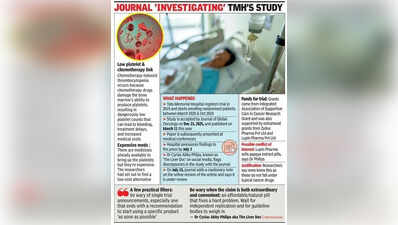
Mumbai: A new research article by Tata Memorial Hospital (TMH) claiming that papaya leaf extract pills help raise platelet count in chemotherapy patients has come under global scrutiny.The Journal of Global Oncology, a peer-reviewed medical journal that published TMH’s paper a few days ago, is “investigating” the study after Kochi-based hepatologist Dr Cyriac Abby Philips —widely known as ‘The Liver Doc’ on social media for his work debunking pseudoscience—requested it to conduct an internal review.The online version of the research paper now carries a disclaimer: “The journal has been alerted to potential concerns regarding the reproducibility and clinical interpretation of the reported findings in this article and is currently investigating. Readers should interpret with caution.”The study began with 219 patients, but after excluding certain individuals, the researchers narrowed the final count to 198, with 69 in placebo. They ultimately concluded that while longer follow-up is required, their findings suggest that the pills are an affordable intervention for chemotherapy-induced thrombocytopenia (low platelet count) and may help maintain chemotherapy intensity.This is one point of contention raised by Dr Philips. He noted that in the group taking the papaya pills, the researchers removed patients who did not recover before calculating the final results. “You can see the number of patients who recovered stays frozen at 83, while the denominator (total number of people in the study) shrinks from 146 down to 129,” he explained.By removing only the failures while leaving every success in place, the researchers effectively lifted the papaya extract’s recovery rate from about 57% to about 64% without a single additional patient actually recovering, Dr Philips added. Besides, he noted that in the placebo group, some patients who did recover were excluded from the final analysis.The study’s lead author Dr Vikas Ostwal said, “The journal has reached out to us with queries, which we are currently addressing as part of standard protocol. We are confident in our research. Our patients have been receiving the extract pills, and their platelet counts have consistently risen by day 4, give or take a day.”The pills for the trial were provided by Micro Labs Private Ltd, and the study received extramural grants from Zydus Pharma Pvt Ltd and Lupin Pharma Pvt Ltd; the latter also sells the extract pills under the brand name ‘Caripapa‘. Dr Ostwal said while the researchers were aware of the funding sources, none of them, including himself, knew that one of the funders sold these pills.Dr Philips also raised concerns that the study’s primary endpoint was moved from day 7 to day 4. A trial’s primary endpoint must be fixed before results are analysed. He noted that the original registration and protocols defined the primary endpoint as ‘platelet recovery by day 7′, yet day 4—which was intended only as an interim check—was used instead.“A trial produces endless data,” Dr Philips said. “If researchers decide after seeing the results what counts as the ‘primary’ endpoint, they can almost always find a positive outcome by pure chance. Deciding in advance is what separates real science from a lucky guess. It is the reason we trust a study’s findings when outcomes are positive.”A biostatistician retired from a public health institution concurred, saying that altering a primary endpoint post-analysis, combined with the exclusions in both arms, is a “red flag” that undermines the reliability of the study. “There could be a clinical benefit that the doctors observed and tried to fit into the data; on paper, there is certainly an issue.”Dr Amar Jesani, one of the founders of Indian Journal of Medical Ethics and former member of the ethics committee at Tata Hospital, said, “There can always be differences of opinion. Science cannot be without conflict. What is not acceptable is something that is done unscientifically, which has to be proved in this case. One way to move forward is for Tata Memorial Hospital to release raw, anonymised data into the public domain.Experts said while the journal’s investigation will be vital, a fresh clinical trial would help prove or disprove the findings.Meanwhile, Dr Philips said a famous institutional name produces a halo effect for journals. “Peer review was never built to catch fabrication or arithmetic that does not add up,” he said. “It runs on an assumption of good faith.”TMH director Dr Sudeep Gupta was unavailable for comment.

Mumbai court grants anticipatory bail to businessman in Rs 65cr Mithi river scam | Mumbai News

Mumbai court grants anticipatory bail to businessman in Rs 65cr Mithi river scam

Mumbai: A sessions court on Friday granted anticipatory bail to businessman Lokesh Onkarlal Jain in connection with the Rs 65 crore desilting scam involving the Mithi river probed by the Economic Offences Wing (EOW). Rejecting the need for custody, Additional Sessions Judge NG Shukla noted that the alleged conspiracy was said to have begun in 2020, while Jain’s contract was for the period 2023 to 2025. The judge observed, “Thus, at the outset, there is no role of the applicant in the alleged conspiracy. The allegation against the applicant regarding forgery of hire agreement and other forged documents submitted to the BMC is independent from the allegation of conspiracy.” Jain, a partner of Bhumika Transport, had approached the court, apprehending arrest.The prosecution alleged that contractors involved in the Mithi river desilting project submitted forged documents, false memoranda of understanding relating to dumping grounds, forged land records and Aadhaar cards, causing a wrongful loss of about Rs 65 crore to the BMC.The EOW alleged that Jain’s firm received Rs 24.49 crore from the BMC by submitting forged documents relating to desilting work. The agency also alleged that Jain entered into a forged hire agreement for specialised desilting machines with a company linked to co-accused Ketan Kadam, though the company had allegedly not purchased those machines. It was further alleged that forged MoUs with landowners, including deceased persons, were submitted for dumping silt.Jain’s lawyers argued that the tender conditions permitted hiring of machines and required contractors to submit assurance documents from manufacturers or suppliers. The defence submitted that the machines were in fact used for the desilting work and that BMC officials had inspected the work from time to time. The defence also relied on the work completion certificate issued by the civic body, which recorded that 1.87 lakh metric tonnes of material had been removed and transported, with the work marked satisfactory.On the allegation of forged dumping-ground MoUs, the defence said Jain had appointed a subcontractor, Kalpesh Corporation, through Arvind Purohit, to handle documents and related work, and that the BMC had been informed about the arrangement. The prosecution opposed bail and argued that custodial interrogation was necessary to trace the source of the alleged forged MoUs, Aadhaar cards and transport records.Granting relief, the court said, “I find that custodial interrogation of the applicant is not required. The documents submitted by the applicant along with tender and during the work of desilting to the officers of SWD (Storm Water Drains) are already seized by the investigating officer from the concerned officer of SWD. In such circumstances, nothing is to be seized from the applicant,” the judge said.