
India’s clean mobility shift won’t be EV-only; hybrids, CNG, hydrogen and biofuels to share the road | Mumbai News
India's clean mobility shift won't be EV-only; hybrids, CNG, hydrogen and biofuels to share the road
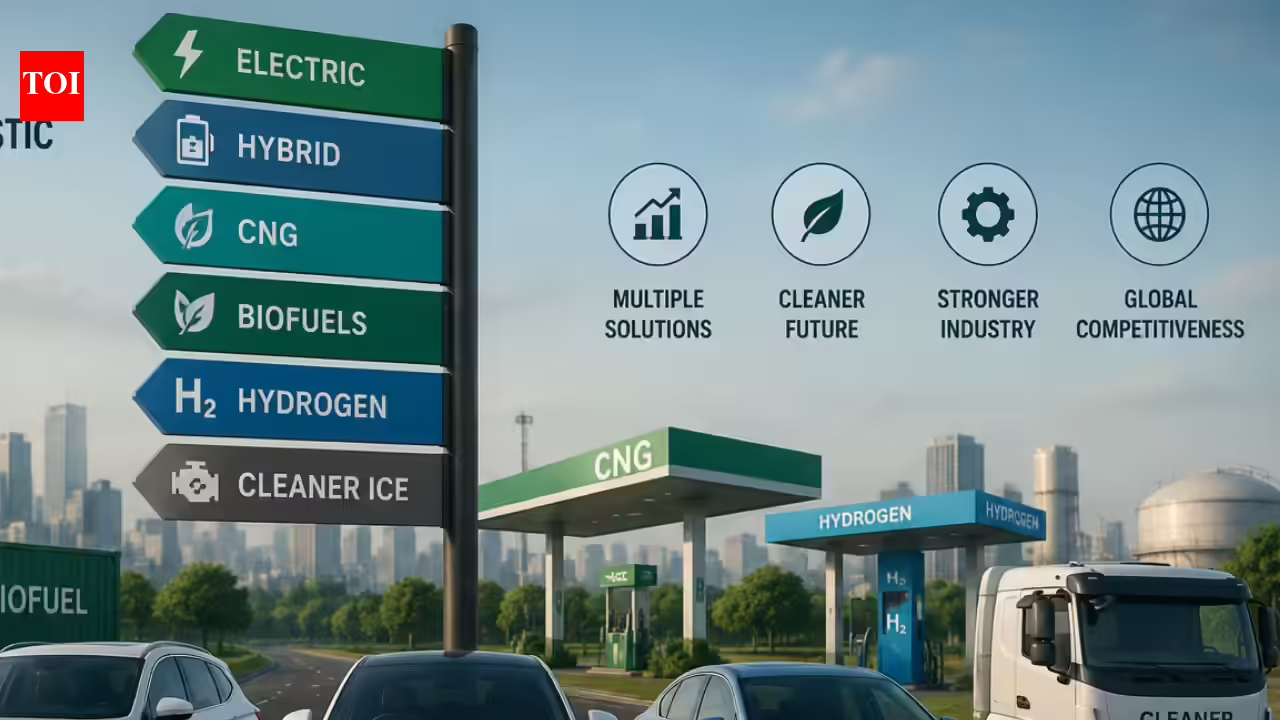
The IEA Global EV Outlook 2026 is broadly in line with NITI Aayog’s advocacy of a technology-neutral strategy for decarbonising transport. (AI-generated image)

MUMBAI: India’s transition to cleaner mobility is expected to follow a technology-agnostic path rather than an exclusively electric vehicle (EV)-led route, with industry experts and policy think tanks indicating that EVs, hybrids, compressed natural gas (CNG), biofuels, hydrogen and cleaner internal combustion engine (ICE) technologies will coexist over the coming decade.The evolving approach is also expected to reshape India’s automotive component industry, creating opportunities for manufacturers to diversify product portfolios while strengthening the country’s position as a global automotive manufacturing hub.According to the International Energy Agency’s (IEA) Global EV Outlook 2026, India continues to be among the world’s fastest-growing EV markets, driven largely by electric two- and three-wheelers. Annual EV sales have crossed 2.4 million units. However, EVs still account for only a small share of the country’s overall vehicle fleet, highlighting the continued role of conventional and alternative powertrains during the transition.The outlook is broadly in line with NITI Aayog’s advocacy of a technology-neutral strategy for decarbonising transport. The policy think tank has argued that India’s diverse geography, varying income levels, different vehicle usage patterns and uneven charging infrastructure require multiple clean mobility solutions rather than reliance on a single technology.For consumers, the multi-technology approach could translate into a wider choice of cleaner vehicles suited to different needs, while allowing the supporting infrastructure—including charging stations, CNG networks and alternative fuel ecosystems—to expand in phases.The transition is also opening new avenues for India’s automotive component industry. According to the Automotive Component Manufacturers Association of India (ACMA), the sector has grown into a USD 75-billion industry, contributing nearly 2.3% to the country’s GDP. Component exports have also risen steadily as global automakers diversify sourcing under the China-plus-one strategy, positioning India as an increasingly important manufacturing base.Industry experts said the next phase of growth will depend not merely on higher production volumes but on technological capabilities. Manufacturers are expected to develop components simultaneously for advanced ICE engines, hybrid vehicles and electric drivetrains while investing in electronics, embedded software, sensors, lightweight materials and precision engineering.They added that research and development, artificial intelligence, automation and digital manufacturing will increasingly determine competitiveness as the industry moves from conventional mechanical engineering towards software-enabled mobility solutions.“India’s automotive industry is undergoing its biggest transformation in decades. While electrification has become the defining global narrative, India’s transition to cleaner mobility will be far more nuanced than simply replacing internal combustion engine vehicles with electric vehicles,” said Adithya Jayakar, deputy managing director of UCAL Ltd.Industry observers also pointed to supply-chain resilience as a strategic priority after the Covid-19 pandemic and geopolitical disruptions exposed India’s dependence on imported electronics, semiconductors and specialised materials. While the Centre’s Production Linked Incentive (PLI) Scheme has accelerated investments in domestic manufacturing, they said deeper localisation of high-value components would be crucial for improving export competitiveness and reducing import dependence.Sustainability is also emerging as a key business imperative beyond regulatory compliance. Renewable energy use, circular manufacturing, responsible sourcing and carbon disclosure are increasingly influencing procurement decisions by global original equipment manufacturers (OEMs), prompting Indian suppliers to align with international sustainability benchmarks.Jayakar said policy support should encourage innovation across the mobility ecosystem rather than favour any single propulsion technology.“India’s competitive advantage lies in its ability to innovate across technologies, not in choosing one over another. As the country aspires to become a global automotive manufacturing hub, success will depend on building capabilities across the entire mobility spectrum,” he said.
BMC asks Taj Mahal Palace to pay ₹27 crore for road, footpath occupation around hotel | Mumbai News

BMC asks Taj Mahal Palace to pay ₹27 crore for road, footpath occupation around hotel
According to the notice issued by the assistant commissioner of A ward, the civic body has directed the hotel to pay ₹4.97 crore towards road occupancy charges and ₹22.15 crore towards footpath occupancy charges, taking the total demand to ₹27.12 crore. The amount includes interest and charges up to March 2026.

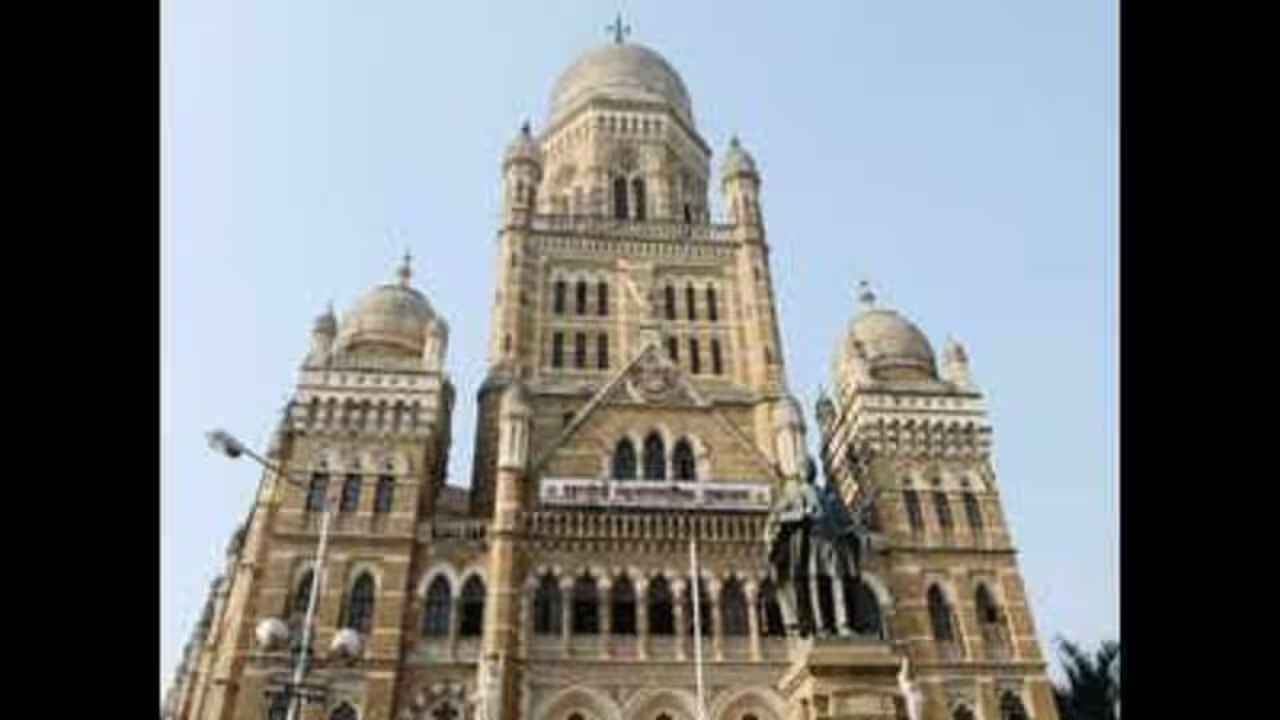
Mumbai: BMC has issued a demand notice to the Taj Mahal Palace Hotel, asking it to pay nearly ₹27 crore towards road and footpath occupation charges for security planters, barricades and parking spaces around the iconic Colaba property, after withdrawing concessions that had earlier been granted.According to the notice issued by the assistant commissioner of A ward, the civic body has directed the hotel to pay ₹4.97 crore towards road occupancy charges and ₹22.15 crore towards footpath occupancy charges, taking the total demand to ₹27.12 crore. The amount includes interest and charges up to March 2026.The dispute pertains to the occupation of 869.59 sq m of road space and 1,136.3 sq m of footpath around the hotel for security installations and parking, put in place after the 26/11 terror attacks.Initially, the Taj had sought a 50% concession on road occupancy charges and a complete waiver of footpath occupancy charges, arguing that the occupied footpath was not being used for commercial purposes. The then BMC Standing Committee approved the proposal in January 2021, but the matter remained pending before the general body.However, after the civic body recovered pending dues from the Bombay Stock Exchange (BSE), the A ward office suo motu reviewed the concessions extended to similar establishments.On February 21, 2025, the municipal commissioner approved the cancellation of the earlier concessions granted to the Taj, following which revised demand notices were issued to the Taj and the Trident Hotel.The BMC said the Trident Hotel paid all pending dues and removed security planters occupying the footpath, while the Bombay Stock Exchange (BSE) agreed to clear pending road occupancy charges amounting to ₹3.25 crore for the period between April 2012 and December 2024. However, officials said the Taj has not yet paid the revised charges despite repeated reminders.The latest reminder states that the hotel had earlier been asked to pay ₹4.03 crore towards road occupancy and ₹18.27 crore towards footpath occupancy up to July 2025. Since the dues remained unpaid, the BMC levied interest, increasing the liability to ₹4.73 crore for road occupation and ₹21.32 crore for footpath occupation up to September 2025. It has also sought an additional ₹1.08 crore for occupation charges from October 2025 to March 2026.A senior civic official said the BMC decided to adopt a uniform policy for commercial establishments occupying public roads and footpaths for security purposes.“BSE agreed to pay the prescribed charges and the Trident also complied, there was no justification for continuing the concession granted to the Taj. The civic body has therefore sought recovery of the revised dues,” the official said.When contacted Taj Mahal Palace did not comment on the issue.

Bombay high court seeks DGP’s report on CCTVs in all police stations, period of footage saved | Mumbai News

Bombay high court seeks DGP’s report on CCTVs in all police stations, period of footage saved

Mumbai: Bombay High Court has directed the state director general of police to conduct a fact-finding exercise across all police stations in Maharashtra and submit a report on the functioning of CCTV cameras and the period of preservation of their footage.Acting Chief Justice Ravindra Ghuge and Justice Gautam Ankhad on Wednesday were hearing a petition by Ghatkopar resident Prashant Kokane, 35, seeking preservation of CCTV footage of the office of DCP (Zone 7) and Ghatkopar police station between March 17 and 20, 2025.On March 17, 2025, he submitted a complaint to the ration office regarding a bogus ration card. On March 20, 2025, chapter proceedings — preventive measures to maintain public order — were initiated by the DCP, who is also special executive magistrate. Kokane said this was done by the opposite party in collusion with police to pressure him to withdraw the complaint. In April 2025, the HC disposed of Kokane’s petition after the state said chapter proceedings would be withdrawn and his allegations against police officers would be brought to the notice of senior authorities to take appropriate action.On March 5, 2026, Kokane filed another petition for preserving the CCTV footage as the inquiry was on.Additional public prosecutor Mankunwar Deshmukh, citing a July 2025 written communication of the senior inspector that CCTV footage is preserved for six months, said it is not available considering the incident is of March 2025.Kokane referred to HC’s March 2022 order in which the state had undertaken to upgrade CCTV systems in police stations and that necessary steps would be taken to ensure recording/data backup is kept for 18 months and not just 12 months. He also submitted his April 15, 2025, application to the senior inspector to preserve the CCTV footage “which was within a month” of the alleged incident. “In view of the above,” the judges directed the DGP to “take an overall view of all police stations” and submit a report on Aug 20. The report should also indicate what steps were taken after the March 2022 order and “why has the Ghatkopar police station reported to us that the CCTV footage cannot be preserved after 6 months and is not available.”

Poll demand leads to uproar in BMC House, opposition walks out | Mumbai News

Poll demand leads to uproar in BMC House, opposition walks out

Mumbai: High drama was witnessed in the BMC general body on Thursday after the BJP-led house sought to accord urgent status to a proposal to widen a road in Ghatkopar (West), triggering a confrontation over voting procedure that ended with the opposition staging a walkout.The urgent proposal pertained to revising the regular road line of Khot Lane in Ghatkopar (West) from 6 metres to 9 metres under the Mumbai Municipal Corporation Act, 1888, and the Development Control and Promotion Regulations, 2034. The proposal covers multiple land parcels in Ghatkopar-Kirol village.Before the proposal could be taken up, however, opposition members demanded a division of votes, arguing that under the rules, an urgent business proposal requires approval by a two-thirds majority before it can be discussed.The opposition claimed the BJP-led Mahayuti did not have the required numbers, leading to a prolonged standoff. After consultations with civic officials and ruling alliance leaders, Mayor Ritu Tawde announced that the proposal would instead be placed before a special meeting on a later date and proceeded to the next agenda item — a discussion on the inquiry report into the fatal Chembur tree-fall incident.The move lead to protests from corporators of Shiv Sena (UBT), Congress, Samajwadi Party, AIMIM and MNS, who accused the Mayor of sidestepping a vote. Leader of Opposition Kishori Pednekar, Congress leader Ashraf Azmi, MNS leader Yashwant Killedar and other opposition members repeatedly demanded that a poll be conducted before the House moved on.As opposition members raised slogans of “Take the poll, take the poll,” BJP corporators countered with chants of “Ganpati Bappa Morya,” reducing the House to chaos. During the impasse, the Mayor, officials from the Municipal Secretary’s Department, Leader of the House Ganesh Khankar and Standing Committee chairman Prabhakar Shinde held discussions on the way forward.Refusing to conduct a division of votes, the Mayor reiterated that the proposal would be brought before a special meeting. The announcement prompted the opposition to walk out of the House. The protesting corporators later demonstrated outside the BMC headquarters, raising slogans against the Mayor and the BJP-Shiv Sena (Shinde) ruling alliance.The opposition said it had demanded that the inquiry report into the incident be taken up at the start of the meeting. They alleged that the inquiry committee had effectively given a clean chit to the contractor, the Gardens Department, engineers and consultants, while recommending only a Rs 7 lakh penalty on the contractor and consultant. The opposition accused the ruling alliance of prioritising administrative and financial proposals over a discussion on the fatal incident.

Six-month-old baby kidnapped from outside Kalyan railway station | Mumbai News

Six-month-old baby kidnapped from outside Kalyan railway station
The victim, Roshani Suraj Sahoo (21), a resident of Vapi in Gujarat, told police that she had left her home following a dispute with her husband and was travelling to Kalyan with her six-month-old son, Aryan, to stay with a friend.

Kalyan: A six-month-old baby was allegedly abducted from outside Kalyan railway station in the early hours of Thursday, prompting a massive search by the police.The victim, Roshani Suraj Sahoo (21), a resident of Vapi in Gujarat, told police that she had left her home following a dispute with her husband and was travelling to Kalyan with her six-month-old son, Aryan, to stay with a friend.According to the complaint, Roshani reached Kalyan late at night. As it was too late to travel further, she slept outside the railway station with her baby beside her.When she woke up at around 2.30 am, she was shocked to find that Aryan was missing. She immediately alerted the local Mahatma Phule police station and lodged a complaint.Based on the complaint, the Mahatma Phule police have registered a case against unidentified persons under relevant sections of the Bharatiya Nyaya Sanhita and launched a hunt for the accused. Police teams have begun scanning CCTV footage from the railway station and nearby areas while questioning autorickshaw drivers and others who may have been present at the spot during the night.Police suspect the infant may have been abducted while the mother was asleep, though all possible angles are being investigated.