
PMO orders Maharashtra gov to probe into Rs 110-crore Mahagenco land acquisition irregularities | Mumbai News
PMO orders Maharashtra gov to probe into Rs 110-crore Mahagenco land acquisition irregularities
The Prime Minister’s Office has directed the Maharashtra government to investigate Mahagenco’s land acquisition practices

MUMBAI: The Prime Minister’s Office (PMO) has directed the Maharashtra government to examine allegations of irregularities in the acquisition of compensatory afforestation (CA) land by Maharashtra State Power Generation Company Ltd (Mahagenco) for its Gare Palma Sector-II coal block in Chhattisgarh.Acting on a complaint submitted by Chhattisgarh-based activist Naresh Chandra Gupta, the PMO forwarded the matter to the Maharashtra government, which has sought a detailed report from Mahagenco.The complaint alleges that nearly Rs 110 crore was spent on acquiring around 214.869 hectares of private land required for compensatory afforestation to secure forest clearance for the coal block.According to the complaint, several land valuation and certification records relied upon for the transactions carried only local-level revenue endorsements and allegedly lacked higher-level verification.The complaint also alleges that detailed historical title verification of the land parcels was not carried out before purchase.The complainant has further alleged that some of the acquired land parcels were linked to multiple interconnected entities and had previously been used as solvency assets in commercial contracts.Questions have also been raised regarding the present physical status and traceability of some of the land parcels.Mahagenco, however, has denied any irregularity, stating that suitable government land for compensatory afforestation was unavailable and that private land was identified following advice from forest authorities.Mahagenco said they procured approximately 530 acres of Compensatory Afforestation (CA) land at a total cost of around ₹93 crore, and not ₹110 crore as alleged.The utility said all acquisitions were carried out through registered sale deeds after obtaining approvals from the competent authorities.The complaint also alleges that several land records contained identical site maps despite relating to different survey numbers, raising concerns about the authenticity of the documentation and whether proper ground surveys were conducted.Another allegation relates to the Expression of Interest (EOI) process used to identify land. The complaint claims the notices received limited public visibility because they were published in newspapers with low circulation and that the exercise effectively restricted wider participation.Mahagenco has rejected the allegation, stating that the EOI was published in government-empanelled newspapers in Raigarh and Raipur and was also hosted on the websites of Mahagenco and its consultant.According to the utility, four proposals were received in response.The complaint further alleges that some participants in the process lacked the financial capacity to independently aggregate land holdings of the scale eventually acquired.It also alleges that several transactions were routed through power-of-attorney arrangements and intermediary entities.While the complainant has questioned whether public funds ultimately reached the original landowners, Mahagenco maintains that the purchases were completed through legally registered transactions and in accordance with applicable procedures.The complaint has also raised concerns that if any of the alleged deficiencies in land records, title verification or documentation are established, they could have implications for the compensatory afforestation process that formed part of the forest clearance requirements for the project.In its response, Mahagenco said valuation was carried out as per applicable norms.It stated that the land received a suitability certificate from the Divisional Forest Officer, Raigarh, and a no-objection certificate from the district collector before purchase.The utility added that after mutation and transfer to the forest department, the land was notified as Reserved Forest by the Chhattisgarh government in December 2022.Officials said the inquiry initiated following the PMO referral would examine the allegations, supporting records, approvals and Mahagenco’s response before any conclusions are reached.
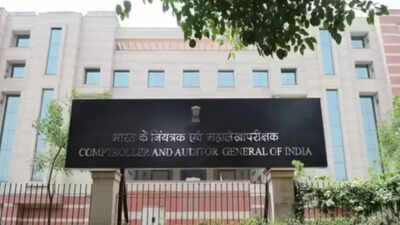
CAG flags widening fiscal stress in Maharashtra despite robust growth; warns of rising revenue deficit, weak budget planning | Mumbai News

CAG flags widening fiscal stress in Maharashtra despite robust growth; warns of rising revenue deficit, weak budget planning
A large portion of state revenue is devoted to salaries and pensions, consuming over half of the total

MUMBAI: Maharashtra’s economy continued to outpace much of the country in 2024-25, but the state’s finances are coming under increasing strain as rising revenue expenditure, mounting committed liabilities and persistent weaknesses in budget management threaten the government’s ability to invest in public infrastructure and essential services, according to the Comptroller and Auditor General’s (CAG) State Finances Report.In its review of the state’s finances and budgetary management, the CAG said Maharashtra’s strong Gross State Domestic Product (GSDP) growth and higher-than-national per capita income provide a solid economic base.However, the audit cautioned that the increasing revenue deficit, high committed expenditure and growing liabilities could force the government to rely more heavily on borrowings to finance development projects, affecting long-term fiscal sustainability.The report noted that while Maharashtra remained within the Fiscal Responsibility and Budget Management (FRBM) limits for fiscal deficit and debt, its revenue deficit widened significantly, meaning a larger portion of government borrowings is being used to meet day-to-day expenditure rather than creating productive assets.The CAG observed that undischarged liabilities exceeding ₹27,184 crore could further worsen both the revenue and fiscal deficits.For ordinary citizens, the trend assumes significance because a larger share of tax revenues is increasingly being consumed by salaries, pensions, interest payments and subsidies, leaving relatively less fiscal space for new roads, hospitals, schools, water supply and other capital works.The audit found that committed expenditure, comprising salaries, pensions and interest payments, stood at ₹2.49 lakh crore, accounting for 51.81% of the state’s revenue receipts during 2024-25.Although this proportion has declined from earlier years, the CAG said it continues to constrain fiscal flexibility and called for greater prioritisation of productive capital expenditure.Subsidies also continued to rise sharply.Total subsidies increased 16.72% to ₹56,089.18 crore, driven mainly by higher electricity tariff subsidies for agricultural pump consumers and support for cotton, soybean and oilseed cultivation. While these schemes support key sectors, the audit stressed the need to ensure that such expenditure remains fiscally sustainable.Chapter II of the report points to persistent shortcomings in budget execution.The CAG found repeated instances of excessive supplementary grants, large savings under several departments despite additional allocations, injudicious reappropriation of funds, delayed surrender of unspent allocations and substantial expenditure concentrated in the final month of the financial year.Such practices reduce the effectiveness of legislative control over public spending and weaken the credibility of budget estimates.The audit also highlighted cases where supplementary provisions turned out to be unnecessary or excessive, indicating weaknesses in expenditure forecasting.In several grants, departments surrendered large amounts only at the end of March, while in others, savings remained unutilised despite additional budgetary support.The CAG said more realistic budgeting and timely monitoring are essential for efficient use of taxpayers’ money.Another concern relates to expenditure bunching at the year-end.According to the report, significant spending was incurred during March 2025, a practice that can compromise financial discipline, reduce scrutiny of expenditure and affect the quality of project implementation.The audit also drew attention to pressures on local body finances. Against the Fifteenth Finance Commission’s recommendation of ₹1,391 crore for million-plus cities, no grant was released by the Centre during 2024-25, while the release made for urban local bodies pertained to withheld grants of the previous year.Maharashtra has six eligible urban agglomerations under this category, where grants are linked to improvements in air quality, drinking water and solid waste management.To improve fiscal health, the CAG has recommended strengthening revenue mobilisation, improving expenditure planning, reducing the revenue deficit, containing committed expenditure, enhancing allocative efficiency and ensuring more realistic budget estimates.It also called for better monitoring of supplementary grants, timely surrender of savings, avoidance of year-end spending spikes and greater focus on capital investment to support long-term economic growth.

Maharashtra’s financial reporting under scanner as CAG flags off-budget debt, fund parking and weak oversight | Mumbai News

Maharashtra's financial reporting under scanner as CAG flags off-budget debt, fund parking and weak oversight
Maharashtra’s financial reporting faces serious concerns from the CAG

Mumbai: Even as Maharashtra kept its fiscal deficit within the Fiscal Responsibility and Budget Management (FRBM) limit, the Comptroller and Auditor General (CAG) has raised serious concerns over the quality of the state’s financial reporting, warning that several accounting and treasury practices are undermining transparency, legislative oversight and public accountability.Chapter III of the CAG’s State Finances Audit Report for 2024-25 paints a picture of systemic weaknesses in financial reporting rather than isolated irregularities.The audit says increasing reliance on off-budget borrowings, delayed utilisation certificates, parking of funds outside the Consolidated Fund, pending contingent bills and delayed accounts of autonomous bodies have together obscured the state’s true financial position.Among the most significant findings is the sharp rise in off-budget borrowings, which stood at ₹28,640 crore as on March 31, 2025.Since these borrowings are raised through state-owned PSUs and agencies instead of the Budget, they dilute fiscal transparency and prevent the Legislature and citizens from getting a complete picture of the state’s liabilities, the audit observed.The CAG also flagged 12,829 pending Utilisation Certificates (UCs) involving ₹40,097.59 crore, saying the absence of UCs weakens assurance that public money released as grants was spent for the intended purposes.The report noted that non-submission of UCs violates provisions of the Maharashtra Treasury Rules and General Financial Rules while exposing deficiencies in financial monitoring and internal controls.Another area of concern is the continued use of Abstract Contingent (AC) bills. As on March 31, 2025, 1,698 AC bills worth ₹3,532.05 crore were awaiting adjustment through Detailed Contingent bills.The audit noted that 268 AC bills worth ₹35.18 crore were drawn in March 2025 alone, indicating a year-end rush to book expenditure, contrary to principles of financial propriety and treasury rules.The report is equally critical of the state’s handling of Virtual Personal Deposit Accounts (VPDAs). According to the audit, despite their introduction to improve fund management, large sums continued to remain parked without actual utilisation.The CAG said ₹20,993.06 crore remained in VPDAs beyond March 31, 2025. Had this amount been returned to the Consolidated Fund at year-end, Maharashtra’s revenue deficit would have reduced from ₹29,994.76 crore to ₹9,001.70 crore.Instead, retention of the balance inflated the reported revenue deficit by ₹20,993.06 crore, the audit said, while questioning a government resolution exempting VPDAs from treasury rules governing year-end lapsing of funds.The audit also found ₹15,298.83 crore lying unspent in Drawing and Disbursing Officers’ bank accounts despite the VPDA mechanism, reflecting continued weaknesses in fund-flow management and internal controls.In another accounting lapse, the CAG said the government did not provide interest of ₹762.49 crore on several interest-bearing deposits, including pension and disaster response funds.This understated revenue expenditure and overstated Public Account balances, thereby distorting the state’s financial position.The report further noted that ₹3,277.58 crore of National Pension System contributions remained parked instead of being transferred promptly to the designated pension fund manager, contrary to Government of India guidelines.Transparency issues extended to statutory bodies as well. The CAG found 74 annual accounts of 26 autonomous bodies pending submission for audit as on March 31, 2025, delaying legislative scrutiny despite continued government funding to several of these institutions.The audit also highlighted weak follow-up on financial irregularities.Cases involving misappropriation, losses and theft worth ₹52.18 crore remained pending, with 151 of the 201 cases dating back more than 15 years, indicating weak internal controls and delayed accountability.To restore credibility in financial reporting, the CAG has recommended bringing all borrowings on-budget, enforcing strict timelines for submission of utilisation certificates and detailed contingent bills, restricting March-end AC bill withdrawals, ensuring unspent balances are returned to the Consolidated Fund, and preventing retention of government money in DDO-operated bank accounts.

2 college students drown while swimming in Mumbai’s Dahisar quarry | Mumbai News

2 college students drown while swimming in Mumbai's Dahisar quarry
The bodies of Om Singh, 19, and Piyush Gupta, 18, were retrieved from the quarry by the fire brigade and local residents and taken to a hospital.

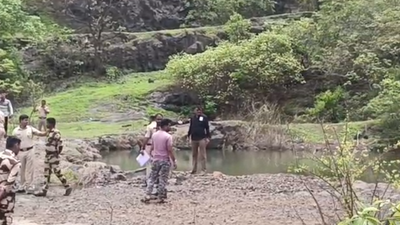
MUMBAI: Two of the four college students who had gone swimming at a quarry in Dahisar East drowned on Saturday. The bodies of Om Singh, 19, and Piyush Gupta, 18, were retrieved from the quarry by the fire brigade and local residents and taken to a hospital. Singh lived in Andheri, while Gupta was a resident of Kandivali. Police said Singh and Gupta, along with two classmates, Aman Giri, 17, and Divyesh Patel, 17, skipped college on Saturday and headed to Shaikh Khadaan Compound near Sanjay Gandhi National Park in Dahisar East. All four were first-year Commerce students at a degree college in Kandivali. One of the boys told police that they had consumed beer near the quarry before entering the water. None of them knew how to swim. At around 10.20 am, Singh and Gupta ventured into deeper water while their friends remained near the edge. “Singh and Gupta started having difficulty breathing. Their friends then threw their college bags into the water so the duo could hold on to them and be pulled out, but the attempt failed,” an officer said. One of the boys then called the police control room. Police and fire brigade personnel soon arrived at the spot. Gupta and Singh were pulled out of the water and rushed to Babasaheb Ambedkar Hospital, where doctors declared them dead. Dahisar police registered accidental death reports (ADRs). Police said the abandoned quarry pits can fill with 30 to 40 feet of water during the monsoon. “Locals are aware of the danger and avoid the area, but youngsters from outside the locality often venture there for a swim during the monsoon,” an officer said. Note: The original copy says the students “skipped college on Thursday,” but the incident is reported as occurring on Saturday. You may want to verify the day, as that appears inconsistent.

For Mumbaikars, K. Rustom was more than just ice cream | Mumbai News

For Mumbaikars, K. Rustom was more than just ice cream
The ice cream parlour’s licence suspension due to hygiene concerns has sparked disappointment among loyal customers

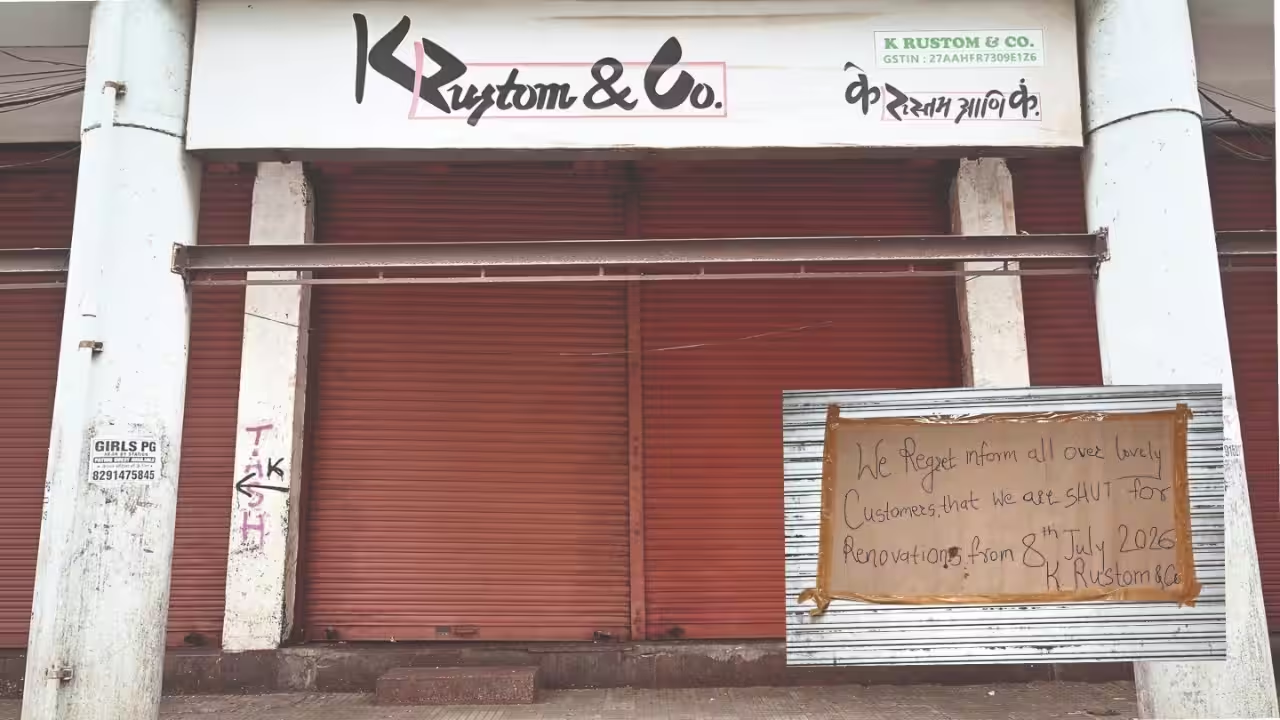
For generations of Mumbaikars, a trip to South Mumbai often ended with an ice cream sandwich from K. Rustom & Co. Long queues spilling onto the pavement, children eagerly choosing flavours and the unmistakable sight of creamy ice cream tucked between crisp wafers made it more than just an ice cream parlour — it became a ritual.That is why the Maharashtra Food and Drug Administration’s decision to suspend the outlet’s food licence after inspectorsfound serious hygiene violations, has left loyal patrons disappointed.What happened?K. Rustom & Co. ice cream parlour, founded by Khodabaksh Rustom Irani in 1953, had its food licence suspended by the Maharashtra Food and Drug Administration (FDA) after a surprise inspection uncovered serious food safety and hygiene violations. The outlet has been directed to remain shut until the deficiencies are rectified and regulatory requirements are met.

MixCollage-11-Jul-2026-01-11-PM-5929

Mumbaikars reactDhara Sanghvi, 58, resident of Breach Candy, says, “I have been visiting K Rustom since I was a child. It was kind of a tradition during the summer to go there for a drive and eat the ice cream from them. We have always loved the ice cream sandwiched between a wafer; it is unique, and they have always maintained the taste and quality of the ice cream. But now this has come as a shock to us that it wasn’t maintaining the hygiene standard.”Whenever friends visited Mumbai, K. Rustom was on my list of places to take them to. The wafer ice cream wasn’t just a dessert; it was part of the Mumbai experience. Hearing about the hygiene violations is disappointing— Rajesh Mehta, 46, chartered accountant from DadarI grew up hearing stories about K. Rustom from my parents before I finally visited it in college. It represented old Bombay and its charm. I hope the authorities ensure all standards are met because people would want such an iconic place to come back only if it’s completely safe— Neha Kapoor, 31, marketing professional from AndheriAs a South Mumbai resident, I have seen generations enjoy K. Rustom. It survived changing food trends and remained relevant because of its quality and simplicity. That’s why these reports are deeply upsetting. Nostalgia is important, but hygiene can never be compromised— Farhad Mistry, 67, retired banker from Colaba

Dream Girl comes full circle as Bollywood celebrates Hema Malini’s Diamond Jubilee | Mumbai News

Dream Girl comes full circle as Bollywood celebrates Hema Malini's Diamond Jubilee
The Hindi film industry gathered to celebrate Hema Malini’s sixty years in cinema. An evening of nostalgia featured candid conversations and musical performances. Industry legends shared behind-the-scenes stories and cherished memories. Hema Malini herself sang and reflected on her remarkable journey. The event celebrated an era of Hindi cinema through stories and songs.

It was an evening of nostalgia, music, laughter and heartfelt memories as the Hindi film industry gathered to celebrate 60 glorious years of Hema Malini in Indian cinema. Hosted and directed by Anirudh Chawla, the Diamond Jubilee celebration unfolded like a journey through the Dream Girl’s remarkable life and career, blending candid conversations, memorable anecdotes, live musical performances and specially curated audio-visual presentations that traced her evolution from a young debutante to one of Indian cinema’s most enduring icons.A WALK DOWN MEMORY LANEThe evening began on an emotional note as Hema Malini reflected on how the venue, Shanmukhanada Hall, held a special place in her life. “This is the same venue where my journey as an actress began. When I came to Mumbai to shoot Sapno Ka Saudagar, this is where I stayed. Every day, I would travel to Raj Kapoor’s studio in Chembur for the shoot. Later, I received my first Filmfare Award here. Over the years, I have performed on this stage so many times. Life has truly come full circle. Sixty years later, here I am again, celebrating this incredible journey.” The event was graced by Union Cabinet Minister Kiren Rijiju as the chief guest and Maharashtra Cabinet Minister Ashish Shelar as the guest of honour.DHARAM JI, BASANTI AND BEHIND-THE-SCENES STORIESOne of the most cherished segments of the evening was Hema Malini’s affectionate recollection of husband Dharmendra. Narrating the story behind Main Jat Yamla Pagla Deewana from Pratigya, she recalled how legendary Kathak maestro Gopi Krishna had initially been brought in to choreograph the actor. “I wondered, ‘Dharam ji Kathak karenge?’ Then I heard the song and thought, how did they think of Gopi Krishna ji for this? Dharam ji looked at the choreography and said, ‘Yeh kya hai?’ Then he told the director, ‘Mujhe choreographer nahi chahiye... aap camera ke peeche baithiye aur main camera ke saamne apna kaam karta hoon.’ He ended up choreographing and performing the song himself,” she said, leaving the audience in splits.THE DREAM GIRL’S BEAUTY MANTRASpeaking about the secret behind looking as radiant today as she did decades ago, Hema said, “It’s the grace of my Lord Krishna. Jab Bhagwan ne aapko sundarta di hai, use pehchanna bhi zaroori hai aur use maintain karna bhi hamara farz hai. I do that through yoga, meditation, dance, and regular workouts.”WHEN CINEMA LEGENDS REMINISCEDThe conversations brought forth several behind-the-scenes stories from some of Hindi cinema’s biggest classics. Director Ramesh Sippy reminisced about working with Hema from his first film Andaz (1971) to his last film Shimla Mirchi (2020). “I was only 25 when I first directed her and she would tease me saying, ‘Yeh toh baccha hai, kaise direct karega?’ She had a photographic memory. Sab dialogues pat pat bol deti thi.He also revealed that convincing Hema to play Basanti in Sholay wasn’t easy. Hema laughed as she admitted, “After Seeta Aur Geeta, I asked him, ‘Film mein itne log hain aur mera sirf tange wali ka role hai?’ But he told me, ‘You must do this role in Sholay. Otherwise, you’ll regret it.'”SONGS THAT BROUGHT BACK AN ERAMusic flowed seamlessly through the evening, recreating some of Hema Malini’s most memorable songs. Kavita Krishnamurti and Suresh Wadkar’s rendition of Naam Gum Jayega drew loud applause before Kavita revealed a deeply personal connection with the actress. “The only reason I came to Bombay and became a playback singer was because of Hema ji and her mother Jaya Chakravarty, who were my neighbours in Delhi. I will remain eternally grateful to HemaJi.Ever the humourist, Suresh Wadkar quipped, “There should always be four ambulances stationed outside any venue where Hema ji performs. Kyonki itni sundar ladki dekhkar toh waise hi log dher ho jayenge.”‘SHE’LL ALWAYS BE MY SISTER HEMU’Madhoo offered a glimpse of the Hema Malini few get to see. “She is the Dream Girl for all of you, but for me she will always be my sister Hemu. She took me to Disneyland for the first time when I was a child. There Dharam Uncle taught me to swim at the hotel’s pool. He would often say,’Bacche tumhe swimming kisne sikhaya.”Rakesh Roshan recalled how Hema had changed the course of his acting career. “Uss waqt ki jo leading ladies thi, unhone mere saath kaam karne se mana kar diya tha. Lekin Hema ji ne haan kaha. Aaj main unki wajah se unke saath iss stage par baitha hoon.”Watching a montage of his films with Hema prompted Jeetendra to joke, “Woh jawani dekh ke yeh budhapa sata raha hai. She is still so charming, but hum toh khatara ho gaye hain.” He also became emotional while remembering Dharmendra. “He always said exactly what was in his mind and heart. That’s a very rare quality.”Adding to the celebratory mood were live performances by Padmini Kolhapure and Anu Malik, who sang Gir Gaya Jhumka, while Anup Jalota, Sudesh Bhosle, Vijayta Pandit Shrivastava, Poornima Sushama Shreshtha, Shabbir Ahmed and several other singers paid tribute to Hema Malini through songs immortalised on screen by the Dream Girl.AN EVENING THAT ENDED ON A MUSICAL HIGHThrough the show, Hema took the microphone to sing a few lines from Kya Khoob Lagti Ho and Tum Haseen Main Jawaan. The evening concluded on a poignant note when Hema joined Kavita Krishnamurti for a soulful rendition of Aye Dil-e-Nadan. As the audience rose for a standing ovation, it was evident that the Diamond Jubilee celebration wasn’t merely a tribute to a legendary actress, it was a celebration of an era of Hindi cinema, brought alive through stories, songs and memories that continue to resonate across generations.

ED initiates FEMA investigation against Mumbai-based film producer linked to Shekhar Suman | Mumbai News

ED initiates FEMA investigation against Mumbai-based film producer linked to Shekhar Suman

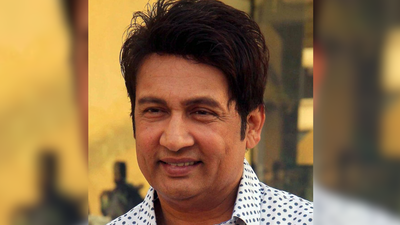
MUMBAI: The ED on Friday initiated a probe under the Foreign Exchange Management Act (FEMA) against a Mumbai-based film producer linked to actor Shekhar Suman over alleged violations involving undisclosed overseas assets and foreign exchange transactions.As part of the investigation, the agency carried out searches on Thursday at premises linked to Kalanee Impex Ltd. and its directors — Dharmesh Sangani, his wife Ranjeeta Sangani, and Narendra Sangani. Dharmesh Sangani is a co-founder of a film academy promoted by Shekhar Suman.Officials said the investigation is currently focused only on the Sanganis and their company.“During the course of search, evidences relating to undisclosed foreign companies and foreign bank accounts of Dharmesh Sangani were found. These companies and accounts have not been disclosed in the Income Tax Returns.“The source of funds, ownership structure and other aspects of these foreign entities and bank accounts are being examined,” the ED said in a statement.Neither Sangani nor Kalanee Impex could be reached for comment. A query sent to the film academy also remained unanswered.The ED alleged that during the searches, Dharmesh Sangani threw his mobile phone from the 13th floor of a building in an attempt to destroy evidence. Investigators later recovered the phone, following which the agency lodged a complaint with Mumbai Police alleging destruction of evidence.According to the ED, Kalanee Impex failed to realise export proceeds worth crores of rupees within the time limit prescribed under the Foreign Exchange Management (Export of Goods and Services) Regulations, 2015, and the Reserve Bank of India’s Master Direction on Export of Goods and Services.The agency further alleged that the company “did not” apply to the authorised dealer banks or the RBI for an extension to realise the export proceeds, as required under the applicable legal framework.The ED also said the Customs department had listed the company among “defaulting” exporters through a public notice issued in May 2026.During the searches, officials recovered documents relating to the seizure of jewellery worth about USD 3 million by the US Customs and Border Protection in June 2025. The seizure was linked to an alleged case involving “smuggled” merchandise and suspected counterfeit trademark goods.“The linkage between the seized consignment and exports from India by the company is being examined,” the agency said.The agency also claimed that Dharmesh Sangani was intercepted at Heathrow Airport in London in September 2016, where authorities seized 7.41 kg of “under-declared” gold jewellery from him.The ED said it is examining the documents and electronic devices seized during the searches to determine the extent of the alleged FEMA violations, trace overseas assets, establish the money trail and identify the role of all those involved.

Court slams police inaction in Baba Siddiqui murder, wants Anmol Bishnoi questioned | Mumbai News

Court slams police inaction in Baba Siddiqui murder, wants Anmol Bishnoi questioned
Court flags police inaction in Baba Siddique case; Anmol Bishnoi named.

MUMBAI: Observing that police inaction and failure to adopt the remedies available under the law are clear from the records in the murder case of former minister Baba Siddiqui, a special MCOCA court Friday directed the crime branch to “scrupulously follow the law” to secure the presence of the absconding accused, including Anmol Bishnoi.Bishnoi, alleged to be the main accused at whose behest Siddiqui was shot dead in Oct 2024, is lodged in Delhi’s Tihar Jail following his deportation from the US last Nov, reports Rebecca Samervel.Calling it unfortunate that the court has to issue directions to ensure compliance with procedure, special judge Satyanaran R Navander said: “Securing the custody of an accused, conducting investigation, interrogating the accused and placing him on trial are the exclusive responsibilities of the investigating agency and the law enforcement authorities.” It sought a compliance report after 2 weeks.Stating that inaction has the potential to prejudice the prosecution itself, the judge directed the investigating agency to submit a compliance report on or before the next date of hearing on July 24.After his deportation, Bishnoi was taken into custody in a 2022 case over an alleged nexus between criminal gangs in India and Babbar Khalsa International, a terrorist organisation, to raise funds, recruit youths and carry out terror strikes.In a seven-page order, the judge further said that the investigating agency has admittedly made no efforts whatsoever to secure the presence of the absconding accused. “Neither has any requisition been made seeking his custody…. Once these facts (Bishnoi’s presence in Tihar jail) are within the knowledge of the investigating agency, it becomes its legal obligation to take appropriate steps for procuring his custody in accordance with law,” the judge said.The prosecution submitted that physical custody was essential for effective interrogation and that proceeding without it would delay the trial for the already arrested accused. Rejecting the prosecution’s stand, the judge said, “We are living in an era of advanced digital technology. Video conferencing has become an integral part of the judicial process and is being regularly utilised by trial courts as well as correctional institutions throughout the country.The order came on a plea filed by Siddiqui’s wife Shehzeen Siddique, who alleged that the prosecution was deliberately avoiding taking the principal accused into custody.Advocates Pradip Gharat and Trivankumar Karnani, appearing for Shehzeen, argued that the police must take immediate steps to arrest Bishnoi and put him on trial alongside the 27 other accused who have already been chargesheeted under the Maharashtra Control of Organised Crime Act. The plea alleged that police were avoiding taking his custody to prevent the names of the “actual” conspirators from coming out.The judge refuted the defence submissions and said, “The investigating agency cannot, merely on that ground, indefinitely postpone proceedings against the principal accused and thereby compromise the larger interests of justice.”

Chembur school bus tragedy: BMC says crash caused by decay and damaged roots of tree | Mumbai News

Chembur school bus tragedy: BMC says crash caused by decay and damaged roots of tree
The accident trapped 13 children inside a school van, with one, Vihaan, succumbing to his injuries.

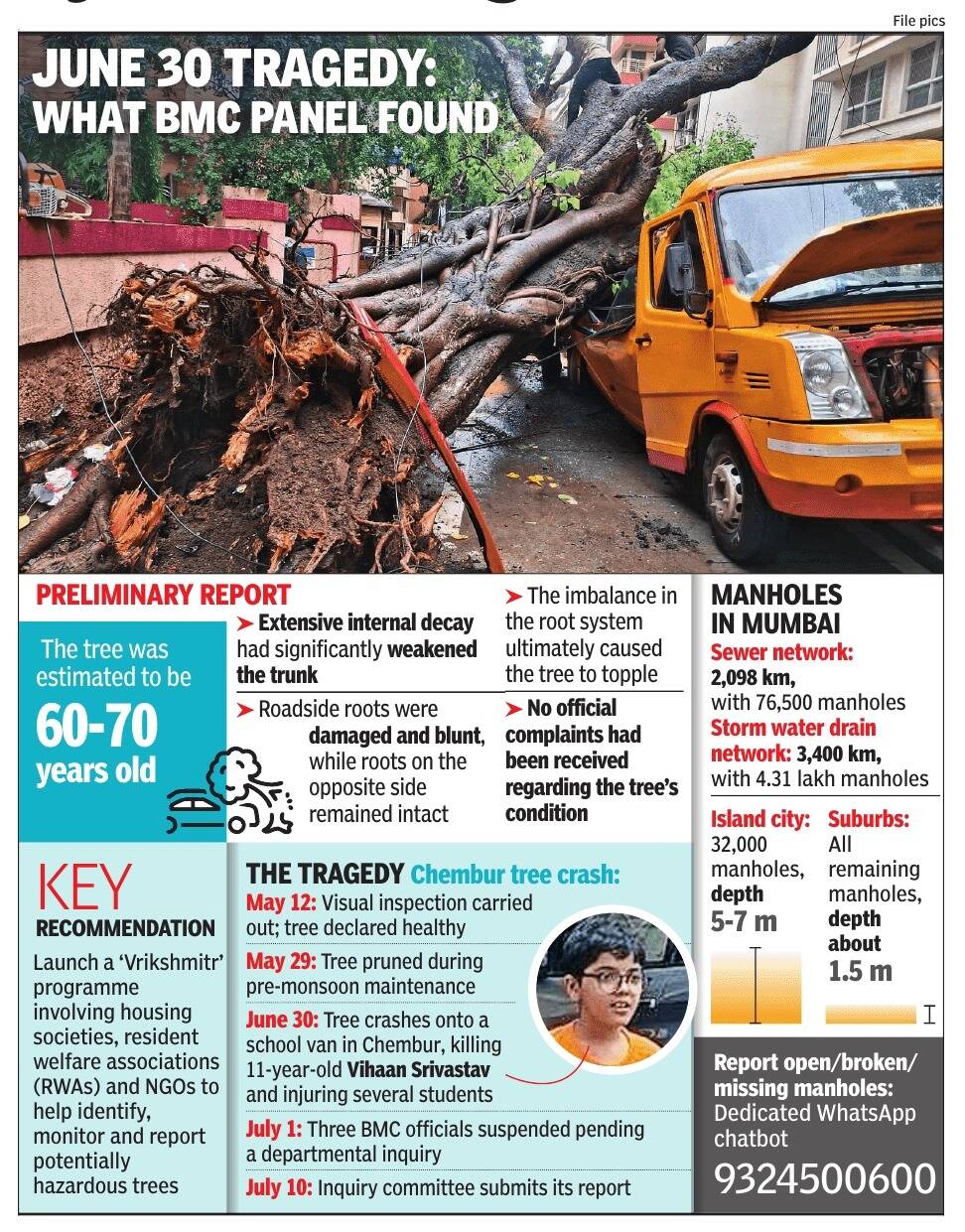
MUMBAI: The Chembur tree that collapsed and killed 11-year-old Vihaan Srivastav had extensive internal decay and damaged roadside roots, which compromised its stability and led to its fall, the BMC’s panel inquiring into the tragedy has said in a preliminary report.The panel noted that the tree had been visually inspected in May and found to be healthy, with no prior complaints regarding its condition.According to the report, submitted on Friday, while the roots on one side remained intact, the roadside roots were blunt and damaged, leaving the tree imbalanced and eventually causing it to collapse. The committee noted visible signs of decay inside the trunk.“The uprooted tree was estimated to be 60 to 70 years old, and no official complaints had been received regarding its condition. The tree underwent a visual inspection on May 12, during which it was found to be healthy and structurally sound, and was pruned on May 29 as part of the annual premonsoon tree maintenance drive,” an official said.

What BMC found

What BMC found

Among the panel’s key recommendations is the launch of a ‘Vrikshmitr’ initiative aimed at encouraging housing societies, resident associations and NGOs to monitor the health of trees in their neighbourhoods and alert the civic body about potentially hazardous trees before they pose a threat to public safety.Following the June 30 incident, the BMC suspended three officials pending a departmental inquiry over alleged negligence: Jagdish Bhoir, assistant garden superintendent of M-West ward; Yogesh Parte, assistant engineer of M-East ward; and Arun Mundhe, sub-engineer (roads), M-West ward.Of the three, the panel has reportedly recommended revoking the suspension of one, who had issued at least two written notices to the road repair contractor and the roads department, warning that excavation around tree bases was damaging roots and could lead to tree crashes.The accident trapped 13 children inside a school van, with one, Vihaan, succumbing to his injuries. Four other children sustained minor injuries.The panel comprised deputy municipal commissioners P Malavde (special engineering) and Shashank Bhore (engineering). The report was submitted to additional municipal commissioner Avinash Dhakane.

Rain eases, hot & humid conditions return to Mumbai | Mumbai News

Rain eases, hot & humid conditions return to Mumbai

Mumbai: After a week of relentless rain, hot and humid weather returned on Friday as rainfall activity eased in Mumbai as well as many parts of Western Ghats. IMD has forecast only light showers over the weekend for the city.The Colaba and Santacruz observatories recorded 0.8mm and 0.4mm of rainfall, respectively, in the 24 hours ending 8.30am on Friday. Most stations in the Western Ghats, which had recorded up to 600mm rain a day during the spell, logged single-digit rainfall in the same period; Koyna (Navja) was an exception at 192mm.The night temperature in Mumbai was also high—both weather stations logged 27°C.While the brief dry spell brought some respite from incessant rain, it also slowed the pace of replenishment in the seven lakes from where Mumbai gets its daily water supply. The lakes’ water stock rose by just 0.8% to 49.4% of their total capacity in 24 hours. The lakes need 14.47 million litres of water by Sept-end for the city to go without a water cut for the rest of the year.