

Bombay high court stays BMC move to take possession of ‘leased’ YMCA playground at Mumbai Central

Bombay high court stays BMC move to take possession of ‘leased’ YMCA playground at Mumbai Central
The Bombay high court bench, expressing surprise at the civic action, orally commented that BMC’s move appears to be at the instance of the local corporator

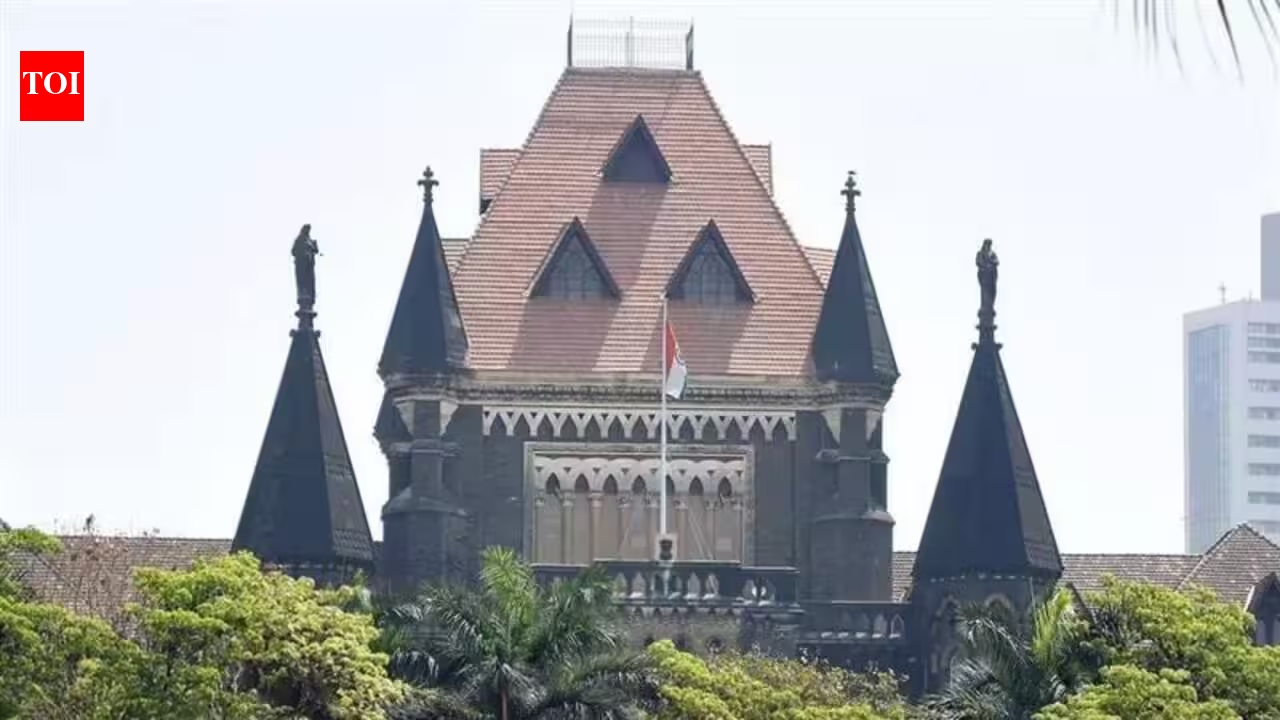
Mumbai: The Bombay high court on Wednesday stayed BMC’s decision to take back possession of a playground at Mumbai Central which Young Men’s Christian Association (YMCA) said was leased out to it in 1928.The HC was hearing YMCA’s plea seeking urgent intervention, fearing immediate loss of possession of Abdul Rehman Sufi Maidan or Jhoola Maidan, formerly known as Willingdon ground, and the gymnasium built on it in 1964 following BMC nod.The civic counsel said the BMC was due to take possession of the playground and gymnasium on Wednesday as the local corporator had received a complaint.The HC bench of Justices A S Gadkari and Kamal Khata, expressing surprise at the civic action, orally commented that BMC’s move appears to be at the instance of the corporator. When the bench asked the BMC counsel why it wanted to take the property from YMCA and who it wanted to give it to, there was no reply.The BMC will file a reply in two weeks.The issue arose in March 2026, said the YMCA, when the BMC issued a notice asking how it was in possession of the gymnasium building and alleged that the premises were not properly maintained. The YMCA said it replied to the notice, but on July 21, sans a hearing, the BMC issued a letter stating that it would take possession of the gymnasium in seven days.On August 7, the BMC sent a team to take possession of the premises, advocate Joel Carlos for YMCA submitted while seeking a stay. YMCA said a few policemen also visited and said possession would be taken on or before August 12 by the BMC with help of the police department, the petition claimed.The petition also stated that the BMC had given Willingdon ground to YMCA on lease on March 19, 1928, and it has been paying rent since then.In 2007, when the BMC said it had lost the rent collection document, the YMCA provided it. It did so again in 2012, when BMC wrote to ask about the construction of the gymnasium building as it claimed to have lost the documents, the petition stated.In 2017, the YMCA said, it obtained permission for installing an electricity meter, and in 2021, it informed the BMC of having completed structural repairs to the building.The YMCA said as an organisation, which since 1875 has been working to uplift the underprivileged people, it promoted sports, physical fitness and youth development activities and even sent several athletes for national level competitions, helping the underprivileged secure jobs under the sports quota.

Property agent’s ‘vegetarians only’ claim for Mumbai flat triggers ‘food apartheid’ debate

Property agent’s ‘vegetarians only’ claim for Mumbai flat triggers ‘food apartheid’ debate
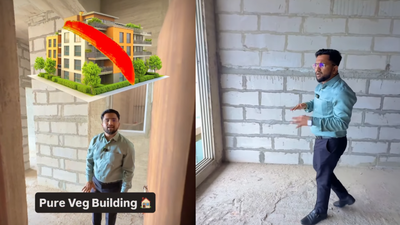
A viral video shows a real estate agent stating vegetarian-only buyers for a Mumbai flat

MUMBAI: A viral video of a real estate agent claiming that only vegetarians are allowed to purchase flats in a posh upcoming high-rise in south Mumbai’s Tardeo area has sparked strong reactions.Some social media users described the development as a case of Mumbai’s cosmopolitan character giving way to “food apartheid”, alleging that housing societies are restricting people’s food choices.The agent, Bhavesh Kaware, who goes by the moniker “propertytransactionguru” on Instagram, posted the video on the platform, news agency PTI reporetd.In it, he said that the 2BHK flat in the building would be sold for Rs 6.5 crore, but only vegetarians would be allowed to buy it.“This is Mumbai of the Marathi people. It belongs to the Agari-Koli community and to the toiling, common people of Maharashtra,” said one of the social media users.“Who are you to decide what someone eats or doesn’t eat in Mumbai? Denying someone a home just because they eat fish, mutton, or chicken isn’t merely an arbitrary act of granting or withholding housing but shows overt social discrimination,” he said.“Will it now be decided whether someone who has eaten fish for generations in Mumbai gets a home or not based on what’s on their plate? Those who discriminate must be taught a lesson,” he said.There have been several much-publicised instances of such discrimination over the past few years, PTI reported.Bollywood actor Saif Ali Khan had revealed that when he was looking for a house in 2012 after his marriage to Kareena Kapoor, he was turned away by several housing societies.In 2014, actor Emraan Hashmi said that a posh housing society had rejected his application.(With agency inputs)

PMAY falters in Mumbai as land prices, lack of bank credit leave 10,000-15,000 MHADA homes unallocated

PMAY falters in Mumbai as land prices, lack of bank credit leave 10,000-15,000 MHADA homes unallocated

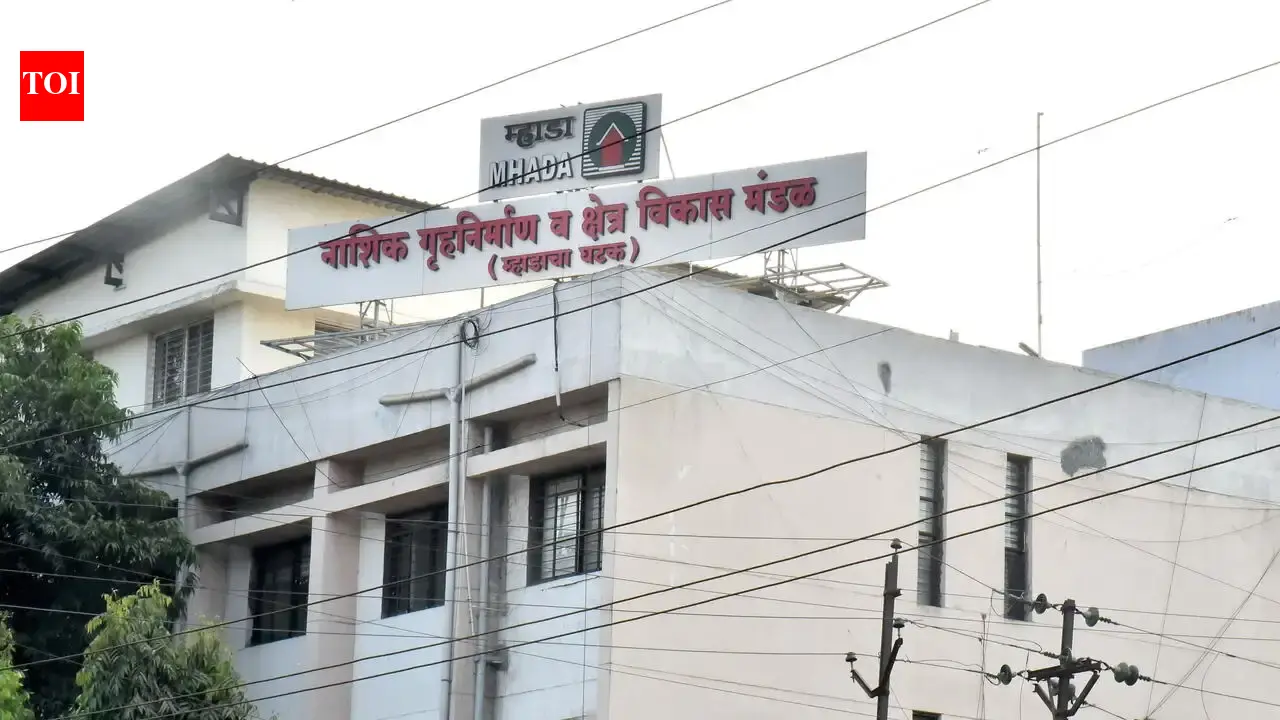
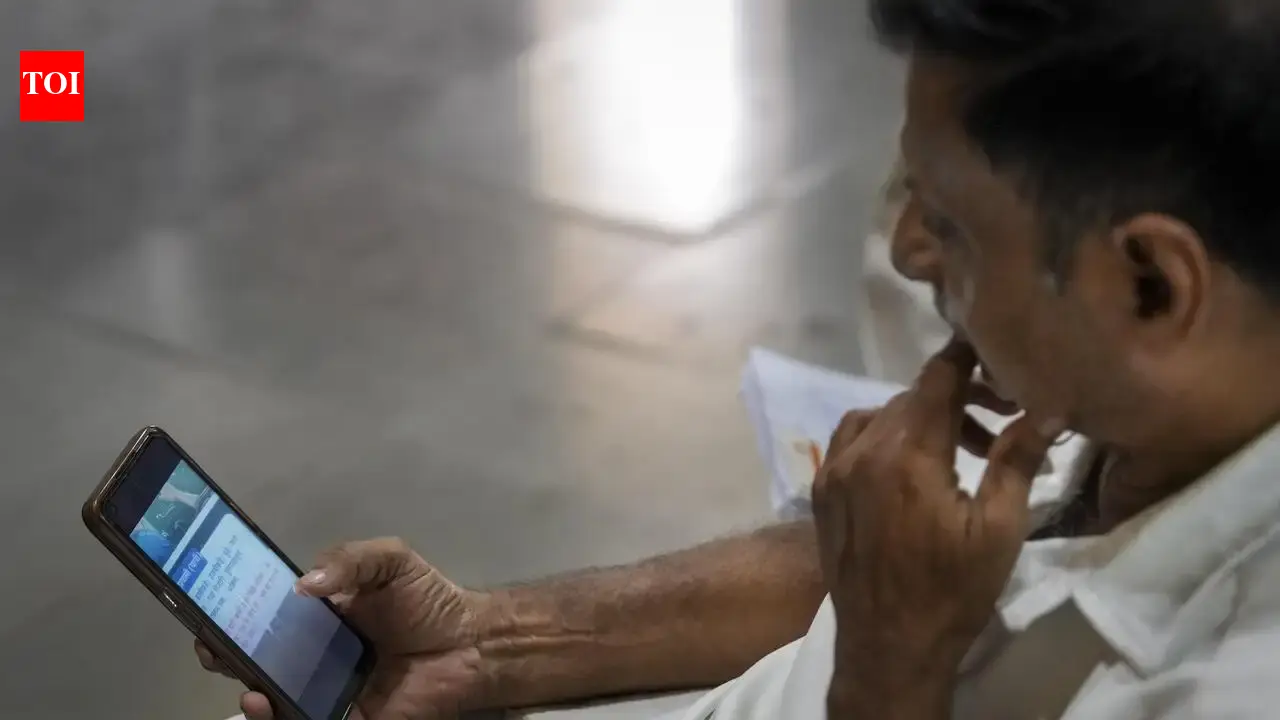
Mumbai: The Pradhan Mantri Awas Yojana (PMAY) has struggled to make a significant dent in Mumbai’s affordable housing crisis, with high land costs and the inability of applicants with irregular incomes to secure bank loans emerging as major roadblocks, said MHADA CEO Sanjeev Jaiswal at the BRICS Friendship Cities conclave on Wednesday.Jaiswal said the problem was particularly acute in the Mumbai Metropolitan Region (MMR), where MHADA has constructed nearly 50,000 homes under its housing initiatives, but has been unable to allot between 10,000 and 15,000 of them because prospective beneficiaries could not arrange financing.“MHADA has constructed close to 50,000 homes in the larger MMR area, but 10-15,000 of these homes we are not able to allocate because individuals were not able to secure funding from banks,” Jaiswal said during a session on housing.He said the experience highlighted a key limitation in implementing PMAY in Mumbai. While the scheme provides a subsidy of Rs 2.5 lakh to eligible beneficiaries, the subsidy alone is insufficient to bridge the gap between the cost of a home and the amount that many low-income households can raise through formal financing.“PMAY provides a subsidy of Rs 2.5 lakh and if the houses constructed in Titwala, Kalyan etc cost anywhere between Rs 12 lakh and Rs 15 lakh,” Jaiswal said, adding that the remaining amount often becomes difficult for beneficiaries to finance.The issue is compounded in Mumbai and the MMR by high land prices, which make affordable housing projects considerably more expensive than in other parts of the state. As a result, even with government assistance, the cost of a dwelling can remain beyond the borrowing capacity of the intended beneficiaries, said Jaiswal.According to him, a significant section of potential beneficiaries earn through informal or irregular employment and therefore do not have the stable monthly income, documented earnings or credit profile required by banks to sanction housing loans. Poor CIBIL scores can further limit their access to formal credit.Around 3 lakh homes have been constructed across Maharashtra under the PMAY scheme.

Catholic Church and Christian NGOs urge Centre to withdraw ‘draconian’ FCRA Amendment Bill

Catholic Church and Christian NGOs urge Centre to withdraw 'draconian' FCRA Amendment Bill
The proposed Foreign Contribution Regulation Amendment Bill faces significant opposition from Christian groups. (Representative image)

MUMBAI: Even as the Centre referred the proposed Foreign Contribution (Regulation) Amendment Bill, 2026 to a 31-member JPC (joint parliamentary committee) Wednesday, the Catholic Church as well as Christian NGOs and activists expressed serious concern over the Bill.Archbishop emeritus of Bombay Oswald Cardinal Gracias wrote to Union home minister Amit Shah, relaying the concern expressed by priests and nuns who work with marginalised communities that their work could be stopped. “Ground level legislation depends on interpretation and implementation,” he wrote. He urged Shah to not rush the Bill and instead have a wider discussion with the Christian community.The archdiocese of Bombay warned that “the new framework risks moving beyond legitimate regulation towards excessive State control over charitable, educational and religious institutions”. It called for the Bill’s withdrawal.Auxiliary bishop Savio Fernandes questioned if the Bill amounted to “regulation or state control”. He wrote, “The practical consequences could be profound. The State could assume control over schools, hospitals, buildings… created wholly or partly with foreign contributions. National interest and institutional autonomy are not competing values. Both can be protected through clear standards, due process… A govt that seeks accountability from civil society must itself remain accountable… The Bill deserves careful reconsideration.”NGOs say the Bill empowers officials to seize Christian properties and assets. Dolphy Dsouza, spokesperson of the Bombay Catholic Sabha termed the “draconian FCRA amendments an ill-conceived move and a tool to weaponize FCRA to harass NGOs which provide humanitarian aid to vulnerable sections where even govts have failed to reach out.”He said, “One of the amendments is also a backdoor method to acquire NGO’s properties. This comes closely after the anti-conversion laws in 13 states terrorising minorities. The Centre continues to have misplaced priorities when the country is facing poverty, lack of educational facilities and unemployment. We demand the Bill’s withdrawal.”Godfrey Pimenta of Watchdog Foundation said, “Granting a govt-appointed authority the power to take over unutilised foreign contribution funds and assets merely because FCRA registration has lapsed risks becoming an instrument of control and asset seizure. This Act is draconian and must be scrapped.”Melwyn Fernandes of the Association of Concerned Catholics reacted to Wednesday’s development. “Finally the Central govt has been forced to heed the opposition parties by appointing a JPC. The Bill should not be rushed into finalization. Charitable organisations must be heard.”

Marathi knowledge now must for app cab drivers in Maharashtra

Marathi knowledge now must for app cab drivers in Maharashtra
More than 1.1 lakh non-Marathi auto and taxi drivers across Maharashtra have completed the functional Marathi language training so far

Mumbai: After drivers of autos and kaali-peelis, the state govt has now made it mandatory for app-based taxi drivers and permit holders of commercial passenger vehicles in Maharashtra to possess a working knowledge of Marathi. It amended Maharashtra Motor Vehicles Rules, 1989, on Wednesday to introduce this rule and warned that non-compliance can lead to a three-month suspension and even cancellation of licences or badges.Maharashtra Motor Vehicles (Amendment) Rules, 2026, cover autos, taxis and app-based cabs fitted with electronic meters. The changes strengthen Marathi language requirements at the entry level, with the amended Rule 4 making it clear that those seeking driving authorisations must fulfil the criterion. According to a notification issued by govt, the level of proficiency must be satisfactory to the competent authority.Govt had on May 1 made basic proficiency in Marathi compulsory for drivers of autos and kaali-peelis and offered a 105-day Marathi training programme across regional transport offices and language training centres. The compliance deadline for these drivers will end on Aug 15 and the state transport department will begin a crackdown on violators on Aug 17. The drive to cover commercial passenger vehicles is expected to begin in a staggered manner thereafter.The most consequential change through the amendments lies in enforcement. Under another rule, if an authorised driver of an app-based cab fails to demonstrate practical knowledge of Marathi, the licensing authority can suspend the relevant authorisation on the licence for up to three months after recording the reasons in writing. Continued non-compliance or repeat violations after the suspension period could lead to cancellation of the authorisation altogether, effectively preventing the person from operating commercial passenger vehicles under that licence category.The obligation goes beyond drivers. The amended Rules 78 and 85 make language proficiency a prerequisite for permit holders of app-based cabs equipped with electronic meters and those looking to renew their permits.Transport minister Pratap Sarnaik said the amendments are intended to remove ambiguities in the existing framework that had allegedly allowed some drivers to evade compliance with the language requirement.More than 1.1 lakh non-Marathi auto and taxi drivers across Maharashtra have completed the functional Marathi language training so far. Marathi Commission chairperson Ravi Gaikwad said the transport department has urged the remaining commercial passenger vehicle drivers to complete the programme before Aug 15. “RTO squads will identify drivers who are unable to speak basic Marathi and penalise them from Aug 17,” he said.Drivers who completed the basic Marathi course will be felicitated at a function at Ram Ganesh Gadkari Rangayatan in Thane on Aug 17. CM Devendra Fadnavis, deputy CMs Eknath Shinde and Sunetra Pawar, and Marathi language minister Uday Samant are expected to attend it. Thousands of drivers will receive certificates from Konkan Marathi Sahitya Parishad.

Don’t have any info on over 36,000 companies shutting down in Maharashtra in 5 years, says industries minister

Don’t have any info on over 36,000 companies shutting down in Maharashtra in 5 years, says industries minister
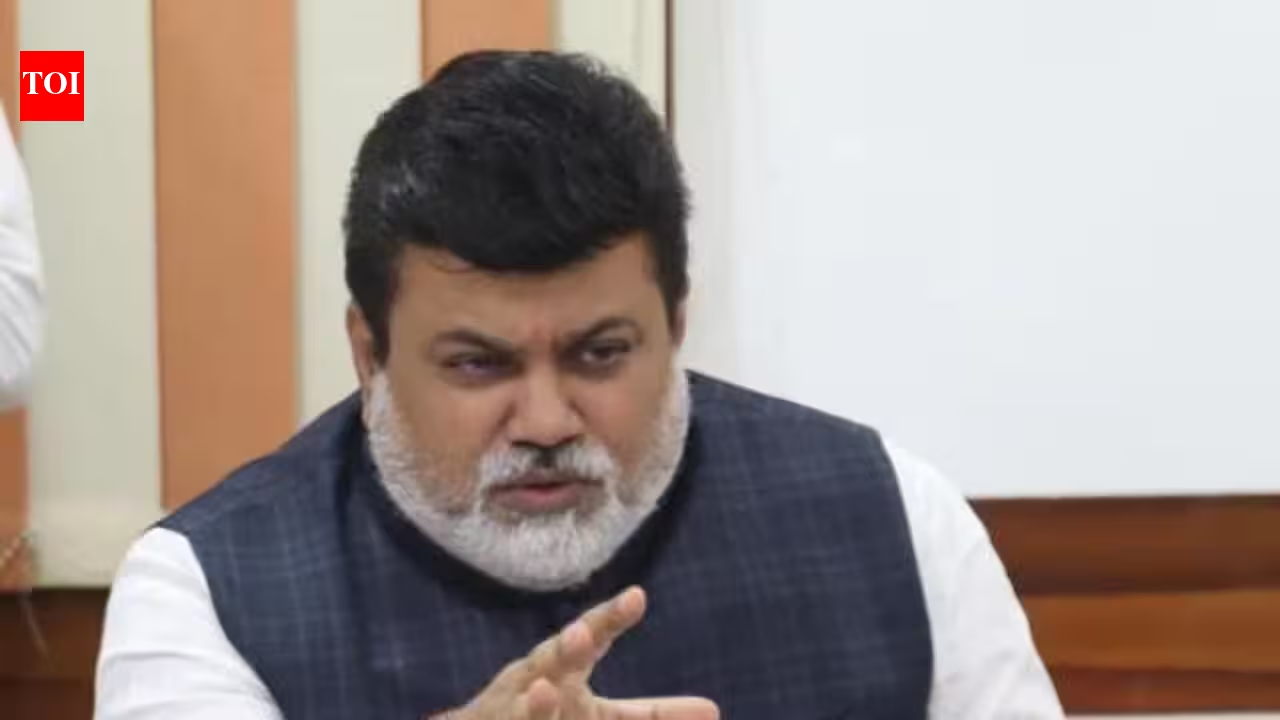
Minister Uday Samant said that though the data has come from the Centre, he will have to verify the data and the figure will have to be investigated

Mumbai: Industries Minister Uday Samant on Wednesday said that the state govt has no information that over 36,000 companies have shut down in Maharashtra in the last five years.Samant said that though the data has come from the Centre, the figure will have to be investigated. “I’m not saying that the information given by the Centre is wrong. We will investigate it. We need one day for this verification. If this figure is true, then we will find out how and why this has happened,” he said.On Wednesday, TOI had reported that in its reply to a query raised by Shiv Sena (UBT) MP Rajabhau Waje in Lok Sabha, the ministry of corporate affairs said that 36,211 private companies were either liquidated, dissolved or struck off in Maharashtra in the last five years. Of these the highest were in business services (14,613); followed by manufacturing, mining and quarrying (6,582); by trading (4,196); and community, personal and social services (3,361). The highest number of companies were shut down in Mumbai at 12,009, followed by Pune at 6,433 and Thane at 4,704.Shiv Sena (UBT) MLA Aaditya Thackeray and NCP (SP) MLA Rohit Pawar slammed the state govt for the closures.Industry experts said the massive wave of company shutdowns in Maharashtra stems from a mix of macroeconomic stress, escalating operational costs, geopolitical shocks, and aggressive regulatory crackdowns by state authorities.“While Maharashtra continues to register the highest number of new businesses in India, it also faces a sharp surge in corporate mortality due to specific structural vulnerabilities. Over two lakh private companies shut down across India over five years, with Maharashtra leading closures at over 36,211 companies. While the state faces high corporate mortality and a purge of defunct companies, it still holds the largest sub-national economy in the country,” an industry expert said. “The high rate of company closures and the migration of industries out of key hubs are widely seen as localised operational failures of both the MIDC and the broader state industries department, combined with macro factors.”

Maharashtra Govt Forms Panel for Exam Reform After Paper Leaks

Maharashtra Govt Forms Panel for Exam Reform After Paper Leaks

Mumbai: In the wake of student protests against paper leaks, the state govt on Wednesday announced the formation of a committee to interact with students and educational institutions’ managements to frame a new policy to ensure safe and secure examinations.CM Devendra Fadnavis said the govt will set up 25,000 safe classrooms to conduct examinations. It will hold dialogue with students at the revenue division level. The recent law passed by Parliament on paper leaks and examination malpractices will be made applicable in the state as it is more stringent than the state law, he added.Fadnavis said the high-level committee has been constituted to recommend comprehensive, more secure, and unanimous reforms in the examination system for various service recruitment exams conducted in the state. “This committee will visit every department in the state and interact with students and submit a report on comprehensive reforms,” he said.The meeting held at the official residence of the CM was attended by Dy CM Eknath Shinde and chief secretary Rajesh Aggarwal.This high-level committee will be headed by additional chief secretary (GAD) V Radha and will include state director general of Police Sadanand Date, secretary, Information Technology, Virendra Singh , secretary, animal husbandry, Dr. N. Ramaswamy and Nashik Divisional Commissioner Praveen Gedam. This committee will visit each revenue division, hold discussions with students , educational institution owners and other stakeholders and understand their views before framing the policy.The recently passed Public Examinations (Prevention of Unfair Means) Amendment Bill, 2026, by Parliament against paper leaks and examination malpractices will be made applicable in the state, said Fadnavis. “Maharashtra also has its own law. However, since the law passed by Parliament is stricter, the process to implement it in Maharashtra should be completed in the next fortnight,” said Fadnavis.He also directed the setting up of at least 25,000 safe classrooms across the state. The meeting also discussed coordination between the district collector, police commissioner, police superintendent, senior officers of the education dept along with examination methods adopted in various countries for competitive exams.

Maharashtra FDA suspends licences of 4 outlets of leading pizza chain over food safety violations

Maharashtra FDA suspends licences of 4 outlets of leading pizza chain over food safety violations
Maharashtra FDA suspended licenses of four Domino’s Pizza outlets for hygiene violations

MUMBAI: The Maharashtra food and drug administration (FDA) has suspended the food business licences of four Domino’s Pizza outlets, including three in Mumbai.The action has been taken for alleged violations of food safety and hygiene norms, officials said on Wednesday.The fourth outlet is located in Satara district of western Maharashtra, the FDA, headed by IAS officer Tukaram Mundhe, said in a statement.In Mumbai, action was taken against Domino’s Pizza outlets operated by Jubilant FoodWorks Ltd at Vile Parle West, Borivali West and R-City Mall in Ghatkopar West during a special drive against chain restaurants, news agency PTI reported.The Vile Parle outlet was found to have deficiencies related to the display of its FSSAI licence, potable water, food storage, pest control and hygiene facilities.The FDA directed it to ensure proper temperature monitoring of frozen food, segregation of food and non-food items, rodent and pest prevention, and adequate hand-washing and hygiene facilities.At the Borivali outlet, the FDA found 15% non-compliance and directed corrective measures covering food storage, temperature monitoring, food testing, cleanliness and pest control.It also sought proper segregation of raw and cooked food as well as vegetarian and non-vegetarian food, along with regular sanitisation of equipment and utensils.The Ghatkopar outlet was found deficient in cleanliness, sanitation scheduling and pest control measures.It also failed to follow FIFO (First In, First Out) and FEFO (First Expired, First Out) practices and maintain proper temperature control in food storage, the FDA said.The authority also flagged the absence of food-grade certificates and records relating to calibration, preventive maintenance, food and water testing and food safety.The licence of the Domino’s Pizza outlet operated by Jubilant FoodWorks at Malkapur and two other fast-food outlets operated by Sapphire Foods India at Karad in Satara district were also suspended, the FDA said.The Malkapur outlet was found to have about 40% non-compliance, with deficiencies in basic facilities, equipment, cleanliness and pest control.At the Karad establishments, the FDA prescribed corrective measures for pizza preparation, including separate ovens and proper segregation of vegetarian and non-vegetarian pizzas, separate pans, and appropriate labelling of sauces and pizza toppings with packing and expiry dates.The special drive covered 104 chain restaurant establishments across Maharashtra.Two establishments were ordered to stop business, 95 were served improvement notices, and licences of five establishments were suspended, the FDA said.The drive covered brands including Domino’s Pizza, KFC, Pizza Hut, McDonald’s, Subway, Burger King, Starbucks and Monginis, PTI reported.In Nashik district, the FDA suspended the licences of five food establishments.They included Hotel Sayali Restaurant and Bar in Satpur, Hotel Chhote Miyan on College Road, Mani Mark on Peth Road in Panchavati, Abhishek Bakery and Sweets in CIDCO and Mohanlal Namkeen in Dindori.The FDA cited deficiencies related to cleanliness, food storage, water, equipment and pest control, among others.In Mumbai, the authority also suspended the licences of Mumbai Metro Dhaba in Mulund and Gulshan-Da-Punjabi Dhaba in Bhandup after inspections found shortcomings in basic facilities, cleanliness, water, ventilation, pest control and food storage.Overall, the FDA inspected 120 establishments over the last few days, issued 54 improvement notices and suspended 11 food business licences, it said.The authority has launched a massive crackdown against violations of food safety and hygiene norms at food establishments, including famous hotels and clubs, ever since Mundhe took over as FDA commissioner in May.(With agency inputs)

BMC swimming pools to reopen in Mumbai from August 16

BMC swimming pools to reopen in Mumbai from August 16
File pic of the BMC pool at Shivaji Park

Mumbai: The BMC has decided to resume municipal swimming pool facilities for Mumbaikars from Sunday, August 16. As part of the reopening, the civic administration has directed that water connections to the swimming pools be restored, water quality be tested, and swimming instructors-cum-lifeguards be on full time duty to ensure safety.The BMC said that the decision to resume water supply to swimming pools was taken after taking into account the improved water stocks in the seven lakes supplying the city. As of 6am on Wednesday, the reservoirs had a combined usable water stock of 12,95,274 million litres, which is 89.49% of their total useful capacity of 14,47,363 million litres.The BMC has further directed that water samples from the pools be tested at the municipal laboratory and that a certificate from the analyst confirming the water is technically fit for swimming be obtained. All these arrangements have to be completed by Saturday, August 15, following which the swimming pool will reopen from August 16, either in the morning or evening session.However, no decision has yet been taken on the withdrawal of the 10% water cut in place since May. “While the decision to resume water supply to swimming pools will provide relief to citizens using them, considering the long-term planning of the available water stock, the need for prudent water usage remains essential. Further decisions regarding withdrawal of the ongoing water cut will be taken based on continuous review of upcoming rainfall, water stock status, and weather forecasts,” said a BMC official.

CIDCO offers new housings for economically weaker sections in Navi Mumbai

CIDCO offers new housings for economically weaker sections in Navi Mumbai

Navi Mumbai: The City and Industrial Development Corporation (Cidco) has announced a new housing scheme offering as many as 4,779 homes for the economically weaker sections (EWS). Online registration is set to commence on Aug 15 through www.cidcohomes.com . Under the housing scheme, Cidco made available 4,229 homes at Taloja sector 39 and 257 homes at Kalamboli Bus Depot and 293 homes at Kharghar Bus Depot. A portion of the homes under the scheme has been reserved for applicants with disabilities.Cidco said the home-wise prices and all applicable charges for each project would be published on the portal before the commencement of registration. Applicants with an annual family income of up to Rs 6 lakh and who did not own a pucca house anywhere in India are eligible to apply.Detailed eligibility criteria and terms and conditions are to be available on the portal.Cidco said the nodes of Taloja, Kalamboli and Kharghar are well connected through an extensive road network, rail and metro connectivity, and their proximity to the Navi Mumbai International Airport, offering residents convenient access to key destinations.Allotment of homes is subject to eligibility verification, scrutiny of documents and fulfilment of the terms and conditions of the scheme, said Cidco. Applicants are advised to visit www.cidcohomes.com for the latest information and updates regarding the new housing scheme.