BMC files case against managements of 7 unauthorised schools in Trombay | Mumbai News

BMC files case against managements of 7 unauthorised schools in Trombay
Mumbai’s BMC Education department has filed a police complaint against seven unauthorized primary schools in Trombay.

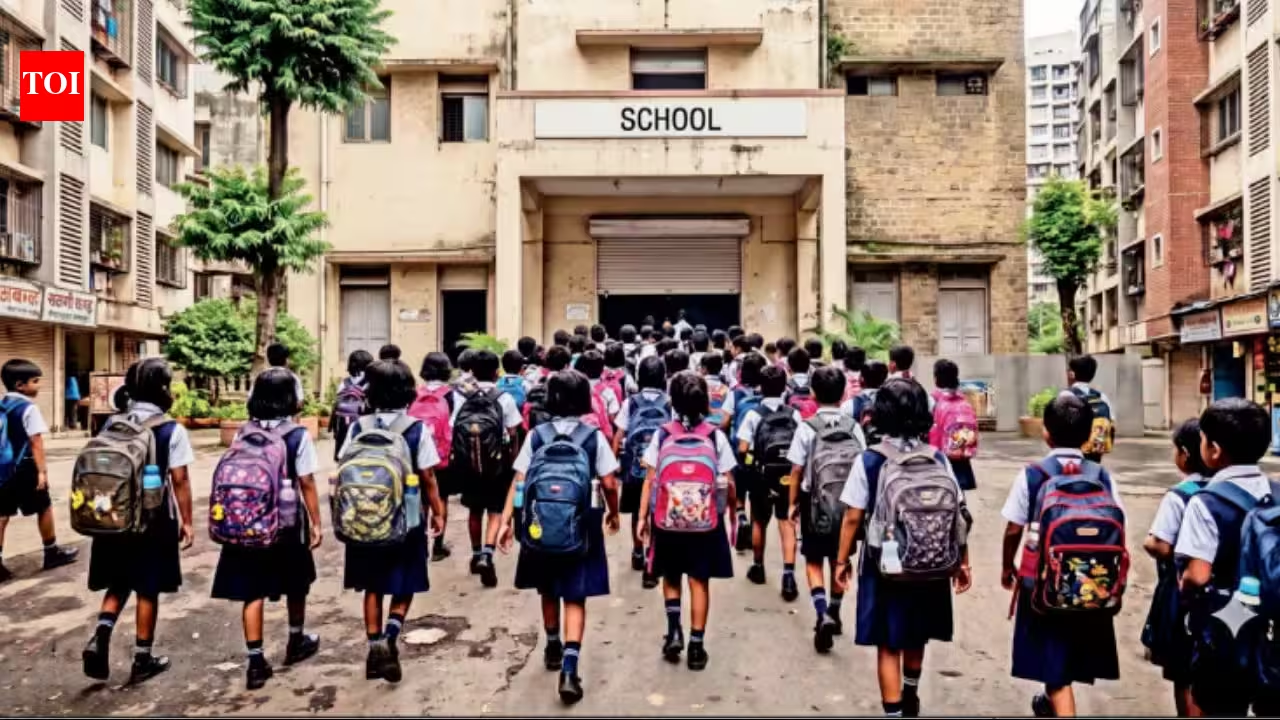
MUMBAI: Now the BMC Education department has lodged against the managements of seven unauthorised primary schools operating in the Trombay area despite repeated closure notices issued by the Education Department.According to the complaint filed at Trombay Police Station by Mohammad Irfan Shah (44), Section Inspector in the Private Primary Schools Department of the BMC, the civic body’s survey for the 2025-26 academic year identified 164 unauthorised primary schools across Mumbai. Of these, seven schools fall within the jurisdiction of Trombay Police Station.The schools named in the complaint are New Akash English School, Ekvira Vidyalaya English School, Abhinav English School, Universal English School, Peace Public School, Trombay Hindi School and Queen Marriage English School, all located in Mankhurd and Trombay.The complainant stated that the Education Department, acting on directions issued by the Directorate of Education, Maharashtra and with authorisation from the Education Officer of the BMC, had served notices to the principals and secretaries of the schools in February and March 2026. The notices directed them to shut down the institutions or submit valid government recognition documents within seven days.However, the schools allegedly neither furnished any explanation nor obtained government approval and continued operations in violation of the notices, the complaint states.Based on the complaint, police have registered an offences against the officials including the principals, secretaries and directors of the seven schools under Section 223 of the Bharatiya Nyaya Sanhita, 2023 and Section 18 of the Right of Children to Free and Compulsory Education Act, 2009. The BMC has also submitted copies of the notices and other documents as evidence, while original records will be produced during the investigation.

Set up study group for Muslim socio-economic survey, name it after late Ajit Pawar: Samajwadi Party MLA Rais Shaikh | Mumbai News

Set up study group for Muslim socio-economic survey, name it after late Ajit Pawar: Samajwadi Party MLA Rais Shaikh
Samajwadi Party MLA Rais Shaikh has urged Deputy Chief Minister Sunetra Pawar to establish a study group for a long-stalled socio-economic and educational survey of the Muslim community.

MUMBAI: Samajwadi Party MLA Rais Shaikh, on Monday urged DCM Sunetra Pawar, who is also minister for minority development, to establish a study group to facilitate the long-pending survey of the Muslim community, which has remained stalled for the past 15 years, and name it after the late Ajit Pawar.In his letter to Pawar, Shaikh said that the Dr Mehmood ur Rahman Study Group, constituted by the Maharashtra government in 2013, had recommended conducting a socio-economic and educational survey of Muslims.“In 2022, the state government assigned the survey to the Tata Institute of Social Sciences (TISS), and a Govt Resolution (GR) was issued on 21 September 2022. However, following a change in government, the survey was never carried out,” Shaikh said.Shaikh stated that a comprehensive assessment of the Muslim community’s living conditions, access to financial assistance, benefits received under government schemes, infrastructure, educational opportunities, and healthcare facilities would present a realistic picture of the community’s status.“It would also help the government formulate region-specific policies to bring Muslims into the mainstream of development. No comprehensive data on the socio-economic and educational status of Muslims has been compiled since the publication of the Sachar Committee Report in 2006,” remarked Shaikh.“The new study group must be named after the late Ajit Dada Pawar. He had consistently pursued issues concerning the Muslim community. Ajit Pawar’s decisive initiatives led to the establishment of the Minority Research and Training Institute (MRTI), the Minority Commissionerate, etc,” demanded Shaikh.Shaikh said that conducting the survey would provide a clearer understanding of the condition of the Muslim community.“Muslims constitute 11.54% of Maharashtra’s population, making them the second-largest religious community after Hindus. The state has 56 Muslim-majority towns. Such surveys can be conducted through outsourced agencies with limited funds and manpower, and that the government has previously conducted similar surveys for several other communities,” he added.

Retired banker loses Rs 1.5 crore to investment scam with fake ad featuring finance minister | Mumbai News

Retired banker loses Rs 1.5 crore to investment scam with fake ad featuring finance minister

Mumbai: A 68-year-old retired bank manager was duped of Rs 1.5 crore in a cyber investment scam after clicking on a fake Facebook advertisement featuring Union finance minister Nirmala Sitharaman.The fraudsters claimed the ongoing Iran-US conflict had created lucrative opportunities in foreign crude oil trading and persuaded the victim to invest through a platform called Savexa.The callers introduced themselves as representatives of an investment firm named Savexa and claimed that the ongoing Iran-US conflict created a rare opportunity to earn massive profits by investing in foreign crude oil markets. A man identifying himself as “Zain”, claiming to be a fund manager, persuaded the retired banker to invest through repeated Zoom meetings and emails.According to the victim’s complaint filed with the Maharashtra nodal cyber police station, he came across a Facebook video, purportedly showing the finance minister claiming that an investment of Rs 22,000 could generate returns of Rs 30 lakh within a month.“Zain” lured him into making multiple RTGS and UPI transfers. The accused in the initial stage even transferred Rs 4 lakh profit to the victim to win his confidence before demanding further investments and promising returns of Rs 10 crore on an investment of Rs 2 crore.After clicking on the link and submitting his details, he began receiving calls from several UK-based mobile numbers.Believing the investment to be genuine, the victim transferred money in multiple transactions between April and May.In all, the victim transferred Rs 1.5 crore before realising that he had been duped. He has now lodged complaints with the nodal cyber police and the national cyber crime helpline. Police have launched an investigation into the fake investment racket and are tracing the mobile numbers, bank accounts and digital trail used by the accused.

Mumbai doctors save infant with rare lipid disorder after heart scare | Mumbai News

Mumbai doctors save infant with rare lipid disorder after heart scare

Mumbai: When doctors at Bai Jerbai Wadia Hospital in Parel drew blood from a two-and-a-half-month-old baby girl, they froze. Instead of the familiar crimson, the syringe filled with a thick, pinkish liquid.What began as an evaluation for an enlarged heart quickly turned into a race against time to save a child suffering from familial lipoprotein lipase deficiency (LPLD), a rare inherited disorder affecting fat metabolism that affects roughly one in a million.The baby, the first child of a Bandra couple after four years of marriage, was referred to Wadia Hospital on May 29 for heart problems. “They came with an X-ray that showed an unusually large heart for a two-month-old,” said paediatric cardiologist Dr Sumitra Venkatesh from Wadia Hospital. But the unusually light-coloured blood suggested something more serious.Tests revealed triglyceride levels of 42,000 mg/dL — almost 300 times the normal level. “With such high triglycerides, arteries can get clogged, triggering heart attack or stroke,” said Dr Venkatesh. Within hours, specialists from paediatric endocrinology, cardiology, intensive care, hepatology, genetics, nutrition and radiology came together to chart a treatment plan.“We came to Wadia Hospital on May 29 for an OPD consultation and never imagined our child had such a rare disorder that she would remain in hospital for a month,” said her father, a mechanic from Bandra.For the next 16 days, she was kept off oral feeds and on IV nutrition to reduce the fat circulating in her blood. “Keeping a hungry, crying infant fasting for over two weeks wasn’t easy, especially with the mother breaking down,” said Dr Venkatesh, adding that the team used a pacifier to quieten the child.Once the triglyceride levels began falling, the focus shifted to designing a safe oral diet. Mother’s milk was ruled out because of fat content. Importing a special feed from the US was expensive. “So, our nutritionist worked out a jugaad, based largely on the easily available skimmed milk powder,” said Dr Venkatesh.By the 19th day of hospitalisation, the baby’s triglyceride level dropped to 242 mg/dL, her blood regained its normal colour and heart function improved. Genetic testing confirmed LPLD, and the hospital plans to test both parents for the mutation.Wadia Hospital medical director and paediatric endocrinologist Prof Dr Sudha Rao described it as one of the most severe cases she encountered. “The child will require lifelong restriction of dietary fat,” she said, adding that she is expected to grow and develop normally.Paediatric cardiologist Dr Swati Garekar of Fortis Hospital, Mulund, said LPLD is so rare that many doctors never encounter a case during their careers. “However, with progress in medicine, we may have appropriate treatment in the near future,” she said.For the parents, the little girl’s recovery is the greatest reward. “She is mostly a happy child — except when she is hungry,” her father said with a smile.

Football ground row: Proposal still in early stages, says BMC | Mumbai News

Football ground row: Proposal still in early stages, says BMC
The move to change the ground’s reservation triggered an uproar

Mumbai: Amid mounting opposition to BMC’s plan to change the reservation of Neville D’Souza Football Ground at Bandra Reclamation from a playground to an exhibition and convention centre, civic officials clarified that the proposal is is still far from being implemented and must clear multiple statutory approvals.They said the proposal has not yet been placed before the civic House and will also require approval from the state’s urban development department before any change in reservation can take effect. The proposal was passed last week by the civic improvements committee amid objections from corporators in the opposition.The controversy began after Mhada, which owns the plot that is currently reserved as a playground/sports ground under Development Plan 2034, sought restoration of the site’s earlier reservation as a convention complex, prompting BMC to initiate the process for modifying the existing reservation.The move triggered sharp criticism from the football fraternity, opposition leaders and residents. Mumbai Congress president and MP Varsha Gaikwad alleged that the proposal would deprive thousands of children of a crucial sporting facility. “WHO recommends 9s m of open space per person. Mumbaikars survive on just 0.87sqm. And now even that is under attack. Neville D’Souza Ground is the city’s only FIFA-standard football ground where nearly 10,000 children train every year. We cannot allow one of Mumbai’s last major playgrounds to be sacrificed,” she said.However, civic officials and members of the governing front defended the proposal, saying the land belongs to Mhada and was originally earmarked for a convention centre. They said the proposal only seeks to restore the site’s original reservation. According to the proposal, there is no convention centre in the vicinity of the plot and Mhada had requested that the reservation be changed accordingly.Officials stressed that the proposal remains at a preliminary stage and that no final decision has been taken. They said the reservation change can come into effect only after it is approved by the BMC’s general body and subsequently sanctioned by the urban development department.

Drain fall an accident, need safety protocol during VIP visits: Civic probe report | Mumbai News

Drain fall an accident, need safety protocol during VIP visits: Civic probe report
The report called a BMC worker’s fall into an open channel an accident

Mumbai: Days after a BMC worker fell into an open stormwater channel during mayor Ritu Tawde’s inspection of a chronic flooding spot at King’s Circle, a civic inquiry termed it an accident and called for better crowd management during VIP visits.Eyewitnesses told BMC officials that the worker was rushing towards media cameras when he fell into the channel.The inquiry report, prepared by the local ward office and the stormwater drains department, was submitted to the BMC chief’s office on Monday. It recommended that areas where civic staff carry out desilting or drainage operations be clearly demarcated and kept separate from spaces accessible to visitors and the public, “particularly during inspections by public representatives such as the mayor”, said a senior BMC official.The recommendations include mandatory barricading of open channels and work sites, and installation of warning signboards and standees. Officials also proposed a separate safety protocol for inspections at active drainage works.A day after the worker’s fall on June 24, Tawde had called it “fishy” and had sought a detailed inquiry from the BMC administration.

Cops: Man behind ‘poisoning plot’ destroyed some chemicals | Mumbai News

Cops: Man behind ‘poisoning plot’ destroyed some chemicals
Some of the seized capsules

Mumbai: The Pune man arrested for allegedly passing out pills filled with zinc phosphide at a Muharram procession last week had destroyed some of the poison he had ordered online, said police.The probe has shown that the suspect, Fayyaz Premji (39), had ordered 30,000 capsules and 50kg of zinc phosphide, often used as rat poison, from an online platform. It isn’t clear how much of it was destroyed. A team is working on the order’s digital trail. “A letter seeking his account statement has been sent to his bank,” said a police officer. Police had seized 14,900 capsules filled with the poison from Premji and are awaiting a chemical analysis report.The motive behind the mass poisoning plot is yet to be ascertained.The officer said Premji appeared to be “disturbed” and claimed that some people from the Khoja Shia community, to which he belonged, had “made his life miserable”. “His wife left him in 2016-17 and moved in with her parents. The couple had no children. His brother’s wife too left the marital home. Premji’s two sisters—an accountant and a physiotherapist—are settled in Iran, along with their mother. The two brothers and their father stayed in Pune.” Premji contested and lost an election within his community in 2015, said the officer. “He claimed that some people used to harass his grandfather as well.”A community leader said he initially questioned many religious practices, but over time, he turned more “destructive”. A leader of Khoja Shia Isnaashri Jamaat in Mumbai said Premji led a campaign against some long-held customs and revered figures in the community. “He began a campaign against Maulana Ahmed Ali Abdi, who is a representative of our Iraq-based marja (a very senior cleric) and spiritual head Agha Syed Ali Sistani in India. He said instead of self-flagellation, Shias should donate blood on Ashura. We do hold blood donation camps, but cannot abolish rituals.”A court on Monday extended Premji’s police custody till July 4.Habib Hospital in Dongri said four persons who had taken ill after consuming the pills are recovering. Javed Shroff, chairman of the hospital trust, said the patients are out of danger.

Mumbai’s homeless brace for monsoon as shanties wash away, work dwindles, diseases lurk | Mumbai News

Mumbai’s homeless brace for monsoon as shanties wash away, work dwindles, diseases lurk
Babu Samir Das and his wife Sapna stay on P D’Mello Road

In Bandra East, Shabbir Khan (33) has stacked a month’s worth of dry firewood beneath the plastic-sheet shelter that eight members of his family call home. Once monsoon arrives, dry wood becomes nearly impossible to find.“We need it to cook whatever we have. This stock will last us a month,” said Khan, a daily wager from Banda village in Maharashtra who earns Rs 8,000–10,000 a month while living on a footpath.But rain is only one of his worries. “I lost my two-week-old child to diarrhoea two years ago. Children get malaria too because water stays accumulated for weeks, and nobody cleans it. It gets filthy.”Unlike Khan, Dadar’s barefoot ragpicker Mukesh Jha (27) has no fixed place to sleep. A BA graduate from Bihar, he earns barely Rs 150 a day collecting discarded bottles. Rains make even that uncertain. “People don’t buy as many bottles during monsoon, so I don’t find enough to sell. Many times, I sleep without eating anything.”On the streets, danger follows Jha every night. “Drug addicts come asking for tobacco or gutkha. If I wake up, it’s fine. But if I’m fast asleep, they use blades to empty my pockets.” Since arriving two years ago, he has been robbed twice, beaten and forced to beg.In Navi Mumbai, Vinodha Bhosle (40) from Amravati has come with her family for daily wage work, which often involves cleaning gutters before the monsoon. A couple earns Rs 1,000 a day, while an individual is paid Rs 500. “We come every summer and usually return before the rains, but this year our dues haven’t been cleared,” she said.Recent rain submerged the family’s shanties, pushing them under a bridge. “The contractor is not helping us. Yesterday, civic officials came, yelled at us and told us to leave. Aren’t we doing this work for them and for the city?”Half-blind Altesha Pawar (40), also from drought-hit Amravati, faces the same trap — stranded by unpaid wages, shelter destroyed by rain. “I wear my husband’s clothes while mine dry. I cannot fall sick; nobody will help.”Mumbai has over 1.5 lakh homeless but only 23 night shelters with space for around 2,500. Most are designed for individuals, forcing families to remain on pavements.Sitaram Shelar, director of Centre for Promoting Democracy, says the city’s homeless are not addicts or mentally ill, but workers who keep Mumbai running.. “The biggest misconception is viewing homelessness through a Western lens. This is nothing but caste bias. The homeless clean drains, recycle waste, and do much of the city’s dirtiest work. Mumbai depends on their labour but denies them basic facilities, turning survival into exploitation.He notes that while summers have grown harsher, monsoon remains the sharpest pain point. “Extreme heat is getting worse, but at least you can find shade. The rains take away everything: shelter, dry food, livelihood, dignity. There is no hiding from monsoon when you have no roof.”Shelar said nearly 85% of Mumbai’s homeless are from Maharashtra and around 70% belong to historically marginalised denotified and nomadic tribes like Pardhis, Lamanis, and Vanjaris that continue to face systemic exclusion.“Not one homeless family we surveyed had benefited from Ladki Bahin or Pradhan Mantri Awas Yojana. Is this a coincidence?” he asked.For some, homelessness has become a permanent condition. On South Mumbai’s P D’Mello Road, Babu Samir Das (70) and his wife Sapna (50) have lived on the pavement for 25 years. Monsoon means less police harassment, but harder survival. “We stay awake all night fixing the plastic whenever water starts seeping in.” He refuses to leave the spot as it rarely floods and is near a hospital, where he feels safer living with his wife and their dog.Despite Supreme Court mandates recognising shelter as part of right to life under Article 21, Mumbai continues to rely on a handful of shelters that cannot accommodate even a fraction of those living on its streets. “If BMC can build a coastal road, it can certainly build 24/7 family shelters,” Shelar said. Referring to the 25,000 homes built under Mahatma Gandhi Path Kranti Yojana, he said the problem is not resources but intent.“The government’s focus should be on permanent housing. But I know nothing will happen. I have lost faith in those elected to govern.”For Jha, the promises of India’s financial capital have long faded. “They stole my bags, they beat me and took my phone,” he said.“Mumbai turned a graduate into a beggar.”

For Mumbai’s homeless, monsoon isn’t a season, it’s a crisis | Mumbai News

For Mumbai’s homeless, monsoon isn’t a season, it’s a crisis
Babu Samir Das and his wife Sapna stay on P D’Mello Road

In Bandra East, Shabbir Khan (33) has stacked a month’s worth of dry firewood beneath the plastic-sheet shelter that eight members of his family call home. Once monsoon arrives, dry wood becomes nearly impossible to find.“We need it to cook whatever we have. This stock will last us a month,” said Khan, a daily wager from Banda village in Maharashtra who earns Rs 8,000–10,000 a month while living on a footpath.But rain is only one of his worries. “I lost my two-week-old child to diarrhoea two years ago. Children get malaria too because water stays accumulated for weeks, and nobody cleans it. It gets filthy.”Unlike Khan, Dadar’s barefoot ragpicker Mukesh Jha (27) has no fixed place to sleep. A BA graduate from Bihar, he earns barely Rs 150 a day collecting discarded bottles. Rains make even that uncertain. “People don’t buy as many bottles during monsoon, so I don’t find enough to sell. Many times, I sleep without eating anything.”On the streets, danger follows Jha every night. “Drug addicts come asking for tobacco or gutkha. If I wake up, it’s fine. But if I’m fast asleep, they use blades to empty my pockets.” Since arriving two years ago, he has been robbed twice, beaten and forced to beg.In Navi Mumbai, Vinodha Bhosle (40) from Amravati has come with her family for daily wage work, which often involves cleaning gutters before the monsoon. A couple earns Rs 1,000 a day, while an individual is paid Rs 500. “We come every summer and usually return before the rains, but this year our dues haven’t been cleared,” she said.Recent rain submerged the family’s shanties, pushing them under a bridge. “The contractor is not helping us. Yesterday, civic officials came, yelled at us and told us to leave. Aren’t we doing this work for them and for the city?”Half-blind Altesha Pawar (40), also from drought-hit Amravati, faces the same trap — stranded by unpaid wages, shelter destroyed by rain. “I wear my husband’s clothes while mine dry. I cannot fall sick; nobody will help.”Mumbai has over 1.5 lakh homeless but only 23 night shelters with space for around 2,500. Most are designed for individuals, forcing families to remain on pavements.Sitaram Shelar, director of Centre for Promoting Democracy, says the city’s homeless are not addicts or mentally ill, but workers who keep Mumbai running.. “The biggest misconception is viewing homelessness through a Western lens. This is nothing but caste bias. The homeless clean drains, recycle waste, and do much of the city’s dirtiest work. Mumbai depends on their labour but denies them basic facilities, turning survival into exploitation.He notes that while summers have grown harsher, monsoon remains the sharpest pain point. “Extreme heat is getting worse, but at least you can find shade. The rains take away everything: shelter, dry food, livelihood, dignity. There is no hiding from monsoon when you have no roof.”Shelar said nearly 85% of Mumbai’s homeless are from Maharashtra and around 70% belong to historically marginalised denotified and nomadic tribes like Pardhis, Lamanis, and Vanjaris that continue to face systemic exclusion.“Not one homeless family we surveyed had benefited from Ladki Bahin or Pradhan Mantri Awas Yojana. Is this a coincidence?” he asked.For some, homelessness has become a permanent condition. On South Mumbai’s P D’Mello Road, Babu Samir Das (70) and his wife Sapna (50) have lived on the pavement for 25 years. Monsoon means less police harassment, but harder survival. “We stay awake all night fixing the plastic whenever water starts seeping in.” He refuses to leave the spot as it rarely floods and is near a hospital, where he feels safer living with his wife and their dog.Despite Supreme Court mandates recognising shelter as part of right to life under Article 21, Mumbai continues to rely on a handful of shelters that cannot accommodate even a fraction of those living on its streets. “If BMC can build a coastal road, it can certainly build 24/7 family shelters,” Shelar said. Referring to the 25,000 homes built under Mahatma Gandhi Path Kranti Yojana, he said the problem is not resources but intent.“The government’s focus should be on permanent housing. But I know nothing will happen. I have lost faith in those elected to govern.”For Jha, the promises of India’s financial capital have long faded. “They stole my bags, they beat me and took my phone,” he said.“Mumbai turned a graduate into a beggar.”

Farmers’ body plans nationwide stir over farm distress, trade pacts; Mumbai meet backs jail bharo campaign | Mumbai News

Farmers' body plans nationwide stir over farm distress, trade pacts; Mumbai meet backs jail bharo campaign
A nationwide Jail Bharo campaign involving farmers, workers and agricultural labourers has been planned on August 10 at district headquarters across the country, AIKS leaders said.

MUMBAI: Raising concerns over growing agrarian distress, the All India Kisan Sabha (AIKS) on Monday announced a series of nationwide agitations, including participation in a countrywide Jail Bharo movement on August 10, following a two-day meeting of its Central Kisan Committee in Mumbai.The meeting, attended by farmers’ leaders from across the country at the YMCA Centre on June 28-29, resolved to intensify protests over what the organisation described as worsening conditions faced by farmers due to government policies.In a statement issued after the meeting, AIKS said key issues discussed included falling farmgate prices, rising cultivation costs, crop insurance concerns, land acquisition, fertiliser shortages, alleged shortcomings in farm loan waiver schemes, sugarcane pricing, and what it termed attempts to weaken the role of the Food Corporation of India (FCI).The organisation also expressed concerns over the possible impact of the proposed India-US, India-European Union and India-New Zealand free trade agreements on Indian agriculture, saying these issues would form the basis of its nationwide campaign.In Maharashtra, where farmers continue to face challenges such as fluctuating crop prices, demands for a remunerative minimum support price (MSP), delayed crop insurance settlements and irrigation issues, the resolutions are expected to add momentum to ongoing agrarian concerns.AIKS said it would strengthen coordination with other farmers’ organisations and participate in the National Convention of the Samyukta Kisan Morcha (SKM) scheduled in Delhi on July 28 to formulate a broader strategy.The organisation also decided to build closer coordination between farmers and workers by participating in the National Struggle Convention, jointly organised by SKM and central trade unions on July 29 against what it termed “anti-people policies” of the government.A nationwide Jail Bharo campaign involving farmers, workers and agricultural labourers has been planned on August 10 at district headquarters across the country to press for their demands. AIKS said it would mobilise members in large numbers.As part of celebrations marking 90 years since its formation, AIKS announced that programmes would be organised across the country. On November 15, the birth anniversary of tribal freedom fighter Birsa Munda, the organisation plans to hoist AIKS flags and hold meetings, seminars and cultural programmes in villages highlighting farmers’ issues.The next national conference of AIKS will be held in Nalgonda, Telangana, from November 18 to 21.