

India’s first electric air taxi enters next phase with full-scale prototype | Mumbai News

India's first electric air taxi enters next phase with full-scale prototype

MUMBAI: For five years, it existed largely as equations, computational models and a series of progressively larger flying demonstrators. On Monday, it finally took the shape of a full-sized aircraft. Chennai-based deep-tech startup The ePlane Company announced that it has unveiled PT-01, the first full-scale prototype of its electric vertical take-off and landing (eVTOL) aircraft. The unveiling at the company’s new 60,000 sq ft production facility on the IIT Madras Discovery Campus marks an important milestone in India’s attempt to build an entirely new category of aircraft. The prototype of the e200X, designated PT-01, will not carry a pilot during its earliest test flights.More than just another flying taxiElectric vertical take-off and landing aircraft, better known as eVTOLs, are frequently described as flying taxis, a label that is catchy but simplistic.Unlike conventional aircraft that require runways, an eVTOL rises vertically like a helicopter before transitioning into wing-borne forward flight. Electric motors replace turbine engines, making the aircraft quieter, mechanically simpler and potentially cheaper to operate. The aircraft solves the problem of road traffic congestion by introducing an entirely new layer of urban transport, one that connects hospitals, airports and city centres by air without the cost and complexity of helicopters.The idea has attracted billions of dollars in investment over the past decade. Companies such as Joby Aviation, Archer Aviation and Beta Technologies in the United States, Vertical Aerospace in the UK, and EHang and AutoFlight in China have all been racing towards commercial certification. But the industry’s biggest lesson has been that building a prototype is only the beginning. Media reports show that certification has repeatedly taken longer than expected, regulators have adopted a cautious approach to a completely new class of aircraft, and several companies have had to push back ambitious commercial timelines. It is against this backdrop that ePlane’s announcement of unveiling of a full scale prototype assumes significance as with it India enters the same phase that many global players are navigating, which is, not proving the concept, but proving its safety.Designing the aircraft around the cityThe image of the aircraft put up on the company website shows a compact, fixed-wing aircraft with multiple electric propellers, built entirely from carbon-fibre composites. It weighs about 2.2 tonnes, has a wingspan of eight metres and an operational range of around 110 km, said the company in a press statement issued on Monday. What range means is that in a single charge the ePlane could theoretically connect Mumbai and Pune, Chennai and Puducherry, or Bengaluru airport with technology parks on the city’s outskirts. More importantly, it could transport a critically ill patient between hospitals in a fraction of the time taken by road during peak traffic.The company said the first commercial application will likely be air ambulances before expanding into passenger services. The more crucial note here is that India’s eVTOL sees itself fitting into the existing aviation infrastructure. “An aircraft that demands a city rebuild its entire skyline around it is a failure of engineering, not a triumph,” said said IIT Madras professor, Satya Chakravarthy, the founder and technical lead of The ePlane company, in an online interaction with TOI. The remark captures the thinking behind the aircraft.Many eVTOL developers have designed aircraft first and assumed cities would eventually build specialised vertiports and new infrastructure around them. Chakravarthy believes the process should work in reverse. “The market should shape the aircraft, not the other way around,” he said. The result is a relatively compact aircraft with a footprint of roughly eight by eleven metres, allowing it to take off and land from spaces about half the size of a basketball court. The compactness would allow many existing hospital helipads and rooftops to be used without extensive new infrastructure, the company said. Hospitals already possess helipads, emergency patients value time above ticket prices, and air ambulances typically operate fixed routes rather than requiring an extensive network of urban landing sites.Why the first flights will have no pilot“The PT-01 is an experimental prototype, its unmanned and that is typically how any eVTOL company starts with, you don’t want to risk putting a human being right in their first prototype itself,” said Chakravarthy. Modern fly-by-wire systems have become mature enough to safely conduct initial testing without placing a pilot onboard, he said. “Today unmanned flights are doable, it’s not like the golden days when people had to actually be in the cockpit and wield the stick in order to be able to fly,” he said. The decision is not driven by regulation. It is driven by engineering philosophy. The company said it wants to demonstrate that the aircraft can safely cope with the failure of one propulsion unit before asking anyone to sit inside it. “This is my conviction as a founder,” Chakravarthy said. “Before I put a human being into the aircraft, let’s actually prove it.” That capability, known as a single-engine failure mode, is not necessarily mandatory for this class of aircraft before piloted flights begin. But Chakravarthy said he believes urban air mobility demands higher levels of redundancy than the minimum required by regulation. Ground testing is expected to begin early next year, followed by critical design reviews and regulatory approvals before certification-compliant flight testing begins around the second quarter of 2027. Commercial certification is expected to take another two to three years after that, although company executives acknowledge that aviation programmes rarely follow precise calendars. Internally, board member and former IndiGo president Aditya Ghosh describes it differently. “We’re now in the thousand-day zone,” he said.The Airline Veteran’s BetIf Chakravarthy provides the engineering vision, Aditya Ghosh brings the perspective of someone who has spent two decades building and running an airline. The former IndiGo president, who now serves on ePlane’s board, said he was drawn not by the novelty of electric flight but by the problem it seeks to solve. “I’ve spent most of my life around civil aviation,” Ghosh said. “Urban mobility is a real problem, not just in India but across the world.” What convinced him was a combination of factors: an engineering team rooted in aerospace rather than software, a product aimed at solving a genuine transportation problem, growing policy support and the emergence of investors willing to back deep-technology ventures. “This is not a new ice cream brand,” he said. “This is actually solving a fundamental need for human beings.“For Ghosh, the attraction also lay in the founder himself. “Here is someone with core domain knowledge,” he said of Chakravarthy. “Someone saying, ‘I’m going to give up my IIT professor academic career and put my money where my mouth is.'” Ghosh’s arrival also marked a perceptible shift in how the company is perceived. Without his name behind the project, the ePlane would have been largely viewed as an IIT Madras research spin-off exploring an emerging technology, like many other projects of the kind. Bringing in a former airline chief executive changed the conversation from whether the aircraft could be built to whether it could eventually become a commercially viable aviation business. The unveiling of the prototype also reflects growing confidence that India may be building the regulatory framework needed for urban air mobility faster than many realise. “The DGCA is actually ahead of the game,” Ghosh said. Building redundancy into the aircraftAircraft certification is, in many ways, the science of imagining everything that could go wrong. The ePlane company said it believes its design differs from several competitors. Many lift-plus-cruise eVTOLs use four vertical lift rotors and a single propeller for forward flight. Lose one lift rotor and the aircraft immediately becomes harder to control. Lose the sole cruise propeller and forward flight ends altogether. The e200X instead uses six independent lift rotors and four forward propellers. “If one of them fails, the remaining five can redistribute thrust,” Chakravarthy explained. “If one forward propeller fails, the remaining three continue.” The distributed electric propulsion system eliminates what engineers call single-point failures, a characteristic the company believes is particularly important for aircraft expected to operate over cities. Then there is its patented “Synergistic Lift” technology.Rather than relying on tilt rotors that rotate between vertical and horizontal flight, the aircraft combines fixed wings with separate lift and cruise propellers. The patent covers the relationship between the wing and the vertical rotors, producing more lift together than would be generated by each independently, he said adding that the particular combination allows the aircraft to produce larger lift than the individual sum.Every kilogram countsThe e200X is designed to carry a pilot plus a 200-kg payload. During the interaction, Chakravarthy clarified that the pilot’s weight is excluded from that figure. For passenger operations, the aircraft has been designed around higher assumed passenger weights than the regulatory minimum, leaving enough margin for luggage. In the ambulance version, the payload accommodates a patient, paramedic and emergency medical equipment including oxygen cylinders.A marathon, not a sprintThe ePlane Company has raised $21.5 million from investors including Speciale Invest, Antares Ventures, Micelio Mobility and several angel investors. The company said it has received commitments for more than 800 aircraft, with much of the early interest coming from emergency medical services.Whether the e200X ultimately transforms urban transport remains an open question. Around the world, dozens of companies are still trying to answer it. But one thing has become clear. For five years, the challenge was building an aircraft. The next thousand days will determine whether India can build something even harder: confidence that an entirely new way of flying belongs in everyday aviation.
Fight to change govt and not just Pradhan should now begin, declares Uddhav Thackeray at Mumbai rally in support of Sonam Wangchuk | Mumbai News

Fight to change govt and not just Pradhan should now begin, declares Uddhav Thackeray at Mumbai rally in support of Sonam Wangchuk
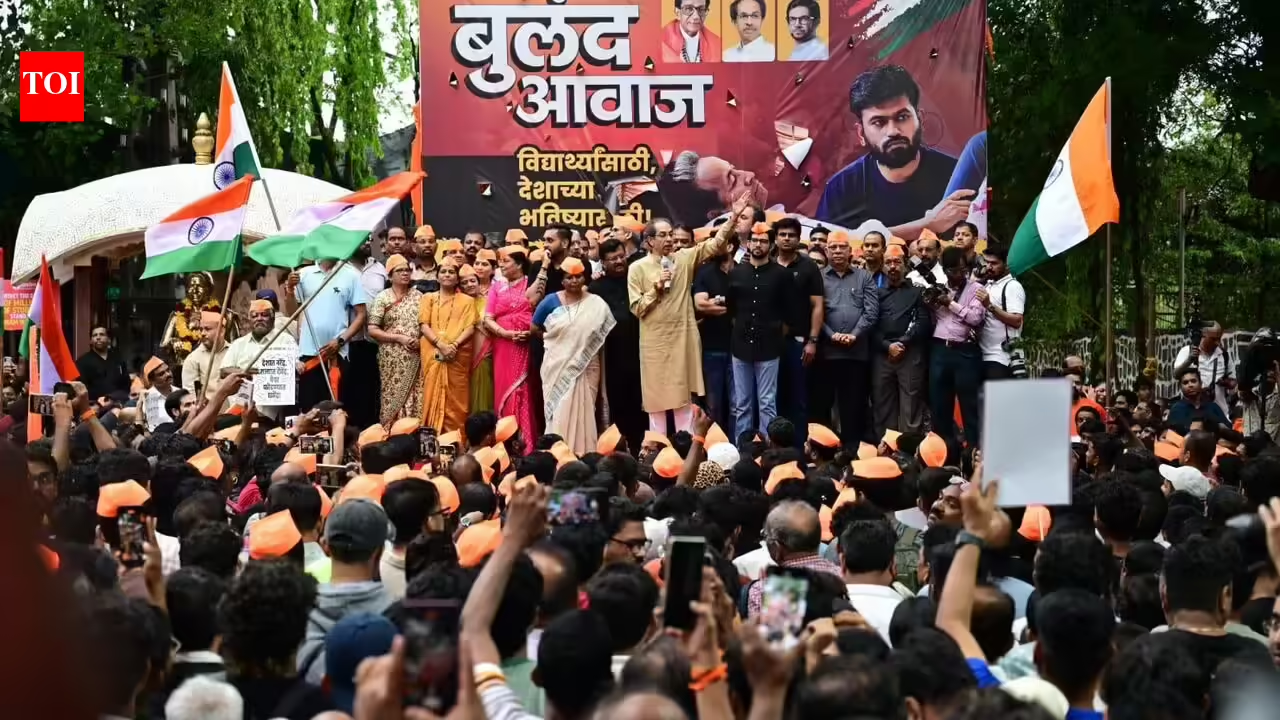
Shiv Sena (UBT) chief Uddhav Thackeray and his son Aaditya address a rally in support of activist Sonam Wangchuk at Shivaji Park on Sunday

Mumbai: The fight to change the government and not just Dharmendra Pradhan (Union education minister) should now begin, declared former chief minister and Shiv Sena (UBT) chief Uddhav Thackeray, while addressing a rally in support of activist Sonam Wangchuk at Shivaji Park on Sunday.“When you steal people to expand your party then you are afraid. They are afraid because they do not have their own loyalists rather those brought on rent,” said Thackeray.He challenged PM Modi, who has been advocating ‘One Nation, One Election’, to hold elections tomorrow.. “It is time to show them what nation means,” said Thackeray.He questioned why Modi could not meet Wangchuk considering the fact that the late PM Indira Gandhi had gone to Ladakh to meet Wangchuk’s father who sat on a hunger strike. Yet, the BJP called Indira Gandhi a dictator, Thackeray said.The former CM said he went to Nagpur on Saturday where the Rashtriya Swayamsevak Sangh (RSS) is headquartered. “The RSS in May issued a statement through (Dattatreya) Hosbale that we should hold dialogue with Pakistan, that the doors for negotiation should be kept open…if we are willing to hold talks with Pakistan then why not with Wangchuk. The government is willing to speak to the country which kills our soldiers, but not to the person who builds tents for our soldiers,” said Thackeray.He further said that a few years ago, Anna Hazare held an agitation, but no one called him anti-national. “The then Manmohan Singh government sent an emissary to understand what he was saying. Why is this humanity missing in the Modi government? Why was Wangchuk bundled in a bed,” he asked.Speaking of the pain “one undergoes when after studying, the paper leaks, Thackeray said: “….there is a question mark on the authenticity of the degree.”

Bhoiwada police reported 14 separate offences of cyber frauds in one day | Mumbai News

Bhoiwada police reported 14 separate offences of cyber frauds in one day
Bhoiwada Police have registered 14 separate cyber fraud offences in a single day, exposing the growing menace of online scams targeting people from all walks of life

Mumbai: Bhoiwada Police registered 14 separate cyber fraud offences in a single day, exposing the growing menace of online scams that targeted people from all walks of life, including housewives, doctors, nurses, govt employees, businessmen and private sector professionals. The fraudsters used different modus operandi, ranging from fake customer care numbers and APK files to bogus KYC updates, fake service providers and impersonation scams.In one case, a woman searching online for Blinkit customer care after not receiving her parcel allegedly contacted a fake helpline. The fraudsters claimed there was a mismatch in her delivery address and later sent her an APK file through WhatsApp. After installing it, ₹1 lakh was fraudulently transferred from her Bank of India and Union Bank accounts without her consent.A 27-year-old homemaker lost ₹95,000 while attempting to sell old furniture online. The accused, identified as Anil Jaiswal, allegedly tricked her into sharing banking details under the pretext of making payment In another case a nurse employed at KEM Hospital was cheated of ₹95,000 after receiving a message asking her to reply “OK” to update her Pay login credentials.A cloth merchant lost ₹93,000 after clicking a fraudulent advertisement on Google while searching for a service. He later received SMS alerts indicating unauthorized debits from his bank account . In another case an employee of Haffkine Bio-Pharmaceutical Corporation was duped of ₹2 lakh by cyber fraudsters, while another Haffkine employee reported that ₹1.98 lakh was withdrawn from his account after receiving suspicious messages, despite not authorising any transaction.A 43-year-old doctor attached to a private hospital in Colaba lost ₹4.95 lakh after opening a malicious APK file sent by fraudsters .A stenographer working at the City Civil Court was cheated of ₹2.84 lakh after opening a message purportedly sent by Mahanagar Gas.An accountant with Bharat Petroleum lost ₹1.12 lakh after searching online for an AC mechanic. The fraudster posed as a service provider and convinced him to complete a fake KYC update. In another case, a woman lost ₹60,000 after a fraudster impersonating a Mahanagar Gas representative sent her a malicious link.Another woman searching Google for the contact number of a cardiologist was contacted by a fraudster posing as the doctor’s assistant. She was sent an APK file and asked to pay ₹10 to register for an appointment. After installing the file, she lost ₹68,000.Cyber Police said the cases highlight the increasing use of fake customer care numbers, malicious APK files, fraudulent Google advertisements and impersonation tactics to steal banking credentials and gain remote access to victims’ mobile phones.Police have advised citizens to avoid downloading APK files received through messaging apps, verify customer care numbers only through official websites, and never share banking or OTP details with unknown callers.Mumbai Police have urged citizens to remain cautious while searching for customer care numbers or service providers online. Avoid downloading APK files or clicking links sent by unknown callers or through WhatsApp/SMS, as these can give fraudsters remote access to your phone and banking apps. Always verify customer care numbers through the official website or app of the company concerned. Never share OTPs, PINs, passwords or banking credentials with anyone. If you suspect a cyber fraud, immediately call the National Cyber Crime Helpline 1930 and report the incident on the National Cyber Crime Reporting Portal at www.cybercrime.gov.in to improve the chances of recovering the lost money.

Three, including 8-year-old boy injured in slab collapse at Navi Mumbai’s Uran region | Mumbai News

Three, including 8-year-old boy injured in slab collapse at Navi Mumbai’s Uran region

Navi Mumbai: Three of a family sustained major injuries while their bedroom slab collapsed on them on Friday morning in Navin Sheva, Uran. The locals and the fire brigade team extricated the trapped victims from the debris in a half-an-hour-long operation. An 8-year-old boy and his parents sustained bone fractures in their legs and hands, besides other injuries.They were rushed to the MGM Hospital-Kamothe. The trio, Pritam Ravkar, his wife Namrata, and their minor son, underwent surgeries.One of the local rescuers, Rajendra Gharat, said, “The victims were trapped among the wood pieces, cement concrete, among others. The fire brigade team nearby arrived fast, leading to expeditious rescue operation.”Vaman Bhoir said, “The victims are now out of danger. All three sustained fractures in their legs. Due to lack of land records and financial issues, we are unable to repair or reconstruct the houses.”

‘Complaint due to break-up’: 11 years on, man acquitted of harassment charges | Mumbai News

‘Complaint due to break-up’: 11 years on, man acquitted of harassment charges

Mumbai: After finding that the woman filed a police complaint against the accused only because he ended their five-year relationship, a magistrate’s court this week acquitted a 35-year-old south Mumbai man who faced 11 years of litigation after being accused of stalking, sending obscene messages, and threatening to unlawfully transmit private photographs of his former girlfriend. While the prosecution claimed the man obtained the complainant’s photographs without her knowledge, the woman stated in evidence that the photographs were clicked by her and sent to the man during the relationship.“This fact clearly goes to show that, the accused did not obtain objectionable photos of the informant without her knowledge, but crystalises that, the informant had sent it, when she was in love-ship with the accused,” the magistrate noted. The magistrate further noted that the complainant admitted that the two dated for about five years and that the man never misbehaved with her during that period. “…the relationship between the informant and the accused which broke after five years of dating has led to this prosecution,” the magistrate said. The prosecution alleged that the man and the complainant had known each other since childhood, studied together and were in a relationship.According to the prosecution, after the complainant became engaged to another person in Oct 2013, the man allegedly threatened to expose private photographs, contacted the fiancé, and later sent abusive and threatening messages along with photographs.The court noted that the chargesheet was filed before receipt of the forensic laboratory report. “It is also clear that, the mobile phone from which messages were sent does not belong to the accused, but it belongs to one Akshay Rathod.”

Thane MP seeks action against railway canteen over alleged hygiene violations | Mumbai News

Thane MP seeks action against railway canteen over alleged hygiene violations

Thane: Thane Shiv Sena MP Naresh Mhaske has written to the Central Railway Divisional Railway Manager (DRM), seeking strict action against a railway canteen at Thane station over alleged unhygienic conditions and risks to passenger health.The development comes close on the heels of complaints received from commuters including a lady passenger who shared a video last week where she was served a cold drink way beyond its consumption date by a station canteen staff.Accordingly, an inspection of the canteen was carried out by Divisional Railway Users’ Consultative Committee member Sanjeev Kulkarni and Thane Sena functionary Prakash Payre following instructions from Mhaske who confirmed the complaints to be true. Further, neither the contractor nor the manager were present during the inspection, Mhaske said.“The canteen and kitchen were violating Food Safety and Standards Authority of India norms, with expired soft drinks, stale food items, burnt cooking oil, poor-quality food, inadequate ventilation and foul odour found on the premises,” he said through a press statement and has demanded penalties be slapped against the contractor. An action taken report has also been sought from the railway.

14-year-old dies in Airoli hospital, family go to police | Mumbai News

14-year-old dies in Airoli hospital, family go to police

Navi Mumbai: A 14-year-old schoolboy residing in a chawl in Digha, who was admitted to a private hospital in Airoli node on July 17 after he complained of severe abdominal pain, died after 12 hours of treatment.The parents of the deceased boy, supported by Vanchit Bahujan Aghadi political party workers, lodged a complaint at Rabale police station against the doctors concerned of the private hospital.When questioned by the VBA workers, the doctors claimed the negligence allegation by the patient’s parents was false.The deceased boy was identified as Prabodhan Shinde. He was a student of Class 9, residing with his parents at Dr Babasaheb Ambedkar chawl, Vishnu Nagar, Digha.

fa8dcd56-9bac-45b1-934f-6ebf6baedff3_IMG_20260719_211849.jpg

Attachment

Bandra’s gaothans are open for business — but at what cost to the community? | Mumbai News

Bandra’s gaothans are open for business — but at what cost to the community?
Residents, architects, and urban planners have long demanded special development control regulations and a policy for gaothans

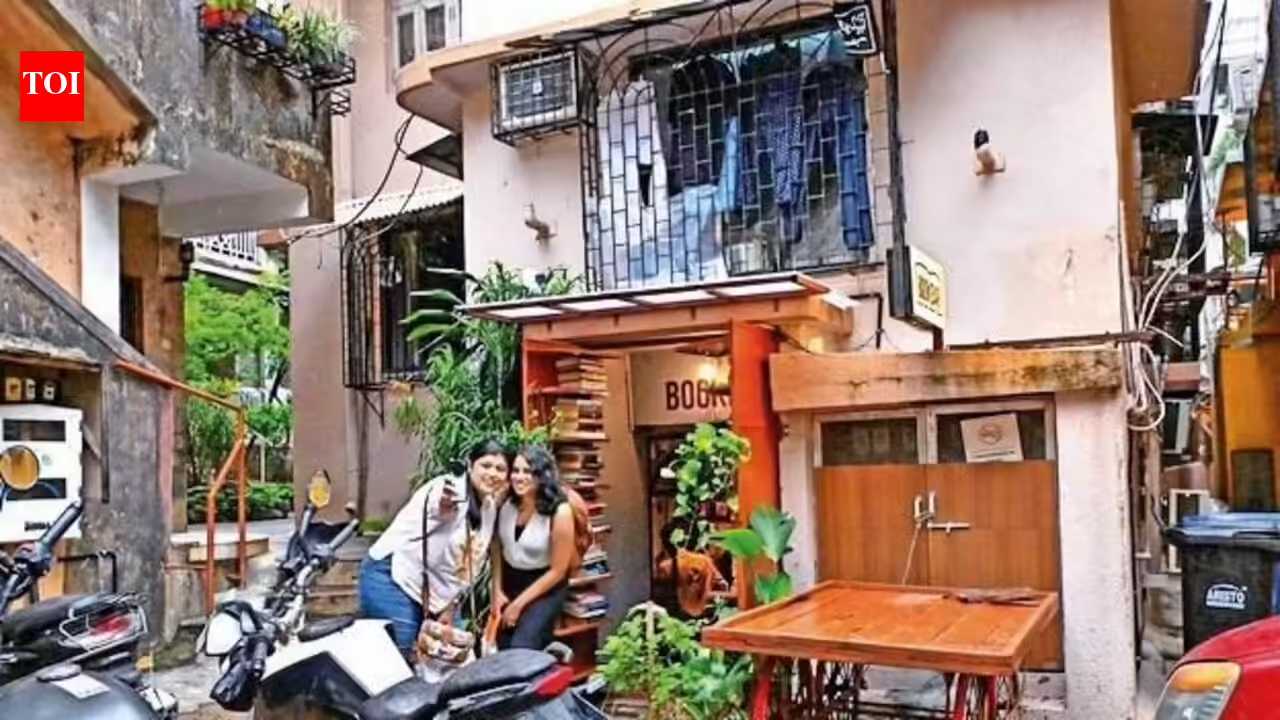
Mumbai: Charles Correa once said, “People don’t come to cities for housing, they come for jobs.” People come to Bandra’s gaothans to escape the city — and for its houses. Here, they make themselves at home in postcard cottages, settling on century-old verandahs to watch village life unspool. It’s a life few can own, but many can briefly have for the price of a coffee and a complimentary madeleine.That’s what the cafes, bookshops, B&Bs and concept stores in Bandra’s gaothans are serving up. In a city caught in the chokehold of concrete, the rustic charm of a rosewood cottage down a flagstone alley flanked by hibiscus in full bloom is a breath of fresh air.Book Bar, far from the madding crowds, has started drawing a crowd of its own. Housed in a low-rise building in the heart of Pali Village, this semi-basement cafe is plastered in paperbacks. “We looked across Bandra, Khar, Versova — until we chanced on this,” says co-founder Avneesh Gadgil. One of four Book Bar cafes — the others are in Pune — it opened in May, removed from the chaos of Ambedkar Road and 16th Road on either side. Gadgil likens the contrast to a cassette: “Everyone experiences Side A of the city, the noise and mayhem; but Bombay also has a Side B — places for pause.”On the adjacent street, Neil Pereira is less charmed. “Pali Village is categorised as a residential zone. How can commercial establishments be allowed here?” demands the longtime resident — though Book Bar, it should be noted, stepped into a former AC repair shop and simply inherited its commercial licence. The concern runs deeper than zoning. “There’s a risk of fire from circuit overload, owing to the high demand for electricity for lighting, cooking and cooling,” says Pereira, founder of the Pali Gaothan East Indian Association. Fire safety norms for commercial establishments in gaothans already forbid flame-cooking, but the risk of electrical overload in these densely wired old buildings is real.Fire is only one worry. S Gonsalves, another Pali Village resident, flags water. “The increased demand from restaurants, offices and studios has affected domestic supply. Their illegal high-horsepower pumps draw water before our tanks can fill up.” Sewage is another pressure point: “The gaothan’s drains were not built for the extra footfall,” says Pereira. “Sewage lines have overflowed in some places.” Heat envelopes from multiple AC units, strangers in the lanes for selfies, security concerns — the list is long.Shormishtha Mukherjee, author of Pudding: The Memory Keepers of Bandra, recalls residents telling her they’ve taken to closing their doors and windows, when once these were gateways to niceties and news. “The changing character of the gaothans has intensified in the last 3-4 years, and it’s visible on its walls. Chapel Road, which once had graffiti, now has ad graffiti.”The question, she asks, is — what are commercial spaces doing for the community? Do they become part of it? Do they ask their customers to be mindful of the neighbourhood?Some do. Chuim 66, a micro-restaurant dishing out pot pies and craft coffee, has signage reminding customers they’re in a residential neighbourhood. “We refitted our chimney when a neighbour complained of the exhaust,” says co-founder Vidit Aren. “We ran the ducting through the centre of the building instead of the exterior to reduce noise. We hope to be here for years and want to coexist with the community.” Book Bar halted interior work for an hour each afternoon to accommodate a neighbour’s nap. “We request customers not to smoke outside and keep the music low,” says Gadgil. “We even hosted an inauguration party for the villagers.”Commerce and community can be combative bedfellows initially, but they can learn to make peace. The sooner the better, because incoming traffic in the gaothans is only going to intensify, warns Shaan Shaikh, a real estate broker. “Enquiries for gaothans have multiplied in the last 3-4 years. I currently have 10 clients looking for cafe space, mostly in Chapel Road and Pali Village. A 250 sq ft cafe rental can cost Rs 1.5-2 lakh at either place,” Shaikh says. “The asking price for a 2,460 sqft, ground+2 bungalow off Carter Road is Rs 5 lakh.” But even at those rates, gaothan cafes are paying nearly 30% less than high-street rents. For homeowners — particularly elderly couples with limited income — the offers are a windfall and a saving grace.Gaothans receive no renovation or maintenance funds from govt. “I spend Rs 3-4 lakh on maintenance every couple of years,” says Clarence Gomes, 75, founder-editor of Bandra Times. “Our 150-year-old house on Bazar Road needs a new balcony, but we’ve been quoted Rs 5-6 lakh just to replace the Burma teak one.”“The question is how to negotiate change while preserving the integrity of the gaothan,” says conservation architect David Cardoz. “Anything that keeps the place going at the same scale without gutting it is fine — unlike redevelopment, which does exactly that.”Residents, architects, and urban planners have long demanded special development control regulations and a policy for gaothans. “In their absence, it’s the community that has conserved them,” says Pankaj Joshi, principal director, Urban Centre Mumbai. He believes communities should link arms with their new commercial neighbours and with civic officials to resolve tensions — and points to European cities developing soft bylaws for residential heritage precincts: noise restrictions at certain hours, rules on lighting and congregation. Mumbai has no such framework yet.“We wanted to establish a low-key neighbourhood space that was accessible,” says Aren, “and the gaothans were the only area that made financial sense. Anywhere else in Bandra and it would have been a heavier ship to run.”

23-year-old man found dead with bullet injury at Badlapur farmhouse | Mumbai News

23-year-old man found dead with bullet injury at Badlapur farmhouse

Badlapur: A 23-year-old man was found dead with a bullet injury to his chest at a cricket turf inside a farmhouse in Badlapur on Saturday late evening, with police investigating whether the death was a case of murder or suicide.The deceased, identified as Bhuvan Krishna Patil, operated the cricket turf business at the farmhouse in Sagaon village. His body was found on the premises, prompting an investigation by the Kulgaon police.After being alerted, officers from Kulgaon police station, along with a forensic team, rushed to the spot and collected evidence. During the preliminary investigation, police found that Patil sustained a single gunshot wound to his chest. A revolver was recovered from near the body.An assistant police inspector, Shivaji Dhavale, from Kulgaon police station said CCTV footage from the farmhouse showed Patil was alone at the cricket turf when the incident occurred. “The footage indicates it could be a case of suicide. However, we are also investigating the possibility of murder. The exact cause of death will be established only after the post-mortem report, forensic analysis and completion of the investigation,” the officer said.

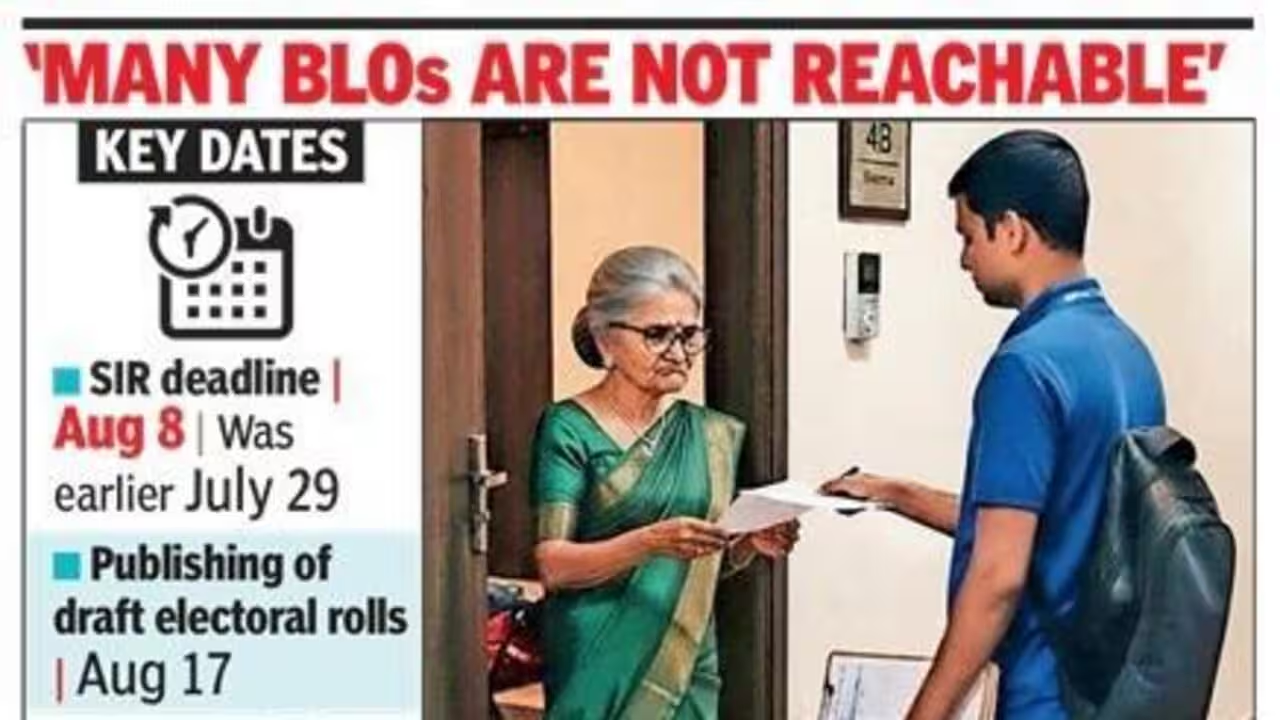
SIR toh mera chakraaye, say many Mumbaikars citing confusion over documents | Mumbai News

SIR toh mera chakraaye, say many Mumbaikars citing confusion over documents
Mumbaikars cite confusion over documents

Mumbai: Mumbai’s special intensive revision (SIR) 2026 voter verification drive is producing sharply different experiences across the city as the submission deadline nears, with residents, political representatives and booth-level officers (BLOs) describing an uneven rollout that ranges from smooth doorstep verification to confusion, anxiety and repeated follow-ups.Across several neighbourhoods, residents reported that the process depends heavily on local execution. Some areas saw quick, orderly visits by officials and clear communication, while others described unclear instructions, uncertainty over acceptable documents and difficulty in contacting BLOs. Many citizens said comparatively better-off localities appeared to face fewer disruptions, while dense neighbourhoods with frequent residential movement reported heightened stress and what locals termed a growing “fear psychosis” around possible deletion from the electoral rolls due to paperwork gaps, spelling mismatches or address changes.Political representatives echoed the concern that shifting interpretations of documentation rules are adding to public anxiety. Nadeem Nusrath, vice-president of Mumbai Congress, pointed to confusion around the status of documents, saying a recent controversy over a passport not being treated as proof of citizenship has intensified fear, confusion and stress across class lines.Residents also alleged gaps in geographic coverage. In Bandra West, some said SIR verification was not being conducted at certain Slum Rehabilitation Authority project sites to which beneficiaries have been shifted, including Lalmatti, Shastri Nagar, Maharashtra Nagar and Slaughter House Compound. According to residents, BLOs cited instructions not to conduct verification at these sites for now. For families who have moved into these locations, the reported pause has created uncertainty about where verification will occur and how their records will be updated to reflect their current addresses.In the Kurla assembly constituency, residents described particular difficulties for voters whose names remain linked to older addresses after relocation. Some complained that BLOs were not answering calls or returning them even after callback requests were logged through the EC app. One voter questioned why contact numbers are shared if they remain unreachable, adding that even after visiting the election office, the guidance received was simply to keep trying because the BLO does not answer. The voter said their name was already in the electoral form (EF), yet completing the formalities still required repeated effort, calling it unnecessary inconvenience for genuine voters.Other localities reported technical and procedural hurdles in linking current electoral entries to older rolls, especially where residents have moved across wards, cities or states. At Dheeraj Upvan Society in Borivli East, a large residential complex built around 2000 with many migrants from other parts of Mumbai and outside Maharashtra, residents said the most difficult step was matching current details with the 2002 list through the app. Even so, some residents described strong participation and a willingness to comply despite the paperwork burden. One resident said the effort was creating chaos around arranging documents but argued it would improve security and help eliminate bogus voters.In Kanjurmarg, resident Tasneem B described a prolonged and shifting verification process that left her uncertain about her status. She said she was initially visited during pre-SIR mapping. When officials could not locate her parents—based in Nagpur—on the 2002 list, she downloaded the ward list and searched manually. She said her father’s name contained multiple errors, making it hard to trace, a problem she said is common on voter lists. Although she was initially told mapping was successful, she later received a message from the BLO that she had been flagged as an anomaly due to a “different parent” and was advised to present her father’s documents and her passport to resolve it. After she complied, she said the BLO again informed her that even with documentary proof, BLOs lack the authority to complete verification in such cases and that she would likely need to attend an SIR hearing after receiving a notice. She criticised the dependence on an AI-driven system that can flag anomalies without an easy correction path and said the experience felt especially harsh for voters acting in good faith. She added that the episode revived fears, based on past experiences elsewhere, that minorities may face stricter scrutiny and higher compliance burdens.BLOs, for their part, are described as being under visible pressure as volume increases. At a housing society in Mira Road, residents gathered around a BLO as people sought help identifying their booths and submitting forms. Residents recounted that the BLO appeared overworked and responded sharply to repeated questions, underscoring how crowding and last-minute demands are testing capacity on the ground.In Mira Road and other areas with sizable Muslim populations, residents and local representatives said misinformation, difficulty locating names on older SIR lists, and spelling discrepancies between documents and earlier records are complicating compliance. A long-time voter, Sani Aslam, said he had tried calling for days without response and later realised he had contacted the wrong BLO, illustrating how confusion over BLO jurisdiction can add to delays.Samajwadi Party MLA Rais Shaikh said volunteers were being deployed in Madanpura, Govandi and Bhiwandi to help residents fill forms and locate BLO information. He said many fear that spelling mismatches could lead to deletions from draft lists. Govandi resident advocate Faiyyaz Alam Shaikh described the situation in Mankhurd Shivaji Nagar assembly constituency as “alarming”, citing density, socio-economic vulnerability and many voters being given the “anomaly” status. He called office-based verification impractical and inaccessible for many genuine electors.Some residents reported smooth experiences. In Vashi’s Sector 9A, Kedarnath Rao Ghorpade said four officers from Navi Mumbai Municipal Corporation arrived prepared, conducted verification transparently and followed a structured process, although he noted that documentation was a challenge for some. In Nana Chowk, Chandana Shetye described a positive interaction, saying the BLO waited for her to return from work and accepted alternative details when she opted not to provide her Aadhaar number.