

GLC Mumbai gets BCI nod, deadline extended; 3 big reliefs for law aspirants

GLC Mumbai gets BCI nod, deadline extended; 3 big reliefs for law aspirants
The Bar Council of India has granted approval to Government Law College along with eighteen other institutions

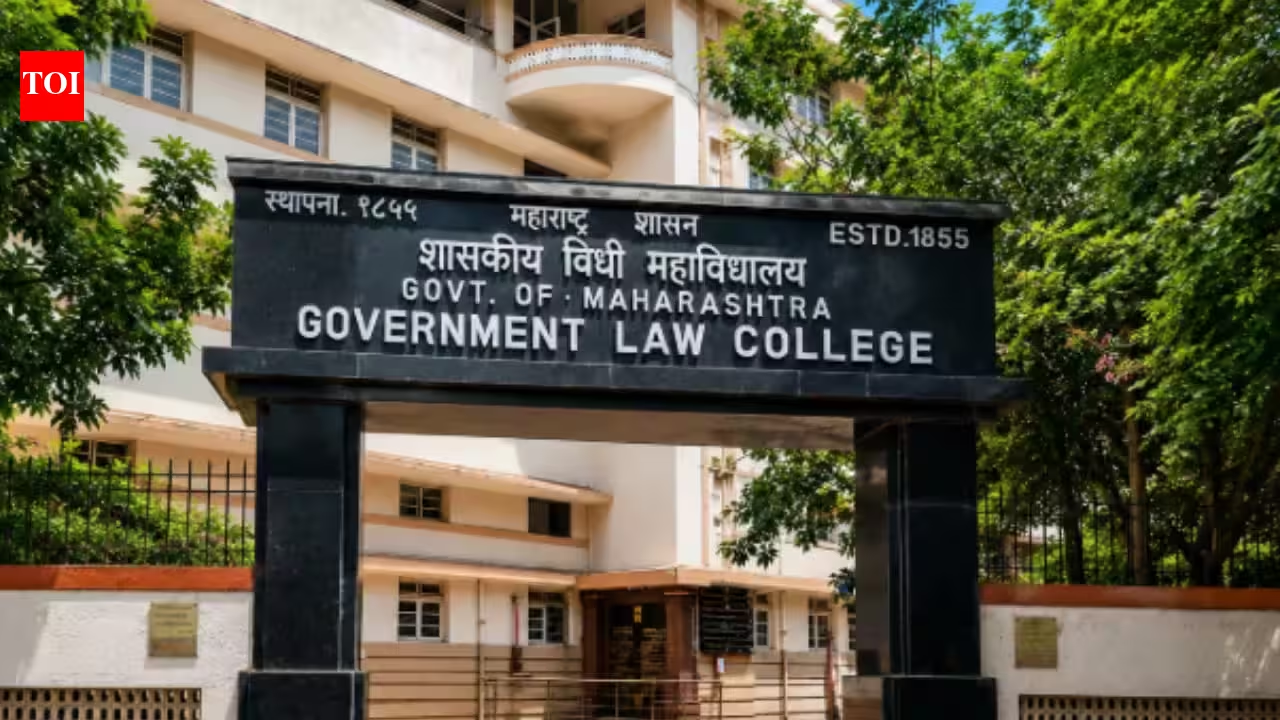
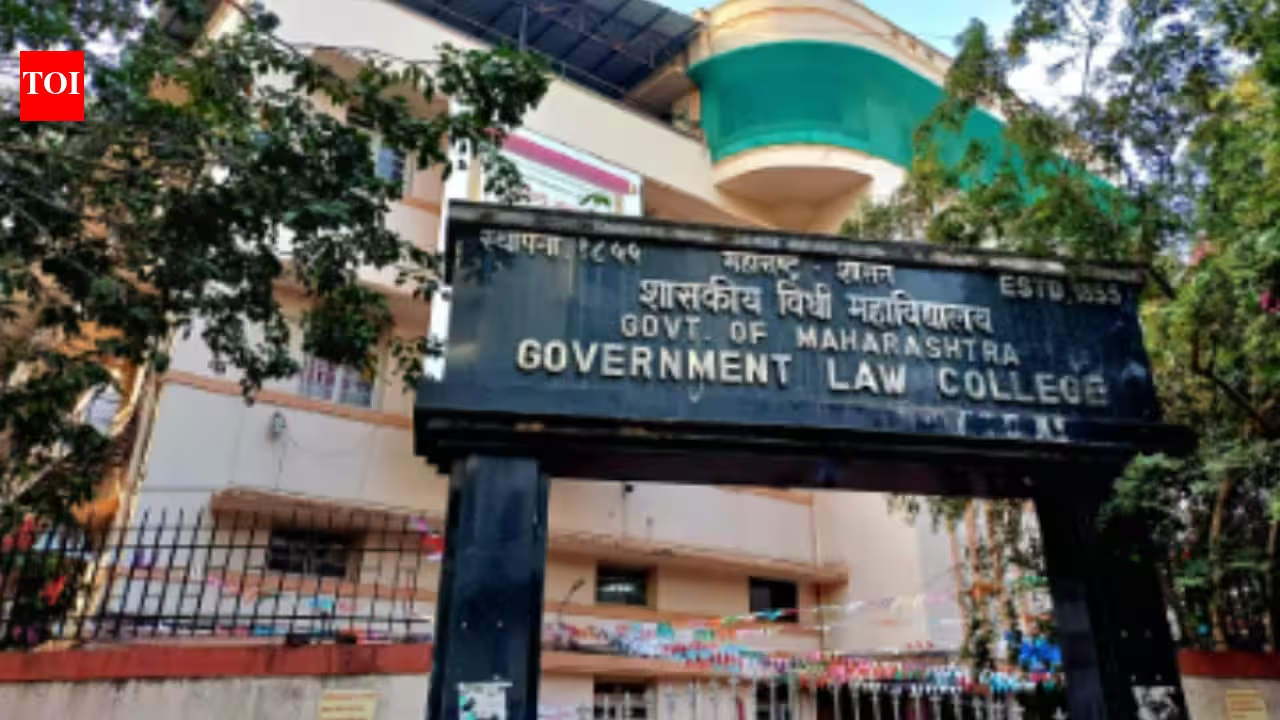
MUMBAI: After days of uncertainty that left thousands of law aspirants on edge, Thursday brought three significant developments that could ease the admission crisis in Maharashtra.The Government Law College (GLC), Mumbai, finally received approval from the Bar Council of India (BCI) and is expected to be added to the State CET Cell’s admission portal on Friday.An additional 18-odd colleges also received the BCI nod and will get added to the list, thus taking the total count of available colleges to 120, said sources.Second, the Bombay High Court on Thursday morning extended the deadline for filling the college option form to August 9 for the three-year LLB programme and for the five-year integrated law course giving students additional time to exercise their preferences.Most importantly, on Thursday evening, in a move that could fundamentally change this year’s admission process, the CET Cell has proposed to the state government that students be allowed to continue participating in subsequent CAP rounds even if they are allotted their first-preference college.It has also recommended that candidates be permitted to submit a fresh option form before every admission round, allowing them to revise their college preferences as more institutions receive approvals.“We have sent our proposal to the state government and are awaiting its approval. Once it comes through, students will no longer be forced to accept admission simply because they have been allotted the college they marked as their first preference: they can either choose it or reject it, which was not allowed earlier. So, if they reject the first choice of college allotted to them, they will be allowed to continue participating in subsequent CAP rounds,” State CET Cell Commissioner Dileep Sardesai told TOI.“This admission season is unlike any other. We understand the anxiety students are going through because of the delayed approvals, which is why we have proposed these changes. We have also suggested that students be allowed to submit a fresh college option form before every CAP round so that they can revise their preferences as more colleges receive approvals,” he added.Admission experts say such a relaxation would be in the interest of fairness. The current preference list, they point out, was prepared without several prominent colleges in contention. Allowing students to revise their options once the list of participating institutions is finalised would ensure that admissions reflect genuine student preferences rather than administrative delays.Data available with the Directorate of Higher Education (DHE) as on August 5 showed that only 102 colleges offering the three-year LLB programme, with an intake of 10,105 seats, and 66 colleges offering the five-year integrated LLB programme, with 5,955 seats, have been cleared for the first round. This is against nearly 54,000 applicants for the three-year course and 20,000 applicants for the five-year programme, drastically shrinking the options available to students.GRAPHICImportant 3 developments as on Thursday:1. GLC and 18 other colleges receive approval from the BCI and will be added to the option list by Friday2. Bombay High Court extend the option filling process (selection of colleges) for law programmes3. State CET Cell sends a proposal to the state govt to alter admission norms: No mandatory auto-freeze if the first choice of college is allotted and allow candidates to fill fresh college option form with their preferences before every round.

GLC Mumbai, dozens of colleges excluded from law admission round

GLC Mumbai, dozens of colleges excluded from law admission round
Many colleges, including Government Law College, are excluded from the initial admission round

MUMBAI: Maharashtra’s top-ranked law aspirants will, for the first time in years, be unable to choose the Government Law College (GLC), Mumbai, as their first preference in the opening round of admissions, even as nearly half the law seats in the state have disappeared from the first round of the Centralised Admission Process (CAP).With GLC, the state’s oldest and most sought-after law college, kept out of the admission process and dozens of other Mumbai University-affiliated colleges also excluded for want of mandatory approvals, thousands of seats have been rendered unavailable, dramatically shrinking the choices before students.The impact is particularly severe for meritorious students. Under the CAP rules, candidates who are allotted the college they list as their first preference must compulsorily accept that seat.Rejecting it results in automatic exclusion from the admission process. With GLC absent from the first round, students who would ordinarily have listed it as their first choice are now forced to rank another college at the top of their preference list.Once allotted that college, they must join it, effectively losing the opportunity to compete for GLC should it become available in a subsequent round.GLC’s exclusion is part of a much larger disruption that has seen nearly half the law colleges in Maharashtra kept out of the first round of admissions after colleges affiliated with the University of Mumbai failed to obtain mandatory approvals.Data available with the Directorate of Higher Education (DHE) as on August 5 shows that only 102 colleges offering the three-year LLB programme, with an intake of 10,105 seats, and 66 colleges offering the five-year integrated LLB programme, with 5,955 seats, have been cleared for the first round.This is against nearly 54,000 applicants for the three-year course and 20,000 applicants for the five-year programme, drastically shrinking the options available to students.Sources said GLC has been excluded because it has failed to pay the mandatory fee to the Bar Council of India (BCI), without which it cannot obtain the approval required to participate in the admission process.It has now been paid and the college, once it receives approval, will be a part of round 2. Several other Mumbai University-affiliated law colleges are also missing for want of BCI approval.bbyThe colleges face another hurdle as well. The University of Mumbai has reportedly flagged several institutions for failing to comply with mandatory staffing norms, including the appointment of qualified principals and adequate full-time faculty. Until these deficiencies are rectified and approvals are secured, the affected colleges are unlikely to be included in the admission process.There may, however, be some relief. “A few more colleges are likely to be added after tomorrow’s court hearing,” said the principal of a law college.Under the existing admission schedule, students submit their college preferences only before the first two CAP rounds.However, sources said the CET Cell has requested the state government to allow candidates to revise and refill their option forms before the second round, once additional colleges are admitted into the process, and again before the third round if more institutions receive approval.Such a move, they said, would prevent students from being permanently locked into choices made when several prominent colleges, including GLC, were unavailable.BOX: “Maharashtra’s LLB admissions are in disarray – Someone owes young students and aspiring lawyers an explanation.Thousands of aspirants who cleared CET with hard-earned percentiles — now facing uncertainty over seats, schedules, and institute credibility.This isn’t a minor administrative hiccup. It’s a systemic compliance failure that regulators and colleges allowed to build up for years, and students are the ones paying the price with lost time, anxiety, and disrupted academic years.” Megha Yadav, a lawyer posted on social media.

Probe Abhijeet Dipke, Saurav Das others over presence of minors at Delhi protest: ‘Mumbai influencer’ to cops

Probe Abhijeet Dipke, Saurav Das others over presence of minors at Delhi protest: 'Mumbai influencer' to cops
CJP founder Abhijeet Dipke, chief spokesperson Saurav Das and national spokesperson Ashutosh Ranka.

MUMBAI: A Mumbai resident claiming to be a social media influencer has filed a complaint with the Indore police, seeking an investigation into the alleged presence of minor boys and girls at a recent students’ protest led by the Cockroach Janta Party (CJP) in New Delhi.The complaint was filed with the city crime branch on Wednesday and seeks an investigation into the alleged role of CJP founder Abhijeet Dipke, chief spokesperson Saurav Das and others in the participation of minors at the protest at Jantar Mantar.The complainant, Faizan Ansari, alleged that the probe should determine whether Dipke, Das or others were involved in bringing, inviting, encouraging or facilitating the participation of minors in the protest held over the NEET question paper leak case.He also sought the preservation and examination of photographs and videos from the protest, media interviews, public statements, CCTV footage from the protest site and surrounding areas, social media posts and other electronic records.The complaint stated that if the investigation establishes any cognizable offence under the Protection of Children from Sexual Offences (POCSO) Act, the Bharatiya Nyaya Sanhita (BNS), the Information Technology Act or the Juvenile Justice (Care and Protection of Children) Act, an FIR should be registered against those involved.Additional deputy commissioner of Police Rajesh Dandotiya said, “We have received a complaint from Ansari, who claims to be a social media influencer. The complaint is being investigated. Appropriate action will be taken based on the facts that emerge from the investigation.”The CJP-led youth protest at Jantar Mantar over the NEET question paper leak lasted 36 days and ended with the resignation of then-Union Education Minister Dharmendra Pradhan.On July 20, when protesters attempted to march towards Parliament, Delhi Police stopped them and used force to disperse the demonstrators, leading to clashes between the two sides.The CJP withdrew its protest on July 25 after Pradhan’s resignation and talks with the government, which accepted the demands raised by the agitators.

JJ Hospital’s forensic team conducts donor post-mortems at Mumbai private hospital

JJ Hospital’s forensic team conducts donor post-mortems at Mumbai private hospital

Mumbai: Families who agree to donate a loved one’s organs after brain death bring hope to several ill patients, but the hours that follow can be particularly difficult. Once organs are retrieved, families traditionally have to wait for the mandatory post-mortem examination and police formalities before the body can be taken home or to the cremation ground.On June 26, a small but significant change helped ease that wait for two donor families at H N Reliance Hospital in Girgaum. The hospital had two deceased donors on the same day and requested state-run JJ Hospital in Byculla to send its forensic team to its premises to conduct the post-mortem examinations, instead of transporting the bodies to the government hospital.The practice is still unusual in Mumbai. According to ZTCC president Dr Surendra Mathur, this was only the second time a government forensic team had conducted a post-mortem at the hospital where organs had been retrieved. The first was at a hospital in Thane, following a similar request. “It helps reduce the waiting time for donor families,” he said. ZTCC coordinates organ sharing among registered transplant hospitals in Mumbai.Post-mortem examination is mandatory following deceased organ donation, but the additional movement of the donor’s body and the time taken for the examination and police inquest can prolong an already emotionally difficult process for families. In Tamil Nadu, a system is in place that allows post-mortems to be conducted at the hospital where organ retrieval takes place, helping reduce the waiting time for families.H N Reliance Hospital CEO Dr Tarang Gianchandani thanked JJ Hospital dean, Dr Ajay Bhandarwar, and Mumbai Police commissioner Deven Bharti for their coordination during the retrieval and allocation process. She said closer coordination between government and private hospitals could further strengthen the deceased-donation programme.

BEST driver says technical snag in bus mishap that killed one, Mumbai police dismiss claim in chargesheet

BEST driver says technical snag in bus mishap that killed one, Mumbai police dismiss claim in chargesheet

Mumbai: The Shivaji Park police last week filed the chargesheet against BEST bus driver Vikas Padave for driving the bus very rashly and at a high speed before it rammed into multiple vehicles, killing a delivery boy and injuring several near Plaza theatre in Dadar (W).In the chargesheet, police dismissed Padave’s claim that there was some technical snag in the bus and stated that he allegedly lost control and crashed into three vehicles before ramming into an e-bike of the delivery boy, 28-year-old Niyaz Ahmed Moharram Ali, and injuring several others.Padave’s statement, which is part of the chargesheet, stated that at the time of the incident, the bus suddenly started moving at high speed after he stopped it at Veer Kotwal Udyan and applied the handbrake. Padave claimed he had not pressed the accelerator and repeatedly tried to apply the brakes, but they did not function properly. Regional Transport Office (RTO), meanwhile, was unable to give a conclusive opinion on whether the bus was roadworthy as the damaged vehicle was found unfit for an on-road test.The investigation also examined whether a mechanical failure could have contributed to the crash. Police obtained an inspection report from RTO, but the authorities could not give a concrete opinion regarding the roadworthiness or running condition of the bus.Investigators had also attempted to obtain CCTV footage from the bus. BEST officials informed the police that the footage was stored in the MNVR box installed in the vehicle. The box was subsequently removed from the damaged bus, sealed and seized in the presence of panch witnesses.However, investigators found no data on the hard disks. Police suspected that the storage devices may have been corrupted due to the impact of the accident. The hard disks were subsequently sent to Judicial Assistant Scientific Laboratory at Kalina for attempts to recover the data. Padave was not under the influence of alcohol or drugs, his medical report said.

MPID Court Grants Bail to UK Businessman Nishit Patel in ₹16.24 crore Javed Jaffery Cheating Case

MPID Court Grants Bail to UK Businessman Nishit Patel in ₹16.24 crore Javed Jaffery Cheating Case

Mumbai: The Maharashtra Protection of Interest of Depositors (MPID) court granted bail to UK businessman Nishit Patel, an accused arrested for cheating actor Javed Jaffery and his wife of Rs .Judge Vikram R. Jagdale allowed Patel’s bail application after noting that while a specific role had been attributed to him in the alleged offence, the other wanted accused had received the bulk of the money and had since settled the dispute with the informant.Patel’s bail comes hot on the heels when the high court is likely to pass an order in BMC ward officer Mahesh Patil’s bail application on Thursday. Patil has allegedly filed a consent term stating to settle the financial dispute with the complainant.The case pertains to a complaint filed by Javed’s wife Habiba alleging that she and her relatives were cheated of nearly Rs 16.24 crore to Rs 17.5 crore on the promise of lucrative returns and property allotment in a redevelopment scheme. Patel was arrested and was in jail.Patel, Patil and few other accused have been booked under various provisions of the Bharatiya Nyaya Sanhita, 2023, along with Sections 3 and 4 of the MPID Act.The prosecution opposed bail, claiming Patel had conspired with absconding accused Mahesh Patil and others and had represented the project to the informant despite having no nexus with it. The investigating officer also told the court that Patel had provided bank account details for deposits and that ₹2.10 lakh had been transferred to his account. Police further claimed that forged documents had been used and that government seals and stamps were yet to be recovered.The intervener also opposed bail, alleging that Patel had personally induced the informant and her family to invest ₹30 crore by promising 20,000 sq ft of commercial premises that would generate substantial rental income. It was further alleged that Patel had handed over forged documents and received a Rolex watch valued at ₹20 lakh along with foreign currency towards the investment.Patel’s advocate, Rahul Moghe, argued that Mahesh Patil was the mastermind and that Patel was instead a victim and whistleblower. The defence submitted that Patel had himself lodged a complaint in November 2025 alleging that he was threatened and assaulted by others to confess to the offence. The defence also cited Patel’s mother’s serious health condition and submitted that he was required to take care of her.The court observed that Mahesh Patil appeared to be the prime accused, while Patel was one of the principal accused against whom specific allegations existed. However, the court noted that the entire amount had been transferred to Patil and that he had settled the dispute with the informant. “Further incarceration of the applicant is not warranted,” the court observed, while granting bail.Patel was directed to furnish a personal recognisance bond of ₹2 lakh with one or two solvent sureties in the like amount. He was also permitted to furnish provisional cash bail of ₹5 lakh for eight weeks.The court directed Patel to surrender his passport, barred him from leaving India without prior permission and restrained him from contacting or influencing witnesses. He was also directed to provide his contact details and residential address, along with those of two close relatives, to the investigating officer.

Pay Rs 25 lakh to Navi Mumbai Municipal Corporation’s ward officer who was manhandled at demolition drive and suffered miscarriage, Bombay high court orders state government

Pay Rs 25 lakh to Navi Mumbai Municipal Corporation’s ward officer who was manhandled at demolition drive and suffered miscarriage, Bombay high court orders state government
The HC rapped the police who remained “mute spectators” at the July 30 demolition drive at Airoli and failed to protect the ward officials

Mumbai: The Bombay high court on Wednesday directed the state government to pay Rs 25 lakh compensation to Navi Mumbai Municipal Corporation’s assistant commissioner of G ward, Airoli, who suffered a miscarriage after she was allegedly manhandled by a mob during a July 30 demolition drive.Justices Ajey Gadkari and Kamal Khata, while awarding her compensation, observed that “the mental agony and physical suffering caused to the officer cannot be ignored.” They rapped the police who remained “mute spectators” and failed to protect her and other officials. They directed the DGP to “take stern necessary legal action against all personnel who were present and have failed to perform their duty”. They also directed compensation amount to be recovered from their salaries.The court was hearing a contempt petition by advocate Kishore Shetty regarding non-compliance of HC’s March 27, 2025 order to within four months conduct a survey to identify illegal constructions and hear its owners/occupants before undertaking demolition.On Tuesday, NMMC’s advocate informed that there was obstruction by a large mob during the July 30 demolition. He submitted the FIR registered regarding assault and manhandling of officers. He also informed that the ward officer later suffered a miscarriage. To the judges’ query regarding police, the advocate replied that police protection was sought and they were present at the site.The judges then questioned the state’s advocate, O A Chandurkar, what the police were doing. They asked Chandurkar to go through videos of the incident and identify the policemen, their role and also inform about the action taken against the accused.On Wednesday, Chandurkar said only commotion is seen in the videos. He said notices have been issued to the accused named in the FIR. When told that the notices were issued on Tuesday, the judges rebuked the state for “doing nothing” and issuing notices only after being questioned by the HC.In the order, the HC bench observed: “We are at a loss to accept that in the progressive state of Maharashtra in broad daylight public servants are assaulted by anti-social elements of society in the presence of police personnel deputed to give them protection. It cannot be permitted that public servants are assaulted, intimidated and coerced by anti-social elements while performing duty.”NMMC’s advocate Sugandh Deshmukh informed that another staffer, who was also manhandled, is receiving threats of dire consequences. The judges directed the police to provide him free of cost round-the-clock protection until the threat “subsides”.

Building’s safety system kept in manual mode, only 2 knew how to operate it

Vile Parle fire: Building’s safety system kept in manual mode, only 2 knew how to operate it
The fire broke out in a flat in which the developer and the family lived on the 11th floor of Shanta Bhuvan in Vile Parle

Mumbai: The 12-storey Vile Parle building where a 23-year-old domestic help and a developer’s two-year-old grandson died in a fire in a flat late on Tuesday did not have a fully automated firefighting system and only two people knew how to operate it, shows an initial probe.Fire brigade officials said the sprinklers installed outside the 11th floor flat of Shanta Bhuvan where the fire broke out failed to get activated. “The firefighting system could not generate enough power on its own and was kept in manual mode. Had the sprinklers turned on, they could have helped control the spread of the fire. The security guards, too, did not know how to operate the system,” said an official. BMC additional commissioner Vipin Sharma said only two members of the family of developer Hiren Batavia, who constructed the building and lived in the affected flat, knew how to operate the system. It wasn’t clear who these two members were.The building received its occupancy certificate in 2020.The help, Ankita Chhetri (23), and the toddler, Abir Siddharth Batavia, were found unconscious in one of the bathrooms attached to a bedroom and later declared dead. “Once the fire flared up, Chhetri moved to one of the bedrooms, where the toddler was. When the fire intensified, she took the toddler in her arms and moved to the bathroom,” said an official. Officials believe that both could have survived had Chhetri opened the sliding windows of the bedroom. Six others, including a fire personnel, sustained injuries. Around 15 occupants were rescued from the building.Hiren (64) managed to escape with his granddaughter as the fire began to spread. He raised an alarm while getting out and alerted occupants of nearby flats. The fire later spread to an adjacent flat. Abir’s parents were out on a stroll when the tragedy occurred.Parth Batavia (32), another son of Hiren, was in the bathroom of another bedroom. He failed to hear his father’s screams and realised there was a fire only after he came out of the bathroom, said a fire official. “He placed himself almost outside the large sliding glass window and near the safety grille and was able to get fresh air. Besides, he also tied a handkerchief over his face. He kept speaking to his relatives on the phone during the period. Subsequently, fire brigade personnel rescued him.”The fire brigade is yet to confirm the cause of the fire, but the family claimed that Chhetri left a hot iron unattended on a table in the hall. Officials said the fire could have originated elsewhere, possibly in an AC unit.After finding Chhetri and Abir, fire brigade personnel, led by station officers A S Khanolkar and RS Pawade, performed CPR on them. “We administered CPR continuously for about 15 minutes till they were shifted to the hospital,” said an official.

Maharashtra assembly Speaker wants Shivaji Maharaj slogans on trains arriving at and departing from CSMT in Mumbai

Maharashtra assembly Speaker wants Shivaji Maharaj slogans on trains arriving at and departing from CSMT in Mumbai
Rahul Narwekar has urged Union Railway Minister Ashwini Vaishnaw to include the slogans ‘Chhatrapati Shivaji Maharaj Ki Jai’ and ‘Jai Bhavani, Jai Shivaji’ in announcements made on every train arriving at or departing from CSMT

Mumbai: Maharashtra Legislative Assembly Speaker Rahul Narwekar has urged Union Railway Minister Ashwini Vaishnaw to include the slogans, ‘Chhatrapati Shivaji Maharaj Ki Jai’ and ‘Jai Bhavani, Jai Shivaji’, in announcements made on every train arriving at or departing from Mumbai’s Chhatrapati Shivaji Maharaj Terminus (CSMT).Narwekar submitted a letter to Vaishnaw during his visit to Delhi, seeking the inclusion of the slogans along with routine railway announcements at CSMT.In his letter, Narwekar said CSMT is not merely a historic railway station, but also a symbol of Chhatrapati Shivaji Maharaj’s ideals of courage, Swarajya and patriotism. Thousands of passengers from across the country travel through the station every day, making it an important platform to spread awareness about the legacy and ideals of Shivaji Maharaj, he said.Narwekar said the proposed announcements would help introduce younger generations to Shivaji Maharaj’s administration, bravery, welfare-oriented policies and commitment to national interest. He also highlighted Shivaji Maharaj’s role in bringing together people from different sections of society while establishing Swarajya.Narwekar requested Vaishnaw to consider the proposal positively and issue necessary directions to the railway administration to incorporate the two slogans in announcements on all trains arriving at and departing from CSMT.Narwekar expressed confidence that the initiative would help carry the message of Shivaji Maharaj’s contribution and the ideals of Swarajya beyond Maharashtra through the extensive railway network.

Domestic help likely tried to save toddler, both choked to death

Vile Parle building fire: Domestic help likely tried to save toddler, both choked to death
The fire broke out in a flat in which the developer and the family lived on the 11th floor of Shanta Bhuvan in Vile Parle

Mumbai: Even in her final moments, little Abir was on Ankita Chhetri’s mind. Officials believe the Batavia family’s domestic help grabbed him from one of the bedrooms as the fire spread and took shelter in the attached bathroom. Rescuers found Abir lying on her chest, both unconscious. CPR on them failed.They were declared dead at Nanavati Hospital. At Cooper Hospital’s postmortem examination centre, officials said they died of asphyxiation and did not sustain burn injuries.Four other members of the Batavia household were taken to Nanavati Hospital, including the developer, Hiren Batavia. They were discharged after being kept under observation through the night. Two others, a fireman and the watchman, were taken to Cooper Hospital for minor injuries. They were discharged as well after treatment.Abir’s parents, Siddharth Batavia and Jayni Batavia, arrived with the extended family to claim his remains on Wednesday. The wait was long due to a few others in the queue. “We are very distraught, we have no option but to wait,” said one of the extended family members. The family could only take possession of the body by around 1pm.A case of accidental death was registered at Santacruz police station.Senior inspector Dattatray Masavekar said Chhetri was a native of West Bengal and her family has been contacted. “We are still finding out more details about her,” he said. Until her family arrives in the city, her postmortem remains pending due to lack of consent from blood relatives. Some of her distant relatives had tried to claim the body earlier in the day; they could not be traced till the time of going to press.