Is Thane’s 55,000cr infra push a cure for congestion or new chaos? | Mumbai News

Is Thane’s 55,000cr infra push a cure for congestion or new chaos?

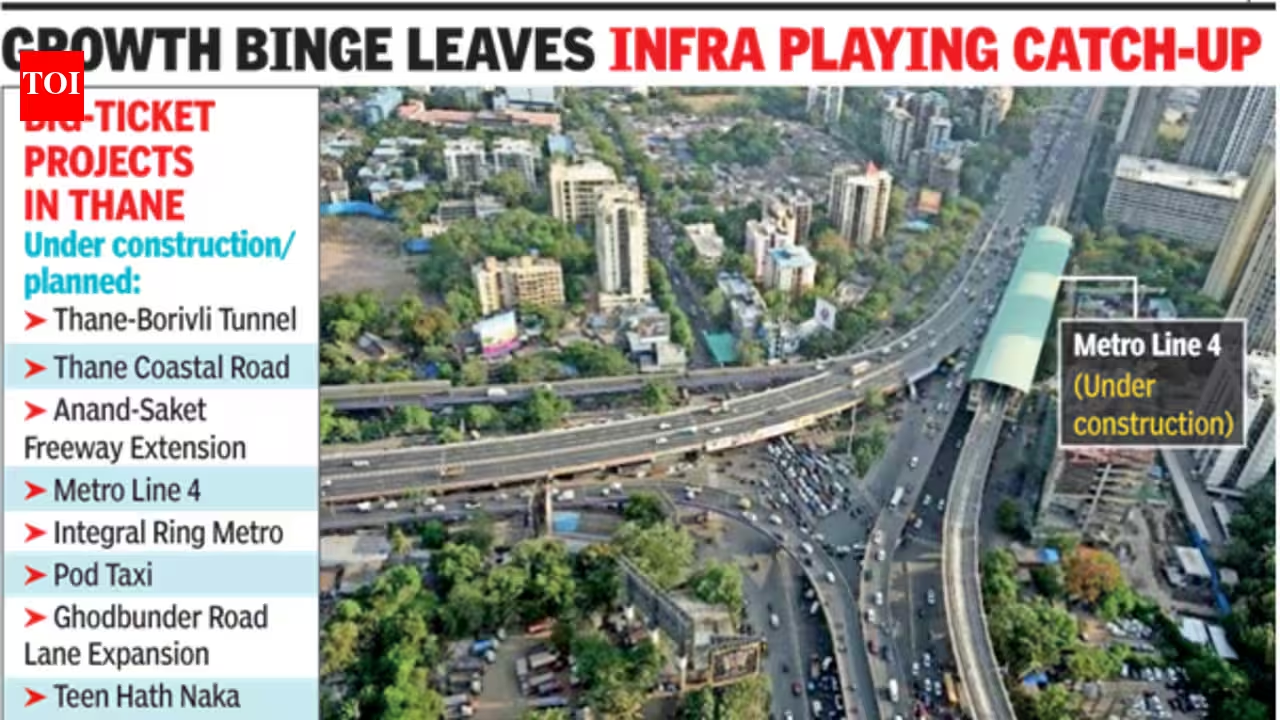
Thane’s rapid shift from a low-rise, green ‘City of Lakes’ to a dense real estate and infrastructure hotspot has outpaced the ability of civic systems to keep up. A massive infrastructure programme valued at about Rs 55,000 crore is now underway to address problems created by years of fast growth, but residents and experts say the cure is generating fresh disruption. With multiple big-ticket projects running simultaneously, many fear the city’s original character is being replaced by an increasingly concrete-heavy landscape that further strains daily life.For decades, Thane’s urban footprint and social geography were clearly defined. The city limits largely ended near the Eastern Express Highway, with middle-income settlements within the traditional municipal belt. Beyond that lay large industrial zones and labour settlements, while the Ghodbunder stretch remained home to native community clusters and pockets of older, semi-rural life. That balance began to change sharply in the early 2000s after the Ghodbunder Road upgrade during the tenure of then municipal commissioner T Chandrashekhar. Around the same period, a state policy that opened up substantial industrial land parcels for residential development accelerated construction activity, said a former town development official.Long-time residents recall the speed of the transformation. Former deputy mayor Naresh Manera said clusters of gaothans that once defined the city’s quieter neighbourhoods were quickly overtaken by high-rise projects as developers moved in. “The visual change was dramatic and immediate, with open vistas disappearing as towers filled what used to be open space,” said activist Dr Mahesh Bedekar. “Where the skyline once allowed long views, sightlines have narrowed to a few metres in many areas because of the scale and intensity of building activity.Real estate professionals attribute Thane’s boom to its location and connectivity. Positioned close to Mumbai, Navi Mumbai, Bhiwandi and routes leading towards northern Maharashtra, Thane increasingly became an alternative for buyers priced out of Mumbai or seeking more space and comparatively affordable options. Realtors said that as commuting networks improved and new residential stock entered the market, the city began attracting investors and end users from farther suburbs, gradually shedding its earlier reputation as merely a dormitory town.But experts and residents argue that the city expanded vertically and outward without the parallel development of essential civic infrastructure. Saket resident Dayanand Nene said traffic jams, bottlenecks and shrinking road space are routine. BJP MLA Sanjay Kelkar said Thane’s infrastructure has not been upgraded to match what he described as a nearly five-fold jump in population. “In Ghodbunder, among the city’s more affluent and highest tax-paying areas, some residents spend lakhs each year on tanker water despite also paying EMIs and property taxes. It highlights how basic utilities have lagged behind real estate expansion.”Facing criticism, the state govt and the Thane Municipal Corporation have cleared and pushed a sweeping list of infrastructure works over recent years. These include metro corridors, flyovers, elevated roads, coastal road links and allied projects, collectively estimated at Rs 55,000 crore. Yet residents and opposition political leaders say the scale and simultaneity of execution has created a second wave of stress. “The irony is that infrastructure meant to reduce congestion is itself intensifying congestion during construction,” said NCP-SP Thane president Manoj Pradhan. Commuters echo the frustration. Frequent motorist Satyajit Shah said the city feels perpetually under construction. “Several projects, like the long-pending Kapurbawdi flyover extension, have been delayed and have not produced noticeable relief.”Deputy CM Eknath Shinde, widely credited with pushing and approving many of the ongoing projects, has defended the works as necessary to address accumulated pressure and prepare Thane for future demand.But project pace and execution have attracted scrutiny from the judiciary and urban planning specialists. Former Supreme Court judge Justice Abhay Oka recently questioned why residents were being excluded from decision-making and consultation when large infrastructure works were planned and implemented. Urban town planner Sulakshana Mahajan said, “Road widening and flyovers alone cannot solve systemic mobility problems. Thane needs a long-term mobility strategy that integrates land use… and environmental safeguards, rather than relying primarily on road-expansion solutions.”Green activist Rohit Joshi said Thane’s ‘City of Lakes’ label was not just a slogan but a defining feature that differentiated it from neighbouring urban centres. He said the city has already lost significant natural assets during its expansion and called for urgent conservation of what remains.

Aadhaar update takes the mickey out of ‘mouse’ | Mumbai News

Aadhaar update takes the mickey out of ‘mouse’
Rafiq Chand Shaikh, alias Chuha, stole over Rs 9 lakh from two homes in Andheri

Mumbai: He scurried away undetected for months but was undone by an Aadhaar update. A habitual burglar, Rafiq Chand Shaikh (38), who went by the moniker ‘Chuha’ (mouse) for the ease with which he could enter homes, was arrested from his Nalasopara residence recently for allegedly decamping with over Rs 9 lakh from two homes in Andheri in just a month.DN Nagar police in Andheri said he fled eight months ago to his daughter’s home in Gujarat and shunned all digital devices to evade arrest but returned last week to get his Aadhaar updated as part of a slum rehab project.Shaikh first allegedly stole gold ornaments and cash worth Rs 4.8 lakh from the house of an Andheri homemaker on Dec 20, 2025, and then pilfered gold ornaments and cash collectively worth Rs 4.3 lakh from another house in Andheri West in Jan. Shaikh claimed the stolen booty was used to fund his daughter’s wedding, said a police officer.Police said that on the instructions of senior officers to track down absconders in old cases, DCP (west zone-2) Mohit Garg supervised a team that included senior inspector Sachin Gawas, inspector Sachin Kondre and SI Jivan Dhoipode.An informant alerted the team that Shaikh returned to his Nalasopara home on Aug 4. “The team asked Shaikh’s wife to call him without giving him a hint about cops’ presence in the house.” When he arrived, the team nabbed him. “When we asked him his name, he simply said he was ‘Chuha”,” said the officer.During Shaikh’s custody from Aug 4-8, police recovered gold ornaments worth Rs 4.6 lakh that he had stolen in the two cases.

SHRC issues notice to BMC over unregistered paramedical staff | Mumbai News

SHRC issues notice to BMC over unregistered paramedical staff

Mumbai: State Human Rights Commission (SHRC) has issued a notice to BMC over an unregistered laboratory technician at VN Desai Hospital in Santacruz.Earlier, a similar notice was issued at Bandra Bhabha. Hospital officials said there are many lab technicians within BMC hospitals who hold MSc degrees but still do not have a Diploma in Medical Laboratory Technology (DMLT), which is required for registration with Maharashtra Paramedical Council.“The technicians are still qualified to do the job, but the issue has happened because the rules changed in 2019,” said a doctor from VN Desai Hospital. In the aftermath of the rule changes, unions protested, arguing that the costs of registering with the council should be borne by the corporation.Furthermore, hospital officials added that there are many technicians whose registration is pending with the council even as the details were submitted to the paramedical council a year or so back due to heavy volumes of applications.

Bombay HC Accepts CID Closure Report in 2007 Builder Murder Plot Case | Mumbai News

Bombay HC Accepts CID Closure Report in 2007 Builder Murder Plot Case
The case originated in 2007 amid a dispute linked to a redevelopment project at Kalachowky

Mumbai: Nearly 20 years after a criminal case was filed alleging a conspiracy to kill a builder in a redevelopment dispute, the Bombay High Court has accepted the State CID’s ‘B-Summary’ closure report in the matter involving Shreepati builder managing director Rajendra Chaturvedi.It said that investigators found no material against the accused and that a Magistrate’s earlier refusal to accept the closure report went against the evidence gathered during the probe.A division bench of Justices AS Gadkari and Kamal Khata, in an order dated July 27, allowed a writ petition filed by Chaturvedi and a criminal revision application filed by the State CID. The court quashed and set aside the January 30, 2013 order of the Metropolitan Magistrate, 10th Court, Andheri, and accepted the B-Summary report submitted by the State CID, Konkan Bhavan, Navi Mumbai.The case originated in 2007 amid a dispute linked to a redevelopment project at Kalachowky, said to be worth around Rs 500 crore. Chaturvedi had contended that he was falsely implicated in a case alleging a plot to eliminate rival builder Rashmikant Shah.As per the allegations in the initial case, Juhu police in February 2007 intercepted four men near the Holiday Inn hotel in Juhu and claimed they had been hired to kill Shah. The police had alleged that Chaturvedi paid Rs 50 lakh for the alleged contract killing. The case had also, at one stage, seen consideration of invoking provisions of the Maharashtra Control of Organised Crime Act (MCOCA).Chaturvedi denied the allegations and maintained that the case was driven by business rivalry and efforts to frame him. The matter was later transferred for investigation to the State CID.During the CID probe, the agency raised questions about the prosecution narrative and indicated an alleged nexus involving the rival builder and certain police officers, suggesting Chaturvedi may have been framed. The investigation led to action against police personnel, with seven policemen suspended in connection with the matter, including then Additional Commissioner of Police Bipin Bihari, who has since retired.The CID also re-examined witness claims about the purported Juhu incident. According to findings placed before the Andheri court, witnesses who had earlier asserted they were present when Shah was allegedly fired at later denied that any such incident occurred.On the basis of its investigation, the State CID concluded there was no material to proceed against the accused and filed a B-Summary report seeking closure on February 13, 2008. The agency also submitted a report under Section 169 of the Criminal Procedure Code, 1973, seeking discharge of some accused due to insufficient evidence.However, the Metropolitan Magistrate, 10th Court, Andheri, rejected the B-Summary report and declined the Section 169 request in an order dated January 30, 2013.Chaturvedi then approached the High Court challenging the Magistrate’s decision and seeking acceptance of the closure report. The State CID filed a separate revision application seeking similar relief, with connected intervention applications also filed by another accused.In its decision, the High Court reviewed the investigation record and the material compiled by the CID, observing that the investigation led to the conclusion that the informant had lodged a false case.

How Nandurbar is stopping sickle cell patients from falling through the cracks | Mumbai News

How Nandurbar is stopping sickle cell patients from falling through the cracks

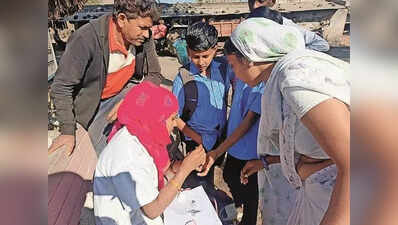
I remember the early days of our sickle cell work not through files or review meetings but through faces.I remember sitting in a tertiary hospital with parents trying to understand how an inherited blood disease they had never been warned about had entered their children’s lives so early, and so harshly. Many were healthy carriers themselves. They had done nothing wrong. They simply did not know. An elderly kaka told us that every few weeks, he left his kheti and travelled nearly 50km for hydroxyurea, a medicine that reduces the frequency and severity of sickle cell crises. A crisis takes over the body, the household and the family economy. On Sickle Cell Day last year, we invited patients to speak. A young woman, only 21, broke down describing how she tells her younger siblings, “Khud ka dhyaan rakho (take care of yourself). No one will come to save you.” It carried both courage and abandonment, and it made the administrative question clear. A public health system cannot wait for people in such circumstances to find their own way through diagnosis, treatment and support. The system has to move first. The National Sickle Cell Anaemia Elimination Mission has created an important mandate. In a high burden tribal district, the real test lies in what happens after screening. Does the patient get hydroxyurea near home? Is there a registry that lets the system remember the patient, instead of the patient having to keep chasing it? Nandurbar has screened nearly 5 lakh people. Trait prevalence here runs nearly 15-20%, against the roughly 10% programme design generally assumes, and disease prevalence is 1-1.5%. Those parents were never told what they were carrying. That is what wide early testing changes, and it matters as much for carriers as for patients. Two tests together made it possible. High performance liquid chromatography gives the fuller picture. Dried blood spot genetic testing, developed by Centre for Cellular and Molecular Biology, lets a frontline worker collect a sample through a finger prick and send it without cold chain, reaching habitations where waiting for people to travel to a lab would have taken years. It has also brought screening forward. The full newborn panel has to wait until the third day, when hormone levels settle enough to read reliably. Sickle cell alone can be caught from a dried blood spot on the first day, wherever the child is born.Diagnosis without treatment is a form of cruelty. Telling someone they have sickle cell disease and then sending them kilometres for medicine transfers the burden back to them. Nandurbar decentralised hydroxyurea to primary health centres, with support and training for doctors. The district also set up a sickle cell helpline unit that does not wait for patients to appear. It calls them, follows up on treatment, connects them to entitlements and builds trust. Disability certificates issued have gone from about 100 a year ago to around 1,500. Monthly sickle cell melas and support groups gave families a place to be tested and to see they were not alone. A Bhili and Pawri language playlist, made with an organisation that has run palliative care in these villages for years, carried stories of hope. Care cannot stay scattered across camp registers, test reports and hospital files. Nandurbar has begun using e-Suchi—its digital health directory—to map patients. Prevention comes next because sickle cell touches marriage, family anxiety and young people’ choices. Elimination is not a campaign but a continuum, and social security delivery and prevention at scale are still unfinished here. For an administration, the real question is not only how many were tested but also how many were found, counselled, treated, followed up and protected from falling through the cracks. That is where the promise of sickle cell elimination will finally be tested.(The writer is Nandurbar’s district collector)

Political meddling delayed Mumbai-Goa highway project for 17 years: Raj | Mumbai News

Political meddling delayed Mumbai-Goa highway project for 17 years: Raj
Raj Thackeray alleged that locals were being kept out of the Third Mumbai plan in Raigad

Mumbai: MNS chief Raj Thackeray on Sunday, while criticising the 17-year delay in redeveloping the Mumbai-Goa highway, said, “This is because of political interference.”Speaking to reporters during his Raigad visit, he raised concerns over the execution of a project crucial to Konkan connectivity and the impact of the continuing works on motorists and local residents.He said he had spoken to Union roads and highways minister Nitin Gadkari about it. “Gadkari said the contractors are fed up. I think the problem is that the govt appoints contractors without completing land acquisition and then the bills keep going up,” Thackeray said.State transport minister Pratap Sarnaik largely echoed Thackeray’s concerns and acknowledged that the Mumbai-Goa highway project had remained delayed for several years. Speaking to reporters in Thane, Sarnaik said that Thackeray’s constructive suggestions cannot be ignored, particularly on the highway project delays. Sarnaik, however, noted that the highway project had been pending since the tenure of the Congress-NCP govt and claimed that work gathered momentum under the present Mahayuti govt.Thackeray alleged that the Third Mumbai being developed in the Konkan would exclude the locals and that they should oppose this approach. Thir Mumbai is being planned for outsiders, he said during a visit to Raigad on Sunday. “There are plans for an Educity, Medicity, and data centres, but what do the locals know about this? These are secretive plans. The locals will remain as ex-land owners. The gains will go to outsiders and industrialists,” he warned.(With inputs from Nishikant Karlikar in Thane)

In Mumbai, time, cost and space crunch keeps clay behind PoP Ganesh idols despite ecological push | Mumbai News

In Mumbai, time, cost and space crunch keeps clay behind PoP Ganesh idols despite ecological push

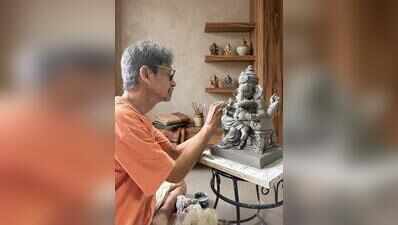
Mumbai: In a workshop at King Circle, a towering Ganesh idol is slowly taking shape, not from Plaster of Paris (PoP), but from shadu clay, sculpted patiently by hand. For years, commercial idol-makers have been arguing that giant public idols cannot be made from clay, claiming the material is too fragile to support its own weight. At GSB Seva Mandal, that assumption quietly falls apart: artisans here have been hand-crafting massive clay idols for over seven decades.Outside its walls, however, PoP continues to dominate Mumbai’s workshops. And as Bombay high court once again hears the state govt’s plea to extend the use of PoP idols taller than six feet for immersion in natural water bodies, the city’s familiar annual environmental debate has returned. Court directions on phasing out PoP date back to 2013, but artisans, environmentalists and organisers say the transition is shaped by far more than the choice of material.Marine biologist Yazad Mehta (30) is clear about the environmental cost. Contrary to popular belief, he says, PoP idols do not dissolve after immersion. Their calcium sulphate base breaks down into dense, non-biodegradable sludge that settles across the seabed. “Along with PoP, it’s also the heavy metal paints on these idols that severely pollute our water bodies,” Mehta says, adding, “synthetic paints laden with toxic heavy metals leach persistent chemicals into the marine ecosystem.Artisans, though, often start the discussion elsewhere: with engineering. At GSB Seva Mandal, trustee RG Bhat says their idol has always been made differently. “Our idol is made with clay only, pure shadu mati,” he says, adding that its dimensions are determined by tradition as much as craftsmanship. Every year, the deity is adorned with more than 65 kg of gold and hundreds of kg of silver jewellery. “Because it has jewellery, all its measurements need to be exact; otherwise it doesn’t fit,” says Avinash Patkar (67), a former JJ School of Art professor and second-generation sculptor behind the idol.Working alongside his daughter Gautami Patkar (35), who has been experimenting with large-scale papier-mâché idols, Patkar spends nearly a month sculpting the idol by hand. Raw clay is mixed with sacred durva grass and dried hay to create a fibrous material that binds naturally without a rigid mould. The idol then dries under industrial exhaust fans for nearly a week before hairline cracks are repaired with fresh clay. “A person doing PoP work cannot even apply it,” Patkar says, pointing to the specialised skill shadu clay demands.Many commercial workshops across Mumbai, though, say the real challenge is less about technique than time and space. PoP cures within hours and dries completely in two to three days; shadu clay can take between 15 and 20 days to dry in Mumbai’s monsoon humidity. Artisans say that difference affects almost every stage of production. A single clay idol often needs to be shifted, rotated and supported between 25 and 40 times as it dries, requiring considerably more workshop space in a city where land is at a premium.Prakash Koyande (54), a spray-paint and detailing specialist in Jogeshwari with 27 years in the trade, says workspace has become his biggest concern. “This year, I don’t have a pandal. The space that I had was through BMC, and it hasn’t been allotted to me this year due to space issues. If I leave one place and go to another, it affects the customers, and I have to look out for my artisans too,” he says. Access to workspace remains a challenge, Koyande says, even as BMC provides free shadu clay through its online single-window system.The economics also shape material choices. Ramchandra Patil of Majha Morya in Navi Mumbai, who has sold PoP, shadu clay, red soil and paper idols since 2017, says customers transporting idols over long distances usually prefer PoP for its durability.Dattadri Kothur (40), art director and founder of Tree Ganesha in Worli, says the difference begins inside the workshop. “PoP makers have more demand and earn more because they get paid per piece,” he says. A worker pouring liquefied plaster into a rubber mould can produce about ten identical idols a day and earn roughly Rs 1,000, Kothur says; a clay artisan may spend the same amount of time shaping and reinforcing a single idol while earning about Rs 500. Those differences show up in retail prices too: mass-produced PoP idols are often available at nearly half the price of comparable clay idols. Clay idols also require customised wooden support frames for transport, adding further to production and logistics costs.Kothur has taken a different approach in his own workshop. Tree Ganesha makes idols from untreated red soil sourced from Gujarat and the Konkan, avoids chemical paints, and embeds each idol with seeds and fertilisers so devotees can immerse them at home in supplied pots. Even then, he says, convincing first-time buyers isn’t easy. “First-time users always ask if it will break during transport,” he says, a hesitation he believes is rooted in faith as much as practicality. “People hold a deep devotion; they fear that if an idol cracks at home during drying or transit, it brings a bad omen.”Municipal data shows Mumbai deployed 298 artificial immersion sites in 2025, with 98% of smaller household idols immersed there. Yet 61% of all idols immersed that year were still made of PoP.Kothur believes the transition to eco-friendly idols will depend as much on public leadership as on policy. “If the mega mandals, the celebrities, and the historic icons like Lalbaugcha Raja lead by example, by voluntarily reducing their height and embracing clay, 100 other neighbourhood mandals will instantly follow,” he says. Until the leadership of the festival changes its definition of grandeur, the artisans on the margins will continue to fight an uphill battle against time, space, and the rigid mould of plaster.


Versova police save Mumbai man from suicide attempt after domestic dispute | Mumbai News

Versova police save Mumbai man from suicide attempt after domestic dispute

Mumbai: A 40-year-old man was saved after the Versova police broke into his house and foiled his suicide attempt on Sunday. The police rushed to Sagar Kutir locality in Andheri (West) after he tried to end his life at 12.42 pm allegedly after an argument with his wife over a domestic issue.Versova police received information through the police control room after a neighbour alerted them. A team reached the spot within five minutes and saved the person.A Versova police officer said: “The couple argued over a domestic issue, following which the man took the extreme step. We received a call from a neighbour, and our team reached the spot within five minutes. The team administered CPR (cardiopulmonary resuscitation) and revived the man.”Later, police took the man to Cooper Hospital in Vile Parle West for further treatment. “After he regained consciousness and medical treatment assistance he was dropped at his resisdence in presence of his family member and was counselled,” said the police.Police did not disclose the man’s name or profession.

Santacruz Police Arrest Bihar Man for Rs 1 Crore Burglary at Actress Lopamudra Raut’s Flat | Mumbai News

Santacruz Police Arrest Bihar Man for Rs 1 Crore Burglary at Actress Lopamudra Raut’s Flat

Mumbai: Santacruz police arrested a 26-year-old man from a village in Bihar’s Darbhanga district for a burglary of over Rs 1 crore from the fifth-floor rental flat of Bollywood actress and Big Boss 2016 second runner-up Lopamudra Raut (32) on July 14. The accused, Chandan Mukhiya, reportedly used a bamboo stick to reach the fifth-floor balcony, broke the door, and entered the actress’s bedroom to steal the valuables. He escaped using the same route and executed the burglary within an hour. Police were searching for Mukhiya’s uncle Lalu (45), who helped in disposing of the stolen property and also helped him buy land.DCP (West Zone-2) Mohit Garg confirmed the arrest of the accused, who was produced before the local court on Saturday after getting his transit remand in Darbhanga on August 2.The burglary occurred when Raut was not present in the flat after she went to her hometown in Nagpur on July 20. She learnt about the burglary when she returned to the residential building on Juhu Tara Road in Santacruz (West) on July 27 at 2 pm and found she was unable to open the door as it was locked from inside. Police said she alerted her flat owner, who informed her that he would call a keysmith to break the lock, but she told the flat owner that she would go to the Santacruz police station and would be back with the cop.In the complaint, “A constable, Patil, who accompanied me along with the two building staff tried to unlock the door but they too failed. Then we sent one of the building staff, Shaifullah Shaikh, to enter the flat through the balcony which he noticed was broken. He unlocked the door and I found my bedroom ransacked with my money and gold valuables stolen from the locker after breaking the cupboard.”Based on Raut’s complaint, DCP (West Zone-2) Mohit Garg supervised multiple teams, including ACP Vinod Gaonkar, senior inspector Dattatray Masvekar, inspector Sakharam Mole, assistant inspector Sanjay Kalhatkar, sub-inspector Umesh Kaulge, assistant sub-inspector Jaywant More and staff. Police said the accused was identified and tracked through technical analysis of Mukhiya’s registered mobile number, which placed him at the scene of the crime on July 14 night, confirming his involvement.Police said the team travelled to Darbhanga and, with the assistance of the local Sonki Police Station, tracked down and apprehended Mukhiya.On Sunday, Raut told TOI, “I applaud the Mumbai police who have speeded up the case and nabbed the thief. Still it is a long way, I have complete faith and trust in the Mumbai police in getting back my stolen property.” Police said they called Raut to verify the recovered property and to know the total count that was stolen.

Denied court relief, ex-TISS student held over Saibaba event | Mumbai News

Denied court relief, ex-TISS student held over Saibaba event
Abhirup Paul was sent to police custody till Aug 10

Mumbai: Hours after the anticipatory bail applications of two former students of Tata Institute of Social Sciences (TISS) were rejected in a case stemming from an unauthorised campus event to pay homage to the late Delhi University professor G N Saibaba last year, who was acquitted in a UAPA case, one of them—Abhirup Paul (32)—was arrested on Friday.He was produced before a court on Saturday and sent to police custody till Monday, said a police officer.The other former student who was denied relief, Kamakhya Das (23), was not arrested till Sunday night.A sessions court denied the two relief after police claimed to have found material on their devices suggesting Maoist ideological influence, non-cooperation and the need for custodial interrogation. Paul was particularly accused of downloading “books reportedly instigating the division of India” and going to places as part of “field work”, and Das of threatening a cop.Paul, originally from West Bengal, did his master’s in disaster management from TISS and was working in Mumbai. Das, who is from Assam, completed his PG in development studies. Both graduated from the institute this May and were awaiting their degrees, said students. The convocation, set to be held on Aug 2, was abruptly postponed due to “unforeseen circumstances” and later rescheduled to Aug 22.A student said the case had been dormant for the last eight months—the case was transferred to the crime br­a­nch and the presiding judge’s transfer necessitated a rehearing—and Paul and Das had completed their studies and moved out of the campus. Very few were in touch with them, said the student.After the arrest, a TISS spokesperson said, “We have taken note of the matter. At this stage, it would not be appropriate for us to comment on individual cases or share any specific details. We are verifying the relevant records and will provide an appropriate response once the details have been reviewed.”An FIR was filed against nine students based on a complaint by TISS that an unauthorised event was he­ld on the campus on Oct 12, 2025, to commemorate the first dea­th anniversary of Saibaba, who had spent nearly a decade in a Nagpur jail after being accused of links with Maoists. He was ultimately acquitted of all charges in March 2024 before his death that year.Seven of the students were granted anticipatory bail last Friday after the cou­rt found that the allegations against them were largely confined to partic­ipation at the event.The court, however, had noted that the students’ conduct was not limited to paying homage and that they had also allegedly raised slogans seeking the release of former student activists Umar Khalid and Sharjeel Imam, who are facing trial under UAPA.