Maharashtra dy CM Eknath Shinde sets 3-year deadline for housing projects, warns developers will miss future govt contracts in case of delay | Mumbai News

Maharashtra dy CM Eknath Shinde sets 3-year deadline for housing projects, warns developers will miss future govt contracts in case of delay

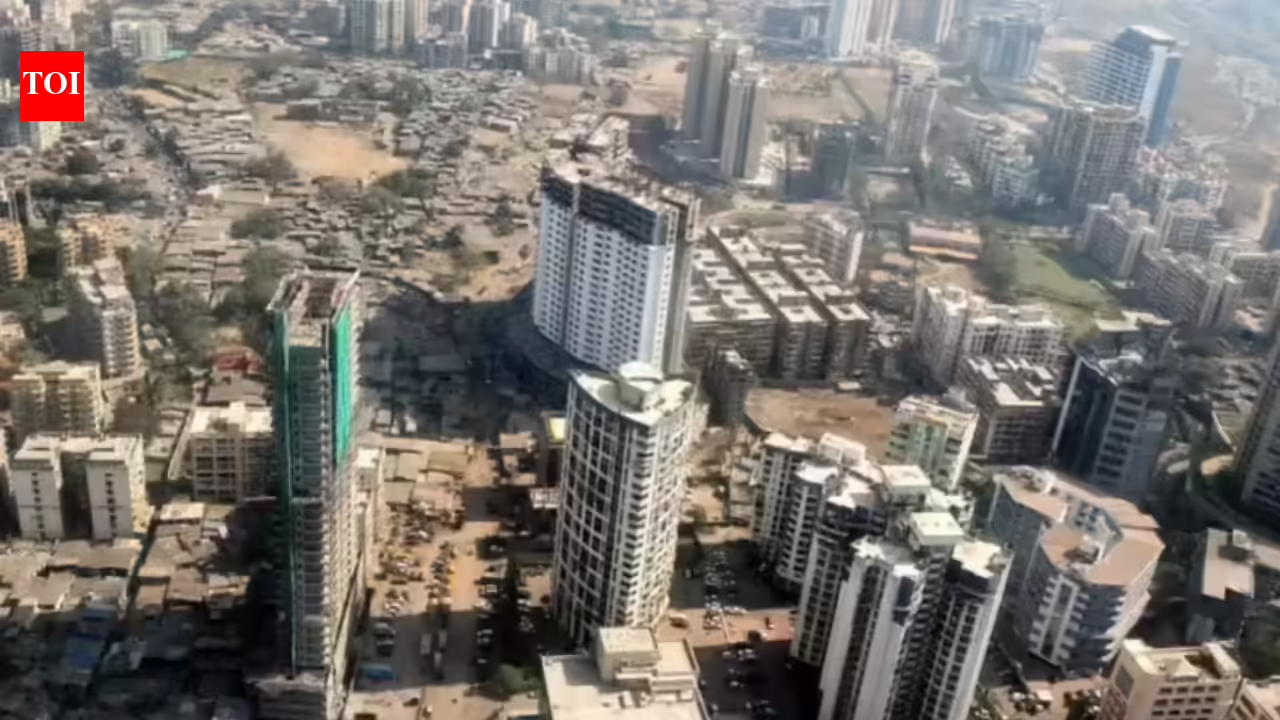
Thane: Maharashtra deputy chief minister and housing minister Eknath Shinde on Sunday issued a stern warning to developers, setting a three-year deadline for completing housing and redevelopment projects and declaring that builders who miss timelines or compromise on quality could be barred from securing future govt contracts.Shinde was speaking after handing over keys to beneficiaries of a redevelopment project in Thane’s Majiwada area late Sunday, where he signalled a tougher stance on delayed redevelopment projects. The state govt, on its part, is keen on removing administrative bottlenecks to fast-track completion of long-pending housing projects and accelerate cluster redevelopment across Maharashtra, he said.“Owning a home is a matter of dignity and security, and every family deserves a quality home. A home is not just four walls but a place of love, happiness and a family’s dreams,” Shinde said, adding that fulfilling citizens’ aspirations of home ownership remains a top priority for the Maharashtra govt.Elaborating, Shinde said the housing department made the completion of stalled redevelopment and housing projects its foremost priority since he assumed charge of the portfolio and assured that all procedural hurdles would be cleared to ensure faster execution.Highlighting the state govt’s redevelopment agenda, he said cluster redevelopment projects were gaining momentum across the state, with projects in Thane’s Wagle Estate nearing completion. He iterated the govt’s vision of making Mumbai and Thane slum-free through planned redevelopment and said citizens would be provided quality homes under the programme.

Gulf conflict slows home sales; Mumbai Metropolitan Region remains India’s biggest housing market despite 8% dip | Mumbai News

Gulf conflict slows home sales; Mumbai Metropolitan Region remains India's biggest housing market despite 8% dip
Despite 8% dip, Mumbai metropolitan region remains India’s biggest housing market

MUMBAI: Geopolitical uncertainty arising from the ongoing West Asia conflict appears to have taken some steam out of India’s residential property market, with housing sales across the country’s seven largest cities declining 6% year-on-year during the April-June quarter even as developers continued to launch new projects.According to ANAROCK Research, around 90,715 homes were sold across the top seven cities in Q2 2026 compared with 96,285 units in the corresponding quarter last year. On a sequential basis, sales declined 11%.For the Mumbai Metropolitan Region (MMR), however, the slowdown did little to dent its position as the country’s largest residential market.MMR recorded the highest absorption of about 28,710 homes during the quarter, nearly one-third of total sales across the top seven cities, despite registering an 8% decline from the 31,275 units sold a year ago.The region also led fresh supply, with developers launching about 34,555 homes, a 23% increase over the corresponding quarter last year, although launches fell 14% compared to the January-March period.More than 57% of the new supply in MMR was priced below Rs 1.5 crore, indicating sustained developer focus on upper-mid income homebuyers.Together, MMR and Bengaluru accounted for nearly 48% of all homes sold and 53% of new launches across India’s seven major residential markets.The report attributed the moderation in demand to uncertainty triggered by the West Asia conflict, its impact on global supply chains and caution among homebuyers amid concerns over the technology sector.“The Middle East war’s impacts on the entire sector were all too obvious. We now have a more balanced housing market where new supply is catching up with absorption as sales growth moderated across most cities,” said Anuj Puri, Chairman, ANAROCK Group.He added that demand continues to be driven by premium housing, infrastructure-led corridors and cities with strong Global Capability Centre (GCC) employment, while uncertainty surrounding the IT and ITeS sectors and rapid advances in artificial intelligence have prompted some prospective buyers to postpone purchase decisions.Despite slower sales, developers maintained confidence by increasing launches 7% annually to about 1.06 lakh units across the top seven cities. ANAROCK said much of the new supply came from large and listed developers launching projects on land parcels acquired during 2025.The report also highlighted a clear shift towards premium housing. Homes priced between Rs 80 lakh and Rs 1.5 crore accounted for the largest share of fresh launches at 27%, followed by the Rs 1.5 crore-Rs 2.5 crore segment with 25%.Luxury housing priced above Rs 2.5 crore contributed another 22%.In contrast, affordable housing continued to lose ground, with homes priced below Rs 40 lakh accounting for just 6% of total new supply, a single-digit share that underlines the widening gap between demand and availability in the budget segment.Among other cities, only Kolkata, Hyderabad and Bengaluru recorded annual growth in housing sales, while Pune witnessed the steepest decline of 15%. Hyderabad posted the highest increase in fresh launches at 53%, while Bengaluru saw a 41% jump in new supply.Residential prices continued to rise, though at a slower pace. Average prices across the seven cities increased 7% year-on-year but only 1% over the previous quarter, suggesting price appreciation is stabilising after the sharp gains seen over the past two years.NCR recorded the highest annual price increase at 13%, followed by Bengaluru at 8%.Meanwhile, unsold inventory across the seven cities rose 10% year-on-year to over 6.16 lakh units by the end of June 2026, reflecting improving supply.Bengaluru registered the highest inventory growth at 34%, while NCR remained the only market where inventory levels stayed largely unchanged.The findings suggest that while housing demand has moderated amid global uncertainties, developers remain optimistic about long-term demand, particularly in metropolitan regions such as MMR where infrastructure expansion and employment growth continue to underpin residential activity.


‘Strict action upon violation’: Maharashtra govt makes Marathi compulsory from Classes 1 to 10 in all schools | Mumbai News

'Strict action upon violation': Maharashtra govt makes Marathi compulsory from Classes 1 to 10 in all schools
Dada Bhuse said, “The Maharashtra government is fully committed to the preservation, promotion, and propagation of the Marathi language.”

MUMBAI: Maharashtra education minister Dada Bhuse on Monday announced that Marathi will be a compulsory language from Classes 1 to 10 across all schools in the state.According to news agency ANI, he warned of strict action against institutions violating the directive and said the government is committed to promoting Marathi and the legacy of Chhatrapati Shivaji Maharaj.Announcing the Maharashtra Legislative Assembly’s Monsoon Session, Bhuse said the state government has issued instructions to ensure Marathi is taught compulsorily in all affiliated schools.The issue was raised during a question by BJP MLA Atul Bhatkhalkar, who flagged concerns over several schools allegedly not implementing the mandatory teaching of Marathi.During the discussion, legislators also pointed out that penalties imposed on erring schools were inadequate and that enforcement of existing rules remained ineffective.Responding to the concerns, Bhuse said, “The Maharashtra government is fully committed to the preservation, promotion, and propagation of the Marathi language.”He stated that a special inspection campaign will be launched across the state, reviewing the compulsory teaching of Marathi in all schools.“If any violations are found during the inspections, strict action will be taken against the concerned schools and officials,” the minister said.Bhuse also spoke about the inclusion of the history of Chhatrapati Shivaji Maharaj in school textbooks, stating that the coverage had been significantly expanded.He said that while textbooks of other education boards earlier devoted only about one-and-a-half columns to Chhatrapati Shivaji Maharaj, the content has now been expanded to 22 pages with the approval of the Central government, enabling students to gain a more comprehensive understanding of the Maratha ruler’s life and contributions.The minister reiterated that the state government remains committed to strengthening the Marathi language and ensuring that students are educated about the glorious legacy of Chhatrapati Shivaji Maharaj.The announcement comes a day after the Central Board of Secondary Education (CBSE) said it would implement the three-language formula in phases across schools in the country.According to the CBSE, the current batch of Class X students will not have to follow the new language policy, and students currently in Classes VII, VIII and IX will not be required to appear for a board examination in a third language when they reach Class X.The CBSE also said students in the current batches of Classes VII, VIII and IX who had already opted for two foreign languages would continue with the same, along with one additional native Indian language (bhartiya bhasha). It added that grade-appropriate resource material would be made available in a time-bound manner.(With inputs from ANI)

Mumbai court acquits woman in 2007 Rs 2 crore investment fraud; complainant never testified | Mumbai News

Mumbai court acquits woman in 2007 Rs 2 crore investment fraud; complainant never testified
The complainant alleged that she became acquainted with Merchant through Mehraj Qureshi, who operated Sunshine Beauty Parlour.

MUMBAI: A Mumbai metropolitan court has acquitted a woman accused in a two decade old investment fraud case, holding that the prosecution failed to prove her involvement in the alleged cheating scheme beyond reasonable doubt.The case related to investments collected in 2007 for a purported textile import business that allegedly promised high returns to investors. The court noted a major gap in the prosecution’s case as the original complainant was never examined during the trial.It also found that witnesses had handed money only to the main accused, Parveen Merchant, and not to the acquitted woman. The court ruled that there was insufficient evidence to establish her role or common intention to defraud investors.The additional chief judicial magistrate SK Fokmare of the 19th Court acquitted Mehraj Qureshi of all the charges of cheating. The case pertains a complaint filed by complainant Aashiya Lasanwala and several other investors were allegedly induced in 2007 to invest money in a purported textile import business run by accused Parveen Tahir Merchant. Police said more than 30 investors were duped of around Rs 2 crores.The complainant alleged that she became acquainted with Merchant through Mehraj Qureshi, who operated Sunshine Beauty Parlour. Qureshi allegedly informed the complainant that Merchant was engaged in importing cloth from Dubai and Pakistan and that investors could earn substantial monthly returns.The complainant claimed she initially invested Rs 50,000 after being promised returns of Rs 10,000 per month. Subsequently, Merchant allegedly sought an additional Rs 1 lakh, claiming the funds were needed to release imported textile consignments.Investors were allegedly assured returns of up to Rs 40,000 per month on investments of Rs 1.5 lakh. The prosecution further alleged that after making an initial payment of Rs 10,000 as a return, Merchant stopped making payments and avoided investors.When investors sought refunds, they were allegedly refused and threatened.The EOW recorded statements of victims and witnesses, conducted searches at premises linked to the accused, and collected various documents, including memorandums of understanding, receipts, cheques, bank records and handwriting expert reports.The accused were charge-sheeted for offences under Sections 406 and 420 read with Section 34 of the Indian Penal Code. During the proceedings, accused Jyoti Hasmukh Mistry and Shakil Ahmed Rehmani were discharged in December 2015. The trial against Parveen Merchant was separated after she absconded.Aftaf Qureshi advocate for Qureshi said the prosecution examined 12 witnesses, including several alleged victims who had invested money in the scheme. However, the court noted a significant weakness in the prosecution case: the original complainant, Aashiya Lasanwala, was never examined during the trial.The court further found that none of the victim witnesses had entered into any monetary transaction with Mehraj Qureshi. Witnesses consistently admitted during cross-examination that they had handed money to Merchant and not to Qureshi.“One witness stated she never gave any money to Qureshi, another admitted she had no financial dealings with Qureshi, a third witness acknowledged that all monetary transactions were with Merchant and lastly, a landlord who testified against Qureshi ultimately admitted that her grievance was limited to unpaid rent and that she had no financial dealings with the accused in relation to the investment scheme,” said advocate Qureshi.The court observed that for an offence of cheating under Section 420 IPC, the prosecution must prove dishonest intention from the very inception of the transaction.Magistrate Fokmare held that while there was material against absconding accused Merchant, the evidence against Qureshi was insufficient. The prosecution failed to establish that Qureshi knowingly made false representations regarding Merchant’s business or that she shared any common intention to cheat investors.The proceedings against absconding accused Parveen Tahir Merchant remain pending. The court directed the prosecution to take steps to secure her presence and continue proceedings against her.

Cloudburst-like spell pounds Mumbai’s eastern suburbs; IMD issues orange alert | Mumbai News

Cloudburst-like spell pounds Mumbai's eastern suburbs; IMD issues orange alert

MUMBAI: The India Meteorological Department’s (IMD) prediction of a rain-soaked week played out dramatically just after midnight on Monday, when an intense three-hour spell of rain lashed Mumbai’s eastern suburbs, leading to the weather bureau to issue an orange alert at 1.05 am.The heaviest downpour was concentrated over the eastern suburbs, with automatic weather station (AWS) data showing Mulund (West) receiving over 200 mm of rainfall in the 24 hours ending 8 am on Monday. Almost the entire deluge, however, fell within a few hours between midnight and the early morning, overwhelming several low-lying pockets.The stark variation in rainfall was evident across the city. While the IMD’s Santacruz observatory recorded 104 mm of rain in the 24 hours ending 8.30 am, the Colaba observatory in south Mumbai logged just 30.4 mm. Localities such as Byculla (43 mm) and Malabar Hill (45 mm) also received less than 50 mm of rainfall.Neighbouring regions bore the brunt as well, with Thane recording 117 mm and Navi Mumbai averaging 118 mm during the same period.The overnight downpour led to waterlogging in some low-lying areas, including the Andheri East-West subway, which was temporarily shut to traffic. However, by the start of the morning rush hour, civic agencies had cleared most water logged stretches, allowing road, school and office traffic to resume.Independent weather observer Athreya Shetty attributed the highly localised ‘cloudburst’ like rainfall to a rare confluence of weather systems. He said strengthening monsoon westerlies carried abundant moisture but failed to penetrate beyond Navi Mumbai, creating a convergence zone over Thane Creek and Navi Mumbai.“This triggered towering cumulonimbus clouds that remained virtually stationary because of weak steering winds, dumping 120-195 mm of rain in barely three hours over the eastern suburbs and Navi Mumbai. At Koparkhairane, rainfall intensity briefly touched 149 mm per hour, approaching cloudburst levels,” he said.The heavy rain kept emergency services busy through the night. The BMC reported 16 short-circuit incidents, including nine in the eastern suburbs, though no injuries were reported. Civic authorities also received 34 complaints of fallen trees and branches and three complaints of partial wall or house collapses. Relief work was initiated in all cases, with no casualties reported.Even as Mumbai received a major rain spell water stocks in the seven lakes supplying to Mumbai are yet to see a significant increase. The seven lakes supplying drinking water to Mumbai currently hold 1 lakh million litres, or just 6.93% of their total capacity of 14.47 lakh million litres. On the same date last year, lake storage stood at 5.71 lakh million litres, or 39.5% of capacity.Average rainfall recorded by IMD observatories for a 24 hour period ending 8.30 am on June 29:

  • IMD Santacruz: 103 mm
  • IMD Colaba: 30.4 mm

Total rainfall recorded by the automatic weather stations in the 24 hours ending 8 am (June 28-29)

  • Versova: 167 mm
  • Goregaon: 129 mm
  • Sion:124 mm
  • Marol: 122 mm
  • Mulund, Veena Nagar: 210 mm
  • Mulund, Gawanpada: 167 mm
  • Byculla: 43 mm
  • Malabar Hill: 45 mm
  • Matunga: 61 mm
Mumbai breathes easy with 8 ‘good’ air days in June, Thane trails in MMR’s AQI tally | Mumbai News

Mumbai breathes easy with 8 ‘good’ air days in June, Thane trails in MMR’s AQI tally
A comparative analysis of air quality index data from June 1 to 27 reveals that Mumbai emerged as the cleanest city in the Mumbai Metropolitan Region

Mumbai: Even as a heavy blanket of monsoon clouds hovered over the Mumbai Metropolitan Region (MMR), the cities of Mumbai, Thane, and Navi Mumbai recorded starkly contrasting air quality trajectories through most of June.A comparative analysis of air quality index (AQI) data from June 1 to 27 showed that Mumbai emerged as the cleanest city in the MMR by clocking eight days in the ‘good’ category (AQI 0–50), while Thane lagged with the lowest count of pristine air days (3) despite maintaining a highly consistent ‘satisfactory’ AQI streak.According to data compiled from the daily AQI calendar, Mumbai registered clean air spells primarily during the latter half of the month — on June 1, 18, 19, 20, and from June 22 to 25. Satellite city Navi Mumbai logged seven ‘good’ air days, while Thane cut a dismal figure with just three days of ‘good’ AQI days from June 22 to 24.However, Thane dominated the ‘satisfactory’ category (AQI 51–100), logging 24 days where the air quality remained moderate with minor health impacts for sensitive individuals. Navi Mumbai recorded 20 ‘satisfactory’ days, while Mumbai saw 19.None of the three cities breached the ‘moderate’ or ‘poor’ thresholds during this 27-day summer-monsoon transition period, ensuring that the overall regional air remained highly breathable.Overall, Mumbai scored the best in the month due to its superior number of ‘good’ air days and lower localised AQI dips, making it the cleanest pocket in the metropolitan belt. PM10 emerged as the predominant pollutant in Thane and Navi Mumbai, where it dictated the AQI on 26 out of 27 days. Conversely, Mumbai exhibited a mixture of different pollutants: PM10 was the most frequent primary pollutant at 13 days, and ozone and NO2 dominated for seven days each.“Mumbai exhibits higher NO2 levels primarily driven by its concentrated industrial emissions, alongside volatile organic compounds that trigger ground-level ozone formation due to intense vehicular density in the island city,” said Sunil Dahiya, founder and lead researcher at Envirocatalyst. “Conversely, PM10 largely fueled by road dust dominates the satellite cities of Thane and Navi Mumbai, where heavy construction and infrastructure projects remain major contributors.

Cabbie threatens undercover police outside Mumbai airport, arrested and booked for extortion | Mumbai News

Cabbie threatens undercover police outside Mumbai airport, arrested for extortion over inflated fare

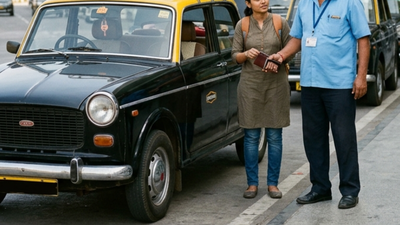
MUMBAI: Sahar police arrested a 49-year-old cab driver for allegedly threatening police officers posing as decoy customers outside Mumbai International Airport and hiring his taxi to travel to Borivli. The incident occurred on June 25 when the accused, Warisali Sayuddin Shaikh, allegedly fixed the fare at Rs 550 for Borivli but midway demanded Rs 800. Shaikh was booked for extortion, his vehicle was seized and his licence was send for suspension.When the decoy customers questioned the increased fare, Shaikh allegedly threatened them with dire consequences and warned them to remain seated if they did not want trouble. “This is the second such incident that occurred in less than 48 hours,” said police.A special drive was carried out by Sahar police to keep a check on auto rickshaw and cab drivers who threatened and fleeced customers hiring their services after exiting the airport. In the complaint, police constable Devidas Sonawane (56) said, “I and police constable Akshay Borate along with two witnesses—Avnish Tiwari (19) and Siddhesh Khedekar (19)—were standing on the opposite side of the exit lane from the airport near Hyatt Signal inquiring about booking an auto-rickshaw and taxi to go to Borivli. A taxi driver approached us. The accused’s behavior was aggressive, and his words created fear in our minds,” said Sonawane in the FIR. Police said a team following the taxi stopped it after receiving a signale from Sonawane and arrested Shaikh.On June 23, Sahar police arrested an auto rickshaw driver, Mohammed Aslam Sheikh (45), from Jogeshwari (W), in a case of extortion after he allegedly tried to fleece decoy passengers outside Mumbai International Airport.After a foreigner on a Mumbai trip on Jan 12 was fleeced of 200 US dollars by two cab drivers for a 400 metre drive to her hotel, Sahar police said they initiated stringent action against cab and auto rickshaw drivers by booking them under extortion charges apart from cheating to curb the menace of drivers threatening, fleecing and extorting money from tourists and passengers.

SHRC takes up VN Desai Hospital’s ‘fake doc’ case | Mumbai News

SHRC takes up VN Desai Hospital’s ‘fake doc’ case
The doctor was appointed on contract through Sai Sanjeevani Services

Mumbai: The State Human Rights Commission has taken up the case of an alleged ‘bogus doctor’ who was found posted in the ICU at VN Desai Hospital in 2024. The hearing is scheduled to start on July 9.The hospital found that Dr Bharat Sawant, appointed on contract through Sai Sanjeevani Services, had suspicious documents after the Maharashtra Medical Council (MMC) could not verify his medical certificate.The hospital has since suspended all financial payments to the hiring agency. However, Sawant had already worked there for almost two years. Dr Jairaj Acharya, the hospital’s former medical superintendent under whose tenure the doctor worked, was unavailable for comment. Dr Sawant too remained unavailable for a comment.In an internal communication, Dr Mayura Nagale, the present medical superintendent of the hospital, said that Sai Sanjeevani Services had a formal agreement dated July 29, 2022, to provide trained and qualified doctors (ICU personnel) for a period of two years. She added that, as per the terms set, it was the sole responsibility of the vendor to ensure all medical staff possessed valid registration with the medical council. The hospital had no role in allowing Dr Sawant to work without proper documentation, she said.“The doctor’s certificate was sent for MMC verification, and it was confirmed to be invalid,” Dr Nagale said.

CM Devendra Fadnavis reviews Mumbai-Delhi freight corridor work, says Mumbai-Vadodara Expressway will be commissioned by August 31 | Mumbai News

CM Devendra Fadnavis reviews Mumbai-Delhi freight corridor work, says Mumbai-Vadodara Expressway will be commissioned by August 31
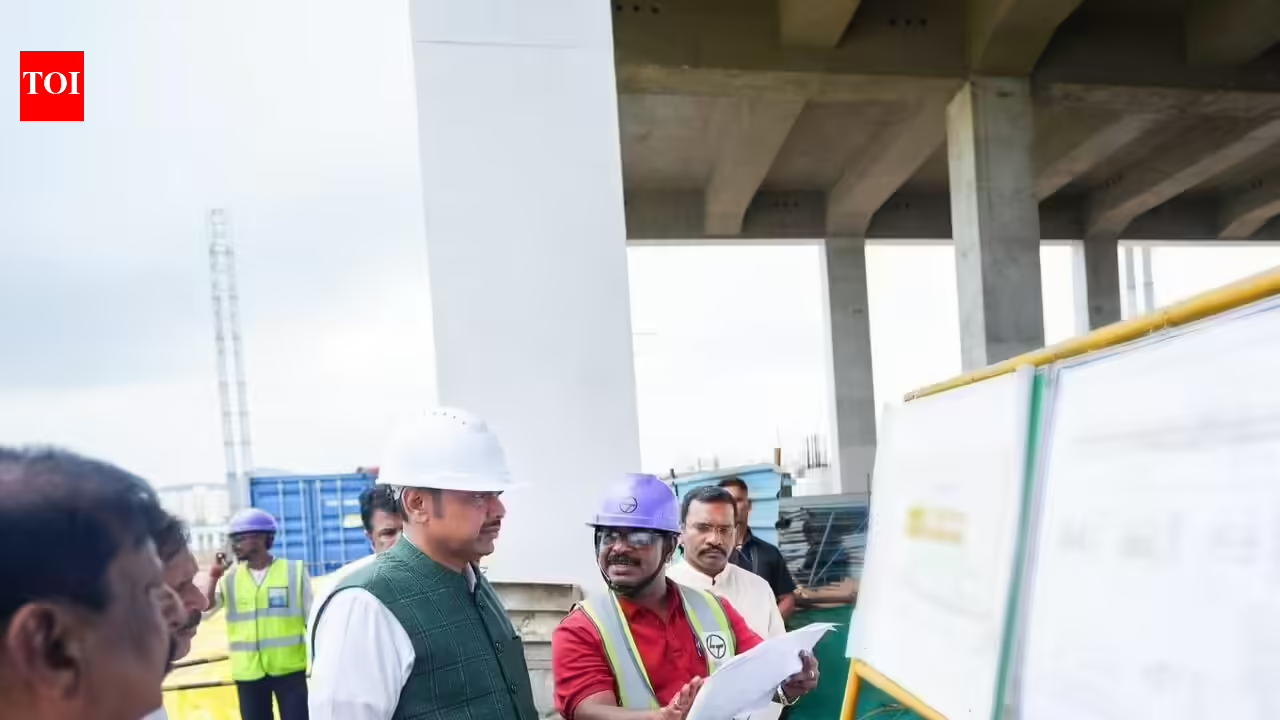
On Sunday, Devendra Fadnavis, accompanied by state forest minister Ganesh Naik and fisheries minister Nitesh Rane, carried out an inspection of various infrastructure projects in Palghar district

Mumbai: The 157km Mumbai-Vadodara Expressway, part of the Delhi-Mumbai freight corridor, will be commissioned by August 31, said CM Devendra Fadnavis. Once commissioned, the travel time between Vadodara to Mumbai will be reduced from the eight hours to about four.It will provide a fast, safe, and traffic jam-free travel experience and also boost commercial transport, said the CM.On Sunday, Fadnavis, accompanied by state forest minister Ganesh Naik and fisheries minister Nitesh Rane, carried out an inspection of the works currently underway of various infrastructure projects in Palghar district.The 1,400km, eight-lane greenfield access-controlled expressway is being built by the Centre at a cost of about Rs 1 lakh crore. It will connect the five states of Haryana , Rajasthan , Madhya Pradesh , Gujarat and Maharashtra. After the completion of this route, the journey between Delhi and Mumbai will be significantly faster and connectivity between the major industrial belts of the country will be more efficient, said Fadnavis. The highlight of this project is its direct connectivity with Jawaharlal Nehru Port Authority (JNPA) . This will make freight transport from North India to JNPA faster, more efficient and less costly, giving a major boost to the country’s logistics chain, he added.The CM directed officials at the site to focus on quality work, along with timely completion of the project.The Vadodara-Mumbai section is estimated to cost Rs 24,000 crore. The construction work was divided into seven packages, of which five have been completed. The two remaining packages are expected to be completed by August, said Fadnavis. The time and fuel wastage caused by the current traffic congestion on the Thane, Bhiwandi, and Ghodbunder routes will be reduced, providing a faster and more reliable alternative route for freight traffic.

Man gets life term for burning wife to death; court relies on woman’s ‘dying declarations’ | Mumbai News

Man gets life term for burning wife to death; court relies on woman’s ‘dying declarations’

Thane: Nearly six years after a young woman was set ablaze at her residence in Diwa, a Thane Sessions Court convicted her husband for murder, relying primarily on her dying declarations and other corroborative evidence. Additional Sessions Judge B.D. Shelke convicted Shahir Devram Parkhe (32), under Section 302 of the Indian Penal Code for murdering his wife, Payal Arjun Vidhyasagar, and sentenced him to life imprisonment along with a fine of Rs 5,000.The court also directed issuance of a show-cause notice to a key prosecution witness who turned hostile during trial, asking why she should not be prosecuted for perjury.According to the prosecution, the couple had a love marriage but frequently quarrelled as the accused suspected his wife’s character. On the intervening night of March 17 and 18, 2020, Parkhe allegedly returned home under the influence of alcohol, poured kerosene on Payal after an argument and set her ablaze. She sustained severe burn injuries and was shifted to Thane Civil Hospital, where her statement was recorded. She succumbed to her injuries on March 23, 2020.During the trial, a key prosecution witness turned hostile and claimed her earlier statement before the magistrate was recorded under police pressure. However, the court held that the admitted portions of her statement, coupled with the victim’s dying declarations, oral dying declaration made immediately after the incident, medical evidence and other circumstantial evidence, conclusively established the accused’s guilt.The court further observed that the witness had deliberately suppressed material facts and intentionally given false evidence during the trial. Holding that a prima facie case of perjury was made out, the judge directed issuance of a show-cause notice to the witness, asking why she should not be prosecuted under Section 193 of the Indian Penal Code for intentionally giving false evidence in judicial proceedings.