Mumbai residents can now report illegal hawking through BMC WhatsApp chatbot | Mumbai News

Mumbai residents can now report illegal hawking through BMC WhatsApp chatbot
The initiative is part of the BMCs efforts to strengthen technology-driven grievance redressal mechanisms.

MUMBAI: Citizens can now report illegal hawking across Mumbai through the BMC’s WhatsApp chatbot, with the civic body introducing a dedicated complaint option following directions from the Bombay high court.The new feature has been added to the BMC’s WhatsApp chatbot on 8999-22-8999, allowing citizens to upload the location and a live photograph of unauthorised hawking spots to help civic officials take prompt action.The initiative is part of the civic body’s efforts to strengthen technology-driven grievance redressal mechanisms.Until now, citizens could register complaints related to roads, potholes and other civic issues through the BMC’s 1916 helpline, social media platforms and the WhatsApp chatbot. However, complaints related to different municipal departments were often handled through separate systems.To streamline the process, the BMC recently launched MyBMC MARG (Management and Redressal of Grievances), an integrated platform aimed at bringing multiple civic complaints under a single interface.As part of compliance with the High Court’s directions, the civic body has now added illegal hawking complaints to the WhatsApp chatbot. Citizens can register complaints by selecting the “Hawker – Nuisance of Illegal Hawking” option, after which they can share the exact location and upload a live photograph of the encroachment.Officials said the new facility will make it easier for citizens to report illegal hawking and help ward offices respond more quickly to complaints.

Bait attached to an explosive blows off pet dog’s head in Neral | Mumbai News

Bait attached to an explosive blows off pet dog's head in Neral

Navi Mumbai: In a shocking case of animal cruelty, a pet dog’s head was completely blown off in Neral after he went towards a food bait that was attached to an illegal explosive.Bombay High Court-appointed honorary animal welfare officer, Soorraj Saha, helped lodge an FIR in the case and intimated the state forest department about the alleged use of the explosive bait to trap and kill leopards for their claws and skin and also wild boars.The FIR lodged against unknown persons at Neral police station was filed under Section 5 of the Explosive Substances Act, 1908, and Section 325 of BNS for the killing of an animal.Saha told TOI: “This horrific incident occurred on June 26 at Asalpada in Karjat taluka, in the foothills of Matheran. A family had come here to a farm resort along with their pet dog, Togo. The poor dog, out of curiosity, went towards a bushy area as he sniffed some sort of food placed there. It was a deadly bait attached to a powerful explosive.”While Neral police are further inquiring into this matter in order to identify the poachers, social activists and residents alleged that several types of explosives are regularly smuggled into Karjat to either break rocks and steal earth or to kill wild animals.Last year, environmentalist B N Kumar of NatConnect Foundation complained to the chief minister’s office about explosions near the riverside at Shingdol, Dhotre villages in Karjat, leading to damage to houses nearby.Saha added: “I have requested the state forest department to do frequent patrolling in areas such as Asalpada, since there have been reports in the past about bombs and explosives used to kill wild animals here. It is surprising how the mafia efficiently brings such banned explosives into Karjat taluka and actually explodes them without fear of the law.”

South Mumbai faces severe power crisis; MLA raises issue in Assembly | Mumbai News

South Mumbai faces severe power crisis; MLA raises issue in Assembly
MLA Rais Shaikh emphasized that no fresh recruitment of technical staff has taken place since 2011, leaving the system overstretched and ill-equipped to manage growing demand

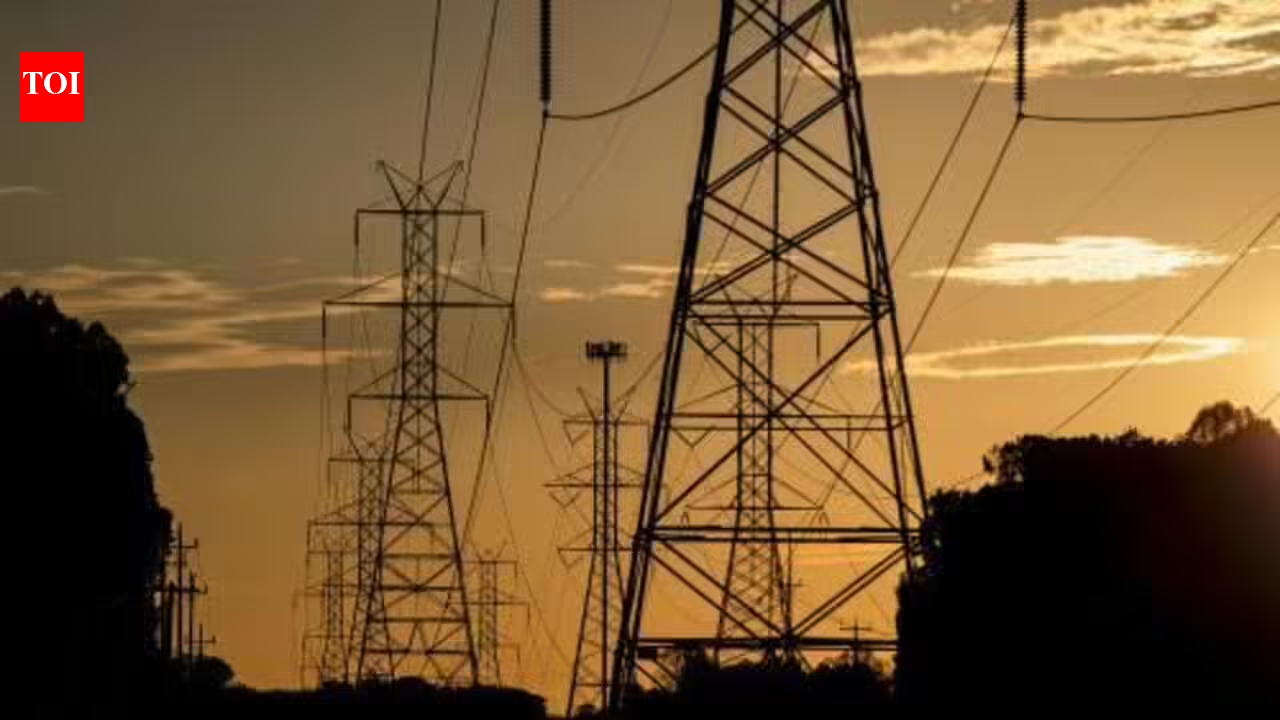
Mumbai: South Mumbai is grappling with an alarming power crisis, with prolonged outages severely disrupting daily life. Highlighting the gravity of the situation, MLA Rais Shaikh raised the issue in the state assembly, drawing urgent attention to recurring electricity cuts lasting between 8 to 12 hours in key areas such as Mohammad Ali Road, Nagpada, Agripada, and Madanpura.Addressing the House, Shaikh pointed to systemic failures in infrastructure and staffing as the root causes of the crisis. He emphasized that no fresh recruitment of technical staff has taken place since 2011, leaving the system overstretched and ill-equipped to manage growing demand. Furthermore, he noted that much of the underground cabling is decades old, resulting in frequent breakdowns and escalating maintenance challenges.The situation has caused immense hardship to residents, particularly senior citizens, patients, and families who rely heavily on uninterrupted power for essential needs. Shaikh stressed that the outages are not merely an inconvenience but a serious public concern that demands immediate government intervention.Calling for accountability and swift action, the MLA urged the government to hold a detailed discussion in the Assembly and asked the concerned minister to present a concrete, time-bound plan to address the recurring power failures.Meanwhile, officials from BEST (Brihanmumbai Electric Supply and Transport) have acknowledged the issue and announced a Rs 20 crore action plan aimed at reducing outages across its supply areas in South Mumbai. According to officials, the replacement of aging underground cables — some dating back to as early as 1950 — is being carried out on a war footing, with necessary permissions secured from the BMC.So far, nearly 50% of the old cables in BEST distribution zones have been replaced.

Now, institution heads responsible for blood bank audits in Maharashtra | Mumbai News

Now, institution heads responsible for blood bank audits in Maharashtra

Mumbai: The State Blood Transfusion Council (SBTC) is reviving the forgotten practice of auditing blood banks across the state, but with a twist: instead of transfusion officers, the ultimate responsibility for the quarterly audits will now lie with the institution heads, such as the deans of state-run medical colleges, the director of BMC hospitals, and the heads of private, trust-based blood banks.The final reports of these audits must be submitted to the FDA and the SBTC. The move comes after the FDA took action against the JJ Mahanagar Blood Bank over the improper disposal of blood bags, defective equipment, and inadequate sterilisation in blood component production.However, for the past decade, this self-audit, the report of which had to be submitted to the FDA, had come to a halt. “Blood transfusion officers had stopped conducting them, and the FDA had also stopped asking for them. They had an 11-page checklist document,” said a blood bank officer from a BMC hospital.Notably, FDA still conducts annual inspections of blood banks. A recent SBTC circular stated that the revived audits will require an evaluation of both technical standards and available resources within each blood banks.Among the many audit conditions, one is to ensure that processing charges for blood and blood components are transparently displayed in a visible spot within the blood bank. Inspectors are also required to audit the physical stock of blood bags. This includes checking for damaged, unused, or discarded stock, the total number of bags purchased or received against the actual blood collected, and the remaining empty bags. The audit further requires blood banks to disclose any excess collection against their average requirement over the past three years. “If bulk transfers are being made from that blood banks to other states, information regarding the rate at which it is being distributed must be provided,” the circular states.Dr Shailesh Mohite, director of major BMC hospitals, said chief medical superintendent Dr Chandrakant Pawar would be responsible for six blood banks across peripheral hospitals. Dr Pawar was unavailable for a comment.One BMC hospital blood bank is already outsourced, and the other five in peripheral hospitals are to be run on a public-private partnership (PPP) basis. SBTC director Dr Suhas Mohnalkar said, “It is still the BMC that would be responsible for their audits. We did not ask them to run them on a PPP basis. It continues to be their responsibility as long as it is within BMC premises.”He added that for private, trust-run banks not affiliated with any public institutions, their respective trust heads would be held responsible for these audits.

Deadline ends June 30, strict action from July 1 for non‑HSRP vehicles in Maharashtra | Mumbai News

Deadline ends June 30, strict action from July 1 for non‑HSRP vehicles in Maharashtra
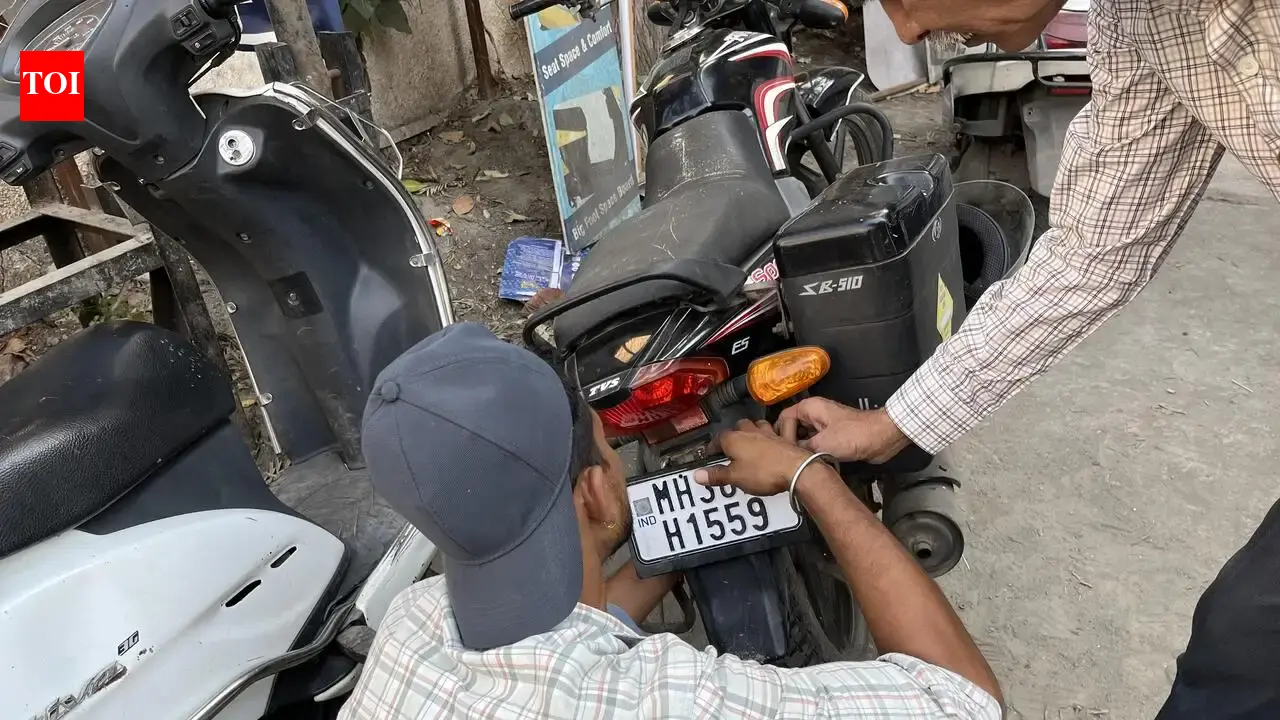
HSRP being fixed on a vehicle in Pune.

Mumbai: Vehicle owners in Maharashtra must install high security registration plates (HSRP) by June 30, failing which strict action will be taken from July 1 under the Motor Vehicles Act, a senior transport department official said on Monday. Transport department has affixed over a crore HSRPs, but the figure is just 51% of the total vehicles (2.10 crore) that need to be fitted.The rule applies to all vehicles registered before April 1, 2019. Non-compliant vehicles will not only face penalties from police and transport authorities but will also be barred from key RTO services, including ownership transfer, address change, hypothecation updates, re-registration, vehicle modifications, and licence renewals. However, the condition will not apply to fitness certificate renewals.Vehicle owners who have already booked authorised HSRP installation appointments before the deadline will receive temporary relief from enforcement action starting July 1.The state has divided implementation into three zones with Rosmerta Technologies Ltd, Real Industries Ltd, and FTA HSRP Solutions Pvt Ltd assigned the work. Rates are fixed at Rs 450 for two-wheelers, Rs 500 for three-wheelers, and Rs 745 for other vehicles (excluding GST).

Maharashtra CM to appoint panel to curb suicides on Atal Setu; state plans urgent barricading, stepped-up security on Atal Setu after 15 suicide cases in 3 years | Mumbai News

Maharashtra CM to appoint panel to curb suicides on Atal Setu; state plans urgent barricading, stepped-up security on Atal Setu after 15 suicide cases in 3 years

Mumbai: Safety infrastructure on the Mumbai Trans Harbour Link, also known as Atal Setu, will be strengthened on priority, the Maharashtra government told the legislative council on Monday after a series of suicides from the sea bridge triggered concern. Replying to a calling attention motion, industries minister Uday Samant said the government will issue a directive to complete barricading along the entire 22-km stretch at the earliest “so that nobody can jump and commit suicide”.The statement follows the recent death of a young man from Pune who allegedly leapt into the sea from the country’s longest sea bridge.Chief minister Devendra Fadnavis has also decided to appoint a high-level committee of senior govt officers to recommend multiple preventive measures. The panel will examine structural interventions, surveillance, and response protocols to deter attempts and enable rapid rescue.Official data tabled in the house showed there were six incidents in 2026, of which four proved fatal, and six incidents in 2025, resulting in five deaths. In all, there were 15 suicides in three years in which 11 people died since 2024.Legislators across parties pressed for immediate safeguards on a corridor that carries high-speed, high-volume traffic. Congress MLC Bhai Jagtap suggested integrating coast guard surveillance to improve response times during such emergencies. “With coast guard surveillance in the area, we can get better emergency response in such untoward incidents,” he said.Samant said that the government will “discuss with the Coast Guard and take their assistance as well”.The state has already deployed emergency resources on the bridge, including three motorbikes, two ambulances, three patrol vehicles and two speed boats to aid search and rescue operations, he said. However, members argued that prevention must be the primary focus.Raising the motion, MLC Uma Khapre flagged gaps in safety preparedness despite continuous vehicular movement on the corridor. She called for high barricades on both sides and emergency communication systems at regular intervals, including dedicated call points or mobile-based contact centres for commuters in distress.While Atal Setu has significantly cut travel time between Mumbai and Navi Mumbai, the government indicated it will now prioritise comprehensive safety upgrades to ensure such tragedies are not repeated on this critical link.

India’s airport sector to attract Rs 4.2 lakh crore investment by 2029, Mumbai set to emerge as key aviation hub | Mumbai News

India's airport sector to attract Rs 4.2 lakh crore investment by 2029, Mumbai set to emerge as key aviation hub
The airport sector in India is gearing up for an investment boom

MUMBAI: India’s airport infrastructure sector is poised to attract investments of nearly Rs 4.2 lakh crore by 2029, as operators race to expand capacity amid sustained growth in domestic air travel and the rollout of new greenfield airports, according to a report by Brickwork Ratings.The report estimates that projects announced and under implementation account for investments of about Rs 3.7 lakh crore, while another Rs 50,000 crore worth of airport projects are expected to be commissioned by 2029.More than 65 airport projects have been announced till FY26, with the sector expected to add capacity for 500-600 million passengers over the next few years.The outlook assumes particular significance for the Mumbai Metropolitan Region, where the upcoming Navi Mumbai International Airport is expected to ease congestion at Mumbai’s existing airport and emerge as one of the country’s largest aviation hubs.Along with the Jewar airport near Delhi, the project is expected to anchor the next phase of India’s aviation growth.Brickwork Ratings expects domestic passenger traffic to grow 8-10%, driven by rising disposable incomes, improved regional connectivity under the UDAN scheme and expanding air travel demand from Tier-II and Tier-III cities.The agency, however, cautioned that international traffic is likely to remain subdued in the near term because of geopolitical tensions in West Asia, route restrictions and elevated fuel prices.Since the Middle East accounts for nearly 38-40% of India’s international passenger traffic, disruptions in the region continue to weigh heavily on overseas travel.According to Niraj Rathi, Senior Director-Ratings at Brickwork Ratings, the first half of FY27 is likely to remain muted, but demand is expected to recover sharply during the second half as airlines add winter schedules and newly commissioned airports ramp up operations.The ratings agency has maintained a stable credit outlook for the airport infrastructure sector despite heavy capital expenditure.It estimates operating margins to improve to 53.8% in FY26 from 44.4% in FY25, and further to 54.5% in FY27, aided by the commissioning of new terminals that generate higher-margin non-aeronautical revenues such as retail concessions, food courts and commercial leasing.The report also points to improving financial health among airport operators. Sector debt-equity ratios are projected to decline from 3.8 in FY25 to 2.7 by FY27, reflecting repayment of construction loans as airports begin generating stronger cash flows.However, the expansion story is not without risks. Despite healthy operating margins, the sector continues to report consolidated net losses because of high depreciation, interest costs and large capital investments. Volatile aviation turbine fuel (ATF) prices remain another concern.Since fuel accounts for roughly 40% of airline operating costs, sustained increases can hurt airline profitability, delay fleet expansion and ultimately slow passenger growth, affecting airport revenues.Long regulatory timelines for tariff approvals and high maintenance costs also remain structural challenges.

Why it matters for Mumbai

For Mumbai, the findings reinforce the strategic importance of the Navi Mumbai International Airport, which is expected to decongest the saturated Chhatrapati Shivaji Maharaj International Airport and support long-term passenger growth.Airport operators are increasingly relying on commercial revenues, from retail, hospitality, advertising and real estate, rather than just passenger charges, making modern terminal development a key driver of profitability.The report also suggests that while India’s airport sector remains one of the country’s strongest infrastructure growth stories, investors and lenders will closely watch the pace of project execution by the Airports Authority of India and private operators, including Adani Airports, besides the trajectory of fuel prices and geopolitical developments that influence international traffic.


Coming after Mumbai’s JJ blood bank case: Sackings, FIR, SOP and QR tracking | Mumbai News

Coming after Mumbai’s JJ blood bank case: Sackings, FIR, SOP and QR tracking

Mumbai: Two officials of the state-run JJ Mahanagar Blood Bank, the largest in Maharashtra, have been sacked over allegations of irregularities in the handling and distribution of blood units, it was announced in the council on Monday.“Their services are being terminated and an FIR is being registered,” minister of state for health Meghana Bordikar told the house.The Mahanagar blood bank was sealed on Friday by the state Food and Drug Administration (FDA) due to severe blood safety violations.On Monday, allegations of serious irregularities in the handling and distribution of blood units at the blood bank came under sharp scrutiny following a calling attention motion moved by MLC Chitra Wagh. The motion flagged that of 77 blood bags collected during a donation camp in Chinchpokli, nearly 50 to 55 units were allegedly transferred to a private blood bank in Badlapur without authorisation.Bordikar responded, terming the lapse as “serious and illegal” and added that the bank’s nodal officer Dr Hitesh Pagare and another official, Ajay Bhise, had been found guilty. “Their services are being terminated,” she told the house.She said that to prevent recurrence, the state will introduce a standard operating procedure (SOP) for all blood banks and roll out QR code-based tracking of blood packets to ensure traceability from collection to utilisation.The minister noted that blood banks operate under licences issued after inspection by FDA, and Maharashtra currently has 417 such facilities. She also announced that a third-party audit of blood banks across the state is being planned.Separately, the State Blood Transfusion Council (SBTC) has ordered recovery of Rs 55,000—calculated at Rs 1,100 per bag—for the 50 units alleged to have been diverted, from the staff responsible. The complaint also points to discrepancies between the number of units collected at donation camps over the past three years and those recorded in the official registry of the JJ blood bank, prompting demands for an independent audit.Raising the issue, Wagh sought a full accounting of collection and utilisation, alleging the existence of a “blood mafia.” Concerns were also raised over patient welfare, with complaints that patients suffering from thalassemia, hemophilia and sickle cell anaemia faced harassment despite possessing valid donor cards, leading to financial and mental distress.

Maharashtra dy CM Eknath Shinde sets 3-year deadline for housing projects, warns developers will miss future govt contracts in case of delay | Mumbai News

Maharashtra dy CM Eknath Shinde sets 3-year deadline for housing projects, warns developers will miss future govt contracts in case of delay

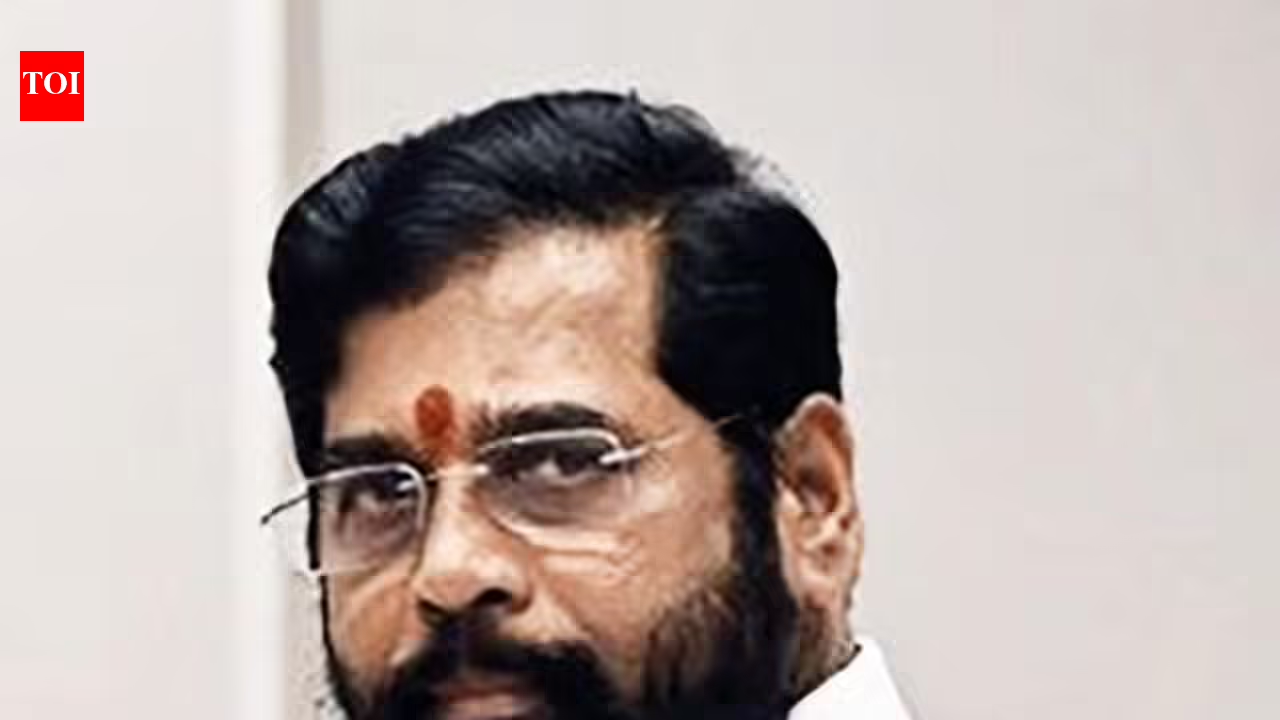
Thane: Maharashtra deputy chief minister and housing minister Eknath Shinde on Sunday issued a stern warning to developers, setting a three-year deadline for completing housing and redevelopment projects and declaring that builders who miss timelines or compromise on quality could be barred from securing future govt contracts.Shinde was speaking after handing over keys to beneficiaries of a redevelopment project in Thane’s Majiwada area late Sunday, where he signalled a tougher stance on delayed redevelopment projects. The state govt, on its part, is keen on removing administrative bottlenecks to fast-track completion of long-pending housing projects and accelerate cluster redevelopment across Maharashtra, he said.“Owning a home is a matter of dignity and security, and every family deserves a quality home. A home is not just four walls but a place of love, happiness and a family’s dreams,” Shinde said, adding that fulfilling citizens’ aspirations of home ownership remains a top priority for the Maharashtra govt.Elaborating, Shinde said the housing department made the completion of stalled redevelopment and housing projects its foremost priority since he assumed charge of the portfolio and assured that all procedural hurdles would be cleared to ensure faster execution.Highlighting the state govt’s redevelopment agenda, he said cluster redevelopment projects were gaining momentum across the state, with projects in Thane’s Wagle Estate nearing completion. He iterated the govt’s vision of making Mumbai and Thane slum-free through planned redevelopment and said citizens would be provided quality homes under the programme.

Gulf conflict slows home sales; Mumbai Metropolitan Region remains India’s biggest housing market despite 8% dip | Mumbai News

Gulf conflict slows home sales; Mumbai Metropolitan Region remains India's biggest housing market despite 8% dip
Despite 8% dip, Mumbai metropolitan region remains India’s biggest housing market

MUMBAI: Geopolitical uncertainty arising from the ongoing West Asia conflict appears to have taken some steam out of India’s residential property market, with housing sales across the country’s seven largest cities declining 6% year-on-year during the April-June quarter even as developers continued to launch new projects.According to ANAROCK Research, around 90,715 homes were sold across the top seven cities in Q2 2026 compared with 96,285 units in the corresponding quarter last year. On a sequential basis, sales declined 11%.For the Mumbai Metropolitan Region (MMR), however, the slowdown did little to dent its position as the country’s largest residential market.MMR recorded the highest absorption of about 28,710 homes during the quarter, nearly one-third of total sales across the top seven cities, despite registering an 8% decline from the 31,275 units sold a year ago.The region also led fresh supply, with developers launching about 34,555 homes, a 23% increase over the corresponding quarter last year, although launches fell 14% compared to the January-March period.More than 57% of the new supply in MMR was priced below Rs 1.5 crore, indicating sustained developer focus on upper-mid income homebuyers.Together, MMR and Bengaluru accounted for nearly 48% of all homes sold and 53% of new launches across India’s seven major residential markets.The report attributed the moderation in demand to uncertainty triggered by the West Asia conflict, its impact on global supply chains and caution among homebuyers amid concerns over the technology sector.“The Middle East war’s impacts on the entire sector were all too obvious. We now have a more balanced housing market where new supply is catching up with absorption as sales growth moderated across most cities,” said Anuj Puri, Chairman, ANAROCK Group.He added that demand continues to be driven by premium housing, infrastructure-led corridors and cities with strong Global Capability Centre (GCC) employment, while uncertainty surrounding the IT and ITeS sectors and rapid advances in artificial intelligence have prompted some prospective buyers to postpone purchase decisions.Despite slower sales, developers maintained confidence by increasing launches 7% annually to about 1.06 lakh units across the top seven cities. ANAROCK said much of the new supply came from large and listed developers launching projects on land parcels acquired during 2025.The report also highlighted a clear shift towards premium housing. Homes priced between Rs 80 lakh and Rs 1.5 crore accounted for the largest share of fresh launches at 27%, followed by the Rs 1.5 crore-Rs 2.5 crore segment with 25%.Luxury housing priced above Rs 2.5 crore contributed another 22%.In contrast, affordable housing continued to lose ground, with homes priced below Rs 40 lakh accounting for just 6% of total new supply, a single-digit share that underlines the widening gap between demand and availability in the budget segment.Among other cities, only Kolkata, Hyderabad and Bengaluru recorded annual growth in housing sales, while Pune witnessed the steepest decline of 15%. Hyderabad posted the highest increase in fresh launches at 53%, while Bengaluru saw a 41% jump in new supply.Residential prices continued to rise, though at a slower pace. Average prices across the seven cities increased 7% year-on-year but only 1% over the previous quarter, suggesting price appreciation is stabilising after the sharp gains seen over the past two years.NCR recorded the highest annual price increase at 13%, followed by Bengaluru at 8%.Meanwhile, unsold inventory across the seven cities rose 10% year-on-year to over 6.16 lakh units by the end of June 2026, reflecting improving supply.Bengaluru registered the highest inventory growth at 34%, while NCR remained the only market where inventory levels stayed largely unchanged.The findings suggest that while housing demand has moderated amid global uncertainties, developers remain optimistic about long-term demand, particularly in metropolitan regions such as MMR where infrastructure expansion and employment growth continue to underpin residential activity.