
‘Culture of Congress leaders’: BJP minister slams Nana Patole feet-washing video | Mumbai News

‘Culture of Congress leaders’: BJP minister slams Nana Patole feet-washing video
Chandrashekhar Bawankule took a swipe at the Congress over what he described as its “culture”.

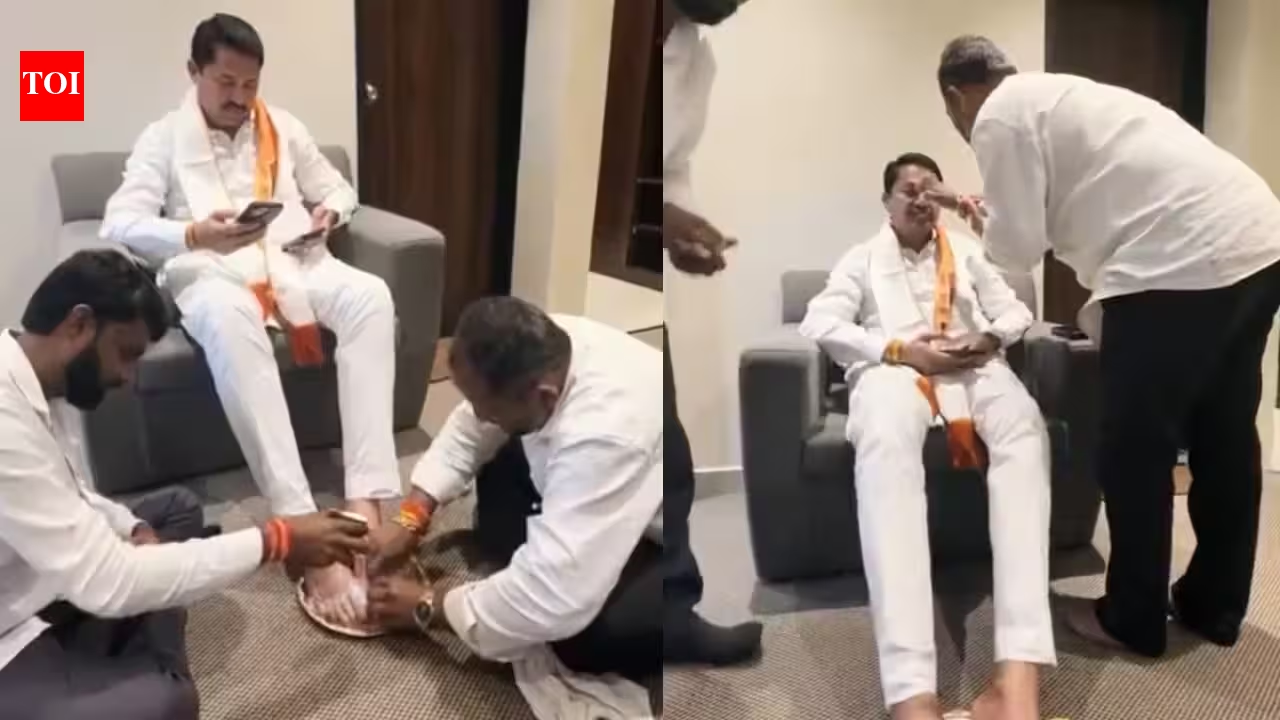
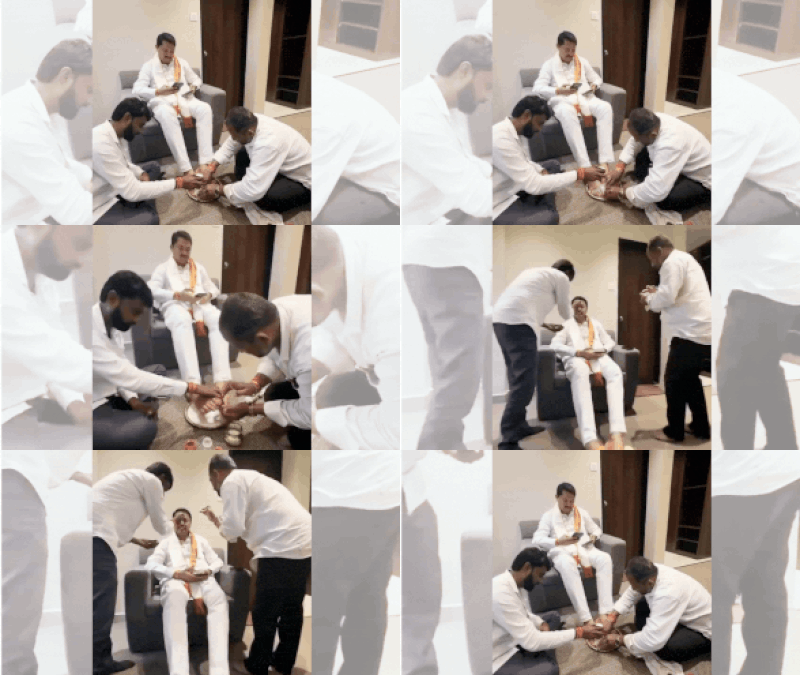
MUMBAI: A video purportedly showing supporters of senior Maharashtra Congress leader Nana Patole washing his feet during Gurupurnima celebrations has sparked political reactions, with Maharashtra revenue minister Chandrashekhar Bawankule criticising the incident.According to news agency PTI, Bawankule took a swipe at the Congress over what he described as its “culture”.“It is the culture of Congress leaders to indulge in such activities. They should have learnt lessons from such incidents. Why indulge in such practices where you will only earn criticism and negative publicity and nothing else,” the revenue minister and senior BJP leader told reporters.The minister was responding to a video that allegedly shows supporters of Patole, a former Speaker of the Maharashtra Assembly, washing his feet and offering prayers as part of Gurupurnima observances.The video has since drawn attention on social media and triggered political criticism from the BJP.

Rs 18 crore being stolen from Siddhivinayak Temple every year: Raj Thackeray | Mumbai News

Rs 18 crore being stolen from Siddhivinayak Temple every year: Raj Thackeray

MUMBAI: Amid the Ram Mandir donation controversy over alleged embezzlement of cash and valuables from donation boxes, Maharashtra Navnirman Sena (MNS) chief Raj Thackeray on Saturday alleged that donations worth Rs 18 crore were being siphoned off every year from Mumbai’s famous Siddhivinayak Temple. The temple is headed by former Shiv Sena MLA Sada Sarvankar and is managed by a trust comprising state government-appointed members. Raj also took a dig at Prime Minister Narendra Modi, questioning why he had not spoken about the alleged theft at the Ram Temple in Ayodhya. Addressing an MNS gathering, Raj read out a letter that he claimed was written by the Siddhivinayak Temple Board of Trustees to deputy chief minister Eknath Shinde, seeking a high-level inquiry into the alleged theft of money from the temple’s donation boxes. “Sir, we, the undersigned, are all trustees of Siddhivinayak Trust Temple, Prabhadevi… you have appointed us as trustees. We are trying to live up to your faith. We have been successful to some extent in increasing the income of the temple by 35%. ..Income?…some employees have been caught stealing money from the temple’s donation box. Before these employees were caught, the amount in the donation box every Wednesday was within Rs 50 lakh. However, after these employees were caught, the amount in the donation box has reached around Rs 1.5 crore in the last three weeks. This means that earlier some amount was being lost from the total money deposited in the donation box every week. Due to this, the temple was losing about Rs 18 crore every year, and we strongly suspect that the threads of this are at the senior level. We, the board of trustees, expect you to take serious note of this entire matter and investigate it at the senior level,” Raj quoted from the letter during his speech. “This letter is from the board of trustees of Siddhivinayak Temple. That is, Rs 18 crores are stolen from Siddhivinayak Temple every year. We go there as devotees, put donations in the donation box and such thefts happen here. These people are looting all the temples. Our people or students go to the temple before exams or during jobs and pray to God to get me a job, but today thefts are happening in the same temple. The people in the temple itself are committing these thefts. Is this our religion? These are the temples of our religion? So what will happen if this is the situation of the country? I think it is necessary for all of us to think about this together,” Raj said. Sarvankar did not respond to Raj Thackeray’s allegations.

MMRDA seeks CRZ clearance for Rs 5,140-crore Thane Coastal Road Phase II project | Mumbai News

MMRDA seeks CRZ clearance for Rs 5,140-crore Thane Coastal Road Phase II project

MUMBAI: The Mumbai Metropolitan Region Development Authority (MMRDA) has approached the State Coastal Zone Management Authority for Coastal Regulation Zone (CRZ) clearance for the proposed Rs 5,140.92-crore Thane Coastal Road Phase II. The statutory approval is required as the 7.13-km project passes through several environmentally sensitive coastal zones, including mangrove areas and the Eco-Sensitive Zone (ESZ) of the Thane Creek Flamingo Sanctuary. The proposal has been submitted as a fresh CRZ application under the CRZ Notification, 2019. According to documents filed by MMRDA, the road alignment falls within CRZ-IA, CRZ-IB, CRZ-II and CRZ-IVB categories, requiring regulatory scrutiny before construction can begin. The authority has invoked provisions of the notification that permit public infrastructure projects such as coastal roads, subject to environmental safeguards. The application states that the project will affect around 12.72 hectares of mangroves, while nearly 1,733 mangrove trees are proposed to be removed. MMRDA said a forest clearance application is already under process and that a compensatory afforestation plan will be submitted as part of the approval process. The environmental assessment also highlights the project’s proximity to protected ecosystems. Part of the alignment passes through the Eco-Sensitive Zone of the Thane Creek Flamingo Sanctuary, with the sanctuary located about 700 metres from the proposed road. The Eco-Sensitive Zone of the Sanjay Gandhi National Park is about 2.6 km away, while the Tungareshwar Wildlife Sanctuary lies within an 8-km radius. As part of the clearance process, MMRDA carried out terrestrial and marine Environmental Impact Assessment (EIA) studies between December 2025 and February 2026. The authority has also prepared a disaster management plan and submitted coastal zone maps showing the project’s alignment across the notified CRZ areas. The proposed six-lane freeway will connect Balkum and Kasheli with Anand Nagar in Mulund East and is intended to serve as a bypass for regional traffic passing through Thane. According to the application, the project aims to ease congestion on the Eastern Express Highway and Ghodbunder Road by diverting non-local traffic, thereby reducing travel time, accidents, pollution and vehicle operating costs. The CRZ clearance is one of the key statutory approvals required before the project can move to the construction stage. Once completed, the road will form part of a wider regional transport network linking Thane with Mumbai and the rest of the Mumbai Metropolitan Region.

House notes: Mumbai tunes in to living room concerts | Mumbai News

House notes: Mumbai tunes in to living room concerts
Intimate house concerts are emerging as a popular alternative night out

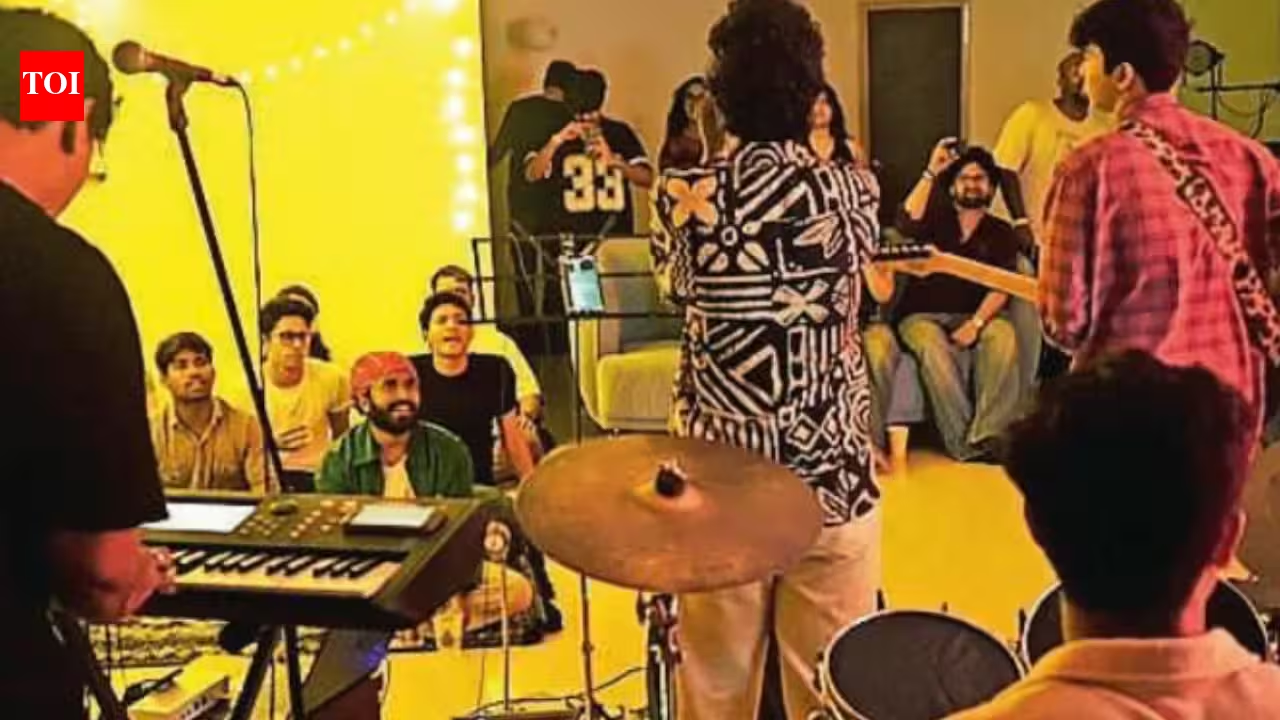
MUMBAI: By now, Smridhi Sharma has learnt to carry earplugs to concerts.Booming speakers have made the 23-year-old marketing professional want to protect her eardrums.Three Saturdays ago, though, volume wasn’t the problem.She winced as sections of the audience heckled an indie singer who was opening for a bigger act.“The noise drowned him out.” No wonder Sharma treasures a gig she attended in a fairy-lit fifth-floor room in Navi Mumbai months ago.There, a few dozen strangers sat on the floor and swayed to an indie band whose name, ‘A Day Old Sushi’, they had never heard.“The conversations between the sets were as memorable as the music,” says Sharma, who ended up talking about life and friendship with a stranger she now chats with daily.Connections, friendships and even love are among the happy side-effects of invite-only house concerts that are increasingly offering an alternative night out.Even as live-music venues contend with rising rents and audiences tire of high-octane shows, intimate gigs are finding new currency with their promise of paid gigs and attentive audiences for young artists and noise-cancelling avenues of engagement for listeners.At Rs 1,200 to Rs 2,000 a ticket, collectives such as Tiny Room Concert (TRC), Sofar Sounds and supper clubs such as Around The Table (ATT) turn homes into venues where 20 to 60 strangers gather for food, music and conversation.Reminiscent of traditional baithaks, “the format isn’t new, but it feels newly relevant”, say ATT founders Ishita and Rukaiya.“People are craving a way to make friends and find their community,” agrees Chyna Brackeen, vice president of Experiences at Sofar Sounds, which began in Bengaluru in 2015 with the idea of bringing music into intimate spaces for meaningful engagement.In the last decade, Sofar Sounds has grown from four or five Indian cities to roughly 15.“Sofar began because musicians were tired of being shoehorned into noisy venues meant to entertain a crowd that wasn’t really listening,” says Ankit Dayal of Sofar Bombay, which has staged nearly 90 shows, drawing from over 500 artists across India over the last decade.“Best friends and even life partners have met at Sofar shows,” says Dayal even as TRC founder Aditya Patil tells us about four unintentional couplings that have happened so far.Started last year by three former event planners who “realised club culture was dying”, TRC has hosted events in villas in Karjat and flats in Navi Mumbai.“Clubs were full of people getting drunk and dancing, and there was no respect for the artists or the DJs,” says Aditya Patil, one of the three Gen Z cofounders of TRC.The appeal lies in what these gatherings remove too.“There’s no pressure to dress up,” says TRC cofounder Pratham.“The events are also great for introverts and safer for women, as we offer the option to stay back,” adds Pratham who has seen lawyers, techies and others break the ice at the venue.TRC had invited the band A Day Old Sushi, named because “sushi tastes better the day after”, to play after watching them win a competition in Terna Engineering College.Though initially concerned about the drum kit drawing complaints, band members say “the acoustics were “just perfect”.“We played Punjabi songs that had the crowd dancing until it turned into a house party”, recalls vocalist Ayush Sawant. “Even the DJ was vibing with us.”That search for connection drives ATT, host of six living-room concerts since Ishita and Rukaiya started the supper club in May 2024.Guests eat first; once music begins, service stops.“You’re sharing silence,” the founders say, “listening together, noticing the same moments in a song.”ATT has settled on 20 to 35 people as the sweet spot.That way, “it becomes less of a performance and more of a shared experience,” says Ishita.What guests are paying for, she adds, isn’t the music alone. It’s being welcomed into someone’s home and watching an artist perform a few feet away, “things you simply can’t replicate in a traditional venue.”Besides a chance to “be vulnerable and transparent” and preview unreleased material, artists even bag gigs.Singer Avantika Ganguly, who has performed at ATT events alongside bassist Sayar Mitra, has since been booked for birthdays by listeners.The economics is “a win-win for us,” says Ganguly, who has felt the pinch of time caps and high rents in studios.Challenges though remain: acoustics, neighbours, floor seating among others.Mumbai’s shortage of spaces does not help.Dayal admits to being “a little jealous” of sister chapters in Hyderabad, Goa and Kochi, which stage shows in heritage properties.Profits, too, are hard to come by but some have started measuring success in other ways.The morning after a recent Navi Mumbai apartment concert, Pratham of TRC texted a male attendee who had come in with a woman colleague: “Hope you enjoyed the night?” The reply came back: “Yes… thank you. I finally got the courage to confess my feelings to her after I got home.”

TV actor Aditi Sharma accuses husband, in-laws of domestic violence; FIR filed in Mumbai | Mumbai News

TV actor Aditi Sharma accuses husband, in-laws of domestic violence; FIR filed in Mumbai
Television actress Aditi Sharma has filed a domestic violence complaint against her husband and his family

MUMBAI: Television actress Aditi Sharma has filed a domestic violence complaint against her husband and his family, leading to the registration of an FIR at Mumbai’s Goregaon Police Station.The FIR was registered on July 30 against her husband, Abhineet Vidyanand Kaushik, mother-in-law Urmila Kaushik (65), and sister-in-law Kirti Kaushik (29). Police have launched an investigation into the allegations.Aditi, who has appeared in television shows including Apollena – Sapno Ki Unchi Udaan, Rabb Se Hai Dua and Kaleerein, alleged that she was subjected to domestic abuse by her husband and his family members. The nature of the allegations has not been disclosed by police.Officials said statements are being recorded and further investigation is underway.

‘why only private eateries?’: after bombay hc’s query, fda team tukaram mundhe reaches canteens at hc | Mumbai News

'Why only private eateries?': After Bombay HC's query, FDA team reaches canteens at HC
Bombay High Court canteens underwent inspection by the FDA on Thursday.

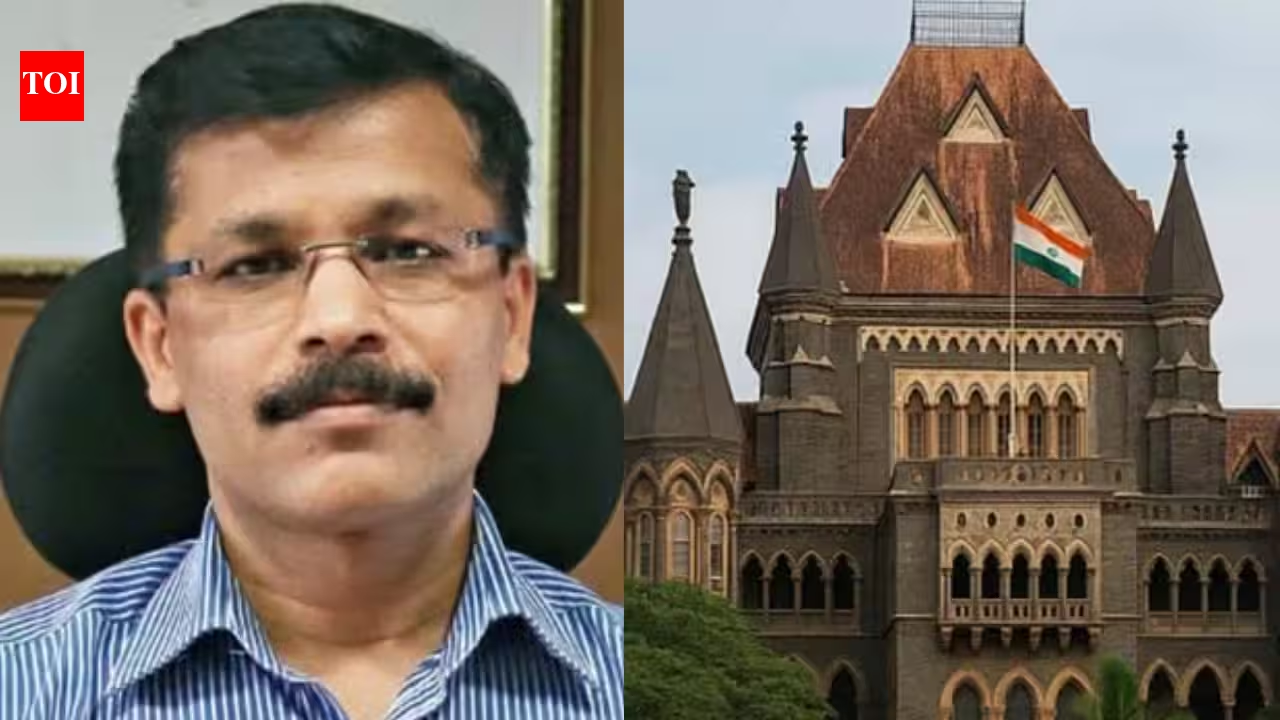
MUMBAI: A day after questioning whether Maharashtra’s Food and Drug Administration (FDA) had inspected canteens run by government and semi-government institutions during its statewide hygiene crackdown, the canteens inside Bombay high court came under the regulator’s scanner.An FDA team on Thursday inspected three canteens operating inside the Bombay high court premises. One was ordered to stop operations for allegedly functioning without a valid Food Safety and Standards Authority of India (FSSAI) licence, while the other two were issued improvement notices. Officials said a detailed inspection report is being prepared.“Our team did inspect the canteens of the Bombay high court. We are preparing a report. Once we submit it to our higher authorities, a statement will be issued,” an FDA official told news agency PTI.Be uniform. Be fair to all. Can’t target only private properties: HCThe inspection followed Wednesday’s hearing before a bench of Acting Chief Justice Ravindra Ghuge and Justice Gautam Ankhad, which had asked the state whether the FDA’s ongoing drive also covered eateries run by government departments, statutory authorities and semi-government bodies. The government assured the court it would place details of inspections conducted across Maharashtra, including at government-run canteens.The FDA’s statewide crackdown has intensified since IAS officer Tukaram Mundhe took charge as commissioner in May. Besides inspecting several restaurants and hotels, the regulator has suspended the licences of establishments, including the Cricket Club of India and MIG Cricket Club, over alleged food safety and hygiene violations.During Thursday’s inspection, the FDA found that the Bombay Bar Association (BBA) canteen had already shut operations voluntarily earlier in the day. Officials later issued it a “stop business” order, alleging it had been operating without the mandatory FSSAI licence.In its order, the FDA said non-compliance could attract a penalty of up to Rs 2 lakh, while continuing to operate without a valid licence could lead to prosecution under the Food Safety and Standards Act.The third-floor BBA canteen, which serves snacks to original side members, had informed its members that services were being “temporarily discontinued until further intimation”. The association’s notice said the closure was initiated voluntarily and that no adverse communication or order had been received from the FDA.BBA president Nitin Thakker said the canteen had been shut before the FDA team arrived. He added that the contractor obtained the required licence later in the day and operations were expected to resume shortly.The FDA also inspected the high court’s ground-floor staff canteen, where food samples were collected, though it remained operational throughout the day. Another small tea canteen near Court Room 36 was shut voluntarily. Advocate Suresh Sabrad, secretary of the Advocates Association of Western India, said no FDA officials visited that outlet.The inspections continued till late evening as officials completed documentation.The high court again took up the issue on Friday, questioning the FDA’s “selective” approach after a lawyers’ panel reported poor hygiene at Mantralaya canteens despite the regulator awarding them a 98% compliance rating. The court sought an explanation from the state on the apparent discrepancy.

Youth paraded with hands tied by rope, notice to Pune top cop | Mumbai News

Youth paraded with hands tied by rope, notice to Pune top cop
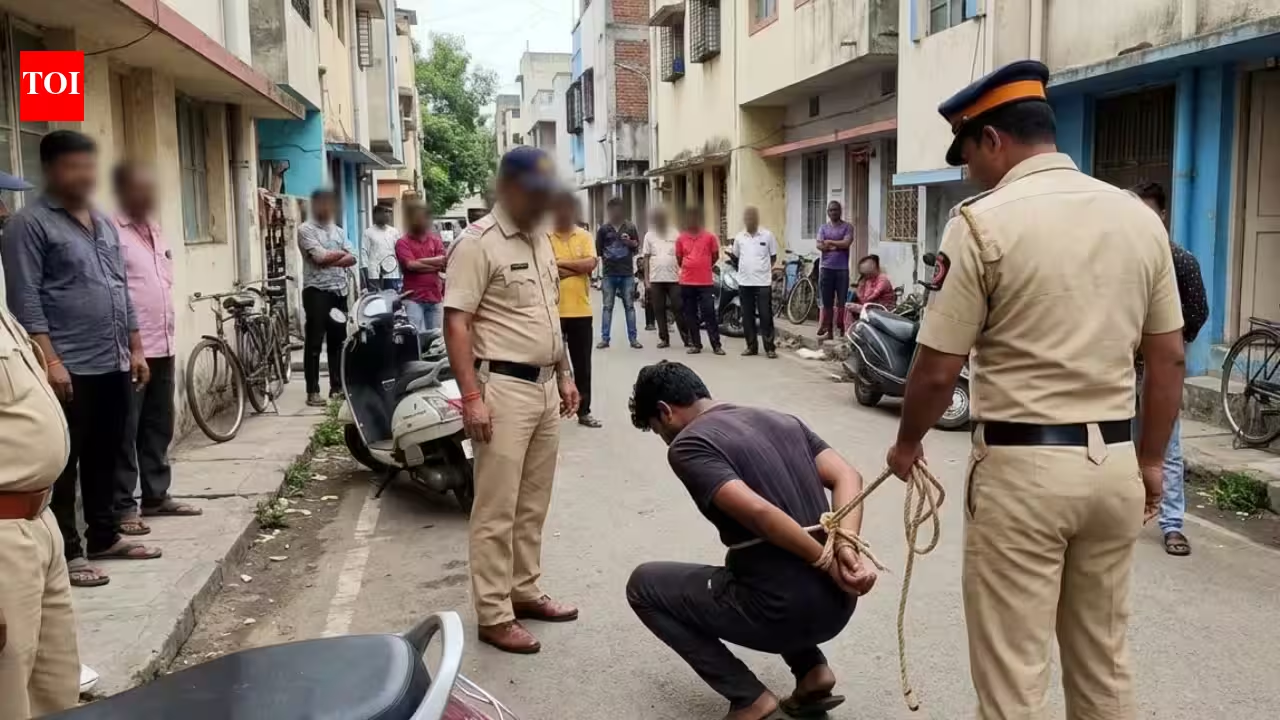
Cops parading youth with hands tied by rope can be seen with other people around. (AI-generated image used for representational purpose)

MUMBAI: The Maharashtra State Human Rights Commission (MSHRC) issued notices to the chief secretary, Pune police commissioner and 11 other police officers primarily from Laxminagar police station in Pune over the alleged public humiliation and assault of a 20-year-old suspect, Sultan Shaikh, who was reportedly caught for damaging vehicles.The police had made a video of the incident which went viral on social media.Pune residents Tanaji Karche and Swapnil Jadhav had filed complaints before MSHRC for human rights violations of Shaikh. Karche stated that the police caught Shaikh for damaging vehicles.“They brought him before residents of a locality and paraded him before them stating that he had broken vehicles in the area. They assaulted him in public and asked him to apologise to people,” he said.The video circulated online showed that Shaikh was paraded in public with his hands tied by a rope, forced to perform squats and abused in public.Justice AM Badar, chairperson of MSHRC, while referring to the complaints, noted in his order that the complainants as well as the photographs annexed to the complaints reveal that the police department of Pune had “virtually imposed physical punishment on the victim instead of following due process of law”.The commission observed that it prima facie amounted to a violation of the victim’s human rights, and scheduled the next hearing of the case on Sept 9.MSHRC held that the police commissioner, who did not respond to the Maharashtra State Human Rights Commission notices earlier, appeared to have been negligent in preventing the abuse and safeguarding the victim’s fundamental human rights.The order passed said that the chief secretary was “free to file a reply to clarify the stand of govt.”

Mumbai Police Arrest Uttar Pradesh Gang Leader Wanted in Multiple Cases | Mumbai News

Mumbai Police Arrest Uttar Pradesh Gang Leader Wanted in Multiple Cases

Mumbai: The Yellow Gate police arrested an accused who was wanted in several criminal cases in Uttar Pradesh and was said to be a gang leader in a criminal case. The accused, Nishant Rajesh Singh, 23, was handed over to the UP police.Yellow Gate police received a tip-off on Thursday that a man was behaving suspiciously at a hotel in their jurisdiction. A police team reached the hotel and questioned the suspect, Nishant Rajesh Singh, a resident of Village Baloriya, Tehsil Sitavali, District Sitapur, UP. During preliminary questioning, the suspect tried to hide his identity and gave evasive replies, police said. Considering his behaviour, he was taken to the Yellow Gate police station for further interrogation.Police found during the probe that three serious crimes were registered against the concerned person in Sitapur district, including theft by force and possession of illegal firearms without a licence.Police said that when the said person’s criminal record was checked, it was found that a case was registered against him at Ataria Police Station, Sitapur, under various sections of the Uttar Pradesh Gangsters (Prevention) Act, 1986 (Gangsters Act).The Ataria Police Station was contacted, and the photograph and other details of the accused were sent to them. The crime registered against him was verified.On Aug 1, a police team from UP reached Yellow Gate police station and took him into custody.

Private garage is public space under MV Act, says Bombay high court, upholds payout for death of worker repairing tanker | Mumbai News

Private garage is public space under MV Act, says Bombay high court, upholds payout for death of worker repairing tanker

Mumbai: Dismissing an insurer’s appeal against an order of compensation for a mechanic who died during repairs of a tanker at a garage, Bombay High Court has held that a private garage can be considered as ‘public space’ and the vehicle, although stationary, was given for repairs and hence ‘in use’.The insurer argued that since the tanker was stationary in a private garage, it was not in “use” as per the Motor Vehicles Act and the garage was not a “public place”, thus absolving itself of the statutory liability under section 147 of Motor Vehicles Act (MV Act). The section outlines the compulsory requirements and limits of liability for motor vehicle insurance policies.An insurance company had filed an appeal in 2021 against a Motor Accident Claims Tribunal (MACT) order of Aug 2020. MACT had passed an order against the vehicle owner and insurer and directed a payout of over Rs 8 lakh with interest to the kin of the mechanic who died in May 2015 due to a blast while carrying out welding work in a Chembur garage.Justice Jitendra Jain of the HC held that though a “garage may be private property, but because it is accessible to the public it falls within the definition of public space under MV Act.” HC said ‘public’ means a defined group of people, in this case vehicle owners whose entry is not prohibited into a garage.When a third party dies or is injured when a vehicle is in use, the insurer is liable to pay compensation stipulated in section 146 of MV Act.“The phrase ‘use of the motor vehicle’ used in Section 147 cannot be given a restrictive meaning to mean an accident occurring only when the vehicle is moving,” Justice Jain said, adding it would include not just active movement but passive use as well for ‘purposes of its movement.’ HC said repairs of a motor vehicle are “integral aspects of its movement” and hence amount to its “use”.Besides, under the MV Act, insurance covers any person,which would include the worker in the garage who died. The tanker had come in for repairs to the garage. The blast could have been due to residual fuel and by law, it was the duty of the vehicle owner to have informed the garage that it needed to be emptied first, HC observed. The victim’s family had lodged an FIR only against the garage owner.HC ruling delivered on July 28 said the insurer has shown no evidence of negligence of the repairer. It added, “When the owner of a motor vehicle entrusts his vehicle to a repairer to carry out repairs, he is in fact allowing the repairer to use his vehicle” and hence the vehicle is said to be in ‘use’ to attract insurance in case of accident.HC held the tribunal was right in holding the driver and the garage owner responsible and not the victim.

Cyber police register 10 FIRs against mule bank account holders in 10 days | Mumbai News

Cyber police register 10 FIRs against mule bank account holders in 10 days

Mumbai: Cyber police are dropping the hammer on the “middlemen” of cyberscams. As part of a nationwide crackdown ordered by Ministry of Home Affairs to get a grip on cybercrime, Mumbai police have registered 10 FIRs (first information reports) against mule bank account holders, or those who rent out their bank accounts to scammers for a quick commission, in less than a fortnight. Police are also actively registering offences against individuals providing mule SIM cards, which are pre-activated mobile phone SIM cards obtained through fraudulent means to facilitate cybercrime.“Fresh offences are being registered against mule bank account holders after verifying that they knowingly granted scammers access to their bank accounts and received a commission for it,” said a senior police officer. He added that the ultimate goal of MHA’s directives is to bring cyber financial crime completely under control by 2028.On Thursday, the Central cyber police, under the supervision of DCP Bajrang Bansode and senior inspector Chimaji Adhav, busted a gang of seven people involved in operating mule accounts and withdrawing money. A few of the gang members were caught red-handed attempting to withdraw Rs 10 lakh each by cheque from two bank accounts in Borivli. Subsequent investigations showed that this single gang operated 27 mule bank accounts scattered across various branches of the same public sector bank at Dadar, Mahim, Borivli, and Mira Road.Explaining the deep-rooted deception in such cases, an officer said, “Typically, a current account is opened in a bank in the name of a firm. The firm is registered and has a valid office address. On physical verification, it may appear legitimate, but it is bogus and its bank account is operated by scammers for receiving illicit funds.”In one instance, police came across a bank account registered in the name of an agricultural firm but used for receiving scammed sums. In another case, investigators found a mule account tucked away with a leading private bank’s Bandra-Kurla Complex branch, where sums totalling Rs 17.67 lakh were withdrawn using cheques.“Registering offences against mule bank account holders and mule SIM card providers will send across a strong message that these activities won’t be tolerated,” said DCP Bansode. He said that 10 FIRs had been registered in the past nine to 10 days alone, and 30 to 35 bank accounts are currently in the process of being frozen.Mule SIM cards are typically registered using stolen or forged personal identities and are crucial tools for facilitating cybercrime, including digital arrest frauds. Police have come across instances where local SIM card dealers or point-of-sale operators have been actively involved in providing mule SIM cards to scammers.According to govt rules, an individual is legally allowed to buy up to nine SIM cards in their name, but only one SIM card can be activated within a period of 24 hours.