

From silk to cards, Mumbai siblings win gold in offbeat sports | Mumbai News

From silk to cards, Mumbai siblings win gold in offbeat sports

Mumbai: One trains with his body. The other trains with her mind. Vir Gahrotra (17) spends hours working on strength, flexibility and choreography for aerial-silk routines performed nearly 30ft above the ground. His sister Viha (14) can spend eight hours at a bridge table, calculating bids, reading opponents and trying to work out what they are holding before they reveal it.The Worli siblings are competing at the top of two very different disciplines. Vir won India’s first-ever gold at the Pole and Aerial Sports World Championship in Hungary last December. Last Wednesday, Viha won a world title of her own, taking gold in the Under-16 Final B at the 9th World Youth Transnational Championship in Hefei, China.Their routes into the sports were equally unexpected. Vir took up aerial silk as physiotherapy for underdeveloped thigh muscles. He was eight when his mother signed him up after seeing a festival performance. Viha picked up bridge after a family friend, himself a three-time Under-16 world champion, conducted a boot camp at her school.Neither was deliberately steered towards an unusual sport. “It just happened organically. It was not a conscious decision,” says their mother, Kaushal Sanghvi.Aerial silk combines strength, flexibility, balance and artistic performance, with athletes climbing, wrapping and dropping through lengths of fabric while suspended high above the ground. Vir trains against the physical demands of the sport as well as an infrastructure gap: while European competitors can train in facilities with ceilings of around 30ft, finding even 18ft of clearance in India can be difficult.He is used to explaining the sport to classmates, who question whether it counts as one or is similar to mallakhamb. Aerial silk is still awaiting recognition from the Indian Olympic Association.The siblings’ training looks nothing alike. Vir works on strength, flexibility and control in the air; Viha trains strategy, memory and anticipation, much of it through online coaching. She trains for up to nine hours a day during her monthly camps.Bridge is an established mind sport, but finding coaching in India remains a challenge. “If she would’ve said ‘I want to play badminton,’ it would have been easier to find a badminton coach,” says Sanghvi. “Bridge, that was our main struggle.”Viha’s classmates also question whether cards can count as a sport. She describes bridge as “a mix between cards and maths” involving bidding systems, covert signalling and reading an opponent’s hand.“If you consider chess a sport, then you have to consider bridge a sport,” she says. “Bridge actually has three different parts.” Also, she says, “It’s recognised by the International Olympic Committee.”At Hefei, Viha competed in the open format, which allows multinational teams. She teamed up with India’s Ananya Mehta and players from Norway and England whom she first met at a bridge event in Poland two years ago. The title comes a year after she reached the final four representing India at the Junior Bridge World Championship, narrowly missing a medal.

Mumbai traffic police crack down on ‘dazzling lights,’ penalise nearly 1200 motorists | Mumbai News

Mumbai traffic police crack down on ‘dazzling lights,’ penalise nearly 1200 motorists

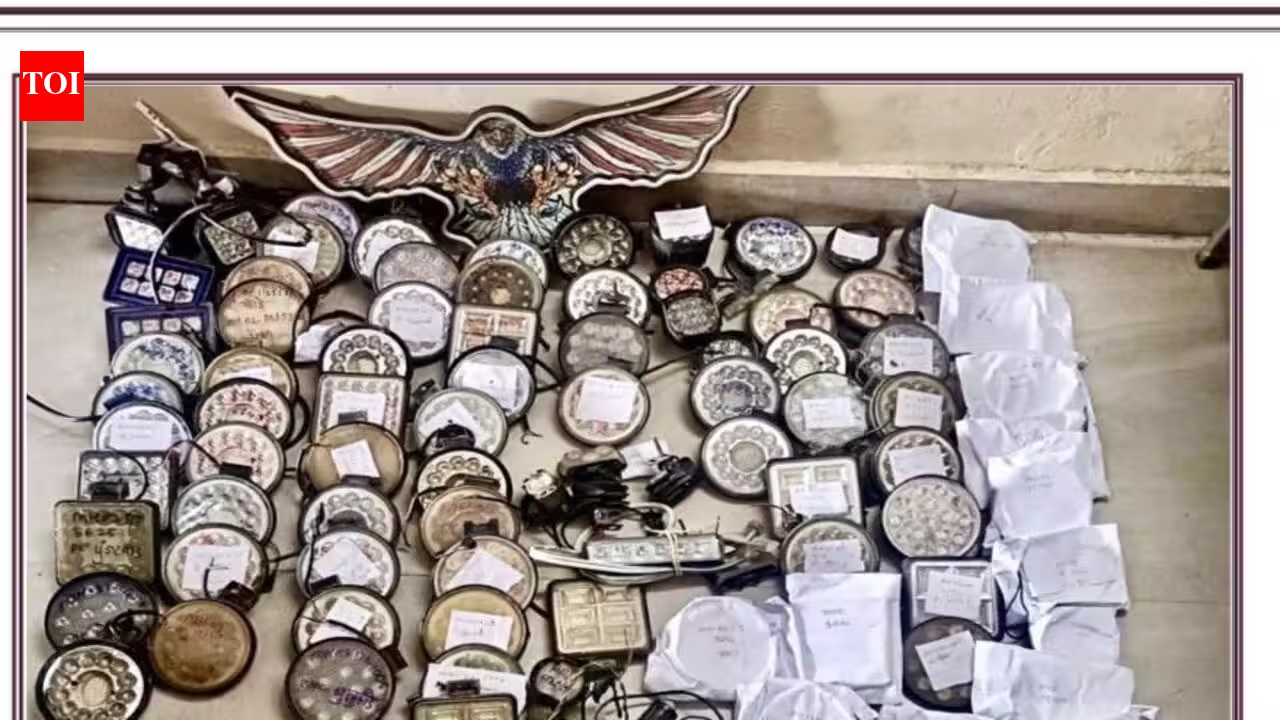
MUMBAI: Cracking down on “dazzling lights” on vehicles, Mumbai Traffic Police penalised 1,194 motorists as part of a special drive recently. Fines up to Rs 7.5 lakh were issued in this drive between Aug 6 and 8.Police said flashing lights, LED bars, fancy or harsh headlights were used by some vehicles at night, which impacted the vision of other road users and could lead to serious crashes. The action was taken under provisions of Motor Vehicles Act and Maharashtra Motor Vehicles Rules.Police have warned that action will continue in future and motorists should use low-beam lights at night.

FIR against Dahisar supermarket cashier, customer for fraud | Mumbai News

FIR against Dahisar supermarket cashier, customer for fraud

Mumbai: An FIR has been registered against a part-time cashier working at DMart Dahisar for defrauding the store by conniving with a customer and selling certain products without scanning or billing them. The customer has also been booked. MHB Colony Police are probing further.The FIR was registered on the basis of a complaint given by a facility staffer working at DMart, Dahisar West. In July 2026, a store employee was checking the daily stock when some products appeared to be missing. The employee alerted the store manager, Mangesh Nevrekar, and cash officer.While going through CCTV footage of the store, the management noticed that a part-time cashier, Abhishek Maurya, had sold some products to customers without scanning on July 20 and 26. The management started to keep a close watch.On Aug 7, it was observed that Maurya was once again selling some products to a customer without scanning or billing them. The minute the customer stepped out of the store, Nevrekar confronted him. The customer was identified as Vikas Kanojia, a laundryman by profession.Kanojia had 91 products from the store but only 72 were billed. Among the 19 unbilled items were garments, dry fruits, cosmetics, a mobilephone stand, oil etc., totalling to nearly Rs 10,000.MHB Colony Police was informed and a complaint was lodged against Maurya and Kanojia. Police said Maurya lived in Dahisar and was employed with the store for the past two years.

Dog-bite scare grips Kalyan, 107 fresh cases reported | Mumbai News

Dog-bite scare grips Kalyan, 107 fresh cases reported

Kalyan: As many as 107 new dog bite cases were reported to the Rukminibai municipal hospital in Kalyan on Monday, a rise from 58 cases reported on Sunday, civic officials informed.Dr Deepa Shukla, medical health officer, KDMC, said 107 cases were reported at Kalyan of which 12 cases were from the station premises. KDMC teams laid traps at various spots and trapped two dogs suspected to have bitten the residents over the last two days. They have been kept under observation.

Mumbai Police Arrest 4 Haryana Residents for Cheating in CSU Exam using Bluetooth | Mumbai News

Mumbai Police Arrest 4 Haryana Residents for Cheating in CSU Exam using Bluetooth

Mumbai: Powai police arrested four men, aged between 25 and 30, from Haryana for allegedly trying to communicate outside an examination centre using Bluetooth buds connected to a mobile phone to get answers for an exam they appeared for on Sunday. The modified handset seized from the four was just two and a half inches. Police are also investigating whether the four intentionally chose Mumbai as the exam centre, hoping to cheat without knowing that jammers were installed in the exam rooms. A total of 324 candidates appeared for the exam at the Mumbai centre.Police identified the accused as Devendra Singh, Bhoop Singh, Ravi Singh, and Ravindra Singh. The men allegedly carried the modified phone past the security check before entering the examination hall at Kendriya Vidyalaya in IIT-Bombay, Powai, on Sunday. Devendra Singh, who was found with the Bluetooth device, tried to escape from the hall and flee the campus before security caught him after an invigilator raised an alarm.The exam was conducted across four metro cities, Bangalore, Delhi, Mumbai, and Chennai. Central Sanskrit University (CSU) conducted its non-teaching written examinations, including those for the Multi-Tasking Staff (MTS/Group D) post for the guard/peon position, on Aug 9.DCP (West Zone-3) Datta Nalawade confirmed the arrest of the four candidates from Haryana. He said Powai police were probing whether they communicated outside or were caught before they could cheat.Police booked the four under Bharatiya Nyaya Sanhita sections for common intention, cheating, and criminal conspiracy. They produced them before the Andheri Court on Monday and were remanded in custody. Police were probing whether more people were involved in the cheating.Police said the candidates who appeared for the exams were not dummy candidates, and their Aadhaar card details matched the hall ticket.The police team was gathering details of the SIM and extracting data to find out whether the four dialled any number after the exam began. Police said the probe focused on how they cleared security and carried the modified mobile.“The mobile cost is worth Rs700 which has just calling features and was assembled after getting the parts. There is no data found in the handset. The team is also finding out who helped them get the modified gadget that is connected to a ear bluetooth bud,” said a police officer of Powai police station.Invigilators grew suspicious after observing the men, who were seated in separate rooms, and found their behaviour amiss. In the complaint, Kendriya Vidyalaya principal Vinod Wankhede said: “The four were caught after invigilator Rakesh Kumar said he found some suspicious with a candidate’s body language in room no 69. On inspection, Devendra Singh was caught with a mobile handset in his pant pocket. He pushed and managed to escape from the exam hall. Singh was caught by security guard in the campus before he could have escaped from the campus. Later, the team inspected the entire candidates and found three more with such device. The police were called then.”

Gangs of WhatsAppur: Mumbai’s thieves reinvent codes for digital age | Mumbai News

Gangs of WhatsAppur: Mumbai’s thieves reinvent codes for digital age
Mumbai’s thieves reinvent codes

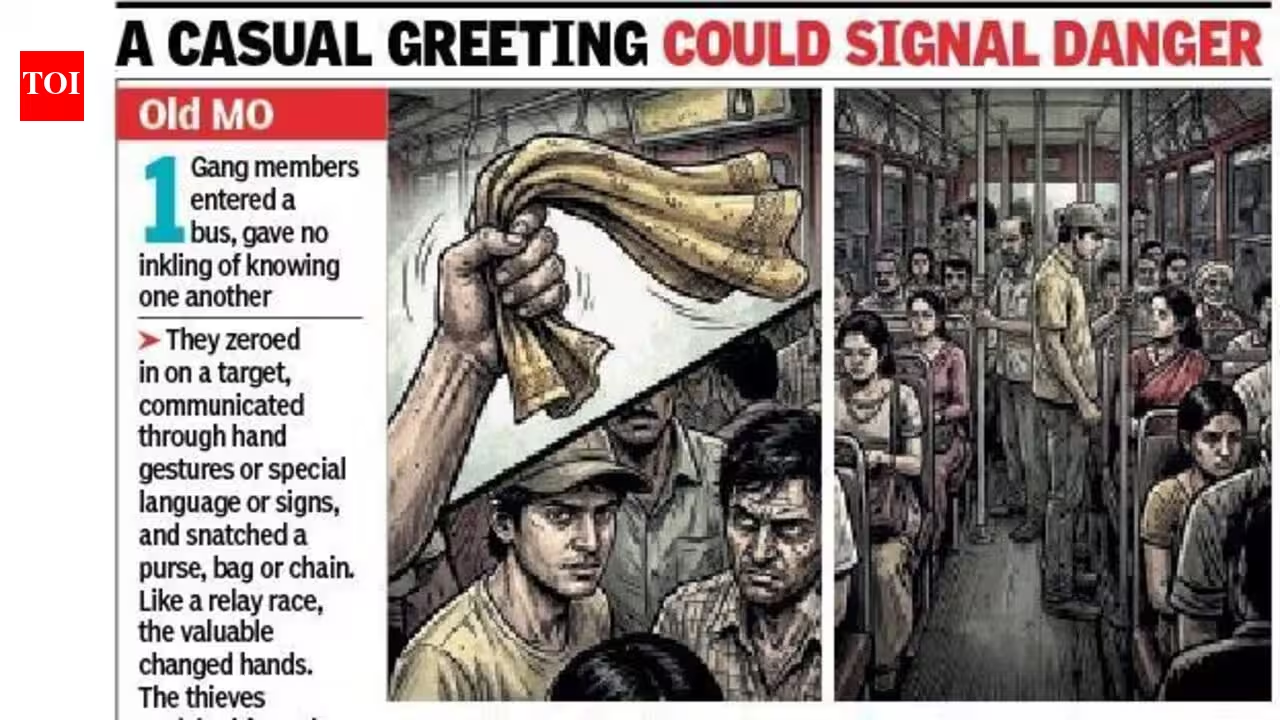
“Chacha ne salaam diya”“Aaj mausam kaisa hai?”To an outsider, these may sound like harmless banter. But as MIDC police in Andheri found out last week, these phrases carried a very different message for the ‘Dhakka gang’ of pickpockets who ran a carefully orchestrated operation and were arrested recently. It was their code language to know if everyone was safe, if anyone had been caught or if they could go ahead with the day’s planning.Cracking the gang’s communications offered police a glimpse of how secret gang communication has entered the smartphone age.DCP (west zone 3) Datta Nalawade, who led the investigations, said the communication was less about planning the theft than checking whether it was safe to proceed. “The purpose wasn’t to discuss the theft. It was to find out whether anyone had been picked up by police,” he said.For as long as criminals have worked in groups, they have needed a way to communicate without alerting the people around them—or police. Mumbai’s thieves have, over the years, used special languages, hand signals, eye blinks, towels and fake names. Today, some have moved to coded WhatsApp calls and social media messages.The leader of the Dhakka gang, whose members had specialised job titles and role assignments to execute thefts, reportedly contacted members every morning on WhatsApp using a code that changed daily. Only after the check would the gang decide where to meet and which bus route to target. After two members were arrested, the others shifted from Andheri to Juinagar in Navi Mumbai.Former police commissioner D Sivanandhan recalls gangs operating in Mumbai in the early 1990s using “special languages”. Among them were ‘Kepmari gangs’ from Tamil Nadu, who worked in groups of three or four on buses and trains. “They used a particular language to communicate and handed over the stolen booty to others. Like a relay race, the purse or bag or chain would change hands and vanish from the scene. They communicated through hand signals or special language or signs,” Sivanandhan told TOI.Over time, the signals became simpler. A blink could mean danger. A towel waved casually could signal a plainclothes policeman nearby. A particular name shouted aloud could mean abort the operation.“There was a time when gangs would meet at gardens, railway stations, bus stops or small hotels,” said Vanrai police senior inspector Abdul Rauf Shaikh, who was then assistant inspector with Mumbai crime branch’s unit-10. That was where they shared the day’s loot, decided the next day’s targets and fixed the code—be it blinking eyes after spotting danger or cops in civil dress, or flagging a towel cautioning gang members to take a back step.Shaikh said several such gangs were busted in 2017. Their members came from different parts of Mumbai Metropolitan Region and targeted commuters in BEST buses but ensured they all got off at different stops.“When I was posted with the crime branch and Trombay police station early in my career, there were gangs that used different code signs to communicate and escape. But the common feature was that they called their art of stealing ‘jaadu’ or ‘jhatka’,” said ACP (Ghatkopar division) Shailesh Pasalwar.Even in 2022, eye contact remained more useful than mobile phones for some gangs.Deputy superintendent of police (Mangaon-Raigad) Shashikant Pawar, who was then with the Mumbai crime branch, recalls gangs travelling in groups of four or five on BEST buses without speaking. Once a target was identified, two or three members created a distraction while “the machine” stole the target’s phone or wallet. They then got off at different stops. The Dhakka gang followed the same pattern.DCP Nalawade said the team that busted the gang—senior inspector Ghanshyam Nair, inspector Sunil Karande, SI Kiran Nawle and staff—found out that members stole at least five high-end phones a day and police recovered 135 phones valued between Rs 90,000 and Rs 1.5 lakh. The thieves reportedly avoided iPhones because they were harder to unlock and had limited resale value in their intended markets in Bangladesh and Nepal.

Scammers Impersonate Directors on Microsoft Teams, Dupe Mumbai Firm of Rs 2.3 Crore | Mumbai News

Scammers Impersonate Directors on Microsoft Teams, Dupe Mumbai Firm of Rs 2.3 Crore

Mumbai: The classic WhatsApp display picture scam, where fraudsters impersonate corporate leaders to trick employees into making unauthorized fund transfers, has taken a dangerous leap in sophistication. Moving beyond messaging apps, scammers are now using professional collaboration platforms for deception.In a recent case, scammers created a fraudulent group chat on Microsoft Teams using the names of two directors of an industrial company. They faked a discussion about a contract and manipulated an employee into transferring Rs 2.3 crore of company funds to them. An FIR was registered by the south Cyber Police and investigations are on.The incident occurred on July 31. A senior VP (finance) working with the industrial company found himself added to a group chat on Microsoft Teams. It was titled ‘work group’. Two individuals, with the same names as the company’s directors, were already a part of the group chat and were discussing a contract. As the company typically held meetings over Microsoft Teams, the victim did not suspect anything.During the discussion, one of the ‘directors’ quizzed the senior VP about the company’s bank balance. The senior VP disclosed the figure. Subsequently, the ‘director’ instructed that Rs 2.3 crore be transferred to a rubber firm in West Bengal for business. He provided the rubber firm’s bank details. Accordingly, the senior VP asked his subordinate to make the payment via RTGS and shared a copy over the group chat.Later that day, another employee who was checking daily transactions made through the company’s bank account raised a query about that particular payment. The senior VP was questioned as to whether the directors had spoken to him on the phone about making the payment. He denied. The employee then verified with the directors and found out that they were never a part of any group chat with the senior VP.The company management immediately approached the Cyber Police, who were able to block the money in the beneficiary’s account before it could be withdrawn by the scammers.Cyber Police have cautioned people against making any monetary transfers of company funds without making a direct phone call and verifying the demand. Experts said organisations should build a culture where employees do not hesitate to verify unusual requests involving money, sensitive data or access privileges, irrespective of who appears to be making the request.

Court extends TISS student’s police custody by another day | Mumbai News

Court extends TISS student’s police custody by another day

Mumbai: The city crime branch has secured one more day of police custody of 32-year-old TISS student Abhirup Ashim Paul alias Ronnie in connection with an alleged unauthorised programme held at the institute’s campus in Oct 2025. Police told the court that they needed his custody to investigate alleged Maoist literature found on his electronic devices, recover deleted digital data and examine his field activities and alleged links with the Progressive Students Forum and other individuals.Paul was arrested by crime branch unit 6 on Saturday after a sessions court rejected his anticipatory bail plea. The case relates to a memorial gathering held at the TISS campus for former Delhi University professor G N Saibaba in Oct 2025. Several students entered the institute premises without prior permission, displayed Saibaba’s photograph, paid tribute to him and held a candle-lighting programme. Police have alleged that slogans such as “Release Umar Khalid” and “Release Sharjeel Imam” were also raised during the event.The case was initially registered at Trombay police station under various provisions of the Bharatiya Nyaya Sanhita (BNS), along with Sections 37(d), 37(e) and 135 of the Maharashtra Police Act. It was subsequently transferred to the crime branch.While seeking further custody before the 37th Metropolitan Magistrate on Monday, investigating officer, police inspector Sushant Sawant, told the court that material allegedly downloaded on Paul’s electronic devices included literature associated with banned Maoist organisations. Police also claimed that WhatsApp conversations showed that Paul had undertaken field visits to different locations and that some messages had allegedly been deleted.Special public prosecutor Shishir Hire said they needed to recover the deleted data, establish the source and purpose of the material, examine his alleged field activities and identify his contacts and associates. Police also sought to determine whether the Oct programme was part of a wider effort to influence or radicalise students.The police further alleged that Paul was associated with Progressive Students Forum and sought to examine its structure, members and alleged external links. They also said notices had been issued to two TISS professors over allegedly suspicious WhatsApp exchanges with Paul and that his presence may be required during the inquiry.Police said nine mobile phones, seven laptops and one tablet had been seized during the investigation.Defence advocate Vijay Hiramath opposed further custody, arguing that Paul’s mobile phone and computer had already been seized and there was nothing left to recover from him physically. The defence sought judicial custody instead.After hearing both sides, the court granted the crime branch one day’s police custody.

BMC proposes Rs 42 crore retaining wall work below elevated nature walkway in Kamla Nehru Park | Mumbai News

BMC proposes Rs 42 crore retaining wall work below elevated nature walkway in Kamla Nehru Park

Mumbai: A Rs 42 crore proposal for constructing a protective retaining wall on the lower side of the elevated nature walkway at Kamla Nehru Park in Malabar Hill will come up for approval before BMC standing committee on Wednesday.According to the civic body, after work on the elevated nature walkway was undertaken, stabilisation of the slopes on the upper side of the trail was urgently required. Accordingly, work to stabilise the slopes on the upper side of the elevated trail was carried out.However, there is a steep slope at some places on the lower side of the elevated trail. Besides, developed buildings, slums and chawls are located at some places at the foot of the hill.The existing retaining wall at the foot of the hill along the elevated nature trail is made of stone. During a site inspection, it was observed that the stone structure was in a dilapidated condition at many places. It was also found that the hill terrain above and at the foot of Malabar Hill Nature Trail, as well as the rock mass and soil in the terrain, had disintegrated.Due to this, landslides have occurred at different locations every year. During the previous monsoon season, a landslide occurred at Loyalka Compound, following which the existing protective wall collapsed. As a preventive measure, barricades have been erected, and the police have also issued safety guidelines to BMC during regular safety inspections of Malabar Hill Reservoir Hill.The civic body pointed out that keeping in mind the recent landslides and projects such as the Pramod Navalkar Gallery and the elevated trail on the hill slopes, as well as the safety of these projects and residential structures located at the foot of the hill, stabilisation of the remaining slopes on the lower side of the elevated trail is necessary.The proposed work plan, structural design and blueprints for the project have been prepared by the appointed structural consultant and reviewed by experts from IIT Mumbai.

Fake currency notes with face value of Rs 1 crore seized in Virar | Mumbai News

Fake currency notes with face value of Rs 1 crore seized in Virar

Vasai-Virar: Crime Branch 2 officials seized counterfeit currency notes with a face value of Rs 1 crore from a vehicle at Shirsad Phata in Virar on Monday night and detained a man.Acting on a tip-off, a team laid a trap at the phata on the Mumbai-Ahmedabad highway. The team intercepted a suspicious four-wheeler and found a bag containing counterfeit currency notes.Police seized 20,000 counterfeit notes of Rs 500 denomination, with a total face value of Rs 1 crore, from the vehicle. A local resident, Pradeep Patil, was detained in connection with the seizure.Police said the process of registering a case against Patil at Mandvi police station was underway.Investigators are probing the purpose for which the counterfeit currency was being transported and are also trying to ascertain where the notes were printed. Further investigation is underway.