Man posing as Mumbai DCP promised to recover Rs 98 lakh | Mumbai News

Man posing as Mumbai DCP promised to recover Rs 98 lakh
Police said preliminary investigation indicates that many other citizens may also have been cheated in a similar manner

Mumbai: The city crime branch arrested a Jaipur businessman and an impostor who impersonated an IPS officer in a fresh case of cheating after a Gujarat businessman lodged a complaint alleging that the accused cheated him of Rs 16 lakh by posing as a Deputy Commissioner of Police (DCP) and promising to recover money allegedly owed to him from one builder.The crime branch last month arrested three persons, Mohammed Guas Khatib alias Raj Khatib, his son Mashab Khatib and Shahid Kapadia, red-handed from a three-star hotel while trying to cheat a person seeking a loan.Unit 1 of the crime branch on Friday arrested Rajasthan businessman Rajesh Bedsingh Choudhary, 46, and Mohammed Khatib, who was already in custody in connection with a similar cheating case.The fresh complaint was filed by Sikander Kothari, who runs an OTT platform, and alleged that he first met Rajesh Chaudhary and Naveen Sharma at Marine Drive in 2024. They allegedly introduced Khatib as a serving DCP in the Mumbai Police. Investigators said Khatib reinforced the deception by showing photographs of himself in a police uniform bearing stars and insignia and claimed he could recover the complainant’s investment from builder Kamal Sadhwani through his influence in the police force. Kothari alleged that he paid Rs 98 lakh to Jadhwani and booked a flat, but he neither got the flat nor his money back.Believing the claims, Kothari allegedly paid Rs 4 lakh in cash, handed over an Apple iPhone worth Rs 1.3 lakh, and later made several additional cash and online payments. The total amount allegedly cheated is Rs 15,90,532.Police said Khatib also claimed that money and expensive gifts were required to “please” police officers handling the matter. Despite repeated assurances, the promised work was never completed.During the investigation, crime branch officers recorded the statement of a retired police inspector who runs a tailoring shop. The witness allegedly stated that Khatib got a khaki police uniform stitched from his shop with provisions for police stars and insignia. Investigators seized the tailor’s receipt book and collected digital payment records, which allegedly show that payment for the uniform was made through the CRED account of Khatib’s son.Police said preliminary investigation indicates that many other citizens may also have been cheated similarly, and hence requested the victims to come forward and register a complaint.

Power bills rise four-fold after smart meters installed, say Kalyan-Dombivli residents | Mumbai News

Power bills rise four-fold after smart meters installed, say Kalyan-Dombivli residents
MSEDCLsays the spike in bills is linked to the exceptionally hot summer, which led to greater use of air-conditioners, coolers and refrigerators

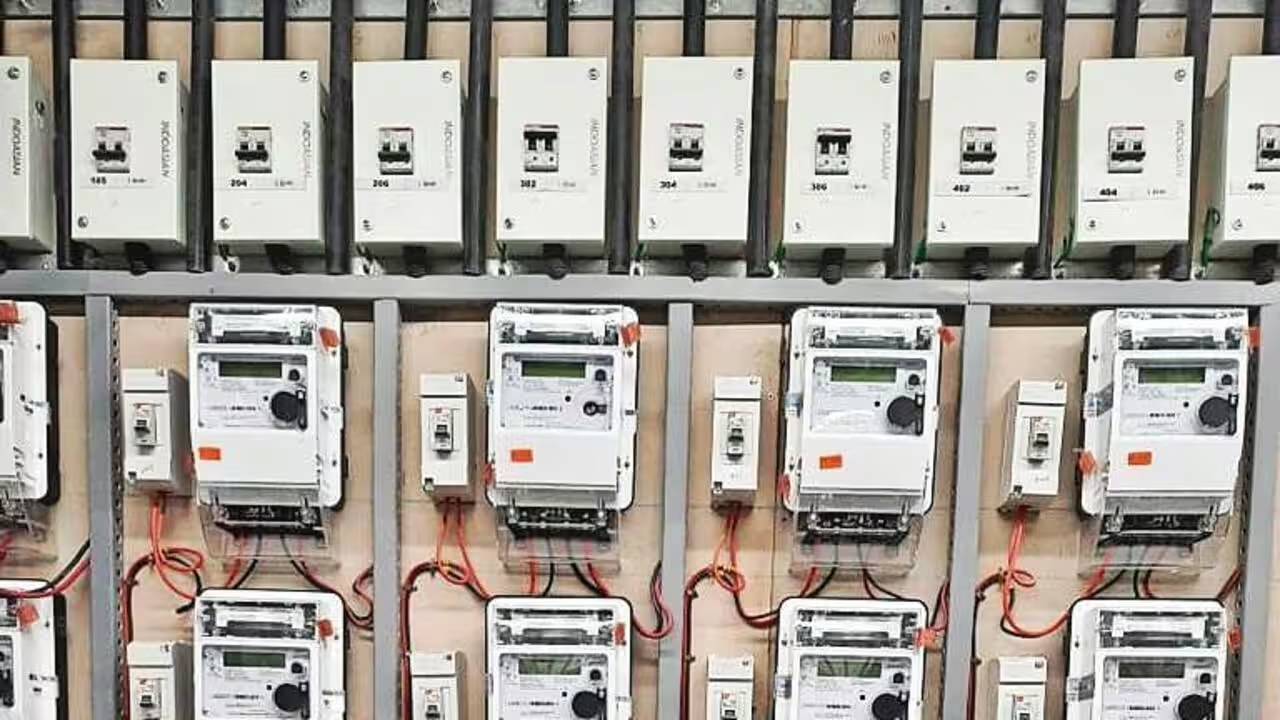
Kalyan: Nationwide protests against smart electricity meters have reached the Kalyan-Dombivli belt, with many consumers alleging their monthly bills have increased three to five times despite no major change in household power consumption.While residents want an independent technical audit of the newly installed meters, the Maharashtra State Electricity Distribution Company Limited (MSEDCL) maintains the higher bills are due to increased summer consumption and the more accurate recording of smart meters.Residents of Runwal Gardens, Dombivli, claim their monthly bills have, on average, risen from Rs 2,000-2,500 to Rs 8,000-10,000. Ahmed Salman Imtiaz’s bill jumped from Rs 3,000 in Feb to Rs 14,000 in Apr. “We installed an AC in Apr, so we had expected a higher bill, but this was steep,” he said. The family consciously reduced AC usage thereafter, “yet my June bill was Rs 17,000”, Imtiaz said.Rajesh Warekar said his monthly bill, usually around Rs 800, shot up to Rs 9,910 after he rented out his house. “But my tenant insists his usage doesn’t warrant such an amount,” he said. Sanjeev Tripathi, who earlier paid around Rs 2,000 during summers, said, “In June, my bill was Rs 9,860. MSEDCL should reinstall the old meters.”Opposition to smart meters has been building in Mumbai since BEST began installing them in south Mumbai in 2024. During the recent assembly session, minister of state for energy Meghna Sakore-Bordikar, responding to queries over 11,000+ complaints from Pune, said it was incorrect to attribute higher bills to smart meters.However, even consumers with conventional meters in Kalyan-Dombivli have reported steep increases this summer. Dombivli resident Lakhi Shaw said his bill rose from Rs 2,000-2,500 to nearly Rs 7,000, while Kalyan resident Ashok Pawar’s bill rose to Rs 6,000-8,000.Opposition to the rollout is becoming intense, with installation teams allegedly assaulted in some localities. Political parties, including the ruling Shiv Sena in Kalyan-Dombivli, have staged demonstrations demanding the rollout be suspended until consumer concerns are addressed.The issue escalated last week when a consumer allegedly attempted to set himself on fire at the MSEDCL office in Vasai. The staff intervened in time. The consumer told TOI he received a bill of around Rs 14,000 after a smart meter was installed despite no change in household consumption.MSEDCL, however, remains firm that the spike is linked to the exceptionally hot summer, which led to greater use of air-conditioners, coolers and refrigerators. Officials also said many ageing electromechanical meters had slowed down over time and were under-recording consumption.“Smart meters record electricity consumption more accurately, including low levels of power usage that older meters often failed to capture. In several complaints investigated by us, defective internal wiring and electricity leakages inside consumers’ premises were contributing to higher consumption,” an MSEDCL official said.Kalyan division chief engineer C R Mishra cited departmental data to support the utility’s stand. “Our analysis shows that among 11.76 lakh consumers who continue to use conventional meters, electricity consumption in June increased by 28% compared with June 2025,” he said.Among 5.53 lakh consumers whose conventional meters were replaced with smart meters, consumption rose by 22%. “Similarly, 3.43 lakh consumers who already had smart meters before June 2025 recorded a 25% increase in electricity usage this June,” Mishra said. He added that if smart meters were over-recording, only that category would have shown abnormal increases. The analysis also found many middle-class households crossed the 300-unit monthly consumption threshold, pushing them into higher tariff slabs.While social activists blame privatisation for the push towards smart meters, MSEDCL says they provide transparent billing by recording actual consumption and allow users to monitor hourly, daily and monthly usage. These meters can help detect power theft, identify faults quickly and reduce transmission losses.(Additional reporting by Somit Sen)

Collector’s office not executing RERA’s refund orders: Bombay HC | Mumbai News

Collector’s office not executing RERA’s refund orders: Bombay HC
The HC had earlier in Feb observed that in general, builders were “exploiting loopholes’’ in law and frustrating orders of refund passed by MahaRERA

Mumbai: The Bombay high court on Friday observed that a pending case of refund under RERA over delay in a Chembur project “discloses an extremely sorry state of affairs with the collector’s office. The HC division bench of Justices AS Gadkari and Kamal Khata said decrees passed under the MahaRERA are not being executed scrupulously by the collectors’ office, though mandated under the law.On July 10, the HC issued notices to the collector of the Mumbai suburban district and a tehsildar to show why no action is attracted under the Contempt of Courts Act for failing to abide by its July 8 order and furnish details sought of a builder’s assets.The HC also appointed a court receiver over a flat in a Khar building to secure the interests of Sneha Tejwani in her plea for refund of Rs 1.5 crore with interest.The HC had earlier in Feb observed that in general, builders were “exploiting loopholes’’ in law and frustrating orders of refund passed by MahaRERA. The HC had even directed the state advocate general to assist the court in formulating measures to prevent those defeating the salutary provision of the Real Estate (Regulation and Development) Act (RERA), which entitles buyers to a refund with interest on withdrawing from delayed projects. The AG Milind Sathe had, among other points, suggested a 25% security of project cost at registration.In 2016, a 550 sq ft flat for Rs 1.65 crore was booked in a project undertaken by builder Niraj Kakad Construction on Sion-Trombay Road in Chembur, her counsel, Neeta Jain, with advocate Mahesh Kukreja, submitted. Tejwani paid Rs 1.5 crore, and possession was due in Aug 2017. But, for certain reasons, the work stopped. In 2019, through her father as her constituted attorney, she invoked her rights under RERA to withdraw from the project. She sought a refund with interest. In 2020, the MahaRERA directed the builder to give her the refund with 10.4 % interest. The builder unsuccessfully challenged the order up to the HC in 2022, but with the recovery process still pending with the suburban collector, Tejwani’s lawyers said she was restrained from petitioning the HC in 2024 for directions.The HC had sought disclosure of assets from the builder. But on July 8, the HC said the builder “attempted to take the court for a ride’’ as he did not disclose all entities where he had financial stakes. The HC thus, on July 8, directed the collector to personally verify and inform on July 10 how many legal entities the builder has interests in. On July 10, initially there was no reply, and in the second half, after the govt pleader sought time, a tehsildar filed a reply which the HC said “undermined’’ the court’s authority. Besides, it lacked the details sought.The buyer’s lawyer said a flat in Khar (west) belongs to the builder and may be attached. The builder’s counsel, Karl Shroff, said there was no agreement on that flat as yet. The HC, in its order, saying, “be that as it may,’’ to secure the refund amount, directed the HC receiver to take physical possession of the Khar flat by July 13. The court posted the matter to July 17 on govt pleader Anjali Helekar’s request.

A new Yemeni cafe at fast-changing Bhendi Bazar brews coffee and hope | Mumbai News

A new Yemeni cafe at fast-changing Bhendi Bazar brews coffee and hope
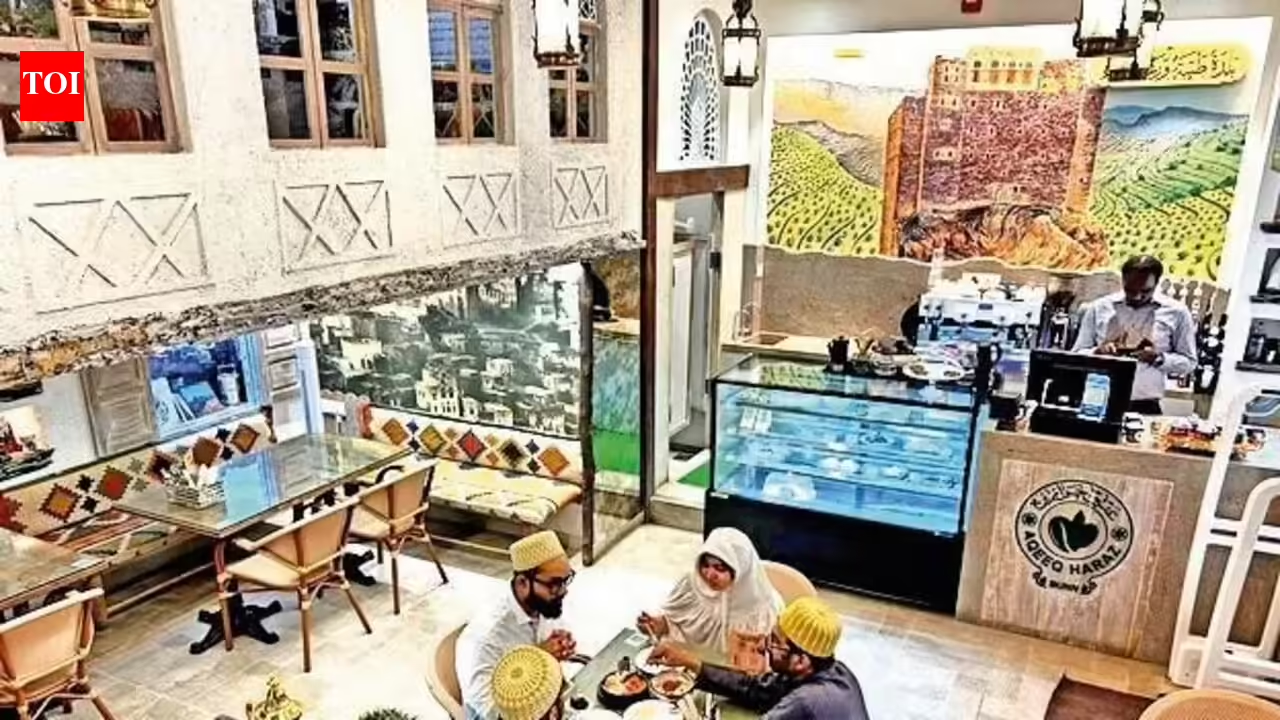
A Dawoodi Bohra family enjoys Yemeni food and its iconic coffee

After a walk down the wide streets, shopping and eating piping hot payas, naans and kebabs, sitting down for some Yemeni coffee can be a nice way to wrap up the outing.Located near Raudat Tahera, the iconic mausoleum housing revered tombs of Dawoodi Bohras’ spiritual leaders Syedna Taher Saifuddin and Syedna Mohammed Burhanuddin in Bhendi Bazar, is a small coffee shop that resembles a piece from Yemen in West Asia of the Arabian Peninsula. Besides coffee, it also serves a mission.Its wooden window frames, stained glass engravings, rustic look of the walls, ceiling and floor, poems in Arabic calligraphy decorating a wall with English translation eulogizing coffee, all help transport you to a Yemeni home.Part of an upliftment project to help Yemeni farmers give up growing qat or khat, a plant whose leaves locals consume as a recreational stimulant, and cultivate coffee instead, the establishment brews hope.Concerned at the deleterious effects of widespread consumption of qat among Yemnis, late Syedna Mohammed Burhanuddin, the 52nd Dai or spiritual head of the Dawoodi Bohras, suggested coffee plantations replacing qat. Haraz, a mountainous region around 90 kms from Yemen’s capital Sana, was initially chosen for the pilot project.“Here farmers were told about harms of qat to their health and economy (the plantation consumes plenty of water and drains resources) and benefits of coffee cultivation. In a few years, the locals’ health improved and economy boomed,” says Shabbir Jabeli, a member at the Aqeeq Haraz Bunn, the company which runs the coffee shop as part of the upliftment project for the Haraz farmers. Jabeli adds that Syedna Mufaddal Saifuddin, the current spiritual head, has blessed the project as it weans Yemen’s farmers away from harmful qat and provides a healthy and profitable alternative cash crop, the Yemeni coffee, considered one of the best in the world.Since Bhendi Bazar is being redeveloped into a clean, traffic-free, infrastructurally rich locality by SBUT, this coffee shop connects the Dawoodi Bohras to Yemen which remained seat of the Dawat (community headquarters) from the time of the first Dai for nearly four hundred years. The spiritual leadership had moved to Yemen following the collapse of the Fatimid rule in Egypt in 1171.How did Bohras’ bond with Yemen grow? The 23rd Dai Syedna Mohammed Ezzuddin appointed Syedna Yusuf Najmuddin as the 24th Dai in 16th century in India, which marked the shift of the Dawat from Yemen to India. With Syedna Jalal Shamsuddin (25th Dai), the headquarters firmly established in Ahmedabad in Gujarat. After moving to many cities in West and Central India, the Dawat eventually settled in Bombay (now Mumbai) in the late 19th century.If Dawoodi Bohras have such a strong bond with Yemen, this coffee shop which also serves several authentic Yemeni dishes, helps strengthen the ties. The café manager Taha Petlawdaawala orders some of the dishes for us. Soon comes shafoot, a savory, chilled yogurt-based salad layered with spongy, fermented flatbread and spicy green herbs, bint al-sahn (daughter of the plate) Yemeni pastry, lahsa, a rich creamy egg dish cooked with spiced tomato base and a Yemeni stew.“Lahsa is a breakfast staple served hot with warm pita and flatbread,” explains Ibrahim Ismail Furniturewala, the chef who studied Culinary Arts in Singapore. “I have read up the recipes, watched videos and prepares authentic Yemeni cuisine,” claims the chef. “We have another branch opposite Al Jamea Tus Safiyah, the community educational institution, in Surat.”With the joint’s popularity growing, it attracts both Bohras and non-Boharas. “As I sat there, sampling authentic Yemeni dishes and drinking coffee which came with dates, I thought I was hosted at a Yemeni home. The ambience is very appealing with its sofa, low tables and an adjoining gift and souvenir shop making the experience memorable,” gushes local MLA Amin Patel after a recent visit.

Harvest rainwater to mitigate floods: Greens want Mumbaikars to soak in idea | Mumbai News

Harvest rainwater to mitigate floods: Greens want Mumbaikars to soak in idea

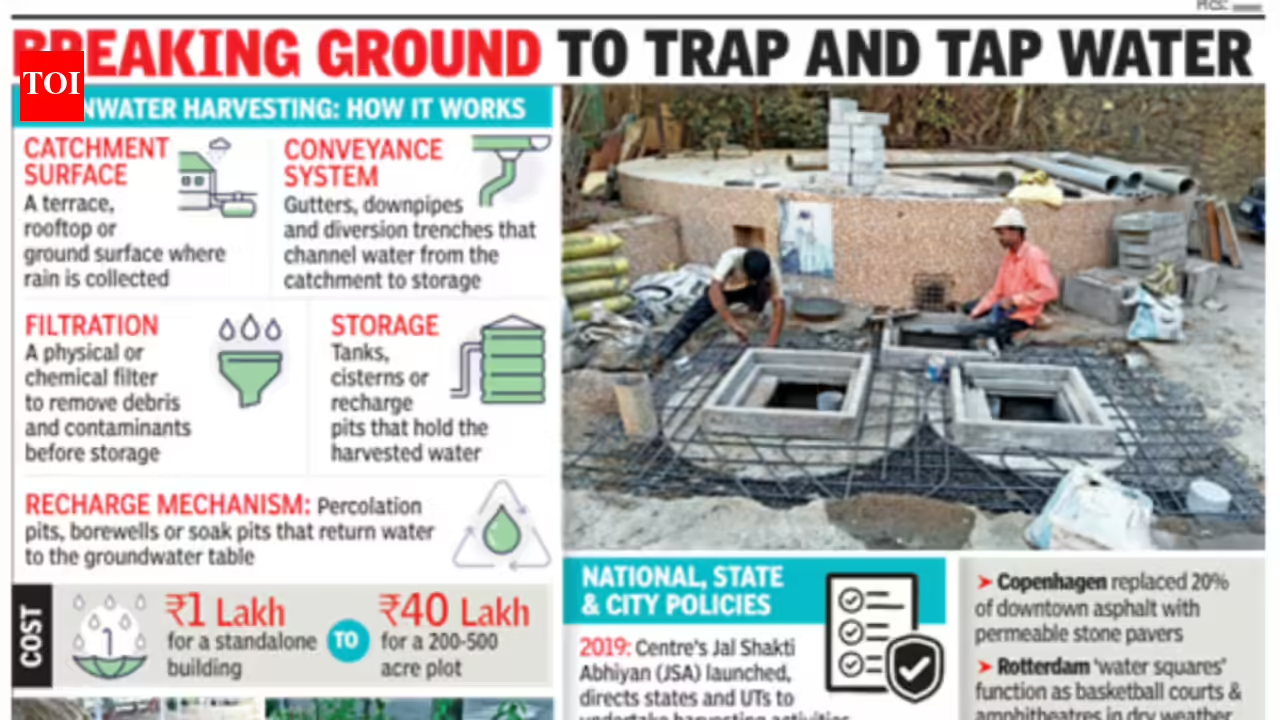
Mumbai: One hundred days’ worth of freshwater supply in volume — that’s approximately how much rainwater landed on Mumbai in the first week of July. Enough, for those inclined to measure it differently, to fill 166,000 Olympic-sized swimming pools.It’s a hot irony that the city continues to face a 10% municipal water cut, and hundreds of Mumbaikars were forced to wade where they ought to have walked. In neighbouring Palghar district, floods marooned people for three to five days without electricity or drinking water.Of the estimated 386-445 billion litres of precipitation Mumbai received within its municipal limits, an estimated 85-90% was surface runoff — between 332 and 400 billion litres washing out to sea. But only after forcing people to reckon with it on the streets first.Every monsoon, people demand better flood management, and the govt recently came up with a Rs 13,000-crore ‘sponge city’ plan that promises to soak up rainwater through bioretention parks, detention-infiltration tanks and permeable pavements.Rainwater harvesting (RWH) — the collection, storage and use of rainwater that would otherwise be lost as surface runoff — has long been viewed as a water conservation strategy. It is now also being championed as a decentralised flood mitigation measure. A network of thousands of such systems across the city could soak up water in situ and prevent runoff from accumulating in low-lying areas.“Water percolation and flood prevention are two faces of the rainwater harvesting coin,” says Rashneh Pardiwala, founder-director of the Centre for Environmental Research and Education (CERE), which has installed more than two dozen RWH systems across Maharashtra, including at fire temples in Mumbai and Pune.Inquiries have doubled in the past three years — none, though, for flood mitigation, which Pardiwala hopes will change.“It’s when water is allowed to percolate directly into the ground — because you can never have a larger tank than the ground itself — that RWH works as an anti-flooding mechanism,” she says.A 2024 paper in the journal Water Supply titled ‘Mitigating flash flooding in the city: Drain or harvest?’ recommends treating RWH systems not just as solutions to water scarcity, but as mechanisms that reduce urban flooding by preventing runoff from accumulating on streets and easing the load on drainage infrastructure — a load that has grown considerably heavier in recent years.Gripped by a grey rush to concretise its land surface, Mumbai lost 81% of open land, 40% of its green cover and 30% of its water bodies between 1991 and 2018. At the same time, monsoon patterns are becoming increasingly erratic, with rainfall concentrated into shorter, more intense bursts. In July alone, a single week brought 1,000 mm of rain — more than the month’s typical average of 768-920 mm — compounding the risk of flash floods when heavy rain coincides with high tide. With natural percolation zones closing up, decentralised RWH systems are a solution that holds water.In 2002, BMC directed new buildings on plots larger than 1,000 square metres to install RWH systems, and in 2007 extended the rule to 300 sq m plots. Yet, there is no data on how many operational systems actually exist in the city — most eventually fall into disuse, experts say. A request to BMC for this data went unanswered.Several institutions and residences, however, went it alone — and discovered downstream benefits they hadn’t anticipated.The Armed Police Headquarters of Mumbai city police in Naigaon started out trying to address water scarcity, which in 2017 impacted nearly 2,000 residential family members who stayed in the police lines. A series of trenches, nearly 3 km long, was dug along three parade grounds and connected to nine borewells. The system improved water supply — but it solved another problem too. “Every monsoon, the main parade ground would get slushy, making it difficult to conduct parades,” says Aswati Dorje, additional director general of police for the Prevention of Crime Against Women and Children, Maharashtra. With excess rainwater draining into the trenches, the grounds held up to the drills.It was Dorje who introduced Maharashtra police to rainwater harvesting, commissioning CERE to install the first system at Naigaon through CSR funding. Impressed with the results, she had another installed at the Maharashtra Police Academy in Nashik — where rainwater flowing off parade grounds was damaging adjacent roads. The system solved both problems.Floods on the Andheri-Kurla Road at Chakala were never of biblical proportion, but that didn’t stop Fr Gerard Rodricks, parish priest of Holy Family Church, from wanting to reduce them. “We’re on a hillock, where water would gush down to the road, taking mud with it. We saw it as wasted water — so 10 years ago, we installed trenches at the bottom of our property, laid with stone, gravel and charcoal, to allow water to percolate into the earth,” he says. They haven’t measured the impact on groundwater levels, but Fr Gerard considers the work done if the neighbours’ wells are fuller for it.“Traditionally, rainwater harvesting has focused on storing water for future use, while flood management has relied on quickly draining excess water away. Climate change demands that these two objectives converge,” says Prerana Langa, CEO of Aga Khan Agency for Habitat (AKAH) India. AKAH plans to install grass pavers — which enhance rainwater infiltration and reduce waterlogging — in Chandrapur and Mira Bhayandar after the monsoon.The Archdiocesan Office for Environment Mumbai is making the same argument. Its first YouTube video on the subject, launched last week, advocates deconcretisation as a way to harvest rainwater at scale: “Keep at least 30% of the area surrounding your building permeable,” says Rudolph D’Souza, recommending perforated concrete blocks for driveways, gravel-filled trenches as soak pits, and ring wells in flood-prone areas.Pardiwala believes incentives are key. “The govt should reduce property tax by 10-15% for those who practise RWH. That will create millions of little recharge pits across the city.” (In 2014, BMC announced a 5% property tax rebate for societies that implement RWH.)Each recharge pit, notes rainwater harvesting consultant Ajit Gokhale, can prevent some measure of water from reaching the road. But he warns that rainwater harvesting must work in tandem with other flood mitigation measures. “Appropriate drainage systems and the restoration of water’s natural path of movement are also essential — the upstream-downstream relationship that construction has blocked must be restored,” he says. “Rainwater harvesting cannot mitigate floods on its own, especially when water accumulates from larger areas into smaller areas and rainfall exceeds 15 mm per hour, because of soil/sand-limited absorption capacity.”Yet, Gokhale saw RWH’s flood mitigation effect at work more than 20 years ago at St Catherine’s Home in Andheri. The shelter’s gate, set at the estate’s lowest elevation, was regularly flooded during the rains. The watchman at the gate was his proof. Before the system was installed, he told Gokhale, he had spent 15-20 monsoon days standing on a chair because of water accumulating around his post. After it: two.(Inputs by Chittaranjan Tembhekar)


BJP neta booked for assaulting on-duty police constable in Mumbai’s Mulund area | Mumbai News

BJP neta booked for assaulting on-duty police constable in Mumbai’s Mulund area

Mumbai: Mulund police have booked Kaushik Patil, BJP’s North East Mumbai district vice-president, for allegedly assaulting and obstructing an on-duty police constable during a late-night incident in Mulund.According to the FIR registered at Mulund Police Station, police constable Bhausaheb Ingle and his colleague were on night patrol when they saw a crowd gathered outside Siesta Tower at Swapna Nagri on LBS Road around 12.50 am Friday. The police asked the group, who were reportedly celebrating a birthday, to disperse.Police alleged that Patil refused to comply, abused and threatened the constable, claiming he could get him suspended and identifying himself as the brother of an MP and a BJP district president. When officers attempted to detain him, he allegedly pushed Ingle, hit him in the chest and tore the pocket of his uniform, damaging his nameplate.

Man held for assaulting video on Dadar railway tracks after viral video | Mumbai News

Man held for assaulting video on Dadar railway tracks after viral video
Police said they are married and had a domestic dispute. The FIR was registered on the basis of a complaint given by the woman.

Mumbai: Less than a week after a horrific video captured a man beating up a woman badly on the railway tracks at Dadar, the Govt Railway Police (GRP) tracked down the couple and registered an FIR against the man. Police said they are married and had a domestic dispute. The FIR was registered on the basis of a complaint given by the woman.The video was filmed by a bystander on July 6 at Dadar railway station’s platform no 6. The man was seen raining kicks and blows on the woman. Later, he dropped her in a long-distance train and left the railway premises.After the video went viral on social media, police scanned footage from several CCTVs and tracked down the couple. The man has been booked under provisions of Bhartiya Nyaya Sanhita for assault.

Poverty-hit woman travels from Assam to Mumbai to meet Salman Khan, rescued in Bandra | Mumbai News

Poverty-hit woman travels from Assam to Mumbai to meet Salman Khan, rescued in Bandra

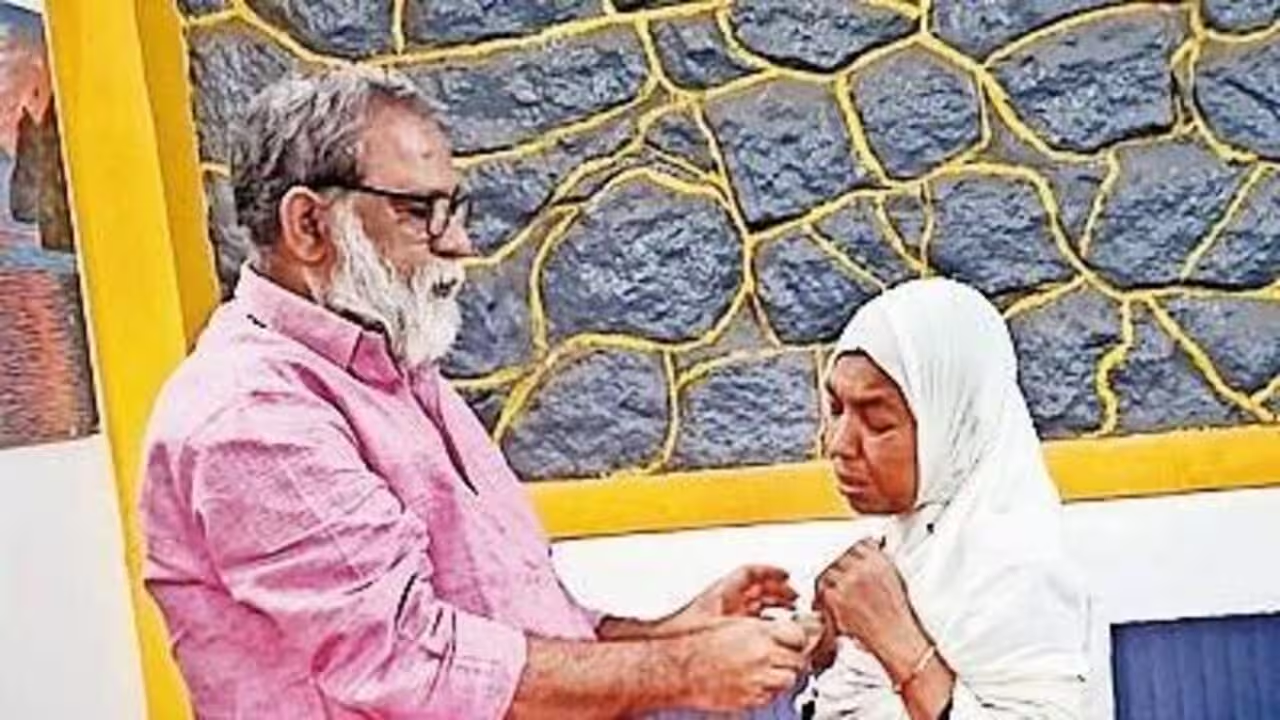
Mumbai: Volunteers from an NGO rescued Jyotsna Begum (55) after they found her in a disturbed state at Bandra’s Carter Road, where she nervously asked people to guide her to the house of actor Salman Khan. Begum travelled from Assam to Mumbai to meet the Hindi film actor because she had read somewhere that “Salman Khan helps his needy fans”.Social and Evangelical Association for Love (SEAL) founder pastor K M Philip said volunteers noticed her while carrying out their annual monsoon rescue drive for homeless destitutes. “We observed how Begum was asking for Khan’s address at Bandra, as she was certain that he would help her financially. After coming to Mumbai from Assam, she became disoriented and hence lost her way in the city,” Philip said.During the counselling sessions at SEAL Ashram, Begum, who lives near Guwahati, had told the social workers that her family is living in poverty, and that she has to take care of her children on her own.“Her only ray of hope was Khan, since she had read a news article that he had financially helped a poor person. However, despite not having any contacts in Mumbai, she set forth on her solo journey, with hardly any money, and she only knew Khan lives somewhere in Bandra,” said a social activist.“We medically treated Begum at our shelter home until she was fully stable. Later, she was reunited with her family in Assam,” Philip said. Begum was among 51 destitutes rescued from the streets during the monsoon drive and taken to the Panvel-based SEAL Ashram for further care. Of the 51 rescued persons, 12 were reunited with their families, including Begum.SEAL chief patron and former vice chairperson of state minorities commission Abraham Mathai said, “State govt must also give a helping hand to enable such NGOs to do such works of compassion”.Philip said the NGO was trying to build a hospital at its Panvel campus to treat rescued patients more efficiently.“Sometimes, private hospitals do not attend to our extreme rescue cases, where there are live maggots seen in their wounds or if they suffer from dangerous diseases like TB, among others,” he said,He also added that the hospital plan can also help other poor villagers in the surrounding areas.

Two collegians out for a dip in Dahisar quarry drown | Mumbai News

Two collegians out for a dip in Dahisar quarry drown

Mumbai: Two teenage collegians — part of a group of four that had ventured to a quarry in Dahisar East for a swim — drowned on Saturday morning. Locals pointed out that casualties are reported at the location during rainy season every year as visitors could find it difficult to ascertain the depth of rain water accumulating in the quarrying pits.The two deceased — Om Singh, 19, and Piyush Gupta, 18, — were FYBCom students at a Kandivli-based college. The duo, along with two of their classmates, reportedly skipped college on Saturday to head for Shaikh Khadaan compound, which is located uphill close to Sanjay Gandhi National Park’s boundary. Police said one of the youngsters had been to the location before and led the group.“Initially, a group of 12 collegians had planned the outing, but most of them dropped out later. The outing was planned a couple of days ago,” said a relative of one of the boys. The quartet met at a mall in Dahisar East and began the ascent. A family member said one of the youngsters had sent photos of the location over Snapchat to his friends around 8.20am.Police said the group did not know how to swim. They entered one of the quarrying pits which is estimated to be filled with rain water between 15 to 20 feet. Singh and Gupta ventured further. When they had difficulty breathing, their classmates, who were closer to the edge, tried to pull them out by throwing in their college bags. But they were unsuccessful. One of the survivors called up the police control room. Dahisar police officers and fire brigade personnel rushed to the location. After a search, Singh and Gupta were brought out around 10.20am and moved to the Babasaheb Ambedkar Hospital, where they were pronounced dead.Singh, an only child, lived in Santacruz with his family. Gupta, who is survived by his mother and three brothers, resided at Charkop. His father passed away a few years ago. Family members of both the boys said the local administration should put up cautionary signboards at the location and barricade it as it is dangerous.

Court orders EOW to file fresh FIR in cheating complaint closed as civil dispute | Mumbai News

Court orders EOW to file fresh FIR in cheating complaint closed as civil dispute

Mumbai: In a major setback to Mumbai police, the designated Maharashtra Protection of Interest of Depositors (In Financial Establishments) Act court has directed the Economic Offences Wing (EOW) to re-register an FIR in a complaint of cheating, which the police closed as a civil dispute.Judge Vikram Jagdale directed the police to register a fresh FIR against Ranbir Real Estate and Developers LLP and its partners Jaikumar Gajanand Gupta and Suyash Jaikumar Gupta, holding that a prima facie case was made out under Sections 3 and 4 of the MPID Act that speaks about fraudulent default and attachment of properties.The court was hearing a miscellaneous application filed by complainant businessman Mahesh Doshi against the closure report.According to his complaint, the accused, through Chirag Shah of Aditi Construction, induced Doshi and his family members in March 2021 to invest money for the redevelopment of a property at Jogeshwari East, promising returns of 18% per annum payable quarterly along with repayment of the principal amount. Acting on the assurance, Doshi and his family invested around Rs 7.65 crore.The court noted that the accused initially paid quarterly interest till June 30, 2024, but subsequently defaulted on both interest and repayment of the principal.The complainant alleged that as of Jan 1, 2025, the outstanding amount due to him, including principal and interest, stood at Rs 8.47 crore. He further claimed that the accused had defaulted on payments to several other investors.The complainant argued that the transactions constituted “deposits” under the MPID Act as the money was accepted with a promise to repay the principal along with assured returns. It was also contended that failure to repay attracts Sections 3 and 4 of the Act.The prosecution opposed the plea, contending that the matter was contractual in nature and that a memorandum of understanding executed between the parties showed a civil dispute.Rejecting the state’s contention, the court relied on the Supreme Court’s recent judgement in Alka Agrawal and Others versus State of Maharashtra.The court held that the definition of “deposit” under the MPID Act has a wide ambit and includes money accepted with a promise of repayment and returns, irrespective of the nomenclature of the transaction.The court observed that the applicant and his family members had advanced substantial sums based on assurances of repayment with 18% annual interest, which the accused had initially honoured the commitment by making part payments towards interest, but later defaulted in repaying both the principal and the promised returns.