

Mumbai court rejects plea of accused to reopen shop near rape survivor home

Mumbai court rejects plea of accused to reopen shop near rape survivor home

The court rejected the argument that filing of the chargesheet and recording of the victim’s statement removed the need for the condition

Mumbai: Reiterating that an accused’s right to earn a livelihood cannot supersede the need to protect a rape survivor from continuous physical proximity to the alleged perpetrator, a sessions court rejected a plea by a 51-year-old pan shop owner —accused of repeatedly raping a woman suffering from intellectual disability and getting her pregnant — to relax his bail conditions so he could reopen his shop near her residence.The accused, who faces the maximum sentence of life imprisonment, was arrested in April 2025 and granted bail three months later, subject to a condition that during the pendency of the trial he would not enter the vicinity where the victim (24) resides until the final decision of the case.The judge noted that the existence of its powers to modify bail conditions does not mean that they are liable to be relaxed merely because the accused subsequently finds the condition inconvenient or financially burdensome. “The applicant does not seek merely to pass through the locality for an unavoidable purpose. He seeks permission to open and conduct his pan shop at or near the entrance of the very building in which the victim resides…Permitting the applicant…would substantially nullify the very object and purpose of the condition imposed while granting bail,” judge Ashwini V Kasture said on Friday.The court rejected the argument that filing of the chargesheet and recording of the victim’s statement removed the need for the condition. “Personal or financial inconvenience cannot be considered in isolation when the proposed activity would bring the accused into the immediate vicinity of the victim in a case involving allegations of a serious sexual offence.” The order noted that no material showed that operating the same pan shop at the same location was the only possible means of livelihood for the accused.Through his advocate, the accused sought relaxation of the condition, saying the investigation had been completed, the chargesheet had been filed, and the victim’s statement had already been recorded. The accused submitted that he was the only earning member of the family, had been without work for about six months, was in financial difficulty, had no criminal antecedents, and had complied with all bail conditions. He claimed false implication and argued that there was no material to support the offences alleged.The prosecution case was that the complainant lived with her mother at the address mentioned in the FIR and that the accused, who ran a pan shop, visited the house, gave Rs 500 to the victim’s mother, offered food to the victim, established physical relations, and threatened the victim not to disclose the incident. Special public prosecutor Ranjana Budhwant opposed the plea.Advocate Lorna Carvaloho, appearing for the intervenor-victim, opposed the plea strongly. The intervenor submitted that the accused was the prime accused and that permitting the pan shop to reopen at the entrance of the victim’s building would create fear and insecurity. The intervenor also claimed that the victim continued to suffer trauma, and that the DNA report was still awaited.
It’s curtains? Only 50 single-screen cinemas remain in Mumbai Metropolitan Region

It’s curtains? Only 50 single-screen cinemas remain in Mumbai Metropolitan Region

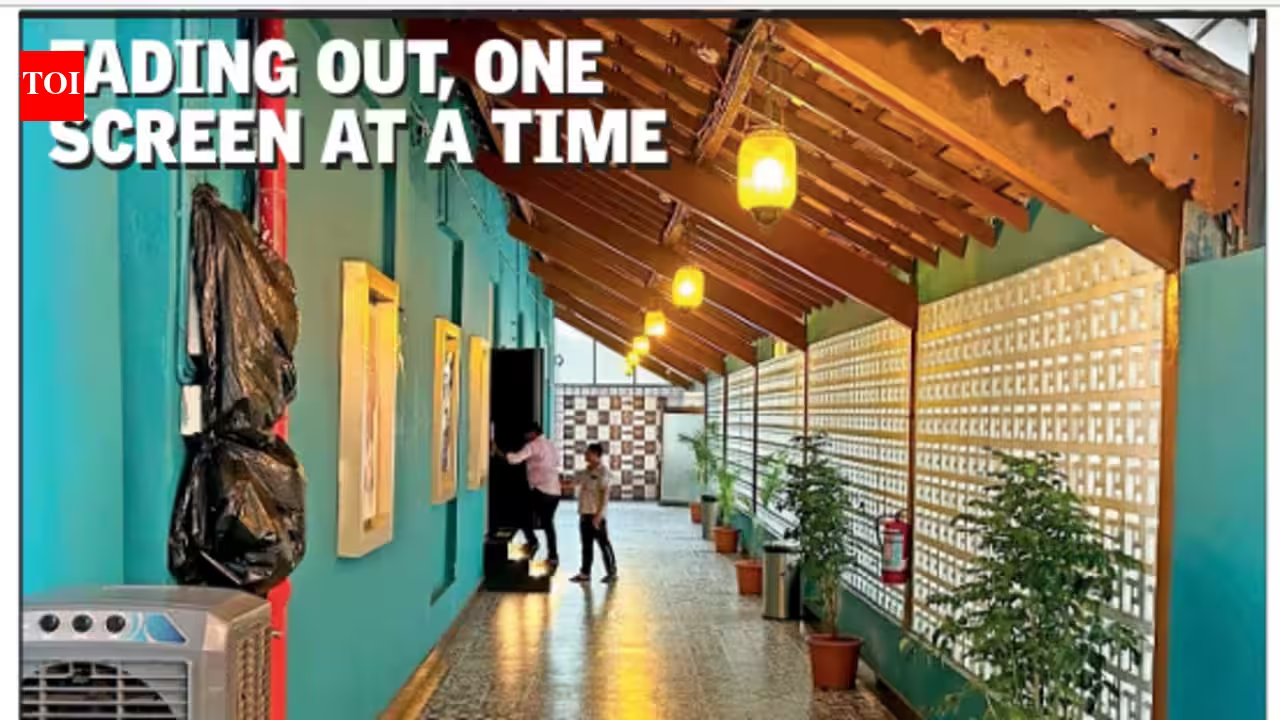
Mumbai: The fortunes of Alexandra Cinema, a famous single screen theatre in Nagpada, rose and ebbed like ocean tides in the last 105 years since it was founded by Ardeshir Irani and Abdulally Esoofally in 1921. Once a favourite haunt of movie-goers for its Sunday Hollywood classics, it gradually fell into disrepute for showing X-rated fare. In 2007 the last film was screened, and around 2011, Alexandra transformed into an Islamic study and prayer centre. Now it is set to be demolished to make way for a residential complex.Audiences recall the magic of watching movies in such standalone theatres in the 1960s-70s where a samosa and ticket cost Rs 2-5 each. Spectators would freely whistle and applaud when Amitabh Bachchan beat Mohan Sherry in Trishul, laugh heartily at Mahmood’s antics in Ginny Aur Johnny, and throw coins at Jayshree T’s mujra ‘Humne maana hum pe saajan’ (Dada).Glitzy multiplexes are a different prospect, say critics, adding tickets and food are prohibitively expensive and collective outpouring of emotion is seldom witnessed.The Cinema Owners and Exhibitors Association of India (COEAI) provided TOI an updated list of June 2026 which shows that only 45-50 single screen cinema halls remain functional in MMR. The rest, around 125, have closed down. A requiem is being written every other week.Owners of single screen theatres say that faulty govt policies including high taxes, electricity bills, tiresome licence procedures and lack of incentives have left them suffocated. In fact, tax holidays are granted to multiplexes owned by rich corporates. The prospect of redevelopment is enticing — only if the mandate to include a movie hall in the new premises is removed, they say.Senior film critic Rajiv Vijayakar says, “I have watched movies in single screen theatres across India because my father had a transferable job. The atmosphere, the enthusiasm of the audience cannot be compared to a multiplex. Rarely do you see people clapping now — maybe in some cases like Dhurandhar.”He recalls, “Decades ago I had gone for a short three-day holiday to Mussourie, and every afternoon, I would visit a particular 50-seater theatre to watch films. I remember seeing CID 909, Shehnai and Yaadein. In Delhi I watched Bridge on the River Kwai and Lawrence of Arabia in Sheela Cinema, which had installed the first 70 mm screen in India. In Chennai I recall going to a nice theatre located in the basement of a building.”Vijayakar moved to Bandra in the 1970s where Bandra Talkies and New Talkies became his standard haunt followed by Gaiety-Galaxy. “Of course it was a lovely era but let me not omit the occasional rat sightings in single screen halls,” he laughs. He recommends that the govt grant a tax holiday to single screens to revive them.The challenge of OTT and web series is not the sole hurdle. Nitin Datar, past president of COEAI, spells out a series of factors that have brought the curtains down on single screen theatres. “The first cause would be the [unfavourable] policies of the govt of Maharashtra, like very high property tax, electricity rates and [cumbersome] licence renewal. Then, multiplexes which were the new entrants were given a tax holiday for a period of five years, and in that duration, they earned around Rs 15-20 crores. But when our single screens asked govt for a similar incentive to compete with multiplexes, we were denied it and left high and dry,” he says.“Thereafter the Maharashtra govt gave a tax free scheme like multiplexes to theatres in the state — except in corporation areas like Mumbai and Pune. But after GST was introduced, govt discontinued this policy. Meanwhile exhibitors had spent a huge amount on renovation — and they came into losses. Then the govt almost put compulsion on single screen theatres to go for digital projection and computerised ticketing. So first we used to sell paper tickets, now it was computerised. And the benefit of this was taken by agencies who monopolised the process,” Datar says.If that were not enough, big distributors and producers were acting like a “monopoly” cartel. “Due to pressure by multiplexes, they did not supply films to all the single screen theatres,” he says.COEAI and other associations requested the govt for subsidy and loans so single screens could survive and compete, to no avail.Datar is presently renovating his own Uday Cinema in Ghatkopar into a commercial complex, including two screens in the mandatory cinema hall.A high profile revival in recent years was that of Eros Cinema, Churchgate, in Jan 2024. A spokesman for Metro Realty which owns the theatre said, “The redevelopment of Eros was a capital intensive and challenging project, envisioning adaptive reuse of spaces in an iconic heritage building. It now houses an IMAX cinema, flagship store and ten dining options.” Similar financial backing is often not available to single screens in non-prime locations.Kapil Bhopatkar’s family has owned Bharatmata Cinema in Lalbaug since 1941. The hall underwent a full makeover in March. Bhopatkar says, “The challenges for a single screen are multiple. Firstly we have no control over the content that we screen. I don’t make the films that I exhibit at Bharatmata. After all only if the film does well, the theatre does well. Moreover, we pay unusually high electricity bills because we are charged at a commercial rate. We pay huge sums in property taxes and of course there are vast upgradation costs. We need some kind of govt support and ease of licencing regulations. Those owners who want to exit the business and apply for change of user should be allowed to go.”Bharatmata has been revamped in a tie-up with One Cinemas, Rajat Haksar and Sunil Patil. “Ours is a heritage structure so we retained the exterior but changed the interiors — chairs, AC, a bigger screen, better sound and 2K projections.”Even as newer direct to home technology and OTT overtakes the cinematic experience, several generations of film lovers long for that one Drive-In or Navrang that did not force them to break the piggy bank.

Retired Mumbai college principal first victim of SIR scam with APK file; loses Rs 17 lakh

Retired Mumbai college principal first victim of SIR scam with APK file; loses Rs 17 lakh

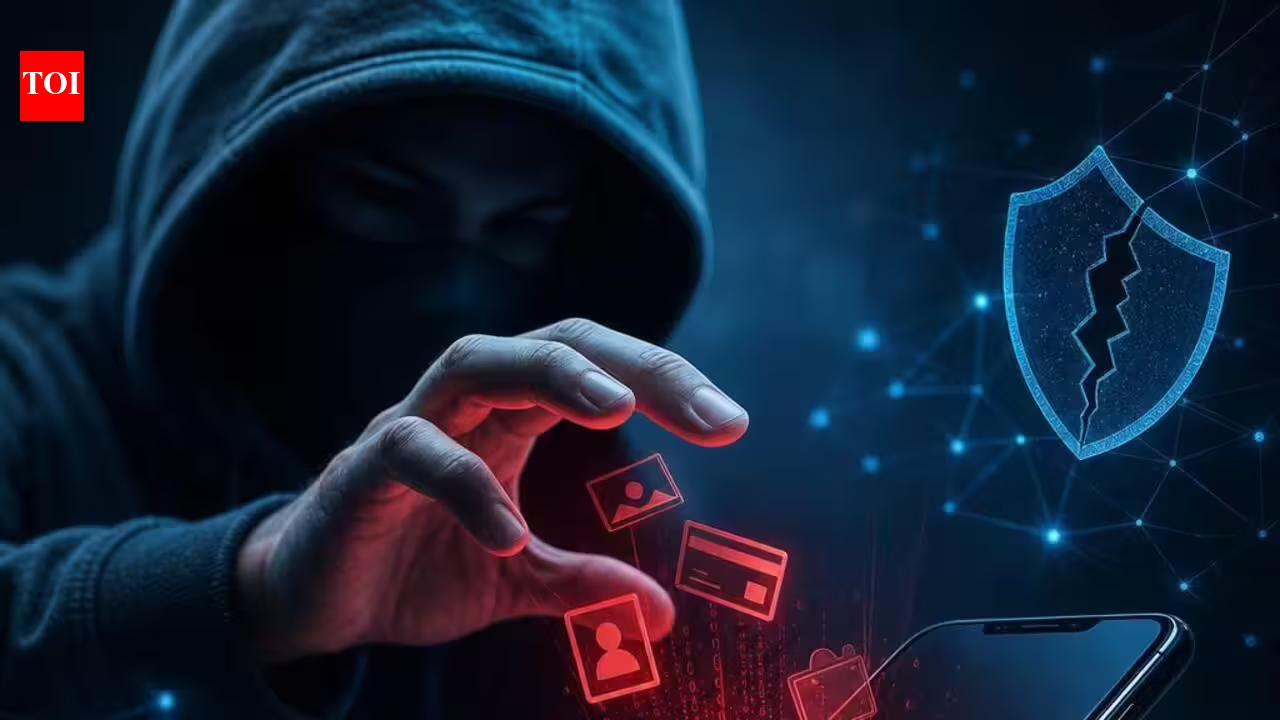
Mumbai: A retired college principal from Deonar lost Rs 17 lakh on Aug 8 after a scammer posing as an Election Commission official forced him to download an APK file on the pretext of updating his Special Intensive Revision (SIR) through an online form, warning him he could not vote in the next election if he did not comply. He is the first victim of an SIR scam using an APK file to gain remote access to his mobile device and steal data.The East Region cyber police station registered an FIR against three unknown persons on Aug 10 after the retired principal received alerts about five fraudulent transactions carried out on Aug 8. The caller identified himself as an Electoral Registration Officer from the Election Commission’s office and said the name of the victim’s father was incorrectly written in the voter list and their team was calling everyone to fill the SIR form to update it before the last date which was on Aug 8.A cyber police officer said the senior citizen lost money after the scammer gained remote access to his mobile phone once he downloaded the link and was asked to transfer Rs 5 as charges towards the form to complete the SIR submission. The five fund transfers were credited to accounts in a private bank and two nationalised banks.He got a call from one “Chandrashekar from the Election Commission”. Later, one Santosh Gupta from the Election Commission office called him and hung up on learning the complainant had entered his banking details online. The victim received two apps, Online Voter Verification and Device Protection on his phone and realised he had been duped.

Scammers impersonate Maharashtra additional chief secretary (home) on WhatsApp, seek ‘financial help’ from dept officials

Scammers impersonate Maharashtra additional chief secretary (home) on WhatsApp, seek ‘financial help’ from dept officials

Mumbai: The state nodal cyber police have registered an offence against unknown fraudsters after several Maharashtra home department officials received WhatsApp messages from foreign numbers impersonating additional chief secretary (home) Manisha Mhaiskar to seek financial assistance.An official from home department has lodged an FIR alleging that the impersonator used Mhaiskar’s name and profile photograph to request an urgent transfer of Rs 50,000 to a bank account in the name of one Imran Khan. The complainant got suspicious after noticing the Indonesian number and verified the request with Mhaiskar. Similar messages were received by other home department officials too. Authorities are investigating the cyber fraud attempt and identity misuse.According to a complaint lodged by Ananda Gore, a Cell Officer in Home Department at Mantralaya, he received a WhatsApp message on Aug 12 from an international mobile number displaying the name and profile photograph of Mhaiskar. Believing the message to be genuine, Gore responded to the sender.The sender allegedly claimed to be busy in a meeting and requested Gore to urgently transfer Rs 50,000 to a person known to her. Bank account details allegedly provided for the transfer were in the name of Imran Khan at a private-sector small finance bank. However, Gore became suspicious after noticing that the message originated from an Indonesian number. He immediately contacted Mhaiskar and verified that the request was fraudulent.The complaint further states that similar messages were received by other home department officials. Cell officer Saugar Patil received a message on Aug 13, while Jaysen Ingole, under secretary in home department, received a similar message from the same number later that day. Another cell officer, Mangesh Jadhav, reportedly received a message on Aug 12. All the messages carried Mhaiskar’s name and photograph and referred to an urgent matter requiring immediate attention.

Tempo driver arrested after bike accident kills student in Sakinaka

Tempo driver arrested after bike accident kills student in Sakinaka

Mumbai: A junior college student was killed after the bike he was riding pillion on was hit by a speeding tempo near Jari Mari Maxus Cinema in Sakinaka, and he was thrown in the air before landing on the road and suffering severe chest injuries, police said.Sakinaka police said they arrested the tempo driver, Mohammed Rizwan (29), after he was traced with the help of a photograph of the vehicle shot by a pedestrian on a mobile phone. The deceased, Wakas Shaikh, a second-year science student, succumbed to injuries 12 hours later while undergoing treatment in the intensive care unit (ICU) of Rajawadi Hospital in Ghatkopar.Shaikh was on leave for the last few days and had resumed Class 12 only three days ago after recovering from ill health. “My nephew left for college as usual at 6.45pm and learnt about the accident when I and my elder brother Ahmed (Wakas’s father) was in the same office where we are employed. At 12.53pm my brother received a call on his mobile from Central Hospital in Sakinaka informing that Wakas had met with an accident near Jari Mari Maxus Cinema in Sakinaka. We rushed to the hospital and saw Wakas was undergoing medical treatment in the ICU,” the deceased’s uncle Faizal Riyaz Ahmed Shaikh (31) told TOI on Saturday.The doctor told the deceased’s uncle that his nephew was in a critical condition due to a chest injury from the vehicle collision. “A person, Umar, who brought him to the hospital had taken a photo of the vehicle that hit my nephew and caused the accident on his mobile. He sent that photo to Wakas’s father which we shared with the police,” said Faizal.Police said Shaikh was riding pillion with his college friend when the speeding tempo hit their bike from behind. “He was riding pillion with his college friend when the speeding tempo hit their bike from behind. He succumbed at 2.10am on Aug 12,” said the police.Sakinaka police senior inspector Avinash Mandle said Rizwan was apprehended a few hours later after he sped from the spot fearing an attack by a furious mob. He was charged with causing death by negligence and rash or negligent driving, and was released on bail after serving notice as the section amounts to less than seven years’ imprisonment.Wakas was the eldest among the five siblings of Ayaz Shaikh.

Navi Mumbai man arrested for killing mother over marital dispute

Navi Mumbai man arrested for killing mother over marital dispute

Navi Mumbai: A 42-year-old man killed his 65-year-old widowed mother residing in Vashi by strangling and banging her head on the floor on Sunday. The man allegedly murdered her as she was preventing him from staying with his estranged wife, who had seperated from him due to frequent quarrels with his mother.Shashikant Chandekar, senior inspector of Vashi, said, “The accused identified as Mahesh Ratnakar Kadam was arrested on Monday early morning from his third-floor apartment in Ashtavinayak society, Sector 11 in Juhugaon, Vashi. The murder victim was identified as Nanda Ratnakar Kadam, residing with her accused son, who works as housekeeping staff at Mindspace IT Park in Juinagar. The incident occurred after 6 pm and came to light around 9.10 pm, when a building resident alerted the Vashi police and two beat marshal constables reached the building and detained Kadam. The accused’s brother-in-law, Mangesh Kashiram Devlekar (49), a resident of Mankhurd has been made a complainant, who had reached the building after being informed by the neighbours.”SPI Chandekar further informed that the victim was rushed to NMMC Hospital, Vashi, where the doctors declared her brought dead on arrival. Police arrested Mahesh on Monday after registering a case against him under BNS section 103(1).Mahesh alleged that his mother was responsible for his wife separating from him due to frequent quarrels. This led his wife to leave him and move away with their two minor daughters. As his mother was reluctant to resolve the dispute with his wife, a verbal argument with his mother escalated. In a fit of rage, he allegedly strangled her with a cloth and banged her head on the floor that proved fatal. Mahesh was produced before the Belapur JMFC court that remanded him to police custody, police said.

BJP plan to provide tabs to 227 corporators hits procurement hurdle

Mumbai: BJP plan to provide tabs to 227 corporators hits procurement hurdle

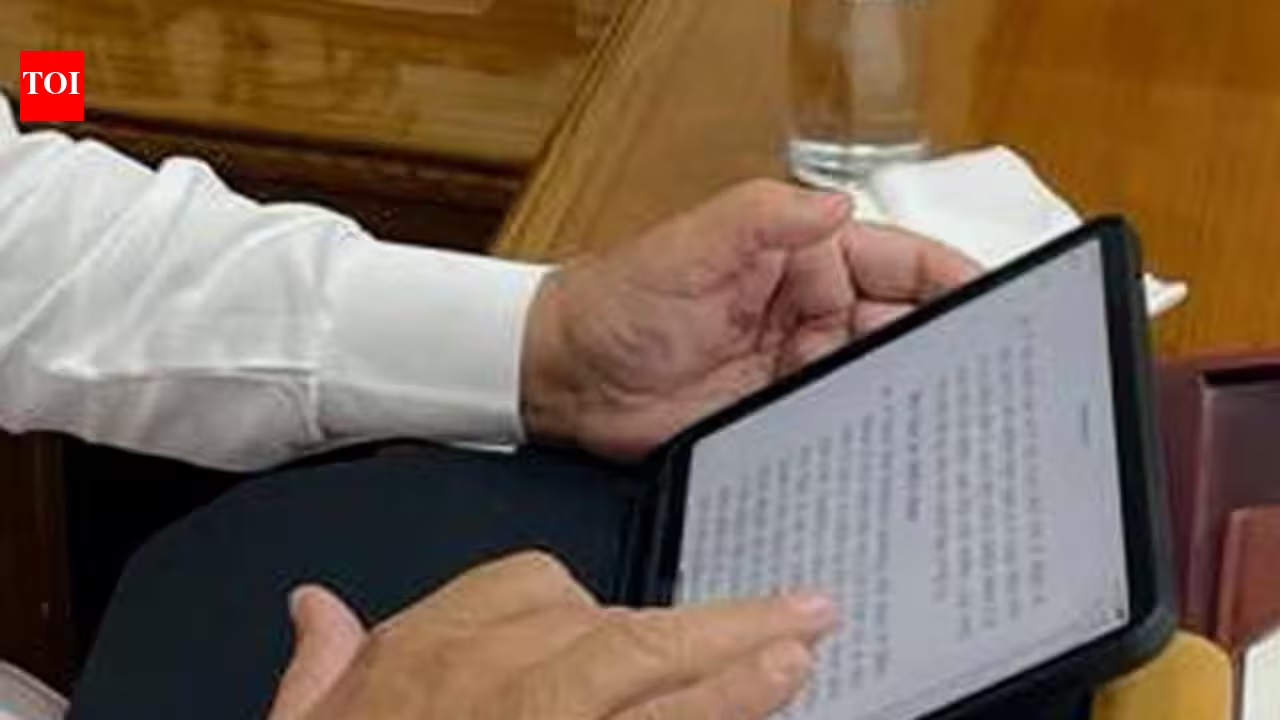
Mumbai: BJP’s plan to provide tablet devices to all 237 corporators appears to have hit a procurement hurdle, with the civic administration finding it difficult to buy the devices through Government e-Marketplace (GeM) portal.According to a BJP functionary, the tablets proposed to be purchased are of Chinese make. Since the particular Chinese-made tablets are reportedly not available for procurement through GeM, BMC may find it difficult to go ahead with the buy through the govt portal.BMC had in recent months decided to procure all of the civic body’s requirements through GeM, govt’s centralised public procurement platform. The portal is used by govt departments and public bodies to buy goods and services through an online system. The proposal to provide tablets to all 227 elected corporators plus 10 nominated corporators had drawn opposition from Shiv Sena (UBT), which had questioned the need for the civic body to incur expenditure on devices for elected representatives.BMC currently prints and distributes voluminous documents for the monthly civic House meetings as well as meetings of various statutory and special committees. These include standing committee, education committee, improvements committee, ward committees, works committee (city), works committee (suburbs), women and child welfare committee, law and revenue committee and health committee, among others.BMC official and BJP functionary Ganesh Khankar said, “Our aim to give tablets to all corporators was only to encourage paperless works. Our intent was good and it would have helped in ensuring that there’s no unnecessary wastage of paper. However, I have been informed that the administration may not be able to procure the devices via the GeM portal, in which case we will not be in favour of it as it was our govt that insisted on the use of the portal.” A dedicated application was proposed for the tablets, through which corporators would have been able to access the agenda and supporting documents.UBT leader and former mayor Kishori Pednekar said that she was opposed to the move since the beginning. “What is the point of providing tablets to all corporators when everyone today has a smart phone? Apart from it, we still prefer civic meeting agendas on paper so that later on it doesn’t give any scope to make any changes once the same is circulated,” she said.

Juvenile lover detained for abetting 24-year-old woman’s suicide

Juvenile lover detained for abetting 24-year-old woman's suicide

Navi Mumbai: After a 24-year-old woman died by suicide after jumping from a moving local train between Vashi and Mankhurd near Vashi creek railway bridge on Aug 1, Vashi GRP has registered a suicide abetment case against a 17-year-old teenage boy hailing from Bihar.The deceased was identified as Priyanka Mithu Ram, who worked as a sales girl at an agritech platform store in Ghansoli and resided in Ghansoli with her widowed mother, elder brother, his wife and two children.Kiran Undre, senior inspector of Vashi GRP, said, The complainant, the deceased woman’s brother, Mahadev Ram Mithu (26), alleged that his sister killed herself due to mental stress. The accused juvenile, with whom she was in a love relationship, had allegedly refused to marry her and threatened her by sending her semi-nude video screenshots, for persuading him to marry her. The IT Act has been invoked since it includes the offence that punishes the violation of personal privacy.”Inspector Undre added, “The accused who has been working in Kalyan for past two months was detained and not arrested as he is a juvenile. Hence, he was produced before the Juvenile Justice Board at Bhiwandi that has sent him to juvenile shelter home. However, when the accused’s mobile was seized and checked, it was found that he had deleted the victim’s obscene images, which will be retrieved sending his mobile to the forensic lab.”As per the FIR, Priyanka and her accused lover were in a long-distance love relationship since April 27. They met when she and her mother had gone to their native place in Bihar for her cousin’s wedding.As her mother and brother agreed to their marriage and contacted the accused over mobile, he claimed that he is willing to get married only after one year as he wants to buy a house first; before that, he can marry Priyanka in a temple. Thereafter, Priyanka and her lover continued talking over mobile, but she started suffering from mental health issues as he had allegedly refused to marry her. On Aug 1, around 7:45 pm, while returning home from her workplace, Priyanka sent a voice recording message to her mother saying that she doesn’t want to live as she cannot survive without him and she is ending her life.Around 8:45 pm, Mankhurd GRP informed her brother Mahadev about Priyanka’s fall from a train and directed him to Vashi GRP, which in turn took him to NMMC hospital, Vashi, where Priyanka was already declared brought dead due to grievous head injuries after jumping off the moving train.On Aug 5, when Mahadev checked the Whatsapp of Priyanka and their mother, he found Priyanka’s obscene images sent from the accused’s mobile number. Acting on Mahadev’s complaint, Vashi GRP seized the mobiles of Priyanka and their mother as technical evidence against the accused and registered an FIR on Aug 7.

Konkani musician Henry D’Souza passes away on Aug 14, 2026 at 83

Konkani musician Henry D’Souza passes away on Aug 14, 2026 at 83

Mumbai: Veteran Konkani musician, composer and singer Henry D’Souza, renowned for iconic songs like ‘Ye Ye Katrina’ and ‘Ami Dogi Sezara’, died at his Mumbai residence on August 14, aged 83.Born in 1943 in Basrikatte, Chikkamagaluru, D’Souza later settled in Mumbai, where he studied law, dabbled in journalism, and eventually carved a career in Konkani music. His most celebrated song, ‘Ye Ye Katrina’ — recorded with Helen D’Cruz, released on HMV in 1971, and touring Byculla, Mahim and Bandra in its lyrics — spawned versions in Hindi and Sinhalese and remains a staple at Goan weddings to this day.With over 700 songs recorded for All India Radio and broadcasts across Sri Lanka, Bahrain and Kuwait, and concerts in India and abroad, D’Souza took Konkani music to the world.

Women Graduates Union turns 111

Leaning in for more than a century: Women Graduates Union turns 111
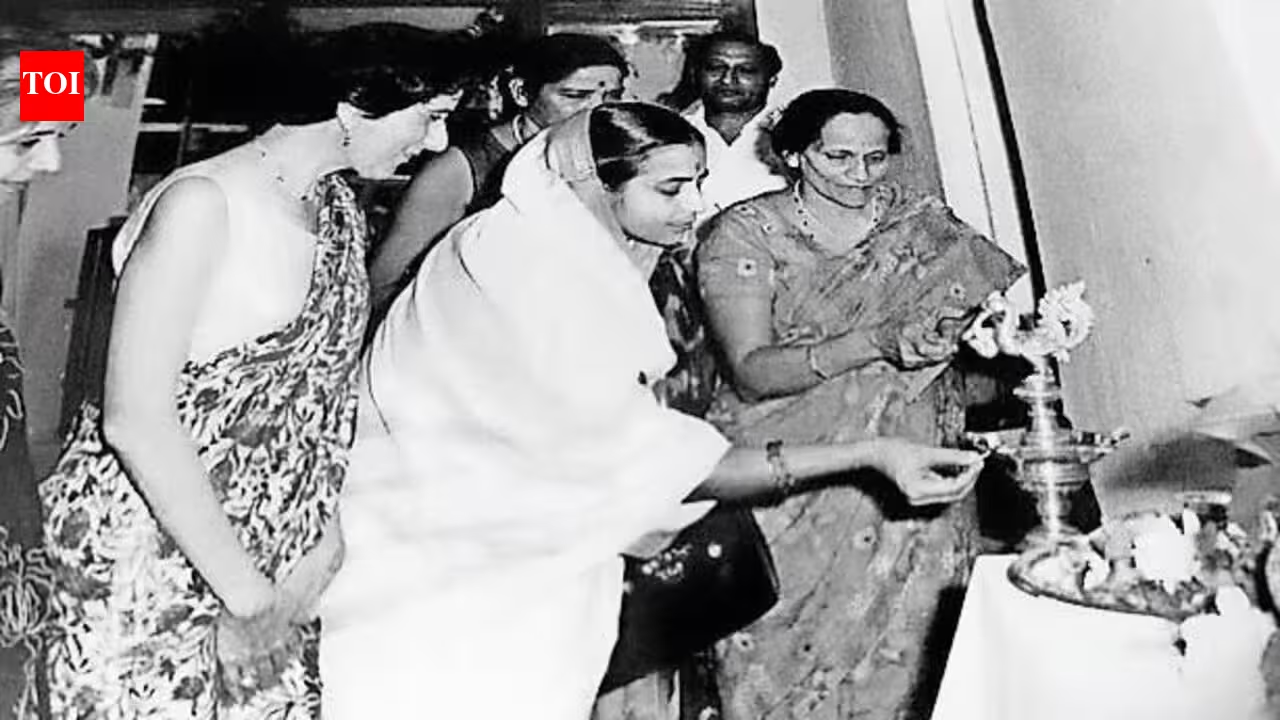
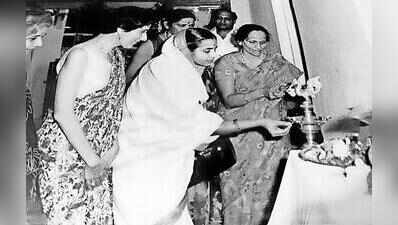
Pratibha Patil inaugurated the Women Graduates Union hostel in 1974

Not far from the bustling fish market in Sassoon Dock sits the Women Graduates Union building in Colaba, with its offices and working women’s hostel tucked into a leafy lane. The organisation, established in 1915, turns 111 this year.It plans to celebrate with a host of cultural events this month (and later in the year) and launch its annual scholarship scheme on Aug 18“We’ve been distributing scholarships since 1957. This year, Rs 25 lakh will be awarded to more than 100 students,” says Gauri Chhabria, the Union’s former president and Scholarship Committee chairperson.Among the thousands who received scholarships from the Union include deputy municipal commissioner, BMC, Chanda Jadhav, “We awarded her a scholarship when she was young and she went on to donate Rs 1 lakh to our scholarship fund later on,” says Chhabria.An initiative of the Association of British University Women in India, the Women Graduates Union is committed to women’s empowerment through education, skill-building and counselling.The Bombay Presidency Women Graduates Union —founded by Dr Annette Benson, a medical officer at Cama Hospital—was the precursor of the Women Graduates Union.Significantly, the first woman Bachelor of Arts graduate from Bombay Province was Cornelia Sorabji, who secured her degree in 1888. (Bombay University opened all its degree courses to women in 1883.)In 1921, Sorabji became the first secretary of the Federation of University Women in India, an institution which was renamed Indian Federation of University Women’s Association (IFUWA). The Women Graduates Union is affiliated with this body and with Graduate Women International.Since its inception, Women Graduates Union has consistently advocated for women’s rights: it secured seats for them in several male-dominated power centres, including the Bombay University senate and Bombay Municipal Corporation.It also secured women bed and board with a hostel, inaugurated by Pratibha Patil, minister for social welfare and cultural affairs at the time—and later President of India—on October 27, 1974.Today, the hostel accomodates more than 100 working women in 80 rooms. “They have to be working women with a monthly salary between Rs 15,0000 and Rs 50,000. Our hostelites include PhD scholars too. Admission is granted after an interview and verification of their jobs, salary and identification of local guardians,” explains chairperson of the hostel committee, Kanta Tripathi.Anushka (second name withheld on request), a scientist at Tata Institute of Fundamental Research, says the hostel is an ideal place for working women. “It is a home away from home, safe and secure.”Besides the hostel which allows women to pursue careers and aspirations with confidence, Women Graduates Union also runs a counselling and guidance centre, a study centre for children from municipal schools and a balwadi for toddlers. “The aim is to provide a strong foundation in education to children in their formative years,” says honourary secretary Raka Ghosh.The organisation’s counselling centre, on the other hand, aims to build a strong emotional bedrock. “Our sessions on mental health teach our members breathing methods, relaxation and mindfulness techniques, how to manage stress and anxiety and cognitive exercises for the brain,” says counsellor and psychologist Rielle Martin.Women Graduates Union also hosts conferences and is invited by other women’s organisations to discuss critical issues of women’s welfare and empowerment, says former president Sabita Chuganee.Their 111-year journey has indeed been eventful.