

100+ of 352 law colleges in Maharashtra told to apply for Bar Council of India recognition in 24 hours | Mumbai News

100+ of 352 law colleges in Maharashtra told to apply for Bar Council of India recognition in 24 hours

Mumbai: As many as 103 of the 352 law colleges in Maharashtra have been given show-cause notices and asked to apply for the Bar Council of India’s (BCI) recognition in the next 24 hours. The state’s directorate of higher education (DHE) will allow these colleges to participate in the CET Cell’s centralised counselling process only once they submit their application letters.Meanwhile, more than 30 colleges that were denied affiliation certificates by Mumbai University are yet to get relief, and some of them are waiting for the university’s shortcomings’ report to move court.This year, the DHE made it mandatory for colleges to get approval from their office, a recognition letter from the BCI and an affiliation certificate from the university, all the three documents, to participate in the state CET Cell’s counselling process.Shailendra Deolankar, director of higher education, said the decision was taken in a meeting held on Wednesday with higher and technical education minister Chandrakant Patil. “We have decided to give them 24 hours to apply to the BCI on the minister’s directive. Only those colleges that have applied will be allowed to register for the CET’s centralised admission process round,” said Deolankar, adding that the recognition letter is likely to take time and, therefore, they are being allowed on the basis of application, so that the admission process doesn’t get delayed further.A college principal said that they are forced to pay a late fee fine to the BCI due to the delay in issuance of affiliation certificates. “BCI gives us a deadline of Dec 31, but university certificates have started coming only now. Some have not even received it and are using last year’s affiliation certificates to complete the online process. We are going to challenge the university’s shortcomings’ report, since no local inquiry committees visited us,” said the principal.Colleges claimed that the govt has not offered any relief from the mandate of BCI recognition, as they are forced to pay up to Rs 8 lakh fine despite not being at fault. University issues affiliation certificates in June every year, when the BCI’s original deadline is Dec 31. They are now forced to pay Rs 8 lakh as a late fee fine.

3 illegal Chembur schools defy closure notices, FIR filed | Mumbai News

3 illegal Chembur schools defy closure notices, FIR filed

Mumbai: RCF police have filed an FIR against the managements of three unauthorised schools in Chembur for allegedly continuing to operate despite repeated closure notices issued by BMC’s education department. As per a complaint by Muhammad Shah, the divisional inspector (schools), private primary schools department, BMC, the education department conducted a survey and found 164 unauthorised primary schools functioning in Mumbai in 2025-26. Notices were subsequently issued to the school managements, directing them to shut down or produce valid govt recognition. However, three Chembur schools—Saraswati Shikshaniketan English High School, Ramzan Shah English Primary High School, and Shukla English High School—refused to follow the diktat, said the complaint.

H1N1 cases in Mumbai in first six months nearly treble to 113 | Mumbai News

H1N1 cases in Mumbai in first six months nearly treble to 113
Cases of other vector-borne diseases also surged during the same period

Mumbai: H1N1 cases in the city between Jan and mid-July this year rose to 113 from 41 reported during the same period last year, according to data released by BMC’s health department. Doctors attributed this sharp rise to erratic weather patterns that have created a conducive environment for viral transmission.While the majority of the cases remained mild, hospitals reported increased severity among patients over the age of 60 and those with underlying comorbidities, with some requiring ventilator support.Cases of other vector-borne diseases also surged during the same period: malaria from 3,115 to 3,681, dengue from 734 to 938, and leptospirosis from 136 to 157. These diseases typically surge as the monsoon progresses. However, BMC’s health department was unable to provide a monthly breakdown of the data.Dr Hemalata Arora, an infectious diseases expert at Nanavati Hospital, said the city has experienced abrupt weather swings characterised by high temperatures and humidity. “Viruses thrive in these conditions,” she said.Although H1N1 has begun to show a downward trend, Dr Gautam Bhansali, a consultant physician at Bombay Hospital, said the season for chikungunya and dengue cases has begun. “We are seeing patients with joints pain, fever and vomiting, which are common in chikungunya. There have also been a few suspected leptospirosis cases,” he said.Dr Anita Mathews, an infectious diseases expert at Fortis Hospital, said due to changing weather patterns and an increase in construction activity, malaria and dengue are no longer largely restricted to the rainy months and are now seen almost throughout the year in varying numbers.While plasmodium falciparum malaria is considered more life-threatening than plasmodium vivax, Dr Arora said there have been severe cases of plasmodium vivax across all age groups. For instance, a 19-year-old plasmodium vivax malaria patient was referred to the hospital after developing a hospital-acquired infection and gram-negative sepsis. “It was followed by Guillain-Barré syndrome as a post-infection complication,” she said.

Speeding at ‘140 kmph’, SUV crashes into parked dumper on Goa highway in Ratnagiri district; 3 of Mumbai family and driver killed, 1 injured | Mumbai News

Speeding at ‘140 kmph’, SUV crashes into parked dumper on Goa highway in Ratnagiri district; 3 of Mumbai family and driver killed, 1 injured

Navi Mumbai: A newly married couple returning to their Mumbai Central home with family from a Goa trip ended in tragedy. The bride, the groom’s mother, his cousin, and the family driver died in an SUV crash along the Mumbai-Goa highway. Allegedly speeding along at 140 kmph, the SUV crashed into the rear of a dumper truck parked on the extreme left lane of the highway near Shanti Nagar at Lanja, Ratnagiri, around 7 am on Wednesday. The groom sustained severe injuries to his neck and has been admitted to a private hospital.The impact of the crash was such that after hitting the right side of the truck’s rear, the SUV yanked off the highway and somersaulted twice, during which time three members of the family got flung out of the SUV,which came to a halt after further crashing into the highway median at a distance of about 50 metres. The SUV was severely mangled, due to which the woman’s son and the chauffeur had to be extricated from it. The chauffeur was declared brought dead at Lanja Rural Hospital.The deceased have been identified as Yasmin Mohammad Irfan Qureshi, 54; her daughter-in-law Fiza Anas Qureshi, 27; her nephew Mohammad Anas Irfan Qureshi, 15; and driver Mustafa Alfaz Kafi, 24, who hailed from Jamnagar in Gujarat. The injured was identified as Anas Irfan Qureshi, 31, Fiza’s husband.The family, which is in the garments business, lived in the Doodhwala Complex, opposite the City Centre Mall, near the Mumbai Central railway station.Anas and Fiza who got married 20 days ago took along his ailing mother and cousin.Anas will be brought to Mumbai and admitted in a hospital in the city.“The family earlier stayed at Bhendi Bazaar and came to reside in Doodhwala Complex just six months ago. Anas and Fiza got married on June 25. This is a very sad incident,” said Dr S A Qureshi, secretary of the Doodhwala CHS. Dr Qureshi and the Qureshis are not related to each other.Qureshi’s elder sister Aafreen and her husband Ashfaque Lashkaria, along with other relatives, reached Ratnagiri and were busy in the legal formalities. The deceased would be buried at the Marine Lines Muslim Bada Qabrastan, said Dr Qureshi.Qureshi’s father, Irfan, passed away around 16 years ago.Neelkanth Bagale, police inspector of Lanja, said Dr Swaroop Eklure, who has a clinic and a residence in Shanti Nagar, reported the accident, as he was at the nearby petrol pump. After the police team reached the accident spot, Dr Eklure and other locals helped the police extricate the driver and Anas from the SUV.Inspector Bagale said, “Upon inspection of the SUV, the speedometer was found locked at 140 kmph. In the Konkan region, even speeding at 70-80 kmph is risky, especially on the Goa highway. The dumper truck was parked on the extreme left of the highway since Tuesday night due to a breakdown. The dumper driver had even kept tree branches on the truck’s rear and side and kept the parking indicator on to signal vehicles coming from behind. However, the SUV was speeding at such a speed that the driver lost control and, veering off the highway, crashed into the dumper truck’s rear, causing the fatal accident. An FIR under the BNS and MV Act sections will be registered against the dumper truck’s driver for allegedly dangerously parking the vehicle along the highway, which resulted in the crashing of the SUV into its rear, causing the fatal accident.”

Central Railway restores second ghat line, Deccan Queen and Intercity services to resume from July 16 | Mumbai News

Central Railway restores second ghat line, Deccan Queen and Intercity services to resume from July 16
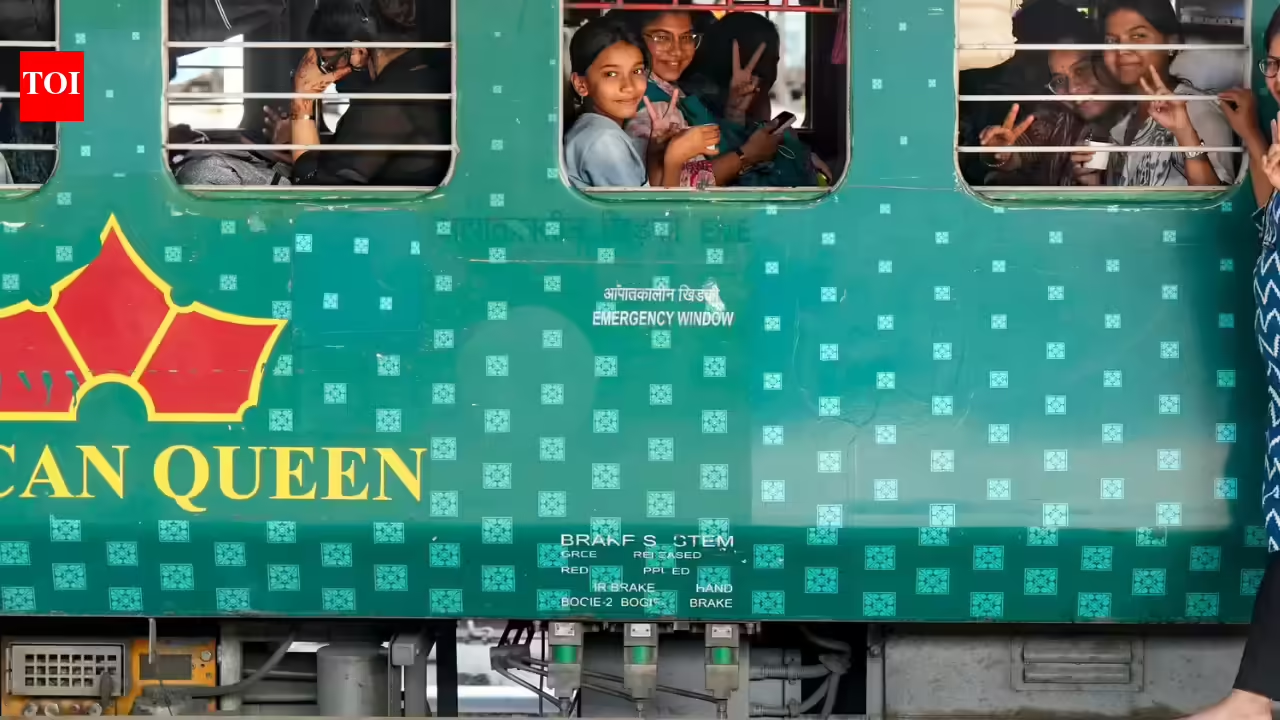
With the line declared fit for operations, 12123/12124 CSMT–Pune–CSMT Deccan Queen and 12127/12128 CSMT–Pune–CSMT Intercity Express will be restored from July 16. (File Photo)

MUMBAI: Central Railway (CR) has restored the second of the three railway lines in the landslide-hit Karjat–Lonavala ghat section, paving the way for the resumption of the Deccan Queen and Intercity Express services from Wednesday, while restoration of the third line is still underway.The South East Down line was restored late on Monday after around 10 days of intensive repair work. Following successful trial runs with three goods trains, the 22107 CSMT–Latur Express became the first passenger train to traverse the restored line, departing Karjat at 11.18 pm on July 14, passing through the affected stretch at a restricted speed of 20 kmph and reaching Lonavala at 12.27 am on Tuesday.With the line declared fit for operations, 12123/12124 CSMT–Pune–CSMT Deccan Queen and 12127/12128 CSMT–Pune–CSMT Intercity Express will be restored from July 16.One of the three railway lines in the ghat section had been reopened on July 7 after train services between Mumbai and Pune remained suspended for nearly 44 hours following landslides at two locations on July 6. At present, trains are operating under a speed restriction of 30 kmph, with around 24 to 25 trains in each direction using the two operational lines every day.The third line is yet to be restored. CR said more than 1,200 labourers, along with engineers, supervisors and senior officers, have been working round the clock in difficult terrain over the past 10 days to clear debris and rebuild the damaged tracks. Heavy machinery, including a Boulder Special Train, Unimat and Duomatic track machines, Poclain excavators and JCBs, has been deployed to speed up the restoration. Labour special trains are also being operated to ferry staff to the work site.CR had announced the cancellation of around 30 mail and express trains on July 9 to facilitate restoration work.

ITAT: Transfer of redevelopment rights cannot be taxed as ‘other income’ | Mumbai News

ITAT: Transfer of redevelopment rights cannot be taxed as ‘other income’

Mumbai: In a significant ruling for property owners participating in redevelopment projects, the Mumbai Income Tax Appellate Tribunal (ITAT) has held that consideration received for the transfer of development rights is taxable as ‘capital gains’ and not as ‘income from other sources’. The tribunal further held that where the statutory conditions are satisfied, the taxpayer is entitled to claim exemption under Section 54EC of the Income-Tax (I-T) Act, by investing the capital gains in notified bonds. Such reinvestment would reduce the taxable component of capital gains.The order assumes particular significance against the backdrop of the large number of redevelopment projects transforming Mumbai and its suburbs. Thousands of residents of ageing cooperative housing societies are entering into redevelopment agreements with builders, often receiving a combination of larger residential premises, monetary compensation, corpus funds and other benefits. As redevelopment gathers pace, the tax treatment of such receipts has become an increasingly important issue for individual taxpayers.The case arose from a redevelopment arrangement involving a taxpayer in Bandra (represented by her legal heir before the ITAT). Under the redevelopment agreement, she transferred her share of development rights to the developer and received a consideration of Rs 50 lakh. The taxpayer invested in eligible bonds and sought an exemption under Section 54EC. The I-T officer, however, treated the consideration received as ‘income from other sources’, thereby denying the exemption available for capital gains.The ITAT held that the development rights constituted a capital asset. The consideration was received for transferring valuable rights attached to immovable property and therefore fell squarely within the ambit of capital gains taxation. Since the receipt was assessable under the head ‘capital gains’, the taxpayers claim for exemption under section 54EC could not be denied merely because the I-T officer had adopted an incorrect head of income.The tax tribunal directed the I-T to verify compliance with the conditions prescribed under Section 54EC and allow the exemption accordingly. The key conditions under this section are that the taxpayer must invest the capital gains within six months of the transfer of property/development rights, the exemption is available only up to a limit of Rs 50 lakh and the bonds must be held for the fixed tenure (which is currently five years and was earlier three years).

Law colleges in Mumbai face delays over Bar Council recognition; fines mount | Mumbai News

Law colleges in Mumbai face delays over Bar Council recognition; fines mount
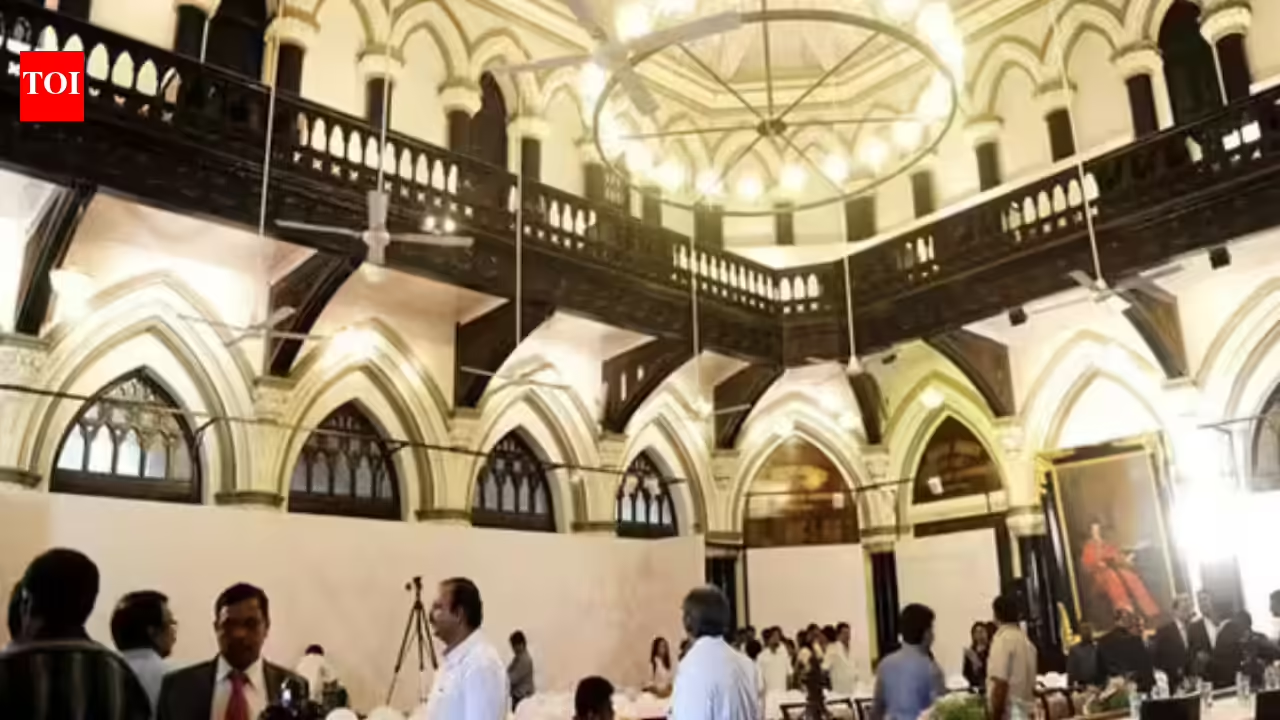
Mumbai law colleges face significant fines for a new state government admission requirement (File photo)

MUMBAI: A majority of law colleges across Mumbai are in a bind over a new state govt requirement that makes the Bar Council of India’s (BCI) recognition letter mandatory for participation in the CET cell’s admission process.Due to a procedural mismatch between the two statutory authorities, Mumbai University (MU) and the BCI, private colleges are forced to pay a fine of up to Rs 8 lakh to obtain BCI approval.Colleges now plan to meet the higher education minister, Chandrakant Patil, to seek a relaxation of the requirement. Meanwhile, 30 colleges, which were denied affiliation certificates, are yet to get relief from the MU.Together, the two issues have raised concerns over delays in this year’s admission process.A principal said ‘the university’s affiliation certificate for the academic session was issued to several colleges only recently, when the BCI process required them to upload the certificate by Dec 31’.“Although the delay is entirely beyond the control of the colleges, the BCI is levying a late fee fine for delayed compliance, which is Rs 4 lakh per programme. Colleges offering both the 3-year and the 5-year LLB are burdened with an unfair financial liability of Rs 8 lakh,” they mentioned in a letter to Patil.The MU, in a letter written to the BCI, mentioned that the affiliation certificates are granted in June every year, as per the provisions of the Maharashtra Public Universities Act, 2016. MU, therefore, appealed to the council to exempt colleges from the imposition of a late fee.No relaxation has been granted by the BCI yet.The problem is faced only by private and unaided colleges that have to seek extension of affiliation from the university every year. Most aided colleges, which enjoy permanent affiliation, have already obtained the BCI recognition letter.Earlier the BCI followed a manual process.Though similar clashes between the timelines of the two statutory authorities have occurred in the past, the shift to an online approval process two years ago has made it even more difficult for colleges, said a principal.“It will be a recurring problem in Maharashtra universities. Either the universities will have to issue the affiliation certificates before Dec 31, or the BCI will have to extend their deadline,” he added.

Mumbai’s VJTI gets its largest donation from alumnus for infra plan; former student to fund 5 storeys of Rs 60 crore academic block | Mumbai News

Mumbai's VJTI gets its largest donation from alumnus for infra plan; former student to fund 5 storeys of Rs 60 crore academic block
Veermata Jijabai Technological Institute received its largest alumni donation

The Veermata Jijabai Technological Institute (VJTI), a state-owned autonomous institution which is on its way to become a university, has got its largest single donation from one of its alumni from the class of 1967.Manu Shah, a BE mechanical engineering graduate from the institute and co-founder of MS International, and his family from the US, through the Shah Happiness Foundation, committed the donation for two of the institute’s flagship projects, a 12-storey multipurpose academic block and the modernisation of the mechanical engineering workshop.While his contribution amount is undisclosed, the entire academic block is projected to cost Rs 60 crore, with Shah funding five storeys.In the recent past, the institute received a donation of about Rs 3 crore from SBICAPS and Rs 2 crore from Savex Technologies as part of CSR funds.The Old Smithy Building on the Matunga campus, which housed the historic blacksmithing workshop for the mechanical engineering department, is being demolished to make way for the new multipurpose academic block.Director Sachin Kore said that the block will be a state-of-the art facility designed for interdisciplinary learning, modern pedagogy and collaborative research.The block will have a cafeteria, several classrooms, two seminar rooms, laboratories, training and placement office, a central computing facility, business incubation facilities, a library and centres of excellence. The ground plus 11-storey building will be spread across a total built-up area of 92,410 square feet.The institute has invited and appealed to alumni and philanthropists to contribute towards the construction of the block and other infrastructural projects, added Kore. The name of the donor and their family will be displayed on a commemorative plaque within the facility.Another project to which the Shah family has contributed is the transformation of the mechanical workshop into a world-class hub for skill development, equipped with high-tech machinery and aligned with Industry 4.0 standards.In a recorded message, Shah, an entrepreneur, whose company is into the distribution of surfacing products, has appealed to the institute’s alumni to come forward and support the institute.

Late-night meetings between Maharashtra CM Devendra Fadnavis, NCP leaders fuel fresh political buzz | Mumbai News

Late-night meetings between Maharashtra CM Devendra Fadnavis, NCP leaders fuel fresh political buzz
Fadnavis, Jayant Patil meeting triggers fresh buzz

MUMBAI: A late-night meeting between Maharashtra chief minister Devendra Fadnavis and senior leaders from both factions of the Nationalist Congress Party (NCP) on Wednesday set off another round of political speculation over the future course of the Sharad Pawar-led NCP (SP), with opposition ally Shiv Sena (UBT) demanding greater clarity on the developments.According to political sources, NCP (SP) state president Jayant Patil met Fadnavis at his official residence, Varsha, after first calling on party chief Sharad Pawar at Silver Oak.Senior ruling NCP leaders Praful Patel and Sunil Tatkare also met the chief minister separately.None of the leaders disclosed the agenda of the meetings, fuelling speculation over a possible political realignment.Seeking to end the speculation, NCP (SP) working president Supriya Sule told reporters that Jayant Patil had met the chief minister only to discuss development-related issues and asserted there was “nothing political” about the meeting.She also ruled out any move by her party towards the BJP-led NDA, saying no such discussions were underway and that the party had neither held talks with the NDA nor been approached on the issue.Shiv Sena (UBT) MP Sanjay Raut, however, said repeated meetings between leaders of the ruling alliance and NCP (SP) were naturally giving rise to doubts among workers of the Maha Vikas Aghadi (MVA).He maintained that allies should remain transparent with each other to avoid confusion and said the opposition alliance expected clarity from its partners.The meetings come days after Sharad Pawar’s interaction with deputy chief minister Eknath Shinde had triggered similar political speculation.While the NCP (SP) has consistently maintained that its meetings with ruling alliance leaders are not politically motivated, the latest developments have once again revived debate over Maharashtra’s shifting political equations.

A pothole-mukt Bharat: Here’s the answer | Mumbai News

A pothole-mukt Bharat: Here’s the answer
Indian cities face recurring costs from pothole repairs on asphalt roads.

Year after year Indian cities spend hundreds of crores on filling up potholes that reappear with the next bout of heavy rain. Roads are tarred before the monsoon, only to crack, cave in and develop potholes in weeks. Emergency tenders are floated, traffic crawls, commuters and vehicle owners lose productive hours and pay dearly for damaged tyres, suspensions and wheel alignments.

Why India's pothole problem never ends

Why India’s pothole problem never ends

This cycle repeats itself year after year with pothole repairs becoming a persistent burden on taxpayers.The rain itself is not the real enemy, say the engineers. The potholes are primarily caused by bad road design, poor drainage, shoddy construction, repeated digging up for utilities and India’s overwhelming dependence on asphalt roads that don’t last long under heavy traffic and monsoon conditions. Experts increasingly believe the country needs to stop fixing roads each year and start building roads that last for decades.Mumbai gets a sneak peek of what permanent roads might look likeMumbai has become the biggest testing ground for cement concrete (CC) roads in India. Before 2022, almost 1,200 km of its approximately 2,050 km road network had been concretised. Another 677 km is being upgraded under the Rs 17,000 crore mega-concretisation project of the Brihanmumbai Municipal Corporation (BMC). The Maharashtra government aims to have almost 95% of Mumbai’s roads concreted by 2027.The best reason for concrete roads is money. BMC’s expenditure on pothole repairs has decreased gradually as more roads have been concretised. Annual expenditure decreased from Rs 202 crore in 2023-24 to Rs 156 crore in 2024-25 and about Rs 89 crore in 2025-26. The actual expenditure has been reduced even further, said chief minister Devendra Fadnavis. The numbers might be different, but the trend is clear: more concrete roads mean less money spent on maintenance and fewer potholes.

Asphalt vs concrete roads

Asphalt vs concrete roads

Why concrete roads last longer It’s engineering that counts. Asphalt roads are made with bitumen which softens under high temperatures and is weakened when water gets into surface cracks. Eventually, those weak spots turn into potholes as constant traffic from heavy vehicles pounds them.Concrete roads are another thing. They are rigid pavements that allow the surface to continuously deform instead spreading the vehicle loads on large slabs. Concrete expands and contracts with temperature change and small cracks can appear. These are not potholes and are controlled with expansion joints. Well designed and constructed concrete roads can give 50 years service or more with relatively little maintenance. Experts say potholes are man-made, not rain-made. Normally, poor workmanship, poor compaction, poor drainage, inferior materials and repeated digging are the causes of road failures.More expensive upfront, but much lower total costConcrete roads are generally two to two and a half times more expensive to build than asphalt. Typically, critics end the comparison there. Engineers say the comparison should be for the whole life of the road.

A pothole-mukt Bharat

Asphalt will need to be resurfaced and repaired many times over its life span. Concrete is more expensive initially but much less to maintain for decades. Concrete roads are more economical in the long run, many experts say, when you factor in recurring repair bills, traffic disruptions, vehicle damage, fuel wastage and productivity losses.The hidden economic costs of potholes are huge. Slow traffic means more fuel consumption, loss of productive hours for businesses, delays in emergency services and an increase in road accidents, especially for two-wheelers during the monsoons. These costs are rarely included in government budgets, but they are ultimately paid by citizens.The facts are also worth noting – as are the environmental concernsConcrete roads are also environmentally friendly. Fewer rebuild cycles mean less movement of construction machinery and materials. They last longer. They also reduce reliance on bitumen, a petroleum product. Their lighter surface reflects more sunlight and can improve night-time visibility. A few engineering studies suggest that using concrete as a road surface could reduce rolling resistance and improve fuel efficiency, particularly for heavy commercial vehicles.Don’t blame the concrete roads when a tree fallsAnother criticism that is often heard after every monsoon is that concrete roads are responsible whenever roadside trees collapse. The problem is much more complicated, experts say. The fact that the road next to them is concrete does not mean that the trees fall for that reason. Trees fall because of aging, fungal decay, damaged roots, bad soil, waterlogging, repeated trenching for underground utilities or strong winds.Modern road engineering permits concrete roads and trees to coexist by incorporating well-designed tree pits, structural soils, root barriers and permeable spaces around tree bases. Urban planners say it’s poor planning, not concrete, that is usually to blame for unstable trees. It is far more important to do better audits of tree health and protect root zones during construction than to give up durable roads.Roads should also gather rainwaterExperts say that cities spending thousands of crores on permanent roads should also improve urban water management at the same time. Recharge pits, infiltration trenches, bioswales and scientifically designed drainage systems should be standard features of major road projects. These actions can help reduce flooding and recharge groundwater.Road building should be viewed as part of a broader urban infrastructure strategy, not as an individual engineering project.The biggest challenge is below the roadThe biggest obstacle to concrete roads is, ironically, the underground infrastructure. Indian cities often have to dig up roads to repair water pipelines, sewer lines, electricity cables, gas pipelines and telecom networks. Asphalt roads can be restored without much difficulty. Concrete highways cannot.Urban planners say the long-term solution is to create. Common Utility Corridors that carry multiple underground services together so maintenance can be done without cutting open roads over and over. Governments should also do all underground utility work before road concretisation, digitally map all utilities using GIS technology and increasingly adopt no-dig methods such as Horizontal Directional Drilling. Heavy penalties for unnecessary road cutting would do much to protect costly public infrastructure.The road before usMumbai is not the only one. Nagpur has long been showing off durable concrete roads. Pune, Surat, Indore and Hyderabad are now increasingly using concrete on busy corridors where long term performance is more important than higher construction costs. Countries such as Germany Japan and the United States also rely heavily on concrete pavements for high traffic roads requiring decades of service.Concrete roads aren’t the cure-all. They are more expensive up front, require better planning and raise legitimate environmental concerns. But India’s annual war with potholes shows that endless patching up of failing asphalt roads is neither economical nor sustainable. With concrete roads along with scientific drainage, stormwater harvesting, protected trees, digitally mapped utilities and common utility corridors, India could finally inch closer to the long-envisioned goal of a pothole-mukt Bharat.The question for India is no longer whether it can afford to build more concrete roads. Increasingly, it may be whether the country can afford not to.