Corporators question BMC’s approach to hawker crackdown

Corporators question BMC’s approach to hawker crackdown

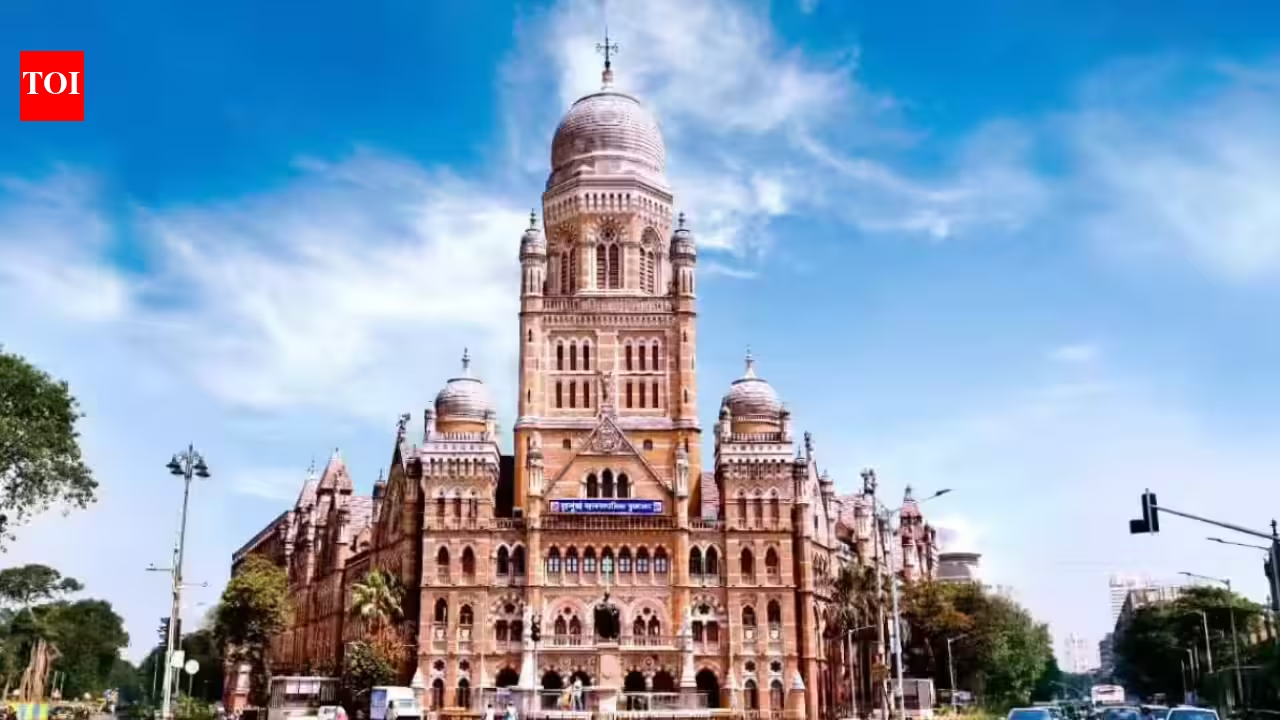
MUMBAI: Corporators cutting across party lines have expressed concern over the manner in which the BMC is carrying out its ongoing action against hawkers encroaching on footpaths, alleging that the drive is arbitrary and suffers from poor execution at the ward level. While corporators broadly backed the ‘Pedestrian First’ initiative, they questioned the way enforcement was being carried out, particularly against hawkers who have been issued QR-coded identity cards by the civic body.BJP corporator Sheetal Gambir said hawkers found occupying excessive space should be asked to reduce their encroachment rather than being repeatedly penalised. “If a hawker is found to be encroaching on the footpath, he should be asked to lessen the space and not be repeatedly penalised. These corporators are coming back to us asking for money to pay the fines too as they are left with no money,” she said.UBT Shiv Sena corporator Deepmala Bhade questioned the BMC’s decision to act against hawkers after issuing them QR-coded identity cards. “QR-coded ID cards were issued to hawkers in our presence and now the BMC is acting against these same hawkers. Then what was the point of distributing these cards?” she asked.BJP corporator Preeti Satam said civic agencies were themselves creating hurdles in implementing the Pedestrian First campaign. She pointed to the lack of JCB machines during enforcement action and said she was informed that the citywide JCB contract had ended on August 9. “In P South there is only one JCB. Where will it act?” she asked.BJP corporator Makrand Narwekar said there was a clear intent among the BMC’s senior leadership to make Mumbai more pedestrian-friendly, but alleged that the same urgency was missing among officials at the lower levels.Congress corporator Tulip Miranda questioned the purpose of QR-coded IDs if they offered no protection to hawkers. “Then why give the QR code itself? Mumbaikars who have been doing business for years are being harassed. We have made the provisions but execution is nil,” she said.The BMC, however, defended its approach, saying the action was not selective. Additional municipal commissioner Prajakta Lavangare Verma said wards had been directed to identify priority footpaths around schools, hospitals and metro stations and ensure pedestrian access.“We are not selectively acting against anyone in particular. We are uniformly cracking down against unauthorised hawkers only,” she said adding that BMC has also created a dashboard to monitor enforcement, with ward officials expected to update details of action taken.

Tukaram Mundhe, the no-nonsense IAS officer leading Maharashtra’s food safety crackdown

Tukaram Mundhe, the no-nonsense IAS officer leading Maharashtra’s food safety crackdown
Tukaram Mundhe, Maharashtra’s ‘Singham’ for his tough approach to administration

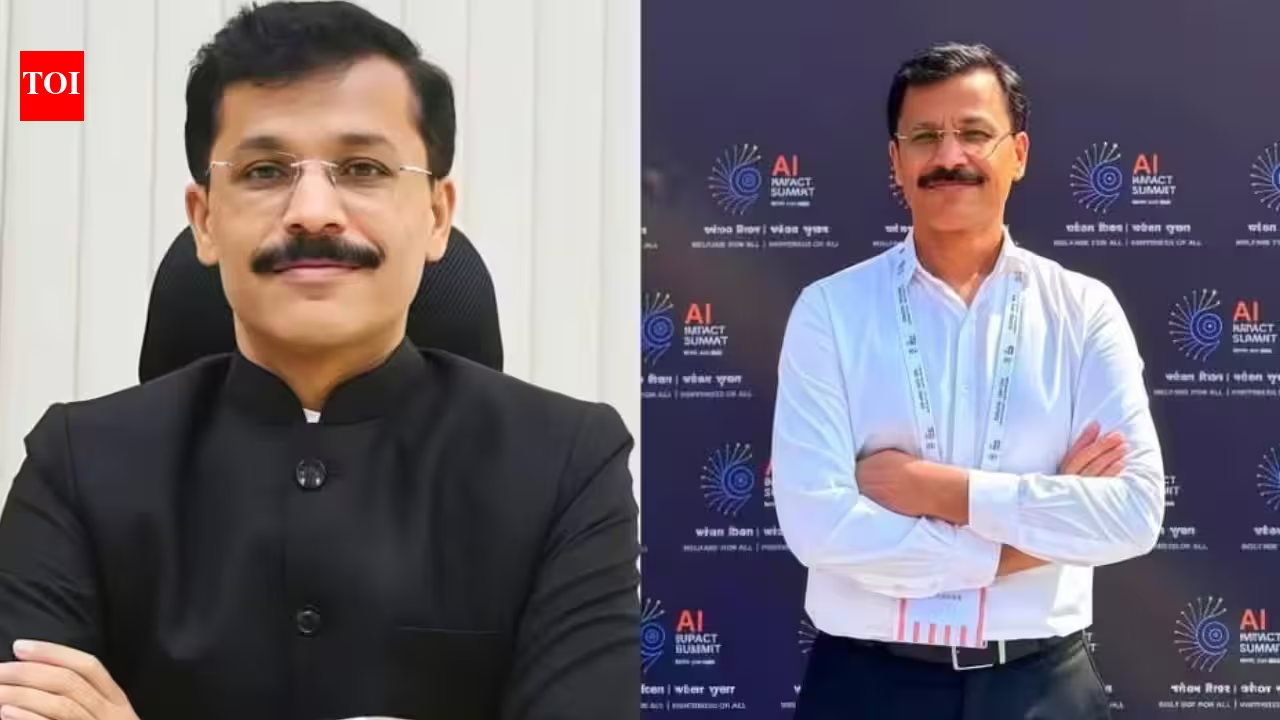
MUMBAI: From crowded kitchens and storerooms to government canteens and food businesses, Maharashtra’s food safety machinery has been stepping up inspections under FDA commissioner Tukaram Mundhe, an IAS officer whose career has been marked by frequent transfers but whose approach to enforcement has remained uncompromising.The inspections have thrown up problems even at some of Mumbai’s well-known food establishments. Officials have reported pest-control and hygiene violations at K Rustom & Co. in Churchgate, while Noor Mohammadi in Bhendi Bazaar was flagged over hygiene and storage-related shortcomings.At Parsi Dairy Farm, inspectors found fungal growth and raw materials stored near mould-affected walls. Shalimar was also cited for multiple hygiene and storage lapses.At Flint and Wara, inspectors seized allegedly mislabelled products and destroyed expired food stock, according to the information provided. The action has brought attention to conditions that may remain hidden from customers who primarily associate these establishments with their reputation, longevity and popularity.The crackdown, however, extends well beyond Mumbai’s famous eateries. The Maharashtra FDA has been inspecting restaurants, milk suppliers, manufacturers and drug businesses across the state. The department says it has carried out 1,131 inspections, seized food stocks worth nearly Rs 50 crore, including more than 1.6 lakh litres of allegedly adulterated milk, and suspended the licences of 56 restaurants.And at the centre of this enforcement drive is Tukaram Mundhe, the 2005-batch IAS officer known for taking on entrenched interests and maintaining a firm approach to administration.The officer behind Maharashtra’s food safety crackdownMundhe took charge as Maharashtra FDA Commissioner on May 25 and subsequently launched a statewide enforcement campaign focusing on adulteration, hygiene violations and businesses operating without proper licences.The commissioner has made it clear that enforcement will not be limited to what is visible on a customer’s plate.“Adulterated food, poisonous liquor and substandard food products are putting people’s health at risk. The FDA has started a toll-free number for complaints and is receiving an enthusiastic response from citizens. Inspections are being conducted as per rules everywhere, from the High Court canteen to government offices,” he said.Mundhe has also stressed that food safety cannot depend entirely on inspections. In his view, the system works only when businesses comply with regulations, regulators enforce those rules effectively and consumers remain alert.Accustomed to transfersMundhe’s reputation for taking tough administrative positions comes against the backdrop of an unusually long list of postings.He was transferred by the Maharashtra government on March 31, marking his 25th posting in a 21-year bureaucratic career, according to a PTI report. He had earlier served as secretary in the Divyang Kalyan Department before being moved to the Disaster Management, Rehabilitation and Revenue and Forest Department.A June PTI report said Mundhe was also replaced as the guardian secretary of Parbhani, where he had been holding additional charge.Repeated transfers, however, appear not to have altered his approach to public service.Asked about the frequent changes in his postings, Mundhe said: “Frequent transfers do not trouble me. In fact, change is an integral part of progress. The more transfers I have, the more opportunities I get to bring about positive changes.”That attitude has become a recurring part of his public image: a bureaucrat who continues to push his priorities despite being moved from one assignment to another.Beyond files and enforcementMundhe has also spoken publicly about subjects extending beyond administration and enforcement.In a recent social media post after his mother’s death, he said his family had “consciously adopted a sensitive and rational approach inspired by scientific thinking” while carrying out her final rites.After the cremation in their native Tadsonga village in Beed, the family chose to bury the ashes on their agricultural land and plant a banyan tree rather than immerse them in water. They also completed the ceremonies within three days instead of following the traditional 10th and 13th-day rituals.“Nature is the creator and the supreme force of this universe. Protecting, nurturing and respecting nature is the truest form of devotion and tribute,” Mundhe wrote.He said the banyan tree would allow his mother’s love and blessings to remain for generations.Message to Gen ZMundhe has also used his public appearances to speak about young people, urging them not to simply follow popular trends.“Do not blindly follow others. Learn the good qualities from everyone, but create your own identity. Instead of merely drifting with the current, make efforts to bring about positive change in society,” he said.He has also warned about excessive digital consumption, saying the attention span of young people has fallen while screen time has increased.“In the digital age, the attention span of the younger generation has come down to around eight seconds, while screen time has increased to eight or nine hours. Do not merely scroll through reels on social media; think. Be prepared to work hard and create your own identity,” he said.For now, his most visible battle is elsewhere — in kitchens, warehouses, food-processing units, restaurants and supply chains across Maharashtra. Under Mundhe, the FDA’s message is that a familiar name, a long-standing reputation or a loyal customer base cannot by itself guarantee that food is safe.Tukaram Mundhe’s career journey

  • 2005-batch IAS officer
    Mundhe belongs to the 2005 batch of the Indian Administrative Service.
  • Maharashtra FDA chief
    He took charge as Commissioner of the Food and Drug Administration on May 25.
  • Statewide crackdown
    His tenure at the FDA has seen inspections targeting restaurants, milk suppliers, manufacturers and drug businesses.
  • 1,131 inspections
    The department says it has conducted 1,131 inspections under the ongoing enforcement campaign.
  • 56 restaurant licences suspended
    The FDA says licences of 56 restaurants have been suspended.
  • 25th posting
    Mundhe’s March transfer was described by PTI as his 24th posting in a 21-year bureaucratic career.
  • Scientific outlook
    Following his mother’s death, Mundhe publicly spoke about his family’s decision to adopt what he described as a scientific and environmentally conscious approach to the final rites.
  • A strong message to young people
    Mundhe has urged Gen Z to resist blindly following trends, reduce excessive social-media consumption and build an independent identity.

Fake Amul, Gokul milk racket busted in Mumbai, 74 litres adulterated milk seized

Fake Amul, Gokul milk racket busted in Mumbai, 74 litres adulterated milk seized
Man caught adulterating milk with impure water in Mumbai

MUMBAI: Mumbai Police have busted a milk adulteration racket in Kandivali East, with a 48-year-old man allegedly caught red-handed while adulterating branded milk with impure water and preparing it for sale.The Detection Squad of Samta Nagar police raided a residence in Kandivali East and seized 74 litres of adulterated milk bearing Amul and Gokul labels, along with material allegedly used for adulteration and counterfeit empty milk pouches.Police said the accused was allegedly mixing impure water into branded milk before preparing it for sale. A case has been registered under relevant provisions of the Bharatiya Nyaya Sanhita (BNS) and the Food Safety and Standards Act, and the accused has been arrested.The raid comes amid a wider probe into the alleged sale of adulterated milk in Mumbai and its suburbs.

Earlier probe uncovered counterfeit milk-packet network

In a related case, the Mumbai crime branch had earlier busted an alleged racket involved in adulterating milk and selling it in counterfeit packets of reputed brands, including Amul and Gokul.Acting on a tip-off, Unit 12 of the crime branch raided premises in Dahisar East on July 9, where police allegedly found milk packets of reputed brands being cut open, diluted with dirty water and resealed before being sold to consumers.Police seized around 470 litres of milk worth Rs 29,750, 13,000 counterfeit empty Amul milk bags, plastic material, equipment used for adulterating milk and four mobile phones worth Rs 10.79 lakh.During the investigation, police identified the alleged main accused and arrested him in Telangana. His interrogation allegedly led investigators to a factory at Lakshmi Industrial Estate, Valiv Phata, Vasai East, Palghar, where counterfeit Amul milk bags were allegedly being manufactured.Police seized fake Amul bags and machinery allegedly used to manufacture the counterfeit packaging, collectively valued at around Rs 10 lakh.The four arrested were identified as Lingya Ganta (42), Saidul Jingli (33), Yadya Batulla (46) and Ramul Bodopalli (65).Police said the alleged main accused had been supplying counterfeit milk bags to people involved in milk adulteration in Mumbai and its suburbs since 2021. The investigation, police said, helped uncover the network allegedly involved in manufacturing fake packaging and selling adulterated milk.A case was registered at Dahisar police station under relevant provisions of the Bharatiya Nyaya Sanhita and the Food Safety and Standards Act.

What is trending in Mumbai today

Marathi rule for drivers, waterfront projects and a murder case: What is trending in Mumbai today
From Marathi rules for drivers to waterfront projects and a murder case

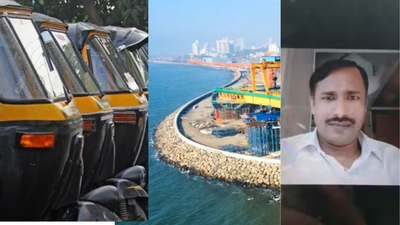
MUMBAI: Mumbai’s biggest local talking points today range from Maharashtra’s new language requirement for commercial drivers to a fresh infrastructure push along the city’s waterfront.Autorickshaw, taxi and app-based cab drivers are preparing for Marathi proficiency requirements, with field testing scheduled to begin from August 16. The move has triggered debate over penalties, livelihoods and the practical challenges faced by drivers.At the same time, the Maharashtra Maritime Board has cleared several major waterfront projects, including work linked to the proposed Mumbai Water Metro, Bandstand redevelopment and the Mandwa jetty.The projects could strengthen water-based connectivity and tourism infrastructure in the Mumbai region.

Marathi test puts drivers under pressure

Drivers and cabbies are scrambling to improve their Marathi skills ahead of the field test. The requirement is emerging as a major issue for Mumbai’s large migrant-driver workforce, with concerns about whether language proficiency should determine their ability to continue operating.

Waterfront infrastructure gets push

Mumbai’s coastline is also back in focus after the Maritime Board cleared infrastructure proposals involving the Water Metro, Bandstand and Mandwa. The projects are being viewed as part of a broader effort to expand Mumbai’s use of waterways and improve waterfront facilities.

Security guard murder case

A human-interest crime story is also drawing attention. Friends and relatives pooled Rs 45,000 to fly the body of security guard Manoj Yadav, who was allegedly strangled in Mumbai earlier this month, back to his family in Madhya Pradesh.

‘Reel master’ Rahul Gandhi responsible for disruption in House, says BJP MP

'Reel master' Rahul Gandhi responsible for disruption in House, says BJP MP
The BJP has criticized opposition parties for disrupting parliamentary proceedings

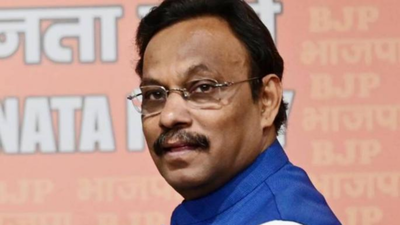
MUMBAI: The BJP has slammed opposition for disrupting Parliament and demanded opposition leader Rahul Gandhi take financial responsibility for wasted parliamentary time. BJP Rajya Sabha MP Vinod Tawde termed Gandhi a “reel master”, holding him responsible for the disruption.CM Devendra Fadnavis said the opposition does not have the courage to face Parliament. “They are bhagode (fugitives). If they had faith in the Constitution they would have been holding discussions.”Tawde expressed disappointment over monsoon session being a washout. He pointed out House could only function for 39 per cent of its time.

Marathi mandate for drivers sparks debate over penalties and livelihood

Marathi mandate for drivers sparks debate over penalties and livelihood
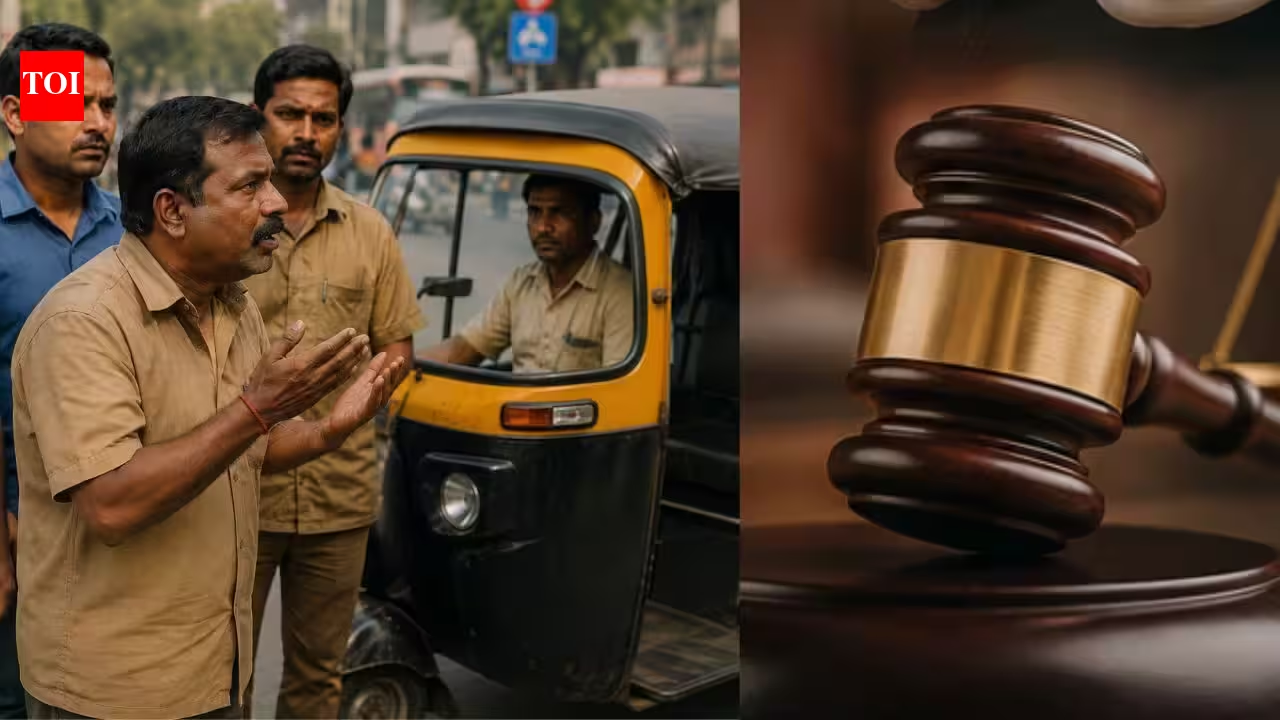
Maharashtra’s new Marathi language rule for drivers is facing significant opposition (AI image used for representational purpose only)

MUMBAI: As Maharashtra moves to implement mandatory Marathi proficiency for autorickshaw, taxi and app-based cab drivers after Independence Day, the policy has drawn a mixed response. While most drivers support the promotion of Marathi and acknowledge the importance of knowing the local language, many are questioning the penalties attached to the new rules.For thousands of auto and taxi operators, driving is the sole source of income for their families. Drivers fear a three-month suspension could have serious financial consequences, affecting household expenses, children’s studies and elderly dependents’ well-being.Many have urged the govt to adopt a more supportive and practical approach. Instead of immediate suspensions, drivers suggest that those lacking Marathi proficiency should be required to attend language classes and be given adequate time to improve. They argue language acquisition is a gradual process that cannot be enforced overnight.Adding to their concerns are complaints about the implementation process itself. Drivers attending mandatory Marathi language training and tests at the Mumbai Central Regional Transport Office (RTO) have reported long queues, delays and difficulties in obtaining completion certificates. Many claim the process is forcing them to lose valuable working days and income.According to drivers, nearly 70-80% of commuters communicate in Hindi while hiring an autorickshaw or taxi. “Passengers typically ask about destinations, fares and routes in Hindi and continue using the language while giving directions during the journey,” said Irfan Mohammed, a driver from Bandra. Even many Marathi-speaking passengers often switch to Hindi while instructing drivers to take a particular road, make a turn or use a flyover, said Brij Mishra, an auto driver from Mulund. “If commuters start speaking Marathi with us, we will learn much faster,” said another.When contacted, transport minister Pratap Sarnaik said, “The Marathi language rule for drivers was on paper for many years, but was never implemented. We are not forcing anyone to master the language -it’s just functional Marathi required for basic conversation with passengers. We are happy that over 1.1 lakh drivers have undergone special training with the help of several tutors across the state,” he said, adding he agreed with drivers when they said commuters should also converse in Marathi, especially locals.

Mumbai Water Metro, Bandstand revamp, Mandwa jetty work get Maharashtra Maritime Board push

Mumbai Water Metro, Bandstand revamp, Mandwa jetty work get Maharashtra Maritime Board push
The Bandra Bandstand project is aimed at improving a heavily used waterfront recreation and tourism zone

Mumbai: Mumbai’s waterways and western waterfront could see a fresh infrastructure push, with the Maharashtra Maritime Board clearing key steps for the Mumbai Water Metro, work at the Radio Club and a makeover of Bandra Bandstand, while also approving repairs and strengthening of the passenger jetty at Mandwa.The decisions, taken at a meeting chaired by fisheries and ports minister and Maharashtra Maritime Board chairperson Nitesh Rane, are significant for Mumbai and MMR as the city looks to expand water-based mobility and improve public-facing waterfront infrastructure.Water Metro: tendering gets focusThe board directed that the tendering process for the Mumbai Water Metro be conducted in a transparent, rule-compliant and competitive manner. The project is envisaged as an additional water-based transport option for Mumbai and the MMR, potentially helping shift a part of passenger movement to waterways.The latest decision, however, is primarily an administrative push for the tendering process; it does not by itself mean that water-metro services are ready to begin. The pace of implementation will depend on the tender process and subsequent project execution.Bandstand to get public amenitiesFor Bandra residents and visitors, the board approved maintenance and repair works at Bandra Bandstand, including a garden, benches, an amphitheatre and other public facilities. The facilities can be provided through outsourcing.The project is aimed at improving a heavily used waterfront recreation and tourism zone. For citizens, the key issue will be whether the promised amenities are maintained properly and remain accessible and safe after implementation.The board also approved the issuance of a work order for the Radio Club project in south Mumbai and directed that the work be completed within schedule and to prescribed quality standards.Mandwa jetty: safety, capacity in focusThe Mandwa passenger jetty in Raigad has been approved for repairs and strengthening. The decision is particularly relevant to Mumbai–Mandwa passengers and the wider Alibaug tourism economy, with the board citing passenger safety and increasing traffic as priorities.The quality and timely completion of the strengthening work will be important for a facility that serves as a key gateway for visitors travelling from Mumbai towards Alibaug and the Konkan coast.Dighi gets shipbuilding cluster pushBeyond Mumbai, the board approved a greenfield shipbuilding cluster at Dighi in Raigad, with tenders to be submitted by August 20.The proposed cluster is intended to attract investment in shipbuilding and related industries, provide common infrastructure and create employment. Its success will depend on actual investor participation, supporting infrastructure, clearances and timely execution.The board also approved the acquisition of land and an approach road required for the Goa Shipyard project at Satkondi in Ratnagiri, aimed at improving access to the project.Maritime Board seeks more revenueThe meeting also placed considerable emphasis on the board’s finances. Rane directed officials to prepare a structured plan to increase revenue by making better use of MMB-owned land and other assets.The board approved leasing out stalls and setting up stalls on its land, with instructions that allotment and lease processes should remain transparent and comply with applicable rules.Officials were also directed to expedite pending projects, tenders and administrative procedures and avoid unnecessary delays.For Mumbai and the Konkan, the decisions collectively point to a wider attempt to use the state’s coastline not only for ports and shipping but also for urban water transport, tourism, commercial activity and shipbuilding. The real test, however, will be how quickly the approvals move from boardroom decisions to projects that citizens and businesses can actually use.

How can IMA challenge law permitting homeopaths to practise allopathy?

State in Bombay high court: How can IMA challenge law permitting homeopaths to practise allopathy?

Mumbai: State govt on Thursday questioned the Indian Medical Association’s legal right to challenge amendments to two Acts that introduced the Certificate Course in Modern Pharmacology (CCMP) and allowed homeopaths to practise allopathy.“How are they aggrieved by this Act?” asked advocate general Milind Sathe, arguing before a special bench of Justices Riyaz Chagla and Farhan Dubash. The 2014 amendments were made to Maharashtra Medical Council Act and Maharashtra Medical Practitioners Act.Sathe argued that IMA is a “voluntary” association of doctors and has failed to show how it has suffered any “legal” injury because of the amendments. He said IMA cannot challenge the constitutional validity of a law merely on the ground that it disagrees with its provisions. He said it must demonstrate its locus standi and legal injury before asking HC to examine the validity of the legislation.Sathe also argued that IMA’s challenge is not based on any alleged violation of the fundamental right of doctors to practise their profession. “Is it the case (of the petitioner) their practice is being affected?” he asked. He also pointed out there was no challenge to the amendments based on Article 19 (1) (g) which protects the right to profession. Instead, IMA had questioned the state’s legislative competence to make amendments to both Acts. Sathe urged HC not to decide the validity of a law in a vacuum, “when the petitioner itself has not shown how it is affected by it.”IMA has challenged the legal framework permitting CCMP practitioners to practise allopathy. The state replied that the Maharashtra law creates a separate state-level registration regime and the provisions have existed as part of the state legislation since 1965. Also, Indian Medical Council Act regulates recognised qualifications for modern medicine at the Central level, while registration to practise in Maharashtra is governed by the state law.In Sept 2025, HC refused to stay registrations of CCMP practitioners, while making them subject to the final outcome of the main petition. It had also directed CCMP practitioners not to exceed their prescribed competency and to refer serious cases to fully qualified allopathy doctors. The arguments will continue on Friday.

Friends, kin pool Rs 45k to fly body of slain Mumbai security guard home

Friends, kin pool Rs 45k to fly body of slain Mumbai security guard home
Manoj Yadav, a native of MP, was strangled to death in the early hours of Aug 2

Mumbai: Friends, relatives and family members pooled Rs 45,000 to book flight tickets to take the body of 35-year-old security guard Manoj Yadav to his family in Itauri village in Madhya Pradesh, which borders UP, after he was strangled to death and his body was dumped in a water tank.Yadav, who worked for the past two years at the 10-storeyed Abhijit residential building in Vile Parle (West), was on night duty when the murder took place on Aug 1. He was killed in the early hours of Aug 2, before four men attempted a dacoity on a sixth-floor flat belonging to a businessman where the fifth accused, cook Jogeshwar Mallik (38), was employed.The Andheri Court extended the custody of the five accused till Aug 18 after completing their seven days on Thursday. The accused were Mallik, Vijay Gonjare, security guard Sharad Yerudkar (43) and his brother Mahadev (35), a farmer from Kolhapur, and Aniket Bornak (30), also a security guard.Police arrested the five on August 7 after the Juhu police team cracked the case using technical analysis following the interrogation of Mallik (38). Police said Mallik and Gonjare (41), a renowned film director’s driver, worked out the plan for the last two-and-a-half years, believing the robbery would help them resolve their debts and loans. Mallik, who lived in Khardhanda with his family and hailed from Madhubani in Bihar, had a Rs 35,000 loan taken for a vehicle purchase, while Gonjare had debts of Rs 8.5 lakh taken as loan and to pay credit card dues.Yadav was the sole bread-winner for his elderly parents, his wife Saraswati Devi and three children, including a seven-year-old son and two younger daughters. His wife, brother Vinod and elderly parents were not in a state to talk. The final rites was performed at his home village. “Yadav did not go to his native place for the last two years. The famliy wanted to see his body to perform the last rites. But financially they are totally broke and depended on my brother’s income he earned working at two places as guard. His younger brother Vinod and his cousin reached Mumbai after learning about the incident. However, they did not have the money and the body was also in bad shape with foul smell started emanating. Finally, friends, relatives and family members from native village pooled money through GPay to Vinod’s account and he booked three tickets on August 4 to fly back to MP where the final rites was performed. According to our capacity we contributed money in range from Rs1000 to Rs5000 to book three flight tickets ,” victim’s cousin brother Balaram Yadav (32), a driver by profession and stayed at Chakala in Andheri (East), told TOI on Thursday.A Juhu police officer said the businessman’s family, where Mallik worked for the past 15 years, remained traumatised after learning that their cook was behind the guard’s murder and had planned to kill them after robbing them, despite their support when police detained him. “Mallik gave the original key to the driver, Gonjare, six months earlier to use it in opening the door lock of the businessman flat on the sixth floor and exchanged it with a duplicate key, but they failed to open the lock on August 2 with the original key,” the officer said.Police said the businessman’s family was lucky because when they checked the keys, the duplicate key was functional while the original, which the cook stole, was non-functional on the day the accused attempted the dacoity.Police booked the five for murder, causing disappearance of evidence, and dacoity attempt. Police said the four accused, excluding Mallik, tied Yadav’s hands behind his back with a cloth rope, and after strangling him to death, threw his body into a water-filled tank on the ground floor of the building and closed the iron lid of the tank after partying.

Mumbai man gets 10-year jail term for stabbing woman over rejected proposal, attacking cop

Mumbai man gets 10-year jail term for stabbing woman over rejected proposal, attacking cop
The court relied on the deposition of the woman, her mother, the injured police constable, medical officers and panch witnesses

Mumbai: Noting that the rising incidents of attacks on police personnel and violence against girls arising from one-sided love are deeply concerning, over four years after a brutal knife attack on a woman and an intervening police constable, a sessions court on Thursday convicted and sentenced a 36-year-old salesman to 10 years’ rigorous imprisonment for attempt to murder. The accused, Anil Babar, was upset as the woman had rejected his marriage proposal. “Such acts reflect a dangerous disregard for law, consent and human dignity. Strict legal action, timely intervention and greater awareness are essential to prevent such incidents and ensure the safety of both police personnel and women,” additional sessions judge RS Aradhye said.The judge also sentenced Babar to three years for stalking, five years for voluntarily causing grievous hurt to a public servant, one year for assaulting a public servant, two years for criminal intimidation and six months’ simple imprisonment under the Maharashtra Police Act. All sentences will run concurrently. “Even if for the sake of argument, it is accepted that there is a love affair between the victim and the accused, but that does not give any right or authority to the accused to assault the victim or any other person for the fulfillment of his proposal of marriage,” the judge said.The prosecution said Babar and the woman lived in the same locality at Salt Pan Road in Wadala East. According to the court record, Babar had developed “one-sided affection” for the woman and repeatedly proposed marriage, but the woman rejected the proposal. The crime occurred on the morning of May 4, 2022. Babar had been stalking the victim and continuously pressuring the victim for marriage despite previous police complaints. Around 10.30 am, the woman left home for work but forgot her mobile phone. Her mother followed to hand on the phone and saw Babar allegedly trying to stop the woman near Barkat Ali Bus Stop and Pooja Junction. When the victim refused to speak with the attacker, Babar pulled out a knife concealed in a waistband and inflicted severe stab wounds to the victim’s abdomen, back and arm. Police Constable Mayur Patil, who was on duty nearby, rushed to the scene to stop the assault. During the rescue attempt, Babar attacked the constable, severely slashing the officer’s hand. Other police personnel eventually disarmed Babar by striking the attacker’s hand with a wooden stick. Both the victim and the constable required prolonged hospitalisation and surgery.The woman was taken to KEM Hospital, where she remained admitted for 10 days and underwent surgery. Patil was treated at Wockhardt Hospital.The court relied on the deposition of the woman, her mother, the injured police constable, medical officers and panch witnesses.On the charge of attempt to murder, the court observed that the absence of fatal injury was not decisive. “The essentials are knowledge and intention of accused while committing the crime and if death were caused by that specific act,” the judge said.The court also held that the attack on the police constable was proved through the bandobast duty order and medical evidence. The judgement said the order showing Patil’s deployment at Kadaria Trust Mosque, Barkat Ali Nagar, Pooja Junction, was “more than sufficient for holding that…Patil was, on the day of incident at the relevant time discharging his duty as a public servant.”Before sentencing, public prosecutor Ranjana Budhwant sought maximum punishment, saying the offence arose out of a one-sided love affair and was also directed against police machinery.“This is the grave offence which the accused committed in the depression of failure in a love affair and brutally attacked the victim, as well as not leaving the Police Constable who tried to intervene in the matter. Therefore, taking into consideration the above-said facts and mitigating circumstances against the accused, I am of the view that in such a matter, if a lenient view is taken, it goes wrong message in society so the severe punishment provided for each offence will meet the ends of justice,” the judge said.Babar has been in custody since the day of the incident. The court directed that set-off be given for the period already spent in jail.