Tata Mumbai Marathon to return on Jan 17; registrations open | Mumbai News

Tata Mumbai Marathon to return on Jan 17; registrations open
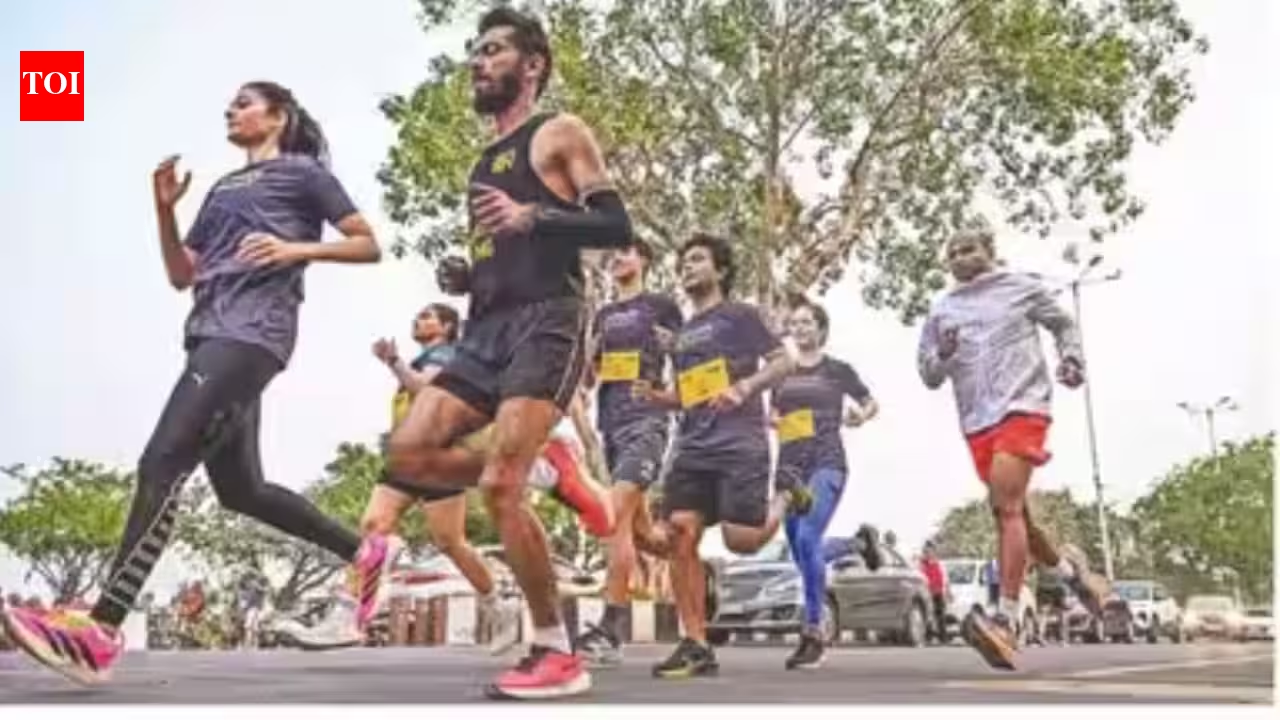
Image Used For Representational Purpose Only

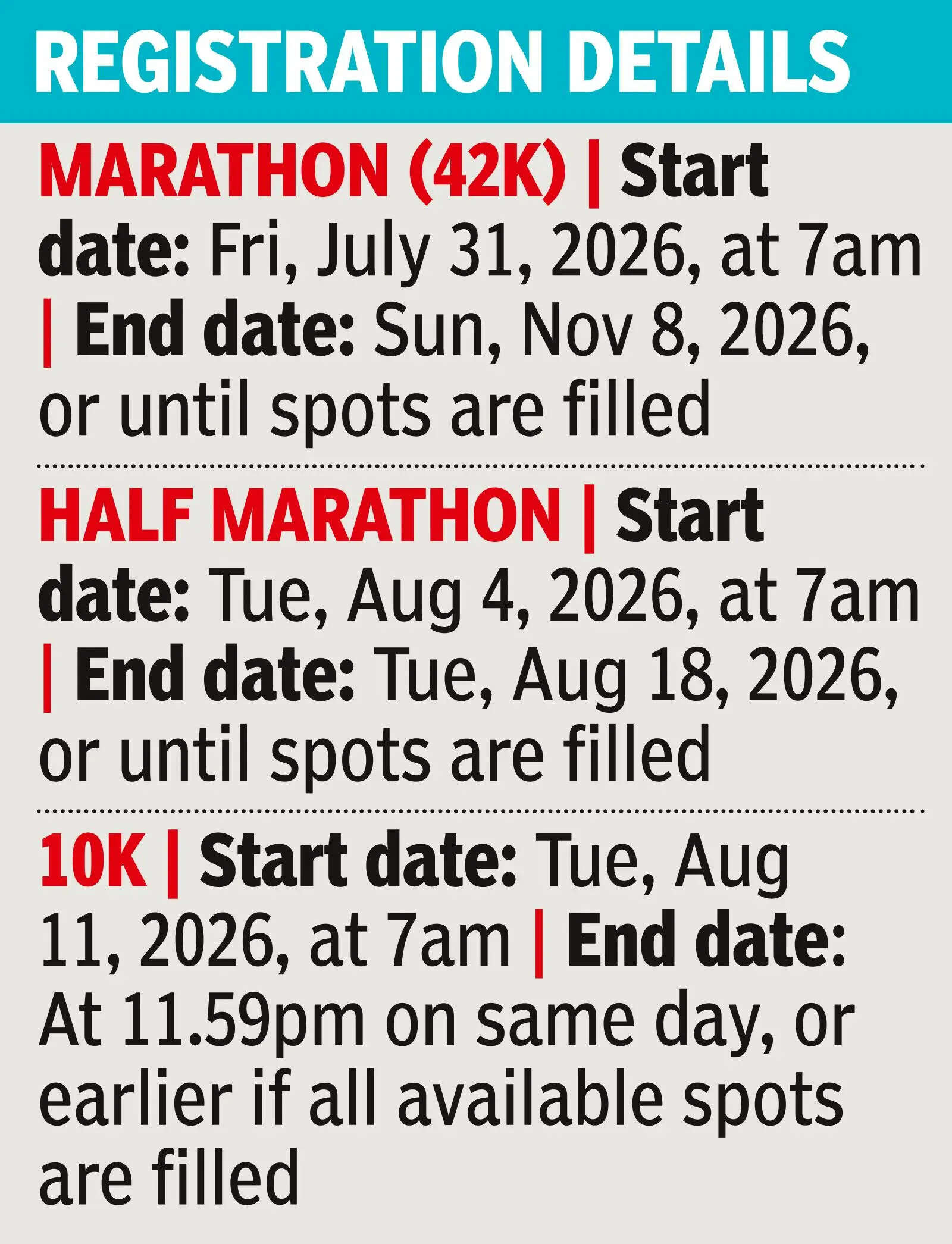
MUMBAI: Registrations for the 22nd edition of the Tata Mumbai Marathon, set to take place on Jan 17, 2027, opened on Friday, as race promoters Procam International also announced registration dates for the event’s other categories.Known to attract the best athletes and amateur runners from across the globe, the World Athletics Gold Label Race, with a total prize purse of US $389,524, will remain open to registrations for its signature 42k run until Nov 8 or until spots are filled before then. The window to sign up for the half marathon will open on Tuesday, Aug 4 at 7am.Speaking to TOI at the launch here on Friday, Vivek Singh, Procam International joint MD, also addressed the hike in registration fees, saying it reflected the transformation of the “entire live entertainment ecosystem”.

Registration Details

Registration Details

“Some people are upset about it, some people are absolutely for it, but we realize that the entire live entertainment ecosystem, whether it be sport, music or participative sport, has been transformed over the last several years,” Singh said. Fees for the marathon (42k) have seen a Rs 1600 hike from Rs 3400 a year ago to Rs 5000 for the upcoming edition. The half marathon registration fee meanwhile has increased to Rs 3500 from Rs 2800.“There is no question that the registration fees have been restrained from actually what the live entertainment ecosystem demands today. So a little bit of course correction was actually par for the course. Some people view it differently and they have every right to do so. But we’re talking of a full marathon where people spend four to seven hours on the road. We also have aspirations of providing more and more services and benefits to the runners,” Singh added. Jishnu Dev Varma, governor of Maharashtra, became the first person to register for TMM 2027.

Solar powers India’s record summer demand as coal’s grip begins to loosen | Mumbai News

Solar powers India's record summer demand as coal's grip begins to loosen
Image used for representative purpose only

MUMBAI/NEW DELHI: India appears to have crossed an important milestone in its clean energy transition, with solar power helping meet record summer electricity demand without a proportionate increase in coal-fired generation, according to a new analysis that points to a gradual but significant shift in the country’s electricity mix.The April-June quarter of FY2026-27 saw India record its highest-ever quarterly electricity generation of 524 billion units (BU), up 9% from a year earlier, even as national peak demand climbed to an all-time high of 271 GW on May 21. Yet, despite the unprecedented demand, coal’s dominance in meeting incremental electricity needs continued to ease as renewable energy—led overwhelmingly by solar—accounted for a growing share of additional power generation. For Maharashtra, the findings carry particular significance. The state recorded the country’s highest peak electricity demand at 30 GW, ahead of Uttar Pradesh (27 GW) and Gujarat (25 GW), reflecting the energy needs of India’s largest industrial economy and one of its fastest-growing urban regions. With rising temperatures, expanding manufacturing, commercial activity and increasing air-conditioner use, electricity demand in Maharashtra continues to outpace most other states. The report by the Centre for Research on Energy and Clean Air (CREA) found that solar electricity generation surged 37% year-on-year to 57 BU, making it by far the fastest-growing source of power. Solar supplied 10.9% of India’s total electricity generation during the quarter—the first time it has crossed the 10% mark in an April-June period—and contributed 36% of the year-on-year increase in electricity generation, compared with just 11% two years ago. Over the past three years, solar generation has more than doubled from 28 BU to 57 BU, while daily solar output touched a record 696 million units on May 11.For consumers and businesses, the trend signals that renewable energy is increasingly helping meet rising daytime demand, reducing pressure on conventional power plants during periods of peak consumption. On 61 of the 91 days during the quarter, the country’s daily peak demand occurred while solar plants were generating electricity, underscoring solar’s growing role in supporting India’s daytime power needs. Coal, however, remains the backbone of India’s electricity system. Coal and lignite together generated around 369 BU, or roughly 70% of the country’s electricity. But their contribution to the increase in electricity generation slipped to 68%, down from 71% in Q1 FY2024-25, suggesting that an increasing share of new demand is now being met by renewable energy rather than additional coal generation. Combined non-fossil sources generated a record 149 BU during the quarter.Another notable development was the operational debut of large-scale battery energy storage in supporting the national grid. On days when peak electricity demand occurred after sunset, battery energy storage systems (BESS) supplied up to 4.1 GW, meeting about 1.1% to 1.8% of national nighttime peak demand. India’s storage pipeline is also expanding rapidly, with tenders issued for around 272 GWh of storage projects, while about 7.5 GWh of battery capacity is already operational and another 3 GWh is expected to come online by the end of this year.India’s installed power generation capacity stood at 549 GW by the end of June, with non-fossil fuel sources accounting for 54% of installed capacity, overtaking fossil-fuel-based capacity for the first time. Renewable energy additions continued to dominate investments, with about 13 GW added during the quarter compared with 2.26 GW of new thermal capacity. Even so, around 42.7 GW of coal-fired capacity remains under construction, though nearly 89% of it is still at an early stage of development. The report, however, points to a major bottleneck that could slow India’s clean energy transition. Despite record renewable generation, substantial quantities of green electricity could not be used because of transmission and operational constraints. During the quarter, around 473 million units (MU) of solar power and 112 MU of wind power were directly curtailed, while even larger volumes were backed down under grid-balancing mechanisms. The findings indicate that unless transmission networks, battery storage and grid flexibility expand much faster, India risks wasting increasing amounts of low-cost renewable electricity even as demand continues to rise.“India is demonstrating that renewable energy is reliable and can be deployed at scale. The next challenge is ensuring the grid can fully utilise renewable electricity,” said Manoj Kumar, India Analyst at CREA. He said expanding transmission infrastructure, accelerating battery storage and improving the operational flexibility of existing coal plants would be crucial, while future decisions on new coal capacity should be evaluated alongside investments that improve the utilisation of existing assets.The quarter’s numbers suggest India’s power sector is entering a new phase. The debate is no longer only about adding renewable capacity but about ensuring that clean electricity generated across the country reaches homes, industries and businesses efficiently. Whether India’s transmission network and storage infrastructure can keep pace may now determine the speed of the country’s energy transition.

‘academics and art can coexist’: mumbai dancer urvashi palandurkar hits back at bjp chhattisgarh ‘gen z’ post, says scored 93% in class 10 and 12 | Mumbai News

'Academics, art can coexist': Mumbai girl hits back at BJP 'Gen Z' post, claims scored 93% in Class 10 and 12
A BJP Chhattisgarh social media post contrasted two Gen Z mindsets using a dancer’s video. Urwashi Palandurkar accused the party of using her footage without permission.

MUMBAI: A social media post by the BJP’s Chhattisgarh unit contrasting two “Gen Z mindsets” has sparked a political row after Mumbai-based professional dancer and content creator Urwashi Palandurkar, whose protest video was used in the post, accused the party of using her footage without permission and responded with a sarcastic rebuttal that has since gone viral.The BJP Chhattisgarh post asked, “Which mindset Gen Z will you choose?” On one side, it featured a video of Palandurkar with the caption, “Babar ki virasat par thumke lagane wali Gen Z.”On the other, it highlighted 14-year-old national judoka Yogita Mandavi, who was recently conferred the Pradhan Mantri Rashtriya Bal Puraskar by President Droupadi MurmuPalandurkar, who has over 3,00,000 followers on Instagram, first posted the protest dance video during the NEET protest, where it went viral and has since garnered more than 24 million views.Reacting after the BJP post on Instagram, she alleged that her video had been used without her permission. She said the post had led to her direct messages being flooded with people asking if she was okay.Her reaction reel carried the caption: “Please watch till end🙏 I AM NOT OKAY!!!! Not okay with reaching and being followed by the wrong audience 💀 The right ones please engage and help me get my cult balance back🥹🎀.”Beginning the video with a serious expression before bursting into laughter, she said, “No, I am not okay. I am that Gen Z student who is facing all this.”Calling it her “reaction video”, Palandurkar responded point by point to the BJP’s post.Mocking the caption, she said, “Your caption game is very weak. Your ChatGPT is not giving you good responses. What is ‘Babar ki virasat’? We can’t relate with it. Make it more relatable.”She also accused the party of trying to divide young people. “Divide and rule in 2026? You’re trying to divide the same Gen Z whose unity taught Parliament the term ‘Gen Z’. Logic is not logicing,” she said.Responding to the comparison between academic excellence and extracurricular activities, Palandurkar said both could coexist. “I got 93% in Class 10 and 93% in Class 12. I danced and created content throughout,” she said, showing photographs of medals and certificates displayed at her home.She added that the awards reflected achievements in academics as well as yoga, karate and other activities.“Extra-curriculars and academics can coexist, and I am living proof of it,” she said.Defending street performances during protests, she added that dancing in public had long been associated with celebration. “I’ve always seen people dancing on the streets after victories. I don’t know why it is not clocking.”She also joked about what she called the “brown girl trauma”, saying, “Being a brown girl, our parents have already taught us how to deal with trauma. You guys are not able to give trauma. Try harder.”Ending the video, Palandurkar acknowledged that she had approached the issue humorously despite its seriousness before signing off with a sarcastic remark, “Vastaguna huiya.”

Rahul Gandhi story snip

The reel has gained traction online and entered the political discourse. Congress leader Rahul Gandhi shared it on his Instagram Story, while Samajwadi Party chief Akhilesh Yadav posted on X: “Those who are companions on the new path, don’t think that they are misguided.”The BJP Chhattisgarh unit has not publicly responded to Palandurkar’s allegations that her video was used without permission.

Hours before CJI’s visit, Mumbai’s TISS postpones convocation; students say fearing protest it got cancelled | Mumbai News

Hours before CJI's visit, Mumbai's TISS postpones convocation; students say fearing protest it got cancelled
The Tata Institute of Social Sciences abruptly postponed its convocation ceremony.

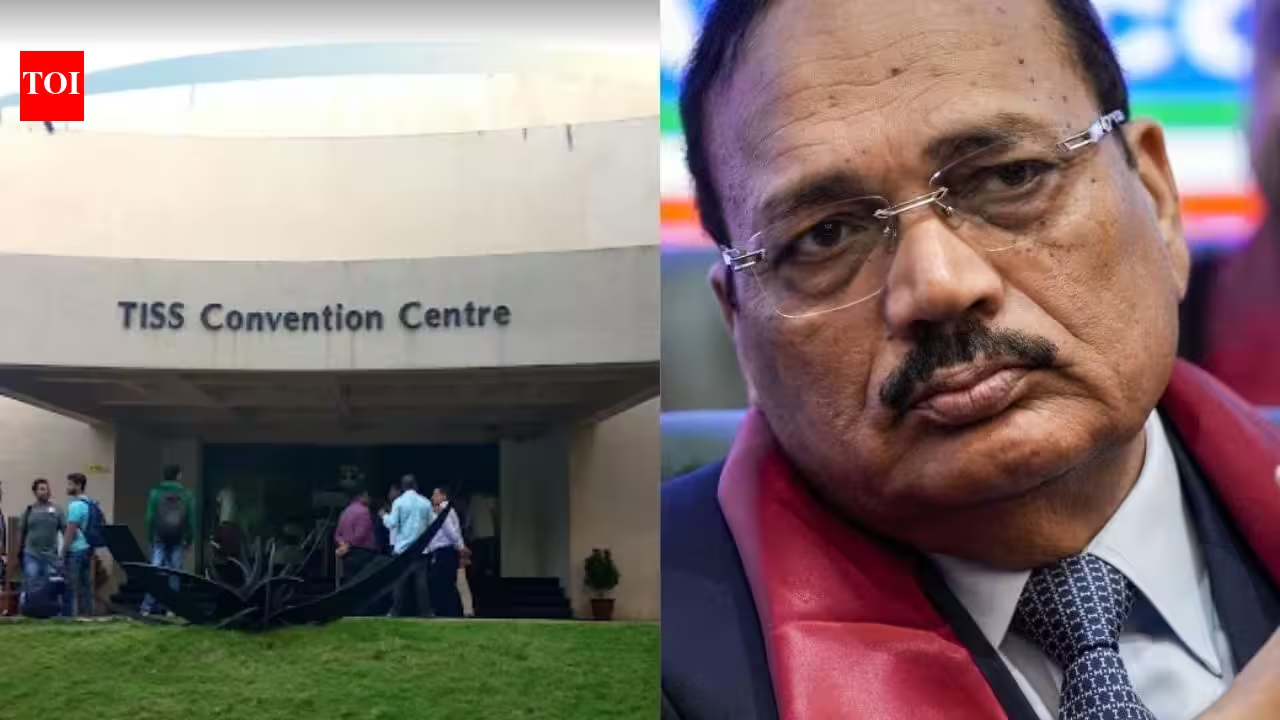
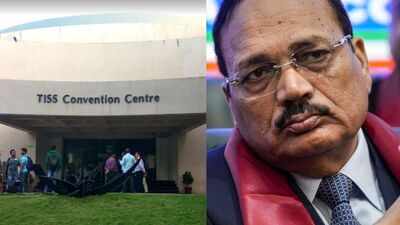
MUMBAI: The Tata Institute of Social Sciences (TISS) abruptly postponed its 86th annual convocation, scheduled for Sunday, just hours before Chief Justice of India (CJI) Surya Kant was to attend as the chief guest, leaving hundreds of graduating students and their families stranded and upset.In an email sent to students around 12.50am on Friday, the institute said the convocation had been postponed due to “unforeseen circumstances”. In a statement issued later in the day, TISS said the decision had been taken in the “best long-term interests of the institute” and to ensure the well-being of students, faculty, staff, dignitaries, guests and the campus community.The institute, however, did not specify the reason for the last-minute postponement. Several students claimed the administration may have cancelled the event over concerns about possible protests linked to the Cockroach Janta Party (CJP). They maintained that no protest had been planned or discussed either on or off campus, and added that students had not been officially informed in advance that the CJI would be attending the ceremony.The sudden cancellation left many students facing financial losses after travelling to Mumbai with their parents and relatives. Several said they had spent on non-refundable flight and train tickets, hotel bookings and had taken leave from work to attend what they described as a once-in-a-lifetime milestone.Student collective Progressive Students’ Forum also questioned the decision, pointing out that final semester results had already been delayed, affecting students. The group demanded accountability from the institute for the last-minute cancellation and compensation for the financial losses incurred by students.In its statement, TISS acknowledged the inconvenience caused to graduating students and their families and said it would examine requests related to financial hardship arising from the postponement on a case-by-case basis. It added that it was working to reschedule the convocation and was exploring alternative formats for holding the ceremony.Students, however, described the midnight communication as “disrespectful” and said it had caused avoidable hardship.“I was already in Mumbai for work, but my parents travelled all the way from our hometown. Graduating from TISS was a proud moment for our family and we were looking forward to the ceremony. Now there is no clarity on compensation or when the convocation will be held,” said one student.Another student said several members of the graduating batch were still awaiting placements and could ill afford another trip to Mumbai. “Some students requested that the institute issue degree certificates and final marksheets without the ceremony, but that was declined. Many of us may not be able to travel again if the convocation is held on another date,” the student said.

‘Academics, art can coexist’: Mumbai girl hits back at BJP ‘Gen Z’ post, claims scored 93% in Class 10 and 12 | Mumbai News

'Academics, art can coexist': Mumbai girl hits back at BJP 'Gen Z' post, claims scored 93% in Class 10 and 12
A BJP Chhattisgarh social media post contrasted two Gen Z mindsets using a dancer’s video. Urwashi Palandurkar accused the party of using her footage without permission.

MUMBAI: A social media post by the BJP’s Chhattisgarh unit contrasting two “Gen Z mindsets” has sparked a political row after Mumbai-based professional dancer and content creator Urwashi Palandurkar, whose protest video was used in the post, accused the party of using her footage without permission and responded with a sarcastic rebuttal that has since gone viral.The BJP Chhattisgarh post asked, “Which mindset Gen Z will you choose?” On one side, it featured a video of Palandurkar with the caption, “Babar ki virasat par thumke lagane wali Gen Z.” On the other, it highlighted 14-year-old national judoka Yogita Mandavi, who was recently conferred the Pradhan Mantri Rashtriya Bal Puraskar by President Droupadi MurmuPalandurkar, who has over 3,00,000 followers on Instagram, first posted the protest dance video during the NEET protest, where it went viral and has since garnered more than 24 million views. Reacting after the BJP post on Instagram, she alleged that her video had been used without her permission. She said the post had led to her direct messages being flooded with people asking if she was okay. Her reaction reel carried the caption: “Please watch till end🙏 I AM NOT OKAY!!!! Not okay with reaching and being followed by the wrong audience 💀 The right ones please engage and help me get my cult balance back🥹🎀.” Beginning the video with a serious expression before bursting into laughter, she said, “No, I am not okay. I am that Gen Z student who is facing all this.”Calling it her “reaction video”, Palandurkar responded point by point to the BJP’s post.Mocking the caption, she said, “Your caption game is very weak. Your ChatGPT is not giving you good responses. What is ‘Babar ki virasat’? We can’t relate with it. Make it more relatable.”She also accused the party of trying to divide young people. “Divide and rule in 2026? You’re trying to divide the same Gen Z whose unity taught Parliament the term ‘Gen Z’. Logic is not logicing,” she said.Responding to the comparison between academic excellence and extracurricular activities, Palandurkar said both could coexist. “I got 93% in Class 10 and 93% in Class 12. I danced and created content throughout,” she said, showing photographs of medals and certificates displayed at her home. She added that the awards reflected achievements in academics as well as yoga, karate and other activities.“Extra-curriculars and academics can coexist, and I am living proof of it,” she said.Defending street performances during protests, she added that dancing in public had long been associated with celebration. “I’ve always seen people dancing on the streets after victories. I don’t know why it is not clocking.”She also joked about what she called the “brown girl trauma”, saying, “Being a brown girl, our parents have already taught us how to deal with trauma. You guys are not able to give trauma. Try harder.”Ending the video, Palandurkar acknowledged that she had approached the issue humorously despite its seriousness before signing off with a sarcastic remark, “Vastaguna huiya.”

Rahul Gandhi story snip

The reel has gained traction online and entered the political discourse. Congress leader Rahul Gandhi shared it on his Instagram Story, while Samajwadi Party chief Akhilesh Yadav posted on X: “Those who are companions on the new path, don’t think that they are misguided.”The BJP Chhattisgarh unit has not publicly responded to Palandurkar’s allegations that her video was used without permission.

Treat South Bombay eatery’s suspension as improvement notice, HC tells FDA | Mumbai News

Treat South Bombay eatery's suspension as improvement notice, HC tells FDA

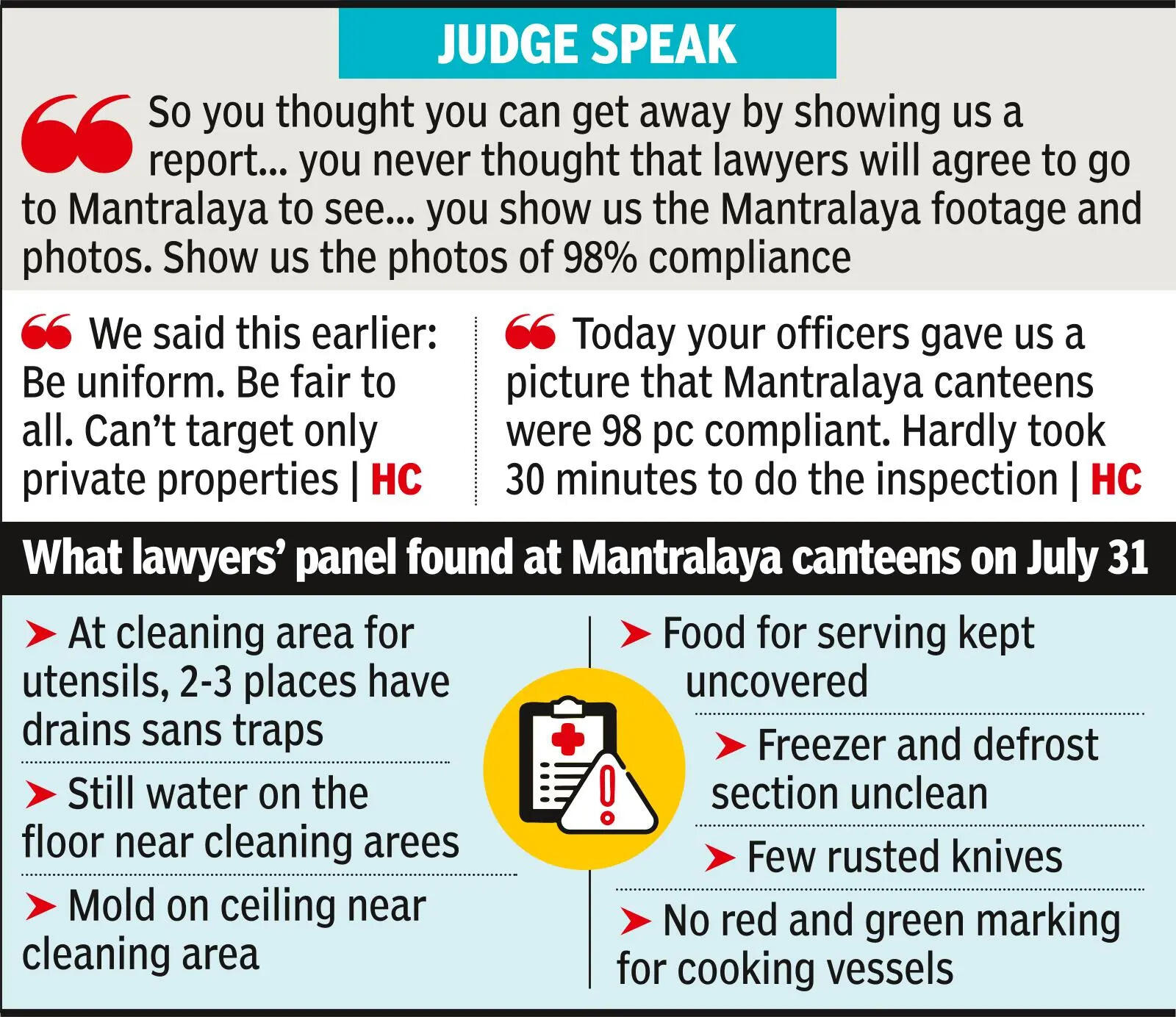
MUMBAI: A High Court bench of acting CJ Ravindra Ghuge and Justice Gautam Ankhad directed that suspension of Poornima restaurant be treated as an “improvement notice” till next Tuesday, with fresh inspection on Wednesday. “All litigants should be treated equally before the law. No special treatment to any, and FDA inspections cannot be lopsided,” the court said.The Udupi restaurant’s owner Pramod Nayak had challenged the July 23 suspension of its Food Safety and Standards Authority of India (FSSAI) licence. The state lawyer said Mantralaya’s canteens had received a 98% compliance report from the FDA team. The HC sought action by FDA against officials who completed the inspection at Mantralaya in 30 minutes and gave the high compliance report. Poornima said the inspection at its 600sqft area went on for five hours. HC pointed out that in the case of Park Inn by Radisson, the inspection went on for 8-10 hours.

Treat SoBo eatery’s suspension as improvement notice, HC tells FDA

Remarking that FDA officers have taken a “chance” with the court, the bench said they (FDA) did not expect that lawyers would be ready to visit the Mantralaya canteens.Representing Poornima, senior counsel Venkatesh Dhond, with Mayur Khandeparkar and Sameer Pandit, had questioned the variance at play. Dhond said “no food samples were taken during the inspection at Poornima, so how can they decide if food was unsafe”; FDA had cited hygiene issues and “fungal” growth on raw food like drumsticks and black spots on bananas. Dhond said uneaten bananas at his home turn black. Acting CJ Ghuge added, “Even at my home.The bench said, “We must appreciate that FDA is taking action,” but added, “It must be equal to all.” State lawyer Pooja Patil said there was videography of the inspection…of the drainage condition. Justice Ghuge responded, “Show us the videography right now. Also show us the footage from Mantralaya.” Grilling the state and FDA lawyer, the judges said, “Under what circumstances are you giving improvement and suspension notices? Do you have parameters? Ask your officer why on the same day when inspection is done is a suspension notice given? Why is no improvement notice given first?”Patil then sought time and the matter was kept back for hearing post lunch when the advocates’ panel comprising Suresh Sabrad, Feroze Bharucha, Kainaz Irani and Swanand Ganoo submitted its report and photographs of the Mantralaya canteens. Holding up photos from Mantralaya and Poornima, HC said, “Tell us why suspension for some? If one is bad, so is the other.” The HC read the advocates’ report of 3 canteens (2 at Mantralaya, 1 at Vidhan Bhavan) and said 2-3 cockroaches were spotted on the wall. The state lawyer said the FDA was agreeable to an “improvement notice” to Poornima and the matter could be heard next week. The hearing is now on Aug 6. Meanwhile, three hospitality industry bodies-HRAWI, NRAI and AHAR-have petitioned the PM, state CM and FSSAI, seeking mandatory improvement notices, a review of the June 23 compliance order and restraint in premature public disclosure.

HC trashes BMC’s waste management near Mumbai heritage sites | Mumbai News

HC trashes BMC’s waste management near Mumbai heritage sites
The HC sought ward-wise action to ensure strict and constant vigilance against garbage dumping

Mumbai: Bombay high court on Friday cited photos of uncleared garbage on roads and pavements, including in the Fort area in south Mumbai. Expressing distress at the lack of proper implementation by BMC of its own Clean Mumbai campaign, it sought ward-wise action to ensure strict and constant vigilance against garbage dumping not only on roads but in nullahs, lakes and the sea.Justices Girish Kulkarni and Aarti Sathe asked the BMC to take police help, too, “to deal with any resistance and/or to discipline unruly citizens.’’ HC cited instances at Horniman Circle in south Mumbai where a huge garbage collection chowki is installed and said the heritage site was “full of trash and odour’’. It commented on “total mismanagement” of waste collection with a chowki for garbage trucks set up close to heritage sites including the Bombay HC, Institute of Science and City Civil Court where foreign tourists flock”, adding that the vehicles cause “nuisance and odour.’’HC said it had listed a petition filed by Kannamwar Nagar residents regarding the Kanjumarg dumping ground’s waste management on Friday to bring to BMC’s notice the “tons of garbage on a day-to-day basis being dumped on the main roads…including plastic bags and bottles… and the serious health issues’’ arising from it. The HC said the judges travel into suburban areas and also till Uttan (where the judicial academy is located) and said the situation of garbage piled by the roads was the same.The HC order said, “It will also be open to the ward officer to take civil or criminal action against those who, with impunity, are violating the provisions of law in destroying/damaging public streets by dumping waste, creating health and hygiene issues detrimental to the larger interest of the society.’

CM Devendra Fadnavis holds stakeholder meeting in Mumbai on PM Modi’s call for clay Ganesh idols | Mumbai News

CM Devendra Fadnavis holds stakeholder meeting in Mumbai on PM Modi’s call for clay Ganesh idols
The Akhil Sarvajanik Utsav Samiti has urged the government not to ban plaster of Paris idols outright, rather to insist on the use of eco-friendly paints for the idols

Mumbai: Chief minister Devendra Fadnavis on Friday held a stakeholders’ meeting to consider PM Narendra Modi’s appeal to use clay idols during the Ganesh festival.Hitesh Jadhav, president of Akhil Sarvajanik Utsav Samiti, Maharashtra, said they have submitted a list of suggestions to the government. He said the Samiti has urged the government not to ban plaster of Paris (PoP) idols outright, rather to insist on the use of eco-friendly paints for the idols. They have also asked the government to make the restriction on height of the Sarvajanik Ganesh idol voluntary.Jadhav said the maximum height of a Ganesh idol in Maharashtra is around 30 feet. “There is not enough clay to cater to the demand across the state. Further, the use of artificial immersion ponds ensure that the PoP idols are not immersed in the sea,” he said. “In Navi Mumbai the recycled PoP was used to make study desks and this was distributed to students two months ago by deputy chief minister Eknath Shinde.”The meeting was held at the chief minister’s residence and was attended by state cultural affairs minister Ashish Shelar, deputy chairperson of the legislative council Sachin Ahir and senior officials.Sources said a core committee of the government will now meet in a couple of days and a report will be submitted to the Bombay High Court on Tuesday.A division bench of Justices AS Gadkari and Kamal Khata is hearing a PIL filed by Thane resident and activist Rohit Joshi, seeking implementation of the Central Pollution Control Board (CPCB) guidelines prohibiting the manufacture and immersion of PoP Ganesha idols. The petition highlights the pollution caused to rivers, lakes and other natural water bodies because of the immersion of PoP idols.

Make Mumbai manhole death inquiry report public: Congress | Mumbai News

Make Mumbai manhole death inquiry report public: Congress
The BMC had maintained that safety nets had been installed on the majority of the city’s manholes

Mumbai: Nearly a month after a 60-year-old man died after falling into an uncovered storm-water drain manhole in Sakinaka during heavy rain, Congress group leader in the BMC Ashraf Azmi on Friday demanded that the civic administration immediately make public the inquiry report into the incident and fix accountability.Aslam Isak Shaikh died on July 2 after falling into an open manhole on Khairani Road in Sakinaka amid heavy rainfall. The incident had triggered outrage, following which the BMC suspended four officials concerned, blacklisted the contractor and ordered an inquiry.Azmi alleged that despite these announcements, the inquiry report had not been made public even after nearly a month.“This was not a natural calamity but a preventable tragedy caused by administrative negligence. Mumbaikars have a right to know who has been held accountable and what action has been taken,” Azmi said.He questioned whether criminal proceedings had been initiated against those responsible and whether Shaikh’s family had received adequate compensation.The Congress corporator demanded that the inquiry report be released without delay, strict action be taken against all officials and contractors found responsible, and concrete measures be implemented to prevent similar incidents during the monsoon.The July 2 incident had renewed concerns over the safety of stormwater drain infrastructure during heavy rain. At the time, the BMC had maintained that safety nets had been installed on the majority of the city’s manholes but ordered a departmental inquiry into the Sakinaka incident after preliminary findings pointed to lapses.

Non-profit organisation launches toolkit for community climate action plan in Mumbai | Mumbai News

Non-profit organisation launches toolkit for community climate action plan in Mumbai

Mumbai: Even as the Navi Mumbai Municipal Corporation announced plans this week to develop its own Climate Change Action Plan (CCAP) for the city, a toolkit for a different kind of CCAP was launched in Mumbai on Thursday.The Community Climate Action Plan, developed by the non-profit YUVA, is not a one-size-fits-all formula but an adaptable framework that identifies local climate vulnerabilities and builds tailored adaptation and coping measures around them.Roshni Nuggehalli, executive director of YUVA, stressed that climate action planning must be anchored in the realities of the communities most exposed to climate vulnerabilities — without that grounding, she cautioned, broad-based CAPs risk being ineffective.Having piloted the framework successfully in 2022 in Ambojwadi — an informal settlement of roughly 53,000 people in Malvani, Malad West — and later implemented it in three other informal settlements, the organisation has now launched it for public use.Unlike top-down city, state, and national climate plans, this ground-up model is led by local people’s collectives who engage local govt directly for targeted interventions.“Around 42% of Mumbai’s population of 11.8 million live in bastis, yet climate action often bypasses this large group,” said Dulari Parmar, project lead for climate justice at YUVA. “CCAPs connect neighborhood priorities with city CAPs and can complement them.” Informal settlements commonly bear the brunt of heat, flooding, rising AQI, landslides, and sea-level rise.The CCAP follows a four-step framework: climate hazard mapping, rapid assessment, community-based vulnerability assessment, and the CCAP itself, with staggered adaptation and coping measures planned across immediate, short-term, and long-term horizons. For water and heat stress in an informal settlement, an immediate measure might be cool roofs paired with strengthened water-rights advocacy, while a long-term goal could be permanent municipal water connections.The CCAP isn’t meant only for informal settlements, said Nuggehalli, but for any community looking to be proactive on climate planning.In Ambojwadi, community consultations identified flood- and sewage-prone areas caused by the absence of sewage lines and successfully advocated with BMC for drains. “We didn’t just go to the ward office with a problem — we brought solutions devised by the community itself,” Parmar says, noting that the settlement’s lack of land tenure rights often blocks access to basic civic services, even as govt has grown more receptive to climate framing.Kiran Dighavkar, associate municipal commissioner for solid waste management at BMC, acknowledged the need to integrate informal settlements more meaningfully into climate planning — but argued that community stewardship, especially around waste management, must go hand in hand with govt action. “Get people to demand segregation and processing centres in their bastis,” he said. “This too is climate action.