

Rs 1,351 crore bid for Century Mills plot to come up before BMC panel on Aug 12 | Mumbai News

Rs 1,351 crore bid for Century Mills plot to come up before BMC panel on Aug 12

Mumbai: A proposal to lease for 30 years 23,822 square metres of land in the Century Mills’ Lower Parel plot for redevelopment to Peddar Realty Ltd, the highest bidder at Rs 1,351 crore, will come up for final approval before BMC improvement committee on Wednesday, Aug 12.BMC had set a reserve price of Rs 1,348 crore for the plot, and four developers — Peddar Realty, K Raheja Corp, Keystone Realtors and Shapoorji Pallonji Real Estate — had submitted their bids in March.According to the civic body, Peddar Realty had submitted a bid of Rs 1,351 crore, which was 0.22% more than the base price. The plot currently has 23 buildings comprising 476 tenements occupied by eligible mill workers’ families and 10 shops.Families of workers of the mill, which shut in 2006, will be permanently rehabilitated as part of the redevelopment.The plot was originally leased to Century Spinning and Manufacturing Ltd (now Century Textiles & Industries Ltd) for 28 years from April 1, 1927, to house employees from the poorer class. The lease deed expired in 1955. According to the civic body’s terms, the lease rent for the first 30 years will be Re 1 per square metre per annum for open land and Re 1 per square metre per annum for buildings under construction (BUA). The lease rent for the next 30 years, which is renewable, will be as per the prevailing policy at the time.The concerned plot will be leased on an ‘as is where is’ basis, and the bidder will have to rehabilitate all eligible residents of the said plot at its own cost. They will be provided flats with a minimum carpet area of 405 square feet. The municipal commissioner reserves the right to take back possession of the concerned land after the expiry of the lease period. If the lease is not renewed further, the lessee shall have to return peaceful possession of the land as well as the developed portion.Meanwhile, Shiv Sena’s (UBT) Aaditya Thackeray had earlier written to the municipal commissioner, stating that BMC should not proceed with the redevelopment proposal without determining the eligibility of local residents and fulfilling their demands.

First meeting to handle medical negligence, scope of work by homeopaths in Maharashtra held | Mumbai News

First meeting to handle medical negligence, scope of work by homeopaths in Maharashtra held

Mumbai: The first committee meeting to address concerns of medical negligence by homeopaths and assess their scope of work was held on Monday at the Directorate of Medical Education & Research (DMER). The committee is also looking to form an ethical framework for the same after homeopaths were granted registrations with the Maharashtra Medical Council (MMC) — effectively allowing them to prescribe modern medicines based on a one-year certificate course — which triggered mass doctor protests last week.Only one such homeopath has been registered with MMC so far. The committee includes Anil Bhandari, commissioner of Medical Education and Research, as the chairperson, alongside Dr Jayesh Lele as the technical member nominated by the DMER, representing the Indian Medical Association; homeopathic council administrator Bahubali Shah as another nominated technical member; MUHS registrar Dr Rajendra Shivaji Bangal; Maharashtra Medical Council registrar Dr Rakesh Waghmare, and registrar of the homoeopathic council.Dr Lele said, “As this was the first meeting, it would be too premature to disclose the details of it at this stage.”However, IMA president Dr Santosh Kulkarni said concerns were raised over the vast medicines that Certificate Course in Modern Pharmacology (CCMP) covers. He said, “There is everything cramped in a short course, including cancer medicines. This was brought up in the meeting and further details on this course were asked from MUHS to determine the depth of it.”He added IMA’s representation in this committee is still to pushback against inclusion of homeopaths in modern medicines, “Being a part of the committee to decide scope of their work does not mean we are accepting the decision.”Homeopathic council administrator, Bahubali Shah, did not wish to comment. Meanwhile, Dr Waghmare, said, “We will have a few more meetings and then the committee will submit its report within a month to the government.”

Mumbai Police Locate Missing 14-Year-Old Boy in Kota, Rajasthan | Mumbai News

Mumbai Police Locate Missing 14-Year-Old Boy in Kota, Rajasthan

Mumbai: A minor boy who had gone missing from Malad East was traced to Kota, Rajasthan, jointly by the Kurar police and the Govt Railway Police (GRP).Police said the 14-year-old had left home on Aug 6, around 7 am, on the pretext of going to school. When he did not return home later in the day, his family got worried and started searching for him everywhere. They contacted the police and lodged a complaint.Police made inquiries with his friends and learnt that he would frequently skip school and roam around. He had been to Juhu, Bandra, Virar and Mumbai Central on his own. Police then checked with the school and found that his attendance was very low– he had attended classes only nine days in three months.Police then started to check CCTV footage from the neighbourhood where he lived and all railway stations between Virar and Churchgate. They discovered that the boy had taken a train and reached Kota in Rajasthan. The GRP in Rajasthan was alerted. The boy was located and produced before the Child Welfare Committee (CWC) in Rajasthan. A police team from Mumbai appeared before the CWC and is on their way back to the city with the boy.

BMC to file reply by Aug 20 in MFA’s plea to save Bandra football ground | Mumbai News

BMC to file reply by Aug 20 in MFA’s plea to save Bandra football ground

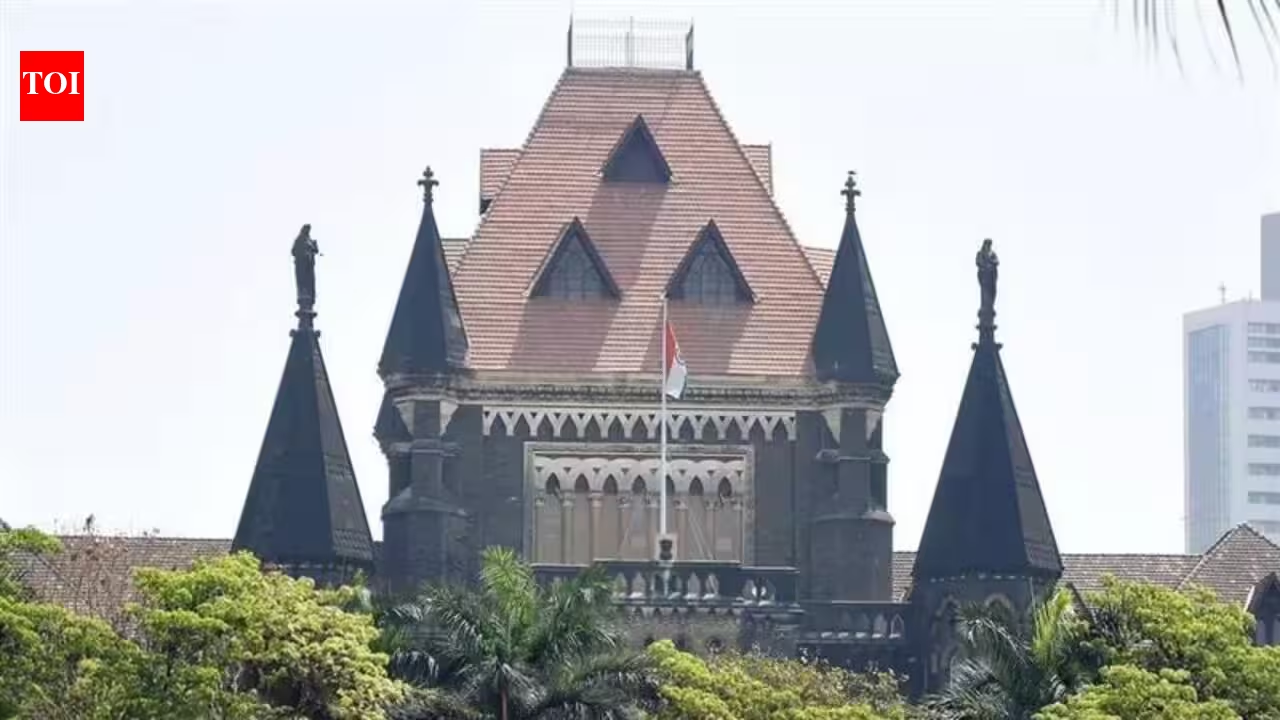
Mumbai: The Bombay High Court on Monday sought a reply from the Brihanmumbai Municiapal Corporation (BMC) to a petition filed by the Mumbai Football Association (MFA) that has challenged a move to turn Mumbai’s key football venue at Bandra into a convention complex.At a hearing before Acting Chief Justice RV Ghuge and Justice Gautam Ankhad, the association, represented by senior counsel Zal Andhyarujina with advocate Pradeep Mane, among others, contended that the plans afoot were detrimental to the future of already diminishing open spaces, which need to be saved. Andhyarujina said May 2026 recommendation by the civic improvements Committee to convert the Neville D’Souza Football Ground at Bandra Reclamation into an exhibition or convention centre was ex-facie “arbitrary, illegal’’.The petition said it “threatens one of the city’s key football venues”. The association challenged a Nov 3, 2025 letter of Mhada, the improvements committee’s plans to alter the land’s designation under Mumbai’s Revised Development Plan (DP) 2034.The BMC counsel, Sheetal Metakari, said an affidavit would be filed by Aug 20 and orally submitted that the process would not be completed by the next date and the HC placed the matter in the ‘urgent admissions’ category, on Aug 24.By the next date, Mhada too is at liberty to file its affidavit in reply, said the HC.

Rs 1,351 crore bid for Century Mills plot in Mumbai to come up before BMC panel on Aug 12 | Mumbai News

Rs 1,351 crore bid for Century Mills plot in Mumbai to come up before BMC panel on Aug 12

Mumbai: A proposal to lease for 30 years 23,822 square metres of land in that the Century Mills’ Lower Parel plot for redevelopment to Peddar Realty Ltd, the highest bidder at Rs 1,351 crore, will come up for final approval before the BMC Improvement Committee on Wednesday, Aug 12.The BMC had set a reserve price of Rs 1,348 crore for the plot, and four developers–Peddar Realty, K Raheja Corp, Keystone Realtors and Shapoorji Pallonji Real Estate — had submitted their bids in March.After the civic body opened the C packet in May this year, it found that Peddar Realty had submitted a bid of Rs 1,351 crore, which was 0.22% more than the base price. The plot currently has 23 buildings comprising 476 tenements occupied by eligible mill workers’ families and 10 shops. The six-acre plot houses 23 buildings, 476 rooms occupied by mill-worker families and 10 shops.Families of workers of the mill, which shut in 2006, will be permanently rehabilitated as part of the redevelopment. While flats will be allotted to mill-worker families, the remaining apartments will be sold in the open market.The plot was originally leased to Century Spinning and Manufacturing Ltd (now Century Textiles & Industries Ltd) for 28 years from April 1, 1927, to house employees from the poorer class. The lease deed expired in 1955. According to the civic body’s terms, the lease rent for the first 30 years will be Rs 1 per square metre per annum for open land and Rs 1 per square metre per annum for buildings under construction (BUA). The lease rent for the next 30 years, which is renewable, will be as per the prevailing policy at the time.The concerned plot will be leased on an ‘as is where is’ basis, and the bidder will have to rehabilitate all eligible residents of the said plot at his own cost. They will be provided flats with a minimum carpet area of 405 square feet. The municipal commissioner reserves the right to take back possession of the concerned land after the expiry of the lease period. If the lease is not renewed further, the lessee shall have to return peaceful possession of the land as well as the developed portion.Meanwhile, Shiv Sena’s (UBT) Aaditya Thackeray had earlier written to the municipal commissioner, stating that the BMC should not proceed with the redevelopment proposal without determining the eligibility of local residents and fulfilling their demands.

FDA suspends Blinkit’s Malad warehouse licence over hygiene violations | Mumbai News

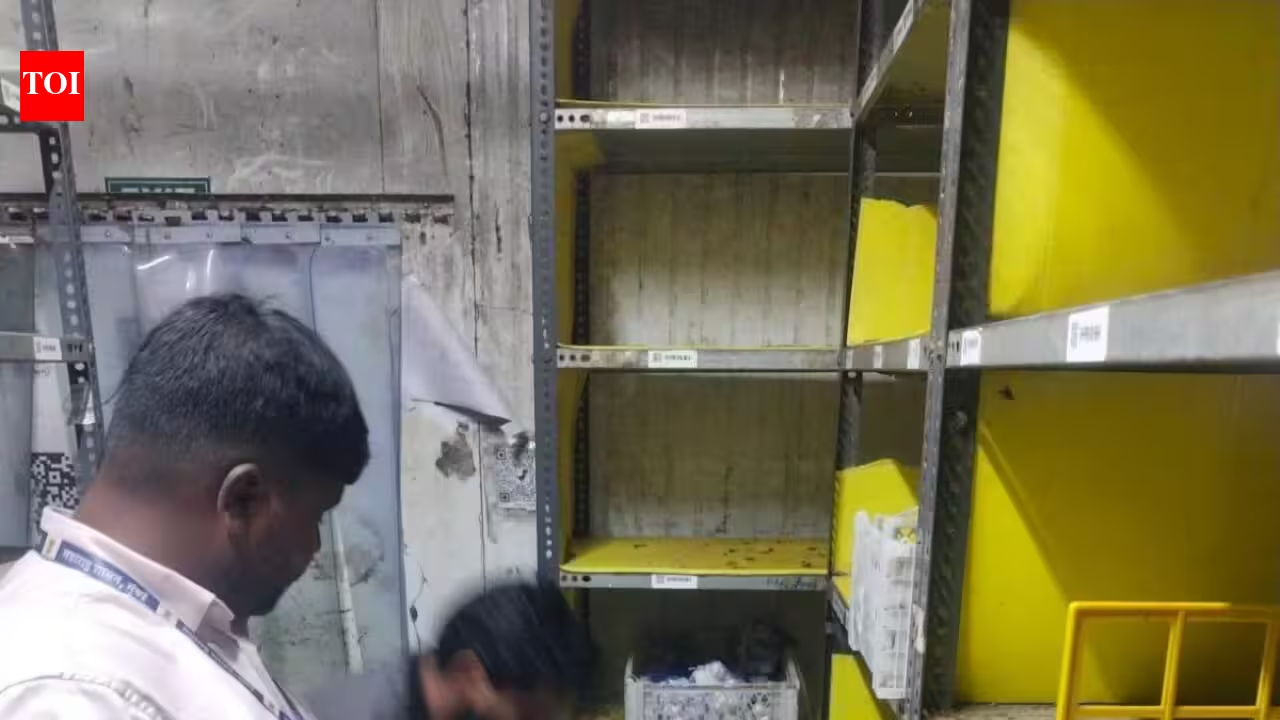
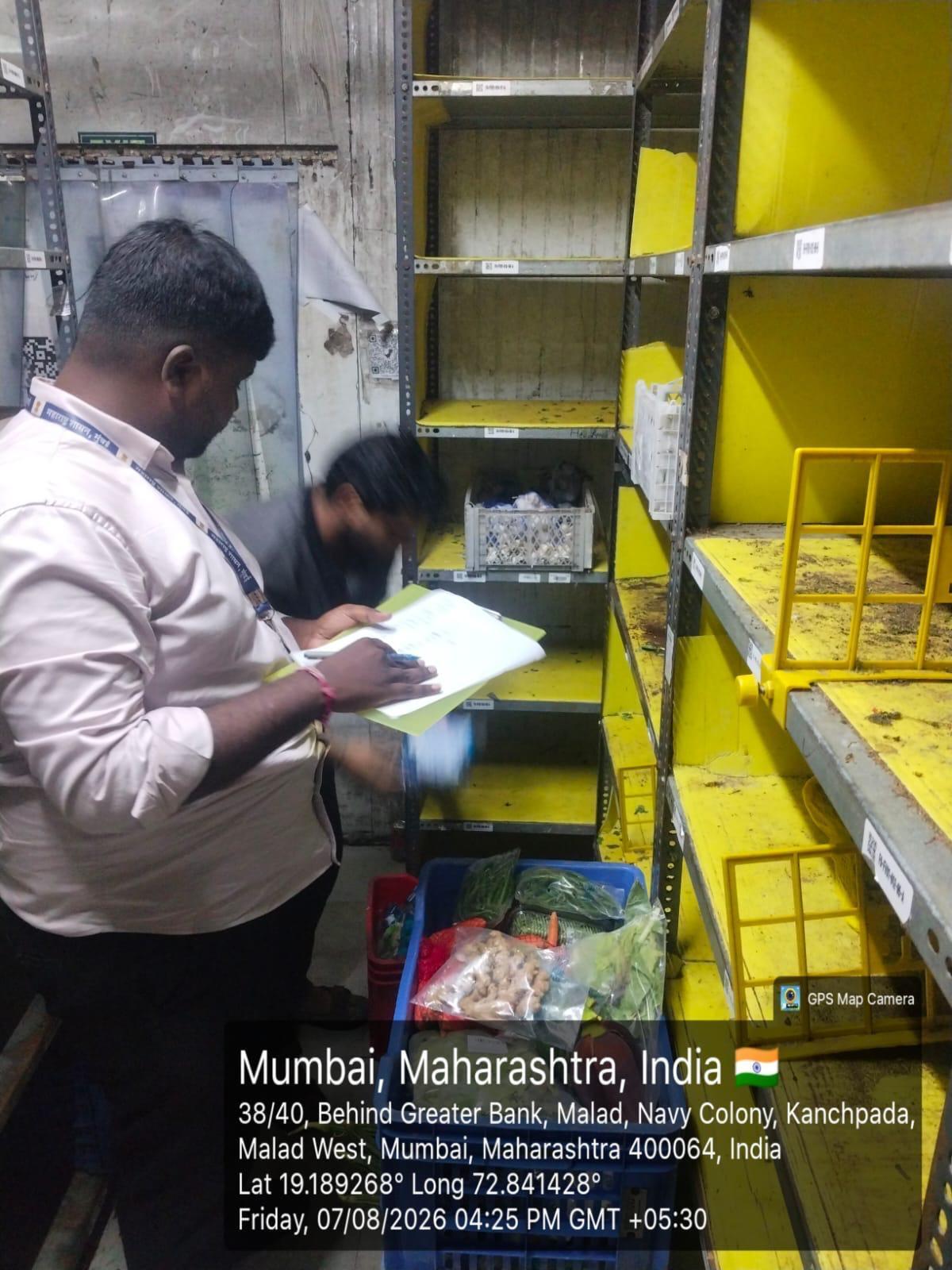
Mumbai: The Food and Drug Administration (FDA) has suspended the food licence of Blink Commerce (Blinkit) Pvt Ltd’s dark store in Malad West on the grounds of unhygienic conditions, cockroach infestation, and food safety violations.The action was taken after an inspection by food safety officers on Aug 7 at the facility located at Sarvodaya Bhuvan on Ramchandra Lane.​According to FDA officials, the warehouse was in a severely unhygienic condition as food items were stored on rusted racks or directly on the floor, while an infestation of cockroaches was discovered on stocks of fresh fruits and vegetables, creating a risk of cross-contamination.​Officials said the warehouse lacked effective pest and rodent control measures across storage and handling areas, poor waste management practices, and the storage of expired, damaged, and tampered packaged food items alongside fresh stock in cold rooms.​Furthermore, fitness records and health check-up records for food handlers were missing, and workers lacked proper protective gear.​This is the second time in weeks that a Blinkit warehouse licence has been suspended. In late July, action was taken against one of its warehouses in Pune’s Viman Nagar.​Last year, a Blinkit facility in Pune had its licence suspended after the FDA found fungal growth on food items, stagnant and clogged water near storage areas, improper cold storage with temperatures not maintained as per norms, and wet, unclean floors with food products stored haphazardly, including directly on the ground. Around the same time, the FDA also found similar issues at a Zepto warehouse in Dharavi and had suspended its licence.
Mumbai Police bust milk adulteration racket and arrest four | Mumbai News

Mumbai Police bust milk adulteration racket and arrest four

Mumbai: The city crime branch busted a racket allegedly involved in adulterating milk and selling it in counterfeit packets of reputed brands, including Amul and Gokul. Police raided a factory in an industrial area in Vasai in Palghar where counterfeit Amul milk packets were manufactured and arrested four persons.Acting on a tip-off, Unit 12 of crime branch raided premises in Dahisar East on July 9 and found milk packets of reputed brands being allegedly cut open, diluted with dirty water and resealed before being sold to consumers.Police seized around 470 litres of milk worth Rs 29,750, 13,000 counterfeit empty Amul milk bags and plastic material, equipment used for adulterating milk, and four mobile phones worth Rs 10.79 lakh. During the investigation, police identified the alleged main accused and arrested him in Telangana. His interrogation led investigators to a factory at Lakshmi Industrial Estate, Valiv Phata, Vasai East, Palghar, where counterfeit Amul milk bags were allegedly being manufactured.Police seized fake Amul bags and machinery used to manufacture the counterfeit packaging, collectively valued at around ₹10 lakh. The four arrested have been identified as Lingya Ganta (42), Saidul Jingli (33), Yadya Batulla (46) and Ramul Bodopalli (65).Police said the main accused had allegedly been supplying counterfeit milk bags to persons involved in milk adulteration in Mumbai and its suburbs since 2021. Police said the operation helped uncover and dismantle the network involved in manufacturing fake packaging and selling adulterated milk.A case has been registered at Dahisar police station under relevant provisions of the Bharatiya Nyaya Sanhita and the Food Safety and Standards Act.

What’s trending in Mumbai today: Food safety raids, Ganesh idols, security alert | Mumbai News

What’s trending in Mumbai today: Food safety raids, Ganesh idols, security alert
Mumbai authorities are intensifying food safety inspections across various establishments.

MUMBAI: On Monday, August 10, food safety inspections, disruption to the city’s transport network, preparations for Ganesh Chaturthi and public safety concerns are among the issues hogging the limelight in Mumbai. Stories ranging from restaurant hygiene to plaster of paris and clay idols are shaping conversations across the city.Crackdown on food safetyFood safety has become one of the biggest stories in Mumbai, with authorities in Maharashtra increasing their inspections of restaurants and other food outlets. The crackdown has unveiled violations ranging from poor hygiene and improper food storage to licensing issues and food reportedly unfit for consumption. The move is part of a larger enforcement drive that has also targeted establishments in Bengaluru.The focus on food hygiene comes as restaurants, hotels and other food businesses are under increasing scrutiny over how they handle raw materials, cooking oil and cooked food. The issue is likely to continue to be a big consumer-interest story as inspections go on.Railway food outlets too have come under the scanner. Earlier this month, an IRCTC-run food outlet at Mumbai Central was shut after an inspection found poor cleanliness, uncovered cooked food, dirty utensils and other hygiene violations. The operator was also fined about Rs 1 lakh.Local trains are still a commuter worryThe suburban railway network of Mumbai continues to be a daily headache for the city, especially during the monsoon. Technical issues and disruptions can quickly affect thousands of commuters travelling across the Central, Western and Harbour lines, while heavy rain can add to the problems.Mumbai’s local train network continues to be one of the city’s most vital lifelines, and therefore even relatively short disruptions make for a major city story. Commuters are watching delays and service changes very carefully, particularly during peak hours.The debate on Ganesh idols: PoP vs clay heats upWith Ganesh Chaturthi just around the corner, Mumbai’s idol makers and devotees are again caught between traditional plaster of paris idols and their more environmentally friendly clay alternatives.Despite efforts to promote clay idols, PoP still dominates the market. Artisans say making idols out of clay takes more time, space and money, whereas PoP is comparatively easier to mould and allows intricate designs.But environmental concerns keep pushing authorities and citizen groups towards clay and other eco-friendly alternatives. The debate underscores the challenge of reconciling Mumbai’s cultural customs with the need for pollution control during the festival.Security remains a priority ahead of August 15Security preparations are also underway ahead of Independence Day. Earlier, a bomb threat had been received by the Mumbai Metro, the Bombay Stock Exchange and the Mayor’s office, prompting authorities to take the warnings seriously and increase vigilance. The threat investigation continues to be a major security-related development for the city.Fuel and daily searches in Mumbai, goldApart from the major civic stories, daily consumer searches continue to be for gold prices, petrol and diesel rates, rainfall, traffic and public transport. These issues are perennial interests of the residents of Mumbai, especially during the monsoon and in the run-up to important festivals.So the big themes for Mumbai today are clear — food safety, commuter disruption, monsoon preparedness, Ganesh festival preparations and heightened security — issues that hit home for the city.

Nilesh Wadkar murder case: SC grants bail to MCOCA accused after over 7 years in custody | Mumbai News

Nilesh Wadkar murder case: SC grants bail to MCOCA accused after over 7 years in custody
The SC granted bail to Abhijeet Ganesh Kadu after over seven years in custody (Representative image)

MUMBAI: The Supreme Court has granted bail to Abhijeet Ganesh Kadu, a MCOCA gangster in the 2019 murder of Pune gangster Nilesh Wadkar, noting that he had spent over seven years and six months in custody and co-accused with similar roles had already secured bail.The bench of Justices Vikram Nath and Sandeep Mehta passed the order on August 5, 2026, while hearing Kadu’s Special Leave Petition challenging the Bombay High Court’s March 12 order rejecting his bail plea.The case relates to 2019 registered at Dattawadi Police Station, Pune City, concerning Wadkar’s murder on January 13, 2019, at Janata Colony in Pune’s Parvati area.Wadkar was walking with his associates when they were intercepted near Yallama Mandir by a group including Kadu, Dokephode and others.The accused allegedly formed an unlawful assembly and were armed with firearms, knives, iron rods and stones. Wadkar suffered multiple injuries and died, while several others were injured.According to the prosecution, there was a longstanding rivalry between two criminal gangs operating in Janata Vasahat. One gang was allegedly led by Sunil Dokephode alias “Chocolate Sunya”, while the other was associated with Wadkar.The rivalry allegedly dated back to 2007 and had resulted in earlier violent clashes. The accused were charged under Sections IPC of 143, 147, 148, 149, 302, 307, 324, 201 and 120-B of the Indian Penal Code, besides provisions of the Arms Act, Maharashtra Police Act and MCOCA.Appearing for Kadu, advocate Sana Raees Khan argued that there was no specific evidence establishing his involvement in the murder.The defence disputed the allegation that Kadu had assaulted Wadkar with a koyta, pointing to differing witness statements and noting that injured witnesses’ statements recorded under Section 164 CrPC did not name him.Khan argued before the Supreme Court that he had been behind bars for over seven years and that there was no specific evidence establishing his involvement in the murder.The defence also submitted that Kadu was not produced before the trial court on 115 hearing dates, contributing to his prolonged incarceration.The Supreme Court held that the period already spent in custody and parity with similarly placed co-accused justified bail.The court directed Kadu’s release on conditions imposed by the trial court and ordered him to continue cooperating with the trial.

Is Thane’s 55,000cr infra push a cure for congestion or new chaos? | Mumbai News

Is Thane’s 55,000cr infra push a cure for congestion or new chaos?

Thane’s rapid shift from a low-rise, green ‘City of Lakes’ to a dense real estate and infrastructure hotspot has outpaced the ability of civic systems to keep up. A massive infrastructure programme valued at about Rs 55,000 crore is now underway to address problems created by years of fast growth, but residents and experts say the cure is generating fresh disruption. With multiple big-ticket projects running simultaneously, many fear the city’s original character is being replaced by an increasingly concrete-heavy landscape that further strains daily life.For decades, Thane’s urban footprint and social geography were clearly defined. The city limits largely ended near the Eastern Express Highway, with middle-income settlements within the traditional municipal belt. Beyond that lay large industrial zones and labour settlements, while the Ghodbunder stretch remained home to native community clusters and pockets of older, semi-rural life. That balance began to change sharply in the early 2000s after the Ghodbunder Road upgrade during the tenure of then municipal commissioner T Chandrashekhar. Around the same period, a state policy that opened up substantial industrial land parcels for residential development accelerated construction activity, said a former town development official.Long-time residents recall the speed of the transformation. Former deputy mayor Naresh Manera said clusters of gaothans that once defined the city’s quieter neighbourhoods were quickly overtaken by high-rise projects as developers moved in. “The visual change was dramatic and immediate, with open vistas disappearing as towers filled what used to be open space,” said activist Dr Mahesh Bedekar. “Where the skyline once allowed long views, sightlines have narrowed to a few metres in many areas because of the scale and intensity of building activity.Real estate professionals attribute Thane’s boom to its location and connectivity. Positioned close to Mumbai, Navi Mumbai, Bhiwandi and routes leading towards northern Maharashtra, Thane increasingly became an alternative for buyers priced out of Mumbai or seeking more space and comparatively affordable options. Realtors said that as commuting networks improved and new residential stock entered the market, the city began attracting investors and end users from farther suburbs, gradually shedding its earlier reputation as merely a dormitory town.But experts and residents argue that the city expanded vertically and outward without the parallel development of essential civic infrastructure. Saket resident Dayanand Nene said traffic jams, bottlenecks and shrinking road space are routine. BJP MLA Sanjay Kelkar said Thane’s infrastructure has not been upgraded to match what he described as a nearly five-fold jump in population. “In Ghodbunder, among the city’s more affluent and highest tax-paying areas, some residents spend lakhs each year on tanker water despite also paying EMIs and property taxes. It highlights how basic utilities have lagged behind real estate expansion.”Facing criticism, the state govt and the Thane Municipal Corporation have cleared and pushed a sweeping list of infrastructure works over recent years. These include metro corridors, flyovers, elevated roads, coastal road links and allied projects, collectively estimated at Rs 55,000 crore. Yet residents and opposition political leaders say the scale and simultaneity of execution has created a second wave of stress. “The irony is that infrastructure meant to reduce congestion is itself intensifying congestion during construction,” said NCP-SP Thane president Manoj Pradhan. Commuters echo the frustration. Frequent motorist Satyajit Shah said the city feels perpetually under construction. “Several projects, like the long-pending Kapurbawdi flyover extension, have been delayed and have not produced noticeable relief.”Deputy CM Eknath Shinde, widely credited with pushing and approving many of the ongoing projects, has defended the works as necessary to address accumulated pressure and prepare Thane for future demand.But project pace and execution have attracted scrutiny from the judiciary and urban planning specialists. Former Supreme Court judge Justice Abhay Oka recently questioned why residents were being excluded from decision-making and consultation when large infrastructure works were planned and implemented. Urban town planner Sulakshana Mahajan said, “Road widening and flyovers alone cannot solve systemic mobility problems. Thane needs a long-term mobility strategy that integrates land use… and environmental safeguards, rather than relying primarily on road-expansion solutions.”Green activist Rohit Joshi said Thane’s ‘City of Lakes’ label was not just a slogan but a defining feature that differentiated it from neighbouring urban centres. He said the city has already lost significant natural assets during its expansion and called for urgent conservation of what remains.