

Housing societies get sweeping governance reforms; nominees gain voting rights, approved bylaws become binding | Mumbai News

Housing societies get sweeping governance reforms; nominees gain voting rights, approved bylaws become binding

MUMBAI: Maharashtra has rolled out one of the most comprehensive overhauls of cooperative housing society governance in recent years, with amendments to the Maharashtra Co-operative Societies Rules, 1961 introducing a host of member-centric reforms that are set to affect lakhs of apartment owners across Mumbai, the MMR and the state. While the changes relating to self-redevelopment and lower penal interest on maintenance dues have received attention, several equally significant governance reforms have largely gone unnoticed.The amended Rules, which came into force on June 18, reduce the minimum number of members required to form a cooperative housing society from 10 to five, introduce a formal name reservation process for proposed societies, prescribe a procedure for admitting specified relatives as associate members on the recommendation of the original member, and make government-approved model bylaws automatically binding on all cooperative housing societies across Maharashtra, irrespective of whether an individual society formally adopts them.The amendments also grant voting rights to nominees admitted as provisional members after the death of an original member, make it mandatory for societies to issue public notices in two newspapers inviting claims from legal heirs where no nomination exists, prohibit societies from collecting charges not authorised under the Rules, empower the general body to decide parking allotments, and permit annual as well as special general body meetings, including those for redevelopment, to be conducted through video conferencing.Housing experts said the reforms are expected to reduce litigation, bring greater uniformity in society administration and improve transparency in areas that frequently trigger disputes, including succession, maintenance charges, parking and redevelopment.One of the most significant changes concerns succession. Under the amended Rules, the nominee of a deceased member can be admitted as a provisional member with voting rights until regular membership is granted. Earlier, nominees often remained without voting rights for prolonged periods because of delays in completing membership formalities, leading to uncertainty in society administration.Where a deceased member has not made a nomination, the Rules now prescribe a uniform procedure requiring societies to publish notices in two newspapers inviting claims from legal heirs before transferring membership. Housing experts said the provision is expected to reduce disputes and ensure greater legal transparency in inheritance-related matters.“The biggest challenge before cooperative housing societies has been ensuring a steady flow of maintenance funds amid frequent disputes over service charges. By incorporating well-settled legal principles into the Maharashtra Co-operative Societies Rules, the government has given statutory backing to a uniform maintenance structure,” said Ramesh Prabhu, chairman, MahaSEWA.“The amendments are based on the state’s 2000 order and the Bombay High Court’s Venus Cooperative Housing Society judgment. While building-related expenses may continue to be recovered on an area basis, common service charges must be levied equally on all members. This will reduce disputes, curb arbitrary billing and bring greater legal certainty to society administration,” he said.In another significant reform, societies have been expressly prohibited from collecting any charges other than those specifically permitted under the Maharashtra Co-operative Societies Rules, addressing a long-standing grievance of flat owners over miscellaneous levies imposed without statutory backing.Parking disputes—among the most common flashpoints in residential societies—have also been addressed. The amended Rules provide that parking allotments will be decided by the general body, reinforcing collective decision-making instead of leaving the issue solely to the managing committee.Recognising the practical difficulties faced by members residing outside their societies, the government has also allowed annual general body meetings and special general body meetings, including those convened for redevelopment proposals, to be held through video conferencing, enabling wider participation while retaining statutory compliance.The financial provisions of the amendments affect every flat owner. Service charges must now be recovered uniformly from all members irrespective of flat size, while water charges will be levied based on the number of taps in each flat. Non-occupancy charges have been capped at 10% of service charges, replacing varying practices followed by different societies, while the maximum penal interest on delayed maintenance payments has been reduced from 21% to 12% per annum.To strengthen long-term financial discipline, societies must maintain a Sinking Fund of at least 0.25% and a Repair and Maintenance Fund of at least 0.75% of the construction cost certified by an architect at the time of construction. The Rules also prescribe ceilings on annual maintenance expenditure, including audit fees, based on the size of the society.The amendments further give a major boost to member-driven redevelopment by permitting societies undertaking self-development or self-redevelopment to borrow from banks and financial institutions up to 10 times the government-approved value of the land, significantly improving access to project finance.The notification also extends key housing society provisions to societies having commercial premises and housing associations while revising registration fees payable to the Cooperation Department according to the size of the society.Housing law experts said that taken together, the amendments seek to bring greater transparency, accountability, financial discipline and uniformity in the functioning of cooperative housing societies. Beyond redevelopment, they are expected to substantially reshape the governance of thousands of housing societies across Maharashtra by simplifying society formation, strengthening members’ rights, standardising administration and reducing avoidable disputes.
‘No role in E20 fuel’: What Nitin Gadkari claimed in suit against X, Meta before Bombay high court | Delhi News

'No role in E20 fuel': What Nitin Gadkari claimed in suit against X, Meta before Bombay high court
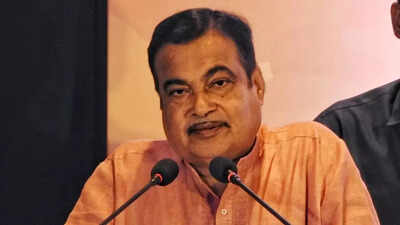
Union minister Nitin Gadkari filed a civil suit seeking removal of deepfakes.

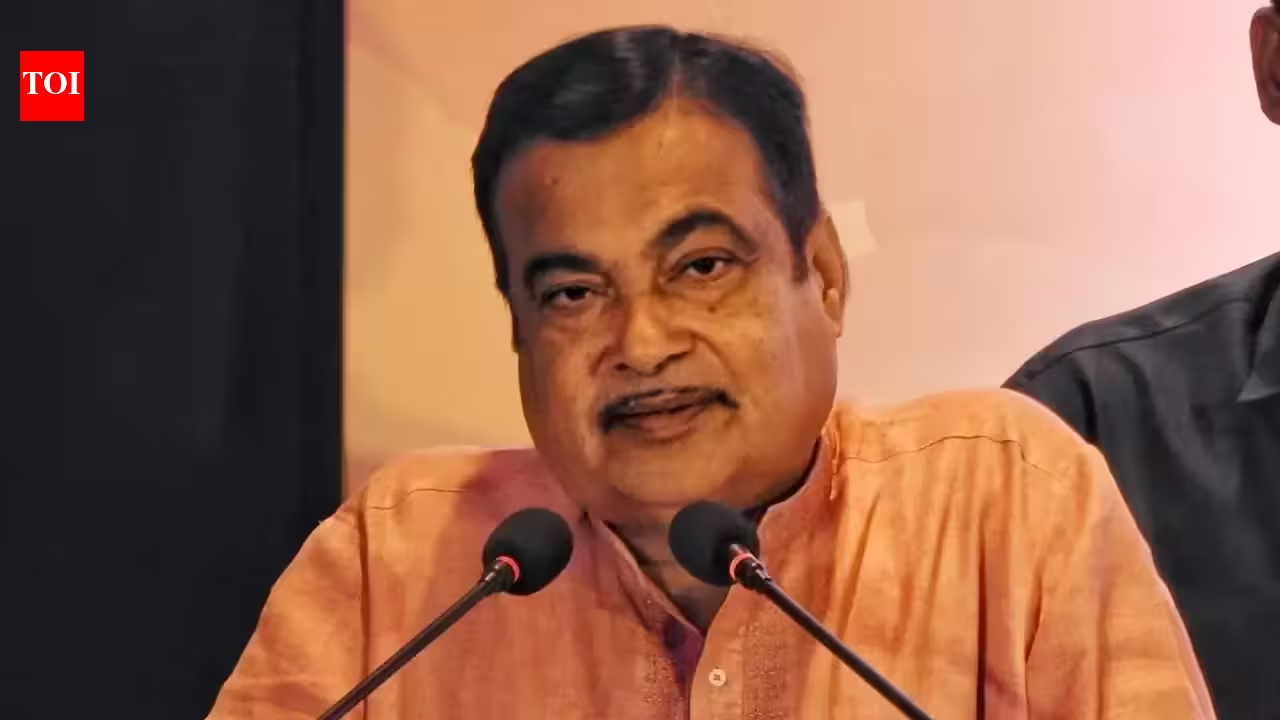
MUMBAI: Union road transport and highways minister Nitin Gadkari has claimed in a proposed civil suit before the Bombay high court that he had no role in the Ethanol Blended Petrol (EBP) programme or the E20 initiative, alleging that AI-generated deepfakes and manipulated online content falsely linked him and his family to financial gains from the policy.The Bombay high court on Monday granted Gadkari permission to file the suit against Meta Platforms, Google LLC, X Corp and others, seeking removal of allegedly “false, fabricated and defamatory” AI-generated videos and digital content.According to the proposed suit, the online posts and deepfakes wrongly portray Gadkari as the driving force behind the ethanol-blending programme and allege that he and his family benefited financially from it.However, the suit asserts that the EBP programme and the E20 initiative fall exclusively under the jurisdiction of the Union ministry of petroleum and natural gas, and not the ministry of road transport and highways headed by Gadkari.Officials from Gadkari’s Nagpur office also told TOI that the decision to implement ethanol blending was taken by the Union Cabinet, not by Gadkari’s ministry.The suit further states that its objective is not to curb public debate or criticism.“The purpose and object of filing the suit is not to curtail or prevent the public at large from engaging in discussion, debate, analysis or fair, just and bona fide criticism of any decision taken by the plaintiff himself or by his office,” the suit says.Instead, Gadkari argues that the disputed content consists of “false, fabricated, malicious, abusive and grossly defamatory” material that amounts to unauthorised use of his personality and publicity rights.His counsel, Sandeep Ladda, submitted before the high court that the allegedly defamatory content was accessible in Mumbai and elsewhere, warranting the court’s permission to institute the suit. Justice Abhay Ahuja granted leave to file the civil proceedings.Gadkari is seeking permanent injunctions directing social media platforms and other defendants to remove, disable and stop the circulation of the allegedly defamatory AI-generated content. The suit is expected to come up for hearing on interim relief on Tuesday.

BMC to re-float town hall tender with 350-seat corporation hall plan | Mumbai News

BMC to re-float town hall tender with 350-seat corporation hall plan
The demand for accommodating 350 corporators has been made after factoring in the likely increase in the number of elected corporators

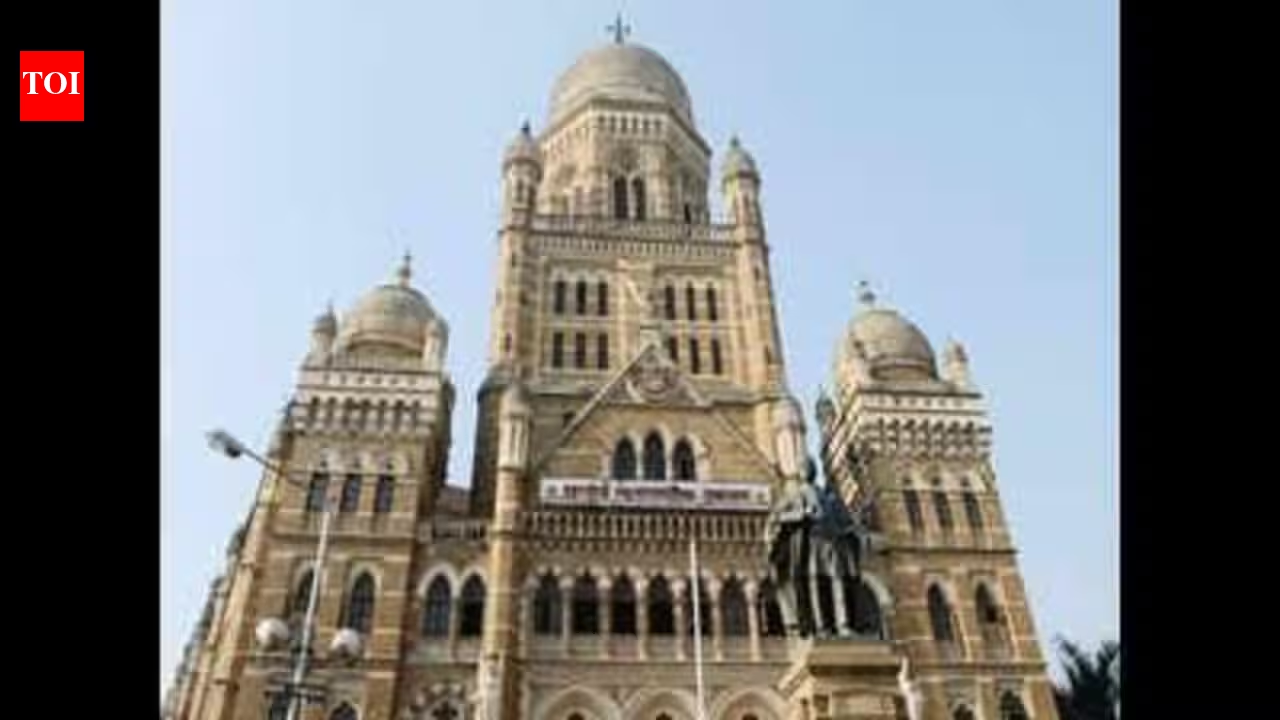
Mumbai: The BMC will soon re-float the tender for the town hall and gymkhana with a fresh proposal that will encompass a revised plan for a corporation hall intended to accommodate about 350 corporators in a tiered seating arrangement similar to that in Parliament. While the earlier proposal was to redevelop the gymkhana building opposite the BMC headquarters, corporators had sought to include a corporation hall. The tender floated earlier for the town hall is being cancelled, and a fresh tender will be issued for constructing a town hall. The shops and food stalls in the front portion of the gymkhana building will be accommodated in the new town hall structure.“We would not have been able to construct a corporation hall that could accommodate 350 corporators, as demanded by the public representatives, under the earlier tender. In the fresh plan, we intend to construct a ground-plus-five structure with a built-up area of about 38,000 square feet. The structure will have a corporation hall with tiered seating or an amphitheatre-like design and is likely to have a height of about 30 feet, which will enable us to create seating space for all the corporators. The structure will also have parking space for 70 to 80 vehicles. There will not be much open space around the structure, but it will be built by incorporating the architectural aesthetics of the heritage BMC headquarters,” said a civic official.The civic body also intends to appoint a project management consultant for the project. Corporators had earlier stalled the civic administration’s proposal to build a town hall opposite the civic body headquarters and sought the incorporation of a corporation hall (House) in the structure in view of the space constraints in accommodating the 237 corporators in the existing corporation hall.The demand for accommodating 350 corporators has been made after factoring in the likely increase in the number of elected corporators.BJP Leader of the House Ganesh Khankar has envisaged a structure that will have separate entry and exit points for the mayor, a cabin for the mayor, and space for the deputy mayor, additional municipal commissioners, group leaders, and the leader of the opposition, among others. Khankar has also sought a gallery for the press and visitors in the corporation hall, along with facilities such as a cafeteria, apart from a gymkhana and a bridge connecting the main BMC headquarters building with the town hall.

Bombay HC seeks govt response to PM’s call for clay Ganpati idols | Mumbai News

Bombay HC seeks govt response to PM’s call for clay Ganpati idols

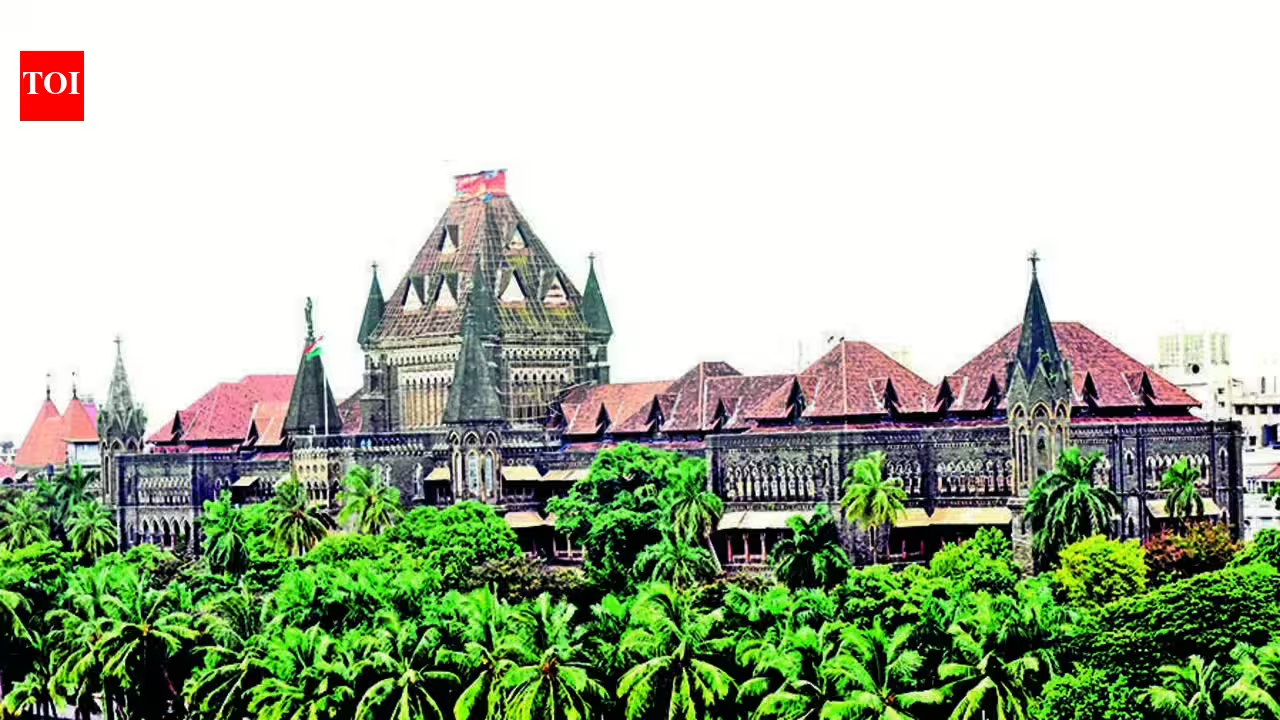
Mumbai: The Bombay High Court on Monday asked the state government for its response on PM Narendra Modi’s appeal during Sunday’s Mann Ki Baat radio programme to use only eco-friendly clay idols during the ensuing Ganesh festival.“What is the state’s response?’’ asked Justices Gadkari and Kamal Khata during the final hearing on a PIL seeking implementation of Central Pollution Control Board’s 2020 revised guidelines that ban the use of Plaster of Paris (PoP) to make religious idols.The judges referred to a Marathi newspaper report and even showed the copy to the advocate general Milind Sathe, who sought time to respond. Last year, after CPCB clarified its guidelines were advisory in nature, HC had allowed above 6 ft idols to be immersed in natural water bodies as per state’s Aug 1, 2025 immersion policy.CPCB’s advocate Abhinandan Vagyani said the guidelines were upheld by HC and National Green Tribunal but also said they are advisory. The judges pointed out that HC and NGT proceeded with matters on the basis that the guidelines are mandatory. “How do you now say they are advisory, not mandatory?” asked Justice Gadkari.The judges questioned why CPCB shifted its stand in 2025 and “why not before 2025.” To this, Vagyani replied saying it was following the state govt’s request and committee’s recommendation. “Because the state govt told you, you changed (your stand)?’’ asked Justice Khata. The hearing will continue on Wednesday.

BMC tree panel to decide fate of 3,169 trees for Dharavi redevelopment & infrastructure projects in Mumbai | Mumbai News

BMC tree panel to decide fate of 3,169 trees for Dharavi redevelopment & infrastructure projects in Mumbai

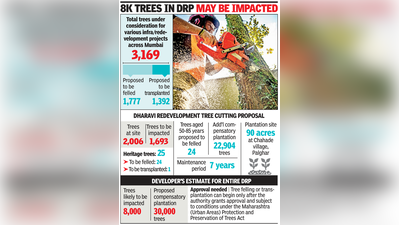
Richa PintoMumbai: BMC’s Tree Authority is set to deliberate on proposals involving 3,169 trees at its meeting on Tuesday, with permissions being sought to fell 1,777 trees and transplant 1,392 others for a series of infrastructure and redevelopment projects across Mumbai.The proposals include the Orange Gate-Marine Drive underground tunnel construction, the Dharavi redevelopment project, an IIT Bombay housing project in Powai and a slum rehabilitation scheme in Ghatkopar.The largest proposal before the authority pertains to the Dharavi Redevelopment Project (DRP). Navbharat Mega Developers Pvt Ltd has sought permission to remove 1,693 trees that would be affected by excavation for rehabilitation buildings on Sub Plot-B in Dharavi’s notified area. According to the proposal, officials found 2,006 trees at the site during inspections carried out in May this year, of which 1,693 trees would be impacted by the planned construction. The developer has sought permission to cut 871 trees, including seven that have already fallen, while 822 trees are proposed to be transplanted. The remaining trees will be retained.The proposal states that 24 of the trees proposed to be felled are between 50 and 85 years old, while 25 trees have been identified as “heritage” trees, of which 24 are proposed to be cut and one transplanted.As part of the proposal, the developer has committed to plant 22,904 compensatory trees within 15 days of the felling permission being granted. The new saplings will be at least 6 feet tall and of indigenous species. The compensatory plantation is proposed on 90 acres of land at Chahade village in Palghar district, for which the developer has submitted a no-objection certificate from the landowner.Nearly 8,000 trees are likely to be impacted across the entire Dharavi Redevelopment Project, for which around 30,000 additional trees will be planted within available open spaces in the project area. The developer has also undertaken to maintain the compensatory plantation for seven years.Another important proposal relates to the Orange Gate-Marine Drive underground road tunnel, which will connect the Eastern Freeway with the Coastal Road. Larsen & Toubro has sought approval to remove 66 trees affected by the revised Option-E alignment of the project in the Marine Drive precinct. Of these, three trees are proposed to be cut and 63 transplanted, while 18 trees located at the site will remain untouched. BMC officials carried out a joint site inspection in March and found 84 trees at the location, though only 66 fall within the project footprint.The authority will also consider a proposal from the Indian Institute of Technology (IIT) Bombay for construction of residential buildings in Powai. The institute has sought permission for 160 trees that are affected by the project. Of these, 49 trees are proposed to be felled and 111 transplanted, while 99 trees at the site will remain undisturbed. One tree was found to have fallen naturally during the site inspection.Another proposal concerns an SRA project in Ghatkopar (East) being undertaken by Ratan Builders for three cooperative housing societies. The developer has revised its plans after being directed by the BMC to explore ways to save more trees. The latest proposal seeks permission to cut 18 trees and transplant 15, while 11 trees will be retained. Officials said an earlier proposal sought permission to remove a larger number of trees, but the developer was asked to modify the layout to minimise tree loss.The proposals come amid increasing scrutiny over tree felling linked to large infrastructure projects in Mumbai. The Tree Authority, constituted under the Maharashtra (Urban Areas) Protection and Preservation of Trees Act, is required to examine whether tree removal is unavoidable and whether adequate efforts have been made to retain or transplant trees before granting permission.

13-year-old girl killed in Mumbra balcony slab collapse | Mumbai News

13-year-old girl killed in Mumbra balcony slab collapse
13-year-old girl was killed after a portion of the second-floor common balcony of a residential building collapsed in Mumbra on Monday night

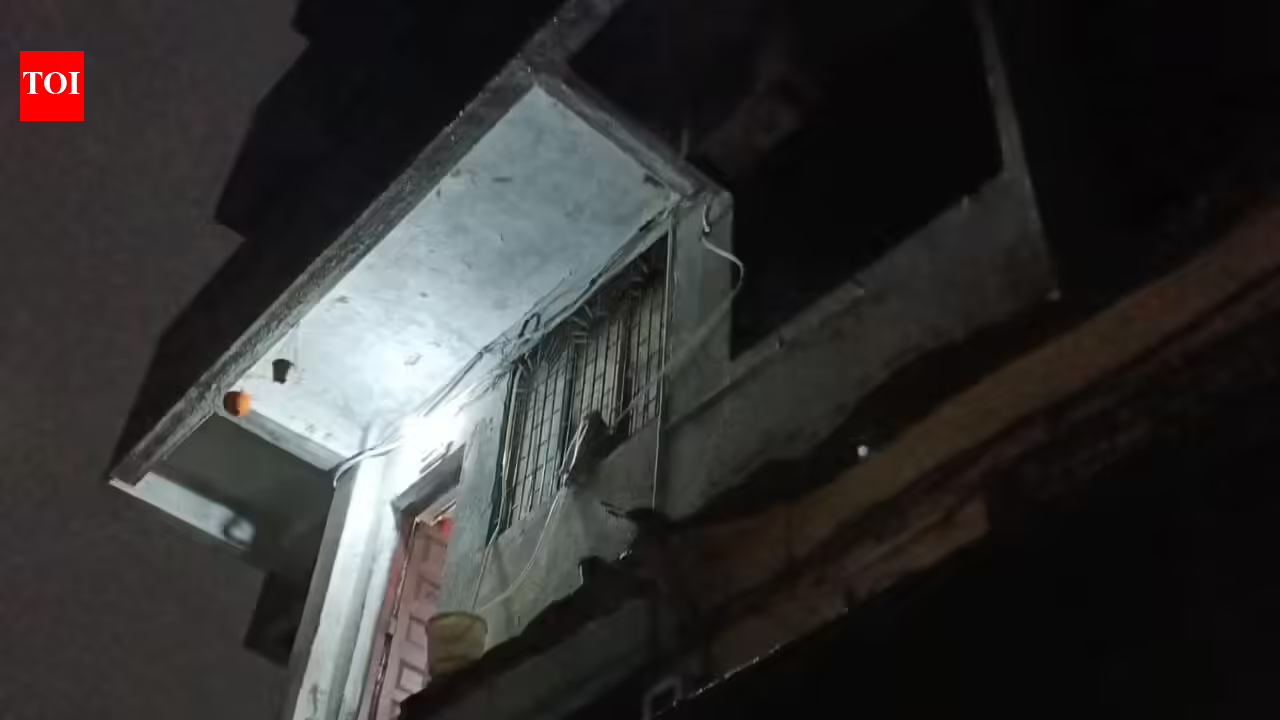
Thane: A 13-year-old girl was killed when a portion of the second-floor common balcony of a residential building collapsed in Mumbra on Monday night.Six residents trapped inside the structure were rescued by the fire brigade and disaster response personnel after a two-hour operation, said Ganesh Khetar of the Mumbra fire station.The incident occurred around 8 pm at the four-storey Faiyyaz Apartments in Amrut Nagar. The deceased, Aasma Shaikh, had been playing with friends in the common balcony when a loud creaking sound was heard by residents. The residents said the slab gave way and Shaikh was buried under the debris. Her friends escaped unhurt.NCP (SP) corporator and Thane Municipal Corporation opposition leader Ashraf Pathan along with civic rescue teams reached the spot within minutes and rushed the injured girl to a nearby hospital, where doctors declared her dead.The building, classified as C2B—requiring structural repairs—houses about 70 residents in 15 flats. As a precaution, all occupants were shifted to nearby municipal schools pending a fresh structural stability assessment, said Hemant Divate, station in-charge, Mumbra fire brigade.Authorities said the exact cause of the collapse will be determined after an inspection, which will also decide if the building can be repaired or needs to be demolished.Shaikh’s death is the fifth monsoon-related fatality reported in Thane district in the past month, despite deputy chief minister Eknath Shinde directing authorities to ensure zero deaths from rain-related incidents. Activists said residents continued to live in dilapidated buildings.

Maharashtra CET Cell files complaint over viral ‘exam malpractice’ clips | Mumbai News

Maharashtra CET Cell files complaint over viral ‘exam malpractice’ clips

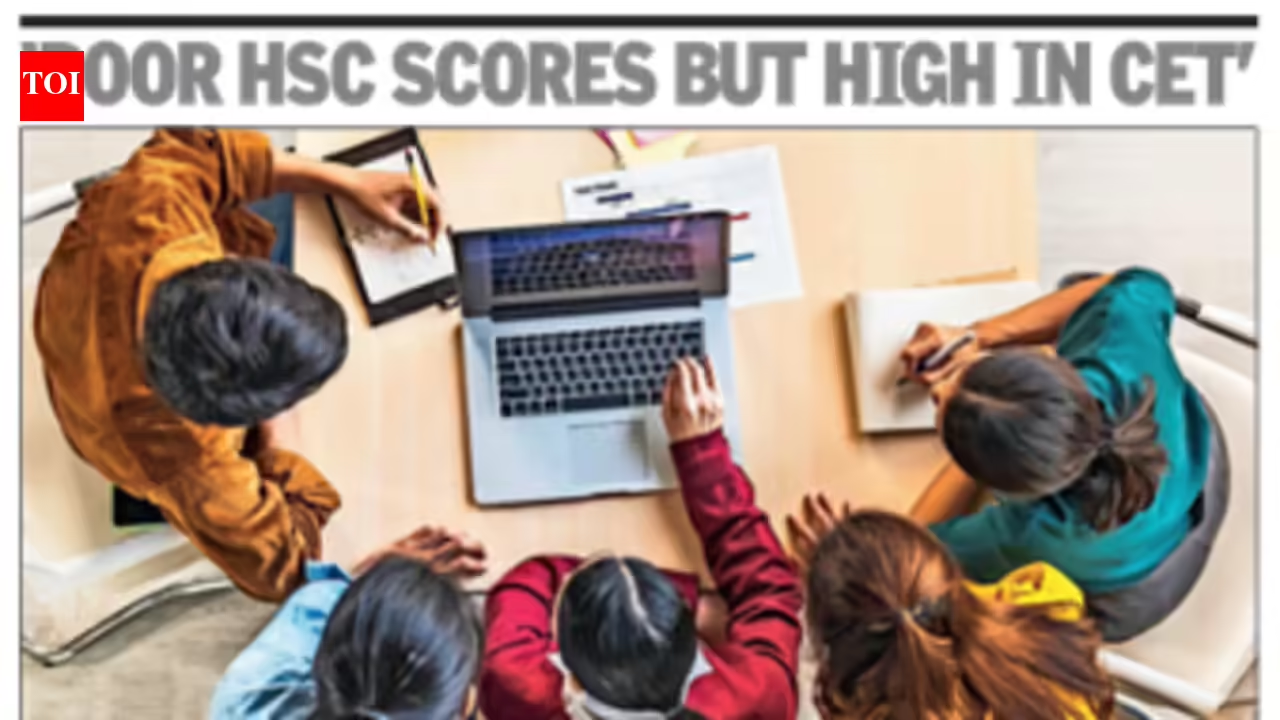
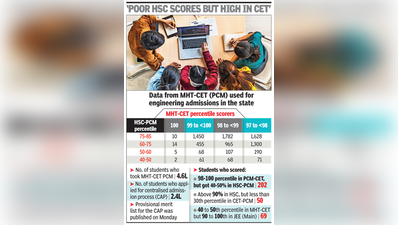
Mumbai: The CET Cell has filed a complaint with the state’s Cyber Cell and the Azad Maidan police station after a video and an audio clip alleging discrepancies in the provisional merit list for engineering admissions, along with claims of manipulation of exam centres in return for money, surfaced on social media and were widely circulated among students. The cell has asked the police not only to identify the source of the clips and the persons involved in creating, uploading and circulating them but also to verify the claims made in them. No FIR has been registered in the matter yet. About 2.4 lakh students registered for the centralised admission process (CAP) for engineering.A person in the video alleged that students who scored higher marks (100th percentile) in the MHT-CET physics-chemistry-mathematics (PCM) exam scored poorly in the state board exams. The audio clip showed that a woman allegedly offered to manipulate the CET exam centre and help students secure the 99th percentile in the CET in return for money.Clarifying that the mismatch between HSC and CET scores is not an anomaly but occurs across score bands and entrance examinations, CET Cell Commissioner Dileep Sardesai said that 202 students who scored between the 98th and 100th percentile in the MHT-CET secured 40%-50% in the PCM subjects in the HSC board examinations. He added that the reverse was also true, with 50 students scoring above 90% in the HSC board examinations but below the 30th percentile in the MHT-CET.Sharing data across different score bands, he said that 69 students who scored between the 40th and 50th percentile in the MHT-CET secured between the 90th and 100th percentile in JEE (Main) as well and that there was no pattern in the same. Sardesai said that the format of the board and the entrance examinations are different and such mismatches in scores occur across entrance examinations. The CET Cell authorities will analyse the data further and see the background of the 202 students and the exam centres from where they appeared.About the allegation of manipulation in the allotment of centres, Sardesai said that these are centrally allotted by the CET Cell and in an automated manner. He said that this year the CET Cell has also limited the use of exam centres to computer laboratories in govt and private engineering colleges.Of the total 25 sessions conducted for the PCM exams, it was found that GH Raisoni College of Engineering, Pune, had 222 students who scored above the 99th percentile in the exam, followed by Thakur College, Kandivali, with 133 students, and GH Raisoni Technical Institute (120), Govt Engineering College (108) and Shah and Anchor Kutchhi Engineering College (99). These centres also had more students appearing for the exam, said the CET Cell authorities, adding that these will be analysed further too.

Mumbai estate agent held for duping cancer patient of Rs 40 lakh | Mumbai News

Mumbai estate agent held for duping cancer patient of Rs 40 lakh

Mumbai: The police have arrested a 36-year-old estate agent for duping a woman cancer patient of Rs 40 lakh by luring her with the promise of a Mhada flat under the reserved category.The police said the flat was never handed over to the woman and a Rs 15 lakh partial refund cheque issued by the accused also bounced.The police identified the arrested man as Anil Mane, proprietor of Om Sai Enterprises. The case was registered at the Dadar police station on July 16 on the complaint of a cancer patient.She said she was looking to buy a flat in the Dadar-Parel belt when she was introduced to Mane through a common acquaintance who claimed the accused could arrange for Mhada and mill workers’ flats in Mumbai in July 2021. Mane allegedly showed her a flat in the Srinivas Mill Complex at Lower Parel and offered to facilitate its purchase for Rs 38 lakh.Believing his assurances, the complainant transferred Rs 10 lakh to Om Sai Enterprises through NEFT as a booking amount and later paid additional sums in cash and through bank transactions. The police said Mane executed an agreement acknowledging receipt of the booking amount and assured the complainant that the flat would be transferred to her name.When the promised flat did not materialise, Mane allegedly told the complainant that the government had imposed a stay on the property and asked her to wait. Later, he allegedly offered another flat in the Bombay Dyeing Spring Mill redevelopment project and persuaded her to transfer another Rs 9.5 lakh, claiming it was required for Mhada formalities.The complainant, who was diagnosed with cancer in 2025 and is undergoing treatment at Tata Memorial Hospital, alleged that despite paying a total of Rs 39.46 lakh, she neither received possession of any flat nor got her money back.The police said Mane later executed a promissory note acknowledging receipt of the money and issued a cheque for Rs 15 lakh, which was dishonoured upon presentation. The complainant alleged that when she repeatedly demanded repayment, the accused abused and threatened her with dire consequences.During the investigation, the police found that the accused had allegedly vacated his Ghodapdeo residence in March this year and had been evading arrest. The police recently traced him after he contacted the complainant from a new mobile number. Technical surveillance, including analysis of call detail records and location data, led police to Bhavani Shankar Road in Dadar, where he was apprehended on Sunday.

Assault on doctors: HC flags police ‘respect’ for KDMC neta, orders probe by DCP | Mumbai News

Assault on doctors: HC flags police ‘respect’ for KDMC neta, orders probe by DCP
Questioning corporator Ramesh Mhatre’s action, the Acting CJ said, ‘They are your voters’

Mumbai: Not satisfied with the probe against Sena’s KDMC corporator Ramesh Mhatre and three others accused of assaulting doctors of a civic hospital earlier this month, Bombay HC on Monday directed that the investigation be handed over to the zonal DCP.Acting Chief Justice (ACJ) RV Ghuge said police accorded the neta “a rare type of respect” by trying to facilitate his production before a magistrate via video conference (VC) after his arrest. He noted that Mhatre was arrested 48 hours after the alleged assault.“Why do you (Mhatre) behave like this? Why beat the public? They are your voters. Surprising that a person who goes to voters and says ‘vote for me, I want to serve you’…after winning, starts beating people,” the ACJ said while hearing a plea filed by the corporator and others seeking bail on any stringent condition HC deemed fit. “Even in public life, you are for the public, are here for the public.”The state told HC that the probe was earlier handed over from a police inspector to a senior police inspector and will now be entrusted to the Kalyan DCP (zone 3) in two days.Advocate general Milind Sathe said as per public prosecutor Shishir Hirey’s submission at the hearing last week, police had “erred on the side of caution” since Mhatre’s blood pressure had shot up to 160 and had requested his production via VC to avoid any incident and any other controversy later. The magistrate had declined this request, following which Mhatre (73) was produced physically and remanded in three days of police custody, said Sathe. HC praised the magistrate.The ACJ noted that after being granted bail later, Mhatre had walked out “as if nothing had happened”. “There was a grand reception… So many supporters. This is what someone had argued that day. This means it was a pretence. Is this why you become a people’s representative?’’ he said. “This is very strange and counterproductive,’’ said the bench, which included Justice Gautam Ankhad.Mhatre’s senior counsel Aabad Ponda sought his release, saying a “hard lesson has been learnt”. He cited his age and health and said Mhatre may even be kept out of Maharashtra’s jurisdiction till the probe is complete and the chargesheet filed. He said after HC suo motu set aside the bail order, Mhatre immediately surrendered.Advocate Sanaa Raees Khan, for the other three co-accused, asked that they too be released as CCTV footage had already been seized. The bench said the footage showed that their actions were more “violent”. “Go watch the footage and come back on Wednesday,’’ said the ACJ.Senior counsel Ashok Mundargi, as amicus curiae (appointed by HC to assist it), agreed with Ponda that “bail is the rule and jail an exception” but said the investigation needs to be first completed and the chargesheet filed as the victims had in the FIR alleged being threatened with repercussions. He said the court may direct the probe to be expedited and completed before the mandated 60 or 90 days.HC directed that protection be given to the complainant doctor for his statement to be recorded in Washim, where he has been staying since the assault.HC posted the matter for Friday to enable victims to file affidavits by then, but said adjournment cannot be given freely as in a ‘civil case’. “The court must be fair to him (Mhatre) too,’’ the ACJ said.So far, three nurses and two doctors, the chief medical officer and the chief health officer of KDMC have recorded their statements, the public prosecutor said. Ten more witnesses are yet to do so. HC sought a probe update on Friday.Doctors and staff of the Dombivli hospital were attacked after a pregnant patient’s relatives alleged delay in her treatment on July 6. An FIR was lodged the next based on a doctor’s complaint. Asked by HC, the public prosecutor said KDMC did not file a complaint. Mhatre was arrested on July 8 and got bail from a magistrate on July 15. HC stayed that order on July 18 and he surrendered the next day.

BMC opens Middle Vaitarna dam gates as lake level rises; Mumbai’s water stock touches 88% | Mumbai News

BMC opens Middle Vaitarna dam gates as lake level rises; Mumbai’s water stock touches 88%
Water discharged from the Middle Vaitarna dam flows into Modak Sagar, one of the seven lakes that supply drinking water to Mumbai

Mumbai: The BMC opened two gates of the Middle Vaitarna dam in the early hours of Monday after the reservoir’s water level touched 282 metres, reflecting the strong inflows from the ongoing southwest monsoon.Although the dam’s full supply level is 285 metres, the BMC does not allow the reservoir to fill to its brim. Civic officials maintain a buffer to accommodate additional inflows from the Upper Vaitarna dam whenever water is released from there.Water discharged from the Middle Vaitarna dam flows into Modak Sagar, one of the seven lakes that supply drinking water to Mumbai.With steady rainfall continuing across the catchment areas, water stock in the seven reservoirs supplying the city has now reached 12.79 lakh million litres, or 88% of their total storage capacity.The improvement marks a dramatic turnaround from the beginning of the month. On July 1, the combined storage in the seven lakes dropped to just 7.18%, raising concerns over the city’s water security.The sustained southwest monsoon over the past few weeks has significantly replenished the reservoirs, easing fears of water shortages and ensuring comfortable reserves for Mumbai in the months ahead. However, Mumbai is still reeling under a 10% water cut.The seven reservoirs — Bhatsa, Upper Vaitarna, Middle Vaitarna, Modak Sagar, Tansa, Vihar and Tulsi — collectively supply nearly 4,000 million litres of water to Mumbai every day.