SHRC takes up VN Desai Hospital’s ‘fake doc’ case | Mumbai News

SHRC takes up VN Desai Hospital’s ‘fake doc’ case
The doctor was appointed on contract through Sai Sanjeevani Services

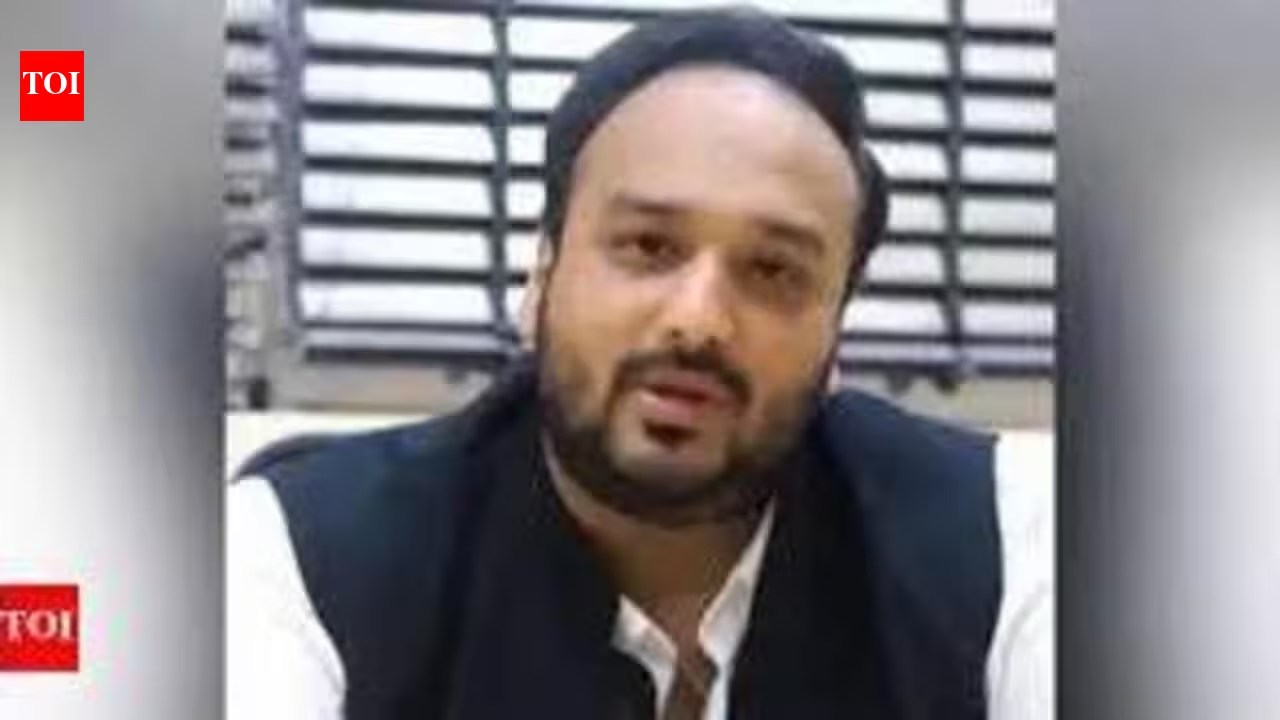
Mumbai: The State Human Rights Commission has taken up the case of an alleged ‘bogus doctor’ who was found posted in the ICU at VN Desai Hospital in 2024. The hearing is scheduled to start on July 9.The hospital found that Dr Bharat Sawant, appointed on contract through Sai Sanjeevani Services, had suspicious documents after the Maharashtra Medical Council (MMC) could not verify his medical certificate.The hospital has since suspended all financial payments to the hiring agency. However, Sawant had already worked there for almost two years. Dr Jairaj Acharya, the hospital’s former medical superintendent under whose tenure the doctor worked, was unavailable for comment. Dr Sawant too remained unavailable for a comment.In an internal communication, Dr Mayura Nagale, the present medical superintendent of the hospital, said that Sai Sanjeevani Services had a formal agreement dated July 29, 2022, to provide trained and qualified doctors (ICU personnel) for a period of two years. She added that, as per the terms set, it was the sole responsibility of the vendor to ensure all medical staff possessed valid registration with the medical council. The hospital had no role in allowing Dr Sawant to work without proper documentation, she said.“The doctor’s certificate was sent for MMC verification, and it was confirmed to be invalid,” Dr Nagale said.

CM Devendra Fadnavis reviews Mumbai-Delhi freight corridor work, says Mumbai-Vadodara Expressway will be commissioned by August 31 | Mumbai News

CM Devendra Fadnavis reviews Mumbai-Delhi freight corridor work, says Mumbai-Vadodara Expressway will be commissioned by August 31
On Sunday, Devendra Fadnavis, accompanied by state forest minister Ganesh Naik and fisheries minister Nitesh Rane, carried out an inspection of various infrastructure projects in Palghar district

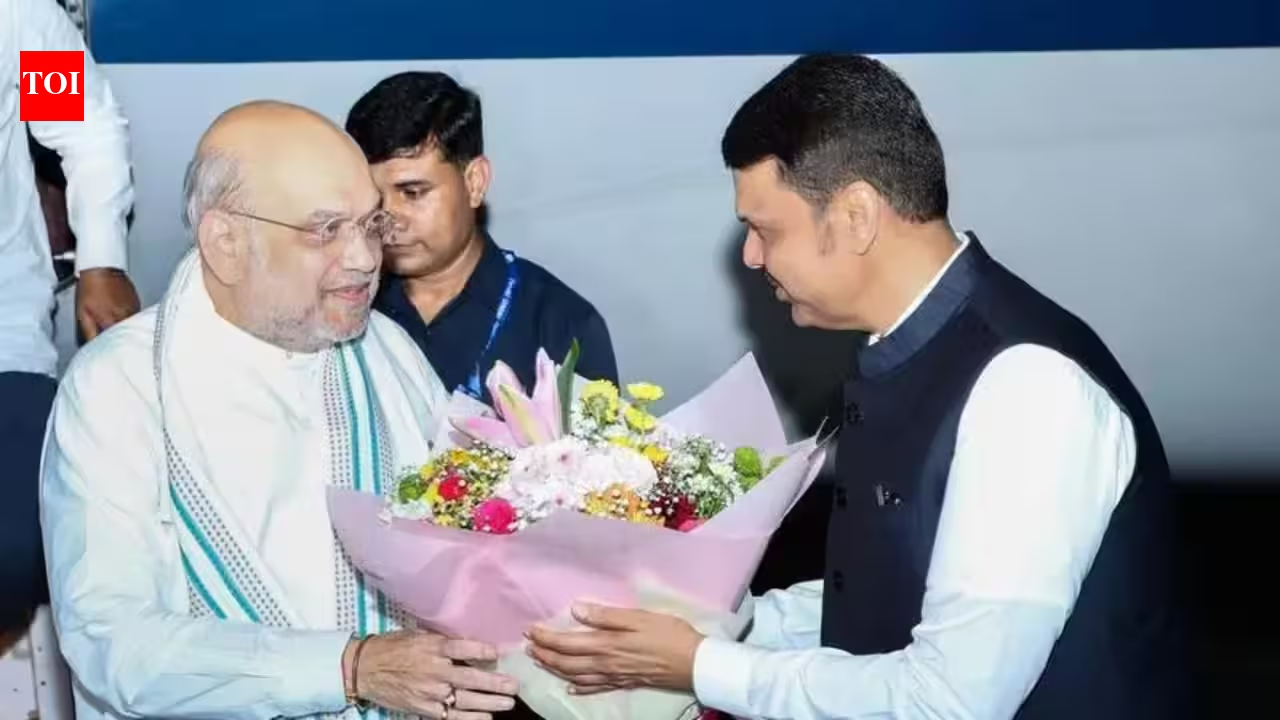
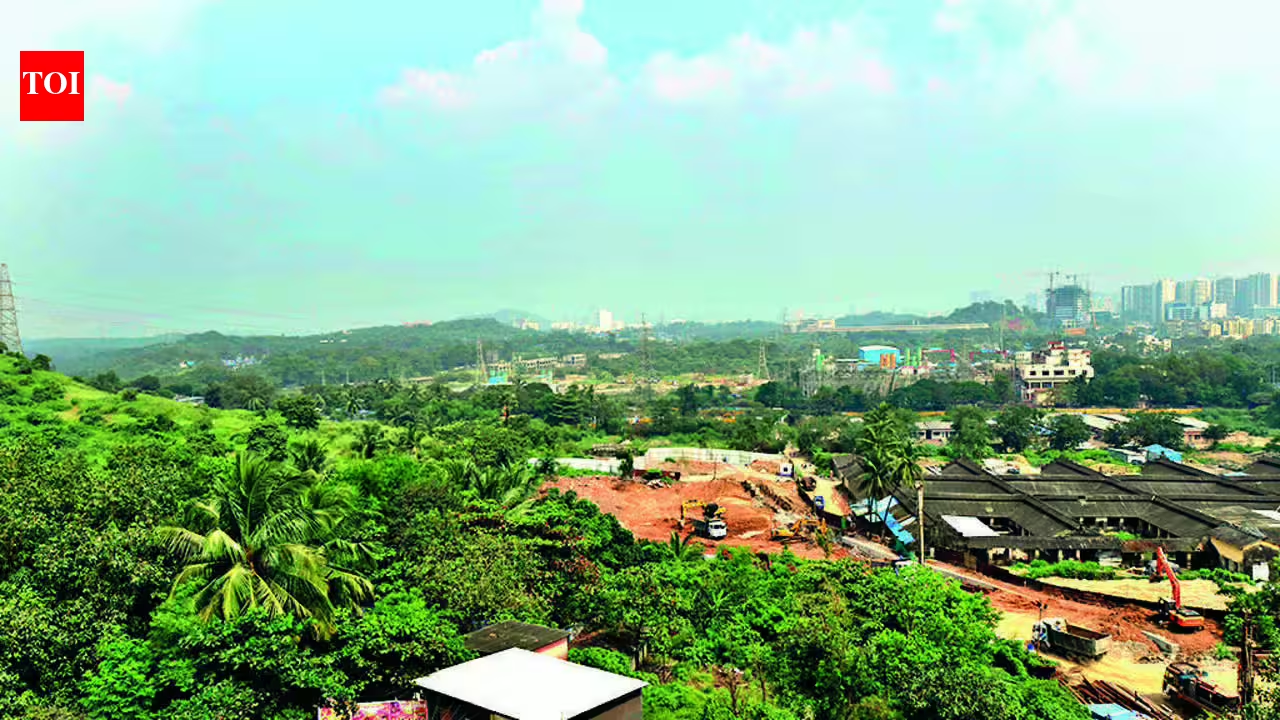
Mumbai: The 157km Mumbai-Vadodara Expressway, part of the Delhi-Mumbai freight corridor, will be commissioned by August 31, said CM Devendra Fadnavis. Once commissioned, the travel time between Vadodara to Mumbai will be reduced from the eight hours to about four.It will provide a fast, safe, and traffic jam-free travel experience and also boost commercial transport, said the CM.On Sunday, Fadnavis, accompanied by state forest minister Ganesh Naik and fisheries minister Nitesh Rane, carried out an inspection of the works currently underway of various infrastructure projects in Palghar district.The 1,400km, eight-lane greenfield access-controlled expressway is being built by the Centre at a cost of about Rs 1 lakh crore. It will connect the five states of Haryana , Rajasthan , Madhya Pradesh , Gujarat and Maharashtra. After the completion of this route, the journey between Delhi and Mumbai will be significantly faster and connectivity between the major industrial belts of the country will be more efficient, said Fadnavis. The highlight of this project is its direct connectivity with Jawaharlal Nehru Port Authority (JNPA) . This will make freight transport from North India to JNPA faster, more efficient and less costly, giving a major boost to the country’s logistics chain, he added.The CM directed officials at the site to focus on quality work, along with timely completion of the project.The Vadodara-Mumbai section is estimated to cost Rs 24,000 crore. The construction work was divided into seven packages, of which five have been completed. The two remaining packages are expected to be completed by August, said Fadnavis. The time and fuel wastage caused by the current traffic congestion on the Thane, Bhiwandi, and Ghodbunder routes will be reduced, providing a faster and more reliable alternative route for freight traffic.

Man gets life term for burning wife to death; court relies on woman’s ‘dying declarations’ | Mumbai News

Man gets life term for burning wife to death; court relies on woman’s ‘dying declarations’

Thane: Nearly six years after a young woman was set ablaze at her residence in Diwa, a Thane Sessions Court convicted her husband for murder, relying primarily on her dying declarations and other corroborative evidence. Additional Sessions Judge B.D. Shelke convicted Shahir Devram Parkhe (32), under Section 302 of the Indian Penal Code for murdering his wife, Payal Arjun Vidhyasagar, and sentenced him to life imprisonment along with a fine of Rs 5,000.The court also directed issuance of a show-cause notice to a key prosecution witness who turned hostile during trial, asking why she should not be prosecuted for perjury.According to the prosecution, the couple had a love marriage but frequently quarrelled as the accused suspected his wife’s character. On the intervening night of March 17 and 18, 2020, Parkhe allegedly returned home under the influence of alcohol, poured kerosene on Payal after an argument and set her ablaze. She sustained severe burn injuries and was shifted to Thane Civil Hospital, where her statement was recorded. She succumbed to her injuries on March 23, 2020.During the trial, a key prosecution witness turned hostile and claimed her earlier statement before the magistrate was recorded under police pressure. However, the court held that the admitted portions of her statement, coupled with the victim’s dying declarations, oral dying declaration made immediately after the incident, medical evidence and other circumstantial evidence, conclusively established the accused’s guilt.The court further observed that the witness had deliberately suppressed material facts and intentionally given false evidence during the trial. Holding that a prima facie case of perjury was made out, the judge directed issuance of a show-cause notice to the witness, asking why she should not be prosecuted under Section 193 of the Indian Penal Code for intentionally giving false evidence in judicial proceedings.

Fire breaks out at timber warehouse in Bhiwandi; no casualties | Mumbai News

Fire breaks out at timber warehouse in Bhiwandi; no casualties

Thane: A fire broke out at a timber warehouse in Bhiwandi town of Maharashtra‘s Thane district in the early hours of Sunday, and no casualties were reported in the incident, an official said. The blaze erupted at the facility in the Bhinar Nimbavali area around 5 am, the official said. “Three fire engines from the Bhiwandi fire brigade are present at the spot, and firefighting operations are underway,” said Yasin Tadvi, chief of the Regional Disaster Management Cell (RDMC) of the Thane Municipal Corporation (TMC). The fire spread rapidly due to the highly flammable wood stored at the warehouse, sending thick plumes of smoke into the air. The exact cause of the blaze is yet to be ascertained, and no casualties or injuries have been reported yet, the official said.

11 baby crocodiles rescued from water tank in Bhandup, Maharashtra | Mumbai News

11 baby crocodiles rescued from water tank in Bhandup, Maharashtra

Mumbai: A total of 11 baby crocodiles were rescued from a water tank located near Vihar Lake in Mumbai’s eastern suburb of Bhandup, a civic official said on Saturday.Pre-monsoon cleaning and maintenance were carried out at the water tank, he said.Workers spotted a few crocodiles and immediately informed the forest department.Rescuers from Resqink Association for Wildlife Welfare were called to the scene. Subsequently, 11 baby crocodiles were rescued from the tank, the official said.In a similar exercise last week, two baby crocodiles were rescued in the same locality.

25ft blue whale calf beached at Bandra, dies despite rescue attempts | Mumbai News

25ft blue whale calf beached at Bandra, dies despite rescue attempts
The calf was buried at Versova beach

Mumbai: A blue whale calf, about 25ft long, died after being stranded along the rocky Bandra coast on Saturday morning.Veterinarians, officials from the forest department’s mangrove cell and the civic body, and other rescue teams attempted to save it but failed. The carcass was recovered with the help of a crane for examination and later buried at Versova beach.It’s unclear why the calf beached itself. State agencies have launched an investigation into it. Whales can strand themselves due to severe illness, injury, disorientation, navigational errors, and human-induced disruptions. Sometimes, they can follow a distressed pod member into shallow waters.Marine mammal expert Dipani Sutaria told TOI: “The blue whale is an endangered species. The veterinarian who checked the carcass said there were no external injuries. However, during monsoon, the mother whale and her calves may have been chasing a shoal of fish or plankton close to the coast, and this particular calf may have become disoriented and hit the rocky Bandra coast. It is also possible that the mother whale may have been injured after being hit by a large trawler and the calf, therefore, lost its way. Underwater noise disturbances, unhealthy biochemicals in the sea or predators like orca can also affect whales.”N Vasudevan, marine biologist and former head of the state mangrove cell, recalled that in 2016, a blue whale had stranded itself on the Raigad coast. “Despite efforts to push it back into the water, it did not survive. More research can throw light on why whales get stranded.”Environmentalists and other marine biologists wondered why the rescue attempts failed. “It is unfortunate that the blue whale calf could not be saved despite attempts to push it back into the sea. There is barely any research done on why the blue whale—the world’s biggest mammal—and other whale species get stranded. I suspect industrial and sewage pollution discharged into the ocean to be the cause of harming marine animals, besides the presence of several fishing trawlers and ships, which can harm whales,” said environmentalist D Stalin of NGO Vanashakti.B N Kumar, director of NatConnect Foundation, which works on environmental causes, called the death “deeply distressing”.Nandakumar Pawar, director of Sagar Shakti, the marine division of Vanashakti, said the death should be treated as an isolated wildlife tragedy. “It is a stark reminder that the health of our seas and the livelihoods of our traditional fishing communities are inseparably linked. When the marine ecosystem is under stress from pollution, habitat degradation and unregulated coastal activities, it is not only marine species that suffer but also thousands of fisherfolk who depend on healthy waters for their survival.

‘Ageing’ underground cable in crowded south Mumbai area catches fire | Mumbai News

‘Ageing’ underground cable in crowded south Mumbai area catches fire

Mumbai: A fire triggered by a suspected short circuit in an “ageing” underground power cable sparked panic in the congested Bhendi Bazaar in south Mumbai on Sunday morning. No injuries were reported. The fire was contained to the site and didn’t spread to nearby structures.It broke out around 11.30am on Mutton Street in the densely populated Don Taki locality of Nagpada, sending thick plumes of smoke from beneath the road and alarming residents, shopkeepers and pedestrians.Fire tenders rushed to the spot. The area was cordoned off as flames and smoke continued to rise from the underground cable network. Crowds gathered even as police worked to control the situation and prevent any untoward incident.Firefighters managed to bring the blaze under control within a short time. As a precautionary step, BEST officials shut down power supply from the nearest substation.A senior BEST official from the power supply division said the fire originated in an ageing low voltage cable that was due for replacement. “There was no ongoing work as it was Sunday. The cable developed a short circuit and burst. The fire was controlled promptly. There was no disruption in electricity supply to the area, and we will replace the cable soon.”Authorities said a detailed technical assessment would be conducted to ascertain the exact reason and prevent recurrences.

BJP corporator seeks demolition of Colaba ‘aspirational’ toilet, action against BMC officials | Mumbai News

BJP corporator seeks demolition of Colaba ‘aspirational’ toilet, action against BMC officials

Mumbai: BJP corporator Makarand Narwekar has demanded the immediate demolition of the allegedly illegally constructed ‘aspirational’ toilet opposite Lion Gate in Colaba. He has also sought the immediate suspension of the municipal officials who approved the project and recovery of the project cost from them.In a letter to Maharashtra Legislative Assembly Speaker Rahul Narwekar and BMC Commissioner Ashwini Bhide, Narwekar said the BMC recently submitted an inquiry report on the matter to the Urban Development Department, which has also been tabled in the state legislature.He stated that the civic body originally proposed a footpath measuring 0.9 to 1.5 metres in width for pedestrians at the site. By permitting the construction of the toilet, the BMC admitted to violating its ‘Pedestrian First’ policy, he said, adding that the structure amounted to a serious encroachment on space meant for pedestrians.Narwekar demanded that the ‘aspirational’ toilet be demolished immediately and the footpath restored to its original condition. He further alleged that around Rs 1.65 crore was spent on the project and demanded that the amount be recovered from the salaries and assets of the officials found guilty.

75% pre-SIR mapping completed, physical revision from June 30 | Mumbai News

75% pre-SIR mapping completed, physical revision from June 30

Mumbai: While the physical verification of the electoral roll through the Special Intensive Revision (SIR) will begin on June 30, election officials have successfully mapped 75% of current voters with records available in the 2002 electoral roll of the voter, their parents or grandparents.Of the state’s 9.8 crore voters, 7.4 crore have been mapped. Of the total, 17.4% names have anomaliesthatneed to be verified.In the pre-SIR mapping, urban areas with high migration have seen the lowest mapping. Three districts have reported below 60% mapping. These include: Mumbai Suburban (53.2%), Pune (54.6%) and Thane (57.5%). Also, Mumbai City is low with 62.5% mapping.By contrast, largely rural districts where there is low migration and polling booths tend to remain the same, report higher mapping. These include Hingoli (92.5%), Sindhudurg (92.3%), Ratnagiri (91.7%), Gadchiroli (91.4%), Amravati (90.7%) and Buldhana (90.4%).Meanwhile, election authorities have appealed to political parties to appoint Booth Level Agents (BLAs) at every polling station to help make the process of removing duplicate and deceased voters and registering new voters, more transparent.So far, 1.7 lakh BLAs have been appointed by political parties. Of these, the highest number amounting to 67,208 are from the BJP. This accounts for 38.7% of the total. The Shiv Sena has 49,336. The Congress has 19,576 while the SS UBT has 15,839.“The BLAs will be given the draft voter list to check for deletions. Soit’s important for political parties to appoint enough BLAs to monitor deletions,” said a senior election official.Physical visits by enumerators will take place between June 30 and July 29. The designated BLOs will conduct house-to-house visits and distribute pre-filled enumeration forms. The information needs to be verified by the voter and the form has to be signed. The enumerator will check if the information on the form is correct or needs to be changed. They will also check on absent, shifted, dead or duplicate voters. Voters will also have to provide a new photograph. —Priyanka Kakodkar

SIR is about building a cleaner electoral roll, asserts state CEO | Mumbai News

SIR is about building a cleaner electoral roll, asserts state CEO

Q. The Special Intensive Revision will start tomorrow. What should voters expect?Chief Electoral Officer S Chockalingam (SC) The field verification is the most important phase of Special Intensive Revision (SIR) because the tentative mapping we carried out so far will be physically confirmed. The guiding principle of the exercise is that no eligible voter should be left out. We have completed around 76% of voters using the previous electoral rolls. It is tentative because similar names may have been wrongly mapped and only a physical verification by the booth-level officer (BLO) and by the elector can confirm whether the mapping is correct. If the mapping is correct, the elector will provide basic details and sign the form, which confirms the mapping. Until then, our mapping is not final. If it is wrong or unmapped, the elector can give correct details for the mapping and sign.Q There is widespread concern that genuine voters could be deletedSC The exercise will ensure the opposite. The law empowers the Electoral Registration Officer (ERO) to determine eligibility after the prescribed legal process. Every voter can establish their eligibility before a decision. If a person’s name is available in the electoral rolls of the previous SIR, that itself is an important reference. Even if the person’s name cannot be traced, those of the parents in previous SIR electoral rolls are important links. We have carried out mapping using historical electoral records. But, this mapping is tentative and is valid only after physical verification and the elector’s signature.Q How important is field verification in urban areas?SC Urban areas are a much bigger challenge. People have shifted houses, changed constituencies and sometimes moved to different districts or states over the last two decades. Therefore, while the overall mapping is around 76%, in urban areas it is below 60%. BLOs can ask voters where they were enrolled in the previous SIR. Even if they do not remember the polling station, many remember the assembly constituency or the MLA they voted for. The Election Commission’s online search facility available on the ECI website (‘Search Your Name in the Last SIR’ button in https://voters.eci.gov.in) enables citizens to search previous electoral details across the country. The part number or polling details help locate the earlier record. Our public advertisements request citizens, particularly urban voters, to keep these details ready before the BLO visits.Q What are the three parts of the form?SC Every elector whose name appears in the electoral roll as on June 18, 2026 will receive a form pre-filled with the voter’s details. If the photograph needs updating, the BLO will take a new one using a cellphone. This is not necessary unless the existing image is blurred. The form has three parts. The first part is pre-filled with the voter’s existing details, including name, EPIC number, address, polling details and photograph, which the elector verifies during the BLO’s visit. The second part seeks details linking the elector or their parents to the last Special Intensive Revision (2002-2004) electoral roll, including the assembly constituency, part and serial number, or the name of a parent or qualifying relative appearing in the earlier roll. The third part contains the elector’s declaration, signature or thumb impression, cellphone number, or that of a close family member and Aadhaar number. If the voter cannot be mapped during the verification, they will still receive the form but will later be issued a notice to submit supporting documents during the claims and objections period before the Electoral Registration Office.Q What documents will voters need to produce?SC The SIR instructions list 11 documents (Aadhaar is 12th document but only as an identity proof), but this is only an indicative list and not an exhaustive one. Equivalent documents can also be accepted. For example, if someone does not possess a matriculation certificate, a transfer certificate or another equivalent educational document can be produced. ERO will verify these documents with the govt departments wherever necessary. All 11 documents need not be submitted, only one is required.Q Some critics say this exercise is about deleting votersSC No. People should understand the difference between a summary revision and an intensive revision. In the former, the existing electoral roll remains the base document and additions or deletions are made. In the latter, a new electoral roll is prepared. Naturally, this removes “deadwood” accumulated over the years—people who have died, permanently shifted, have duplicate registrations or cannot be traced. This should not be viewed as a deletion but as a cleaning up of the electoral roll. Whoever is available, provides the basic information and signs the form will be included in the draft rolls. Final rolls would include properly mapped electors. Electors who are unmapped or mapped with anomalies will be included in the final rolls on submission of documents. Eligible voters will remain in the electoral roll while non-genuine or obsolete entries will naturally get excluded after due process.