
TET leak when papers were on way to Washim, Jalna & Latur: Cops | Mumbai News

TET leak when papers were on way to Washim, Jalna & Latur: Cops

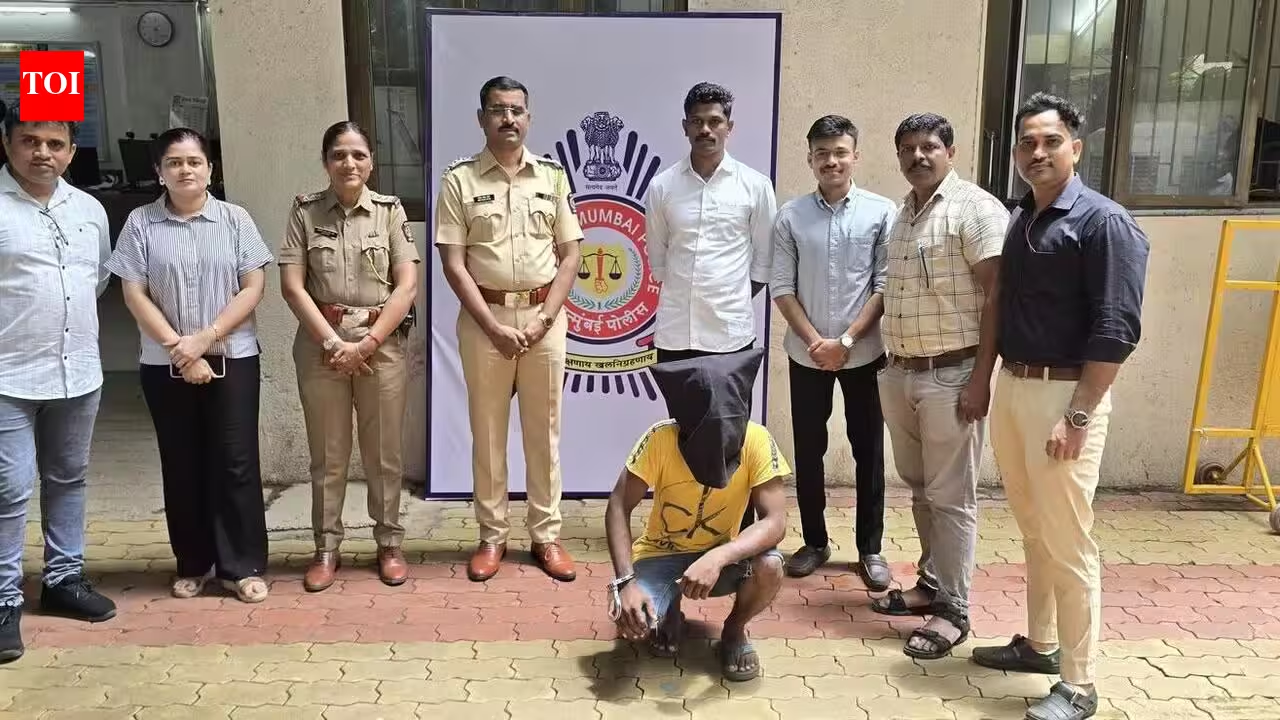
Pradeep GuptaBhiwandi: The probe into the state Teacher Eligibility Test (TET) paper leak has revealed that the papers may have been leaked while being transported from a printing press in Uttar Pradesh to exam centres in Maharashtra, prompting Thane police to launch a multi-state hunt for the alleged mastermind Bjiender Gupta and his associates. Police have begun the process of issuing a lookout notice for Gupta and another accused who is on the run.According to investigators, the Maharashtra State Council of Examination had entrusted printing of TET papers to Mahim Patran Pvt Ltd, an Agra-based company with a corporate office in Delhi that has reportedly been printing papers for the council for nearly 25 years. After printing, the papers were despatched under security to exam centres across Maharashtra.Police said that by analysing QR codes printed on the four leaked papers recovered from the arrested accused, they found three were meant for exam centres in Washim, Jalna and Latur districts. Investigators suspect the papers were leaked somewhere between the Agra printing facility and their destinations in Maharashtra. Papers recovered from the accused were photocopies of the originals.“We are tracing every link in the movement of the papers to identify where the security breach occurred,” an officer said.The probe is currently centred on the alleged mastermind Gupta, a resident of Samastipur, Bihar. According to investigators, Gupta has been accused in several paper leak cases registered in different states over the years. Police believe his interrogation will be crucial in identifying the source of the leak.Police are also searching for Kapil Dahiya, another key suspect who was with the three arrested accused—Rajiv Shah, Akash Kumar and Dhiraj Singh—in Bhiwandi on the day cops caught them with the papers. But before the police raid, he allegedly left for Pune to negotiate the sale of the leaked papers. After allegedly learning his associates had been arrested, Dahiya is believed to have returned to Mumbai and boarded a flight to Delhi.According to police sources, undercover officers posing as prospective buyers contacted the accused and negotiated a deal for four leaked TET papers—Marathi, Hindi, social science and maths. The accused allegedly demanded Rs 1.25 crore. After the officers agreed to pay Rs 25 lakh as advance, the accused allegedly produced the papers, following which the police team caught them.Investigators said Rajiv Shah and Akash Kumar, both residents of Bihar, were allegedly in contact with Gupta and were in possession of papers, while Dhiraj Singh and Dahiya, both from Haryana, were responsible for negotiating deals with prospective buyers.The probe has also brought family members of the accused to Bhiwandi. A family friend of Akash Kumar, Nitesh Singh, who travelled from Patna, claimed Akash had left home telling his parents he was going to appear for an exam. According to the family, Akash is the only son of his parents, holds a BCom degree, and had been preparing for govt exams. His father works as supervisor at a four-wheeler showroom, while his mother has been unwell for some time.Relatives of Dhiraj Singh said he belongs to a family of farmers in Panipat, worked in a private company and after the death of his parents was supporting his younger brother and sister, both of whom were preparing for govt jobs.Dhiraj’s lawyer Satinder Redhu alleged that Gupta, known for allegedly promising govt jobs, had taken money from Dhiraj on the assurance of arranging employment. The family claimed Gupta may have falsely implicated Dhiraj.The third arrested accused, Rajiv Shah, is married and holds a BSc degree in physics, while Dahiya is the son of a retired army serviceman.“The investigation so far indicates Bijender Gupta is the main accused. Once he is arrested, we expect to establish how the papers were leaked, who assisted the accused and whether more people are involved,” DCP Pawan Bansod of Thane police said.

BMC plans Rs 14.7-cr backup power system at Bhandup plant to prevent water cuts | Mumbai News

BMC plans Rs 14.7-cr backup power system at Bhandup plant to prevent water cuts

Mumbai: In a bid to ensure power failures do not disrupt Mumbai’s water supply, the BMC has proposed setting up a backup power transformer at its Bhandup water treatment complex, which supplies nearly 80% of the city’s drinking water.The proposal, to be tabled before the Standing Committee on Wednesday, seeks approval to spend Rs 14.67 crore on installing an additional 110 KV power transformer along with associated switchgear at the Bhandup electrical substation.The move comes against the backdrop of the recent recurring power outages in the city. Civic officials said the additional transformer will ensure water treatment and pumping operations continue uninterrupted even if one transformer develops a technical fault.Mumbai receives around 4,100 million litres per day (MLD) of water from seven lakes—Upper Vaitarna, Middle Vaitarna, Modak Sagar, Tansa, Bhatsa, Vihar and Tulsi. The water is treated at facilities in Bhandup, Panjrapur, Vihar and Tulsi before being distributed across the city.Of the total supply, the Bhandup water treatment complex alone treats nearly 3,000 MLD, making it the backbone of Mumbai’s water distribution network. The complex comprises the original 1,910-MLD treatment plant and a 900-MLD facility commissioned in 2014, making it one of the largest water treatment plants in Asia.Officials said uninterrupted electricity is critical to the functioning of the Bhandup complex. The proposed backup transformer will ensure that if one transformer fails, the second can immediately take over, preventing interruptions in water treatment and supply. The proposal states that strengthening the electrical infrastructure at Bhandup is essential to safeguard the city’s water supply system and avoid water cuts arising from technical failures in the power network.

Thrashed, 2 kids flee ashram school, rescued at Dadar station | Mumbai News

Thrashed, 2 kids flee ashram school, rescued at Dadar station
Two minors ran away from an ashram school in the western suburbs after being assaulted

Mumbai: An FIR has been lodged against the manager of an ashram school in the western suburbs for allegedly physically assaulting two boys, aged 11 and 14, which forced them to flee in the dead of night earlier this month.A passenger found the children at Dadar station as they were planning to board a train to Ahilyanagar and took them to GRP. They are currently at a govt shelter.The 11-year-old told police he used to live in the eastern suburbs with his parents and studied till Class 4 in a civic school. Fed up with his parents fighting often, he went to live with his grandmother. Last Sept, his father died and his mother enrolled him at the ashram school.The child and a cousin, who also stayed at the ashram school, were assigned the task of filling up water at 4am every day. On June 8, they finished the task from 4am-5am and went back to bed. The 11-year-old was assigned kitchen duty at 6am, but he and his cousin failed to wake up on time.The 21-year-old manager, who is physically challenged and wears a prosthetic, hit the cousin with a bottle. He then entered the kitchen where the 11-year-old was working, hit him twice on the back, grabbed him by his neck, and slapped him multiple times. The boy later confided in his 14-year-old friend, whose task was to purchase vegetables from a vendor.The two decided to escape. The older boy borrowed Rs 100 from the vendor. Late one night, the two slipped out of the school and took a lift from an auto driver till the nearest station. They boarded a local train and got off at Dadar station.The 11-year-old wanted to travel to Ahilyanagar to be with his mother. As the two began enquiring about tickets, a passenger spotted them and took them to Dadar GRP.GRP learnt about the abuse, got them to speak to their parents over phone, and sent them for medical examinations. The FIR was lodged under relevant sections of Juvenile Justice Act and BNS and the case transferred to local police recently.

All govt exams to go online from next year, govt considering slapping MCOCA on TET paper leak accused: School edu min | Mumbai News

All govt exams to go online from next year, govt considering slapping MCOCA on TET paper leak accused: School edu min

Mumbai: From next year, all exams conducted by the state govt will be held online, school education minister Dada Bhuse announced in the Maharashtra assembly on Monday. A committee has been formed under state chief secretary Rajesh Agarwal to create the necessary infrastructure to conduct online examinations. Bhuse added that all those found guilty in the TET paper leak case will be tried under the Maharashtra Control of Organised Crime Act (MCOCA) after making appropriate changes in the law.Brijkishor Zanwar, public relations officer for the school education department, said “the committee has been formed to look into how all exams like the TET conducted by various departments and ministries can be conducted online.”The TET examination, scheduled for Sunday, was postponed on Saturday, after the alleged paper leak surfaced.Speaking on the paper leak, BJP MLA Sudhir Mungantiwar in the assembly asked why the question papers were printed in Agra when currency notes are printed in Nashik, demanding that all question papers be printed within Maharashtra. He alleged that outsiders were involved and no Maharashtrians were part of the leak.Bhuse said the state govt was serious about the matter and an SIT has been formed and three teams have been sent outside the state – one to Delhi, two to Bihar and one to Haryana – to probe the crime.Earlier in the day, the opposition held a demonstration outside the state assembly demanding the resignation of state education minister Dada Bhuse.Congress legislator Vijay Wadettiwar alleged in the assembly that “the main accused in the TET case (at the time of the TET paper leak in 2018), Abhishek Savrikar, was involved in a similar case but was given respectful entry into the ruling party.”Wadettiwar stated that the paper leaks have affected six lakh teachers and hurt the state’s reputation.Shiv Sena (UBT)’s Bhaskar Jadhav said, “The reputation of Maharashtra is suffering because of paper leaks. Even in the NEET exam, seven of the 11 accused were from Maharashtra.”On the setting up of the committee, Madhav Suryavanshi of the Shikshan Vikas Manch at the Yashwantrao Chavan Centre stated, “Such committees are always set up and they are only a mirage to show the govt is doing something. Similarly, in 2018, the TET paper was leaked, a committee was formed, and reports were prepared, yet nothing came of it and we are back in the same place. Fundamentally what needs to happen is that the paper-setters need to change. They have been the same for years. Also, a multi-set system of question papers should be created each year for better security.”

BMC to get IIT-B to audit four railway FOBs in Mumbai flagged as unsafe | Mumbai News

BMC to get IIT-B to audit four railway FOBs in Mumbai flagged as unsafe

Mumbai: Four pedestrian bridges over railway tracks in south and central Mumbai, flagged as unsafe by the railways, will undergo structural audits by IIT Bombay, with the BMC set to seek approval from the civic standing committee to pay the IIT-Bombay institute Rs 12 lakh in advance for the exercise.The proposal, which will be placed before the Standing Committee on July 1, pertains to structural audits of four foot overbridges at Masjid Bandar and Matunga-Dharavi. The bridges include two FOBs at Masjid Bandar and two at Matunga-Dharavi.According to the civic administration, the railways have informed the BMC that the bridges are in a dangerous condition and require reconstruction. Before any decision is taken on rebuilding them, the BMC has proposed an independent structural assessment through IIT Bombay. The decision follows directions issued by the additional municipal commissioner (projects) during a meeting with railway authorities on April 21 this year.The BMC has proposed appointing IIT Bombay directly, without inviting competitive tenders, citing the institute’s technical expertise and the specialised nature of the work. Under the amended Mumbai Municipal Corporation Act, works exceeding Rs 3 lakh are ordinarily required to be tendered. However, the civic body has sought relaxation from this provision under Section 72(3), arguing that no useful purpose would be served by floating public tenders for such a specialised assignment.IIT Bombay has quoted a fee of Rs 12 lakh for carrying out the structural audit and has sought full advance payment before commencing the study. The structural audit will help determine the condition of the bridges and whether reconstruction is warranted. The expenditure will be met from the bridge department’s budgetary allocation for 2026-27.Many FOBs in the city are jointly owned and maintained by the railways and the BMC under a 50:50 cost-sharing arrangement.

Inspection drive to enforce Marathi from Std 1 to 10 in all boards, says Maharashtra education minister | Mumbai News

Inspection drive to enforce Marathi from Std 1 to 10 in all boards, says Maharashtra education minister
Education minister Dada Bhuse

Mumbai: State education minister Dada Bhuse announced in the assembly on Monday that the government would undertake a special inspection drive to enforce the teaching of Marathi in all boards in the state from Standards 1 to 10. This includes central boards and international boards like the IB and IGCSE.“If any violations are found during the inspections, strict action will be taken against the schools and officials concerned,” Bhuse said. He said that schools are expected to conduct examinations in each standard.He urged MLAs to inform the state about violations to the mandatory Marathi language rule in their constituencies.The issue was raised during a question by BJP MLA Atul Bhatkalkar, who flagged concerns over several schools allegedly not implementing the mandatory teaching of Marathi.Shiv Sena (UBT) MLA Varun Sardesai alleged that some IB schools had declared that they would not teach Marathi. “How many schools have been sent notices by the government?” he asked.Shiv Sena UBT MLA Sunil Prabhu claimed that several schools taught Marathi but did not conduct exams in the subject.Bhuse said, “The state made it mandatory to teach Marathi in schools from Standards 1 to 10 since 2020. The first violation invites a notice. After that, the penalty is a Rs 1 lakh fine.”In April 2026, the government had introduced a new rule stating that the licence of schools which violate the rule will also be revoked.Bhuse spoke about the inclusion of the history of Chhatrapati Shivaji Maharaj in school textbooks, stating that the coverage had been significantly expanded.He said that while textbooks of other education boards earlier devoted only about one-and-a-half columns to Chhatrapati Shivaji Maharaj, the content has now been expanded to 22 pages with the approval of the Centre, enabling students to know more about the Maratha king.In the council, concerns were raised over a decline in the number of Marathi-medium schools in Mumbai from 461 to 337. Legislators pointed to a growing preference among parents for English-medium schooling, citing the perceived importance of English in a globalised era as a key driver behind the shift.An MLC said that several Marathi schools face dwindling enrolment, with some being merged into English-medium institutions. As per norms, schools with fewer than 20 students are not allotted teachers, often leading to closure. Poor infrastructure and conditions in some Marathi schools across the state have further accelerated migration to private English-medium institutions.Members also flagged the impact on teachers, many of whom face displacement. An MLC stressed that even schools with small enrolment should be supported, urging the government to ensure teachers are provided and Marathi-medium schools are not shut down.(With inputs from Somit Sen)

Mumbai residents can now report illegal hawking through BMC WhatsApp chatbot | Mumbai News

Mumbai residents can now report illegal hawking through BMC WhatsApp chatbot
The initiative is part of the BMCs efforts to strengthen technology-driven grievance redressal mechanisms.

MUMBAI: Citizens can now report illegal hawking across Mumbai through the BMC’s WhatsApp chatbot, with the civic body introducing a dedicated complaint option following directions from the Bombay high court.The new feature has been added to the BMC’s WhatsApp chatbot on 8999-22-8999, allowing citizens to upload the location and a live photograph of unauthorised hawking spots to help civic officials take prompt action.The initiative is part of the civic body’s efforts to strengthen technology-driven grievance redressal mechanisms.Until now, citizens could register complaints related to roads, potholes and other civic issues through the BMC’s 1916 helpline, social media platforms and the WhatsApp chatbot. However, complaints related to different municipal departments were often handled through separate systems.To streamline the process, the BMC recently launched MyBMC MARG (Management and Redressal of Grievances), an integrated platform aimed at bringing multiple civic complaints under a single interface.As part of compliance with the High Court’s directions, the civic body has now added illegal hawking complaints to the WhatsApp chatbot. Citizens can register complaints by selecting the “Hawker – Nuisance of Illegal Hawking” option, after which they can share the exact location and upload a live photograph of the encroachment.Officials said the new facility will make it easier for citizens to report illegal hawking and help ward offices respond more quickly to complaints.

Bait attached to an explosive blows off pet dog’s head in Neral | Mumbai News

Bait attached to an explosive blows off pet dog's head in Neral

Navi Mumbai: In a shocking case of animal cruelty, a pet dog’s head was completely blown off in Neral after he went towards a food bait that was attached to an illegal explosive.Bombay High Court-appointed honorary animal welfare officer, Soorraj Saha, helped lodge an FIR in the case and intimated the state forest department about the alleged use of the explosive bait to trap and kill leopards for their claws and skin and also wild boars.The FIR lodged against unknown persons at Neral police station was filed under Section 5 of the Explosive Substances Act, 1908, and Section 325 of BNS for the killing of an animal.Saha told TOI: “This horrific incident occurred on June 26 at Asalpada in Karjat taluka, in the foothills of Matheran. A family had come here to a farm resort along with their pet dog, Togo. The poor dog, out of curiosity, went towards a bushy area as he sniffed some sort of food placed there. It was a deadly bait attached to a powerful explosive.”While Neral police are further inquiring into this matter in order to identify the poachers, social activists and residents alleged that several types of explosives are regularly smuggled into Karjat to either break rocks and steal earth or to kill wild animals.Last year, environmentalist B N Kumar of NatConnect Foundation complained to the chief minister’s office about explosions near the riverside at Shingdol, Dhotre villages in Karjat, leading to damage to houses nearby.Saha added: “I have requested the state forest department to do frequent patrolling in areas such as Asalpada, since there have been reports in the past about bombs and explosives used to kill wild animals here. It is surprising how the mafia efficiently brings such banned explosives into Karjat taluka and actually explodes them without fear of the law.”

South Mumbai faces severe power crisis; MLA raises issue in Assembly | Mumbai News

South Mumbai faces severe power crisis; MLA raises issue in Assembly
MLA Rais Shaikh emphasized that no fresh recruitment of technical staff has taken place since 2011, leaving the system overstretched and ill-equipped to manage growing demand

Mumbai: South Mumbai is grappling with an alarming power crisis, with prolonged outages severely disrupting daily life. Highlighting the gravity of the situation, MLA Rais Shaikh raised the issue in the state assembly, drawing urgent attention to recurring electricity cuts lasting between 8 to 12 hours in key areas such as Mohammad Ali Road, Nagpada, Agripada, and Madanpura.Addressing the House, Shaikh pointed to systemic failures in infrastructure and staffing as the root causes of the crisis. He emphasized that no fresh recruitment of technical staff has taken place since 2011, leaving the system overstretched and ill-equipped to manage growing demand. Furthermore, he noted that much of the underground cabling is decades old, resulting in frequent breakdowns and escalating maintenance challenges.The situation has caused immense hardship to residents, particularly senior citizens, patients, and families who rely heavily on uninterrupted power for essential needs. Shaikh stressed that the outages are not merely an inconvenience but a serious public concern that demands immediate government intervention.Calling for accountability and swift action, the MLA urged the government to hold a detailed discussion in the Assembly and asked the concerned minister to present a concrete, time-bound plan to address the recurring power failures.Meanwhile, officials from BEST (Brihanmumbai Electric Supply and Transport) have acknowledged the issue and announced a Rs 20 crore action plan aimed at reducing outages across its supply areas in South Mumbai. According to officials, the replacement of aging underground cables — some dating back to as early as 1950 — is being carried out on a war footing, with necessary permissions secured from the BMC.So far, nearly 50% of the old cables in BEST distribution zones have been replaced.

Now, institution heads responsible for blood bank audits in Maharashtra | Mumbai News

Now, institution heads responsible for blood bank audits in Maharashtra

Mumbai: The State Blood Transfusion Council (SBTC) is reviving the forgotten practice of auditing blood banks across the state, but with a twist: instead of transfusion officers, the ultimate responsibility for the quarterly audits will now lie with the institution heads, such as the deans of state-run medical colleges, the director of BMC hospitals, and the heads of private, trust-based blood banks.The final reports of these audits must be submitted to the FDA and the SBTC. The move comes after the FDA took action against the JJ Mahanagar Blood Bank over the improper disposal of blood bags, defective equipment, and inadequate sterilisation in blood component production.However, for the past decade, this self-audit, the report of which had to be submitted to the FDA, had come to a halt. “Blood transfusion officers had stopped conducting them, and the FDA had also stopped asking for them. They had an 11-page checklist document,” said a blood bank officer from a BMC hospital.Notably, FDA still conducts annual inspections of blood banks. A recent SBTC circular stated that the revived audits will require an evaluation of both technical standards and available resources within each blood banks.Among the many audit conditions, one is to ensure that processing charges for blood and blood components are transparently displayed in a visible spot within the blood bank. Inspectors are also required to audit the physical stock of blood bags. This includes checking for damaged, unused, or discarded stock, the total number of bags purchased or received against the actual blood collected, and the remaining empty bags. The audit further requires blood banks to disclose any excess collection against their average requirement over the past three years. “If bulk transfers are being made from that blood banks to other states, information regarding the rate at which it is being distributed must be provided,” the circular states.Dr Shailesh Mohite, director of major BMC hospitals, said chief medical superintendent Dr Chandrakant Pawar would be responsible for six blood banks across peripheral hospitals. Dr Pawar was unavailable for a comment.One BMC hospital blood bank is already outsourced, and the other five in peripheral hospitals are to be run on a public-private partnership (PPP) basis. SBTC director Dr Suhas Mohnalkar said, “It is still the BMC that would be responsible for their audits. We did not ask them to run them on a PPP basis. It continues to be their responsibility as long as it is within BMC premises.”He added that for private, trust-run banks not affiliated with any public institutions, their respective trust heads would be held responsible for these audits.