Domicile cert must for bike-taxi & aggregator cab drivers from Aug 1: Transport minister | Mumbai News

Domicile cert must for bike-taxi & aggregator cab drivers from Aug 1: Transport minister

Mumbai: Faced with the proliferation of unauthorised bike-taxis in the state, the govt has decided to introduce rules to regulate this form of transport which require drivers of bike taxis and aggregator cabs to get a state-issued badge from Aug 1. For this, a domicile certificate and knowledge of Marathi will be mandatory. The proposal for this new rule is before the state’s law department and approval was expected by July-end, transport minister Pratap Sarnaik told the assembly on Tuesday.He also said bike-tax operators would need to pay the govt Rs 5 per day and also 2% of the fare per ride towards a welfare fund.This is an attempt to bring bike taxis within a regulatory framework and also generate revenue for the cash-strapped state. “These steps will act as a control on unauthorised bike taxi operators, generate revenue for the state and provide employment to youth,” Sarnaik said.Mumbai Rickshawmen’s union leader Thampy Kurien said kaali-peeli taxis and autos across the state already had a rule of mandatory domicile certificate, police verification and basic knowledge of Marathi for obtaining a public service vehicle authorisation (PVSA) badge. “The rule is applicable to all drivers of passenger vehicles, and govt has now brought aggregator cab and bike taxi drivers under this ambit. They too will have to produce domicile certificate for a driver’s badge,” he said.Sarnaik admitted there were around 4.5 lakh illegal bike taxis operating without a permit in the state and called it a “serious issue.” He was responding to questions in the assembly on the growth of unauthorised bike taxis.Earlier this year, the state had temporarily permitted EV bike-taxis. However, it found there was a proliferation of petrol-operated bike taxis on the roads, which had not been allowed. “We started taking action and penalising petrol taxis. After this, temporary permits for EV bike taxis were stopped,” Sarnaik said. Aggregators including Rapido, Ola and Uber run bike taxis.“We found they were using the same app as the aggregator cabs in order to operate and lodged a complaint with the cyber crime department. But since they were operating through a common platform, we could not enforce this,” Sarnaik said.The issue was raised in the assembly by Shiv Sena MLA Dilip Lande and Shiv Sena (UBT) MLA Sunil Prabhu. “There is no control on bike taxis. They are not subject to rules, unlike auto-rickshaws and black-and-yellow cabs. And they do not contribute to govt revenue. Instead, they create traffic problems and are unsafe for women,” Lande alleged.Prabhu said bike taxis used by food delivery services were causing traffic problems. “They drive rashly and cause traffic disruptions,” he said.In a written reply, Sarnaik also said squads from the transport offices are continuously catching bike taxi services operating without a permit. From April 2025 to March 2026, 814 delinquent vehicles were found. Out of these, 151 vehicles were seized and 14 cases (FIRs) were registered. A fine of Rs 16.2 lakh was collected in this action. In the two months of April and May 2026, action was taken against 211 delinquent vehicles. Out of these, 66 vehicles were seized and a fine of Rs 2.3 lakh was collected.-Inputs by Somit Sen

Labourer falls to death from Vashi’s 3-storeyed bldg terrace while putting plastic sheets over terrace roof tin monsoon shade | Mumbai News

Labourer falls to death from Vashi's 3-storeyed bldg terrace while putting plastic sheets over terrace roof tin monsoon shade

Navi Mumbai: A 40-year-old labourer fell to his death from the terrace of a 3-storeyed residential building in Shree Dattaguru complex in sector 15, Vashi, after he lost his balance while covering the terrace roof tin with plastic sheets to prevent seepage of rainwater in a third-floor flat on Tuesday around 2.30 pm.An accidental death report was registered at Vashi police station.Shashikant Chandekar, senior inspector of Vashi said, “The deceased labourer was identified as Gajanan Watey, a resident of Turbhe. A tenant at a third-floor flat in building number 58 had hired him to cover the terrace tin roof with plastic sheets after he informed the landlord about seepage of rainwater from the terrace into his flat, causing dampening of the flat’s ceiling and walls. However, Watey slipped from the edge of the terrace and landed in the society compound. He sustained grievous head injuries and was rushed to NMMC hospital, Vashi where he was declared brought dead on arrival.”

Maharashtra Clinical Establishments (Registration and Regulation) Bill, 2026 referred to joint select committee | Mumbai News

Maharashtra Clinical Establishments (Registration and Regulation) Bill, 2026 referred to joint select committee
The 21-member committee has been asked to give recommendations by the end of the ongoing monsoon session of the legislature

Mumbai: The state Legislative Assembly unanimously referred the Maharashtra Clinical Establishments (Registration and Regulation) Bill, 2026, to a joint select committee of both Houses of the state legislature. The 21-member committee has been asked to give its recommendations on the bill before the end of the winter session of the state legislature.Last week, in an overhaul of healthcare regulation, public health minister Prakash Abitkar had introduced a bill to replace the Maharashtra Nursing Homes Registration Act, 1949, expanding the law’s ambit from nursing homes and maternity homes to hospitals, clinics, diagnostic centres, pathology laboratories and day-care centres. However, while the bill promises greater transparency and accountability, it exempts govt-run hospitals from its ambit.The demand to send the bill to a joint select committee was moved by MLAs Aslam Shaikh, Vijay Wadettiwar, Amin Patel, Nana Patole, Vikas Thackeray, Jyoti Gaikwad, Dr Vishwajit Kadam, Sajid Pathan, Hemant Ogle, Ramdas Masram, Amit Zhanak and Dr Nitin Raut.Abitkar said the bill aims to create a unified regulatory framework for private healthcare by making registration mandatory, prescribing minimum standards of infrastructure and staffing, mandating the display of treatment charges, and introducing a charter of patients’ rights. As per the bill, clinical establishments must provide emergency stabilisation and basic life support irrespective of a patient’s ability to pay, issue itemised bills, publish tariffs on their websites, and undergo periodic inspections.It also proposes a digital state register of healthcare facilities and penalties of up to Rs 5 lakh for operating without registration or violating provisions.According to the bill’s Statement of Objects and Reasons, the 1949 law is no longer adequate as it regulates only nursing and maternity homes, leaving the rapidly expanding healthcare sector — including clinics, laboratories and diagnostic centres — outside its purview.

Viral video shows man assaulting woman at Dadar railway station | Mumbai News

Viral video shows man assaulting woman at Dadar railway station
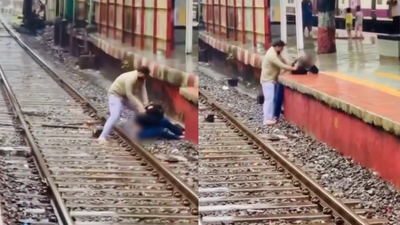
A disturbing video shows a man assaulting a woman on Dadar railway tracks

MUMBAI: A horrific viral video clip shows a man assaulting a woman on the railway tracks at Dadar railway station recently.Police said the two are yet to be identified and no case has been registered. Police are looking for the man.An official said that after the video was brought to the attention of the cops, they checked CCTV footage of the station.The man has been captured on camera taking the woman to a long-distance train, after the assault, and dropping her off.He then leaves the station. Police said it appears the two are acquainted.The viral video was filmed by a bystander but not a single commuter stepped forward to intervene, police said.The woman did not approach the cops with a complaint either.

One killed, 5 injured after speeding SUV crashes multiple vehicles and a bystander in Taloja | Mumbai News

One killed, 5 injured after speeding SUV crashes multiple vehicles and a bystander in Taloja

Navi Mumbai: A 32-year-old Scooty rider died on the spot, while five others were injured after an electric SUV being driven by a builder’s son rammed into the two-wheeler, a tempo and an autorickshaw, and then a wada pav stall about 12:30 pm on Tuesday at Taloja Phase-1, barely 200 metres from a police chowky in Sector 10. All vehicles were completely mangled in the fatal accident.The deceased Scooty rider was identified as Nadeem Khan, 32, a resident of Taloja Phase-1. He was declared brought dead at MGM Hospital, Kamothe, where the five injured persons are undergoing treatment.“A special team has been formed to trace the accused SUV driver, Arafat Patel, 22, a resident of Taloja village. The SUV is registered in his father’s name,” said police inspector (crime) Sagar Nikam. Patel was seen fleeing in the CCTV footage from the locality.The SUV came to a halt after crashing into a roadside wada pav stall, after which Patel fled. One man who was waiting outside the stall, Ramdulare Gupta, 37, a security guard from Taloja Phase 1, sustained minor burn injuries to his cheeks, neck and back when the vessel filled with oil to fry wadas fell on him.The other injured victims include Sharafuddin Ali, 43, from Sector 10 in Taloja employed in a metal refinery, who sustained severe bruises to his left leg; Sunny Nishad, 33, from Kalamboli, who sustained multiple injuries to his head, right shoulder and back; Vignesh Pansare, 17, a college student from Sector 10, Taloja, who fractured his leg; Mohammad Sheikh, 28, a tempo driver from Taloja village, who sustained minor injuries to his head and abdomen.

Water stocks in lakes supplying to Mumbai swell to 28.9%, up from 17% a day earlier | Mumbai News

Water stocks in lakes supplying to Mumbai swell to 28.9%, up from 17% a day earlier

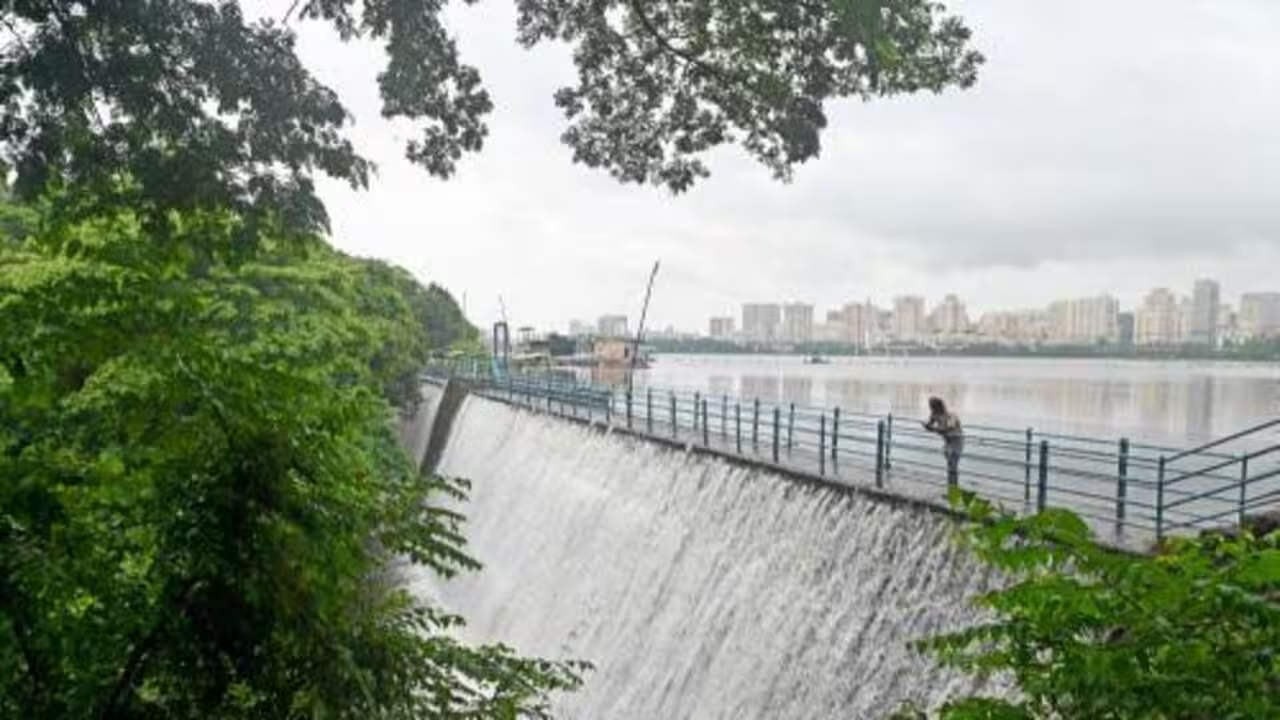
Mumbai: The ongoing wet spell has led to the single-biggest jump in water stocks this monsoon in the seven lakes that supply drinking water to Mumbai.As of 6 am on Tuesday, July 7, the total water stocks stood at 4.2 lakh million litres, or 28.9% of the lakes’ total live storage capacity. Just 24 hours earlier, the reserves were at 2.4 lakh million litres, or 17% of the total capacity.Between July 4 and 7, the cumulative water stock in the lakes rose nearly 20%. On July 1, the reservoirs were just 9.4% full. Within a week, the storage climbed to 28.9%, owing to heavy rainfall across the lakes’ catchment areas.Further on, data shows that between July 6 and 7, the rainfall recorded in all the seven lakes was in triple digits. For instance, Upper Vaitarna recorded 212 mm of rainfall, and Modak Sagar, Tansa and Middle Vaitarna 345 mm, 322 mm and 235 mm, respectively. Bhatsa Lake, from where Mumbai gets more than 50% of its daily water supply, recorded 172 mm of rain, while Vihar and Tulsi recorded 151 mm and 160 mm. While the water stocks in the lakes as on July 7 were at 28.9%, on the same date last year, these stood at 9.8 lakh million litres, or 67.9%, and in 2024 at 2.10 lakh million litres, or 14.5%.When asked whether the civic administration planned to roll back the 10% water cut currently imposed across the city, as well as other restrictions such as the suspension of water supply to construction sites and swimming pools and the 20% reduction in supply to industrial and commercial establishments, municipal commissioner Ashwini Bhide said there was no such immediate proposal.“We need the seven lakes to reach 100% storage by Sept 30 to ensure there is sufficient water for the city until the next monsoon. We will continue to wait and watch the water situation,” said the civic chief. Bhide added that every 1% of water stock is sufficient to meet the city’s demand for about three days, which means the current storage is enough to sustain Mumbai for roughly 87 days.

Water cut in Kalyan Dombivli for 48 hours | Mumbai News

Water cut in Kalyan Dombivli for 48 hours
The fresh announcement comes a day after KDMC had already imposed a 12-hour water shutdown

Kalyan: Thousands of residents in Kalyan East and Kalyan West are likely to face an extended water crisis after the Kalyan-Dombivli Municipal Corporation (KDMC) on Tuesday announced that water supply from the Barave Water Treatment Plant would remain suspended for nearly 48 hours due to damage to the main water pipeline laid on the Ulhas riverbed, reports Pradeep Gupta.According to the civic body, the pipeline was damaged after the water level in the Ulhas river rose sharply following continuous heavy rainfall. The damage has forced KDMC to stop water supply from the Barave Water Treatment Plant, affecting large parts of Kalyan East and Kalyan West.The civic administration said repair work has been taken up on a war footing but is expected to take around 48 hours to complete, depending on river conditions.The fresh announcement comes a day after KDMC had already imposed a 12-hour water shutdown. On Monday, the civic body had stated that the rising water level in the Ulhas river had caused silt and floating debris to accumulate in the strainers of pumps at the Mohane pumping station, reducing their efficiency. To carry out maintenance work, KDMC had suspended water supply to Kalyan East and West from Monday midnight until Tuesday afternoon.However, before normal supply could resume, the main pipeline in the Ulhas riverbed was damaged, prompting the civic body to extend the disruption by another 48 hours.The back-to-back shutdowns are expected to cause severe inconvenience to residents, many of whom had already been managing with limited water supplies over the past 12 hours. The civic body has appealed to citizens to use water judiciously and cooperate with the administration until repairs are completed and normal supply is restored.

No power, drinking water or mobile network for 40 hours in Vasai-Virar; flood-hit residents remain stranded | Mumbai News

No power, drinking water or mobile network for 40 hours in Vasai-Virar; flood-hit residents remain stranded

Vasai: Life remained crippled across flood-hit Vasai-Virar on Tuesday as several areas continued to remain without electricity for over 40 hours. With power supply snapped, residents have also been left without drinking water, mobile network and internet services. As floodwaters refuse to recede, concerns are now mounting over the outbreak of water-borne diseases.Large parts of the city remained waterlogged after two days of heavy rain. Houses, housing societies, shops and roads continued to remain inundated, severely affecting daily life.The worst-hit has been the power infrastructure. The Maharashtra State Electricity Distribution Company’s main substation at Suncity in Vasai (West) was submerged, while several transformers, feeder pillars and underground cables were inundated. Falling trees also damaged power lines in many areas, while a few transformers developed faults.As a safety measure to prevent electrocution, the power utility suspended electric supply in several localities. As a result, thousands of residents have been living without power for more than 40 hours.The prolonged outage affected mobile towers, disrupting network and internet connectivity. Employees working from home and students and traders dependent on online services have been among the worst affected.“We lost power at 6 am on Monday. Even by Tuesday evening, electricity had not been restored. Our inverter has drained completely and our mobile phones have run out of charge. Knee-deep water outside our house has left us stranded indoors,” said Dipali Bagul, a resident of Diwanman in Vasai.The power outage disrupted water supply as electric pumps were unable to lift water to overhead tanks in residential buildings. Several housing societies are now facing an acute shortage of drinking water.Flooded roads have affected the supply of essential commodities. Milk vans have been unable to reach several localities, resulting in shortages of milk, vegetables and other daily necessities.With stagnant water still remaining in several parts of the city, foul smell has started spreading across affected neighbourhoods. Residents fear an outbreak of water-borne diseases if the floodwaters do not recede soon.Suburban train services between Nalasopara and Virar continued to remain disrupted for the second consecutive day as water remained on the tracks. Several local trains were delayed and a few services were cancelled, causing severe inconvenience to thousands of commuters. The Vasai-Virar Municipal Corporation’s transport service was also badly affected, with only 16 buses operating across the city on Tuesday.

Customs foil bid to export drugs, 2 held in Mumbai | Mumbai News

Customs foil bid to export drugs, 2 held in Mumbai
Mumbai customs officials arrested Sreekant Sreedhan, a marketing manager, and a customs broker.

MUMBAI: The customs department arrested Sreekant Sreedhan, marketing manager of Supriya Lifescience ltd, and a customs broker for allegedly attempting to export 200 kg of Ketamine Hydrochloride, a psychotropic substance illegally to South Korea.Export of the substance requires a prior No Objection Certificate (NOC) from the Narcotics Commissioner under the NDPS Act, 1985.Ketamine hydrochloride is a controlled “psychotropic substance” under NDPS Act.Reacting to the situation, Supriya Lifescience issued an official statement stating that the company has manufactured and exported this regulated pharmaceutical ingredient for legitimate medical use for over three decades under a strict statutory framework.“The Company is extending its full cooperation to the investigating agencies, has initiated an internal review, and remains committed to complying with all applicable regulatory requirements. As the matter is under investigation, it would not be appropriate to comment further at this stage,” the statement read.

RTI activist Jeetendra Ghadge questions Maharashtra SIC order denying access to corruption sanction data | Mumbai News

RTI activist Jeetendra Ghadge questions Maharashtra SIC order denying access to corruption sanction data
RTI activist Jeetendra Ghadge criticized the decision, alleging it shields information on prosecution approvals (Photo credit: X)

MUMBAI: A recent order of the Maharashtra State Information Commission (SIC) upholding the Anti-Corruption Bureau’s (ACB) response to an RTI application seeking details of prosecution sanctions in corruption cases has triggered fresh debate over transparency in anti-corruption investigations.Mumbai-based RTI activist Jeetendra Ghadge, founder of The Young Whistleblowers Foundation, has criticised the order, alleging it effectively shields information on prosecution sanctions sought, granted, refused or pending under Section 17A of the Prevention of Corruption Act.The RTI application had sought statewide data from January 2020 on sanction proposals, decisions on those proposals, copies of sanction or rejection orders, and details of cases allegedly delayed for want of government approval.After hearing the matter, the SIC dismissed Ghadge’s appeal, accepting the ACB’s contention that the information sought was not maintained in the compiled format requested and that the information available with the public authority had already been provided.Ghadge has argued that the Commission should have examined whether the Public Information Officer was required under Sections 5(4) and 6(3) of the RTI Act to obtain records from other authorities or transfer the application to departments holding the information.He also contended that while compiled statistics may not exist, individual records such as sanction proposals, pending files and sanction or rejection orders could still be disclosed under the RTI Act.Section 17A of the Prevention of Corruption Act requires prior government approval before investigation against a public servant in specified circumstances, making the sanction process a key stage in corruption cases.“This was never about statistics alone. It was about finding out whether corruption complaints are being buried because prosecution sanctions are refused or indefinitely delayed. When the transparency watchdog refuses to enforce the RTI Act in such a matter, the public loses its only independent window into how anti-corruption laws are functioning,” Ghadge said.He further alleged that permitting public authorities to deny information on the ground that it is “not compiled” could weaken transparency and accountability under the RTI Act.The order was passed by State Information Commissioner Dr. Pradeep Vyas. Ghadge has also raised concerns over Vyas hearing the matter, noting that Vyas’s name had figured in the investigation into the Adarsh Housing Society scam. Public records show Vyas was arrested during the probe and later granted bail. The case remains pending before the courts, and there has been no final finding of guilt against him.Ghadge has appealed for wider public attention to the issue, saying access to information on prosecution sanctions is essential to independently assess whether corruption investigations are progressing or being delayed.The ACB’s position, as recorded by the Commission, is that the information sought is not maintained in the form requested and that all available information had already been furnished. Meanwhile, SIC Mumbai Dr Pradeep Vyas did not respond to the message regarding the same order when contacted.