
Assembly passes Bill making devotion to Ram mandatory for managing trustees of Ramtek’s temple | Mumbai News

Assembly passes Bill making devotion to Ram mandatory for managing trustees of Ramtek’s temple

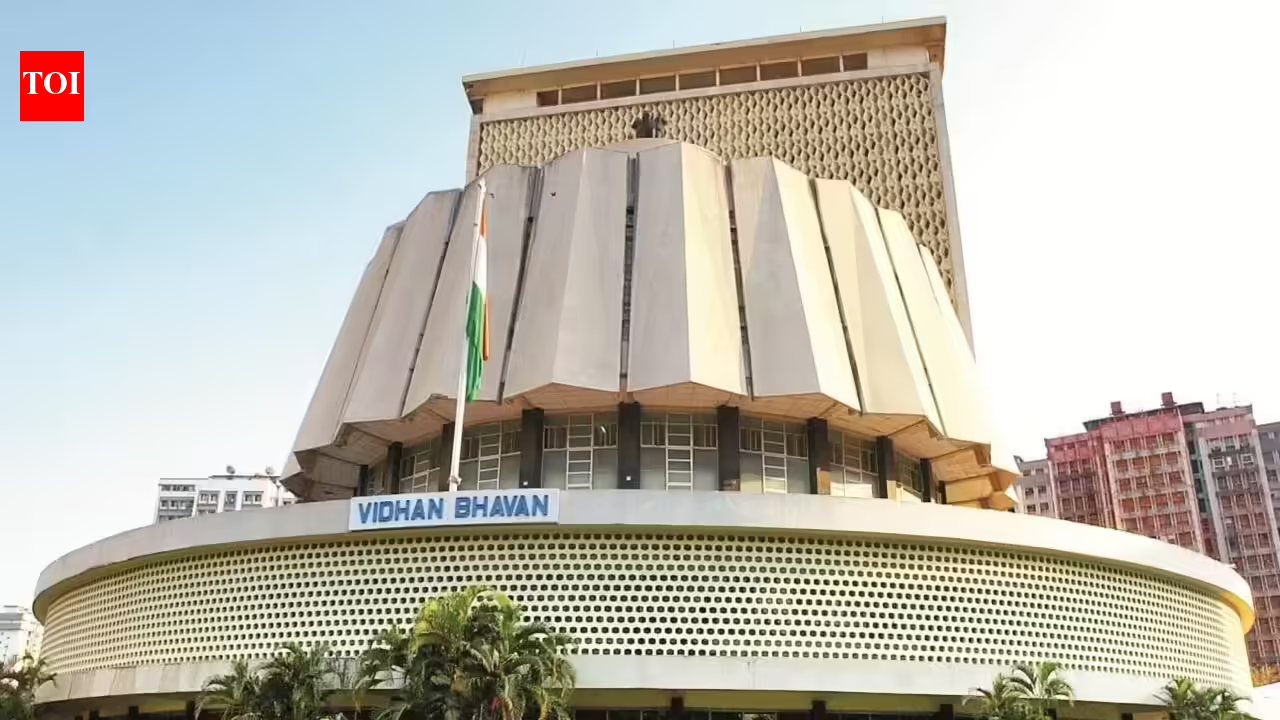
Mumbai: The state assembly on Friday passed a Bill to reconstitute a public trust to manage the Shree Ram Mandir Devasthan in Vidarbha’s Ramtek district which mandates that members of the trust committee should be devotees of Shree Ram of Ramtek and make a declaration to this effect in a form, prior to their appointment.This comes at a time when the Ram Janmabhoomi Trust in Ayodhya, which has been rocked by a donation theft controversy, has declared that while appointing a CEO, the devotion to Lord Ram will be a primary consideration.The clause in the Bill caused an outcry from the Opposition with NCP SP MLA Jayant Patil stating the Constitution forbade discrimination on the basis of religion and demanded that the Bill be referred to a joint select committee to be studied further. However, the Bill was passed within just half an hour.Shiv Sena (UBT) MLA Varun Sardesai asked, “Who will decide whether the committee member is really a devotee of Ram? Anyone can make such a declaration,” he said.The Bill states that the govt will form a committee of not more than 11 members to manage the trust. It says the MLA from Ramtek, currently the minister of state for finance Ashish Jaiswal who introduced the Bill in the assembly, will be an ex-officio member of the trust. Also, the president of the Ramtek Municipal Council will also be an ex-officio member. However, they will leave the trust once they demit office. One member of the committee has to be from the Bhosale family associated with the devasthan.Sardesai said Jaiswal introducing the bill was a conflict of interest. “Jaiswal is introducing the Bill and as per the bill, he will become a member of the trust committee by virtue of being the MLA of Ramtek. This is a clear conflict of interest,” he said.Several MLAs opposed the appointment of politicians to the committee. “There should be no political interference in the running of the temple. MLAs should not be appointed,” said Congress MLA Vijay Wadettiwar. “What if they divert funds to build a road in their constituency?” asked Jayant Patil.Wadettiwar also asked what measures had been taken to prevent donations being stolen as had happened in the temple at Ayodhya.Shiv Sena (UBT)’s Bhaskar Jadhav asked why the Bill was introduced on the last day of the 3-week monsoon session of the state assembly.Jaiswal said he was born on the day of Ram Navami and considered it the blessing of Lord Ram that he became the Ramtek MLA. “Most of the legislation to administer temple trusts in the state is along the same lines, whether it is the Shirdi or Siddhivinayak temples,” said Jaiswal.The Shree Ram Mandir Devasthan is located around 50 km from Nagpur. According to folklore, Lord Ram, Sita and Lakshman are said to have stayed there during their exile.

‘Hang me in front of temple’: Eknath Shinde alleges Siddhivinayak donation ‘loot’; ex-trust chief rejects charge, seeks probe | Mumbai News

'Hang me in front of temple': Eknath Shinde alleges Siddhivinayak donation 'loot'; ex-trust chief rejects charge, seeks probe
Eknath Shinde claimed those questioning the Ram Temple issue remained silent when the Siddhivinayak temple’s donation box was allegedly looted.

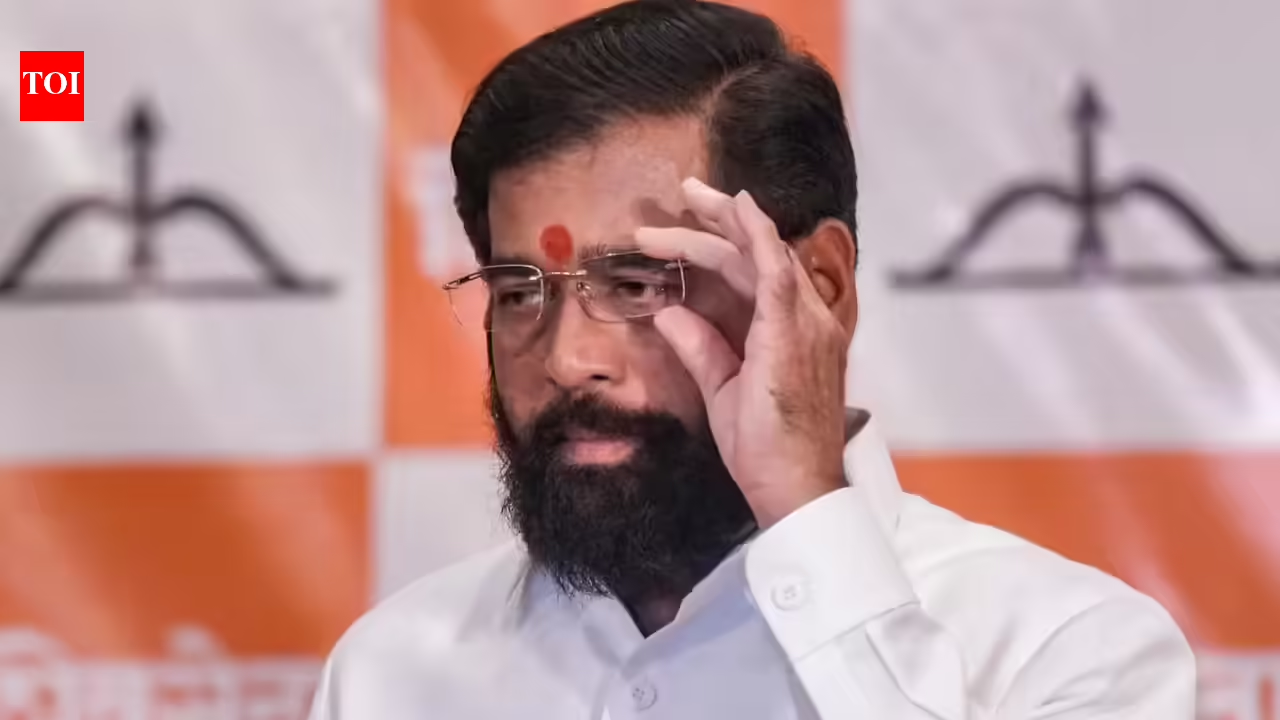
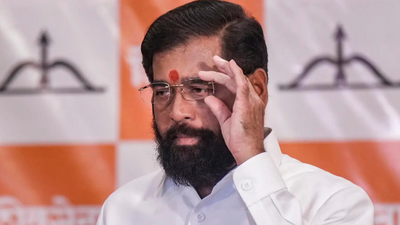
MUMBAI: Maharashtra deputy CM Eknath Shinde on Friday triggered a political row in the legislative council by alleging irregularities in the handling of donations at Mumbai’s Shri Siddhivinayak Temple during the previous Maha Vikas Aghadi regime, while countering opposition criticism over the alleged Ram Temple donation theft case.Without naming former Siddhivinayak Trust chairman Aadesh Bandekar, Shinde claimed those questioning the Ram Temple issue remained silent when the temple’s donation box was allegedly looted. Waving what he described as documentary evidence, he asked why no probe was ordered then.Responding later, Bandekar rejected the allegations, saying his tenure ended three years ago and that the temple’s executive and finance officers are appointed by the state government.He said any proven irregularity should be made public and investigated. “If I am found guilty, hang me in front of the temple. But don’t level false allegations,” Bandekar said, while demanding a fair inquiry into any alleged wrongdoing.A major controversy erupted in the first week of June after alleged irregularities were detected in the counting of donations at the Ram temple in Ayodhya.The Uttar Pradesh government constituted an SIT following the recommendation of the trust.The SIT found prima facie evidence of embezzlement, following which an FIR was registered and eight people associated with the temple’s donation-counting were arrested.

Speeding BEST bus rams into 14 vehicles in Mumbai’s Andheri, 2 injured | Mumbai News

Speeding BEST bus rams into 14 vehicles in Mumbai's Andheri, 2 injured
Fire brigade officials said in a statement that a man and a woman were injured.

MUMBAI: Two pedestrians — a female doctor, Sakshi (33), and Santalal Yadav (33) — suffered minor injuries after a wet lease BEST bus lost control and rammed into multiple vehicles at Amboli Naka in Andheri (West) on Friday. DN Nagar police records show the injury of the woman pedestrian, whose statement was recorded in the FIR registered against the BEST bus driver, Sahil Sawant (30). He was detained and booked for rash and negligent driving. Fire brigade officials said in a statement that a man and a woman were injured. BEST officials said at least six to eight people sustained minor injuries after the wet lease bus, which had started from Mateshwari and was heading towards Santacruz Bus Depot, lost control on SV Road at around 4.15 pm while taking a turn.“We have a woman pedestrian injury in the record. Rest may be minor injury who did not approach the police with a complaint so far. The driver has been detained in the case. Prima facie it seems that the driver lost control due to brake failure which will be known after the RTO inspect the accident reason,” said a police officer of the DN Nagar police station.In a statement, BEST officials said both the driver and the conductor were staff of Wet lease MUT. “The said bus was proceeding from Millat Nagar to Andheri Bus Station (West). While taking a right turn from Caesar Road to SV Road near Andheri Subway, the bus was out of control, and collided with 14 vehicles on the road. Bus was towed to Andheri West Bus Stn from accident place. Approximately six to eight persons sustained injuries in the accident,” the statement said.An official said a three-wheeler tempo, four private cars and nine auto rickshaws piled up and got damaged after the bus collided into it. The bus driver and bus conductor were taken to DN Nagar Police Station by the police for inquiry.Officials said it was a wet lease bus and the fifth such case of a driver losing control of a bus and hitting other vehicles in the past two years.

Ulhasnagar Municipal Corporation identifies Rs 170 crore in property tax linked to non-existent or wrongly recorded properties | Mumbai News

Ulhasnagar Municipal Corporation identifies Rs 170 crore in property tax linked to non-existent or wrongly recorded properties

Ulhasnagar: In a first-of-its-kind initiative to clean up its property tax database and improve revenue administration, the Ulhasnagar Municipal Corporation (UMC) has identified nearly Rs 170 crore in outstanding property tax linked to non-existent or wrongly recorded properties under ‘Project Manthan’, a data-cleaning exercise launched by municipal commissioner Manisha Awhale.The project, being implemented by the property tax department under the supervision of in charge Neelam Kadam, seeks to eliminate inaccuracies from municipal records, remove duplicate entries, identify ghost properties and bring unassessed properties into the tax net.The exercise has been divided into three phases. The first phase covers properties with tax dues exceeding Rs 5 lakh, the second targets dues between Rs 50,000 and Rs 5 lakh, while the final phase will cover dues ranging from Rs 5,000 to Rs 50,000. Officials said the survey began immediately after the March 31 property tax recovery season and was carried out entirely by UMC staff without hiring any external agency.During the first phase, civic officials identified 1,121 ghost properties with dues of Rs 116 crore, 114 duplicate property entries worth Rs 13 crore, 50 non-existent mobile tower assessments involving Rs 15.4 crore, and 163 demolished or collapsed properties that continued to reflect tax arrears of Rs 24.3 crore. Together, these categories accounted for nearly Rs 170 crore in unrealisable dues.Awhale said the objective of Project Manthan is not merely to delete incorrect records but to create a transparent and reliable property tax database. “A clean database will help us determine the corporation’s actual recoverable arrears, improve revenue planning and ensure that genuine taxpayers are not affected by inaccurate records,” she said.The civic body currently has recorded property tax arrears of Rs 996 crore, while its annual property tax collection stands at around Rs 112 crore. The identified ghost and duplicate properties will be placed before the Standing Committee for approval before being removed from the tax database.Property tax department in charge Neelam Kadam said the drive has also resulted in major administrative improvements. “For the first time, our own staff delivered property tax bills to nearly 1.5 lakh property holders, covering 82.29% of assessed properties. This saved the corporation around Rs 35 lakh and enabled us to update the addresses and mobile numbers of nearly 80% of property owners,” she said.Kadam added that the updated database will eventually allow UMC to send property tax bills through WhatsApp with digital payment links. Simultaneously, the department is verifying occupancy certificates issued by the town planning department to identify unassessed properties and bring them into the tax net, thereby strengthening the civic body’s future revenue base.

‘Just a casual interaction’: Supriya Sule moves to calm MVA tensions after Sharad Pawar’s surprise meeting with Eknath Shinde | Mumbai News

'Just a casual interaction': Supriya Sule moves to calm MVA tensions after Sharad Pawar's surprise meeting with Eknath Shinde
Supriya Sule referred to Sharad Pawar’s encounter with Eknath Shinde as an informal chat, suggesting that the media had exaggerated the situation

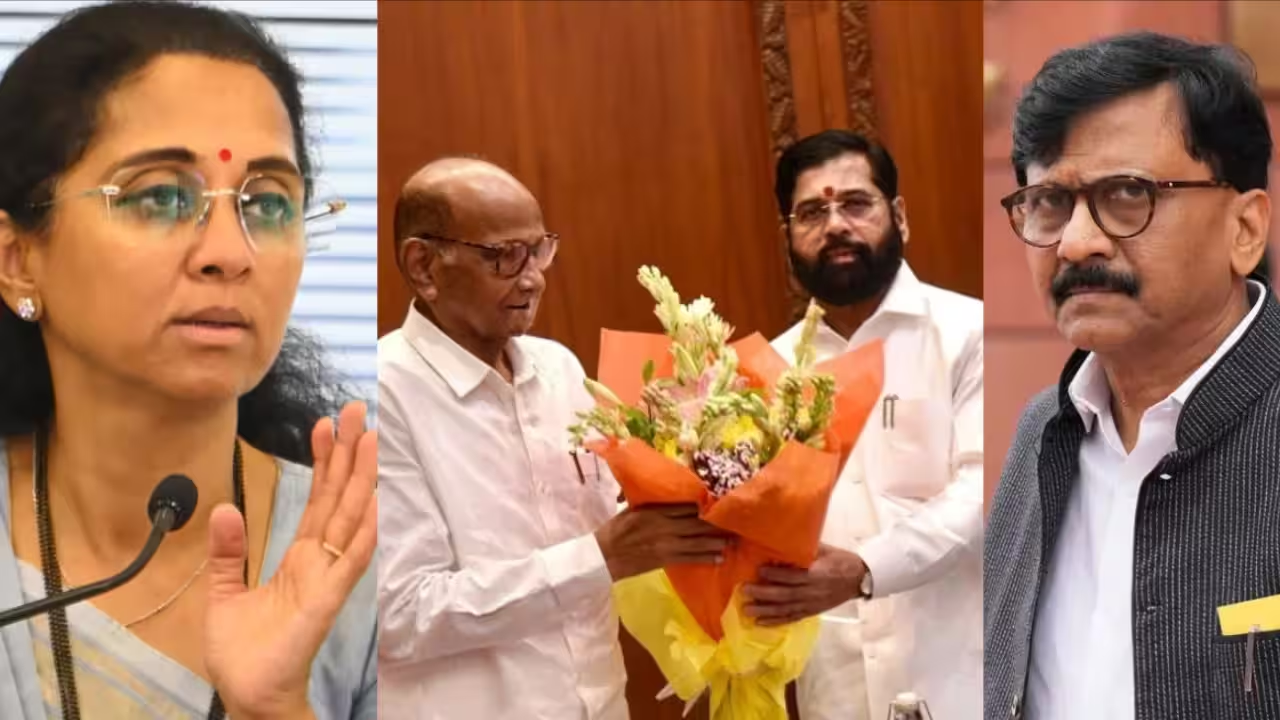
MUMBAI: Nationalist Congress Party (SP) MP Supriya Sule on Thursday sought to play down the controversy over party chief Sharad Pawar holding party in Maharashtra deputy chief minister Eknath Shinde‘s office at the Vidhan Bhavan, asserting that it was merely a “casual interaction” and “not a political development.”Her remarks came a day after Shiv Sena (UBT) MP Sanjay Raut strongly criticised Pawar’s visit, saying it had hurt party workers and amounted to the “glorification of traitors.”However, Sule dismissed suggestions that Pawar’s meeting with Shinde carried any political significance.“There was no meeting here. Pawar saheb went to Vidhan Bhavan and while he was coming back, in one of the cabins, where amdar of the Nationalist Congress Party (were present), they both got together and discussed their work. Then Pawar saheb sat in his car and left.”Sule said the incident had been blown out of proportion and insisted there was nothing unusual about it.“We don’t even know whether it happened or not. We didn’t give it much importance because he was sitting somewhere for a meeting. He went to Shinde saheb’s office. Shinde saheb spoke a few words to Pawar saheb and then he returned to his cabin. This happened in a very casual manner,” she said.Seeking to defuse tensions within the opposition Maha Vikas Aghadi (MVA), Sule said she had personally spoken to Raut after his remarks.Sule further maintained that interactions between senior political leaders holding constitutional positions should not be viewed with suspicion.“Meeting constitutional functionaries is normal, there was nothing unusual about it,” she said.The controversy erupted after Sharad Pawar visited Shinde’s chamber at the Vidhan Bhavan on Wednesday after attending a meeting on the Maharashtra-Karnataka border dispute. During the visit, Pawar also interacted with MLAs of his party inside Shinde’s office.The development drew sharp criticism from Shiv Sena (UBT) leader Sanjay Raut, who on Thursday reiterated that his party had been “upset” by the meeting because it involved Eknath Shinde, whom the Sena (UBT) considers responsible for splitting the party and bringing down the Uddhav Thackeray-led government in 2022.“We were upset yesterday, but we are not upset today. Pawar saheb is our supreme leader and a leader of the Maha Vikas Aghadi. Yesterday, we only expressed our feelings,” Raut said.He, however, maintained that Shinde was “the biggest traitor” and said leaders should not accord respect to those who betray political parties.Senior Congress leader and former CM Prithviraj Chavan also weighed in on the controversy, saying it was natural for Shiv Sena (UBT) workers to feel hurt given Shinde’s role in the party split. However, he added that there was nothing wrong with political rivals maintaining cordial personal relations outside the political arena.(With agency inputs)

West Asia conflict revives focus on home-grown fuel: ICT research points to energy from farm waste | Mumbai News

West Asia conflict revives focus on home-grown fuel: ICT research points to energy from farm waste
Indian researchers are developing technology to convert farm waste into valuable fuel

MUMBAI: The recent conflict in West Asia, which rattled global energy markets and renewed concerns over the security of oil supplies through the Strait of Hormuz, has once again highlighted India’s dependence on imported crude.While oil prices have eased after the end of the conflict, the episode has reinforced a larger question: can India insulate itself from future geopolitical shocks?One answer, according to researchers at Mumbai’s Institute of Chemical Technology, may lie not beneath the ground but in the country’s vast quantities of agricultural waste.Leading the effort is Prof. Jyeshtharaj Bhalchandra Joshi, whose team has spent years developing technology that converts crop residue into fuel gas, bio-oil and biochar — potentially addressing energy security, air pollution and farm incomes simultaneously.India produces an estimated 600 million tonnes of agricultural residue every yearA significant portion is burnt in fields, particularly in northern states, contributing to severe winter air pollution.Prof. Joshi argues that instead of treating the residue as waste, it can become a valuable source of clean energy.The technology relies on thermochemical conversion of biomass in an oxygen-controlled environment.As the material is heated, it releases combustible gases and bio-oil while leaving behind biochar, a carbon-rich material that can improve soil quality.Researchers say biochar has shown promising results in field trials.Experiments led by researcher Rohan Oak in the Sangli-Miraj region reportedly recorded soybean yield improvements ranging from 20% to 85%, while later studies indicated even higher gains under suitable conditions.Higher soybean production could also reduce India’s dependence on imported edible oils.The energy potential is equally significant. According to the research team, decentralised biomass processing plants could convert locally available agricultural residue into cooking fuel, electricity and industrial fuel.A processing unit serving a roughly seven-kilometre-by-seven-kilometre agricultural zone could utilise around 50,000 tonnes of annual biomass, enough to supply cooking gas for nearly 5,000 people while generating surplus energy for industry or power generation.To make the technology adaptable across India’s diverse agro-climatic regions, ICT researchers analysed biomass samples collected from across the country.Artificial intelligence was used alongside experimental data to predict conversion efficiencies for different crop residues, allowing plants to be designed for local feedstock.The research has progressed from laboratory-scale experiments to pilot plants. A 10-kg-per-hour unit was first developed and later installed in Jaipur under the guidance of Prof. Abhishek SharmaThis was followed by a 40-kg-per-hour plant, while Pune-based MITCON has commissioned a 200-kg-per-hour facility.The collaborative project also involves Prof. Vaidya, Prof. Manish Yadav of ICT and Prof. Sharma of BITS Goa.Another important breakthrough emerged during refinery trials. Researchers found that bio-oil could be blended with conventional crude oil and processed successfully at lower concentrations.Initial tests reportedly demonstrated satisfactory refining with 5% and 10% bio-oil blends.Challenges encountered at higher blending levels were addressed by introducing waste plastic into the feedstock, improving refining performance while also offering a productive use for plastic waste.The project has attracted support from government agencies. According to the researchers, the Maharashtra government, through the Rajiv Gandhi Science and Technology Commission, has committed financial assistance for scaling up the technology, while additional support is expected from the Centre for a larger demonstration plant in Gadchiroli, where bamboo biomass is abundantly available.Beyond energy security, the researchers see multiple gains: reducing stubble burning, lowering air pollution, improving soil fertility, generating additional income for farmers and cutting India’s import bill for fossil fuels and edible oils.Prof. Joshi is no stranger to indigenous innovation. Working with scientists from the Bhabha Atomic Research Centre, he earlier contributed to the development of lighter and more affordable indigenous bulletproof jackets, reducing dependence on imports.While the biomass technology still requires large-scale commercial deployment and further validation, the recent volatility in global oil markets has lent renewed urgency to such home-grown alternatives.For a country that has previously transformed agriculture, dairy production, telecommunications and space technology through sustained policy support, researchers believe converting farm waste into fuel could become India’s next major self-reliance story.

Mumbai’s redevelopment boom can become a ‘materials mine’, not a debris crisis | Mumbai News

Mumbai's redevelopment boom can become a 'materials mine', not a debris crisis
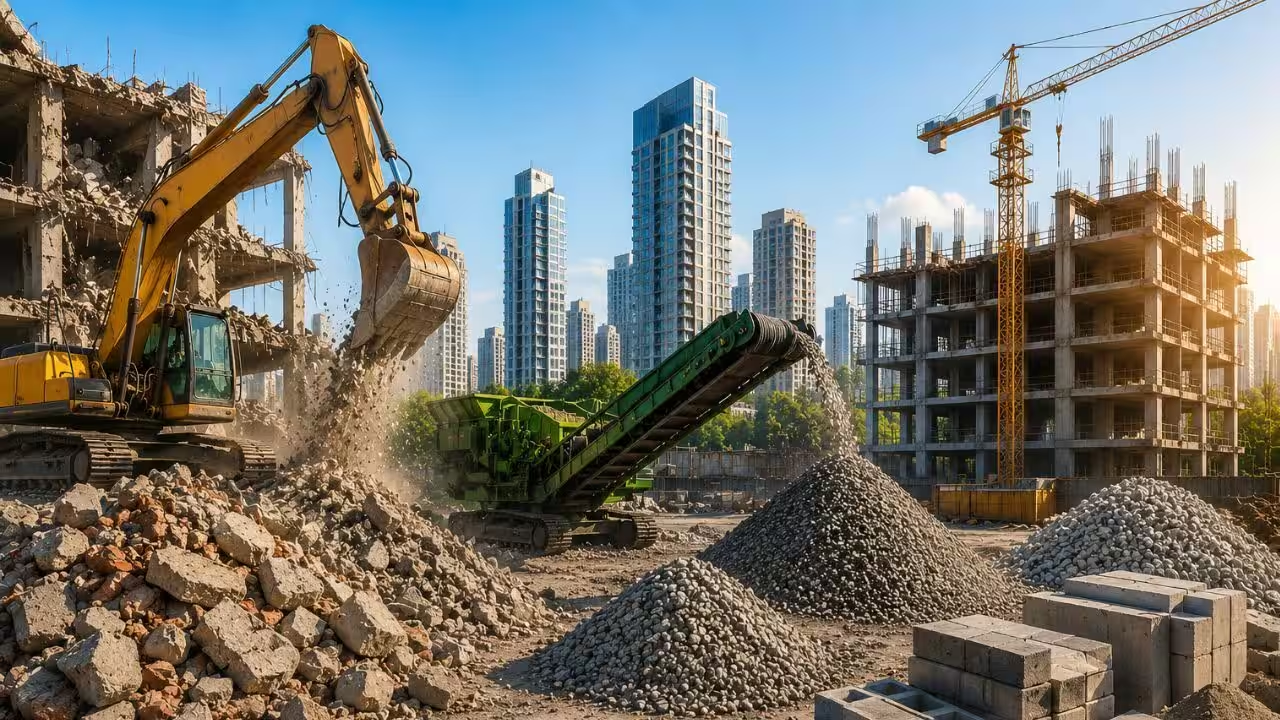
Mumbai’s extensive redevelopment drive presents a significant opportunity for waste material reuse (Representative image).

MUMBAI: Every old building pulled down for redevelopment creates mountains of debris. For a city witnessing one of the country’s biggest redevelopment drives across ageing housing societies, MHADA colonies, cessed buildings and infrastructure projects, experts say the real opportunity lies not in disposing of this waste, but in treating it as a valuable raw material for the next phase of construction.Architect and interior designer Moayyed Fatehi argues that construction and demolition (C&D) waste should be viewed as an “urban mine” capable of supplying recycled materials for new buildings, roads and public infrastructure. With landfill space shrinking and environmental concerns rising, he says recycling building waste can become a crucial pillar of sustainable urban development.The building sector is among the largest consumers of natural resources and one of the biggest generators of inorganic waste. Fatehi estimates that nearly 70-80% of construction waste can be repurposed if it is properly segregated and processed, reducing dependence on virgin materials while lowering the environmental impact of redevelopment.The principle, he says, extends beyond the familiar “Reduce, Reuse and Recycle”. It requires designing a circular economy in which materials from demolished buildings return to the construction cycle instead of ending up in landfills.Proper segregation at source is critical. Organic, biodegradable, inorganic and hazardous waste must be separated before recycling begins, making recovery of usable materials more efficient and preventing contamination.Concrete from demolished buildings can be crushed into recycled aggregates for structural fills, utility backfilling and road construction. Broken brick masonry can be reused in waterproofing beds, landscaping or processed into material for manufacturing fresh bricks.Metals offer even greater potential. Structural steel, reinforcement bars, copper wiring and aluminium can be recovered, melted and recycled without losing their engineering properties, reducing both mining pressure and manufacturing emissions.Wood waste, another significant component of demolition debris, can be converted into medium-density fibreboards, particle boards and wood-cement composite panels used in interior and exterior applications. Discarded ceramic tiles can also find a second life as decorative china mosaic flooring.Fatehi notes that while some construction debris is suitable for reclamation works, hazardous materials such as lead-based products, certain plastics and chemically contaminated waste require separate handling because of their environmental risks.He also points to emerging technologies that could expand the use of recycled materials. Digital design tools and specialised computer software now make it possible to incorporate recycled building components into new construction while maintaining structural performance and design flexibility.As Mumbai pursues large-scale redevelopment and infrastructure expansion, the challenge is no longer merely managing debris but ensuring that valuable construction materials remain within the economy instead of becoming waste. Experts say such a shift can reduce pressure on landfills, conserve finite natural resources and support lower-carbon urban growth.For a city rebuilding itself at an unprecedented pace, the next generation of buildings may increasingly rise from the materials of those they replace—turning demolition into the first step of sustainable construction rather than the last stage of a building’s life.Ends

Raj Thackeray asks CM Devendra Fadnavis: How is Maharashtra insulted when Missing Link is criticised? | Mumbai News

Raj Thackeray asks CM Devendra Fadnavis: How is Maharashtra insulted when Missing Link is criticised?

MUMBAI: Maharashtra Navnirman Sena (MNS) president Raj Thackeray on Thursday took aim at chief minister Devendra Fadnavis, questioning why raising concerns over the quality of infrastructure projects such as the Missing Link is being portrayed as an insult to Maharashtra.Speaking at an event organised by the MNS Rail Sena, the party’s railway union, Thackeray also questioned why seeking accountability and asking questions about infrastructure projects is being labelled as politics.“What were you (BJP) doing when others were in power? How is anyone insulting Maharashtra when they talk of the Missing Link? Castigating the government does not mean criticising Maharashtra….If you say anything against the Centre, then it is (dubbed as) anti-national,” Thackeray said.Thackeray alleged that the BJP had initiated the trend of targeting its political opponents on online platforms, but said the strategy was now backfiring on the party.His remarks came after the newly inaugurated Missing Link section of the Mumbai-Pune Expressway was briefly closed earlier this week following a landslide near one of its tunnels. The incident drew criticism of the BJP-led Maharashtra government over the quality and safety of the infrastructure project.Replying to a discussion in the Maharashtra Assembly on Wednesday, Devendra Fadnavis accused critics of the Missing Link project of spreading misinformation through television and social media, alleging that hired trolls were being used to defame the state. He warned that those tarnishing Maharashtra’s image by circulating false information would face action.Responding to the remarks, MNS chief Raj Thackeray claimed that contractors executing government projects were allegedly forced to pay a 54% commission.Thackeray also criticised the BJP over the alleged donation theft at the Ram temple in Ayodhya, saying that questioning the alleged irregularities did not amount to insulting the religion. He claimed that 12 of the temple’s 15 trustees were appointed by the Centre and were associated with the RSS, VHP and BJP.He further asked how the BJP would have reacted had a different party been in power when the alleged theft came to light.(Witrh agency inputs)

Private member’s bill proposes amendment to MHADA law to revive redevelopment of 13,000 old buildings | Mumbai News

Private member's bill proposes amendment to MHADA law to revive redevelopment of 13,000 old buildings

MUMBAI: In a move that could revive the long-stalled redevelopment of more than 13,000 old and dilapidated cessed buildings in Mumbai, a private member’s Bill has proposed an amendment to the MHADA Act to remove the legal ambiguity that led the Bombay High Court to stay the implementation of Section 79A.The Bill, recently introduced in the Assembly by legislator Ajay Choudhari, proposes authorising officers empowered by the Maharashtra Housing and Area Development Authority (MHADA) to exercise powers under Section 79A. If the state government introduces a similar Bill, it would replace the earlier reference to a “competent authority”, which became the focal point of the legal challenge.The proposed amendment is significant for lakhs of tenants living in ageing buildings, many of them built before 1940, whose redevelopment has remained stalled for years due to landlord-tenant disputes, prolonged litigation and the reluctance of some property owners to redevelop unsafe structures.Nearly a year ago, the Bombay High Court stayed around 935 notices issued by MHADA under Section 79A, observing that the powers may have been exercised without proper legal authority. The matter is currently pending before the Supreme Court.Sections 79A and 79B were inserted into the MHADA Act in 2020 following a series of fatal building collapses in Mumbai, including the Husaini Building collapse in 2017, the Dongri collapse in 2019 and the Fort building collapse in 2020. The provisions empowered MHADA to step in when landlords failed to redevelop dangerous buildings and allowed tenants, subject to majority consent, to undertake redevelopment themselves.The urgency of speeding up redevelopment is underscored by official figures. According to RTI information obtained by activist Jeetendra Ghadge, Mumbai recorded 345 incidents of full or partial building collapses between 2021 and August 2025, resulting in eight deaths and 28 injuries. MHADA records also show that 815 people died in building collapses between 1970 and 2018.Welcoming the amendment, Ghadge, founder of The Young Whistleblowers Foundation, said the government could remove the ambiguity that has stalled the implementation of Section 79A by acting on the Bill. He also expressed hope that the Supreme Court would eventually allow the scheme to be implemented, paving the way for the redevelopment of dangerous buildings.Legal experts said the proposed amendment, if taken up by the government, is intended to strengthen the state’s position before the Supreme Court by clearly identifying the authority empowered to issue directions under Section 79A. However, implementation of the redevelopment mechanism will remain subject to the outcome of the pending proceedings before the apex court.If the proposed amendment survives judicial scrutiny after being introduced by the state government, it could pave the way for one of Mumbai’s biggest redevelopment initiatives, offering a fresh opportunity to redevelop thousands of ageing buildings and improve safety for lakhs of residents living under the city’s traditional pagdi tenancy system.

How 13,000-crore flood plan aims to turn Mumbai into a ‘sponge city’ | Mumbai News

How 13,000-crore flood plan aims to turn Mumbai into a 'sponge city'
Mumbai plans a Rs 13,000-crore flood mitigation master plan for chronic flooding issues.

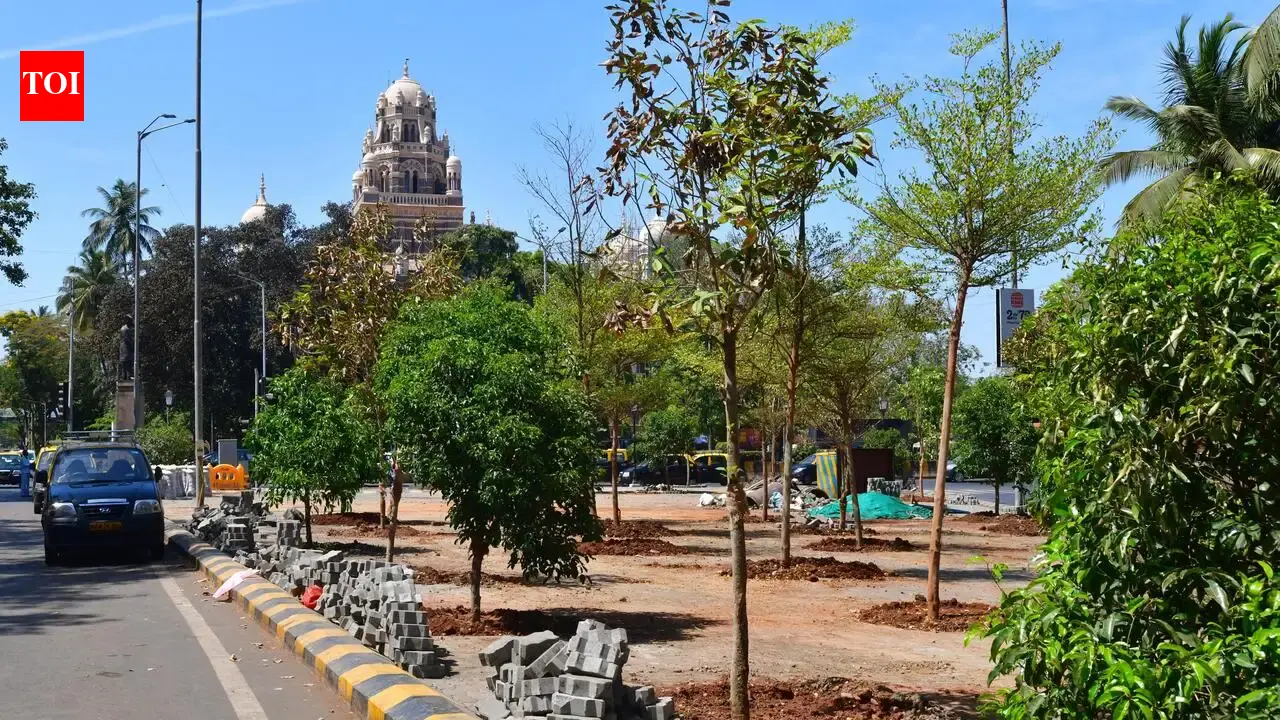
MUMBAI: The Rs 13,000-crore integrated flood mitigation master plan announced by chief minister Devendra Fadnavis during the ongoing Assembly session on Wednesday combines conventional drainage upgrades with nature-based solutions to tackle Mumbai’s chronic flooding, particularly in low-lying areas.BMC officials said the proposal has been submitted to the Centre and the National Disaster Management Authority (NDMA), which has granted it in-principle approval. A detailed project report (DPR) is now being prepared following multiple rounds of consultations with the NDMA.Comparable in scale to the Rs 13,984-crore Coastal Road project, the flood mitigation plan will be funded with 40% from the National Disaster Response Fund, 30% from the Maharashtra government and the remaining 30% from the BMC.The blueprint has been in the works for over a year. The first NDMA meeting was held on March 12, 2025, followed by site visits and a presentation to Union home minister Amit Shah in June, after which the proposal received in-principle clearance.“The plan proposes a mix of engineering and ecological interventions, with exact locations to be finalised through the DPR. Key measures include upgrading storm-water drains to handle rainfall exceeding 55 mm per hour in vulnerable stretches and at locations where multiple nullahs discharge into a single drain, expanding pumping capacity in flood-prone areas such as Mahul and Mogra, and taking up the next phase of the Mithi river improvement project. Nature-based interventions include detention-infiltration tanks, bio-retention parks, sponge parks and permeable pavements to reduce surface runoff and improve groundwater recharge,” said additional municipal commissioner Abhijit Bangar.The plan goes beyond conventional flood-control measures by introducing nature-based interventions designed to reduce surface runoff and increase groundwater recharge. Officials said permeable pavements are being considered as they can absorb 12-15% of rainwater that would otherwise contribute to waterlogging while also benefiting trees planted along footpaths.

..

..

Detention-infiltration tanks — underground honeycomb-like structures — will temporarily store rainwater before allowing it to gradually percolate into the ground. The proposal also seeks to address one of the biggest impediments to efficient drainage — plastic waste clogging nullahs and culverts. Officials said interception systems and longitudinal nets are being planned at strategic locations to trap floating garbage before it blocks storm-water channels.Authorities acknowledged there is “no magic wand” to eliminate flooding in Mumbai, but said a series of targeted interventions, backed by scientific modelling and upgraded drainage infrastructure, could substantially reduce the frequency and severity of waterlogging.