Another rain tragedy in Mumbai: 63-year-old man dies after tree collapses | Mumbai News

Another rain tragedy in Mumbai: 63-year-old man dies after tree collapses
This marks the city’s second fatal tree-fall incident in under a week, following a similar tragedy in Chembur.

MUMBAI: A 63-year-old man died after a tree collapsed on a shop near BMC Hindi school, Gomes Gown Building, Naupada, Kamini Kurla (West) on Sunday amid heavy rainfall. This marked the city’s second fatal tree-fall incident in less than a week.The deceased, Yunus Kundawala, a resident of Bandra, was about to open his rented shop selling electrical accessories near Kurla Kamani when a tree branch fell on him at around 10.30 am.He was rushed to Fauzia Hospital, where doctors declared him brought dead.Personnel from the fire brigade, Mumbai Police, BEST and the Brihanmumbai Municipal Corporation (BMC) reached the spot and carried out rescue and clearance operations.The incident comes days after an 11-year-old boy, Vihan Srivastav, was killed and several others were injured when a tree uprooted and fell on a moving school bus in Chembur on June 30.(With inputs from PTI)

Bombay high court penalizes Kalyan college for student admission lapse; Rs 1 lakh costs imposed for negligence in eligibility notification | Mumbai News

Bombay high court penalizes Kalyan college for student admission lapse; Rs 1 lakh costs imposed for negligence in eligibility notification
Bombay high court slapped a Rs 1 lakh penalty on a Kalyan college for admitting a student to a BMS course despite his ineligibility and then informing him late (Representative image)

MUMBAI: Bombay high court has imposed costs of Rs 1 lakh on a college for belatedly informing a student last February, of his ineligibility to a BMS course he was admitted to in 2022, and denying him permission for final semester examination.The college said he was ineligible as he hadn’t cleared the HSC exam in the first attempt, as required. The cost must be paid in 2 week to the Mumbai University and its Examination Board, Justices RI Chagla and Farhan Dubash held in their July 1 order available on Friday.Mehul Ghavari, the student had last year petitioned the HC to challenge the denial of permission by the college to appear for the sixth semester.The college, Seth Hirachand Mutha College in Kalyan is “entirely to blame” and “student should not be made to suffer,’’ since the college was aware of his ineligibility in December 2022, yet allowed him to continue, said the HC.Mumbai University’s counsel Rui Rodrigues informed the HC that in December 2022 itself following scrutiny the college was informed that the students was amongst two, found to be ineligible.In March the HC had directed the college to comply with its December 2025 order permitting the student, represented by advocate Atharva Dandekar, to fill the exam form and now the student wanted his results.Advocate Sumit Kothari for the college submitted its affidavit dated June 29 which said the Covid-19 pandemic led to remote working, communication challenges, staff shortage and the unprecedented circumstances led to the “oversight in admission’’ to the Bachelor of Management Studies. It was “a human error’’, sans malafides.Rodrigues citing a July 2025 HC order against the same college for a similar oversight in the same course, in 2021-22, where while granting relief to that student, who cleared HSC in his third attempt– said, court imposts costs of Rs 50,000. The HC had directed the college to scrupulously follow the rules on eligibility. This was the second instance and heavy costs be imposed on college, Rodrigues argued.The HC, agreeing with MU counsel, said the college had committed lapse earlier too in student admission for the same course. “The Petitioner should not be made to suffer at the hands of the College,’’ the HC said and directing the results be given to the petitioner in a week, sought an undertaking from the college to not commit such lapses of granting admission to similarly placed students, in the future.

IIT Bombay scientists develop placenta-on-chip to aid foetal research | Mumbai News

IIT Bombay scientists develop placenta-on-chip to aid foetal research
Researchers from IIT Bombay and the ICMR-National Institute for Research on Women’s Health (NIRWoH) have developed an indigenous placenta-on-chip platform that mimics the human placenta in the laboratory.

MUMBAI: In a breakthrough that could make medicines safer for pregnant women while reducing animal testing, researchers from IIT Bombay and the ICMR-National Institute for Research on Women’s Health (NIRWoH) have developed an indigenous placenta-on-chip platform that mimics the human placenta in the laboratory.The placenta is a temporary organ that develops during pregnancy and serves as an interface between mother and baby. It regulates the exchange of nutrients, oxygen, hormones, drugs and waste products while protecting the developing foetus.However, due to ethical and practical limitations, direct investigation of placental function during pregnancy remains extremely difficult.The new device allows scientists to study how medicines, nutrients and waste products move between the mother and foetus.

Major leap

Major leap

The study, published in the journal Biofabrication, describes a compact two-chamber device containing human placental and blood vessel cells grown on opposite sides of a porous membrane.The model successfully reproduced placental functions, including hormone secretion, nutrient transport, waste exchange and selective barrier function.Unlike many existing organ-on-chip systems that require complex equipment, the Indian platform uses a simpler design that is easier to manufacture and operate.“Many organ-on-chip systems are powerful but often require specialised infrastructure. We wanted to develop a robust platform that could be adopted more broadly by research laboratories,” said IIT Bombay’s Prof Abhijit Majumder, co-corresponding author of the study.The system’s biological validation was led by researchers at ICMR-NIRWoH’s Prof Deepak Modi, who said such human-relevant models are increasingly important for understanding disease biology and evaluating therapeutic safety.“By combining engineering and reproductive biology, we have created a platform that can help bridge this gap and advance research,” he said.

Heavy rain batters Mumbai: Intense showers bring 80% of city’s July average rainfall in just 4 days; IMD issues ‘red’ alert | Mumbai News

Heavy rain batters Mumbai: Intense showers bring 80% of city's July average rainfall in just 4 days; IMD issues 'red' alert
Mumbai is experiencing relentless heavy rainfall, with the city receiving a significant portion of its average July rainfall in just four days

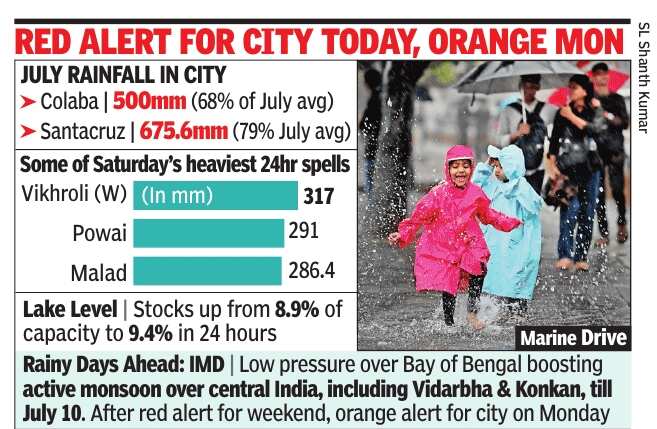
MUMBAI: Heavy rain continued lashing the Mumbai region Saturday with the city receiving nearly 80% of its average July rainfall in just 4 days. Since July 1, the IMD’s Santacruz observatory has recorded 675. 6mm of rain while Colaba got 500mm, taking the city’s cumulative monsoon rainfall past the 1,000mm mark within 12 days of the monsoon’s arrival (see box) .IMD has retained a red alert for Mumbai, Thane and Palghar for Sunday, and issued an orange alert for Monday.

Red alert for city today

Red alert for city today

Two deaths were reported when youths ventured to the barred and dangerous Pandavkada falls in Navi Mumbai’s Kharghar. Elsewhere, the heavy rains led to water-logging and several cases of rainrelated injuries. Children were able to stay home, as following in the footsteps of Palghar, Thane and Navi Mumbai, BMC declared a holiday for schools and colleges for the second session on Saturday.In Bhandup (W), a stretch of LBS Marg opposite Asian Paints caved in, causing trees at the site to collapse. BMC got 103 complaints of fallen trees and branches, including 21 from the island city, with one within CCI Club, 26 from the eastern suburbs, and 56 from the western suburbs.

Music was my first love long before acting: Padmini Kolhapure | Mumbai News

Music was my first love long before acting: Padmini Kolhapure
Padmini Kolhapure returns to the stage as a vocalist for Hema Malini’s Diamond Jubilee Concert, celebrating a six-decade cinematic legacy. Reflecting on her own 50-year acting career, Kolhapure emphasizes music’s personal significance and the irreplaceable magic of live performance.

Padmini Kolhapure is set to return to the stage as a vocalist at Hema Malini’s Diamond Jubilee Concert on July 10. As she prepares to celebrate the Dream Girl’s six-decade journey in cinema, Padmini, whose acting career has spanned 50 years, reflects on her enduring bond with music, the changing face of the entertainment industry, and the importance of continually reinventing oneself. BACK TO WHERE IT ALL BEGAN Though she became one of Hindi cinema’s most beloved actresses, Padmini says music has always occupied a special place in her heart. “Music was my first love long before acting happened,” she says. “Singing has always been deeply personal because it comes directly from the soul. Acting allows you to portray different characters, but music allows you to express your own emotions.” For Padmini, performing at Hema Malini’s Diamond Jubilee Concert carries both personal and emotional significance. She believes the concert, conceived under RJ Anirudh Chawla’s Legends Ki Kahani, Legends Ki Zubaani format, will be a fitting tribute to Malini’s extraordinary six-decade legacy. THE IRREPLACEABLE MAGIC OF LIVE PERFORMANCE Having recently returned to the stage through theatre, Padmini says live performance offers a thrill that cinema cannot replicate. “In films, you have retakes and editing. On stage, there are no second chances,” she says. “The audience is right there with you, sharing every emotion in real time.” While digital platforms dominate entertainment today, Padmini remains encouraged by audiences’ continued appetite for live storytelling. “Theatre reminded me that genuine human connection will never go out of fashion,” she says, adding that performing live prepares an artiste for special evenings where emotions, memories and music converge before an audience. STARDOM MAY EVOLVE, BUT LONGEVITY REMAINS UNCHANGED As she reflects on Hema Malini’s enduring appeal, Padmini notes how the nature of stardom has evolved in the age of social media. “In our time, there was a certain mystery associated with stars. Audiences connected with us primarily through our work,” she says. “Today, social media has made artistes far more accessible.” Yet she believes the fundamentals of a lasting career remain unchanged. “Longevity still comes from talent, discipline, hard work and the ability to connect with audiences over time,” she says, pointing to Malini as a perfect example of an artiste whose contribution continues to inspire admiration decades later. HAS THE INDUSTRY LOST SOMETHING ALONG THE WAY? Asked whether the industry has lost patience in craft, respect for senior artistes or emotional depth in storytelling, Padmini prefers to see it as a shift rather than a decline. “The pace of life today is much faster and entertainment reflects that reality,” she says. “Earlier, there was more time for nurturing stories, music and performances.” She acknowledges that songs and films from earlier decades often enjoyed a deeper emotional rhythm, but maintains that every generation develops its own creative language. “I still believe that good storytelling, meaningful music and genuine talent will always find an audience. The mediums may change, but the power of emotion remains timeless.” REINVENTING WITH AGE AND EXPERIENCE Over the years, Padmini has moved seamlessly between films, music, television and theatre. While many actresses from her generation have spoken about being sidelined with age, she says she chose to focus on growth rather than relevance. “Every artiste faces phases of transition. As women, we have often had to redefine ourselves and seek meaningful opportunities beyond conventional roles,” she says. Instead of resisting change, she embraced it. “Creativity has no age limit. Whether through acting, music, television or stage performances, I embraced every new opportunity with gratitude.” Today, she says, experience has brought a different kind of fulfilment. “I feel more confident and comfortable in my own skin than ever before. The love and support I continue to receive from audiences have been my greatest strength.” As she takes the stage once again on July 10, Padmini sees the evening not only as a tribute to Hema Malini but also as a celebration of artistic longevity, reinvention and the enduring power of music.

Two habitual offenders with 11 past cases held for Rs 15 lakh house burglary by Navi Mumbai police | Mumbai News

Two habitual offenders with 11 past cases held for Rs 15 lakh house burglary by Navi Mumbai police

Navi Mumbai: The Navi Mumbai crime branch Unit 1 arrested two men accused of a house-break theft at a locked apartment in Bonkode on June 7, where they decamped with gold ornaments worth Rs 15 lakh along with Rs 40,000 cash stolen from the neighbouring apartment. The arrested duo are both habitual offenders.ACP (crime) Prerana Katte informed that the arrested accused were apprehended from the Koparkhairane area on June 23 around 6.30 pm.Thereafter, during interrogation in police custody remand, they confessed to committing as many as 11 crimes, including house burglaries, robbery by gold-chain snatching of pedestrians and bike theft , thus enabling recovery of gold ornaments and a bike collectively worth Rs 11.67 lakh. There are 51 cases of burglaries and robbery by chain-snatching against the accused Yusuf Sheikh, who was released on bail on March 20. While there are 32 house break-in cases against the accused Naushad Alam.On June 7, they targeted the flats of Pramod Wadal, 41 , and his neighbour Shankar Nagare in Swastik Yamuna Society in Koparkhairane. Katte said, “The duo accused were zeroed in from CCTV camera footage of the crime scene and in the locality. They were identified as habitual criminals by an investigating police officer who previously arrested them. The probe revealed that they were not staying at this residence address, but daily changed locations by staying in different dormitories and lodges accross MMR.

FDA finds mercury, lead in Pak-made fairness cream sold illegally | Mumbai News

FDA finds mercury, lead in Pak-made fairness cream sold illegally

Mumbai: The Maharashtra Food and Drug Administration (FDA) has issued a health alert against three skin-lightening creams, including one allegedly manufactured in Pakistan, after laboratory tests found they contained mercury and lead far above the permissible limits, making them unsafe for use.An FDA release, issued on Saturday evening, ordered an immediate stop to the use, sale and distribution of these three creams.One of the products, Goree Beauty Cream, is reportedly of Pakistani origin. A few days ago, Mumbai police registered a criminal case against a Chembur shopkeeper for allegedly stocking and selling Goree cream despite the Centre’s ban on imports from Pakistan.The other two products declared “Not of Standard Quality (NSQ)” are Face Fresh Gold (Beauty Cream & Beauty Serum) and Golden Star Beauty Cream.Tests conducted at FDA’s laboratory found excessive levels of the toxic heavy metals, which can damage the skin, kidneys and nervous system with prolonged exposure.The FDA release said that these products didn’t have the mandatory labelling details, including the manufacturer’s name and address, batch number, manufacturing date and expiry date, in violation of cosmetic regulations.The FDA has advised consumers to stop using or purchasing the products immediately. Retailers, wholesalers, distributors and e-commerce platforms have been directed to halt their sale, stocking and distribution, while stockists have been asked to recall available stocks and report the quantity recovered to the nearest FDA office.The alert comes amid an intensified statewide crackdown on substandard medicines and cosmetics. FDA commissioner Tukaram Munde on Saturday said the department raided 34 manufacturing units in June, seizing illegal drugs, medical products and cosmetics worth Rs 4.12 crore. Of these, products worth Rs 2.86 crore were seized, while the sale of products worth Rs 1.26 crore was prohibited.In June, FDA laboratories tested 787 samples of drugs, cosmetics and medical products. While 752 met quality standards, 35 were declared NSQ. These included sunscreens, kumkum, syrups, tablets, creams, shampoos and injections that failed tests for microbial contamination, potency, dissolution, sterility or labelling. Nine FIRs were registered and two persons were arrested.

BJP ex-MP elected Mumbai’s Asiatic Society president, his panel sweeps polls | Mumbai News

BJP ex-MP elected Mumbai’s Asiatic Society president, his panel sweeps polls

Mumbai: The delayed, fiercely-debated and much-litigated elections to the Asiatic Society of Mumbai, one of the city’s premier institutions of research and scholarship, finally took place on Saturday with former BJP Rajya Sabha member Vinay Sahasrabuddhe of the ‘Asiatic Tomorrow’ panel voted in as president and his group sweeping all the other 18 posts. The ‘Save Asiatic’ panel led by former Congress Rajya Sabha member Kumar Ketkar ended as runners-up.The poll had become a high-stakes one with the group led by Ketkar alleging a “BJP-RSS and right-wing bid” to take over the 222-year-old institution with “an openly political campaign”, while the Sahasrabuddhe group had countered the attack by claiming decades of “gatekeeping” and “exclusionary strategies aimed at throttling intellectual openness” at the institution. The Sahasrabuddhe panel had said that for years anyone who did not subscribe to the left worldview had been kept out.For the president’s post, Sahasrabuddhe secured 349 votes while Ketkar did not cross 150 as the elections, which are usually noted for their poor polling percentage, saw more than 500 members out of a total of 2,500-plus turn out at the famous Durbar Hall to cast their ballot on a day of non-stop rain.Originally scheduled to be held in Nov 2025, the elections were delayed owing to three rounds of litigation and allegations of a deliberate influx of party-affiliated members by both the major groups, with one group saying even membership fees were being allegedly paid from the NCP (SP) accounts. Two petitions, filed by Ketkar and Deepak Pawar, against the charity commissioner’s March 13 order to stay the elections were dismissed by the Bombay high court in April.The stay had come after complaints of irregularities related to addition of over 1,460 names to the list of members. Apart from deferring elections, the charity commissioner had also ordered preparation of a fresh list of eligible voters and the holding of polls to the posts of president (one member), vice-presidents (4), managing committee (6), scrutinising committee (7) and honorary secretary (1), that is, 19 posts in all.The charity commissioner had appointed K D Talokar as election officer to oversee the poll process. Just two days before the election, the high court dismissed a third petition filed by eight society members led by Vivek Monteiro challenging the decision to exclude them from the voters’ list.After the results, Sahasrabuddhe posted on X, “Deeply grateful to all voters who have given a resounding mandate to our Asiatic Tomorrow panel… Personal thanks for electing me as President of the 222-yr-old knowledge-institute of great repute. We are committed to ensure that Asiatic Society of Mumbai regains the glory and evolves while building bridges with the NextGen and extends its activities beyond South Mumbai with an all-inclusive, non-partisan approach! Thanks to CM Devendra Fadnavis for his promise of all support!”

Simply moving around Mumbai is now being seen as risky | Mumbai News

Simply moving around Mumbai is now being seen as risky

Mumbai: The daily commute is tiring for most Mumbaikars as they negotiate crowds, delays and traffic snarls. But incidents over the last fortnight — an open manhole claiming a life, a schoolboy killed by a falling tree, a commuter stabbed on local trains, passengers electrocuted in waterlogged streets and fatal road accidents — have added new facets such as “uncertainty” and “lack of safety” to this already stressful commute.Fearful FortnightOn July 2, 55-year-old labourer Aslam Shaikh died after falling into a manhole at Sakinaka, Andheri. His brother Akbar said, “It was a regular day and he was on his regular path. It’s a busy road, so to think that a manhole was left open on such a stretch is very distressing.”The day before, two college girls from Nerul, Ujwala Wagh (18) and Shubhangi Balkhande (16), suffered electric shock while walking home, unaware of electricity flowing through the floodwater near the Nerul flyover. Luckily, they survived. Shubhangi’s father Subhash Balkhande is worried such incidents can recur. “She returns from college by share auto and walks some distance after alighting. Now every day till she reaches home, we will be in constant fear.Vihaan Shrivastav, 11, the only son of his parents, was killed on June 30 when a tree fell upon his school bus in Chembur. BJP leader in BMC Ganesh Khankar said the death of another child in a tree-fall incident, after a similar tragedy killed a girl in Khar, could not be dismissed as an isolated accident.In a case that shook the city’s conscience, on June 23, train commuter Mayank Lohar, 21, was stabbed to death by co-traveller Roshan Suvarna as they argued over shutting the compartment door during a downpour. In Jan, college professor Alok Kumar Singh was similarly murdered in a local train. Lohar’s father Ramesh said the murder has sparked fear in the minds of train commuters.On June 25, office peon Navin Prasanna was stabbed multiple times outside Mahim station, only because he collided with a man who dropped his phone. On June 8, a BEST bus driver lost control in Dadar and rammed his vehicle into five vehicles, killing one person and injuring three.Depression AngleGlobally, urban commuting is being recognised as a public health issue, with a growing body of research linking long and stressful daily travel to poorer mental wellbeing. Mumbai is no different. A 20-year-old Pali Hill resident, who used to travel daily to her South Mumbai college until her graduation three months ago, refused to travel by train last week, saying it was a “scary proposition.” Two days after Lohar was stabbed, a psychologist waiting at Andheri station noticed that five youngsters were apprehensive about boarding crowded trains.A 2025 systematic review published in the ‘Journal of Transport & Health’ found prolonged and congested commutes not only increase stress and fatigue but spill over into family life, reducing leisure time. Other studies have shown commutes lasting over an hour are associated with higher levels of stress, anxiety and depression.Psychiatrist Dr Harish Shetty believes repeated exposure to uncertainty is beginning to affect the city’s psychological wellbeing.“People are constantly anticipating something going wrong — whether it is flooding, overcrowding or violence. Living with that uncertainty every day creates chronic stress,” he said. For a section of commuters, such stress-laden commute could lead to a post-traumatic stress disorder (PTSD)-like situation, he added.Train TravailsFor railway activist Subhash Gupta, commuter tragedies are symptoms of a transport system operating under relentless pressure. “Every commute has become a gamble,” he said, considering suburban trains routinely carry four times their capacity. He also cited the June 9, 2025 tragedy in which five commuters fell to their deaths from overcrowded trains between Mumbra and Diva, and the Nov 6, 2025 incident in which two stranded passengers were run over near Sandhurst Road after a railway union protest disrupted services.“Accountability after such tragedies rarely lasts long enough to deter future negligence,” Gupta said.The risks are not confined to rail travel.Although over 80% of Mumbai’s 2,000-plus roads have been concretised, pedestrians continue to negotiate broken pavements, encroachments and unsafe walking conditions. Shiv Sena MLC Manisha Kayande said the city is yet to achieve true “ease of walking.” She added, “Elderly residents are unable to walk comfortably on city roads.”AGNI trustee Zahida Banatwalla blamed haphazard road concretisation that has narrowed footpaths, poor pavement quality, encroachments, inadequate lighting, hawkers, open-flame cooking, parked two-wheelers and the added danger posed by weakened trees.Powai dabbawala Arun Shinde recalled what he described as a “close brush with death.” He said, “I had finished delivering tiffins and was walking back towards Sakinaka circle when a huge tree came crashing down behind me. A car got crushed and two women were injured. I had a close brush with death.” Mumbai is no longer a city for pedestrians, he added.BEST panel member Ajay Singh said he recently travelled in a bus where rainwater leaked through the roof, forcing passengers to open umbrellas inside. He also raised concerns over brake-related issues, maintenance of wet-lease buses and training of drivers.Walkability activist Rishi Aggarwal believes the city’s commuters endure “silent suffering” every day, much of which rarely becomes news. “Extreme incidents like Lohar come to notice. But the silent suffering rarely does,” he said. Referring to a viral video of commuters struggling to board an AC local because the doors would not close, he said, “These are horrible lived experiences of people every day.”(Inputs by Bella Jaisinghani, Malathy Iyer, Richa Pinto, Nitasha Natu, Somit Sen, Manthan Mehta, Hemali Chhapia and George Mendonca)


Breaking through the fifth wall: How immersive art draws viewers in | Mumbai News

Breaking through the fifth wall: How immersive art draws viewers in
Visitors tread through light at an immersive installation in Second Nature

Outside, Mumbai’s monsoon is doing what it does best… turning the city into an immersive installation of its own. Inside somewhere, visitors wander through forests of digital flowers, chase bubbles that pop into light, and find their own shadows swallowed and multiplied by the walls around them.That’s the world of Second Nature, an immersive showcase making its India debut across all four floors of NMACC’s Art House. Created by Superblue — the Miami-based enterprise behind some of the world’s best-known experiential art projects — the six-month exhibition belongs to a growing genre of art you can walk into, rather than admire it from behind a rope.For Mollie Dent-Brocklehurst, co-founder of Superblue, that switch from spectator to participant is what matters. Long before immersive art became one of the biggest draws for museums around the world, the British curator had already spotted its potential after having spent decades moving through the upper echelons of the art world.She helped establish Gagosian’s first London gallery, brought international contemporary art to Moscow through Garage, curated sculpture exhibitions in the grounds of her family’s Sudeley Castle, and later built a partnership between the urban design firm Futurecity and Pace Gallery to commission site-specific work beyond gallery walls.At every stage of her career, Dent-Brocklehurst questioned where art should live, and along the way kept running into the same problem. “Some of the most ambitious contemporary artists didn’t fit that well into the gallery system… paintings and sculptures or into this kind of rather pervasive art fair world,” she says. Museums, meanwhile, typically rotated exhibitions every few months, while large-scale installations took weeks to build and far longer runs to justify the cost.So when she co-founded Superblue in 2019, she built a new model that commissions large-scale experiential works, pays artists upfront, and shares ticket revenue with them, instead of relying on collectors or institutions to buy objects. She compares it to another creative industry that stopped depending on wealthy patrons. “A bit like the moment where music changed from being something that was commissioned to being bought by the public.Artists can now create works that were previously commercially unsustainable. It’s also prodded traditional institutions towards embracing artists whose work struggled to fit in. “I’ve been working in the art world all my life, and there were some artists and voices who were saying such extraordinary things but not enough people were hearing it.”Then came a bigger test. Superblue launched on the eve of the pandemic, when gathering strangers in a shared space suddenly seemed unimaginable. Yet, the wager was that people would emerge from lockdown craving shared physical experiences more, not less.That instinct appears to have paid off. Today, experience-led exhibitions have become one of the fastest-growing strands of popular culture, with museums worldwide commissioning walk-through installations that blur the boundaries between art, architecture, theatre, music, digital tech, and who gets to call themselves an artist.The artists behind Second Nature are as likely to work alongside engineers, programmers, architects and musicians as fellow painters. “In my earlier days in the gallery world, there was a sort of cut-off between art and design… fine art and craft,” says Dent-Brocklehurst. “Those definitions have been relaxed. To create these extraordinary experiences, you need multidimensional thinking.”Of course, as the format proliferates, so does criticism. Detractors dismiss it as little more than elaborate selfie backdrops. Margot Mottaz, Superblue’s senior director of exhibitions, doesn’t buy that. “It’s important to create work that people can connect with emotionally the moment they walk in, yet the longer they stay, the more layers they uncover. When immersive art is done well, and you work with great artists, it’s great art. Playfulness and immersion can coexist with meaning,” she says, adding that audiences, too, are becoming more discerning and just slick production is no longer enough.At its heart, it’s about making contemporary art feel less intimidating. “If someone who never visits museums walks into Second Nature and later decides contemporary art is for them, then we’ve done our job,” says Mottaz.